Full Length Research Article
EARLY NEGATIVE BEHAVIOR IN THE PEDIATRIC POSTOPERATIVE ANESTHESIA CARE UNIT-
INTERFERENCE BETWEEN FREQUENTLY USED OBSERVATIONAL ASSESSMENT TOOLS
1
Marta Somaini,
2Marinella Astuto,
3Per-Arne Lonnqvist,
4Carmelo Minardi,
2RitaScalisi,
5
Andrea Sanna and *
6Pablo M. Ingelmo
1
Department of Anaesthesia and Intensive Care I. ASST Grande OspedaleMetropolitanoNiguarda Hospital Milan.
University of Milano-Bicocca, Milan, Italy
2
Department of Anaesthesia and Intensive Care. Policlinico University Hospital, Catania, Italy
3
Section of Anaesthesiology& Intensive Care, Department of Physiology & Pharmacology, Karolinska Institutet,
Stockholm, Sweden; Paediatric Anaesthesia, PICU & ECMO Services, Astrid Lindgrens Children's
Hospital/Karolinska University Hospital-Solna, Stockholm, Sweden
4
Department of Anesthesia and Intensive Care, Hospital of Padova, Padova, Italy
5
Service of Anaesthesia and Intensive Care.San Gerardo Hospital, Monza, Italy,
University of Milano-Bicocca, Milan, Italy
6
Department of Anesthesia.Montreal Children’s Hospital, Montreal, Canada
ARTICLE INFO ABSTRACT
Central to both clinical care and research is the use of observational assessment tools that help recognition and quantification of different behaviors in young children. In clinical practice it is common to experience difficulties when trying to discriminate between emergence delirium (ED) and pain after general anesthesia. The aim of this study was to explore the possible interference between two validated scores to assess ED and pain, respectively. In this prospective observational study, we included 231 children aged 1-6 years undergoing MRI scanning under general anesthesia. After awakening from general anesthesia,PAED score (ED) and FLACC score (pain) was repeatedly assessed by two observers. FLACC > 4 or a PAED score > 10 or both were defined as having early post-operative negative behavior (e-PONB). e-PONB was present in a total of 86 children(37%) during the first 30 minutes after spontaneous awakening. Children experiencing ED were three times more likely as also exhibiting pain behavior (RR 3.8 95%CI 2.8-5.2, p<0.00001). FLACC may erroneously indicate pain behavior in the early phase after awakening from general anesthesia when the true cause for the aberrant behavior is ED. The occurrence of e-PONB is much more common following sevoflurane exposure compared to propofol anesthesia.
Copyright©2016, Marta Somainiet al.This is an open access article distributed under the Creative Commons Attribution License, which permits unrestricted use, distribution, and reproduction in any medium, provided the original work is properly cited.
INTRODUCTION
The use of various observational assessment tools to recognize and to quantify different important parameters is central to pediatric perioperative clinical care and research, particularly in young children. The correct use of such assessment tools allows the definition of predetermined scores that will trigger the administration of rescue medication or other clinical interventions.
*Corresponding author: Pablo M. Ingelmo
Department of Anesthesia.Montreal Children’s Hospital. Montreal, Canada
Furthermore, adequate observational scores are crucial to appropriate scientific evaluations. Ideally such assessment tools should not only have been properly validated, but should also be specific with regards to the parameter they set out to quantify1. Unfortunately, this may not always be the case, which can lead to suboptimal research results as well as erroneous clinical actions. A frequent example of this dilemma occurs everyday in the pediatric postoperative anesthesia care unit (PACU) (Finkel et al., 2001 and Galinkin et al., 2000), where it can be difficult to distinguish between emergence delirium (American Psychiatric Association, 2000 and Malarbi et al., 2011) (ED) and acute postoperative pain. This could be
ISSN: 2230-9926
International Journal of Development Research
Vol. 06, Issue, 07, pp.8473-8477, July,2016
DEVELOPMENT RESEARCH
Article History: Received 25th April, 2016 Received in revised form 16th May, 2016 Accepted 14th June, 2016 Published online 31st July, 2016
Key Words:
attribute tothat the assessment tool for ED (the Post Anesthesia Emergence Delirium score – PAED) (Sikich, 2004) share certain domains with the commonly used assessment tool for pain (the FLACC scale) (Merkel et al., 1997). The interference between these two observational tools could lead to misinterpretation of the pain characteristics to ED diagnosis, and vice versa. As a result clinicians could over-treat children with ED or under-treat children in pain. As recently described, the FLACC scale is well-validated score for postoperative pain assessment in preschool children, but not for procedural pain. Children experiencing procedural pain generally have fear and anxiety, and the behaviors associated with these negative emotions may mimic pain behaviors (Cohen et al., 2002). As well, there are no data supporting the validity and feasibility of the FLACC scale during the early period after awakening form general anesthesia. Thus, the aim of the present prospective observational study was to explore the possible interference between PAED score and FLACC scale to assess ED and pain, respectively, in the pediatric PACU.
MATERIALS AND METHODS
Following Ethics Committee approval (N° 318, April 28th2009Azienda Ospedaliera Universitaria Policlinico Vittorio Emanuele of Catania, Italy)and parental written informed consent, we consecutively enrolled childrenaged 1-6 years, ASA I or II, scheduled for elective MRI studiesat the A.O.U. Policlinico Vittorio Emanuele of Catania, Italy. Exclusion criteria were long-term medication with anticonvulsant drugs, chronic pain, cognitive impairment, communication disorders, and need of premedication.
Choice of study context
To properly evaluate ED without interference of potential concomitant pain, studies should be performed in a context where general anesthesia is provided in the absence of any painful interventions (Cravero et al., 2000). Thus, to study children that undergo Magnetic Resonance Imaging (MRI) constitute an ideal clinical scenario in this regard since no relevant pain component should exist during early recovery in this situation (Somaini et al., 2015). Against this background, we decided to perform our study in children undergoing MRI under general anesthesia to provide a study situation where any influence of concomitant pain during emergence from anesthesia will be insignificant or even totally absent.
Anesthetic regimen
In children with previously establish intravenous (iv) access anesthesia was induced by propofol (2-4 mg kg-1). In the remaining cases, anesthesia was induced by inhalation of sevoflurane by face mask (7 % sevoflurane in oxygen) where afteriv access was secured. Parental presence was guaranteed during induction, as part of standard operating procedures in our institution (Astuto et al., 2006). The choice of maintenance of the anesthetic was left at the discretion of the attending anesthetist and was, thus, either performed by continuous iv infusion of propofol (60-200 mcg kg-1min-1) or by inhalation of sevoflurane (1.0-1.5 MAC) in oxygen-air. Airway management in the sevoflurane group was by use of a
laryngeal mask airway (LMA) in all patients, whereas most patients in the propofol group were administered oxygen-air by means of nasal cannulae and only a minority needed insertion of a LMA. The anesthetic was titrated to maintain immobility and normocapnia during spontaneous breathing. Standard monitoring included ECG, EtCO2, non-invasive
blood pressure and pulse oximetry. Following termination of the MRI scan, the LMA or nasal cannulae, as well as the anesthesia monitors, were removed and the child was subsequently transferred to a quiet PACU within the MRI area, where the child was again reunited with the parents. No other stimuliexcept attachment of a pulse oximeter were allowed in the PACU. In case of unsettle behavior upon awakening, caregivers were allowed to use physical comfort and/or protection to avoid child self-injuries.
Postoperative assessments
Two trained observers, unaware of the study hypothesis and not involved in clinical decisions, concurrently evaluated children’s behavior in the PACU either for ED (using the PAED score) (Somaini et al., 2015) or pain (using the FLACC scale) during the first 30 min after awakening (defined as spontaneous eye opening). Observers were trained by one of the authors (M.A.) on how to apply each scale in at least 20 patients in the same clinical scenario. The inter-observer reliability was not evaluated. The assessment tool to be used by each observer was allocated by coin tossing for each new patient. Thus, each observer used either the PAED score or the FLACC scale on each specific study patient. The observers recorded the highest values for each descriptor of PAED and FLACC scores, respectively, during the initial 5-minute interval after spontaneous eyes opening and then at each consecutive 5-minute interval during a total of 30 minutes. Pain was defined as FLACC ≥ 4 and EDwas defined as a PAED score > 10. Children that after spontaneous eye opening were assessed as having FLACC > 4 or a PAED score > 10 or both were defined as having early post-operative negative behavior (e-PONB).
Statistics
The sample size estimation: the estimated incidence of ED in preschool children following sevoflurane anesthesia varies from 20% to 40%. (Cohen et al., 2002; Demirbilek et al., 2004; Valley et al., 2002; Vlajkovic, 2007) Assuming an ED incidence of 20%, combined with an alpha value of 0.05 and a beta value of 80%, a sample size of at least 95 children per anesthesia group would be necessary to detect a clinically significant (50%) interference between pain and ED. Continuous data (age, weight, gender and duration of MRI) were presented as mean ± SD and analyzed using ANOVA test or Kruskal-Wallis test for two groups. Categorical or dichotomous data were presented as number of patients/events, percentage and 95% confidence interval (95%CI) and analyzed by the chi-square test, reporting the risk ratio. Statistical analysis was performed using Microsoft Excel 2010 (Microsoft Inc., Redmond, WA), with SPSS Statistics 20, 2011 (IBM Corporation, New York, USA).
RESULTS
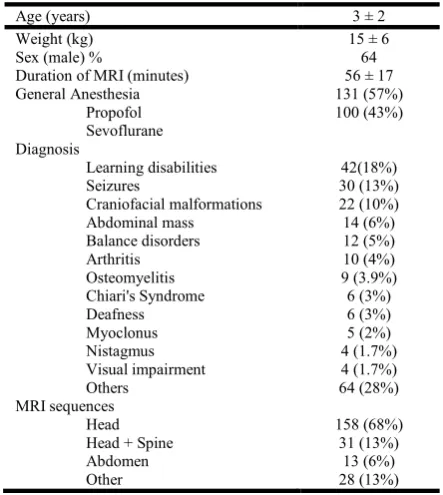
A total of 231 children were included in the study and completed final statistical analysis. Baseline clinical characteristics are reported in Table 1.
Table1.Baseline clinical characteristics. Data are presented as mean ± SD, and number of patients and percentage
Age (years) 3 ± 2
Weight (kg) 15 ± 6
Sex (male) % 64
Duration of MRI (minutes) 56 ± 17 General Anesthesia
Propofol Sevoflurane
131 (57%) 100 (43%)
Diagnosis
Learning disabilities 42(18%)
Seizures 30 (13%)
Craniofacial malformations 22 (10%)
Abdominal mass 14 (6%)
Balance disorders 12 (5%)
Arthritis 10 (4%)
Osteomyelitis 9 (3.9%)
Chiari's Syndrome 6 (3%)
Deafness 6 (3%)
Myoclonus 5 (2%)
Nistagmus 4 (1.7%)
Visual impairment Others
4 (1.7%) 64 (28%) MRI sequences
Head 158 (68%)
Head + Spine 31 (13%)
Abdomen 13 (6%)
Other 28 (13%)
[image:3.595.310.551.122.270.2]Eighty-six children (37%) presented e-PONB during the first 30 minutes after spontaneous awakening from general anesthesia. A FLACC scale score ≥ 4 was noted in a total of 77children (33%) during the first 30 minutes after awakening:39 (17%) children with a PAED scores of < 9 and 38 children (16%) with a PAED score > 10.Nine children (4%) presented a PAED score > 10 and a FLACC < 3. (Figure 1)
Figure 1. The overlap of different components of e-PONB (early PostOperative Negative Behavior). Data are numbers and
percentage
There was a strong association between ED and pain behavior during the first 15 minutes after awakening. Children experiencing ED were three times more likely as also
exhibiting pain behavior, FLACC scale score ≥ 4 (RR 3.8 95%CI 2.8-5.2, p<0.00001). The incidence ofe-PONB decreased over time and most patients were free of symptoms 15 minutes after awakening (Figure2). No children required pharmacological treatment for e-PONB.
Figure 2.e-PONB (early Post Operative Negative Behavior) within 30 minute after awakening. Data are numbers of patients
with emergence delirium (ED, PAED score≥10); pain behavior (FLACC scale≥ 4); and the association of ED and pain behavior
DISCUSSION
The main finding of the present study was that a considerable interference was identified between assessment tools that evaluate ED and pain behavior, respectively, during the early phase of recovery from general anesthesia. The most prominent problem was that ED was inadequately assessed as pain despite the study context being recovery following general anesthesia for MRI scanning where significant pain is unlikely.
Potential reasons for interference between PAED and FLACC assessments
[image:3.595.51.273.158.406.2]ED. Thus, in a different situation where significant pain may well be present immediately upon awakening in the PACU, this obviously poses a clinical problem to distinguish between ED and pain. No child in our series required pharmacological treatment to control e-PONB. The negative behaviors were all self-limited. Thus, clinicians and parents only needed to use physical comfort and/or protection to avoid self-injuries during the period before the ED subsided (Banchs, 2014).
Study limitations
It is important for the reader to appreciate the limitations associated with our study design. Anapparent imperfection is the non-randomized nature of the study. The choice not to randomize patients between the different anesthesia management was mainly due to the fact that the study aim was to evaluate the possible interaction of the observational assessment tools and not the effect of the anesthetics per se. Additionally, in order to limit possible bias, observers were kept unaware of the study aim and were unable to influence clinical management (Sikich, 2004). For the same reason we do not provide analysis of different behavior score following propofol vs sevoflurane anesthesia since we believe that such analysis may confound and distract the readers from the aim of this study. In summary, we believe that the non-randomized nature of this study should not be emphasized. Because of the high association between the scores, it could be argued that the result could be due to a criterion contamination. Criterion contamination occurs when the results of one test bias the results of another and artificially inflates the correlation between these two tests (Valley et al., 2013). In this study, two observers evaluated each child simultaneously and independently. Each observer applied either the PAED or the FLACC scale on each single patient.
Data collection was done by trained observers and not by nurses involved in the clinical care of the patients. However, the observers experience or education did not affect the clinical consensus in determining the underlying causes of unsettled behaviorin children (Voepel-Lewis, 2005). There was no assessment of interrater reliability amongst the observers in the diagnosis of ED or pain, which is a limitation of the study. We did not record the duration of the events. However, to the best of our knowledge the minimal time to make the diagnosis of ED or pain has not yet been established. Moreover, to base the diagnosis of e-PONB on the basis of the duration of crying or inconsolability (i.e for longer than 3 min) would result in a high false-positive rate (Merkel et al., 1997). The varying definitions of ED reported in the literature may also be considered a confounding factor. The cut-off used in this study for the PAED score was in accordance with the original validated description of the scale (Somaini, 2015). As suggested by others authors, different cut-off of PAED score could improve the sensitivity of this 'original' tool (Bajwa et al., 2010).
Implications for clinical management of early e-PONB in the PACU
In situations where ongoing nociceptive stimulations is highly unlikely (e.g. post-MRI scanning) or if the patient is judged to
have received appropriate intraoperative analgesia (e.g. apparently working regional anesthesia, appropriate intraoperative amount of opioids combined with other analgesics) a high immediate FLACC score should be suspected to represent ED and should either be treated with general comfort measures or by a dose of iv propofol (0.5-1.0 mg kg-1) depending on severity (Astuto et al., 2006; Dahmani
et al., 2014; van Hoff et al., 2015). If the child responds by
going back to sleep for an adequate time period, followed by a much more normal awakening, the initial reaction was most likely ED. Since propofol is not analgesic a non-response or only very brief response to propofol administration most likely represents pain and should then be treated accordingly. Another possible action instead of administering propofol would be to give an iv dose of fentanyl (1 mcg kg-1) since fentanyl and propofol are equally effective when treating ED (Kim et al., 2013).
However, since fentanyl is associated with a significantly higher risk of provoking nausea and vomiting this seems like a less attractive option (Bortone et al., 2014; Kim et al., 2013). Furthermore, to administer potent opioids in a situation without relevant ongoing nociceptive input may well result in unwanted hypoventilation in the early postoperative phase (Brown et al., 2006). However, we would like to point out that the algorithm suggested above, to help resolve the potential interaction of the FLACC and PAED scales in the early postoperative period, is currently based on logic and has not been properly validated. In conclusion, our results appear to support that the FLACC scale may erroneously indicate pain behavior in the early phase after awakening from general anesthesia when the true cause for the aberrant behavior is ED. As a consequence, the FLACC scale should only be used in fully awake children.
Acknowledgements
This work was supported by the Department of Experimental Medicine, Milan Bicocca University (Milan, Italy). No external financial support was received. PI affirms that the manuscript is an honest, accurate, and transparent account of the study being reported and that no important aspects of the study have been omitted.
REFERENCE
American Psychiatric Association Task Force on, DSM-IV Diagnostic and statistical manual of mental disorders: DSM-IV-TR: American Psychiatric Association, 2000. Astuto, M., Rosano, G., Rizzo, G., Disma, N., Raciti, L.,
Sciuto, O. 2006. Preoperative parental information and parents' presence at induction of anaesthesia. Minerva Anestesiol 72: 461-465.
Bajwa, S.A., Costi, D., Cyna, A.M. 2010. A comparison of emergence delirium scales following general anaesthesia in children. Paediatr Anaesth 20(8): 704-11
Banchs, R.J., Lerman, J. 2014. Preoperative anxiety management, emergence delirium, and postoperative behavior. Anesthesiol Clin., Mar 32(1):1-23.
Bortone, L., Bertolizio, G., Engelhardt, T., Frawley, G, Somaini, M., Ingelmo, P.M. 2014. The effect of fentanyl and clonidine on early postoperative negative behavior in children: a double-blind placebo controlled trial. Paediatr Anaesth. Jun; 24(6):614-9
Brown, K.A., Laferriere, A., Moss, I.R. 2006. Recurrent hypoxemia in young children is associated with decreased analgesic sensitivity to opiates. Anesthesiology 105:665-9 Cohen, I.T., Finkel, J.C., Hannallah, R.S., Hummer, K.A.,
Patel, K.M. 2002. The effect of fentanyl on the emergence characteristics after desflurane or sevoflurane anesthesia in children. AnesthAnalg 94(5): 1178–81.
Cravero, J., Surgenor, S., Whalen, K. 2000. Emergence agitation in paediatric patients after sevoflurane anaesthesia and no surgery: a comparison with halothane. PaediatrAnaesth 10(4): 419–24.
Crellin DJ, Harrison D, Santamaria N, Babl FE. (2015) Systematic review of the Face, Legs, Activity, Cry and Consolability scale for assessing pain in infants and children: is it reliable, valid, and feasible for use? Pain. Nov; 156(11):2132-51
Dahmani, S., Delivet, H., Hilly, J. 2014. Emergence delirium in children: an update. Curr Opin Anaesthesiol. Jun; 27(3):309-15
Demirbilek, S., Togal, T., Cicek, M., Aslan, U., Sizanli, E, Ersoy, M.O. 2004. Effects of fentanyl on the incidence of emergence agitation in children receiving desflurane or sevoflurane anaesthesia. Eur J Anaesthesiol 21: 538-42 Finkel, J.C., Cohen, I.T., Hannallah, R.S., Patel, K.M., Kim,
M.S., Hummer, K.A., Choi, S.S., Pena, M., Schreiber, S.B., Zalzal, G. 2001. The effect of intranasal fentanyl on the emergence characteristics after sevoflurane anesthesia in children undergoing surgery for bilateral myringotomy tube placement. AnesthAnalg 92(5): 1164–8
Galinkin, J.L., Fazi, L.M., Cuy, R.M., Chiavacci, R.M., Kurth, C.D., Shah, U.K., Jacobs, I.N, Watcha, M.F. 2000. Use of intranasal fentanyl in children undergoing myringotomy and tube placement during halothane and sevoflurane anesthesia. Anesthesiology 93(6): 1378–83
Kim, M.S., Moon, B.E., Kim, H., Lee, J.R. 2013. Comparison of propofol and fentanyl administered at the end of anaesthesia for prevention of emergence agitation after sevoflurane anaesthesia in children. Br J Anaesth. Feb; 110(2):274-80.
Malarbi, S., Stargatt, R., Howard, K., Davidson, A. 2011. Characterizing the behavior of children emerging with delirium from general anesthesia. PediatrAnesth 21(9): 942–950.
Merkel, S.I., Voepel-Lewis, T., Shayevitz, J.R., Malviya, S.. 1997. The FLACC: a behavioral scale for scoring postoperative pain in young children. PediatrNurs 23(3): 293-7.
Sikich, N., Lerman, J. 2004. Development and psychometric evaluation of the pediatric anesthesia emergence delirium scale. Anesthesiology 100: 1138-45.
Somaini, M., Sahillioğlu, E., Lovisari, F., Marzorati, C., Engelhardt, T., Ingelmo, P.M. 2015. Emergence Delirium, Pain or Both? A challenge for clinicians. PaediatrAnaesth. May;25(5):524-9.
Valley, R.D., Freid, E.B., Bailey, A.G., Kopp, V.J., Georges, L.S., Fletcher, J., Keifer, A. 2003. Tracheal extubation of deeply anesthetized pediatric patients: a comparison of desflurane and sevoflurane. AnesthAnalg 96: 1320-24. van Hoff, S.L., O'Neill, E.S., Cohen, L.C., Collins, B.A. 2015.
Does a prophylactic dose of propofol reduce emergence agitation in children receiving anesthesia? A systematic review and meta-analysis. Paediatr Anaesth. Jul;25(7):668-76.
Vlajkovic, G.P., Sindjelic, R.P. 2007. Emergence delirium in children: many questions, few answers. AnesthAnalg. Jan; 104(1):84-91
Voepel-Lewis, T., Burke, C., Hadden, S.M. Hadden, S.M., Tait, A.R., Malviya, S. 2005. Nurses’ diagnoses and treatment decisions regarding care of the agitated child. J PerianesthNurs 20: 239–348