IJPSR (2016), Vol. 7, Issue 11 (Research Article)
Received on 27 May, 2016; received in revised form, 12 July, 2016; accepted, 27 July, 2016; published 01 November, 2016
DEVELOPMENT AND VALIDATION OF A RP HPLC METHOD FOR SIMULTANEOUS ESTIMATION OF ASPIRINE AND CLOPIDOGREL IN COMBINED TABLET DOSAGE FORM
Abdullah Al Masud *1 and Iris Begum 2
Department of Pharmacy 1, Jagannath University, Dhaka - 1100, Bangladesh. Southeast University 2, Banani, Dhaka - 1213, Bangladesh.
ABSTRACT:In this present study a novel, simple, economical, accurate and precise
RP-HPLC method has been developed and validated for simultaneous estimation of aspirine and clopidogrel in combined tablet dosage form. Chromatographic separation was carried out on a Kromasil HD C18 (150 x 4.6 mm, 5µm) column with
a mixture of acetonitrile and 0.1% (v/v) orthophosphoric acid aqueous solution in a ratio of 40:60 (v/v) as mobile phase at a flow rate of 1.5 ml/min. Detection was accomplished at 237 nm by employing a DAD (Diode array detector). The retention times were 2.78 and 4.99 min for aspirine and clopidogrel respectively. The method was validated according to ICH guidelines for accuracy, precision, linearity, specificity and sensitivity. Calibration plots were linear over the concentration range 10 – 70 µg/ml for both aspirine and clopidogrel with r2>0.997. Recovery was found to be 99.2 – 99.8% and 99.2 – 99.9% for aspirine and clopidogrel respectively with RSD < 2 for both. There were no interference due to any components of pharmaceutical dosage indicating high specificity of the method. LOD and LOQ value were found to be26.2 ng/ml and 78.2 ng/ml for aspirine and 52.7 ng/ml and 152.1 ng/ml for clopidogrel reflecting high sensitivity of the method. The method was successfully employed for quantitative analysis of commercial product. Validation study revealed that method is specific, rapid, reliable and reproducible, so it can be used for routine quality control study of aspirine and clopidogrel in combined tablet dosage form.
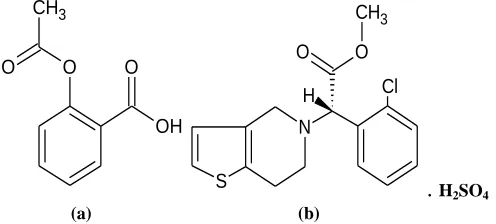
INTRODUCTION: Aspirine (ASP) (Fig. 1a), chemically 2-acetoxy benzoic acid is a cyclo oxygenase inhibitor which is used as an analgesic, antipyretic, anti-inflammatory and anti thrombic agent 1. It is one of the most commonly used anionic drugs in the world 2. After ingestion, it rapidly hydrolyzes to salicylic acid which is primarily responsible for its pharmacological action
3
. It is included in the official monograph of both USP-NF 4 and BP 5.
QUICK RESPONSE CODE
DOI:
10.13040/IJPSR.0975-8232.7(11).4443-48
Article can be accessed online on:
www.ijpsr.com
DOI link: http://dx.doi.org/10.13040/IJPSR.0975-8232.7 (11).4443-48
US Food and Drug administration has approved this drug for use in secondary prevention of heart attacks and stroke due to its anti-platelet activity 4-5.
Clopidogrel bisulphate (CLO) (Fig 1b) is a USP – NF 6 enlisted drug. Its chemical name is (+)-(S)-methyl2-(2-chlorophenyl) - 2 - (6,7-dihydrothieno [3,2-c] pyridin-5(4H)-yl)acetate, sulphate which is a new thienopyridine derivative. It is an antiplatelet agent, which directly inhibits the binding of adenosine diphosphate (ADP) to its platelet receptor and blocks the subsequent ADP-mediated activation of the glycoprotein GPIIb/IIIa complex, thereby inhibiting platelet aggregation 7. It is used to prevent ischemic stroke, myocardial infarction and vascular disease and has proved its clinical efficacy superior to that of aspirine. So, Clopidogrel is indicated for the patients with
Keywords:
RP HPLC, Aspirine, Clopidogrel, ICH guideline, LOD, LOQ
Correspondence to Author: Abdullah Al Masud
Department of Pharmacy
Jagannath University, Dhaka-1100, Bangladesh.
atherosclerosis documented by recent stroke, recent myocardial infarction or cardiovascular disease 8. The combination of ASP and CLO is used for atherosclerotic patients suffering from various heart diseases 9.
O O
CH3
O
OH N
Cl
O O
CH3
H
S . H
2SO4
(a) (b)
FIG 1: CHEMICAL STRUCTURES OF (a) ASPIRINE (b) CLOPIDOGREL BISULPHATE
Literature survey revealed several assay methods for ASP and CLO individually or in combination with other drugs by UV spectrophotometry 10-12, High performance liquid chromatography (HPLC)
13-26
, RP HPLC-UV 27, Reverse phase -Ultra fast liquid chromatography (RP-UFLC) 28-29, Gas Chromatography-Mass Spectrometry (GC-MS) 30 and LC-MS/MS 31. However every method has its own limitation. Thereby, an attempt has been taken to develop and validate a simple, economic, reliable, reproducible, accurate and precise RP-HPLC based method for simultaneous estimation of ASP and CLO in combined tablet dosage form where validation of the analytical method has been performed in accordance with ICH guideline 32.
MATERIALS AND METHOD:
Apparatus and chromatographic condition: The chromatographic condition consisted of a PerkinElmer Flexar HPLC integrated with DAD (Diode Array detector). Chromatographic separation was carried out on a Kromacil-100 HD,C18 column (15cm x 4.6mm i.e., 5 µm) with mobile phase composed of acetonitrile and 0.1% (V/V) orthophosphoric acid aqueous solutionin a ratio of 40:60 (v/v) at flow rate of 1.5 ml/min. The mobile phase was prepared freshly, filtered, sonicated before use and the detection wavelength was set at 237 nm. The injection volume was 20 µl.
Chemicals and Reagents:
The pharmaceutical grade pure samples of aspirine (99.20%) was supplied by Zhejiang Tianu Pharma
co. Ltd. China, clopidogrel bisulfate (99.12%) from INFA, Italy. HPLC grade acetonitrile (Scharlau Chemie S. A., Spain) and analytical grade orthophosphoric (Scharlau Chemie S. A., Spain) were used. Commercial samples for analysis were purchased from pharmacy outlets in Dhaka, Bangladesh, labels claiming 75 mg of aspirine and 75 mg of Clopidogrel. Proper storage condition and shelf life were confirmed.
Preparation of Stock Solutions of Standard ASP and CLO:
Stock solutions of 0.5 mg/ml ASP and 0.5 mg/ml CLO were prepared in mobile phase. Serial dilution of the stock solutions were carried out using mobile phase at concentration range of 10 – 70μg/ml for both ASP and CLO. This solution was subjected to liquid chromatographic analysis.
Analysis of Tablet Formulation:
Twenty tablets were weighed accurately and grounded to power. Powder equivalent to 50 mg of ASP and 50 mg of CLO were weighed and transferred to a 100 ml volumetric flask. The powder sample was dissolved in mobile phase by intermittent shaking and sonication. A filtered portion was diluted to mobile phase to get a final concentration of 50μg/ml for both ASP and CLO. All the solutions were filtered through 0.2 micron disk filter prior to inject through HPLC.
RESULT AND DISCUSSION: Optimization of HPLC method:
[image:2.612.49.297.139.251.2]because at 1.0 ml/min retention time is high and at 2.0 ml/min pump pressure is a risky factor. Analysis at several wavelength were performed but 237 nm was selected due to optimum intensity of both of the peaks.
Linearity:
The linearity for HPLC method was determined at five concentration level ranging from 10-70 μg/mlfor both ASP and CLO. The calibration curve was constructed by plotting peak area against respective concentration of ASP and CLO. The plots of peak area Vs respective concentration of ASP and CLO were found to be linear in the range of 10-70.0 μg/ml with coefficient of correlation (r2) 0.9998 and 0.9999 for ASP and CLO respectively (Table 1)
TABLE 1: LINEARITY RANGE STUDY RESULTS FOR ASP AND CLO
Parameters ASP CLO
Linearity range 10 – 70 μg/ml 10 – 70 μg/ml Correlation
coefficient (r2)
0.9998 0.9999
Slope 30883 14417
Intercept 290.43 -2456.24
Recovery:
Recovery studies were performed at three different levels 80, 100 and 120%. Placebo/matrix were spiked with known amount of ASP and CLO. At each level of the amount three determinations were performed and the results obtained were compared with expected results. Recovery for pharmaceutical
formulations should be within the range of 100±5%. The percent R.S.D. of individual measurements was also determined. High recovery and satisfactory RSD value at each level (Table 2) indicates that this method can be used for routine analysis of ASP and CLO in combination drugs.
TABLE 2: RECOVERY STUDY RESULTS FOR ASP AND CLO (n=3)
Label Claim (mg/tablet)
Level of Addition
(%)
Amount Added
(mg)
Recovery (%) (Mean ±
SD)
%RSD (Average)
ASP (75) 80 60.0 99.3±0.12 0.22
100 75.0 99.2±0.24
120 90.0 99.8±0.29
CLO (75) 80 60.0 99.9±0.26 0.32
100 75.0 99.2±0.37
120 90.0 99.2±0.34
Precision:
[image:3.612.312.570.175.280.2]Precision of the assay was determined by repeatability (intra-day) and intermediate precision (inter-day) for 2 consecutive days. Six replicates from a homogenous sample of ASP and CLO were analyzed in the same day (intra-day precision) and 2 consecutive days (inter-day precision). %RSD of six determinations should be less than 2% at each day and day to day assay variation should be less than 1%. The specifications were absolutely conformed according to data presented on Table3 indicating high precision of the method for simultaneous estimation of ASP and CLO from combined tablet dosage form.
TABLE 3: INTRA - DAY AND INTER – DAY PRECISION RESULT FOR ASP AND CLO. (n=6)
Compound Intra-day precision (Repeatability) Inter day precision Assay (%) ± SD %RSD Assay (%) ±
SD
% RSD Difference in assay (%) between day1 and day2
ASP 99.3±0.27 0.27 99.1±0.34 0.34 0.20
CLO 99.1±0.29 0.29 98.9±0.35 0.35 0.20
Sensitivity:
Limit of detection (LOD) and limit of quantitation (LOQ) were determined from the signal-to-noise ratio. LOD and LOQ were calculated using 3.3σ/s and 10σ/s formulae, respectively, where, σ is the standard deviation of the peak areas and s is the slope of the corresponding calibration curve. The limit of detection (LOD) and limit of quantification (LOQ) were found to be 26.2 ng/ml and 78.2 ng/ml for ASP and 52.7 ng/ml and 152.1 ng/ml for CLO.
Lower LOD and LOQ value indicates high sensitivity of the method.
[image:3.612.50.564.524.590.2]of the peaks corresponding to ASP and CLO was found to be < 1.5.
TABLE 4: ROBUSTNESS STUDY RESULTS FOR ASP AND CLO (n=6)
Parameters ASP CLO
RT TF RT TF
A.Flow rate
1.4 2.82 1.12 5.05 1.37
1.5 2.78 1.11 4.99 1.35
1.6 2.72 1.08 4.84 1.31
Mean ± SD 2.77 ± 0.05 1.1±0.016 4.96 ± 0.11 1.34±0.025
B. Mobile phase ratio (Aqueous: organic)
39:61 2.74 1.12 5.02 1.38
40:60 2.75 1.11 4.98 1.38
41:59 2.72 1.08 4.93 1.36
Mean ± SD 2.74 ± 0.013 1.10 ± 0.017 4.98 ± 0.037 1.37 ± 0.014
Specificity:
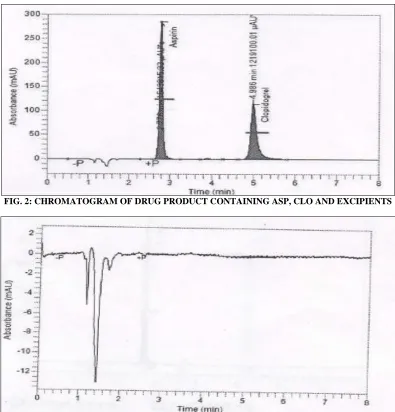
For testing the interference of placebo/matrix in the peak region of ASP and CLO, drug product (Placebo+ ASP + CLO) and only Placebo (mixture of all the ingredients of drug product except ASP
[image:4.612.111.504.330.519.2]and CLO)were run through the column, but no trace of peaks were found within the peak region of ASP and CLO due to Placebo. So this method can be used selectively used for ASP and CLO combination product. (Fig.2 and 3).
FIG. 2: CHROMATOGRAM OF DRUG PRODUCT CONTAINING ASP, CLO AND EXCIPIENTS
System Suitability:
The system suitability was evaluated by six replicate analyses of ASP and CLO mixture at a concentration of 50μg/ml for both ASP and CLO. The acceptance criteria were a R.S.D. of peak areas and retention times less than 2%, Theoretical plate
[image:5.612.50.544.157.201.2]numbers (N) at least 2500 for each peak and tailing factors (T) less than 1.5 for ASP and CLO. From table 5 all the system suitability parameters are within the acceptable range indicating the suitability of the method for estimation of ASP and CLO from combined product.
TABLE 5: SYSTEM SUITABILITY STUDY RESULT (n = 6)
Compound Peak Area
(%RSD)
Retention time (%RSD)
Tailing Factor (Average)
Theoretical plate (Average)
ASP 0.058 0.12 1.11 6997
CLO 0.063 0.15 1.37 6155
Stability of Solution:
Stability of solution was evaluated by injecting the same solution containing ASP and CLO at 24 hours interval. The solution was stored at room temperature. Day to day variation in parameters
[image:5.612.49.561.302.378.2]like peak area, retention time, tailing factor, theoretical plate counts were within the acceptable range indicating that the prepared solution can be used for two days. (Table 6)
TABLE 6: SOLUTION STABILITY RESULT (n = 6)
Parameters (Mean ± SD)
ASP (50 µg/ml) CLO (50 µg/ml)
Day1 Day2 Day1 Day2
Peak area 1543815±852 1543201±889 1219100±763 1218963±782 Retention time 2.77±0.0034 2.77±0.0039 4.99±0.0075 4.99±0.0078
Tailing factor 1.11±0.0012 1.11±0.0015 1.35±0.0016 1.36±0.0018 Theoretical plate 6981±18 6992±23 6149±18 6132±21
Market product analysis:
Two brands of ASP and CLO combination from commercial market were tested according to this method and satisfactory result was found. Table7.
TABLE 7: COMMERCIAL PRODUCT ASSAY RESULTFOR ASP AND CLO (n=3)
Compound Label claim Brand 1 Brand 2
Average drug content (mg)
% of drug content
Average drug content (mg)
% of drug content
ASP 75.0 mg 74.84 99.79±0.11 74.65 99.53±0.16 CLO 75.0 mg 74.82 99.76±0.21 74.95 99.93±0.075
CONCLUSION: The developed HPLC method is simple, economic, specific, accurate and precise for the simultaneous estimation of ASP and CLO in combined tablet dosage form. The developed method offers good resolution between ASP and CLO. It was successfully validated in terms of system suitability, linearity, range, precision, accuracy, specificity, LOD, LOQ and robustness according to ICH guidelines. So, the described method is suitable for routine analysis and quality control of pharmaceutical preparations comprising these drugs either as individual or in combination.
ACKNOWLEDGEMENT: We are thankful to Veritas Pharmaceuticals Ltd. Bangladesh for
providing working standard of both Aspirin and Clopidogrel Bisulfate.
CONFLICT OF INTEREST: None
REFERENCES:
1. Tripathi KD. Essentials of medical pharmacology. 5th ed. Jaypee Brothers Medical Publishers (P) Ltd, New Delhi. 2004, pp. 560.
2. Jain DK, Jain N and Verma J: RP-HPLC Method for Simultaneous Estimation of Aspirine and Prasugrel in Binary Combination. International Journal of Pharmaceutical Sciences and Drug Research 2012; 4(3): 218-221.
4. United States Pharmacopoeia/National Formulary. Pharmacopeial Convention, Rockville, MD, 24th ed, 2000, P.161.
5. British Pharmacopoeia. HMSO Publication, London, Vol. 1, 2007, p.184.
6. Toronto, Ontario: The Official Compendia of Standards, Webcom Limited; 2005. The United States Pharmacopoeia- National Formulary.
7. Gomez Y, Adams E and Hoogmartens J: Analysis of purity in 19 drug product tablets containing Clopidogrel: 18 copies versus the original brand. J Pharm Biomed Anal. 2004; 34:341–348.
8. Mitakos A and Panderi I: A validated LC method for the determination of Clopidogrel in pharmaceutical preparations. J Pharm Biomed Anal. 2002; 28:431–438.
9. Londhen SV, Deshmukh RS, Mulgund SV and Jain KS: Development and Validation of a Reversed-phase HPLC Method for Simultaneous Determination of Aspirine, Atorvastatin Calcium and Clopidogrel Bisulphate in Capsules. Indian Journal of Pharmaceutical Sciences 2011; 73(1): 23-29. 10. Murtaza G, Khan SA, Shabbir A, Mahmood A, Asad MHHB, Farzana K, Malik NS and Hussain I: Development of a UVspectrophotometric method for the simultaneous determination of Aspirine and paracetamol in tablets. Sci. Res. Ess. 2011; 6: 417-421.
11. Salunke PA, Patil SV, Wagh RS, Shaikh WM, Shimpi SK, Raut MB and Barhate SD: Simultaneous Estimation of Amlodipine and Clopidogrel in Bulk and Marketed Formulation by Q-Absorbance Ratio Method. IAJPR. 2013; 3(5): 3847-3854.
12. Kunturkar KL and Jain HK: Development and validation of UV- Spectrophotometric method for determination of S (-) Metoprolol Succinate and Clopidogrel Bisulphate in bulk and tablet dosage form.Int. J. Pharm & Pharm. Sci. 2013; 5(3): 593-598.
13. Kumara P, Shukla S, Ganurea ALand Subudhia BB: Development and validation of a novel isocratic RP-HPLC method for simultaneous determination of atenolol and Aspirine in fixed dose combinations. Der Pharma Chemica. 2011; 3: 13-21.
14. Kumar VP and Sunandamma Y: simultaneous determination of Clopidogrel and pioglitazone by high performance liquid chromatography in bulk drug and dosage forms. International Journal of Pharmaceutical and Life Sciences 2013; 2(1):1-6. 15. Dubey N, Patel M and Jain DK: Simultaneous estimation of
Aspirine, Atorvastatin and Clopidogrel in combined capsule dosage form using Reverse phase High performance liquid chromatography. International journal of biomedical and pharmaceutical sciences 2013; 7(1):42-44.
16. Sathiyasundar R and Valliappan K:An improved RP-HPLC
Method for the Simultaneous Estimation of Aspirine, Atorvastatin, and Clopidogrel in Pharmaceutical Formulation using Experimental Design Methodology. Int J Pharm Pharm Sci. 2014; 7(11):279-283.
17. Patel D, Patel N, Vaishy R, Patel V, Solanki C, and Patel M: Development and Validation of RP-HPLC Method for Simultaneous Estimation of Aspirine and Esomeprazole Magnesium in Tablet Dosage Form. Journal of Chemistry 2012;2013:1-5
18. Rasheed A, Pattanayak S and Rao TR: Analytical Method Development and Validation for the Simultaneous Estimation
of Aspirine, Clopidogrel Bisulphate and Atorvastatin Calcium in Tablet Dosage Form. Am. J. PharmTech Res. 2014; 4(4): 535-541
19. Sahoo NK, Sahu M, Rao PS, Indira JN, Rani SN and Ghosh GK: Validation of assay for bulk Clopidogrel and for some tablet forms by reverse-phase high performance liquid chromatography. J. Taibah Uni. Sci. 2014; 8: 331–336. 20. Bhagat D, Mannur V and Mastiholimath V: Development and
Validation of RP-HPLC method for the estimation of Clopidogrel Bisulphate. Malaysian J. Anal. Sci.2013; 17: 387–393.
21. Gurupadayya BM and Sama S: Bio-analytical determination of Clopidogrel and Pantoprazole by RP-HPLC method in rat plasma: Application to drug interaction study.Asian J Pharm Clin Res.2014; 7(1): 10-13.
22. Kumar VP and Sunandamma Y: Simultaneous Determination of Clopidogrel and Pioglitazone by high performance liquid chromatography in bulk drug and dosage forms.Int. J. Pharma. & life Sci.2013; 2(1): 1-9.
23. Pandya N and Mashru RC: Simultaneous estimation of Rosuvastatin Calcium and Clopidogrel Bisulphate in combined pharmaceutical formulation.Int. J. Drug formulation & Res. 2012; 3(5): 40-53.
24. Mounika A and Sriram N: Method Development and Validation of Clopidogrel Bisulphate by RP-HPLC in Bulk and Pharmaceutical dosage forms.Int. J. Pharm. & Anal. Res. 2012; 1: 1-7.
25. Rajput S and Fanse S: RP HPLC method for simultaneous estimation of Lansoprazole and Aspirin in balk and laboratory mixture. J. Adv. Pharm. Edu. & Res. 2015; 5(2):87-93. 26. Patil AE, Devtalu SV, Patil ND, Patil SV, Bari MM and
Barhate SD: Validated RP-HPLC Method for Simultaneous Estimation of Amlodipine Besylate and Clopidogrel Bisulphate in Bulk and Tablet Dosage Form. International Journal of Bioassays 2013; 02 (02): 412-415.
27. Chatrabhuji PM, Pandya CV and Patel MC: Development and validation of RP-HPLC-UV method for simultaneous Quantitation of Clopidogrel Bisulphate and Aspirin in bulk drug.Anal. Chem. Ind. J.2014; 15(2): 43-48.
28. Nagabi JB and Gurupadayya B: Simultaneous Estimation of Clopidogrel and Atorvastatin in Human Plasma using Bio-analytical RP-Ultra Fast Liquid Chromatographic. International Journal of Current Pharmaceutical Research 2015; 7(1):30-35.
29. Nagavi JB, Gurupadayya B and G. P: Validated Bio-analytical Method Development for Simultaneous Estimation of Clopidogrel and Aspirine in Human Plasma by RP-Ultra Fast Liquid Chromatography. World journal of pharmacy and pharmaceutical sciences 2014; 3(9):518-531.
30. Housheh S, Trefi S, Haroun M and Chehna MF: A novel GC-MS for the determination of Clopidogrel Bisulphate in bulk and pharmaceutical dosage forms. J. Chem. & Pharm. Sci. 2014; 7(4): 312-316.
31. El-Sadek ME, Moustafa SM, Kadi HO and Hakami AM: Determination of Clopidogrel Carboxylic Acid in Human Plasma by LC-MS/MS.Ame. J. Anal. Chem. 2011; 2: 447-455.
32. Proceedings of the International Conference on Harmonization. Geneva: 1996. Mar, ICH, Q2B, Harmonized Tripartite Guideline, Validation of Analytical Procedure: Methodology, IFPMA.
All © 2013 are reserved by International Journal of Pharmaceutical Sciences and Research. This Journal licensed under a Creative Commons Attribution-NonCommercial-ShareAlike 3.0 Unported License.
This article can be downloaded to ANDROID OS based mobile. Scan QR Code using Code/Bar Scanner from your mobile. (Scanners are available on Google Playstore)
How to cite this article: