PROGRAM FOR IMPROVING ACCESS AND QUALITY OF BASIC CARE: ANALYSIS OF THE
WELCOMING IN TWO CYCLES
*1
Flávio Araújo Prado,
2Eliany Nazaré Oliveira,
2Maristela Inês Osawa Vasconcelos,
3Roberta
Cavalcante Lira,
3Roberta Magda Martins Moreia,
4Pollyanna Martins,
2Aldecira Uchoa Monteiro
Rangel,
6Heliandra Linhares Aragão,
5Roberlandia Evangeista Lopes,
3Andrine Tavares Pereira,
6Maria Michele Bispo Cavalcante and
6Jéssica Fernandes Lopes
1
Health Secretariat of the City of Forquilha, Ceará, Brazil
2
Vale do Acaraú State University (UVA), Sobral - Ceará, Brazil
3
Federal University of Ceara (UFC) – Sobral, Ceará, Brasil
4
Faculdades Luciano Feijão, Sobral - Ceará, Brazil
5
INTA /UNITA University Center, Sobral - Ceará, Brazil
8,12
Health Secretariat of the City of Sobral, Ceará, Brazil
ARTICLE INFO ABSTRACT
The objective of this study was to analyze the process of welcoming the spontaneous demand in the Basic Health Care of a municipality from the perspective of professionals from the Program for Improving Access and Quality of Basic Care (PMAQ-AB). An exploratory and documentary study with a quantitative approach, carried out in the Primary Health Care services of a municipality, through the results of the first and second cycles of the external evaluation of the PMAQ-AB, in the years from 2012 to 2015, about the process of welcoming with assessment / classification of risk and vulnerability through themes such as access, protocols and risk and vulnerability criteria, and work organization. Increasing data were observed when comparing the two cycles, mainly related to welcoming implantation, the use of protocols with definition of therapeutic guidelines to accommodate the spontaneous demand / urgency and the availability of services to remove users. However, there was a decline in the frequency of occurrence the assessment of risk and vulnerability in the elcoming of users, reservation of same-day service places and the definition of maximum scheduling time. Thus, the welcoming still presents limitations in its implantation and consolidation within the Basic Healh Unit.
Copyright © 2019, Flávio Araújo Prado et al. This is an open access article distributed under the Creative Commons Attribution License, which permits unrestricted use, distribution, and reproduction in any medium, provided the original work is properly cited.
INTRODUCTION
The public policies adopted by the Unified Health System (SUS) have undergone continuous transformations, seeking to reaffirm health as a universal right. The embracement, understood as an operational guideline of the National Policy of Humanization of SUS Care and Management has been gaining its own meanings and importance in Primary Health Care to ensure universal, humanized access and resolution to the health demands of users and communities (Ministério da Saúde, 2013).
*Corresponding author: Flávio Araújo Prado,
Health Secretariat of the City of Forquilha, Ceará, Brazil
The embracement is understood by a process of building relationships between users and professionals and not only a provision of services, thus acquiring the discourse of social inclusion in defense of SUS, subsidizing the generation of reflections and changes in the organization of services and attitude of professionals, the idea of universal access, the resumption of the multiprofessional team and the qualification of the bond between users and health professionals (Mitre, 2012). In addition, the reception with risk classification was instituted, which aims to reorganize the attention, by welcoming the user and prioritizing the service, according to the severity of the risk or presented picture, to then systematize the service making it more agile. safe and humanized (Ministério da Saúde, 2013). This system has advantages for
ISSN: 2230-9926
International Journal of Development Research
Vol. 09, Issue, 09, pp. 30170-30174, September, 2019
Article History: Received xxxxxx, 2019 Received in revised form xxxxxxxx, 2019
Accepted xxxxxxxxx, 2019 Published online xxxxx, 2019
Citation: Flávio Araújo Prado, Eliany Nazaré Oliveira et al, 2019. “Program for improving access and quality of basic care: analysis of the welcoming in
two cycles”, International Journal of Development Research, 09, (09), 30170-30174.
Article History:
Received 17th June, 2019 Received in revised form 26th July, 2019
Accepted 11th August, 2019
Published online 30th September, 2019
Key Words:
Health evaluation. Primary health care. User embracement.
controlling demand, optimizing emergency care, reducing occupational overload of the health team and strengthening the user-worker bond (Zanellatto, 2010). On the other hand, some problems persist, such as the lack of articulation in integrated networks, the excess demand, the hegemonic biomedical model, the lack of training and democratic and reflexive spaces to reorganize the health work process, which reinforces incisively, the potential of this guideline in the operationalization and qualification of SUS2. Thus, reception with risk classification is an important attribute in all health care and management practices, which can facilitate overcoming some challenges such as fragmented work process, conflicts and power asymmetries, among others. Ministry of Health Ordinance No. 1,654 created the Program for Improving Access and Quality of Primary Care (PMAQ-AB) and instituted a broad mobilization process for the implementation of changes in the work process that impact on access and quality of services. , articulated to an evaluation and certification that links transfers of resources according to the performance achieved in the implementation and development of the elements evaluated by the program in the quality of the Family Health Strategy (FHS) (Ministério da Saúde, 2011). Among the evaluated tools is the reception process with risk and vulnerability classification, and has as one of its main aspects, the voluntary character of adherence, aiming to qualify the service (Pinto, 2014). Given this, it is important to discuss about welcoming and how it is being evaluated in health services through PMAQ-AB, given its social function and potential to help managers, professionals or users of health services to make more consistent decisions. in their institutions and in the models of care provided. Therefore, the aim of this study was to analyze the process of receiving spontaneous demand in Primary Health Care in a municipality from the perspective of professionals from the Program of Access and Quality Improvement of Primary Care.
MATERIAL AND METHODS
It is an exploratory documentary study - descriptive, retrospective with quantitative approach. The research was carried out in the Primary Health Care services of a municipality located in the northwest of Ceará state, through the results from the first and second cycles of the external evaluation of PMAQ-AB. The evaluation was performed with the family health teams that joined the PMAQ-AB from 2012 to 2015, so the first cycle was conducted in 2012 and 2013 with a sample of six teams, while the second evaluated eight in the years. 2014 and 2015. To this end, we used a cut-off of the data from the External Assessment instrument, which considered only the questions related to the Reception, using Module II, entitled interview with the Primary Care team, which aims Obtain information about the work process of the team and the organization of service and care for users with a focus on analyzing the conditions of access and quality of services 1. Thus, we considered for consideration only the standards of quality in common in both cycles and that were closely related to the objectives of the study, including information relevant to the object, such as: the welcoming process with risk assessment / classification and vulnerability by through the themes of access, protocols and criteria of risk and vulnerability and work organization. Data were compiled in Excel spreadsheets and analyzed with the support of R version 3.2 software. Subsequently, they were described by absolute frequencies, percentages and Fisher's exact test was applied to compare similar variables obtained in both cycles.
For the inferential analysis, a significance level of 5% was adopted to identify whether there was a difference in proportion between the two cycles for those variables that were similar. The results were presented in tables based on descriptive analysis about the distribution of variables. Because it is a study involving human beings, this research is based on and based on Resolution No. 466/2012 of the National Health Council (CNS) (Ministério da Saúde, 2012), and was submitted to the Research Ethics Committee of Vale do Acaraú State University. with approval under Opinion No. 1,474,581.
RESULTS
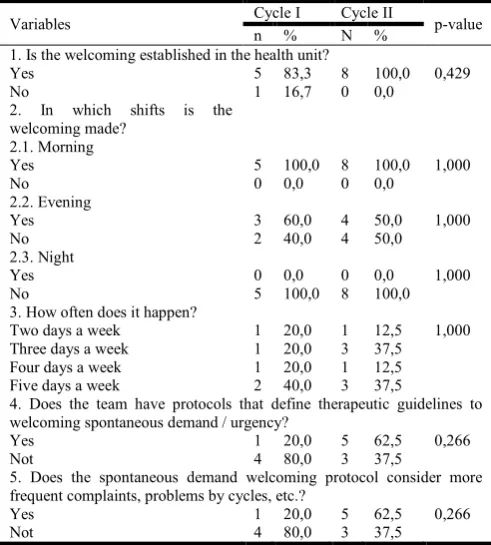
[image:2.595.310.556.432.705.2]PMAQ-AB is an important process for assessing the degree of implementation of various actions proposed by itself and by programs in other areas that are part of the National Health Policy (PNS). Thus, besides being an evaluation tool, the PMAQ presents itself as an instrument for critical and situational analysis, based on the perspective of professionals and users from the collaborative perspective of co-management. Thus, the process of reception in the Primary Care service was analyzed from the perspective of professionals regarding the implementation of reception, as well as the process of care at times and the use of protocols to subsidize care. Table 1 shows the data found in these perspectives, comparing the data for the two PMAQ-B Cycles between 2011 and 2014.
Table 1. Comparison of the data of health professionals regarding the institutionalization of the welcoming in the BHU in PMAQ
Cycles I and II of the studied city, Ceará
Variables Cycle I Cycle II p-value
n % N %
1. Is the welcoming established in the health unit?
Yes 5 83,3 8 100,0 0,429
No 1 16,7 0 0,0
2. In which shifts is the welcoming made?
2.1. Morning
Yes 5 100,0 8 100,0 1,000
No 0 0,0 0 0,0
2.2. Evening
Yes 3 60,0 4 50,0 1,000
No 2 40,0 4 50,0
2.3. Night
Yes 0 0,0 0 0,0 1,000
No 5 100,0 8 100,0
3. How often does it happen?
Two days a week 1 20,0 1 12,5 1,000 Three days a week 1 20,0 3 37,5
Four days a week 1 20,0 1 12,5 Five days a week 2 40,0 3 37,5
4. Does the team have protocols that define therapeutic guidelines to welcoming spontaneous demand / urgency?
Yes 1 20,0 5 62,5 0,266
Not 4 80,0 3 37,5
5. Does the spontaneous demand welcoming protocol consider more frequent complaints, problems by cycles, etc.?
Yes 1 20,0 5 62,5 0,266
Not 4 80,0 3 37,5
reduction in the afternoon shift for the second cycle and in the period. night, there was no reception. Regarding the frequency with which this reception occurs, there was a significant drop, in which the majority was 40% during the five days a week in the first cycle, transposing the frequency of 37.5%, between three and five days a week in the second cycle. As for the existence of protocols with definition of therapeutic guidelines to meet spontaneous demand / urgency, the study showed an advance between the two cycles, with an evolution from 20% in the first to 62.5% in the second, a value similar to consider users' most frequent complaints as well as life cycle issues. From this perspective, table 2 shows the data regarding the dynamics of reception among professionals, making a noticeable reduction in risk assessment and vulnerability of users, which was changed from 100% in the first cycle to 87.5% in the second. . It also portrays a decrease in the availability of same-day service spaces when it comes to any urgency with this need. However, when relating the availability of services for user transfer to other institutions, there was a considerable increase from 66.7% in the first cycle to 100% in the subsequent, where 80% in the second cycle was for ambulances.
Table 2. Comparison of data from health professionals regarding the dynamics of the AB Team against Reception in
PMAQ Cycles I and II
Variables Cycle I Cycle II p-value
n % n %
1. Does the team conduct risk and vulnerability assessment of users at the welcoming?
Yes 5 100,0 7 87,5 1,000
No 0 0,0 1 12,5
2. If the user has a problem that is not recommended scheduling for another day, are there vacancies reserved for same day?
Yes 6 100,0 6 75,0 0,472
No 0 0,0 2 25,0
3. Does the team have user removal services?
Yes 4 66,7 8 100,0 0,165
No 2 33,3 0 0,0
4. What service? Ambulance of own mobile service
0 0,0 7 80,0 <0,001
Others 0 0,0 1 20,0
Not informed 6 100,0 0 0,0
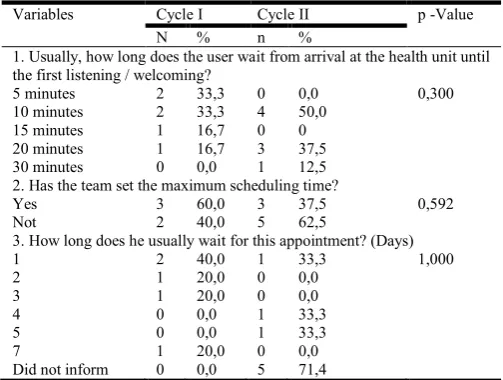
Table 3. Comparison of data from health professionals regarding the time factor for solving demands in PMAQ welcoming in
Cycles I and II
Variables Cycle I Cycle II p -Value
N % n %
1. Usually, how long does the user wait from arrival at the health unit until the first listening / welcoming?
5 minutes 2 33,3 0 0,0 0,300
10 minutes 2 33,3 4 50,0 15 minutes 1 16,7 0 0 20 minutes 1 16,7 3 37,5 30 minutes 0 0,0 1 12,5 2. Has the team set the maximum scheduling time?
Yes 3 60,0 3 37,5 0,592
Not 2 40,0 5 62,5
3. How long does he usually wait for this appointment? (Days)
1 2 40,0 1 33,3 1,000
2 1 20,0 0 0,0
3 1 20,0 0 0,0
4 0 0,0 1 33,3
5 0 0,0 1 33,3
7
Did not inform 1 0
20,0 0,0
0 5
0,0 71,4
When you have the possibility of scheduling, there are numerous factors to discuss. Thus, table 3 shows the data regarding the organization in the reception process, which deals with the comparison of data related to the time factor for the resolution of demands in the reception, in which the user waited until the moment of the first listening / reception. was, for the most part, from 66.6% considering five and ten minutes of waiting in Cycle I to 50% in ten minutes in Cycle II. There was also a reduction in the maximum scheduling time defined by the team, and in Cycle I, 60% of the BHU set this time and only 37.5% in Cycle II. About the time, in days, of waiting for a scheduled appointment, it was appointed mostly 1 day (40%) in Cycle I, while 71.4% in Cycle II.
DISCUSSION
When analyzing the implementation of risk-classified care, it is observed that all units in the second cycle presented such organization. These findings are important and positive for the practice of primary health care in the city, since assuming reception in the FHS facilitates the reorganization of health care, with articulated actions to respond to the health needs of the population, with access increased urgencies and changes the strategy of pre-scheduling with long waiting periods for consultations (Ministério da Saúde, 2013). At this juncture, reception is a potent resource in expanding access, which modifies the functioning of health services based on the principle of universality. This mechanism provides a reflection on the flow of care in the FHS as well as the work process, which should present an effective interpersonal relationship between professionals and users with emphasis on qualified listening, resolubility and multiprofessional care (Andrade, 2016). For this, it was investigated about the opening hours of the reception as well as the frequency in which it is held and a greater offer was noticed during the morning, however, when evaluating the afternoon and night shift there is a reduction, especially regarding the last one. On the other hand, the importance of welcoming spontaneous demand every day is reinforced so that there is no restriction on access to the service. Thus, research confirms this idea, since it demonstrates that the way to expand access to Primary Health Care (PHC) is to extend the hours of care, to strengthen longitudinality and reduce the fragmentation of care, minimizing the search for others. services that do not know the clinical and social history of the user, which interferes with the continuity of care (Pessoa, 2017).
[image:3.595.36.288.586.776.2]resolute and agile care for users. In this context, there was a high percentage regarding the risk and vulnerability assessment in these individuals, which consists in identifying the peculiarities of each user and their needs, facilitating the flow of care. At the national level, 66.96% of the FHS assessed by PMAQ AB in cycle I stated that they carry out risk and vulnerability assessment during the reception in the BHU, a value similar to that found in the BHU of this study (62.5%) 10. The assessment of risk and vulnerability in the FHS ensures access from the principle of equity, with a view to analyzing biological, physical and social vulnerabilities, to contribute to the management of care through protocols and instruments that can systematize this assessment. aggregated to the subjectivity and needs of each individual (Ministério da Saúde, 2011). Guiding the structure and operation of the service and the work process of the FHS according to the needs of users is an important and generous strategic guideline. The role of PMAQ-AB in operationalizing this guideline and in monitoring its evolution, cyclically relating action and effect, is certainly one of the most important functions. Thus, there is a reduction in the reservation of vacancy for same-day service, if the user has a problem that is not recommended to schedule another date, and wonders about this need and the existence of another service that can monitor this user ensuring quality integral and longitudinal care (Pinto, 2014). Given the need for referral, it was investigated about the availability of service for the removal of the user with positive responses in all BHU compared to the second cycle, in which 80% is configured as an ambulance of own mobile service. In the meantime, it is emphasized that user transportation is an important vehicle for the operationalization of a health care program or policy, favoring the achievement of longitudinality, completeness, accessibility and the interaction between the professional and the user / family (Ministério da Saúde, 2012).
Some factors directly affect the relationship between those involved in the reception, as well as the accessibility and adherence of users, among them the waiting time for listening in the reception in general is reinforced, which were between five and ten minutes in the first cycle and ten to twenty. minutes in the second, while in the period for the scheduled consultation, the first cycle shows balanced data between one and seven days, and in relation to the second, most did not inform this variable, and wonders if this time is longer than the delimited one. And so it was not informed or the professionals really do not hold that knowledge. Moreover, it is observed that in most FHS there is no maximum time for scheduling, so the importance of using protocols to standardize this wait and activities according to severity and vulnerability to adequately meet the individual, respecting the needs of each, as well as the principles governing the care at PHC, with activities focused on the work of the multidisciplinary team at the moment for qualified listening, making decisions together and reduce the number of schedules. From this perspective, a survey reveals that the biggest difficulties related to reception are due to the restricted working hours, as well as the work process of the teams in the scheduling models, with gaps between the demand for care and the offer of this service, since there are a proportion of the more delayed this lower offer will be the quality and resolution in attendance, generating negative responses in care, adherence and users of the links establishment with the team (Pessoa, 2017). The moment of reception in the health service is translated by the meeting between the needs of one and the clinical actions of the other, the latter being based on intervention processes that, primarily,
are based on light technologies, in order to maintain or recover User Lifetime (Clementino, 2015). In this sense, it is noticed a relational process between user and worker in care vision to the individual subject. Thus, one should consider the time factor in the reception of spontaneous demand for the service as needed by the user, seeing the risk or vulnerability presented as a need for contact with the professional. The host is a designated method to collaborate with the qualification of health systems so that allows the user access to a fair and comprehensive care through the multiprofessional and intersectoral. It is a tool that enables the SUS to realize its constitutional principles (Coutinho, 2018). From this perspective, the variable waiting time is fundamental for defining the quality of care.
In a study conducted in the city of Campina Grande and Paraíba, with a database of the 1st cycle of PMAQ-AB, the results showed that the long waiting time for care was considered as one of the factors that could hinder users' access. at the service. In this case, when the waiting time is too long, usually public services are described as slow and ineffective, producing a devalued concept of care offered to the population. The higher the timeout, the greater the chance for users to seek other means to solve their problems, reaching most of the time to emergency health services and emergency, given the obstacles found in UBS. In addition, there is also an increase in absenteeism rates of scheduled users (Clementino, 2018). The evaluation processes are fundamental for replanning and advances in health care. By analyzing two PMAQ-AB cycles one can identify potential and vulnerability points. Study conducted in São Paulo on the perception of managers regarding the implementation of the PMAQ, concluded that the managers interviewed demonstrated an incipient process of incorporating the evaluative culture in a systematic way and as a subsidy for the continuous improvement of quality in primary care. Although the gap between the PMAQ proposals and the practice in the BHU studied is still notorious, the program favored the organization of work processes and contributed to directing managers' gaze to the practice of teams and to their own performance (Silva, 2018). Some studies point to the importance of PMAQ-AB as a powerful assessment tool. Results of this evaluation process are noticed in subsequent evaluations, where evaluated municipalities show improvements in indicators based on previous years (Ferreira Lucilene Renó, 2019 and Flôres Gabriela Mendes da Silva, 2019). Another element that should be highlighted in the evaluation of PMAQ-AB is that it causes changes in management aspects. Because it motivates professionals through financial incentive, this element is fundamental for adherence to the program and the search for better results (Flôres Gabriela Mendes da Silva, 2019).
Conclusion
cycles, not including qualitative data, since it is believed that the comparison of more cycles can bring evidence of the evaluation process in relation to the municipality analyzed. And the qualitative aspects would be a complementary support for further analysis / evaluation. From this perspective, this research contributed to investigate and propagate about the process of reception in the FHS from the evaluation of PMAQ-AB, in addition to strengthening the importance of this strategy to consolidate some principles of SUS and to involve comprehensive and multidisciplinary care as expanded. the needs involved. Thus, it is suggested the development of qualitative research from the perspective of welcoming from the perspective of professionals and users in order to understand about the factors that are implicated in the subjectivity of the implementation and implementation of this important care tool.
REFERENCES
Andrade RTS, Santos AM, Oliveira MC. Programa de melhoria de acesso e qualidade da atenção básica no município de Amargosa, Bahia. Rev. Baiana Saúde Pública. 2016; 40(1):123-46.
Clementino FS, Gomes LB, Vianna RPT, et al. Acolhimento na Atenção Básica: Análise a partir da Avaliação Externa do Programa de Melhoria do Acesso e da Qualidade da Atenção Básica (PMAQ-AB). Rev Saúde Ciênc, 2015; 4(1): 62-80.
Clementino FS, Santos LNN, Gomes LB, et al. Acolhimento na perspectiva do Programa de Melhoria do Acesso e da Qualidade da Atenção Básica. Rev. Bras. Ciên. Saúde [Internet]. 2017 [acesso em 20 mai 2018]; 21(4): 323-32. Disponível em: http://periodicos.ufpb.br/ojs2/index.php/ rbcs/article/view/323-332
Coutinho LRP, Barbieri AR, Santos MLM. Acolhimento na Atenção Primária à Saúde: revisão integrativa. Saúde debate[Internet]. 2015Jun [acesso em 13 mai 2018]; 39(105): 514-24. Disponível em: http://www.scielo.br/
scielo.php?script=sci_arttext&pid=S0103-11042015000200514&lng=en.
Ferreira Lucilene Renó, Silva Júnior João Antônio da, Arrigotti Thaís, Neves Vanessa Ribeiro, Rosa Anderson da Silva. Influências do programa de melhoria do acesso e qualidade nos processos de trabalho na atenção básica. Rev. esc. enferm. USP[Internet]. 2018[citado 2019 Set 22] ; 52: e03407. Disponível em: http://www.scielo.br/ scielo.php?script=sci_arttext&pid=S0080-623420180001 00488&lng=pt. Epub 20-Dez-2018. http://dx.doi.org/ 10.1590/s1980-220x2017046403407.
Flôres Gabriela Mendes da Silva, Weigelt Leni Dias, Rezende Maristela Soares de, Telles Rosimeri, Krug Suzane Beatriz Frantz. Gestão pública no SUS: considerações acerca do PMAQ-AB. Saúde debate[Internet]. 2018Jan [cited 2019 Sep 22] ; 42( 116 ): 237-247. Available from: http://www.scielo.br/scielo.php?script=sci_arttext &pid=S0103-11042018000100237&lng=en.
http://dx.doi.org/10.1590/0103-1104201811619.
Ministério da Saúde (Brasil). Acolhimento à demanda espontânea. Brasília: Ministério da Saúde; 2013.
Ministério da Saúde (Brasil). Acolhimento à demanda espontânea. Cadernos de Atenção Básica 28. Brasília: Ministério da Saúde; 2011.
Ministério da Saúde (Brasil). Política Nacional de Atenção Básica.Brasília: Ministério da Saúde; 2012.
Ministério da Saúde (Brasil). Resolução nº 466, de 12 de dezembro de 2012. Diretrizes e Normas Regulamentadoras de Pesquisas Envolvendo Seres Humanos. Diário Oficial da União. 2012.
Mitre SM, Andrade EG, Cotta RMM. Avanços e desafios do acolhimento na operacionalização e qualificação do Sistema Único de Saúde na Atenção Primária: um resgate da produção bibliográfica do Brasil. Ciênc. Saúde Colet. Rio de Janeiro. 2012;17(8): 2071- 85.
Pessoa BHS, Gouveia EAH, Correia IB. Funcionamento 24 horas para Unidades de Saúde da Família: uma solução para ampliação de acesso? Um ensaio sobre as “Upinhas” do Recife. Rev Bras Med Fam. Rio de Janeiro. 2017 Jan-Dez; 12(39):1-9.
Pinto HA, Sousa ANA, Ferla AA. O Programa Nacional de Melhoria do Acesso e da Qualidade da Atenção Básica: várias faces de uma política inovadora. Saúde Debate. Rio de Janeiro. 2014 out; 38(Esp):358-72.
Silva JA. Reorganizar e humanizar o processo de trabalho através do acolhimento: relato de experiência. Rev. Baiana Saúde Pública. 2015 Jan-Mar; 39(1):174-81.
Silva LMC, Ferreira LR, Rosa AS, et al. Implementação do Programa de Melhoria do Acesso e Qualidade segundo gestores da Atenção Básica de São Paulo. Acta paul. enferm. [Internet]. 2017Ago [acesso em 27 mai 2018]; 30(4): 397-403. Disponível em: http://www.scielo.br/
scielo.php?script=sci_arttext&pid=S0103-21002017000400397&lng=en.
Zanellatto DM, DalPai D. Práticas de acolhimento no serviço de emergência: a perspectiva dos profissionais de enfermagem. Ciênc Cuid Saúde. 2010; 9(2):358-65.