ISSN: 1992-8645 www.jatit.org E-ISSN: 1817-3195
A MULTI-POPULATION HARMONY SEARCH ALGORITHM
FOR THE DYNAMIC TRAVELLING SALESMAN PROBLEM
WITH TRAFFIC FACTORS
1 2MOHANAD MUAYAD JOHN JURJEE, 3HAFIZ MOHD SARIM, 4NOORA HANI
ABDULMAJEED AL-DABBAGH, 5ERNA BUDHIARTI NABABAN
1 4
Faculty of Information Science and Technology, Universiti Kebangsaan Malaysia, Bangi, Malaysia 2
College of Science, Al-Mustansiriyah University, Baghdad, Iraq 3
Data Mining and Optimization Research Group, Centre for Artificial Intelligence Technology, Universiti
Kebangsaan Malaysia, Bangi, Malaysia 5
Faculty of Computer Science and Information Technology, Universitas Sumatera Utara
E-mail: 1 [email protected], [email protected], [email protected], 5
ABSTRACT
Recently, there has been a growing attention to employ evolutionary algorithms (EAs) in addressing dynamic optimisation problems (DOPs) due to its significance in real world applications. The most notable challenge when solving DOPs is that the objective should not only attempt to seek the global optimum by an efficient way, but be able to keep track the optimal solution during the environmental changes. Thus, several mechanisms have been developed for EAs in order to improve the search performance of the algorithm in accommodating the dynamic changes such as by increasing the diversity of the population. Among these strategies, the multi-population mechanism has been found beneficial for EAs for DOPs. Dynamic travelling salesman problems (DTSPs) are categorised under DOPs. In the Travelling Salesman Problem (TSP), a salesman wants to distribute items sold in different cities starting from his home city and returning after he visited all the cities to his starting city again by optimising his time and tour efficiently. However, in the DTSPs, it is more challenging to consider the traffic delays that may affect the route of the salesman and change the time planned beforehand. Therefore, the salesman will optimise his time again and find a new alternative route to avoid long traffic delays. The presented work aims to build upon the state of the art research methodologies for the DTSPs with traffic factors, where in order to cope with the dynamic behaviour, a multi-population approach is applied to harmony search algorithm that mimics the musical process of trying to find a state of harmony. Moreover, a multiple pitch adjustment rate (PAR) strategy is proposed since PAR assumed to be the moving rate from one city to the nearest city in the TSP. The performance of the proposed multi-population HS algorithm is verified on two variations of DTSPs with traffic factors, i.e., random and cyclic traffic delays. Based on different DTSP test cases, the experimental results show that the proposed approach is able to obtain competitive results when compared to the best-known results in the scientific literature.
Keywords: Dynamic Optimisation, Travelling Salesman Problem (TSP), Harmony Search, Multi-Population Approach, Diversity
1. INTRODUCTION
Problem optimisation in dynamic environments has attracted an increasing attention because of its significance in real world problems [1]. In the dynamic optimisation problems (DOPs), there is a probability to change the problem through the execution of an algorithm [2]. These changes are touching the objective function, problem instance,
and decision variables. Therefore, it may move the optimum. So that, the problem will be more realistic, challenging and pragmatic.
ISSN: 1992-8645 www.jatit.org E-ISSN: 1817-3195 The travelling salesman problem (TSP) is one of
the major combinatorial optimisation problems (COPs) and of the most intensively researched problems in computational mathematics. The TSP belongs to the class of NP-complete problems since it requires exponential time to create the optimal solution [4]. It has excited studies by researchers of varied fields, e.g., computer science, mathematics, chemistry, physics and psychology. Teachers also involve the TSP to make discrete mathematics known by students in schools or universities. In the dynamic travelling salesman problem (DTSP), cities may be added or deleted and the distances between each pair of cities may be changed during the tour. However, the problem will be more realistic if it is subjected to consider traffic jams which may affect the tour and change the original time. In this case, the salesman must optimise the time again and find his alternative path to avoid the traffic jams. Recently, several methods have been used to solve various types of DTSPs due to its significance for a large number of real-world implementations [5].
Over the years, population based methods have been applied successfully for the DOPs [6]. These methods are dealing with a population of solutions that are dispersed over the entire search space, and that will help the algorithm to track the environmental changes since each solution in the population is assigned to a various region in the search space [1]. However, it is not possible for the population based methods that were improved to handle SOPs, to solve DOPs easily.
It is evident that to deal with dynamic optimisation, the proposed population-based methods have to combine with some mechanisms that would adapt their conduct by modifying their components to be suitable for accommodating the dynamic changes. Increasing diversity after a dynamic change is a simple mechanism to modify the behavior of the population-based methods in order to cope with dynamic environments [7]. Immigrants schemes, memory approaches and the multi-population mechanism have been found valuable when applied to evolutionary algorithms for solving DOPs [8]. Due to the developing strategies that managed to maintain the diversity, some population-based algorithms have been used successfully to solve DOPs, e.g., Genetic Algorithms (GA) [9], Ant Colony Optimisation (ACO) algorithm [10], Particle Swarm Optimisation (PSO) algorithm [11] and Harmony Search (HS) algorithm [12].
DYNAMIC TRAVELLING SALESMAN PROBLEMS (DTSPS)
In the DTSP with random traffic delays, a random number that represented the traffic delays will be generated during the running of an algorithm, where the number of traffic delays is greater or equal to the lower bound of the traffic factor and smaller or equal to its upper bound. The visited environments are not guaranteed to appear once more in the random pattern.
But with the cyclic pattern, the visited environments are guaranteed to appear another time. The cyclic variation of DTSP is showing a practical idea more than random DTSPs because a 24-hours traffic jam in the day is considered. The cyclic environment can be structured by creating various dynamic states with traffic factors as the base states. The DTSP environments with either lower, average, or higher traffic are represented by these dynamic cases. Therefore, the environment will be cyclic in a fixed logical circle within different dynamic cases.
Environments with various traffic factors can be created depending on the time of the day. A higher expectation is given to generate a random number that represented the traffic delays, closer to the upper bound of traffic factor tijin the case of
rush-hour periods when traffic is at its heaviest for example. In the opposite way, a higher expectation is given to generate the random number of traffic delays, closer to the lower bound of traffic factor tij
in the case of evening-hour periods.
3. THE MULTI-POPULATION HARMONY SEARCH ALGORITHM
This work aims to investigate the performance of the suggested HS algorithm to solve the DTSP with traffic factors. However, the application of population-based algorithms for the DOPs is impractical. To deal with DOPs, the proposed population-based method has to combine with a mechanism that would adapt its conduct by modifying its components to be suitable to adjust the dynamic changes. In this work, HS algorithm is hybridised with multi-population approach to maintain the population diversity.
3.1. Harmony Search
ISSN: 1992-8645 www.jatit.org E-ISSN: 1817-3195 underlying objectives. The musicians are starting
with some harmonies and then try to achieve the better harmony through the improvisation process by refining the current harmony or producing a new one. Then, the last harmony will be evaluated in order to accept it or discard it. This analogy used by the researchers to derive the population-based search heuristic that employed for solving optimisation problems where the musicians correspond to decision variables and the harmonies are identified with the solutions.
HS has been subject of a lot of publications since its introduction and has been applied in many fields such as Sudoku puzzle solving, Web page clustering, Water network design, Dam scheduling, Soil stability analysis, Energy system dispatch and Ecological conservation [14].
HS consists of five steps in order to imitate the music improvisation process. These steps are: Step 1: Initialise the problem and algorithm parameters,
Step 2: Initialise the harmony memory, Step 3: Improvise a new harmony, Step 4: Update the harmony memory, and Step 5: Termination criterion.
3.2. Hybridised HS with Multi-Population Approach
The population diversity mechanism that embedded within HS algorithm in order to maintain the population diversity, is presented in this section. In this work, the multi-population mechanism divides the population into two sub-populations, i.e. the quality population and the diversity population. Then the solutions in each sub-population will be ordered; in the quality population to the objective function and the diversity population to the dissimilarity value.
The proposed multi-population HS algorithm needs to keep track of the changes during the search process by maintaining the population diversity in order to cope with the dynamic changes.
After the harmony memory (HM) is initialised in step 2, the initial HM will divided into two sub-populations with the same size for both at the first iteration. The 10 top quality solutions in the initial HM will be selected to the quality harmony memory (QHM) and the 10 most diverse solutions that remain in the HM will be selected to the diversity harmony memory (DHM). The solutions in the QHM will be ordered to their objective function and the solutions in the DHM will be ordered to their dissimilarity value.
In the third step of the proposed algorithm, two subsets will be derived from the HM, i.e. QHM and DHM, as follows:
i. Select the top 10 quality solutions from the HM and store them in the QHM.
ii. The diversity of the remaining solutions in the initial HM will be measured.
iii. Select the 10 solutions from HM that are least similar to the solutions in the QHM, to be stored in the DHM [15].
After a new harmony is improvised, the decision variable value will be selected from QHM solutions before using the pitch adjustment rule if the random number is less than HMCR. Otherwise, it will be selected from DHM solutions.
If the quality of the generated harmony vector is better than the worst quality of harmony vector stored in QHM, then the worst harmony vector in QHM is replaced by the new vector, else if the generated vector is more diverse than the less diverse vector in DHM, then the less diverse vector in DHM is replaced by the new vector. Otherwise, the new vector is ignored.
The hybrid HS algorithm with multi-population approach that implemented and applied to solve the DTSP with traffic factors, is shown in Fig. 1.
3.3. The Multiple PAR Strategy
In this work, the multiple PAR strategy is proposed for the multi-population HS algorithm. Pitch Adjustment Rate (PAR) is the moving rate from one value in the harmony memory to a neighboring value. In this work, three PARs are used, i.e., the rates of moving to nearest city = 0.35, second nearest city = 0.105 and third nearest city = 0.045 [16], since the PAR becomes the moving rate from one city to the nearest city in the TSP.
4. EXPERIMENTAL SETUP
Several experiments are carried out in this work in order to investigate the effect of the multi-population approach and multiple-PAR strategy on HS algorithm for the DTSP.
The proposed method was tested on the DTSP instances that are generated from three stationary benchmark TSP instances that can be freely downloaded from TSPLIB, i.e., kroA100, kroA150, and kroA200, which represent small, medium, and larger scale problem instances in the related works, respectively [5].
ISSN: 1992-8645 www.jatit.org E-ISSN: 1817-3195 order to examine the performance of the suggested
algorithm against the standard HS algorithm, i.e., eil51, lin318, pr439 and rat783.
In this work, two kinds of DTSPs are generated, i.e., random and cyclic traffic factors, with lower
bound of the potential traffic jams ( ) = 1 and
upper bound of the potential traffics ( ) = 5. Then, the values of the random number (R) that represents the traffic jams ∈ [1, 5]. In addition, three cyclic states are used in cyclic DTSPs. For both random and cyclic types, the frequency parameter (f) value for the environmental changes was set to 5 and 100 in order to indicate fast and slow dynamic changes, respectively. Also, the value of the magnitude parameter of the dynamic changes (m) was set to 0.1, 0.25, 0.5, and 0.75 in order to indicate the degree of dynamic changes from small, to medium, and large, respectively [5]. Consequently, eight dynamic test DTSP instances are generated from each dataset, i.e. four values of m × two values of f. Therefore, 24 dynamic test cases are used to analyse the adaptation capabilities of the proposed algorithm on the DTSP with traffic factors for each type of DTSPs, i.e., three TSP instances × eight cases each. In order to analyse the adaptation capabilities of the multi-population HS algorithm on the DTSP against the basic HS algorithm, 56 dynamic test cases are used for both of random and cyclic types, i.e., seven TSP instances ×eight cases each. For the suggested multi-population HS algorithm on a DTSP instance, N = 30 runs are executed on the same environmental changes. The algorithm are executed for G = 1000 iterations.
5. COMPARISON BETWEEN THE MULTI-POPULATION HS ALGORITHM WITH THE BASIC HS ALGORITHM
In this section, the results obtained by the multi-population HS algorithm using multiple PARs strategy (denoted MPHSA-3PARs) are compared against the basic HS algorithm (denoted HSA) and also the multi-population HS algorithm using one PAR (denoted MPHSA-1PAR).
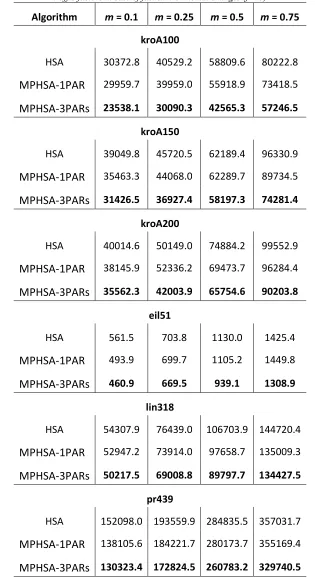
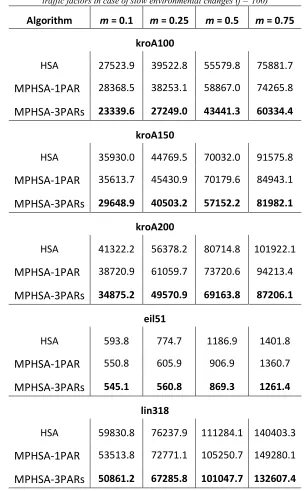
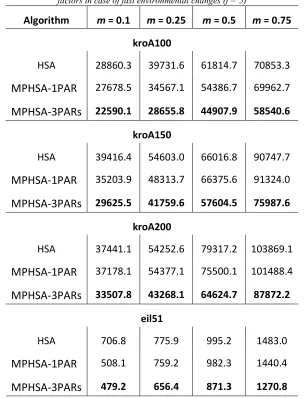
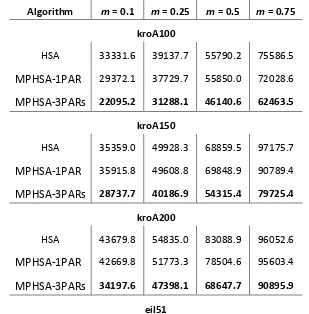
The basic experimental results in DTSP with random traffic factors in case of fast environmental changes (f = 5) are given in Table 1, and in case of slow environmental changes (f = 100) are given in Table 2. The basic experimental results in DTSP with cyclic traffic factors in case of fast environmental changes (f = 5) are given in Table 3, and in case of slow environmental changes (f =
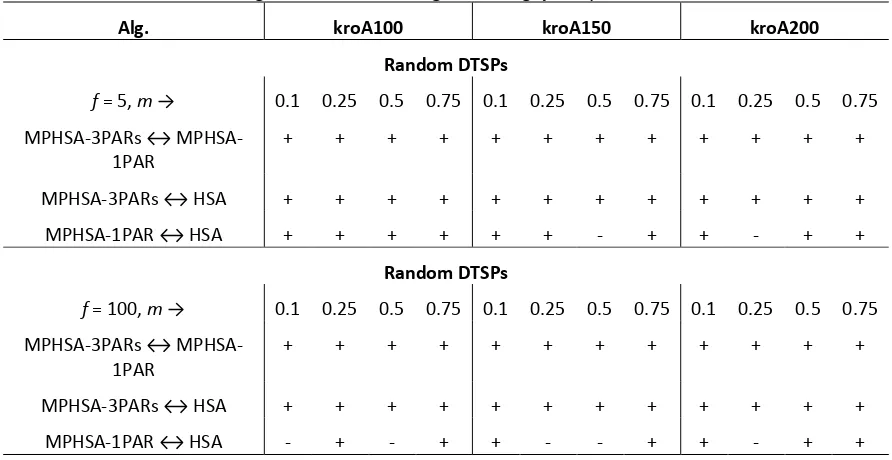
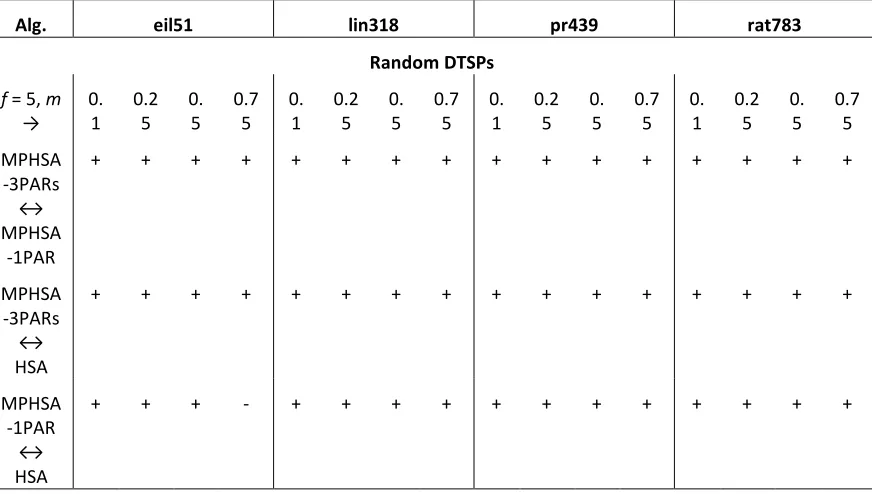
Statistical test results regarding the offline performance of HSA, 1PAR and MPHSA-3PARs on random and cyclic DTSPs that tested on kroA100, kroA150 and kroA200 instances are given in Table 5, and that tested on eil51, lin318, pr439 and rat783 instances are given in Table 6. The results show that the multi-population HS algorithm using multiple PARs strategy is able to obtain better results than the standard HSA and the multi-population HS algorithm using one PAR in all of the seven tested datasets with random and cyclic traffic factors, and in all of the different cases.
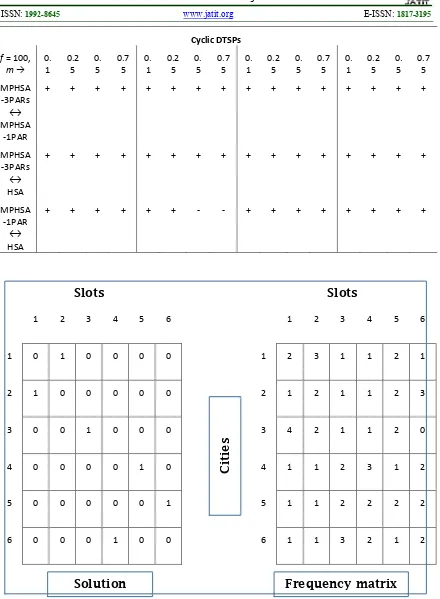
In order to measure the solution diversity, a frequency matrix is used to store the frequency of assigning a city to the same slot. Thus, the frequency matrix saves how many times a salesman has been assigned to the same path. The frequency matrix is initialised to zero and updated if any solution is improved by the algorithm. An example of a solution and its identical frequency matrix is shown in Fig. 2 where the rows represent the cities and the columns represent slots (the available locations). For example, city 1 is assigned to slot 2 and city 2 is assigned to slot 1 in the solution on the left of Fig. 2. Whilst, the frequency matrix on the right side of Fig. 2 shows that city 1 is assigned to slot 1 twice and to slot 2 three times, and city 2 is assigned to slot 1 once; and so on for the other cities and slots.
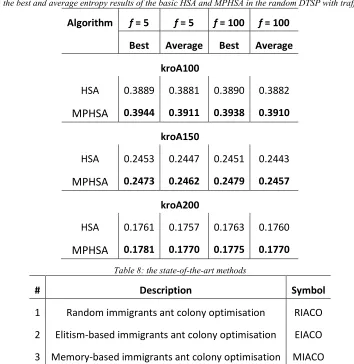
In this work, entropy information theory is used to measure the diversity as follows [17]:
=
=
where n is the number of slots, is the frequency of allocating city i to slot j, and m represents the number of objects, is the entropy
for city i, and is the entropy for one solution (0 ≤ ≤ 1).
ISSN: 1992-8645 www.jatit.org E-ISSN: 1817-3195 algorithm enhance the effectiveness in dealing with
DTSP by maintaining higher diversity.
6. COMPARISON
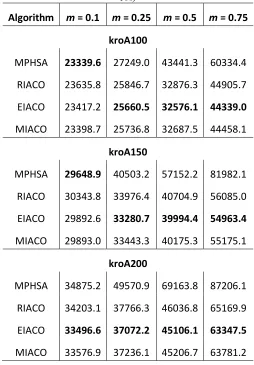
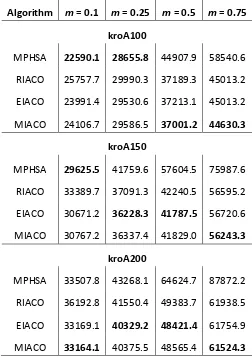
In this section, the results obtained by the multi-population HS algorithm using multiple PARs strategy (denoted MPHSA in this section) are compared against the state-of-the-art algorithms. The compared methods are as shown in Table 8. The reference of all the three compared algorithms is 5.
The basic experimental results in DTSP with random traffic factors in case of fast environmental changes (f = 5) are given in Table 9. The best results are introduced in bold. The comparison shows that the multi-population HS algorithm is able to obtain new best results in the three tested datasets in case of small degree of dynamic changes where m = 0.1 and 0.25.
The basic experimental results for DTSP with random traffic factors in case of slow environmental changes (f = 100) are given in Table 10. The comparison shows that the proposed multi-population HS algorithm is able to obtain new best results in two out of the three tested datasets in case of small degree of dynamic changes where m = 0.1. The basic experimental results for DTSP with cyclic traffic factors in case of fast environmental changes (f = 5) are given in Table 11. The proposed multi-population HS algorithm is able to obtain new best results in two out of the three tested datasets in case of small degree of dynamic changes where m = 0.1 and in one dataset in case of m = 0.25.
The basic experimental results for DTSP with cyclic traffic factors in case of slow environmental changes (f = 100) are given in Table 12. The results show that our proposed algorithm is able to obtain new best results in two out of the three tested datasets in case of small degree of dynamic changes where m = 0.1.
Table 13 shows statistical test results regarding the offline performance of our proposed method against RIACO, EIACO, and MIACO on random and cyclic DTSPs.
7. CONCLUSION
Hybridised HS algorithm to solve DTSP with traffic factors has been proposed in this work. The basic HS algorithm is hybridised with (i) multi-population mechanism, and (ii) multiple-PAR strategy. The hybrisisation process with the multi-population mechanism help to keep track the dynamic changes and maintain diversity and the hybrisisation with multiple-PAR strategy is
suggested in order to enhance the performance on solving the DTSP.
The experiments are carried out to investigate the effect of the proposed hybrisisations on HS algorithm for the DTSP. The performance of our proposed method is verified on two variations of DTSPs with traffic factors, i.e., random and cyclic traffic delays. A number of dynamic test cases are used for both of random and cyclic types of DTSP to analyse the adaptation capabilities of the suggested algorithm. The experimental results show that the multi-population HS algorithm using multiple PARs strategy is able to outperform the basic HS algorithm and is able also to obtain a number of new best results in the DTSP with traffic factors when compared against the state-of-the-art methods.
Although the results show that the multi-population HS algorithm produces good and competitive results in case of small degree of dynamic changes, however; the results also revealed that the proposed algorithm couldn’t produce better results when compared to the state-of-the-art methods in case of large degree of dynamic changes.
REFRENCES:
[1] Yang, S., Ong, Y.S. and Jin, Y. 2007. Evolutionary computation in dynamic and uncertain environments. Ed. Springer Verlag. [2] Talbi, E.-G. 2009. From design to
implementation. John Wiley & Sons, Inc. [3] Branke, J., Salihoğlu, E. and Uyar, C. 2005.
Towards an analysis of dynamic environments. In: Proceedings of the 2005 Genetic and Evolutionary Computation Conference, ACM Press. pp. 1433-1440. [4] Lim, Y.-F., Hong, P.-Y., Ramli, R. and Khalid,
R. 2011. An Improved Tabu Search for Solving Symmetric Traveling Salesman Problems. IEEE Colloquium on Humanities, Science and Engineering Research (CHUSER 2011), Dec 5-6 2011, Penang.
[5] Mavrovouniotis, M. and Yang, S. 2013. Ant colony optimization with immigrants schemes for the dynamic travelling salesman problem with traffic factors. Applied Soft Computing 13, 4023-4037.
[6] Jin, Y. and Branke, J. 2005. Evolutionary optimization in uncertain environments—a survey. IEEE Transactions on Evolutionary Computation, 9 (3) 303-317.
time-ISSN: 1992-8645 www.jatit.org E-ISSN: 1817-3195 dependent non-stationary environments.
Technical Report AIC-90-001, Naval Research Laboratory, Washington, USA. [8] Nguyen, T.T., Yang, S. and Branke, J. 2012.
Evolutionary dynamic optimization: A survey of the state of the art. Swarm and Evolutionary Computation, vol.6, pp. 1-24. [9] Yang, S. 2008. Genetic algorithms with
memory and elitism based immigrants in dynamic environments. Evolutionary Computation 16 (3) 385-416.
[10] Mavrovouniotis, M. and Yang, S. 2011b. Memory-based immigrants for ant colony optimization in changing environments. In: EvoApplications 2011: Applications of Evolutionary Computing, LNCS 6624, Springer-Verlag, pp. 324-333.
[11] Parrott, D. and Li, X. 2006. Locating and tracking multiple dynamic optima by a particle swarm model using speciation. IEEE Transactions on Evolutionary Computation, 10 (4): 440-458.
[12] Turky, A.M. and Abdullah, S. 2014. A multi-population harmony search algorithm with external archive for dynamic optimization problems. Information Sciences, Volume 272, Pages 84–95.
[13] Geem, Z.W., Kim, J.H. and Loganathan, G.V. 2001. A New Heuristic Optimization Algorithm: Harmony Search. Simulation, vol. 76, no. 2: 60-68.
[14] Geem, Z.W. 2010. Recent advances in harmony search algorithm. Ed. 1 Springer Verlag.
[15] Mansour, N., Isahakian, V. and Ghalayini, I. 2011. Scatter search technique for exam timetabling. Applied Intelligence 34 (2): 299-310.
[16] Geem, Z.W., Tseng, C.-L. and Park, Y. 2005. Harmony search for generalized orienteering problem: best touring in China. Advances in Natural Computation, Lecture Notes in Computer Science, Volume 3612, pp. 741-750.
ISSN: 1992-8645 www.jatit.org E-ISSN: 1817-3195
Start
Step 1
Initialise the algorithm parameters
Step 2
Initialise and evaluate the harmony memory (HM)
Step 3
Construct QHM and DHM
Step 4
With probability HMCR:
●
Select a new value for a variable from QHM
with probability 1-PAR:
●
Do nothing
with probability PAR (multiple PAR strategy):
●
Choose a neighbouring value
With probability 1-HMCR:
●
Select a new value for a variable from DHM
Step 5
More diverse than
No New harmony vector is
less diverse vector
better than the existing
in DHM? harmony vectors in the Yes
QHM?
Yes No
Update DHM
No
Step 6
Satisfied? Update QHM
Yes
Return the best solution
ISSN: 1992-8645 www.jatit.org E-ISSN: 1817-3195
Table 1: the experimental results of the basic HSA, MPHSA-1PAR and MPHSA-3PARs in the DTSP with random traffic factors in case of fast environmental changes (f = 5)
Algorithm
m
= 0.1
m
= 0.25
m
= 0.5
m
= 0.75
kroA100
HSA
30372.8
40529.2
58809.6
80222.8
MPHSA-1PAR
29959.7
39959.0
55918.9
73418.5
MPHSA-3PARs
23538.1
30090.3
42565.3
57246.5
kroA150
HSA
39049.8
45720.5
62189.4
96330.9
MPHSA-1PAR
35463.3
44068.0
62289.7
89734.5
MPHSA-3PARs
31426.5
36927.4
58197.3
74281.4
kroA200
HSA
40014.6
50149.0
74884.2
99552.9
MPHSA-1PAR
38145.9
52336.2
69473.7
96284.4
MPHSA-3PARs
35562.3
42003.9
65754.6
90203.8
eil51
HSA
561.5
703.8
1130.0
1425.4
MPHSA-1PAR
493.9
699.7
1105.2
1449.8
MPHSA-3PARs
460.9
669.5
939.1
1308.9
lin318
HSA
54307.9
76439.0
106703.9 144720.4
MPHSA-1PAR
52947.2
73914.0
97658.7
135009.3
MPHSA-3PARs
50217.5
69008.8
89797.7
134427.5
pr439
HSA
152098.0 193559.9 284835.5 357031.7
MPHSA-1PAR
138105.6 184221.7 280173.7 355169.4
ISSN: 1992-8645 www.jatit.org E-ISSN: 1817-3195
rat783
HSA
12424.0
16220.0
22695.5
28838.9
MPHSA-1PAR
11692.1
14690.9
21906.1
28485.0
[image:9.612.151.456.207.698.2]MPHSA-3PARs
11621.1
14662.9
21604.9
28404.1
Table 2: the experimental results of the basic HSA, MPHSA-1PAR and MPHSA-3PARs in the DTSP with random traffic factors in case of slow environmental changes (f = 100)
Algorithm
m
= 0.1
m
= 0.25
m
= 0.5
m
= 0.75
kroA100
HSA
27523.9
39522.8
55579.8
75881.7
MPHSA-1PAR
28368.5
38253.1
58867.0
74265.8
MPHSA-3PARs
23339.6
27249.0
43441.3
60334.4
kroA150
HSA
35930.0
44769.5
70032.0
91575.8
MPHSA-1PAR
35613.7
45430.9
70179.6
84943.1
MPHSA-3PARs
29648.9
40503.2
57152.2
81982.1
kroA200
HSA
41322.2
56378.2
80714.8
101922.1
MPHSA-1PAR
38720.9
61059.7
73720.6
94213.4
MPHSA-3PARs
34875.2
49570.9
69163.8
87206.1
eil51
HSA
593.8
774.7
1186.9
1401.8
MPHSA-1PAR
550.8
605.9
906.9
1360.7
MPHSA-3PARs
545.1
560.8
869.3
1261.4
lin318
HSA
59830.8
76237.9
111284.1 140403.3
MPHSA-1PAR
53513.8
72771.1
105250.7 149280.1
ISSN: 1992-8645 www.jatit.org E-ISSN: 1817-3195
pr439
HSA
146157.7 199596.8 291293.9 375393.8
MPHSA-1PAR
143572.0 192611.7 256519.2 365761.2
MPHSA-3PARs
133953.5 169913.3 242123.7 348406.3
rat783
HSA
11650.8
16128.1
22424.2
29318.7
MPHSA-1PAR
11268.6
15944.6
21599.3
28830.1
[image:10.612.154.458.299.698.2]MPHSA-3PARs
11236.1
14235.7
20840.9
27918.6
Table 3: the experimental results of the basic HSA, MPHSA-1PAR and MPHSA-3PARs in the DTSP with cyclic traffic factors in case of fast environmental changes (f = 5)
Algorithm
m
= 0.1
m
= 0.25
m
= 0.5
m
= 0.75
kroA100
HSA
28860.3
39731.6
61814.7
70853.3
MPHSA-1PAR
27678.5
34567.1
54386.7
69962.7
MPHSA-3PARs
22590.1
28655.8
44907.9
58540.6
kroA150
HSA
39416.4
54603.0
66016.8
90747.7
MPHSA-1PAR
35203.9
48313.7
66375.6
91324.0
MPHSA-3PARs
29625.5
41759.6
57604.5
75987.6
kroA200
HSA
37441.1
54252.6
79317.2
103869.1
MPHSA-1PAR
37178.1
54377.1
75500.1
101488.4
MPHSA-3PARs
33507.8
43268.1
64624.7
87872.2
eil51
HSA
706.8
775.9
995.2
1483.0
MPHSA-1PAR
508.1
759.2
982.3
1440.4
ISSN: 1992-8645 www.jatit.org E-ISSN: 1817-3195
lin318
HSA
59705.8
73510.6
112984.4 140153.7
MPHSA-1PAR
56840.5
68602.4
106642.5 135648.7
MPHSA-3PARs
52902.4
68357.7
105486.4 131297.6
pr439
HSA
154865.1 209363.2 285646.8 377426.4
MPHSA-1PAR
139654.7 197195.6 271933.9 353211.0
MPHSA-3PARs
134855.7 181477.3 250809.3 343266.0
rat783
HSA
11763.1
15918.0
23155.6
29321.6
MPHSA-1PAR
11357.6
15693.2
22324.2
28801.5
[image:11.612.150.459.400.714.2]MPHSA-3PARs
11244.6
15168.2
22252.7
28570.6
Table 4: the experimental results of the basic HSA, MPHSA-1PAR and MPHSA-3PARs in the DTSP with cyclic traffic factors in case of slow environmental changes (f = 100)
Algorithm
m
= 0.1
m
= 0.25
m
= 0.5
m
= 0.75
kroA100
HSA
33331.6
39137.7
55790.2
75586.5
MPHSA-1PAR
29372.1
37729.7
55850.0
72028.6
MPHSA-3PARs
22095.2
31288.1
46140.6
62463.5
kroA150
HSA
35359.0
49928.3
68859.5
97175.7
MPHSA-1PAR
35915.8
49608.8
69848.9
90789.4
MPHSA-3PARs
28737.7
40186.9
54315.4
79725.4
kroA200
HSA
43679.8
54835.0
83088.9
96052.6
MPHSA-1PAR
42669.8
51773.3
78504.6
95603.4
MPHSA-3PARs
34197.6
47398.1
68647.7
90895.9
ISSN: 1992-8645 www.jatit.org E-ISSN: 1817-3195
HSA
544.3
781.5
1010.8
1484.4
MPHSA-1PAR
535.8
698.2
1007.3
1447.6
MPHSA-3PARs
526.3
657.4
979.9
1284.3
lin318
HSA
66185.6
75906.3
113374.7 139509.7
MPHSA-1PAR
56205.5
71792.7
114404.9 142719.4
MPHSA-3PARs
52237.3
68125.6
94152.9
132936.5
pr439
HSA
149845.0 198400.8 283354.8 380267.0
MPHSA-1PAR
144822.5 192192.1 269330.6 358798.3
MPHSA-3PARs
142074.2 187408.5 267868.8 343560.5
rat783
HSA
11793.8
15716.7
23338.9
29465.6
MPHSA-1PAR
11388.2
15520.0
22479.9
28746.4
[image:12.612.83.529.469.699.2]MPHSA-3PARs
11203.3
15097.3
21074.1
28132.1
Table 5: statistical test results regarding the offline performance of HSA, MPHSA-1PAR and MPHSA-3PARs on random and cyclic DTSPs tested on kroA100, kroA150 and kroA200 instances, where + or - indicates that the first
algorithm or the second algorithm is significantly better.
Alg. kroA100 kroA150 kroA200
Random DTSPs
f = 5, m → 0.1 0.25 0.5 0.75 0.1 0.25 0.5 0.75 0.1 0.25 0.5 0.75
3PARs ↔ MPHSA-1PAR
+ + + + + + + + + + + +
MPHSA-3PARs ↔ HSA + + + + + + + + + + + +
MPHSA-1PAR ↔ HSA + + + + + + - + + - + +
Random DTSPs
f = 100, m → 0.1 0.25 0.5 0.75 0.1 0.25 0.5 0.75 0.1 0.25 0.5 0.75
3PARs ↔ MPHSA-1PAR
+ + + + + + + + + + + +
MPHSA-3PARs ↔ HSA + + + + + + + + + + + +
ISSN: 1992-8645 www.jatit.org E-ISSN: 1817-3195
Cyclic DTSPs
f = 5, m → 0.1 0.25 0.5 0.75 0.1 0.25 0.5 0.75 0.1 0.25 0.5 0.75
3PARs ↔ MPHSA-1PAR
+ + + + + + + + + + + +
MPHSA-3PARs ↔ HSA + + + + + + + + + + + +
MPHSA-1PAR ↔ HSA + + + + + + - - + - + +
Cyclic DTSPs
f = 100, m → 0.1 0.25 0.5 0.75 0.1 0.25 0.5 0.75 0.1 0.25 0.5 0.75
3PARs ↔ MPHSA-1PAR
+ + + + + + + + + + + +
MPHSA-3PARs ↔ HSA + + + + + + + + + + + +
[image:13.612.90.526.339.586.2]MPHSA-1PAR ↔ HSA + + - + - + - + + + + +
Table 6: statistical test results regarding the offline performance of HSA, MPHSA-1PAR and MPHSA-3PARs on random and cyclic DTSPs tested on eil51, lin318, pr439 and rat783 instances, where + or - indicates that the first
algorithm or the second algorithm is significantly better.
Alg. eil51 lin318 pr439 rat783
Random DTSPs
f = 5, m
→ 0.
1 0.2
5 0.
5 0.7
5 0. 1
0.2 5
0. 5
0.7 5
0. 1
0.2 5
0. 5
0.7 5
0. 1
0.2 5
0. 5
0.7 5
MPHSA -3PARs ↔ MPHSA
-1PAR
+ + + + + + + + + + + + + + + +
MPHSA -3PARs ↔ HSA
+ + + + + + + + + + + + + + + +
MPHSA -1PAR ↔ HSA
ISSN: 1992-8645 www.jatit.org E-ISSN: 1817-3195
Random DTSPs
f = 100,
m →
0. 1 0.2 5 0. 5 0.7 5 0. 1 0.2 5 0. 5 0.7 5 0. 1 0.2 5 0. 5 0.7 5 0. 1 0.2 5 0. 5 0.7 5 MPHSA -3PARs ↔ MPHSA -1PAR + + + + + + + + + + + + + + + + MPHSA -3PARs ↔ HSA + + + + + + + + + + + + + + + + MPHSA -1PAR ↔ HSA + + + + + + + - + + + + + + + + Cyclic DTSPs
f = 5, m
ISSN: 1992-8645 www.jatit.org E-ISSN: 1817-3195
Cyclic DTSPs
f = 100,
m →
0. 1
0.2 5
0. 5
0.7 5
0. 1
0.2 5
0. 5
0.7 5
0. 1
0.2 5
0. 5
0.7 5
0. 1
0.2 5
0. 5
0.7 5
MPHSA -3PARs ↔ MPHSA
-1PAR
+ + + + + + + + + + + + + + + +
MPHSA -3PARs ↔ HSA
+ + + + + + + + + + + + + + + +
MPHSA -1PAR ↔ HSA
+ + + + + + - - + + + + + + + +
Slots Slots
1 2 3 4 5 6 1 2 3 4 5 6
1 0 1 0 0 0 0 1 2 3 1 1 2 1
2 1 0 0 0 0 0 2 1 2 1 1 2 3
3 0 0 1 0 0 0 3 4 2 1 1 2 0
4 0 0 0 0 1 0 4 1 1 2 3 1 2
5 0 0 0 0 0 1 5 1 1 2 2 2 2
[image:15.612.90.530.67.666.2]6 0 0 0 1 0 0 6 1 1 3 2 1 2
Figure 2. solution and its identical frequency matrix.
C
it
ie
s
ISSN: 1992-8645 www.jatit.org E-ISSN: 1817-3195
Table 7: the best and average entropy results of the basic HSA and MPHSA in the random DTSP with traffic factors
Algorithm
f
= 5
f
= 5
f
= 100
f
= 100
Best
Average
Best
Average
kroA100
HSA
0.3889
0.3881
0.3890
0.3882
MPHSA
0.3944
0.3911
0.3938
0.3910
kroA150
HSA
0.2453
0.2447
0.2451
0.2443
MPHSA
0.2473
0.2462
0.2479
0.2457
kroA200
HSA
0.1761
0.1757
0.1763
0.1760
MPHSA
0.1781
0.1770
0.1775
0.1770
Table 8: the state-of-the-art methods
#
Description
Symbol
1
Random immigrants ant colony optimisation
RIACO
2
Elitism-based immigrants ant colony optimisation
EIACO
3 Memory-based immigrants ant colony optimisation
MIACO
Table 9: the experimental results in the DTSP with random traffic factors in case of fast environmental changes (f = 5)
Algorithm
m
= 0.1
m
= 0.25
m
= 0.5
m
= 0.75
kroA100
MPHSA
23538.1
30090.3
42565.3
57246.5
RIACO
26557.8
30420.4
38252.7
53471.6
EIACO
26100.0
30258.0
38166.9
53491.6
MIACO
26198.9
30341.5
38312.4
53728.9
kroA150
MPHSA
31426.5
36927.4
58197.3
74281.4
RIACO
33816.5
38512.4
48133.7
66340.4
ISSN: 1992-8645 www.jatit.org E-ISSN: 1817-3195
kroA200
MPHSA
35562.3
42003.9
65754.6
90203.8
RIACO
38535.5
43914.6
55048.9
76008.3
EIACO
37926.2
43576.3
54922.2
76103.4
[image:17.612.178.432.246.611.2]MIACO
38050.7
43677.9
55108.7
76355.5
Table 10: the experimental results for the DTSP with random traffic factors in case of slow environmental changes (f = 100)
Algorithm
m
= 0.1
m
= 0.25
m
= 0.5
m
= 0.75
kroA100
MPHSA
23339.6
27249.0
43441.3
60334.4
RIACO
23635.8
25846.7
32876.3
44905.7
EIACO
23417.2
25660.5
32576.1
44339.0
MIACO
23398.7
25736.8
32687.5
44458.1
kroA150
MPHSA
29648.9
40503.2
57152.2
81982.1
RIACO
30343.8
33976.4
40704.9
56085.0
EIACO
29892.6
33280.7
39994.4
54963.4
MIACO
29893.0
33443.3
40175.3
55175.1
kroA200
MPHSA
34875.2
49570.9
69163.8
87206.1
RIACO
34203.1
37766.3
46036.8
65169.9
EIACO
33496.6
37072.2
45106.1
63347.5
ISSN: 1992-8645 www.jatit.org E-ISSN: 1817-3195
Table 11: the experimental results for the DTSP with cyclic traffic factors in case of fast environmental changes (f = 5)
Algorithm
m
= 0.1
m
= 0.25
m
= 0.5
m
= 0.75
kroA100
MPHSA
22590.1
28655.8
44907.9
58540.6
RIACO
25757.7
29990.3
37189.3
45013.2
EIACO
23991.4
29530.6
37213.1
45013.2
MIACO
24106.7
29586.5
37001.2
44630.3
kroA150
MPHSA
29625.5
41759.6
57604.5
75987.6
RIACO
33389.7
37091.3
42240.5
56595.2
EIACO
30671.2
36228.3
41787.5
56720.6
MIACO
30767.2
36337.4
41829.0
56243.3
kroA200
MPHSA
33507.8
43268.1
64624.7
87872.2
RIACO
36192.8
41550.4
49383.7
61938.5
EIACO
33169.1
40329.2
48421.4
61754.9
ISSN: 1992-8645 www.jatit.org E-ISSN: 1817-3195
Table 12: the experimental results for the DTSP with cyclic traffic factors in case of slow environmental changes (f = 100)
Algorithm
m
= 0.1
m
= 0.25
m
= 0.5
m
= 0.75
kroA100
MPHSA
22095.2
31288.1
46140.6
62463.5
RIACO
23980.4
26401.9
31072.9
37717.3
EIACO
23220.3
26061.0
30988.1
37486.1
MIACO
23272.8
26031.9
30850.6
37361.5
kroA150
MPHSA
28737.7
40186.9
54315.4
79725.4
RIACO
30245.7
32323.3
36056.6
47116.3
EIACO
29558.5
32012.2
35761.9
46395.4
MIACO
29732.8
32035.5
35745.8
46251.5
kroA200
MPHSA
34197.6
47398.1
68647.7
90895.9
RIACO
33641.2
35914.9
42646.5
52493.2
EIACO
32381.9
35516.8
41779.5
51617.5
ISSN: 1992-8645 www.jatit.org E-ISSN: 1817-3195
Table 13: statistical test results regarding the offline performance of MPHSA against the state-of-the-art methods on random and cyclic DTSPs tested on kroA100, kroA150 and kroA200 instances, where + or - indicates that the first
algorithm or the second algorithm is significantly better.
Alg. kroA100 kroA150 kroA200
Random DTSPs
f = 5, m → 0.1 0.25 0.5 0.75 0.1 0.25 0.5 0.75 0.1 0.25 0.5 0.75
MPHSA-3PARs ↔ RIACO + + - - + + - - + + - -
MPHSA-3PARs ↔ EIACO + + - - + + - - + + - -
MPHSA-1PAR ↔ MIACO + + - - + + - - + + - -
Random DTSPs
f = 100, m → 0.1 0.25 0.5 0.75 0.1 0.25 0.5 0.75 0.1 0.25 0.5 0.75
MPHSA-3PARs ↔ RIACO + - - - + - - - -
MPHSA-3PARs ↔ EIACO + - - - + - - - -
MPHSA-1PAR ↔ MIACO + - - - + - - - -
Cyclic DTSPs
f = 5, m → 0.1 0.25 0.5 0.75 0.1 0.25 0.5 0.75 0.1 0.25 0.5 0.75
MPHSA-3PARs ↔ RIACO + - - - + - - - + - - -
MPHSA-3PARs ↔ EIACO + - - - + - - - -
MPHSA-1PAR ↔ MIACO + - - - + - - - -
Cyclic DTSPs
f = 100, m → 0.1 0.25 0.5 0.75 0.1 0.25 0.5 0.75 0.1 0.25 0.5 0.75
MPHSA-3PARs ↔ RIACO + - - - + - - - -
MPHSA-3PARs ↔ EIACO + - - - + - - - -