ISSN: 1992-8645 www.jatit.org E-ISSN: 1817-3195
FCM-BPSO: ENERGY EFFICIENT TASK BASED LOAD
BALANCING IN CLOUD COMPUTING
1
GEETHA MEGHARAJ, 2DR. K. G. MOHAN
1
Associate Professor, CSE, Sri Krishna Institute of Technology, Bengaluru 2
Professor & HOD CSE, Sai Vidya Institute of Technology, Bengaluru
E-mail: [email protected], [email protected]
ABSTRACT
Virtual machine (VM) migration is a methodology used for attaining the system load balancing in a cloud environment by transferring the one VM from one physical host to another host. In this paper, we plan to migrate the extra tasks from overloaded VM to suitable VM instead of migrating the entire overloaded VM. In order to select the host VMs, a FCM clustering algorithm has been used to group the similar kind of host VMs. Once the VMs identified as overloaded, then the corresponding candidate VMs are found using the FCM clustering algorithm. Binary Particle Swarm Optimization (BPSO) methodology has been used for selecting the host VMs from the set of candidate VMs based on multi-objective fitness function, which includes task transferring time, task execution time and energy consumption. By allocating the extra task from the overloaded VMs to the proper VMs, we achieved the load balancing in the cloud environment. The implementation of proposed methodology FCM-BPSO has been done using CloudSim tool and comparative analysis done to evaluate the FCM-BPSO method with a traditional load balancing algorithm in terms of energy consumption and time.
Keywords: Load Balancing Algorithm, Task Scheduling, Particle Swarm Optimization, Fuzzy C Means, Clustering.
1. INTRODUCTION
In the past years, it was little bit tough for smaller organizations to increase the number of essential computing resources like hardware, software or storage media (e.g. virtual desktop, virtual machines, development tools etc.), to increase their computation power and storage capacity. But nowadays, cloud computing delivers on demand resource allocation plan. These plans are coming for pay per use basis, in the form of services over the internet [1]. Cloud computing is an emerging technique and it is very successful due to its following characteristic like reliability, security, speed, fault tolerance and efficient communication etc. among different networks [2]. Because of the exponential growth of cloud computing, a number of clients and their demands for services are increasing quickly. This results in heavy workload over the servers and computing resources. An efficient load-balancing algorithm require for proper utilization of the resources to tackle workloads of the server. Load balancing is a mechanism for distribution of the workload uniformly across all the participating servers [3], [4].
So, to use the advantages of cloud computing entirely, an effective Load balancing technique is necessary. Several Load Balancing mechanisms had been proposed before. However, there are some
challenges like: minimum migration time,
minimum downtime, and minimum workload because of Virtual Machine Migration [5], [10]. The cloud computing platform for resource management achieves dynamic balance between the servers using virtualization technology. The online VM migration mechanism [6] can achieve
remapping of VMs & physical resources
dynamically to accomplish load balancing of the entire system [7]. Specifically, VM migration has been employed to carry out flexible resource allocation or reallocation, through transferring a VM from one physical machine to another for stronger computation power, larger memory, fast communication capability, and energy savings [8]. The major disadvantage of conventional procedure for accomplishment of the system load balancing in a cloud environment is that the majority's endeavor to migrate overloaded VMs [6], [7], [8], [9].
ISSN: 1992-8645 www.jatit.org E-ISSN: 1817-3195 memory in both primary Physical Machine (PM)
and new host PM, (3) it needs to pause the primary VM, so triggering VM downtime, (4) it carries the risk of losing recent customer activities in online VM migration, and (5) it is not cost effective and time-consuming [1].
2. LITERATURE REVIEW
Shahrzad Aslanzadeh et al. [11] presented a workflow load-balancing algorithm that could be used in an elastic cloud. STeM algorithm was suggested as the potential algorithm that could improve the load management by explaining the magnitude and direction of the fluctuation between dependent tasks. The model helped to find the level of the dependencies between each task by acknowledging the magnitude and direction of the load. Considering the behavior of the depended tasks, this approach explained a pattern for managing the load balancing more efficiently. The expected benefits of the proposed algorithm improved load balancing technique, which could result in better performance rate.
Dhinesh Babu L. D. and P. Venkata Krishna [12] proposed a load balancing mechanism for cloud computing environments based on behavior of honey bee foraging strategy. They balanced the load and took into consideration the priorities of tasks that had been removed from heavily loaded Virtual Machines. The tasks eliminated from these VMs were treated as honeybees, which were the information updaters globally. Their algorithm also considered the priorities of the tasks. Honeybee behavior motivated load balancing enhanced the total throughput of processing & priority based balancing focused to reduce the amount of time a task had to wait on a queue of the VM. Their methodology reduced the response of time of VMs.
Zhi-Hui Zhan et al. [13] presented a LAGA, which was developed to solve task-scheduling problems in a cloud computing environment. As a better version of existing algorithms, it was suitable for complex problems and was capable of finding more load balancing solutions while maintaining good performance of the Makespan. Through the introduced time load balancing model to modify the fitness function, and the Min-Min, Max-min methods used for population initialization, the algorithm was proved efficient and useful.
Fahimeh Ramezani et al. [14] developed a Task Based System Load Balancing (TBSLB) approach to achieve system load balancing and confront with the lack of capacity for executing new task in one VM, by assigning the task to another homogeneous VM in a cloud environment. In addition, they proposed an algorithm to resolve the issue of migrating these tasks into a new VM host, which is a multi-objective problem in order to minimize cost, minimize execution time, and transfer time. To resolve this issue, they applied Multi-Objective Genetic Algorithm (MOGA).
Fahimeh Ramezani et al. [10] presented TBSLB-PSO method to achieve system load balancing in the cloud environment by migrating arrival tasks from an overloaded VM into a new homogeneous VM using PSO, without migrating the entire VM. This algorithm comprises of a task migration optimization model that reduces task execution time & task transfer time. In addition, they extended the CloudSim package and combined it with the Jswarm package to apply their PSO-based task-scheduling model as the task-scheduling algorithm in CloudSim and evaluated their proposed model.
3. FCM-BPSO TASK-SCHEDULING SYSTEM FOR ENERGY EFFICIENT LOAD BALANCING IN CLOUD COMPUTING
Rapidly increasing of number of clients and their demands of services also increasing due to reason of exponential development of cloud computing which leads to computing resources. These environments require a great efficient load-balancing algorithm intended for appropriate utilization of the resources. The virtualization method has enhanced utilization & system load balancing through permitting VM migration, and has delivered important advantages for cloud computing. VM migration specifically has been employed to flexible resource allocation or reallocation through transferring executing VMs from one physical machine to another machine for stronger computation power, larger memory, fast communication capability, or energy savings. The problems in traditional virtual machine (VMs) migration is presented in section 1.
ISSN: 1992-8645 www.jatit.org E-ISSN: 1817-3195 transferring additional tasks from an overloaded
VM without migrating the entire overloaded VM. They have used PSO algorithm for selecting the host VM in terms of minimizing the task execution time and transferring time. The drawback of previous work is they do not concentrate energy in the objective function for electing the host VMs and they have used constraints for choosing the candidate VM that leads to give more number of candidate VMs that makes PSO become more complex to return the optimized result.
Here, Fuzzy C Means clustering technique is utilized for grouping VM’s having similar characteristics of the overloaded VMs such as number of CPU, capacity of CPU, memory and bandwidth. This leads to reduce the complexity of the PSO algorithm. The proposed load balancing methodology also considers the Energy function as objective function to select the host VM.
Once a virtual machine identified as
overloaded
VM
r, FCM clustering algorithm is usedwhich helps to find candidate VM ( Z
r
VM ) having
the same capabilities as the overloaded VM
(
VM
r), such as number of CPU, capacity of CPU,memory and bandwidth. Then PSO algorithm selects set of target VMs based on the multiple objective fitness function from the set of host VMs
(i.e.
VM
Zr ) to schedule the overloaded tasksfrom
VM
r.3.1 Selection of Candidate Virtual Machines
With the intention of Migrating the extra task from an overloaded VMs to host VMs, initially, our proposed algorithm selects the set of candidate VMs for each overloaded VM. The set of candidate VMs should have similar properties of overloaded VMs. To find the similar properties, in this paper, we utilize FCM clustering algorithm for grouping the similar type of VMs with respect to the properties of overloaded VMs such as number and speed of the processors and memory, status of (idle or active) etc. These VMs properties are considered as features of FCM algorithm and it
avoids the idle state
VM
for host VM because anidle PM must be turned on if tasks are transferred to it, and this action will increase energy consumption and cost.
3.1.1 Fuzzy C Means Clustering Algorithm
The FCM algorithm operates by allocating membership to every data point with respect to each cluster centroid based on distance between the cluster centroid & the data point. More the data is close to the cluster centroid, more is its membership headed for the particular cluster centroid. So, summation of membership of each data point should be equivalent to one. The proposed method also decreases energy consumption by avoiding the selection of idle PMs as the new host PMs. The clustering of VMs is based on minimization of the following objective function presented in equation (1).
j i N
i C
j
ij
x
c
J
=
∑∑
−
=1 =1
µ
(1)Where
N
indicates the total number ofVMs in the cloud environment and
C
depicts thetotal number of clusters. The
µ
ijrepresents themembership valueithdata point (virtual machine)
with respect to
j
thcluster. In this paper, the numberof cluster defined based on the number of overloaded VMs presented in the following equation (2).
1
+
=VM R
C (2)
From the above equation 2, where
C
indicates the number of clusters andR
VM represents the number of overloaded VMs.
Once the number of cluster has been defined, the next thing is to select the number of centroids
randomly
C
and it can be updated using theISSN: 1992-8645 www.jatit.org E-ISSN: 1817-3195
∑
∑
= =⋅
=
N i ij N i i ij jx
c
1 1µ
µ
(3)∑
=
−
−
=
Ck i k
j i ij
c
x
c
x
11
µ
(4)From the above equation 3, where
j
c
indicates the updation ofj
thcentroid andi
x
represents the data point andj i
c
x
−
signifies the Euclidian distance betweenthe th
i data point with respect to
j
thcentroid, andj i
c
x
−
denotes the Euclidian distance betweenthe th
i data point with respect to all other centroids
except
j
thcentroid. With the aid of equation 3 and4, the centroids and membership values are updated at each iteration. This process is repeated until
minimum value of
J
stated in equation (1) isachieved.
3.1.2 Computation of Candidate Virtual Machines from Resultant Partitions
From the FCM clustering algorithm, we
obtain
C
number of clusters, and set of centroidsduring the
K
number of iterationsC
=
{ }
c
kjwhere
1
≤
k
≥
K
and1≤ j≥C. Each overloadedvirtual machine
VM
trare compared with set ofcentroids
c
kj to select the proper set of candidateVM. Consider the set of overloaded virtual machine
{
r}
R VM
VM =
1
≤
r
≥
R
for each overloadedvirtual machine VMrhas set of candidate virtual
machine VMz can be represented as
{ }
zr Z
r
VM
VM
=
1
≤
z
≥
Z
which is obtain fromthe equation (5).
{
k}
j r c
Z
r p x c
VM = argmin − 1≤k ≥ K,1≤ j≥C (5)
From the above equation 5,
where
p
cindicates the partition with respect thecentroid which satisfies the condition of
k j r
c
x
−
min
arg
and xr represents the featuresof overloaded virtual machine. Likewise, the candidate virtual machines are obtained for each overloaded virtual machine and the total number of candidate VMs collected as presents in following equation (6).
( )
[
(
Z)
]
r Z R z r
VM
VM
CD
=
U
,,=1 (6)The host VMs are selected from the set the candidate VMs, the selection process can be taken by the BPSO algorithm.
3.2 Particle Swarm Optimization
Initially, the population for the PSO is
initiated randomly POPk with particles
X
ik can berepresent as
[
k]
n k k k k
X
X
X
X
pop
=
1,
2,
3,
K
,
where POPk isthe set of
n
particle solutions in the swarm atiteration
k
. From POPk, whereX
ik indicates thecandidate solution
i
in swarm at iterationk
. Eachof the candidate solution
i
represented by ad-dimensional vector and can be defined
as
[
iidk]
k i k i k i k
i
x
x
x
x
X
=
1,
2,
3K
. Each particle hastheir own velocity which can be described as
[
k]
iid k i k i k i k
i
v
v
v
v
V
=
1,
2,
3K
wherev
ikid is thevelocity with respect to th
d dimension.
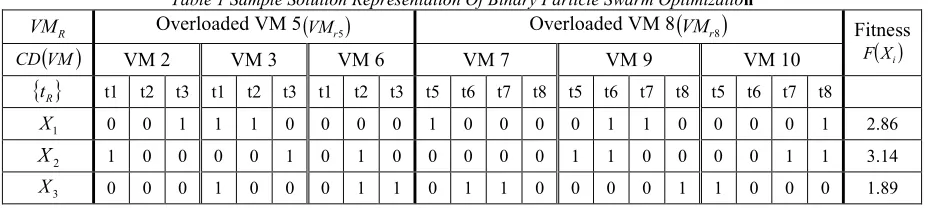
The table 1 represents the sample solution representation of proposed binary particle swarm optimization algorithm. Consider the overloaded
virtual machines
(
VM
r5)
and(
VM
r8)
from whichthere are three overloaded task
{
1 2 3}
5
t
,
t
,
t
t
R=
from(
VM
r5)
and fouroverloaded task
t
R8=
{
t
5,
t
6,
t
7,
t
8}
from(
VM
r8)
.For migrating the overloaded tasks
5
R
t
from(
VM
r8)
, andt
R8from(
VM
r8)
set ofcandidate VMs are defined by FCM algorithm z
z z Z
r
VM
VM
VM
ISSN: 1992-8645 www.jatit.org E-ISSN: 1817-3195 z
z z Z
r
VM
VM
VM
VM
5=
7,
9,
10 respectively. Fromthe table 1,
X
1,X
2andX
3represents the samplesolutions representation and
F
( )
X
i indicates themulti-objective fitness for the solution
X
i. Thesolutions are represented in terms of binary values such as ‘0’ and ‘1’. The binary term ‘1’ depicts that
corresponding task
t
iis allocated to the candidatevirtual machine
VM
zotherwise the value will be [image:5.612.75.540.179.285.2]‘0’.
Table 1 Sample Solution Representation Of Binary Particle Swarm Optimization R
VM Overloaded VM 5
(
VMr5)
Overloaded VM 8(
VMr8)
Fitness( )
XiF
( )
VMCD VM 2 VM 3 VM 6 VM 7 VM 9 VM 10
{ }
tR t1 t2 t3 t1 t2 t3 t1 t2 t3 t5 t6 t7 t8 t5 t6 t7 t8 t5 t6 t7 t81
X 0 0 1 1 1 0 0 0 0 1 0 0 0 0 1 1 0 0 0 0 1 2.86
2
X 1 0 0 0 0 1 0 1 0 0 0 0 0 1 1 0 0 0 0 1 1 3.14
3
X 0 0 0 1 0 0 0 1 1 0 1 1 0 0 0 0 1 1 0 0 0 1.89
3.2.1 Multi Objective Fitness Function
In this paper, our ultimate aim to reduce the energy consumption in datacenter which can be attained by defining multi-objective fitness function expressed in terms of task execution time, task transfer time and energy consumption. The proposed multi-objective fitness function is given in the following equation.
( )
(
F Xi)
=Texe + Ttrans +ECmin
arg (7)
In the above equation (7),
Texe
represents the total execution time ofmigrated task, second parameter represents task transferring time during the migration process and EC represents energy consumption for the execution of migrated task. Our aim is to minimize the multi-objective fitness based on the task execution time, task transferring time and energy consumption.
3.2.1.1 Task Execution Time
The task execution time [10] in the host virtual machine can defined using the following equations.
∑
=
×
=
ni my cy
iy y
VM
VM
DE
Texe
1
(8)
∑
=
=
my
y
Texe
Texe
1
(9)
From the above equation 8, Texey
represents task execution time at Yth Virtual
Machine. DEiy denotes the amount of data that the
task
i
assigns to VMy and VMmy indicates theamount of memory of VMy and VMcy indicates the
number of CPU’s on VMy. Overall task execution
time can be obtained using the equation 9.
3.2.1.2 Task Transferring Time
While migrating the task from one virtual machine to host virtual machine, task-transferring time is one of important factor for an optimized task-scheduling problem. The task transferring time [10] is depending on the bandwidth between the overloaded virtual machine and the host virtual machine. The task transferring time can be computed using the following equation (10).
∑∑∑
= = =
×
=
ni m
y m
z yz
yz iyz
BW
DT
u
Ttrans
1 1 1
(10)
From the above equation 10,
u
iyz become 1when the th
i task is assigned from
Y
thvirtual
machine to
z
th virtual machine and DTyz representsthe volume of data transfer between the
Y
thvirtual
ISSN: 1992-8645 www.jatit.org E-ISSN: 1817-3195
bandwidth capacity between the
Y
thvirtual machine to
z
th virtual machine.3.2.1.3 Energy Consumption Model
The proposed approach assigns tasks to the VM’s so as to save energy by efficiently utilizing the resources and improve the performance by minimizing the execution time of the jobs.
The energy consumption model for the virtual machine [15] presented in this section.
Energy consumption of a Virtual Machine can be defined as the power consumption of that Virtual Machine during t units of time. Energy consumption of a virtual machine is depends of task
execution time Texey and power consumption
y
PCfor execution of the task.
Therefore, ECy energy consumption at the
Yth virtual machine is given by using the following
equation.
y y
y
PC
Texe
EC
=
×
(11)Power consumption PCyfor execution of
the task which can be compute using the following equation (12).
(
y) (
y)
y
RPU
RMU
PC
=
×
(12)At any given time, for Yth Virtual Machine, the
CPU utilization RPUy and memory utilization
RMUy can be given as
∑
=
= n
i i
y rpu
RPU 1
(13)
∑
=
= n
i i y rmu
RMU
1
(14)
Where rpui and rmui are the CPU and memory
utilizations of i tasks running in
Y
thVMs.
The overall energy consumption is the summation of energy consumption of each host virtual machine.
The total energy consumption at all the m
Virtual Machines given by,
∑
=
=
my y
EC
EC
1
(15)
Once the fitness function is calculated for every particle, then the next process to find the Gbest and Pbest in which Pbest (particle’s best) best value of each individual so far and Gbest (Global best) represents the best particle in overall swarm.
3.2.2 Updation of Velocity
Each particle adjusts its own position towards its previous experience and towards the best previous position obtained in the swarm. The particles are updated based on its velocity and the velocity is updated based on the Pbest and Gbest and exiting velocity. The updation of velocity is presented in equation (16).
(
best i)
g(
best i)
pk i k
i V cr P X cr G X
V +1=
ω
+ 1 − + 2 − (16)3.2.3 Updation of Particle
In this paper, binary particle swarm is applied to solve this problem and sigmoid function is used to update the particle with the aid updated velocity and the solution contains 0 or 1, so which presented in equation (17) and (18).
( )
11
1
1
+
+
=
+
k i
V k
i
e
V
S
(17)( )
<
=
+ +
otherwise
V
S
R
if
X
k i k
i
,
0
,
1
11
(18)
In this study, searching process is terminated predetermined set of iterations.
4. EXPERIMENTAL RESULT AND DISCUSSION
ISSN: 1992-8645 www.jatit.org E-ISSN: 1817-3195 consumption. The proposed methodology is
implemented using CloudSim toolkit [16]. The simulation was carried out for 80–100 VMs,
100-500 tasks of various sizes.
The initial work allocation is done by finding the proper eligible VMs for the arrived task based on the properties of VMs. Once the works are started by the eligible VMs, the additional task are needed to be allocated into other VMs. In this process our proposed methodology uses FCM-BPSO and the performance of our proposed methodology is compared with TBSLB-PSO [10]. The number of arriving works and the number of eligible VMs and the number of overloaded works are similar for the both methodologies. However, our proposed methodology performs differently for the selection of candidate VMs for transfer the overloaded tasks.
The selection of the number of candidate VMs for completing the overloaded task by TBLSB-PSO is more than our proposed algorithm. Since the calculation of transfer cost and the task execution cost of every candidate VMs should calculate for the selection of proper VMs. In our proposed method, initially we use FCM clustering algorithm for grouping the VMs based on the properties of eligible VMs. Since the number of candidate VMs get reduced which leads to increase the processing speed to select the proper candidate VMs. Based on the above process, we designed evaluation metrics based on the number of candidate VMs that should be less otherwise processing time for selection of proper VMs become high. The performance of selected VMs by our proposed methodology is evaluated based on the execution time and energy consumption.
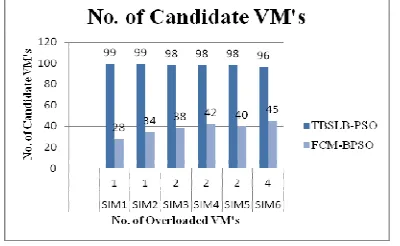
Figure 1: Comparative analysis based on the number of candidate VMs
Figure 1 represents the comparative analysis of a number of candidate VMs. The graph shows that the proposed methodology selects the less number of candidate VMs when compared with the existing methodology. The less number of candidate VMs helps the PSO algorithm to select the target VMs in a less number of iterations. So, the proposed methodology helps to reduce the selection timing of target VMs. Moreover, the selected candidate VMs have more relevant characteristics as that of the overloaded VMs which
helps improvement in task execution
[image:7.612.315.510.247.359.2]time.
Figure 2: comparative analysis in terms of task execution time
The figure 2 depicts the comparative analysis in terms of task execution time and shows that the proposed methodology performs well in terms of total task execution time compared to TBSLB-PSO.
[image:7.612.316.519.551.671.2] [image:7.612.96.296.552.675.2]Figure 3 represents the comparative analysis of Energy Consumption and shows that the proposed task based load balancing algorithm has less energy consumption when compared to the existing load balancing algorithm.
ISSN: 1992-8645 www.jatit.org E-ISSN: 1817-3195
5. CONCLUSION
Here, we proposed FCM-BPSO task scheduling algorithm for attaining the efficient load balancing in cloud environment. Once the VMs are identified as overloaded, candidate VMs are identified from the FCM algorithm by grouping VM’s with similar characteristics as that of the overloaded VMs. The BPSO algorithm based on multi-objective fitness function transfers the extra task from overloaded VMs to target VM’s. The multi-objective fitness function aims to minimize the task execution time, task transferring time and energy consumption and also leads to better load balancing in cloud environment. The performance of the proposed methodology is evaluated by comparing the results with TBSLB-PSO load-balancing algorithm and simulation result shows that the proposed algorithm FCM-PSO has performed well in terms of energy consumption and task execution time.
REFRENCES:
[1] P. Mell and T. Grance, "The NIST definition of
cloud computing”, Communications of the
ACM, Vol. 53, no. 6, 2010.
[2] V. Venkatesa Kumar and K. Dinesh, “Job Scheduling Using Fuzzy Neural Network
Algorithm in Cloud Environment”, Bonfring
International Journal of Man Machine Interface, Vol. 2, No. 1, 2012.
[3] Y. J. Lee, G. Y. Park, H. K. Song, and H. Y. Youn, “A Load Balancing Scheme for Distributed Simulation Based on Multi-Agent
System”, Proceedings of IEEE 36th Annual
Computer Software and Applications Conference Workshops (COMPSACW), 2012, pp. 613-618.
[4] Grover, J., and Katiyar, S."Agent Based Dynamic Load Balancing in Cloud Computing", In Proceedings of International Conference on
Human Computer Interactions, pp. 1-6,
Chennai, 2013.
[5] R. Palta and R. Jeet, “Load Balancing in the Cloud Computing Using Virtual Machine
Migration: A Review”, International Journal of
Application or Innovation in Engineering & Management (IJAIEM), Vol. 3, No. 5, 2014. [6] C. Clark, K. Fraser, S. Hand, G. H. Jacob, “Live
migration of virtual machines”, Proceedings of
2nd ACM/USENIX Symposium on Network Systems, Design and Implementation (NSDI), pp. 273-286, 2005
[7] C. Jun, and C. Xiaowei, “IPv6 virtual machine live migration framework for cloud computing”,
Energy Procedia, 13, pp. 5753-5757, 2011. [8] H. Jin, W. Gao, S. Wu, X. Shi, X. Wu, and F.
Zhou, “Optimizing the live migration of virtual
machine by CPU scheduling”, Journal of
Network and Computer Applications, Vol. 34, No. 4, pp. 1088-1096, 2011.
[9] X. Liao, H. Jin, and H. Liu, “Towards a green cluster through dynamic remapping of virtual
machines”, Future Generation Computer
Systems, Vol. 28, No. 2, pp. 469-477. 2012. [10] F. Ramezani, J. Lu, F. K. Hussain, “Task-Based
System Load Balancing in Cloud Computing
Using Particle Swarm Optimization”,
International Journal of Parallel Programming, Vol. 42, No. 5, pp. 739-754, 2014.
[11] S. Aslanzadeh, Z. Chaczko, and C. Chiu, “Cloud Computing-Effect of Evolutionary
Algorithm on Load Balancing”, Computational
Intelligence and Efficiency in Engineering Systems, vol. 595, pp 217-225, 2015.
[12] D. B. LD, and P. V. Krishna, “Honey bee
behavior inspired load balancing of tasks in cloud computing environments”, Applied Soft Computing, Vol. 13, No. 5, pp. 2292-2303, 2013.
[13] Z. H. Zhan, G. Y. Zhang, Y. J. Gong, and J. Zhang, “Load balance aware genetic algorithm for task scheduling in cloud computing”,
Simulated Evolution and Learning, pp. 644-655, 2014.
[14] F. Ramezani, J. Lu, and F. Hussain, “Task Based System Load Balancing Approach in
Cloud Environments”, Knowledge Engineering
and Management, pp. 31-42, 2014.
[15] N. J. Kansal, and I. Chana, “Artificial bee colony based energy-aware resource utilization
technique for cloud computing”, Journal of
Concurrency and Computation: Practice & Experience, Vol. 27, No. 5, pp. 1207-1225, 2015.
[16] R.N. Calheiros, R. Ranjan, A. Beloglazov, C.A.F.D. Rose, R. Buyya, CloudSim: a toolkit
for modeling and simulation of cloud