Applied Mechanics and Materials Vol. 330 (2013;) pp 61P623 Online available since 2013/Jun/27 at www.scientific.net O (201 3) Trans Tech Publications, Switzerland doi: 10.4028/www.scientiJic.net/AMM 330.619
Frame Work of LV-UTHM:
AN
I S 0 14649 Based Open Control System for
CNC Milling Machine
Yusri Yusofa and Kamran
~atifO
Facultyof Mechanical and Manufacturing Engineering, Universiti Tun Hussein Onn Malaysia (UTHM) Parit Raja, 86400, Johor, Malaysia.
Keywords: STEP-NC, Open Control System, Real time Control
Abstract. Open control is a well known term in the field of machine control. This paper presents a framework of STandard for the Exchange of Product Data-compliant Numerical Control (STEP-NC) based open control system for Computer Numeric Control (CNC) milling machine. Real time control, high efficiency and low cost have been the main focus of proposed open control system. A method that develops open control system is composed of hardware and software platforms. Proposed open control system helps in to improves the quality of machining, increase productivity, saves times, avoid machine accidents, increase tool life and enables monitoring/inspection/control system for various machining processes and parameters onlineloffline.
Introduction
Manufacturing work took a massive step in 1950's with the introduction ofNumerical Control (NC) machine tools. After that a next significant development in machine tool automation was the introduction of Computer Numerical Control (CNC) in 1970's where a computer replaced most of the electronic hardware and punch card of the NC machine [I]. However, manufacturing is still in a 'dark age' with respect to integration and standardization of technologies. The need to have a knowledge-based intelligent system integrating various CADICAMICAE subsystems and process monitoring and control modules, has evoked strong support in the recent past. The absence of a single standard which would have established uniform engineering and technical criteria across the manufacturing community has contributed significantly to the absence of an integrated system. The manufacturing community across the globe has realized the vast potiential integrated systems provide in terms of compatibility, interoperability, safety, repeatbility, quality to withstand the raising competition and cost effective manufacturing. The call for an improved, superior, samrt manufacturing system is greater than ever before [2].
In the 1980s, the design philosophy of open architecture controllers began to draw wide attention. Without a unified definition of open CNC system nowadays, openness is generally perceived as modularity, portability, extendibility, interoperability and scalability [3]. The first open architecture controller was the MOSAIC system developed by New York University in 1998 [4]. Since then, ever-more-increasing efforts around the world have been made to introduce open-architecture systems for industrial controls. One of the most important achievements was made in 1992 within the frame of European project named OSACA. In 1994 a similar project named OSEC under the IROFA Consortium [5] was carried out in Japan, and earlier in the USA a number of American researchers acquired outstanding progresses in the realm of OMAC. There were a lot of Chinese experts who engaged in the study of open architecture controllers and thereby devised various controllers on the base of "software IC", software component etc. which, however, proved to be defective in incompatibility and lack of portability as well as inter-changeability [6-71.
Personal Computer (PC) has been one of the preferred hardware platform of open CNC system for its good openness, high performance-price ratio [S]. At present, with PC as the hardware platform, and real-time operating system as software platform, open architecture CNC system based on the development of CNC technology, has been the mainstream direction of open CNC system. Now open CNC system is stepping into the "Soft CNC" stage by taking the PC as the hardware platform, using
620 Materials ~ n $ i n e e r i n ~ and Automatic Control II
Windows as software platform, and designing the hardware and software of Numerical Control(NC) based on the motion controller [9]. Motion control is a sub-field of automation in which the position and/or velocity of machines are controlled using some type of device such as a hydraulic pump, linear actuator, or an electric motor. Motion control is also important part of robotics and CNC machine tools [lo]. W lee built and develop five axis CNC milling machine run by STEP-NC in XML [ l l ] . L Hongbo deleveloped an conceptual framework of STEP-NC controller based on the concept of multi agent system [12]. M K M Nor design and developed an control system for a five-axis ultra precision micro milling machine - Ultra-Mill. The design specifications of Ultra-Mill are based on motion and positioning accuracy, dynamic stiffness, thermal stability, and online monitoring and inspection requirements, which are heavily dependent on the control system for the micro milling machine and associated micro milling processes [13]. Pengfei Li developed a novel open architecture CNC system with the key hardware "PC+PMAC controller" based on the CAD graph-driven technology. The data of graphic features identifying and geometric parameters extracting from the CAD part drawing are adapted to control the relative motion between cutting tool and part. The ant-colony algorithm is applied to optimize the cutting tool paths in machining process [14]. L M Velazquez presents an open architecture platform based on multi-agent hardware-software units, by developing a novel Multi-Agent Distributed Controller (MADCON) system. The design of intelligent drives for this system follows a hardware-software co design approach using a simple and intuitive structure. The hardware units of the proposed system integrate control and monitoring functions providing an FPGA-based open architecture for reconfigurable applications. On the other hand, software components were developed utilizing the XML structure for system description files, gathering features like a flowchart descriptive language and a graphic user-interface. MADCON was applied to a retrofitted to CNC lathe for control and monitoring [I 51. XU Xiao-ming developed an open CNC system based on PC and motion controller. Software and hardware of the system are based on the idea of modularization construction, and the developed system includes high degree of integration, low coupling system management software, algorithms based on motion controller two-order interpolation and rough interpolation using Cubic b-sp line curve chord segmentation interpolation algorithm [16]. At present, Lab VIEW software is taken for the development of control system because Lab VIEW simplifies the scientific computation, process control, research, industrial application and measurement applications. Because Lab VIEW has the flexibility of a programming language combined with built-in tools designed specifically for test, measurement and control [17]. Y. Weidong fiom china developed a lab view based CNC controller by using motion control card with PC [I 81. That system required two operating systems such as Microsoft (MS) windows and NC operating system which is configured by inserting an NC function board in PC. The added on card, usually Digital Signal Processing (DSP) based, performs the time critical NC kernel tasks and the PC is for the non real time function. The two Central Processing Unit (CPU)s communicate each other by PC bus or dual port Random Access Memory (RAM). D. Elias from Malaysia developed an intelligent controller based on STEPNC [19], developed system is composed of hardware and software platform to control the motion of 3 axis CNC milling machine. The developed system is found to be limited in terms of intillegent and flexibility.
Proposed Open Control System
Proposed framework is an attempt made to improve D. Elias [17] system by minimizing its limitations and make that system more open, advance, flexible, intelligent and accurate. In this system the software and hardware platform is chosen and software realization methodology for the CNC system is determined on the mode of PC plus Motion controller.
Applied ~ e c h a k c s and Materials Vol. 330 621
Nomenclature of Proposed Open Control System
Proposed open control system is composed of four steps as shown in Fig. 2.
Figure. 1 Denford NOVAMILL ATC NS Figure. 2 Nomenclature of Proposed System
Step 1: Generation of I S 0 14649 file. In this step, STEPNC part 21 file is generated from Computer Aided Design (CAD)/Express/ISO 6983 by using ST developer as shown in Fig. 3.
I
CADIEipressilSO 69831
@
I
ST Developer I S 0 14649 Part 21 [image:3.599.84.510.103.282.2]- -
Figure.3 Generation of STEP part 21
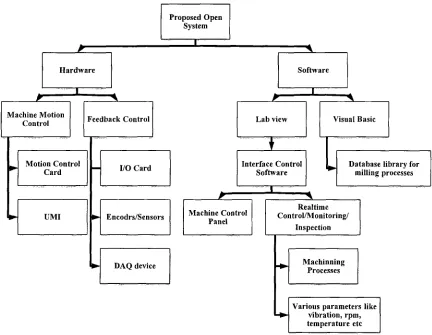
Step 2: Development of Interface Control Software. In this step interface control software is developed by using JAVANisual Studio and Lab view. This software takes I S 0 14649 part 21 file as input data model and connects with CNC machine. This interfacing software includes many functions like machine axis control, spindle control of machine, data base library for milling processes, real time control system to monitor/inspect/control various machining processes and parameters onlineloffline and machine collision detection control. Fig. 4 shows the flow chart of step 2.
[image:3.599.82.497.345.419.2], 622 Materials ~ngineering and Automatic Control II
Step 4: Experimental Objects. In this step objects are to be manufactured and monitoredlinspected by proposed system on Denford Novamill.
Proposed Open System
Hardware
Y
Various parameters like vibration, rpm, temperature etc SoftwareI I I I
[image:4.603.84.516.124.459.2]b I A b I 4
Figure. 4 Flow chart of step 2 and step 3
Future Trend
Tomorrow's manufacturing world is believed to take a more distributed, decentralized and collaborated shape, the traces of which are already abundantly clear in many parts of the world. In fact, many factors help shape the future trends of advanced CNC systems due to the rapid development of manufacturing systems. Being proprietary in nature, these conventional CNC systems are limited in flexibility and robustness when there are needs to interface them with other systems. To unlock the unfulfilled potential, CNC machine tools will become more open, adaptable, interoperable, distributable, reconfigurable and modularized. The next generation of CNC systems can increase their capabilities and lower the cost by closing the loop of CADICAPPICAWCNC process chain.
Lab view
+
Interface Control Software Machine Motion
Control Visual Basic
Conclusion
Feedback Control
C UMI
P .
)
Open control is a well known term in the field of machine control. Since early nineties, several initiatives have been taken world-wide on concepts for enabling control vendors, machine tool builders and end users to benefit more from flexible and agile production facilities. The main aim was the easy implementation and integration of customer-specific controls by means of open interfaces and configuration methods in a vendor neutral, standardized environment. In recent years, PC-based
Database library for milling processes
Processes Motion Control
Card
b I A
I10 Card
+
EncodrslSensors PanelRealtime Control/Monitoringl
Inspection Machinning
Applied ~ e c h a ~ i c s and Materials Vol. 330 623
control technology has become a widely used industry practice. Proposed system is an attempt made to make STEP NC based open CNC control system more flexible, advance and accurate by enabling feedback control system, whose benefits include faster design cycles, improves accuracy, lower downtime, increased productivity and decreased maintenance costs.
Acknowledgement
This work was supported by the Malaysian Government under GIPs Grant, University Tun Hussein Onn Malaysia (UTHM).
References
[I] S. Y. Liana, R. L. Hecker, and R. G. Landers: Journal Of Manufacturing Science And Engineering. Vol. 126 (2004), p. 297-310
[2] M. P. Groover: Automation, Production Systems, And Computer-Integrated Manufacturing: Prentice Hall Press, 2007.
[3] G. Pritschow, Y. Altintas, F. Jovane, Y. Koren, M. Mitsuishi, S. Takata, H. Van Brussel, M. Weck, and K. Yamazaki: CIRP Annals-Manufacturing Technology.Vo1. 50 (2001), p. 463-470
[4] S. Schofield and P. Wright: Journal Of Manufacturing Science And Engineering. Vol. 120 (1998), p. 417-424
[5] C. Sawada and 0 . Akira: Emerging Technologies and Factory Automation Proceedings, 6th International Conference (1997), p. 543-550
[6] J. Zuo, Y. Chen, Z. Zhou, A. Nee, Y. Wong, and Y. Zhang: The International Journal of Advanced Manufacturing Technology. Vol. 16 (2000), p. 643-648
[7] L. Bin, Z. Yun-fei, and T. Xiao-qi: Computers in Industry. Vol. 55 (2004), p. 73-85
[8] J. Zheng, W. Zhao, and Z. Li: Computer Integrated Manufacturing Systems-Beijing. Vol. 11 (2005), p. 1179
[9] Z. Kai: Manufacturing Technology & Machine Tool. Vol. 12 (2002), p. 016
[lo] J. Olawale, A. Oludele, A. Ayodele, and N. M. Alejandro: Computer Science and IT Education Conference. (2007)
[ I l l W. Lee, Y.-B. Bang, M. Ryou, W. Kwon, and H. Jee: International Journal of Computer Integrated Manufacturing. Vol. 19 (2006), p. 593-602
[12] H. Lan, C. Zhang, and R. Liu: A Framework for Intelligent STEP-NC Controller Based on Multi-agent
[13] M. Nor and K. Cheng: Journal of Engineering Manufacture. Vol. 224 (201 0), p. 163 1-1 644 [14] P. Li, T. Gao, J. Wang, and H. Liu: Robotics and Computer-Integrated Manufacturing. Vol.
26 (2010), p. 720-724
[15] L. Morales-Velazquez, R. d. J. Romero-Troncoso, R. A. Osornio-Rios, G. Herrera-Ruiz, and E. Cabal-Yepez: Journal of Systems Architecture. Vol. 56 (2010), p. 407-418
[16] X.M. Xu, Y. Li, J.H. Sun, and S.G. Wang: Procedia Engineering. Vol. 29 (2012), p. 1845-1 850
[17] L. U. Manual: National Instruments Company. (2000)
[IS] Y. Weidong and G. Zhanbiao: Computer Application and System Modeling (ICCASM) International Conference. Vo14 (2010), p.476-479
Materials Engineering and Automatic Control I1
1 0.4O28/www.scientific.net/AMMMM33O
Frame Work of LV-UTHM: An I S 0 14649 Based Open Control System for CNC Milling Machine