ABSTRACT
With increasing sensitivity of electronic equipment and automated controls in modern power systems, the power quality monitoring become growing concerns for many industrial facilities and a common practice for utilities. Studies of power quality phenomena have emerged as an important subject in recent years due to renewed interest in improving the quality of the electric supply. Power quality issue has attained considerable attention in last decade due to the increased use of power electronics in residential, commercial and industrial. The most frequently power quality events occur are voltage sag, voltage swell and harmonics distortion. All of the power quality events may interrupt working processes or even cause electronic devices to malfunction. Therefore, it is very important to detect and classified the power quality event occur. This study presents methods to detect and classify power quality events using Analysis of Variance (ANOVA) and Wavelet Transform. This method is tested for a large class of test conditions simulated in MATLAB and focused on the three major of power quality problems which are voltage sag, voltage swell and harmonics distortion in 22 kV distribution network. For the result of this study, the two methods used are able to classify and identify the power quality events. The ANOVA method can detect the range and type of power quality events occur and the wavelet transform can identify the location and time for every problem occur in this distribution network.
ABSTRAK
Dengan meningkatnya kepekaan alat elektronik dan kawalan automasi dalam system kuasa
moden, pengesanan kualiti kuasa menjadi kebimbangan bagi kemudahan industri dan
menjadi amalan biasa kepada utility-utiliti. Sejak kebelakangan ini, kajian fenomena kualiti
kuasa telah muncul sebagai satu perkara yang sangat penting dengan adanya minat baru
untuk meningkatkan kualiti bekalan elektrik. Sejak sedekad lalu, isu kualiti kuasa telah
menjadi satu perkara yang perlu dititikberatkan disebabkan meningkatnya alat-alat elektronik
kuasa di kawasan kediaman, komersial dan industri. Voltan lendut, voltan kembang dan
herotan harmonik adalah masalah kualiti kuasa yang seringkali berlaku. Kesemua masalah
kualiti kuasa ini bukan sahaja menyebabkan gangguan proses kerja malahan akan
menyebabkan kerosakkan peralatan elektronik. Lantaran itu, adalah sangat penting untuk
mengesan dan mengklasifikasi masalah-masalah kualiti kuasa. Kajian ini membentangkan
kaedah-kaedah untuk mengesan dan mengklasifikasi masalah kualiti kuasa dengan
menggunakan kaedah Analisis Varian (ANOVA) dan Wavelet Transform. Kaedah ini diuji dengan meluas menggunakan perisian MATLAB dan memfokuskan kepada tiga major
masalah kualiti kuasa iaitu voltan lendut, voltan kembang dan herotan harmonik dalam
sistem pengagihan 22 kV. Hasil daripada kajian ini telah membuktikan kedua-dua kaedah ini
mampu mengklasifikasi dan mengenalpasti masalah-masalah kualiti kuasa. Kaedah ANOVA
TABLE OF COTETS
CHAPTER TITLE PAGE
TITLE i
DECLARATION ii
DEDICATIONS iii
ACKNOWLEDGEMENT iv
ABSTRACT v
ABSTRAK vi
TABLE OF CONTENTS vii
LIST OF TABLES x
LIST OF FIGURES xi
LIST OF ABBREVIATIONS xiii
I ITRODUCTIO
1.1 Introduction 1
1.2 Project Background 2
1.3 Problem Statement 3
1.4 Objectives 4
1.5 Project Scope 5
II LITERATURE RIVIEW
2.1 Introduction 7
2.2 Previous Works 8
2.2.1 Analysis of Variance (ANOVA) method 8
2.2.2 Wavelet Transform 10
2.3 Theory of Power Quality 12
2.3.1 Voltage Sag 12
2.3.2 Voltage Swell 13
2.3.3 Harmonics Distortion 14
2.3.4 Transient 15
2.4 Conclusion 16
III METHODOLOGY
3.1 Introduction 17
3.2 Software Development 18
3.2.1 Analysis Using RPM Power Analysis
Software 19
3.2.2 Steps to Converted Waveform to Excel
File 20
3.2.3 Application of the ANOVA Method 23
……..3.2.4 Single-factor ANOVA test 24
……..3.2.5 Wavelet Transform 28
3.2.6 Discrete Wavelet Transform 29 3.2.7 Flow Chart of Wavelet Transform 30
4.1 Introduction 32
4.2 Single-factor ANOVA Method 33
4.2.1 Voltage Sag 33
4.2.2 Voltage Swell 35
4.2.3 Harmonics Distortion 37
4.2.3.1 Current Harmonics 37 4.2.3.2 Voltage Harmonics 39
4.2.4 Comparison for All Data of Power
Quality Events 41
4.3 Power Quality events Analysis using Wavelet
Transform 43
4.3.1 Voltage Sag 44
4.3.2 Voltage Swell 45
4.3.3 Harmonics Distortion 46
4.4 Comparison Using ANOVA and Wavelet
Transform Method 48
4.5 Conclusion 49
V COCLUSIO AD RECOMMEDATIO
5.1 Conclusion 50
5.2 Recommendation 51
LIST OF TABLES
O. OF TABLE TITLE PAGE
3.1 Single-factor ANOVA 23
4.1 Comparison for All Data of Power Quality Events
41
4.2 Range for All Power Quality Events 42
4.3 Comparison between ANOVA and Wavelet Transform
LIST OF FIGURES
O. OF FIGURE TITLE PAGE
2.1 Voltage Sag Waveform 13
2.2 Voltage Swell Waveform 14
2.3 Harmonics Distortion Waveform 15
2.4 Transient Waveform 16
3.1 Flow Chart for software development 18
3.2 The voltage sag problem from PMU Skudai, Johor 22 kV
20
3.3 The Harmonics Distortion problem from PMU Skudai, Johor 22 kV
21
3.4 Data of power quality events in text file (*.txt) 22 3.5 Data of power quality events in excel file
(*.xls)
22
3.6 ANOVA summary table in MATLAB 24
3.7 Flow Chart for ANOVA Method 27
3.8 Multi-resolution Analysis 28
3.9 Flow Chart for Wavelet Transform 30
4.1 ANOVA Summary Table for Voltage Sag 34
4.2 Graph of Voltage Sag 34
4.3 ANOVA Summary Table for Voltage Swell 35
4.4 Graph of Voltage Swell 36
4.5 ANOVA Summary Table for Current Harmonics
38
4.7 ANOVA Summary Table for Voltage Harmonics
39
4.8 Graph of Voltage Harmonics 40
4.9 Original Signal (top) and Wavelet Signal (bottom) of Voltage Sag
44
4.10 Original Signal (top) and Wavelet Signal (bottom) of Voltage Swell
46
4.11 Original Signal (top) and Wavelet Signal (bottom) of Harmonics Distortion
LIST OF ABBREVIATIOS
ANOVA - Analysis of Variance
ASD Adjustable-Speed Drives
Db Daubechies
DWT Discrete Wavelet Transform
Hz Hertz
kV - Kilovolt
MRA Multi Resolution Analysis
PLC - Programmable Logic Control
PQ - Power Quality
RMS Root Mean Square
RPM - Reliable Power Meter
CHAPTER I
ITRODUCTIO
1.1 Introduction
With increasing sensitivity of electronic equipment and automated controls in modern power systems, the power quality monitoring become growing concerns for many industrial facilities and a common practice for utilities. Studies of power quality phenomena have emerged as an important subject in recent years due to renewed interest in improving the quality of the electric supply [1]. The qualities of electric power are concerned in both electric utilities and end users of electrical power. The term power quality has become one of the most prolific buzzword in the power industry since the late 1980s [2]. The power quality events are not confined to only energy efficiency and environment but more importantly on quality and continuity of supply or power quality and supply quality.
A power quality event is defined as any power problem manifested in voltage, current, or frequency deviations that result in power failure or disoperation of equipment [3].
voltage. On the other hand, power quality problems concerning voltage magnitude deviations can be in the form of voltage fluctuations, especially those causing flicker. Other voltage problems are the voltage sags, short interruptions and transient over voltages. Among them, three power quality problems have been identified to the major concern to the customers are voltage sags, voltage swell and harmonics, and this project is focussed on that three major of power quality problems.
1.2 Project Background
Power quality issue has attained considerable attention in last decade due to the increased use of power electronics in residential, commercial and industrial [4]. The most frequent occurred power quality events are voltage sag, swell, harmonics and transients. All of the power quality events may interrupt working processes or even cause electronic devices to malfunction [5]. Therefore, it is very important to detect and classified the power quality event occur. There are some various method have been proposed for classification and identification of power quality events such as Analysis of Variance (ANOVA), Wavelet Transform, Fast Fourier Transform, S-Transform and etc.
power quality events for various combinations of PQ events. In order to form the better result, the data is analyzed again with wavelets transform method. This is because by using ANOVA method, only the range of the type of power quality events can detect and the specific place and time the power quality event can’t be detect by ANOVA method [8]. Due to this problem, the wavelets transform can used to detect the specific time when the power quality events occur. Beside the several method used to detect the power quality problems, there are some method comes with this advantage such as Neural Network and fuzzy logic. This method fails to detect voltage sag/swell and has a complex calculation and it also required lots of data for training and learning process [9].
1.3 Problem Statement
Electric utilities have made a substantial amount of investment to improve the reliability of the system network that can reduce the number of faults occurs but they still cannot control and predict the existence of faults in distribution networks. Due to the increase used of microelectronic processors in various types of equipments such as computer terminals, programmable logic controllers and diagnostic systems, the demand for clean power has been increasing in the past several years [9].
1.4 Objectives
The major objective of this project is to diagnose power quality events in distribution network by using ANOVA Method. There are several measurable objectives to be achieved in the end of the project which include:
a) To analyze power quality events base on given data using ANOVA and Wavelet Transform method
b) To analyze the data of power quality events by using the RPM Power Analysis Software
c) To investigate the different between ANOVA Method and Wavelet transform for power quality diagnosis.
1.5 Project Scope
The scopes and limitation of this study are:
1. This study is only focused on three major power quality events that usually occur and identified. The power quality events are voltage sags, voltage swell and harmonics distortion.
2. The data is taken from 22 kV distribution systems in Skudai, Johor.
3. The technique used to identify the power quality events is Analysis of Variances (ANOVA) and Wavelet Transform method.
4. Identification or simulation of power quality events using the Matlab software.
1.6 Project structures
This final project report is divided into five main chapters. The presented chapters are introduction, literature review, methodology, results, analysis and discussion, and conclusion.
Chapter 1 gives slightly entire introductions regarding this project. The project overview, objectives and scopes of study are all viewable in this chapter.
Chapter 2 of this report consists of literature review of the project which detailed the theoretical background and the previous studies that related to this project.
The project’s procedure and also the approach taken to implement this project such as the software development and method used will be explained in the Chapter 3. The following Chapter 4 consists of the results, analysis and discussion that obtained using this method.
CHAPTER II
LITERATURE REVIEW
2.1 Introduction
2.2 Previous Work
This section is discussed about the previous research that had been carried out on power quality problems. There are many researches have been done in previous literature on power quality identification using various method as mention before.
2.2.1 Analysis of Variance (AOVA) method
Claudio De Capua, Stefano De Falco, Annalisa Liccardo and Amelia Romeo [12] have discussed about the improvement of new synthetic power quality problem. The proposed approach consists of two steps. The first one concerns definition and validation of the indexes of measure with the statistical validation with correlation and ANOVA approach, the second one is about the evaluation of the effects (costs for the user experiencing PQ decrease) through the Taguchi’s function. Through the ANOVA technique, it has been realized the base to build the cost function and this is true when a correspondence is found between the indexes variance levels and the cost of the technologic solution to overcome PQ problem [13]. In view of this study, it’s not carried on to validate and prove its significance in terms of effective cost. This paper also did not acquire the information related to economics effect generated by the voltage and current disturbances detect through define more sensible indexes.
steganalysis, ANOVA method is used to test which statistics are consistent and accurate against the effects of various steganography tools or various steganography rate. For the conclusion, the author was state that the ANOVA technique is used to test which statistics are more significant to hidden messages compared with other wavelet statistics. Those statistics with higher F-scores (low p-value) are significant to hidden message and accordingly chosen as images’ features. The results of classification show that the ANOVA used to test proper wavelet statistics is effective and testing accurate rate have got been apparently improved.
For the conclusion in this part, from the previous work it can show that, the ANOVA method is not very familiar with power quality field. The ANOVA method mostly use in image processing. Because of some advantages of ANOVA method, this method is prefer to used in this project.
2.2.2 Wavelet Transform
paper, the author also discuss about the advantages using the wavelet method. This method is independent of the load voltage and can be easily customized for different sampling frequencies. In this approach, for detecting each disturbance a particular wavelet is used. The method uses wavelet filter banks in an effective way and does multiple filtering to detect the disturbances. The performance evaluation of different wavelets in the proposed method shows the capability of a particular wavelet in detecting a particular disturbance.
detection, processing and comparison of disturbances simultaneously. This method also can detect the time of disturbances.
From the previous work, it can shows that the wavelet transform method is a good method used to detect and classify the PQ events.
2.3 Theory of Power Quality
A power quality problem is defined as any power problem manifested in voltage, current, or frequency deviations that result in power failure or disoperation of customer of equipment from the perspective of customers [15].
2.3.1 Voltage Sag
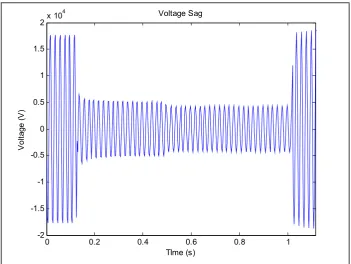
0 0.2 0.4 0.6 0.8 1 -2 -1.5 -1 -0.5 0 0.5 1 1.5
2x 10
[image:20.595.148.500.84.348.2]4 TIme (s) V o lt a g e ( V ) Voltage Sag
Figure 2.1: Voltage Sag Waveform
2.3.2 Voltage Swell
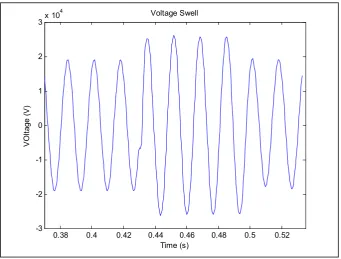
0.38 0.4 0.42 0.44 0.46 0.48 0.5 0.52 -3
-2 -1 0 1 2 3x 10
4
Time (s)
V
O
lt
a
g
e
(
V
)
[image:21.595.149.491.84.343.2]Voltage Swell
Figure 2.2: Voltage Swell Waveform
2.3.3 Harmonics Distortion
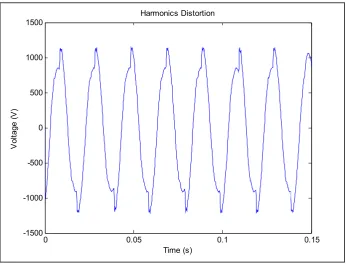
Harmonic distortion is found in both the voltage and the current waveform generated by electronic loads, also called non-linear loads drives. Harmonics distortion can cause the waveforms of the voltage supplied by the utility and the current utilized by consumers are perfect 50 Hz sine wave deformed and produce multiple frequencies other than the 50 Hz sine wave [18]. Figure 2.3 shows the harmonics distortion phenomena in power quality events.
0 0.05 0.1 0.15 -1500
-1000 -500 0 500 1000 1500
Time (s)
V
o
lt
a
g
e
(
V
)
[image:22.595.146.493.84.348.2]Harmonics Distortion
Figure 2.3: Harmonics Distortion Waveform
2.3.4 Transient
Figure 2.4: Transient Waveform
2.4 Conclusion
CHAPTER III
METHODOLOGY
3.1 Introduction
3.2 Software Development
The main purpose of this study is to construct a simple programming to detect and classify power quality events based on ANOVA and Wavelet Transform method using MATLAB software version 7.8. Figure 3.1 shows the flow chart for software development in this study.
3.2.1 Analysis Using RPM Power Analysis Software
The data contain the power quality events like voltage sags, voltage swell and harmonics distortion is identified and analyzed using the RPM Power Analysis Software. The data in this project is taken from 22 kV distribution systems in Skudai, Johor. By using the RPM Power Analysis Software the data of power quality events is identified in graph form. In order to analyzed the data, graph must be convert excel file (*.xls). This is because using the MATLAB software, all the data need to be analyzed must be in excel file (*.xls).
3.2.2 Steps to Converted Waveform to Excel File
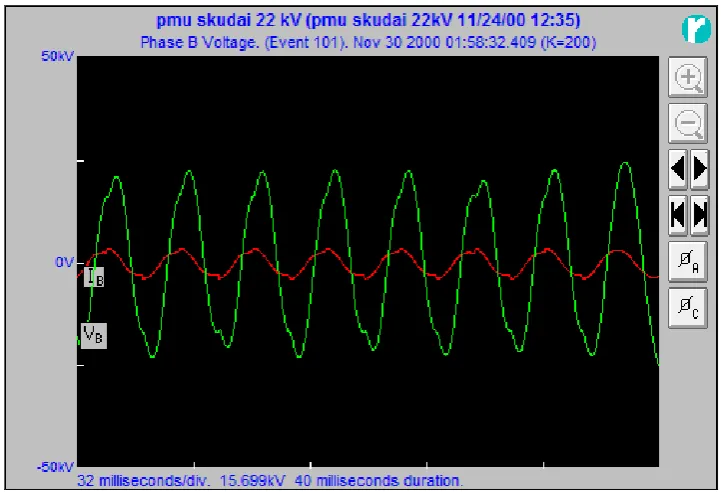
The first step to convert waveform to excel file is to identify the waveform that has power quality events using RPM Power Analysis software. The following Figure 3.2 and Figure 3.3 show the waveform of voltage sag and harmonics distortion power quality events that can detect with RPM Power Analysis software.
[image:26.595.138.499.493.739.2]Figure 3.2: The voltage sag problem from PMU Skudai, Johor 22 kV
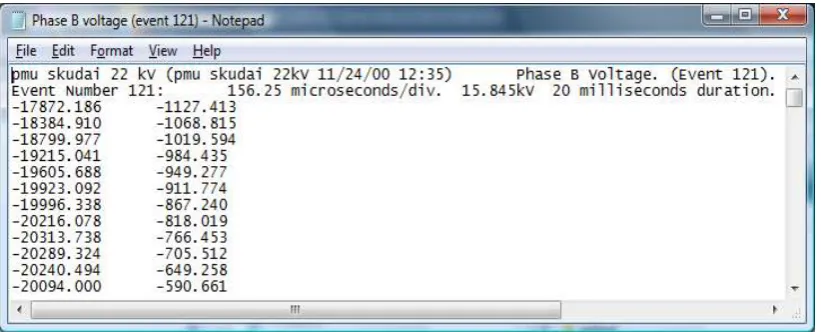
Figure 3.2 shows the voltage sag quality events from PMU Skudai, Johor for 22 kV distribution network and Figure 3.3 shows the harmonics distortion quality events from PMU Skudai, Johor 22 kV. Based on Figure 3.2 and Figure 3.3, they show very clear the waveforms that content the power quality event. By using this software only waveform can be detected several information like time, voltage or current cannot be detect. From this, the waveform must to convert in text file to get the data of power quality events. The following Figure 3.4 show the display when data is converted into text file (*.txt). In this text file, there are 1024 value is detected for one power quality events.
Figure 3.4: Data of power quality events in text file (*.txt)
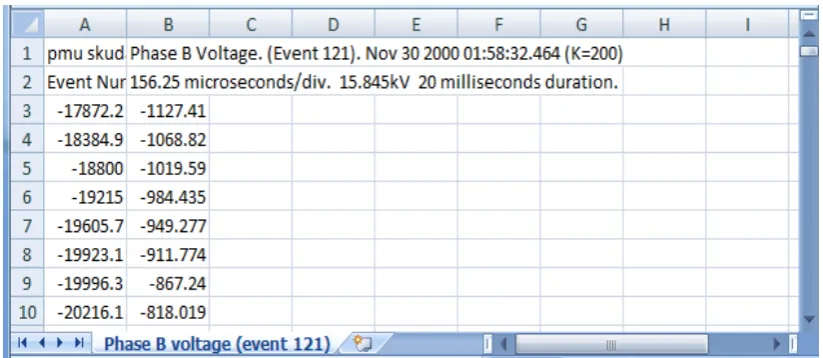
Figure 3.5: Data of power quality events in excel file (*.xls)
3.2.3 Application of the AOVA Method
ANOVA method is a statistic test for comparing the means of two or more independent random variables that follow a normal distribution [8]. ANOVA method is generally used to analyze the large data. In this project, there are 1024 value data in one PQ events. ANOVA is used as a statistical tool to show whether data from PQ events could be accounted for by the hypothesized factor.
Table 3.1: Single-factor ANOVA [20]
Source of Variation
Sum of Square (SS)
Degree of freedom (df)
Mean Square
(MS) F-Ratio
Regression SSR k MSR
k SSR = MSE MSR F =
Error SSE n-k-1 MSE
k n SSE = − − 1
Total SST n-1
3.2.4 Single-factor AOVA test
There are several step can use to test the data using single-factor ANOVA test. The following steps show the step of single-factor ANOVA test.
1. Propose null hypothesis H0 and alternative hypothesis H1 for the comparison of independent groups.
H0: µ1=µ2; PQ events is occur
2. Compute Mean Square for regression and Mean Square for error
a. Mean square for regression, MSR
k SSR
MSR= ...(4.1)
b. Mean square for error MSE:
1
− − =
k n
SSE
MSE ... (4.2)
3. Compute statistic F
MSE MSR
F = ... (4.3)
4. Determine significant level and select test statistics
Given a significant level α, the probability of F ≥ Fαis P{F≥Fα}=α. ANOVA returns P value for null hypothesis that means there are no PQ events. A low P value,
namely high F-statistic, indicates that there is evidence to reject the null hypothesis
H0 in favor of the alternative H1. Given a significant level of 0.05, any test resulting in a P value under 0.05 would be significant. Therefore, the null hypothesis would be
rejected in favor of the alternative hypothesis, means that the data have no PQ events.
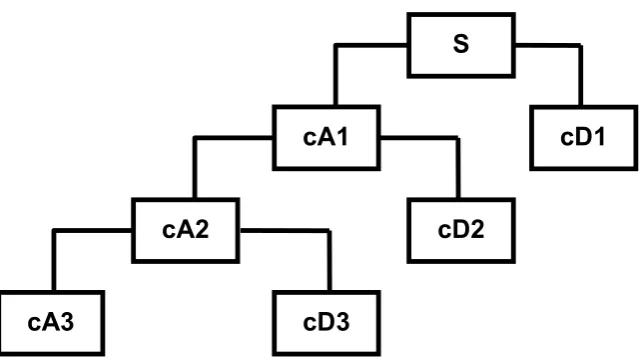
Wavelet Transform (WT) is a mathematical tool, which provides an automatic detection of Power Quality (PQ) events waveforms, especially using Daubechies family [17]. Several types of Wavelets Network algorithms have been considered for detection of power quality problems. But both time and frequency information are available in Multi Resolution Analysis (MRA). Wavelet will represent the signal as a sum of the wavelets at different location and scales and it also will transform the signal into different time domain [20]. Figure 3.8 shows the Multi-resolution Analysis
Figure 3.8: Multi-resolution Analysis
3.2.6 Discrete Wavelet Transform
S
cD
1
cA
1
cA
3
cA
2
cD
3
The discrete wavelet transform (DWT) is one of the three forms of wavelet transform. It moves a time domain discritized signal into its corresponding wavelet domain. This is done through a process called “sub-band codification”, which is done through digital filter techniques [22]. In power quality researches, however, more properties other than stationary are required, and thus make the DWT application more appropriate than Fourier transform [23].
3.3 Conclusion
CHAPTER IV
RESULT, AALYSIS AD DISCUSSIO
4.1 Introduction
REFERECES
[1] D. Saxena, K.S. Verma and S.N. Singh, (2010). “Power quality event classification: an overview and key issues”, International Journal of Engineering, Science and Technology, Vol. 2, No. 3, 2010, pp. 186-199
[2] Alok Thapar, Tapan Kumar Saha, Zhao Yang Dong, “Investigation of Power Quality Categorisation and Simulating It’s Impact on Sensetive Electronic Equipment”, University of Queensland, Australia
[3] Sudipta Nath, Arindam Dey and Abhijit Chakrabarti, (2009). “Detection of Power Quality Disturbances using Wavelet Transform”, World Academy of Science, Engineering and Technology 49
[4] Roger C. Dugan, Mark F. McGranaghan and H. Wayne Beaty, TK1001.D84 (1996). “Electrical Power Systems Quality”, Mc Graw-Hill. Pages 1-8 and 39-80.
[5] Muhammad Faizal bin Mohamad Yusof, (2009). “Voltage Sags Ride Through Mitigation Techniques”, UTM
[6] J. JIN and H. GUO, (2003). ANOVA Method for Variance Component
[7] Santoso, S., Powers, E. J. & Grady, W. M. (1997). Power Quality Disturbance Data Compression Using Wavelet Transform Methods. University of Texas: IEEE. pp. – 1250 – 1256.
[8] Shuang-Huan Zhan and Hong-Bin Zhang (2007). “Blind Steganalysis Using Wavelet Statistic and ANOVA”, Proceedings of the Sixth International Conference on Machine Learning and Cybernetics, Hong Kong
[9] Sharmeela, C., Mohan, M. R., Uma, G. & Baskaran, J. (2006). A Novel Detection and Classification Algorithm for Power Quality Disturbances Using Wavelets, American Journal of Applied Sciences, Vol. 3. No. 10, pp. 2049-2053.
[10] Norshafinash binti Saudin, (2007). Voltage Sags Mitigation Techniques Analysis, Master Thesis, UTM
[11] A. Mahmoudi, S. H. Hosseinian, A. Doroudi (2010). “ANew and Fast Method for Detection of Power Quality Disturbances Using Wavelet Transform”, Tehran, Iran, PQC2010-1217
[12] Claudio De Capua, Stefano De Falco, Annalisa Liccardo and Amelia Romeo, (2005). “Improvement of New Synthetic Power Quality Indexes: An Original Approach to Their Validation”, Technology Conference Ottawa, Canada
[13] Claudio De Capua, E. Remeo, A. Liccardo, (2004). “New Synthetic Power Quality Indexes and associated Measurement Techniques”, Proc. Of 13th IMEKO TC4 Symposium, Athens
![Table 3.1: Single-factor ANOVA [20]](https://thumb-us.123doks.com/thumbv2/123dok_us/8779246.903250/29.595.112.530.96.297/table-single-factor-anova.webp)