DEVELOPMENT OF BUILDING ASSESSMENT TOOL FOR EVALUATION OF
PURPOSE BUILT OFFICES LIFE CYCLE MANAGEMENT: BENCHMARKING AND
ASSESSMENT FOR ENVIRONMENTAL PERFORMANCE
M. F. KHAMIDI
Department of Construction and Real Estate Management, Universiti Tun Hussein Onn Malaysia (UTHM), 86400 Parit Raja, Batu Pahat, Johor, Malaysia
e-mail : [email protected]
Abstract
Malaysia has undergone rapid economic, social and environmental change over the last fifty years. Today, the progress is still continuing and to ensure that it is going in the right direction, the 9"1 Malaysia Plan (2006 - 2010) has outlined its Thrust 4 as "to improve the standard and sustainability of quality of life" among all Malaysians. The construction industry has a great impact not only to the Malaysian socioeconomic landscape but also to the environment. Since 1990s, it has steadily generated about 5 -10% of the total national Gross Domestic Product. However the global construction industry is also responsible for contributing 35 - 45% of CO2 emissions throughout the world. Studies conducted by the United Nations Environment Programme in early 2007 indicate that by 2020, major parts of CO2 emissions will come from the developing countries.
Sustainable Development is indeed a strategic necessity for the buildings and construction sector. This paper aims to address issues pertaining to sustainability in our built environment, that is the sustainable development (ecology) and its relations to sustainable growth (economic). The conceptual framework here is to assess environmental performance of existing building stocks in particular purpose built offices (PBOs) in major cities throughout Malaysia.
Since 1990's many built-environment related institutional body or NGOs around the world has been developing various assessment tools to evaluate various kind of buildings in a framework of Sustainable and Green Building agenda. Among the leading building assessment tools are currently used in United States (Leadership in Environmental and Energy Design - LEED), Canada (Green Building Tool GBTool), Japan (Comprehensive Assessment System for Building Environmental Efficiency -CASBEE) and Australia (GreenStar).
For Malaysia to stimulate market demand for high-performance buildings, provide 'branding', and transform the skills and knowledge of the sector as a whole, green building assessment tool and rating system is deemed necessary. This paper introduces Building Environmental Efficiency as Sustainable Tool for Assessment and Rating Initiative (BEESTARI), a research work that is currently in progress. With the mantra of "adopt and adapt", the four abovementioned building assessment tools is used as a point of reference to modify and develop Malaysia very own Building Assessment Tool. However, this paper focuses and analyse issues pertaining to the environmental considerations that are essential in determining the most suitable framework for the Malaysian case.
BEESTARI has a potential to act as an action checklist and quality rating tool that can be used by pertinent stakeholders throughout all four phases of a building life cycle. It is also hoped that the utilization of BEESTARI under the proposed Malaysia Green Building Council's leadership as part of the Malaysia Green Building Initiative is an innovative way for Malaysian construction industry to move forward in a sustainable manner. It is believed that BEESTARI would be able to set a benchmark for pertinent stakeholders in the building and construction sector to produce more buildings that are environmentally responsible, profitable and healthy places to live and work. It is hoped that PBOs stakeholders will instill a sense of urgency in holistic building process practices that will improve building performance by meeting specified standards to reduce the negative impact of buildings not only to the occupants but also to the environment where in the long run will be able to improve the overall Life Cycle Management of PBOs.
Keywords: Purpose Built Office, Building Assessment Tool, Environment, Life Cycle Management.
1. Introduction
not really a surprise to learn that the Malaysia Quality of Index from 1990 - 2004 marked that the environmental state of the nation is indeed declining. Since we know that the building and construction sector play a dominant role in the nation development, a concerted effort from the government in this particular sector is deemed necessary to rectify the problems.
2. The Malaysia Quality of Life
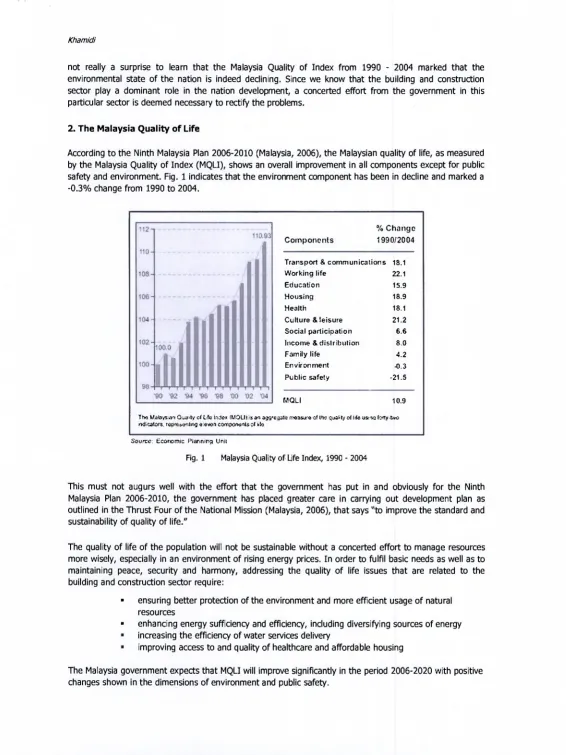
According to the Ninth Malaysia Plan 2006-2010 (Malaysia, 2006), the Malaysian quality of life, as measured by the Malaysia Quality of Index (MQLI), shows an overall improvement in all components except for public safety and environment. Fig. 1 indicates that the environment component has been in decline and marked a -0.3% change from 1990 to 2004.
Components
% Change 1990/2004
Transport & communications 18.1
Working life 22.1 Education 15.9 Housing 18.9 Health 18.1 Culture & leisure 21.2
Social participation 6.6 Income & distribution 8.0
Family life 4.2 Environment 4).3 Public safety -21.5
MQLI 10.9
The Ma&ysgtn Oua*ty of Life Index JMOth s an it^'c^Ui measure of the quafty of ifo forty-two heaters, rep«se!iteig «:««>!> cwromjsits of ife
[image:2.613.26.592.27.782.2]Sourcc: Economic Planning Unit
Fig. 1 Malaysia Quality of Life Index, 1990 - 2004
This must not augurs well with the effort that the government has put in and obviously for the Ninth Malaysia Plan 2006-2010, the government has placed greater care in carrying out development plan as outlined in the Thrust Four of the National Mission (Malaysia, 2006), that says "to improve the standard and sustainability of quality of life."
The quality of life of the population will not be sustainable without a concerted effort to manage resources more wisely, especially in an environment of rising energy prices. In order to fulfil basic needs as well as to maintaining peace, security and harmony, addressing the quality of life issues that are related to the building and construction sector require:
• ensuring better protection of the environment and more efficient usage of natural resources
• enhancing energy sufficiency and efficiency, including diversifying sources of energy increasing the efficiency of water services delivery
improving access to and quality of healthcare and affordable housing
3. Sustainable Development and the evolution of Malaysia's environmental policy
Hezri and Hasan (2006) states that changes in policy content and specific instruments can be distinguished in four main stages as a response of the Malaysian government to the challenges of environmental degradation from resource exploitation. The first stage from 1971 to 1976 is focussing more to tackle environmental problems and the need for policy action. One of the highlights is the formation of The Environmental Quality Act (EQA), passed in 1974, which focusing on pollution control, provides a legal framework at the federal level and is enforceable throughout the nation. This is followed by administrative innovations such as the creation of the Division of the Environment under the Ministry of Local Government and Housing in 1975 (moved to the Ministry of Science, Technology and the Environment in 1976) which later in 1983, is upgraded to a department status. Now, the Department of Environment is under the jurisdiction of Ministry of Natural Resources and Environment since March, 2004.
The Third Malaysia Plan 1976-1980 has dedicated 'development and environment' in one of its chapters (Malaysia, 1976). This reflects the overall policy that was to conserve environment in line with the progress of development as the ultimate objective. However, in a rapidly developing economy like Malaysia, it is indeed and uphill task to do so which is reflected in the second stage. In this stage, from 1977 to 1988, dubbed as 'crises and consolidation' stage by Hezri and Hasan (2006), saw a series of environmental crises that is later followed by legal and administrative consolidation. This stage also marked the beginning of environmentalism in Malaysia in the form of Consumer's Association of Penang as a pioneer in the movement. The highlight is definitely the recognition of environmental impact assessment (EIA) as a mandatory, mandating EIA for 19 categories of activities that are detrimental to the environment.
The publication of Our Common Future which is also known as the Brundtland Report (WCED, 1987), has set the momentum for a powerful concept termed as sustainable development which later embraced by Malaysia and lead the path for the third stage that spanned from 1989 to 2000. The highlight is of course various ad-hoc national policy processes that review among others policy framework for forestry and biodiversity.
The stage four, which is the most recent stage of policy response, from 2001 to 2005, concentrates more on the implementation of the concept of sustainable development by putting together strategy and indicators at the national level. The highlight is the formation of the new Ministry of Natural Resources and Environment that tackles policy fragmentation by combining the separate environmental portfolios under a single authority: forests; irrigation and drainage; wildlife; minerals; environmental conservation; marine parks; land management and administration; land surveying; and mapping. Energy and water resources are under the Ministry of Water, Energy and Communications and meanwhile, building and construction sector is under the Public Works Department of the Ministry of Works; and for housing, it is placed under the National Housing Department of the Ministry of Housing and Local Government.
The last two stages saw government initiatives to embed and create sustainable development principles and framework in various environmental portfolios. Table 1 shows that among the considered portfolios are renewable energy, forestry, water resources, industrial energy efficiency and the general national policy on environment.
It is understood that most of the initiatives and programmes concentrate more on achieving energy efficiency and eventually reducing C02 emissions, however there is still no concerted effort from the
Table 1. Summary of Malaysian Government initiatives in various environmental portfolios
Initiative Name Environmental
Portfolio
Accountable Ministry/Agency
Period/Year
1. National Policy on Environment Environment
in general
Bureau of Science, Energy & Technology (BEST), Ministry of
Science, Technology & Environment (MOSTE), Department of Environment (DOE) Started 1994; released in October
2002
2. Sustainable Forest Management
(SFM)
forestry Ministry of Primary
Industries, Malaysia Timber Council, National Committee on SFM
1994
3. Biomass for electricity generation Renewable energy Ministry of Water,
Energy & Communication,
Pusat Tenaga Malaysia
2001 (8th Malaysia
Plan)
4. Malaysian Industrial Energy
Efficiency Improvement Programme (MIEEIP)
C 0 2 reduction
(GHG emissions)
Ministry of Water, Energy & Communication,
Pusat Tenaga Malaysia
1999 ~ 2004;
extended until June 2007
5. Malaysia Building Integrated
Photovoltaic (BIPV) Technology Application Project (Suria 1000)
Renewable energy and C 0 2 reduction
Ministry of Water, Energy & Communication,
Pusat Tenaga Malaysia
2006 ~ 2010
(9th Malaysia Plan)
6. Building Rainwater Collection
(Harvesting)
Water resources Prime Minister
Department & Office, Ministry of
Housing & Local Authority
3. The building and construction sector - a key sector for Sustainable Development
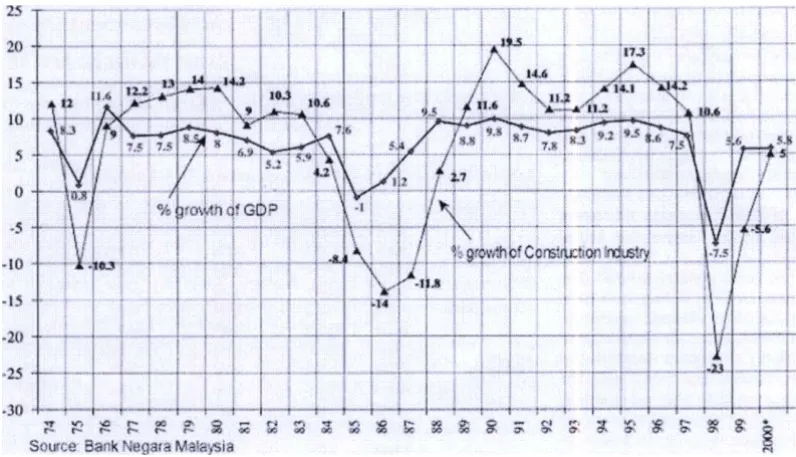
[image:5.615.109.507.189.418.2]Since 1990s, the building and construction sector has steadily generated about 5 - 10% of the total national Gross Domestic Product (GDP). Fig. 2 clearly illustrates that economic growth and the construction growth move in the same trajectory; hence they are inter-dependent to each other. The building and construction sector typically provides 5 - 10% of employment at national level.
Fig. 2 National GDP and Construction GDP, 1974 - 2000
It is said that building and construction sector globally is responsible for contributing 35 - 45% of C02
emissions that derive from the consumption of 30 - 40% of energy in buildings, worldwide (UNEP, 2007). A simple analogy is that the C02 emissions of any 18-storey modern high rise in Kuala Lumpur, Singapore or
Hong Kong is equivalent to about 900 automobiles output (Hong, 2007). Due to population growth, economic development and rapid urbanization, construction activities in developing countries are now more intense than ever. United Nations Environment Programme (UNEP, 2007) estimates that after 2020 major parts of C02 emissions will come from developing countries. This scenario will definitely create more
opportunities in implementing sustainable development principles in the building and construction sector throughout the world.
Awareness on sustainable development in the building and construction sector is low because it is seen as a relatively new concept in the developing countries like Malaysia (Shafii, 2005). However, generally today, there is an increase in awareness on sustainable building and construction (SBC) although it is not across the whole spectrum of the building and construction sector. One of the reasons is that sustainable building
projects are viewed as 'special' and 'cutting-edge' rather than the 'norm'.
4. Introducing Building Environmental Efficiency as Sustainable Tool for Assessment and Rating Initiative (BEESTARI)
A holistic approach in constructing new building must be determined by taking into account the five main phases involved, i.e. pre-design; design; construction and commissioning; operations; and post-occupancy (demolition or refurbishment). BEESTARI has a potential to act as an action checklist and quality rating tool that can be used by pertinent stakeholders throughout all four phases of a building life cycle as shown in Fig. 3 below.
P E R T I N E N T S T A K E H O L D E R S
Developer, Planner, Architect, Engineer, Contract Manager etc.
Developer, Contractor, Sub-Contractor, Material Supplier etc.
Owner, Tenant, Facilities Manager, |
Maintenance Contractor etc.
[image:6.615.109.495.219.386.2]Owner, Tenant, Demolition Contractor or Refurbisher etc.
Fig. 3 Five phases of building process and pertinent stakeholders involved
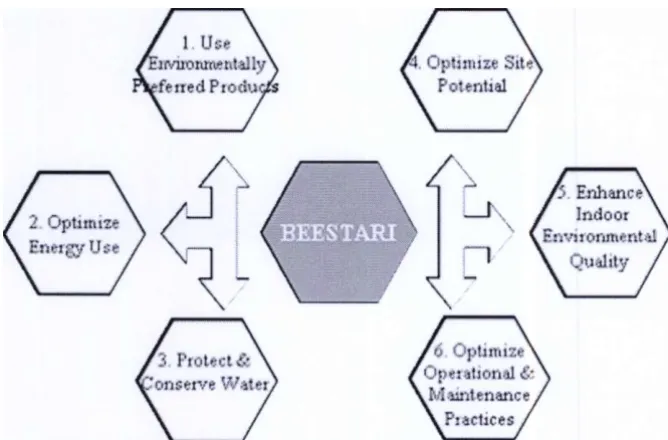
[image:6.615.135.469.491.711.2]After 10 months of intensive and extensive research, BEESTARI has identified relevant dimensions, attributes, sub-attributes and parameters based on the reference of four prominent building assessment tool currently being used in the United States (Leadership in Environmental and Energy Design - LEED), Canada (Green Building Tool - GBTool), Japan (Comprehensive Assessment System for Building Environmental Efficiency - CASBEE) and Australia (GreenStar). The six main dimensions are illustrated in Fig. 4.
The next phase of the research is to conduct a few pilot studies among existing stocks of purpose built offices in major cities in Peninsular Malaysia such as Kuala Lumpur and Johor Bahru based on BEESTARI. The outcome of the pilot study will be detrimental to benchmark the current status of our buildings from sustainable point of view and also to gauge the acceptance level among stakeholders in the building and construction sector in Malaysia. This outcome will also feed us with relevant data and information for the rating exercise among PBOs in Malaysia. However how the rating is going to be given out is yet to be determined.
It is hoped that the utilization of BEESTARI under the leadership of the proposed Malaysian Green Building Council as part of the Malaysia Green Building Initiative is an innovative way for Malaysian building and construction sector to move forward in a more sustainable manner.
Conclusions
The establishment of Malaysia Green Building Initiative under the leadership of the Malaysia Green Building Council could play a positive role to rectify issues and problems surrounding the quality state of our environment today. Through market mechanism, Malaysia's building assessment tool and rating system (BEESTARI) should be adopted by the pertinent stakeholders in the building and construction sector. It is believed that the utilization of BEESTARI can set a benchmark for pertinent stakeholders in the building and construction sector to produce more buildings that are environmentally responsible, profitable and healthy places to live and work.
Acknowledgements
The author of this paper wish to thank you many individuals and parties that either directly or indirectly have played their part in the execution of this research project in particular to the Ministry of Higher Education Malaysia for granting us this Fundamental Research Grant Scheme (FRGS) and Research Management and Innovation Centre of Universiti Tun Hussein Onn Malaysia; and last but not least to fellow co-researchers and research assistants at the Department of Construction and Real Estate Management, Faculty of Technology Management, Universiti Tun Hussein Onn Malaysia.
References
Hezri, A.A. & Hasan, M.N., 2006. Towards Sustainable Development? The evolution of environmental policy in Malaysia. Natural Resource Forum, 30: 37 - 50.
Hong, W., 2007. Trends in Asia's Building Energy Efficiency Policies. Paper presented at International Conference on Climate Change. 2 9t h- 31st May 2007. Hong Kong.
Retrieved online at http://www.hkie.orq.hk/iccc2007/docs/PDF/Qral%20Papers/H04.pdf Malaysia, 1976. The Third Malaysia Plan 1976-1980. Government Printer, Kuala Lumpur. Malaysia, 2006. The Ninth Malaysia Plan 2006-2010. Government Printer, Kuala Lumpur.
Shafii, F., 2005. Report: The Conference on Sustainable Building South-East Asia (SB04SEA): Outcomes and Recommendations. Kuala Lumpur. Retrieved online at http://www.cibklutm.com/SBQ4SEA/SB04SEA-OUTCOMES.pdf
UNEP, 2007. Buildings And Climate Change: Status, Challenges and Opportunities. United Nations Environment Programme - Sustainable Building and Construction Initiative.
WCED, 1987. Our Common Future. World Commission on Environmental and Development. Oxford University Press, Oxford.