Enhancing dynamic Source Routing (DSR) Protocol
for Vehicular Ad-hoc network through Ant Colony
Optimization
Deepshikha Dhiman1, Praveen Sharma 2
M-Tech Student1, Assit. Prof. 2 & Department of CSE & NGF College of Engineering &Technology Palwal, Haryana, India
ABSTRACT
Vehicular Ad hoc Network (VANET) is the major area in ad hoc Network. The network is built with vehicle and rode side unit. The routing protocol is very helpful to transfer the data from source to destination node. The dynamic routing protocol is reactive on demand routing protocol which utilizes source routing and manage routes lively. It uses two phases: route discovery and route maintenance. DSR is the routing protocol in which correspondent find the right order of nodes of which a packet is transmitted. In this paper, to examine the several routes among nodes in the network ant colony optimization algorithm is employed. The performance analysis of DSR routing protocol is examined by using ACO with various QoS parameters i.e. throughput, delay, packet delivery ratio etc.
I. INTRODUCTION
A Vehicular Ad-Hoc Network or VANET is a technique that has mobile vehicles as nodes in a network for generating a mobile network. We can say that VANET turns each and every vehicle into a wireless node, permitting cars to link to one another which are 100-300 meters apart and, in turn, generate a broad range of network. As cars fall out because of signal range and drop out of the available network, other cars can join in to linked vehicles to one another so a mobile Internet can be produced. It is considered that the first systems in which it is combined are police and fire vehicles to interact with one another to offer safety. It is a term which is utilized to explain the spontaneous ad hoc network that is built over vehicles travelling on the roads. Vehicular networks are very fast evolving for deploying and developing new and conventional applications. It is featured by frequently changing
configuration, high mobility, and ephemeral, one-time communications. The challenges in Vehicular Ad-hoc Networks are the communication connection lifetime is very short and less path redundancy available; unpredictable node density is there, strict application needs build routing and network quite
challenging. Vehicular Ad-hoc networks are
complicated to manage because of high speed between vehicles and result is configuration changes. No significant power restraints, particularly in sensors the restricted battery power is a challenge in VANET. Networking challenges in VANET is a significant field of work for routing security efficiency and collision avoidance. Intelligent Transportation system faces several challenges in routing, application, power management etc. There
are different challenges in communication
applications for road obstacle warning, collision warning, cooperative driving, lane change assistance and intersection collision warning etc. Vehicular Ad-hoc networks nodes are a dynamic behavior and challenging for discovering and managing routes. In Vehicular Ad-hoc networks, several protocols were introduced for routing and they offers routing the different messages for different objectives. In Vehicular Ad-hoc networks there are various routing techniques have been described depending on architecture and requirement of applications or scenarios. In VANET, the routing protocols are classified into five types: Topology, Position, broadcasting, Clustering, and Geo cast routing protocol. These protocols are featured depending on area application where they are most appropriate. In VANET routing protocols, primarily they are categorized in two kinds first is routing information
and the other is transmission techniques.
protocols delivery of information from a source node to a destination node are categorized in four kinds: unicast, broadcast, multicast and geocast. Where geocast is a particular kind of multicast transmission is utilized by the protocols to obtain the node location and neighbor nodes. Routing information: It is
utilized in packet forwarding; it primarily
concentrates on graphic-based and topology based routing. It is further categorized as position based and topology based protocols. In Position based routing protocol, source forwards data packet to destination node utilizing its geographic process instead of its network address. In topology based routing protocol , it utilizes connection information which is saved in routing table as a bases to send packets They are further categorized into reactive and proactive protocols. The main protocol employed is AODV, DSR, DSV and other protocols.
II. OVERVIEW OF ANT COLONY
OPTIMIZATION (ACO)
Artificial ants utilized in ACO are stochastic solution construction techniques that probabilistically make a solution by iteratively adding Solution components to partial solutions by taking into consideration (i) Heuristic information on the problem in-stance being solved, if existed, and (ii) (artificial) pheromone trails which change dynamically at run-time to resemble the agents’ acquired search experience. [5][6] The interpretation of ACO as an extension of construction heuristics is appealing due to various reasons. A stochastic component in ACO permits the ants to make a broad variety of several solutions and thus explore a much larger no. of solutions than greedy heuristics. Simultaneously, the usage of heuristic information, which is readily existed for several problems, can the ants towards the most promising solutions. More significant, the ants’ search experi-ence can be utilized to affect in away reminiscent of reinforcement learning the solution made in future algorithm iterations. In addition to, the usage of a colony of ants can provide the algorithm increased robustness and in several ACO applications the collective communication of a population of agents Is required to effectively solve a issue. The applications domain of ACO algorithms is vast. In principle, ACO can be used to any discrete optimization issue for which some solution construction technique can be conceived.
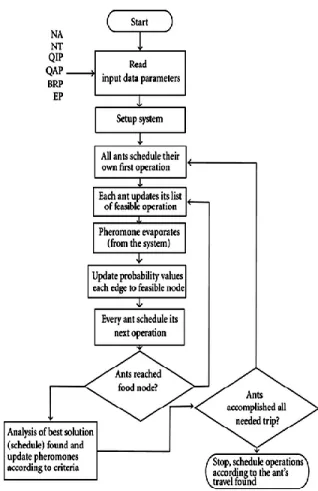
Figure 2: Flow chart of Ant colony optimization algorithm.
Fig 2 represents the ACO algorithm, as all ants in the system scheduled their own first operation. When ants move along the route to discover the food from source node to destination node, all ants update their list of viable operation in the search.
• In above fig 3 from left to right explained as follows-
• Two ants begin with equal possibility of going on either path
• The ant on shorter route has a shorter to-and fro time from its nest to food.
• The pheromone density on shortest path is higher due to two passes by the ants in comparison of the one by other.
• The next ant considers the shortest route.
• Over much iteration more ants start the path with higher pheromone, thus further reinforcing it. • After some time, the shorter path is almost exclusively utilized.
• The ants capacity is to self classify is based on four significant beliefs. They are positive feedback,
negative feedback, randomness and multiple
communications.
• Positive feedback –utilized to look up the good result. When ants travel from one node to another, the pheromone concentration along that trail increases. This supports other ants to travel in this route. • Negative feedback –utilized to damage bad solution. It can be completed by pheromone concentration decay with value to time. The decay rate is trouble definite. Low decay rate encourages the bad result not being damaged for longer time and higher decay rate destroys good solution early. • Randomness –Path to be considered by ant is entirely random thus there is probability of generation of new solutions.
•Multiple interactions: The solution is determined by dealings of several agents, so one ant cannot find the food, as the pheromone would decay. Thus further ants can search food faster in food searching mechanism [4].
III. EXPERIMENTAL RESULTS Simulation Setup
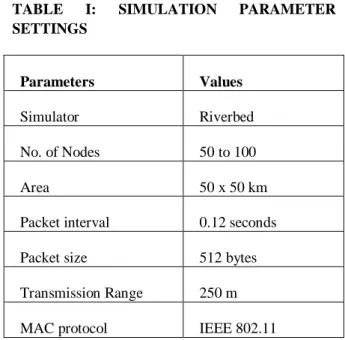
The simulation of DSR Protocol is done in the area which is square of 50 x 50 km using Riverbed. Vehicles are able to communicate with one to many utilizing the IEEE 802.11 MAC layer. The simulation is done for the nodes ranging from 50-100 nodes for several QoS parameters i.e. jitter, delay, energy consumption and routing load of the network in case of DSR and ACO_DSR.
The simulation parameter settings are given in following table.
TABLE I: SIMULATION PARAMETER
SETTINGS
Parameters Values
Simulator Riverbed
No. of Nodes 50 to 100
Area 50 x 50 km
Packet interval 0.12 seconds
Packet size 512 bytes
Transmission Range 250 m
MAC protocol IEEE 802.11
Simulation Metrics
The analysis is performed based on following various parameters
• Delay: This metric represent the time necessary for a packet to go through the network from source node to destination node. It describes the latency created by the routing technique.
• Jitter: It is the deviation in the time of packets reaching, caused by timing drift, network congestion or route changes.
• Energy consumption: Amount of energy consumed in a system or process.
• Routing load: It is computed by dividing the total no. of routing packets forwarded by the total no. of data packets obtained.
IV. SIMULATION RESULTS
The measurement of DSR routing protocol and its optimization utilizing ant colony algorithm is explained in this. Fig 4 illustrates the delay of ACO_DSR and DSR. ACO_DSR generates better results as compared to other routing protocols. This is due to the Ant colony technique in this the shortest path once discovered then all the routing that is transfer of packets take place on that path which overcomes the route finding process. So here the ACO_DSR delay is less than DSR.
Figure 4. Delay: ACO_DSR Vs DSR Fig 5 represents the routing load of DSR and ACO_DSR. ACO_DSR and DSR are pure reactive protocol with no zone concept. When the network size increases a vehicle has more choices for routes to destination node which proves the process to be multi path form. As there is using an ant colony procedure to optimize the protocol these initially represents a high result in comparison of other protocols which is indicated below. So the ACO_DSR has less routing load in comparison of DSR and same path searching takes place in reactive routing protocol.
Figure 5. Routing Load: ACO_DSR vs DSR
Fig 6 depicts the analysis of percentage of packet delivery ratio. As a result the packet delivery ratio increase as no. of nodes increases. The packet delivery ratio increases in the ant colony optimization mechanism.
Figure 6: Packet delivery ratio ACO_DSR vs DSR V. CONCLUSION
In this paper we introduce a swarm based optimization mechanism to enhance the DSR protocol performance for vehicular ad hoc network. DSR is appropriate for VANET due to its self organ-izing and maintenance characteristics. As explained in the results, ant colony optimization method works properly for vehicular ad hoc network and enhance the several quality of service parameters i.e. jitter, end to end delay, energy consumption in the network, packet delivery ratio and routing load. The DSR routing protocol provides excellent performance utilizing the ACO algorithm for multi hop wireless adhoc network, so using ACO with DSR will be flexible and optimal for data packages routing in vehicular ad-hoc networks (VANETs). This work concentrates and outline on the usage of ACO in the VANET routing algorithms.
REFERENCES
[1] Ahyoung Lee, Charlemagne G. Laviña, Jonathan Caballero, Ilkyeun Ra,”Performance Analysis of Ad
Hoc Routing Protocols based on Selective
Forwarding Node Algorithms”, International 0 0.002 0.004 0.006 0.008 0.01 0.012 6 m 12 m 18 m 24 m 30 m d el ay (s ec .) -->
Simulation time (minutes) -->
Delay (sec.)
ACO DSR DSR 0 20000 40000 60000 80000 100000 120000 140000 160000 6 m 12 m 18 m 24 m 30 m N e tw o rk lo ad (b it s/s ec .)Simulation time (minutes) --> Network load (bits/sec.)
ACO DSR DSR 0 500000 1000000 1500000 2000000 2500000 6 m 12 m 18 m 24 m 30 m T h ro u gh p u t (b it s/s ec .) -->
Simulation time (minutes) -->
PDR (bits/sec.)
ACO DSR DSR
Conference on Information Science & Applications (ICISA),IEEE, 2013.
[2]Bhushan Vidhale, S.S. Dorle, “Performance
Analysis of Routing Protocols in Realistic
Environment for Vehicular Ad Hoc Networks”, 21st
International Conference on Systems Engineering, IEEE, pp. 267-272, 2011.
[3]Arzoo Dahiya and Dr. R.K. Chauhan,
“Experiment Analysis of AODV and DSR with varying Vehicle Mobility And Density in VANET Scenario”, International Journal of Network Security
& Its Applications (IJNSA), Vol.5, No.4, pp. 65-70,
July 2013.
[4] Shouzhi Xu,Pengfei Guo, Bo Xu, Huan Zhou, “QoS Evaluation of VANET Routing Protocols”,
Journal Of Networks, Vol. 8, No. 1, pp. 132-139,
January 2013.
[5] Jing Zuo, Yuhao Wang , Yuan Liu and Yan Zhang, ”Performance Evaluation of Routing Protocol in VANET with Vehicle-node Density”, IEEE, pp. 95-101, 2010.
[6] Himanshu Saini, Rajarshi Mahapatra,
“Implementation and Performance Analysis of AODV Routing Protocol in VANETs”, International
Journal of Emerging Science and Engineering (IJESE) ISSN: 2319–6378, Volume-2, Issue-3,
January 2014.
[7]Kahina Ait Ali, Oumaya Baala, Alexandre Caminada, “Routing Mechanisms Analysis in Vehicular City Environment”,IEEE, 2011.
[8] Radityo Anggoro, Teruaki Kitasuka, Ryoji Nakamura, Masayoshi Aritsugi ,“Performance
Evaluation of AODV and AOMDV with
Probabilistic Relay in VANET Environments”,IEEE
Third International Conference on Networking and Computing, pp. 259-263, 2012.
[9] Haiqing Liu, Licai Yang, Yao Zhang, “Improved AODV routing protocol based on restricted broadcasting by communication zones in large- scale VANET”, Springer, pp. 857-872, 2015.
[10]Yatendra Mohan Sharma and Saurabh
Mukherjee,“Comparative Performance Exploration Of AODV, DSDV & DSR Routing Protocol In Cluster Based VANET Environment”, International
Journal of Advances in Engineering & Technology,
Vol. 4, Issue 2, pp. 120-127, Sept 2012.
[11] Tajinder Kaur, A. K. Verma, “Simulation and Analysis of AODV routing protocol in VANETs”, International Journal of Soft Computing and Engineering (IJSCE) ISSN: 2231-2307, Volume-2, Issue-3, July 2012.
[12] C. Perkins, E. Belding-Royer, and S. Das, “RFC 3561-ad hoc on-demand distance vector (AODV) routing,” Internet RFCs, pp. 1–38, 2003.
[13] Amirhossein Moravejosharieh, Hero Modares, Rosli Salleh and Ehsan Mostajeran, “Performance Analysis of AODV, AOMDV, DSR, DSDV Routing Protocols in Vehicular Ad Hoc Network”, International Science Congress Association, Vol. 2(7), 66-73, July (2013).
[14] Himanshu Saini, Rajarshi Mahapatra,
“Implementation and Performance Analysis of AODV Routing Protocol in VANETs”, International
Journal of Emerging Science and Engineering (IJESE) ISSN: 2319–6378, Volume-2, Issue-3, pp.
24-29, January 2014.
[15] Ammar Odeh, Eman AbdelFattah and Muneer Alshowkan, “Performance Evaluation Of AODV AND DSR Routing Protocols In MANET Networks”,
International Journal of Distributed and Parallel Systems (IJDPS) Vol.3, No.4, pp. 13-22, July 2012.
[16] Rahul Kumar and Monika Sachdeva,
“Performance Evaluation of AODV Protocol in MANET Using OPNET 2”, International Conference
on Communication, Computing & Systems (ICCCS),
pp. 228-232, 2014.
[17] Thodeti Srikanth, Dr.V.B.Narsimha,
“Simulation-based approach to performance study of routing protocols in MANETs and ad-hoc Networks”,
IJCSNS International Journal of Computer Science and Network Security,Vol. 11 No.9, pp. 111-115,
September 2011.
[18] Meenakshi Tripathi, M. S. Gaur, Vijay Laxmi, “Analysis of effects of Mobility and Active Route Timeout between Sensor Nodes in Wireless Sensor Networks”, Special Issue of International Journal of
Computer Applications on Wireless Communication and Mobile Networks, No. 5, pp. 22-25, Jan 2012.
[19] Ashutosh Lanjewar, Neelesh Gupta,
“Optimizing Cost, Delay, Packet Loss and Network Load in AODV Routing Protocol”, (IJCSIS)
International Journal of Computer Science and