319
©IJRASET: All Rights are Reserved
Numerical Analysis of Slope Stability- A
Parametric Study
Anand Hulagabali1, Dumesa Gudissa2, Woyesa Ararsa3
1, 2, 3
Civil Engineering Department, Institute of Technology, Ambo University
Abstract: This research is contributing towards the community by suggesting very economical solution to minimize the landslide disaster. The main objectives of present study are, i) to carry out the parametric study on the behavior of slope for different cohesion, angle of internal friction, slope angle, unit weight and height of the slope. ii) to review past and current works in regards to Numerical and experimental modeling of slope. Methodology: For modeling of slope stability with different parameters, “GEO STUDIO – 2012” is used. Many parameters are varied in this analysis. Results and Conclusions: i) Initially, slope was modeled for different parametric studies. It was observed that, as the cohesion, angle of internal friction increased, factor of safety increased. ii) Also, when the slope angle and slope height was increased, factory of safety was decreased, leading to failure of slope tremendously. iii) We also observed that, change in unit weight of soil did not affect the stability of slope, as the shear strength of soil totally depends upon shear parameters such as cohesion and angle of internal friction.
Keywords: Landslides, Slope Stability, Cohesion, Angle of Internal Friction, Parametric Study
I. INTRODUCTION
Slope is a measure of the steepness of a line, or a section of a line, connecting two points and a surface that lies at an angle to the horizontal so that some points on it are higher than others at an angle to a horizontal surface of 30°or part of the side of a hill or mountain. Slope can be defined as the angle, inclination, steepness, or gradient of a straight line. Slope often is used to describe the steepness of the ground's surface. Slope can be measured as the rise (the increase in elevation in some unit of measure) over the run (the horizontal distance measured in the same units as the rise). Many geographic information systems (GIS) can analyze digital elevation data (elevation points, contour lines, digital elevation models, etc.) and derive both slope and aspect data sets. Slope is an important landscape metric.
A. Slope stability Analysis
Slope stability analysis is performed to assess the safe design of a human-made or natural slope (e.g. embankments, road cuts, open-pit mining, excavations, landfills etc.) and the equilibrium conditions. Slope stability is the resistance of inclined surface to failure by sliding or collapsing.
The main objectives of slope stability analysis are finding endangered areas, investigation of potential failure mechanisms, determination of the slope sensitivity to different triggering mechanisms, designing of optimal slopes with regard to safety, reliability and economics, designing possible remedial measures, e.g. barriers and stabilization. Successful design of the slope requires geological information and site characteristics, e.g. properties of soil/rock mass, slope geometry, groundwater conditions, alternation of materials by faulting, joint or discontinuity systems, movements and tension in joints, earthquake activity etc. The presence of water has a detrimental effect on slope stability.
Water pressure acting in the pore spaces, fractures or other discontinuities in the materials that make up the pit slope will reduce the strength of those materials.
Choice of correct analysis technique depends on both site conditions and the potential mode of failure, with careful consideration being given to the varying strengths, weaknesses and limitations inherent in each methodology. Before the computer age stability analysis was performed graphically or by using a hand-held calculator.
Today engineers have a lot of possibilities to use analysis software, ranges from simple limit equilibrium techniques through to computational limit analysis approaches (e.g. Finite element limit analysis, Discontinuity layout optimization) to complex and sophisticated numerical solutions (finite-/distinct-element codes).
320
©IJRASET: All Rights are Reserved
currently in use (Bishop, Spencer, etc.) may differ considerably. In addition, the use of the risk assessment concept is increasing today. Risk assessment is concerned with both the consequence of slope failure and the probability of failure (both require an understanding of the failure mechanism). Within the last decade (2003) Slope Stability Radar has been developed to remotely scan a rock slope to monitor the spatial deformation of the face. Small movements of a rough wall can be detected with sub-millimeter accuracy by using inter geometry techniques.
II. HIGHLIGHTSOFPREVIOUSRESEARCH
Researcher Year Content
Ali Fawaz et. all 2014 Slope stability analysis carried out to landslide that occurred during road excavation work in Lebanon using PLAXIS • dry season stable
• presence of layers with varying permeability • triggering factor: rainfall
• surface drainage
M. Rabie 2014 Focused on advantages of FE using PLAXIS in the analysis of slope stability problems over traditional LEM • no assumption of failure surface
• stresses and strains • LEM are conservative • Saturated and unsaturated • FEM overestimated FOS
Dino Zuljani et.al. 2015 Parametric analysis of anchored bored pile wall as a part of landslide stabilization measures on the Grohovo road landslide, Croatia using Slide
• 4 bore holes (inclinometers, piezometer) • max movement of 4mm towards toe • high water levels even in dry season
• remedies: anchored bored pile wall, lowering GWT Debarghya
Chakraborty and Deepankar Choudhury
2009 Static and seismic analysis for a tailings earthen dam using FLAC, TALREN 4, SEEP/W and SLOPE/W • min FOS in static condition=1.22 (FLAC)
• min FOS in seismic condition=0.89 (Talren-4) • kh=0.15 kv=0.075
Khadija Baba et. all 2012 stability was applied to a railway slope in Moroccon, of complex geometry, composed of alternating sandstone and marls using FEM and LEM
• PLAXIS, GEO-SLOPE, and TALREN • no significant difference
• advantages of FEM
• FOS values of FEM are nearest to Bishop
Demin Xue et. all 2013 Numerical modeling of giant Badu landslide that reactivated by excavation in China using FLAC • Initially activated in 1994
• 76 piles with surface drainage • reactivated in 1997 due to heavy rainfall
• Two grading retaining walls with surface & underground drainage Ammar Rouaiguia
and Mohammed A. Dahim
2013 Influence of pore water pressure, cohesion, internal friction angle, and unit weight of upper soil layer on the factor of safety for slope stability problems using GEO-SLOPE
• FOS varies linearly with increase in cohesion, decrease in unit weight, pore water pressure • FOS varies non linearly with increase in φ
N. Hamdhan et. all 2013 Stability analysis of 11-m-high cut slope in Zaoyang, Hubei, China, subjected to rainfall infiltration. • PLAXIS
• Infiltration caused decrease in metric suction, increase in moisture content & hydraulic conductivity • Displacements using FEM were more close to field conditions
Latifa Ouadif, et. al 2012 Stability study of this highway fill and compared the calculation results of the safety factor using LEM (GEO slope) & FEM (PLAXIS).
• No significant difference in dry & saturation
• Under seismic condition reduction in FOS using LEM is 30% • Using FEM it does not exceed 14%
Ahmad Safuan A Rashid
2013 Assessment of soil nailing performance by using FEM (PLAXIS) & FDM (FLAC) • Total excavation of 12m in 6 steps
• FOS was higher for 1st & 2nd step by FDM
321
©IJRASET: All Rights are Reserved
III.PARAMETRICSTUDYOFSLOPESTABILITY
Modeling of slope stability with different parameters using “GEO STUDIO SOFTWARE” The factor of safety is defined as the ratio of the available shear strength to the shear stress acting on the plane. The slope stability was carried out using Limit equilibrium analysis. Limit Equilibrium Method
1) Limit equilibrium investigate the equilibrium of soil mass tending to slide down under the influence of gravity
2) LEM is based on comparison of forces resisting of the mass and those that causing instability (disturbing forces).
3) Thus slope stability is usually expressed in terms of an index, most commonly the factor of safety, which is usually defined as
4) If FS = 1.5, then the slope is in critical condition.
5) If FS>1.5 the slope is stable
6) If FS<1.5 the slope failure is occurring
At the time of failure, the shear strength of the soil is fully mobilized along the failure plane.
A. Behavior Of Slope With Respect To Cohesion Of Soil
TABLE 3.1
Parameters adopted in model for effect of cohesion studies Parameters adopted
in model
Values
Cohesion (kN/m2) 0, 25, 50, 75, 100
Angle of Internal Friction 350
Unit Weight (kN/m3) 19
Height of Slope (m) 30 m (Approx.)
Angle of Slope (Degrees) 60
Fig. 1 Slope stability model for cohesion of soil 100 KN/m2 Fig. 2 Factor of Safety variation w.r.t. cohesion of soil Factor of safety has direct proportional to the cohesion of soil, as cohesion of soil increases, factor of safety of slope increases.
[image:3.612.69.554.298.563.2]B. Behavior Of Slope With Respect To Angle Of Internal Friction Of Soil
TABLE II
Parameters adopted in model for effect of angle of internal friction studies
Parameters adopted in model Values
Cohesion (kN/m2) 0
Angle of Internal Friction 24, 28, 32, 36, 40
Unit Weight (kN/m3) 19
Height of Slope (m) 30 m (Approx.)
[image:3.612.161.453.635.722.2]322
©IJRASET: All Rights are Reserved
Fig. 3 Slope stability model for angle of internal friction of soil 400 Fig. 4 Factor of Safety variation w.r.t. friction angle The angle of internal friction has directly proportional to the factor of safety, as angle of internal friction increases, the factor of
safety also increases.
C. Behavior Of Slope With Respect To Unit Weight Of Soil
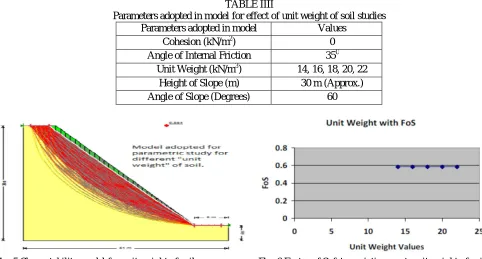
TABLE IIII
Parameters adopted in model for effect of unit weight of soil studies
Parameters adopted in model Values
Cohesion (kN/m2) 0
Angle of Internal Friction 350
Unit Weight (kN/m3) 14, 16, 18, 20, 22
Height of Slope (m) 30 m (Approx.)
[image:4.612.52.547.56.229.2]Angle of Slope (Degrees) 60
Fig. 5 Slope stability model for unit weight of soil Fig. 6 Factor of Safety variation w.r.t. unit weight of soil
Unit weight of soil does not have influence on slope instability. Because, in analysis of slope stability, strength of soil depends upon soil shear parameters such as, cohesion and angle of internal friction.
D. Behavior Of Slope With Respect To Height Of Slope
TABLE IIIV
Parameters adopted in model for effect height of slope studies Parameters adopted in model Values
Cohesion (kN/m2) 0
Angle of Internal Friction 35
Unit Weight (kN/m3) 19
Height of Slope (m) 10, 20, 30, 40, 52
[image:4.612.57.539.295.554.2]323
[image:5.612.53.544.60.228.2]©IJRASET: All Rights are Reserved
Fig. 7 Slope stability model for unit weight of soil Fig. 8 Factor of Safety variation w.r.t. unit weight of soil
Factor of safety has inversely proportional to the height of slope of soil If height of the slope increases, the factor of safety decrease, because soil becomes unstable as shear strength of the soil reduces, as particles moves away from each other.
E. Behavior Of Slope With Respect To Slope Angle
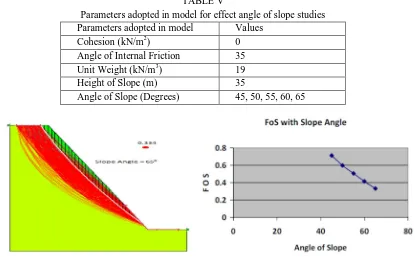
TABLE V
Parameters adopted in model for effect angle of slope studies Parameters adopted in model Values
Cohesion (kN/m2) 0
Angle of Internal Friction 35
Unit Weight (kN/m3) 19
Height of Slope (m) 35
Angle of Slope (Degrees) 45, 50, 55, 60, 65
Fig. 9 Slope stability model for unit weight of soil Fig. 10 Factor of Safety variation w.r.t. unit weight of soil
As the angle of slope increases, factor of safety of slope will start decreasing. Present soil, taken for modeling is poorly graded sand. This soil is loosely deposited in the slope. Friction between the particles is very less, which leads to slope failure.
IV.CONCLUSIONS
A. Initially, slope was modeled for different parametric studies. It was observed that, as the cohesion, angle of internal friction increased, factor of safety increased.
B. Also, when the slope angle and slope height was increased, factory of safety was decreased, leading to failure of slope tremendously.
[image:5.612.103.518.303.560.2]324
©IJRASET: All Rights are Reserved
REFERENCES
[1] Ali Fawaz, Elias Farah, Fadi Hagechehade (2014), “Slope stability analysis using numerical modeling”, American Journal of Civil Engineering, Vol. 2, pp.60-67
[2] M. Rabie(2014), “Comparison study between traditional and finite element methods for slopes under heavy rainfall”, Housing and Building National Research Center Journal, pp.160–168
[3] Debarghya Chakraborty and Deepankar Choudhury (2009), “Investigation of the Behavior of Tailings Earthen Dam Under Seismic Conditions”, American J. of Engineering and Applied Sciences, Science Publications 559-564
[4] Khadija Baba, Lahcen Bahi, Latifa Ouadif, Ahmed Akhssas (2012), “Slope Stability Evaluations by Limit Equilibrium and Finite Element Methods Applied to a Railway in the Moroccan Rif”,Open Journal of Civil Engineering pp. no.27-32
[5] Demin Xue, Tianbin Li and Yongxing Wei(2013), “Numerical Modeling of Giant Badu Landslide Reactivated by Excavation in China”, Journal of Earth and Science Engineering 2, pp.109-115
[6] Ammar Rouaiguia and Mohammed A. Dahim(2013), “ Numerical Modeling of Slope Stability Analysis”, International Journal of Engineering Science and Innovative Technology (IJESIT) Volume 2, Issue 3, pp.533-542
[7] Latifa Ouadif, Lahcen Bahi, Khadija Baba, Ahmed Akhssas (2012), “Study of Stability of a Highway Fill Application of the Analytical and the Finite Elements Methods”, International Journal of Engineering Research and Applications (IJERA) Vol. 2, Issue 1, pp. 904-910