Toward Cleaner Web Corpora
Christoph Ringlstetter
∗Klaus U. Schulz
∗CIS, University of Munich
Stoyan Mihov
†Bulgarian Academy of Science, Sofia
Since the Web by far represents the largest public repository of natural language texts, recent experiments, methods, and tools in the area of corpus linguistics often use the Web as a corpus. For applications where high accuracy is crucial, the problem has to be faced that a non-negligible number of orthographic and grammatical errors occur in Web documents. In this article we in-vestigate the distribution of orthographic errors of various types in Web pages. As a by-product, methods are developed for efficiently detecting erroneous pages and for marking orthographic errors in acceptable Web documents, reducing thus the number of errors in corpora and linguistic knowledge bases automatically retrieved from the Web.
1. Introduction
The automated analysis of large corpora has many useful applications (Church and Mercer 1993). Suitable language repositories can be used for deriving models of a given natural language, as needed for speech recognition (Ostendorf, Digalakis, and Kimball 1996; Jelinek 1997; Chelba and Jelinek 2002), language generation (Oh and Rudickny 2000), and text correction (Kukich 1992; Amengual and Vidal 1998; Strohmaier et al. 2003b). Other corpus-based methods determine associations between words (Grefenstette 1992; Dunning 1993; Lin et al. 1998), which yields a basis for com-puting thesauri, or dictionaries of terminological expressions and multiword lexemes (Gaizauskas, Demetriou, and Humphreys 2000; Grefenstette 2001).
From multilingual texts, translation lexica can be generated (Gale and Church 1991; Kupiec 1993; Kumano and Hirakawa 1994; Boutsis, Piperidis, and Demiros 1999; Grefenstette 1999). The analysis of technical texts is used to automatically build dictio-naries of acronyms for a given field (Taghva and Gilbreth 1999; Yeates, Bainbridge, and Witten 2000), and related methods help to compute dictionaries that cover the special vocabulary of a given thematic area (Strohmaier et al. 2003a). In computer-assisted lan-guage learning (CALL), mining techniques for corpora are used to create individualized and user-centric exercises for grammar and text understanding (Schwartz, Aikawa, and Pahud 2004; Brown and Eskenazi 2004; Fletcher 2004a).
By Zipf’s law, most words, phrases, and specific grammatical constructions have a very low frequency. Furthermore, the number of text genres and special thematic
∗Funded by German Research Foundation (DFG) †Funded by VolkswagenStiftung
areas that come with their own picture of language is large. This explains that most of the aforementioned applications can only work when built on top of huge heteroge-neous corpora. Since the Web represents by far the largest public repository for natural language texts, and since Web search engines such as Google offer simple access to pages where language material of a given orthographic, grammatical, or thematic kind is found, many recent experiments and technologies use the Web as a corpus (Kehoe and Renouf 2002; Morley, Renouf, and Kehoe 2003; Kilgarriff and Grefenstette 2003; Resnik and Smith 2003; Way and Gough 2003; Fletcher 2004b).
One potential problem for Web-based corpus linguistics is caused by the fact that words and phrases occurring in Web pages are sometimes erroneous. Typing errors represent one widespread phenomenon. Many Web pages, say, in English, are written by non-native speakers, or by persons with very modest language competence. As a consequence, spelling errors and grammatical bugs result. The character sets that are used for writing Web pages are often not fully adequate for the alphabet of a given language, which represents another systematic source for inaccuracies. Furthermore, a small number of texts found in the Web is obtained via optical character recognition (OCR), which may again lead to garbled words. As a consequence of these and other error sources, the Web contains a considerable number of “bad” pages with language material that is inappropriate for corpus construction.
In one way or the other, all the aforementioned applications are affected by these inadequacies. While the problem is probably not too serious for approaches that merely collect statistical information about given language items, the construction of dictio-naries and related linguistic knowledge bases—which are, after all, meant to be used in different scenarios of automated language processing—becomes problematic if too many erroneous entries are retrieved from Web pages. Obviously, in computer-assisted language learning it is a principal concern that words and phrases from the Web that are presented to the user are error free.
In discussions we found that problems resulting from erroneous language material in Web pages for distinct applications are broadly acknowledged (see also Section 4.4 of Kilgarriff and Grefenstette [2003]). Still, to the best of our knowledge, a serious analysis of the frequency and distribution of orthographic errors in the Web is missing, and no general methods have been developed that help to detect and exclude pages with too many erroneous words. In this article we first report on a series of experiments that try to answer the following questions:
1. What are important types of orthographic errors found in Web pages? 2. How frequent are errors of a given kind? For a given error level
(percentage of erroneous tokens)τ, which percentage of Web pages exceeds error levelτ?
3. How do these figures depend on the language, on the thematic area, and on the genre of the Web pages that are considered? How do these figures depend on the document format of the Web pages that are considered?
We then look at the problem indicated above.
4. Which methods help to automatically detect Web pages with many orthographic errors?
To answer questions 1–3, we retrieved and analyzed a collection of large English and German corpora from the Web, using suitable queries to Web search engines. In our error statistics we wanted to distinguish between (1) “general” Web pages collected without any specific thematic focus on the one hand and Web pages from specific thematic areas on the other hand, and (2) between Web pages written in HTML and Web documents written in PDF. To cover the first difference, for both languages we retrieved two general corpora as well as a number of corpora for specific thematic areas. All these corpora only contain HTML pages. A parallel series of general cor-pora was collected that are composed of PDF documents. Details are provided in Section 2.
Special Vocabulary.Web pages often contain tokens that do not belong to the standard vocabulary of the respective language. Typical categories are, for example, special names, slang, archaic language, expressions from foreign languages, and special ex-pressions from computer science/programming. Classification and detection of special vocabulary is outside the scope of the present article. Since sometimes a clear separation between special vocabulary and errors is difficult, we briefly come back to this problem in Section 5.4.
Proper Errors.Focusing on garbled standard vocabulary, tokens may be seriously dam-aged in an “unexplainable” way. Most of the remaining errors can be assigned to one of the four classes mentioned above:
r
typing errors (i.e., errors caused by a confusion of keys when typing a document),r
spelling errors (“cognitive” errors resulting from insufficient language competence),r
errors resulting from inadequate character encoding, andr
OCR errors.In order to estimate the number of errors of a given kind in the corpora, special
error dictionaries were built. These dictionaries, which only list garbled words of a given language that do not accidentally represent correct words, try to cover a high number of the conventional errors of each type that are typically found in Web pages and other documents. Section 3 motivates the use of error dictionaries for er-ror detection. Details of the construction of the erer-ror dictionaries are discussed in Section 4.
In Section 5, we estimate the number of orthographic errors in the corpora that remain undetected because they do not occur in the error dictionaries. We also estimate the percentage of correct tokens of the corpora that are erroneously treated as errors since they appear in the error dictionaries. Our results show that the number of tokens of a text that appear in the error dictionaries can be considered as a lower approximation of the number of real orthographic errors.
results that illuminate the relationship between the error rate of a document and its genre.
In our experiments we observed in all corpora a rich spectrum of error rates, ranging from perfect documents to a small number of clearly unacceptable pages. This moti-vates the design of filters that efficiently recognize and reject pages with an error rate beyond a user-specified threshold. The construction of appropriate filters is described in Section 9, where we also demonstrate the effect of using these filters, comparing the figures obtained in Section 6 with the corresponding figures for filtered corpora. Filters work surprisingly well due to a Zipf-like distribution of error frequencies in Web pages.
In Section 10, we present two experiments that exemplify how the methods de-veloped in the article may in fact help to improve corpus-based methods. The general question ofhow deeplydistinct methods from computational linguistics based on Web corpora are affected by orthographic errors in Web pages and to what extent the meth-ods developed in the article help to remedy these deficiencies are too complex to be discussed here.
The main insights and contributions are summarized in the Conclusion (Section 11) where we also comment on future work and on some practical difficulties one has to face when collecting and analyzing large corpora from the Web.
2. Corpora
The basis for the evaluations described below is a collection of corpora, each composed of Web pages retrieved with Web search engines (Google/AllTheWeb). In order to study how specific features of a language might influence the distribution of ortho-graphic errors, all corpora were built up in two variants. The English and German variant, respectively, contain Web pages that were classified as English and German Web pages by the search engine. As described above, for both languages we collected general corpora with Web pageswithout any thematic focusand, in addition, corpora that cover five specific thematic areas to be described below. Statements on the “representative-ness” of corpora derived from the Web are notoriously difficult. The composition of corpora retrieved with Web search engines depends on the kind of queries that are used, on the ranking mechanisms of the engine, and on the details of the collection strategy. We mainly concentrated on simple queries and straightforward collection strategies. Still, the large number of subcorpora and pages that were evaluated should guarantee that accidental results are avoided.
2.1 General Web Corpora
In a first attempt, we tried to obtain a general German HTML corpus using the mean-ingless query der die das, i.e., the three German definite articles. However, queries of this and a similar form did not lead to satisfactory results: As a consequence of Google’s ranking mechanism, which prefers “authorities” (Brin and Page 1998), mainly portals of big organizations, companies, and others were retrieved. These pages are often dominated by graphical elements. Portions of text are usually small and carefully edited, which means that orthographic errors are less frequent than in other “less official” pages.
10 pages per query (quintuple) until we obtained 1,000 pages. A considerable number of the URLs were found to be inactive. After conversion to ASCII and a preliminary analysis of error rates with methods described below, some of the remaining pages were found to contain very large lists of general keywords, including many orthographic errors. Apparently these lists and errors were only added to improve the ranking of the page in search engines, even for ill-formed queries. We excluded these pages. The remaining documents represent the “primary” general German HTML corpus. Since we wanted to know how results depend on the peculiarities of the selected set of pages, a second series of queries of the same type was sent to Google to retrieve a “secondary” general German HTML corpus with a completely disjoint set of pages.
Similar procedures were used to obtain a primary and a secondary general English HTML corpus, a general German PDF corpus, and a general English PDF corpus. The translation from PDF to ASCII was found to be error prone, in particular for German documents (cf. Gartner 2003). Due to this process, some converted PDF documents were seriously damaged. Since we focus on errors in original Web pages (as opposed to converted versions of such pages), these files were excluded as well. We found these pages when computing error rates based on error dictionaries as described in Sections 6 and 7.
The number of Web pages and the number of normal tokens (i.e., tokens composed of standard letters only) in the resulting six corpora are shown in Table 1. Numbers (1) and (2) stand for the primary and secondary corpora, respectively.
2.2 Web Corpora for Specific Thematic Areas
We looked at the thematic areas “Middle Ages,” “Holocaust,” “Fish,” “Mushrooms,” and “Neurology.” The given selection of topics tries to cover scientific areas as well as history and hobbies.
Simple Crawl. A first series of corpora was collected by sending a query with 25 “terminological” keywords mechanically found in a small corpus of the given area to the AllTheWeb search engine and collecting the answer set. For example, the queries
mushrooms mushroom pine edible harvesting morels harvested harvesters dried chanterelle matsutake poisonous flavor chanterelles caps fungi drying stuffing humidity varieties boletes recipes spores conifers pickers
Table 1
Number of Web pages, number of normal tokens (tokens composed of standard letters only), and sizes in megabytes of the “general” corpora. Numbers (1) and (2) refer to primary and secondary corpora, respectively.
General corpora Web pages Normal tokens Size (MB)
English HTML (1) 829 7,900,337 157 English HTML (2) 929 7,152,783 188 German HTML (1) 618 9,525,484 189 German HTML (2) 857 11,539,035 284
English PDF 570 2,193,598 393
disorder disorders anxiety self hallucinations delusions anatomy cortex delusion neuroscience disturbance conscious psychotic stimulus hallucination unconsciously receptors cognitive psychoanalytic unconscious consciously stimuli ego schizophrenia impairment
were respectively used for collecting the corpora Mushrooms E and Neurology E. The ranking mechanism of AllTheWeb prefers pages containing hits for several keywords of a disjunctive query. Since this form of corpus construction is straightforward, not all pages in the resulting corpora belong to the given thematic area.
Refined Crawl.We wanted to see how results are affected when using less naive crawl-ing methods. For the three areas “Fish,” “Mushrooms,” and “Neurology,” the sec-ondary corpora were retrieved using the following refined procedure: Starting from a small tagged seed corpus for the given domain, we mechanically extracted termino-logical open compounds for English (Sornlertlamvanich and Tanaka 1996; Smadja and McKeown 1990) and compound nouns for German. Examples areamino group, action potential, defense mechanism(English, neurology),truffle species, morel areas, harvesting tips
(English, mushrooms),Koffeinstoffwechsel,andEisenkonzentration(German, neurology). Each of these expressions was sent as a query to Google. From each answer set we collected a maximum of 30 top-ranked hits (many answer sets were smaller). For each document in the resulting corpus, the similarity with the seed corpus was controlled, using a cosine measure (in practice, almost all documents passed the similarity filter). Our method can be considered as a variant of Baroni and Bernardini’s (2004) and leads to corpora with a strong thematic focus.
The statistics for all thematic corpora are summarized in Table 2. Numbers (1) and (2) stand for corpora crawled with the simple and the refined crawling strategy, respec-tively. The numbers indicate one interesting effect: Documents in the thematic corpora obtained with the refined crawling strategy turned out to be typically rather short. Since we only used the 30 top-ranked documents for each single query, this probably points to a special feature of Google’s ranking mechanism. A manual inspection of hundreds of documents for both the simple and the refined crawl did not lead to additional insights.
3. Error Detection
For detecting orthographic errors of a particular type in texts, two naive base methods may be distinguished.
1. A representative list of errors of the respective type is created and manually checked. Each token of the text appearing in the list represents an error (lower approximation).
2. A spell checker or a large-scale dictionary is used to detect “suspicious” words (error candidates). For each such tokenWwe manually check ifWreally represents an error and we determine its type (upper approximation).
Table 2
Selected topics and statistics of English (E) and German (G) corpora for specific thematic areas. Numbers (1) and (2) refer to corpora crawled with the simple and the refined strategy,
respectively.
Topic/Language Web pages Normal tokens Size (MB)
Middle Ages E 710 5,069,796 172
Fish E (1) 510 10,090,682 266
Fish E (2) 940 547,407 22
Holocaust E 699 8,797,882 199
Mushrooms E (1) 676 7,876,067 197
Mushrooms E (2) 933 734,337 22
Neurology E (1) 624 8,765,899 197
Neurology E (2) 923 779,699 24
Middle Ages G 614 6,774,794 195
Fish G (1) 655 7,621,579 199
Fish G (2) 804 688,882 32
Holocaust G 616 5,659,924 160
Mushrooms G (1) 527 5,951,305 147
Mushrooms G (2) 614 538,575 28
Neurology G (1) 486 4,322,952 115
Neurology G (2) 323 345,070 12
checked becomes too large. In practice, a large number of error candidates represent correct tokens. This is mainly due to special names and other types of nonstandard vocabulary found in Web pages, as mentioned in the introduction.
We decided to use a third strategy, which can be considered as a synthesis and compromise between the above two approaches. As a starting point, we took stan-dard dictionaries of English, D(English); German, D(German); French, D(French); and Spanish, D(Spanish); and a dictionary of geographic entities, D(Geos); a dictio-nary of proper names, D(Names); and a dictionary of abbreviations and acronyms,
D(Abbreviations).1 The number of entries in the dictionaries is described in Table 3. The German dictionary contains compound nouns, which explains the large number of entries.
From these standard dictionaries, we derived special error dictionaries that were used in the experiments described later. First, for each of the four error types mentioned above we manually collected a number of general patterns that “explain” possible mutations from correct words to erroneous entries. In a second step, these patterns were used to garble the words of the given background dictionaries. Third, garbled words that were found to correspond to correct words (entries of the above dictionaries) were excluded (filtering step). Collecting the remaining erroneous strings, we obtained large error dictionaries for each type of orthographic error.
Experiments described in Section 5 show that our error dictionaries cover the major part of all orthographic errors occurring in the English and German Web pages. At
Table 3
Size of background dictionaries.
Dictionary Number of entries
D(English) 315, 300
D(German) 2, 235, 136
D(French) 85, 895
D(Spanish) 69, 634
D(Geos) 195, 700
D(Names) 372, 628
D(Abbreviations) 2, 375
the same time, the number of tokens that are erroneously treated as errors due to the unavoidable incompleteness of the filtering step remains acceptable. On this basis, an estimate of the number of conventional orthographic errors occurring in Web pages is possible, counting the number of occurrences of entries of the error dictionaries.2Before we comment on these points, we describe the construction of the error dictionaries in more detail. In the remainder of the article, by Dconv we denote the union of all the conventional dictionaries listed above.
4. Construction of Error Dictionaries
For the construction of error dictionaries, the most important error patterns for each type of error were determined. For typing errors and errors caused by character en-coding problems, error patterns were obtained analytically. For spelling errors and Optical Character Recognition (OCR) errors, important mutation patterns were col-lected empirically. As a general rule, all error dictionaries were restricted to entries of length >4. Many tokens of length ≤4 occurring in texts represent acronyms, special names, and abbreviations, and it is difficult to mechanically distinguish between this special kind of vocabulary and errors.
4.1 Error Dictionaries for Typing Errors
Typing errors can be partitioned into transpositions, deletions, substitutions, and inser-tions. Transpositions of two letters occur if two keys are hit in the wrong order. Deletions result if a key is not properly pushed down. Substitutions occur if a neighbor key is pressed down instead of the intended one. Horizontal and vertical shifts of fingers may be distinguished. If a finger hits the middle between two keys, a neighbor key may be pressed in addition to the intended one. The wrong letter may occur before or after the correct letter.
Transpositions, deletions, substitutions, and insertions cover most of the typing errors discussed in the literature (Kukich 1992). We ignored homologous errors, that is, substitutions that are traced back to a confusion of the left and right hand. Since
there are many possible positions for both hands, this kind of error leads to large confusion sets.
Since we did not find other patterns in the texts, only mutation variants that are exclusively composed of standard letters (as opposed to digits and other special sym-bols) were taken into account. Furthermore, since typing errors in general do not affect the first letter of a word,3 we left this letter unmodified. We analyzed the number of mutated variants of a given word. Both for the American and for the German keyboard we have approximately 16lvariants for a word of lengthl. This shows that the above patterns for typing errors are very productive. It is not possible to garble all the words of our background dictionary for constructing the error dictionaries. For the generation of the dictionary of English typing errors, Derr(English,typing), we took the 100,000 entries of the English background dictionary with the highest frequency. Applying the above mutation patterns we generated 10,785,675 strings. After removal of duplicates and deletion of words in Dconv (filtering step), we obtained 9, 427, 051 entries for the dictionaryDerr(English,typing).
The same procedure was used for creating the dictionary of German typing errors,
Derr(German,typing). Since the average length of German words is large, we obtained 13, 656, 866 entries.
4.2 Error Dictionaries for Spelling Errors
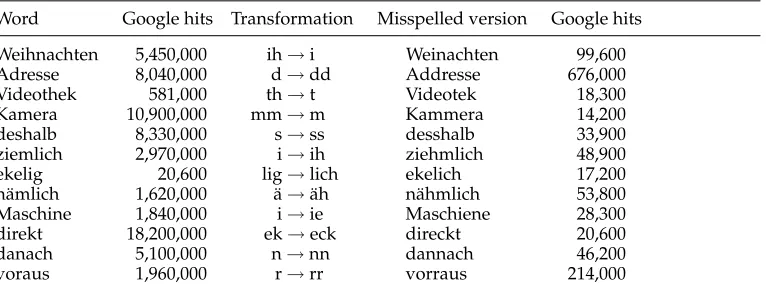
English.In order to find the most characteristic patterns for English spelling errors, a bootstrapping procedure was used to compute an initial list of errors. We started with the misspelled English wordsverry, noticable, arguement, andinteligence. For each term we retrieved 20 Web documents. After conversion to ASCII we computed the list of all normal tokens occurring in these documents. The resulting list was sorted by frequency, and words inDconv were filtered out. After a manual selection of new errors with high Google counts, the procedure was iterated until we did not find new erroneous words with high frequency. During the bootstrapping procedure, we also found Web pages that listed some “common misspelled words” of English. The most frequent errors mentioned in these lists were also added. Table 4 presents some strings that were found with a large number of Google hits.4
Most of the errors that we found can be traced back to a rule set partially described in Table 5. The full rule set contains 95 rules. We applied each rule to D(English), introducing one error at the first possible position, for each entry of the appropriate form. As a result we obtained a list with 1,223,128 garbled strings. After applying the standard filtering procedure, we obtained the dictionaryDerr(English,spell) of English spelling errors with 1,202,997 entries.
German.Similarly as for English, we built an initial error list. Bootstrapping was started with the misspelled German terms n¨ahmlich, addresse, resourcen, and vorraus. Table 6 shows some of the resulting German words, the misspelled variant, and the number of Google hits of the garbled version. From the initial error list, we obtained a set of 65 rules partially described in Table 7. We applied these rules toD(German), introducing one error for each entry of the appropriate form. Each rule was applied to each entry using the first possible position for mutation. For example, for the lexical entryAdresseof
Table 4
Some frequently misspelled English words and the number of Google hits of the correct and misspelled forms.
Word Google hits Transformation Misspelled variant Google hits
accommodate 5,800,000 mm→m accomodate 559,000 category 109,000,000 teg→tag catagory 525,000 definitely 10,800,000 itely→ately definately 1,270,000 independent 25,700,000 dent→dant independant 523,000 millennium 10,500,000 nn→n millenium 2,540,000 occurrence 4,640,000 rr→r occurence 279,000
receive 57,000,000 ie→ei recieve 1,260,000
recommend 31,400,000 mm→m recomend 707,000
separate 26,300,000 ara→era seperate 1,340,000
[image:10.486.59.343.392.664.2]the German standard dictionary we obtained the following error terms:adrese, ahdresse, adrehsse, addresse, adrresse. As a result we obtained a list with 19, 265, 271 strings. The large size is mainly caused by the rules for reduplication of consonants, which are not restricted by word context. The filtering procedure led to an error dictionary with 18, 970, 716 entries.
Table 5
Rule set (incomplete) for the generation of English spelling errors with examples for each transformation class.
Deletion of doubled consonants
cc → c occasionally → ocasionally
nn → n drunkenness → drunkeness
Deletion of consecutive consonants
mn → m column → colum
rh → r rhythm → rythm
Deletion of doubled vowels
ee → e exceed → exced
uu → u vacuum → vacum
Deletion in vowel pair
aison → ason liaison → liason
ou → o mischievous → mischievos
ievous → evious mischievous → mischevious
Deletion of silent vowels
?ed → ?d maintained → maintaind
Substitution of consonants
sede ↔ cede supersede → supercede
dent ↔ dant independent → independant
Substitution of vowels
itely → ately definitely → definately
teg → tag category → catagory
Insertion/reduplication of consonants
κ∈ {c,d,f,l,n,m,p,r,s,t} → κκ always → allways
Transposition of consonants
ght → gth right → rigth
Transposition of vowels
Table 6
Some frequently misspelled German words and the number of Google hits of the misspelled version.
Word Google hits Transformation Misspelled version Google hits
Weihnachten 5,450,000 ih→i Weinachten 99,600
Adresse 8,040,000 d→dd Addresse 676,000
Videothek 581,000 th→t Videotek 18,300
Kamera 10,900,000 mm→m Kammera 14,200
deshalb 8,330,000 s→ss desshalb 33,900
ziemlich 2,970,000 i→ih ziehmlich 48,900
ekelig 20,600 lig→lich ekelich 17,200
n¨amlich 1,620,000 ¨a→¨ah n¨ahmlich 53,800
Maschine 1,840,000 i→ie Maschiene 28,300
direkt 18,200,000 ek→eck direckt 20,600
danach 5,100,000 n→nn dannach 46,200
voraus 1,960,000 r→rr vorraus 214,000
4.3 Error Dictionaries for OCR Errors
[image:11.486.51.396.410.665.2]As a starting point we used a list of typical OCR errors that we found in a corpus with 200 pages of OCR output (Ringlstetter 2003). Error types are shown in Table 8.
Table 7
Rule set (incomplete) for the generation of German spelling errors. The symbol ˆt means that t is not the preceding letter.
Deletion of doubled consonants
dd → d Kuddelmuddel → Kudelmuddel
mm → m Kommando → Komando
Special rules for deletion of consonants
mn → m Kolumne → Kolume
¨ah → ¨a ¨ahnlich → ¨anlich
Deletion of vowels
ie → i ziemlich → zimlich
aa → a Aal → Al
Substitution of consonants
nt → nd eigentlich → eigendlich
rd → rt Standard → Standart
Substitution of vowels
¨a → e Empf¨anger → Empfenger
era → ara Temperatur → Temparatur
Insertion/reduplication of consonants
[aeiou¨a ¨o ¨u] ↔ [aeiou¨a ¨o ¨u]h viel → viehl [aeiou¨a ¨o ¨u]k → [aeiou¨a ¨o ¨u]ck direkt → direckt
κ∈ {d,f,l,n,m,p,r,t} → κκ Großbritannien → Großbrittannien
ˆtz → tz Schweiz → Schweitz
Insertion of vowels
i → ie Maschine → Maschiene
Shifting
¨au → a ¨u ¨außerst → a ¨ußerst
Table 8
List of typical OCR errors.
Character substitutions Character merges Character splits
l→i rn→m m→rn
i→l ri→n n→ri
g→q cl→d ¨u→ii
o→p l→t v→y y→v o→c e→c l→1
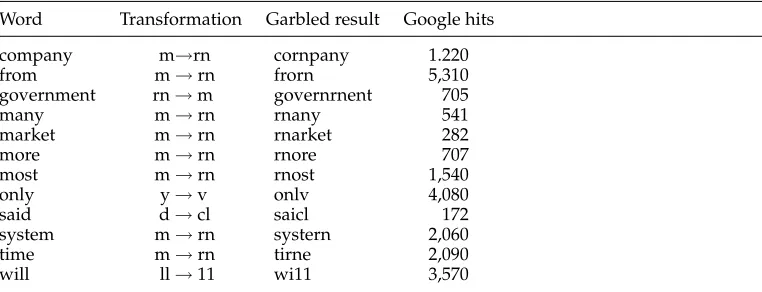
English. The error dictionaryDerr(English,ocr) was generated by applying to the en-tries of D(English) the transformation rules listed in Table 8. The transformation of
D(English) with its 315, 300 entries led to a list of 1,697,189 entries. The filtering pro-cedure where we erase words fromDconv led to the error dictionaryDerr(English, ocr) with 1, 532, 741 entries. Table 9 shows some of the most frequent English words, the transformation result, and the number of Google hits of the garbled variant.
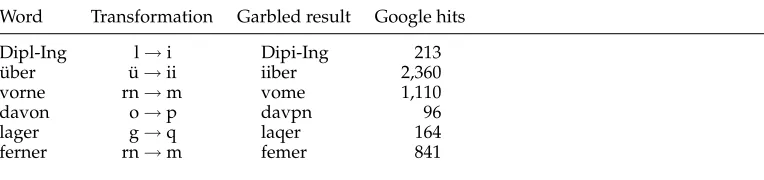
[image:12.486.50.431.517.663.2]German. When scanning German texts, vowels ¨a, ¨o, and ¨u are often replaced by their counterparts a, o, u. However, even more frequently, this kind of replacement occurs as the result of a character encoding problem (see below). Since we wanted to avoid having our statistics for OCR errors being heavily overloaded with errors caused by character encoding problems, we did not add these patterns to the list of typical OCR errors for German texts. This means that we applied to D(German) the transformation rules mentioned in Table 8. The transformation ofD(German) with its 2, 235, 136 entries led to a list of 11, 623, 989 strings. After filtering, we obtained the error dictionary Derr(German,ocr) with 10, 608, 635 entries. Table 10 shows some frequent German words, the transformation result, and the number of Google hits of the garbled variant.
Table 9
Some members of the top 1,000 most frequent English words transformed by typical OCR error transformations and the number of Google hits of a garbled version.
Word Transformation Garbled result Google hits
company m→rn cornpany 1.220
from m→rn frorn 5,310
government rn→m governrnent 705
many m→rn rnany 541
market m→rn rnarket 282
more m→rn rnore 707
most m→rn rnost 1,540
only y→v onlv 4,080
said d→cl saicl 172
system m→rn systern 2,060
time m→rn tirne 2,090
Table 10
Some members of the top 1,000 most frequent German words transformed by typical OCR error transformations and the number of Google hits of a garbled version.
Word Transformation Garbled result Google hits
Dipl-Ing l→i Dipi-Ing 213
¨uber ¨u→ii iiber 2,360
vorne rn→m vome 1,110
davon o→p davpn 96
lager g→q laqer 164
ferner rn→m femer 841
4.4 Error Dictionaries with Erroneous Character Encoding of German Words
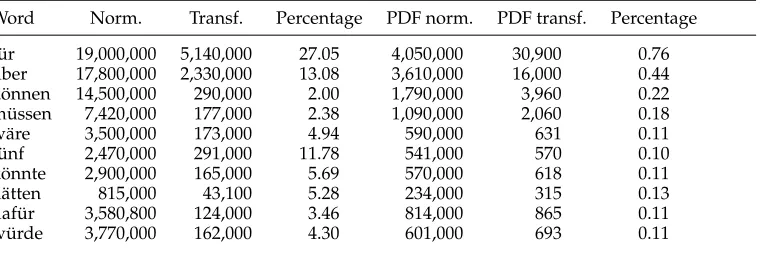
In character sets used for the encoding of Web pages, often the German lettersA, ¨¨ O, ¨U, ¨a, ¨o, ¨u, andß(“sharp s”) are not available. In many of these cases, vocals are replaced, following the substitution scheme (e-transformation):
¨
A→Ae, ¨O→Oe, ¨U→Ue, ¨a→ae, ¨o→oe, ¨u→ue.
In other Web pages, the aforementioned vocals are replaced using the following scheme:
¨
A→A, ¨O→O, ¨U→U, ¨a→a, ¨o→o, ¨u→u.
This transformation, which is typically found in Web pages written by non-native speakers of German, will be called-transformation.
Table 11 shows some transformed terms of the top 1,000 German words and gives the number of Google hits for correct and incorrect spellings. The right-hand side of the table gives the corresponding numbers for PDF documents. The numbers show that misspellings caused by e-transformation are a widespread phenomenon. Note that the quality of PDF corpora is much better in this respect.
When applying the e- or -transformation, letter ß is typically replaced by ss
(s-transformation). For two reasons, the distinction betweenßandssis a delicate matter. Since the Swiss spelling isss, a string representing an erroneous German word may be a correct Swiss word. To make things even more complicated, the correct spelling of many German words has been changed during the so-called “Rechtschreibereform” some years ago, which affected the selection betweenß andss(e.g.,Mißverst¨andnisbecame
Missverst¨andnis). Still (and unofficially), the old spelling variant is broadly used. In what follows, a token written withssthat is officially written withßis treated as an error.
We built two error dictionaries respectively representing errors introduced via e-transformation and -transformation. All vowels of the form ¨a, ¨o, ¨u (or upper-case variants) in the German dictionary were replaced by their images under the respective transformation. Letter ßoccurring in the entries was categorically replaced byss. For the e-transformation we obtained a list of 436, 198 strings. The filtering procedure led to an error dictionaryDerr(German, enc-e) with 432, 987 entries.
partial explanation: For so-called strong verbs some paradigmatic forms only differ by a mutation of vowels (m¨ochte-mochte).
An extra error dictionary Derr(German,enc-s) was built by replacing ß by ss in German dictionary entries without occurrences of vocalsA, ¨¨ O, ¨U, ¨a, ¨o, ¨u. The dictionary has 42, 340 entries.
4.5 Summary and Maximal Error Dictionaries
Using the union of all error dictionaries for both languages, we constructed the maximal error dictionariesDerr(English,all) andDerr(German,all). Table 12 summarizes the sizes of all error dictionaries.
5. Error Overproduction and Underproduction
Before we analyze the number of tokens in the corpora that represent entries of the error dictionaries, we comment on the limitations of this kind of analysis. Obviously, not all orthographic errors of a given type occur in the respective error dictionary (underproduction). On the other hand, some tokens classified as errors by the error dictionary might in fact be correct words (overproduction) due to the incompleteness of
Table 11
Most frequent German words with vowels ¨a, ¨o, ¨u; frequencies of correct spelling and frequency after applying e-transformation. Frequencies are counted in arbitrary Web pages (left part of the table) and in PDF documents in the Web.
Word Norm. Transf. Percentage PDF norm. PDF transf. Percentage
f ¨ur 19,000,000 5,140,000 27.05 4,050,000 30,900 0.76 ¨uber 17,800,000 2,330,000 13.08 3,610,000 16,000 0.44 k ¨onnen 14,500,000 290,000 2.00 1,790,000 3,960 0.22 m ¨ussen 7,420,000 177,000 2.38 1,090,000 2,060 0.18
w¨are 3,500,000 173,000 4.94 590,000 631 0.11
f ¨unf 2,470,000 291,000 11.78 541,000 570 0.10 k ¨onnte 2,900,000 165,000 5.69 570,000 618 0.11
h¨atten 815,000 43,100 5.28 234,000 315 0.13
[image:14.486.54.434.388.528.2]daf ¨ur 3,580,800 124,000 3.46 814,000 865 0.11 w ¨urde 3,770,000 162,000 4.30 601,000 693 0.11
Table 12
Size of error dictionaries.
Error dictionary Entries Error dictionary Entries
Derr(English,typing) 9, 427, 051 Derr(German,typing) 13, 656, 866
Derr(English,spell) 1, 202, 997 Derr(German,spell) 18, 970, 716
Derr(English,ocr) 1, 532, 741 Derr(German,ocr) 10, 608, 635
Derr(German,enc-e) 432, 987
Derr(German,enc-) 407, 013
Derr(German,enc-s) 42, 340
the final filtering step in the construction of the error dictionaries. From the construction of the error dictionaries we may expect that incompleteness/underproduction is mainly caused by
r
missing patterns for spelling errors and OCR errors, andr
the fact that we do not seriously damage words when constructing the error dictionaries.For both English and German, to estimate under/overproduction of the error dictio-naries, the primary general HTML corpus was split into four subclasses. The class Best contains all documents where the number of hits (tokens representing entries of the maximal error dictionary) per 1,000 tokens is ≤1. For class Good (Bad, Worst, respectively), the number of hits per 1,000 tokens is 1–5 (5–10,>10, respectively). The number of documents in each class is found in Tables 13 and 14.
5.1 Estimating Underproduction
To estimate underproduction of the English error dictionaries, the English general HTML corpus was split into subfiles, each containing 300 tokens. We then randomly selected such subfiles and analyzed the proper errors found in these portions. Since we wanted to avoid an unbalanced selection where most errors are from the doc-ument class Worst, a maximum of three errors from each subfile was used for the analysis. Error candidates were found with the help of a spell checker and using our standard dictionaries as a second control. Slang and special vocabulary were not used for the statistics. We also excluded errors where two words were merged. We found that most of the latter errors were caused by the conversion process from HTML to ASCII. Each candidate was manually controlled; in difficult cases we con-sulted Merriam-Webster Online. We continued the search until 1,000 proper errors were isolated. From these, 624 (62.4%) turned out to be entries of the maximal English error dictionary.
Table 13 refines these statistics and shows the number of errors and the percentage of errors found in the error dictionary for the four quality classes of documents. As a tendency, recall of the error dictionary is better in “bad” documents.
The same procedure was used for German and confirmed this tendency. From 1,000 errors in the German general HTML corpus, 638 (63.80%) were found in the maximal German error dictionary. The statistics for the four quality classes of documents is presented in Table 14.
5.2 Estimating Overproduction
In our first experiment with English texts we found that a considerable number of hits corresponded to special names introduced in the documents. Many of these names are artificial (e.g., Hitty). In order to avoid all difficulties with special names we decided to restrict the error analysis in English texts to words starting with a lowercase letter. In each of the four classes, 1,000 hits of this form were randomly selected. We then manually checked which of these tokens represent correct words, reading contexts and consulting Merriam-Webster Online in difficult cases.
Table 13
Underproduction of the maximal error dictionary in the primary English general HTML corpus.
Document class Documents Errors found Entries of error dict. %
Worst 24 248 166 66.93
Bad 39 194 131 67.53
Good 226 389 242 62.21
Best 540 169 85 50.29
Table 14
Underproduction of the maximal error dictionary in the primary German general HTML corpus.
Document class Documents Errors found Entries of error dict. %
Worst 50 389 307 78.92
Bad 42 166 101 60.84
Good 297 385 201 52.21
Best 229 60 29 48.33
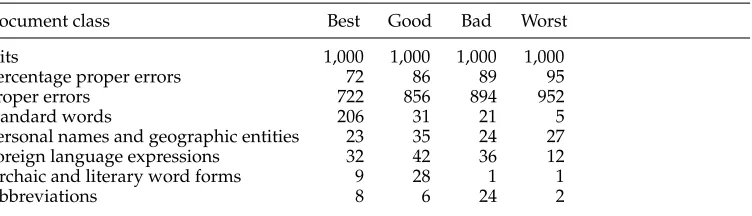
of all hits are proper errors; in the class Best, only 60% of the hits represent orthographic errors. Most of the remaining hits could be assigned to one of the following categories: correct standard expressions (missing entries of the standard dictionaries), names and geographic expressions, foreign language expressions, archaic and literary word forms, and abbreviations. The number of hits in each category is found in Table 15. The large number of standard words among the hits in the class Best is caused by an incomplete-ness of our English dictionary, which does not always contain both the British and the American spelling variants.
[image:16.486.57.433.556.664.2]In the German general HTML corpus, where we could not restrict the experiment to tokens starting with a lowercase letter, a more shallow picture is obtained (Table 16). For the classes Best (61% proper errors), Good (62% proper errors), and Worst (88% proper errors), results are similar to the English case and confirm the above-mentioned general tendency. Due to the large number of names, foreign language expressions, and archaic/literary word forms that are found in class Bad, we here have only 56% proper errors. The results show that overproduction could be considerably reduced when filter-ing error dictionaries with better standard dictionaries for geographic entities, personal names, foreign language expressions, and archaic and literary word forms.
Table 15
Overproduction of the maximal error dictionary in the English general HTML corpus.
Document class Best Good Bad Worst
Hits 1,000 1,000 1,000 1,000
Percentage proper errors 72 86 89 95
Proper errors 722 856 894 952
Standard words 206 31 21 5
Personal names and geographic entities 23 35 24 27 Foreign language expressions 32 42 36 12 Archaic and literary word forms 9 28 1 1
5.3 Summary So Far
From the above percentages we obtain a naive estimate for the ratio between the real number of errors and the number of hits of the error dictionaries, which is presented in Table 17. The results show that the number of hits can be seen as a lower approximation of the real number of errors. The ratio between both numbers is larger for English. It does not differ dramatically between the distinct quality classes. However, since both over- and underproduction are larger for “good” documents, error estimates for these classes come with a larger degree of uncertainty.
5.4 Difficulties
The above analysis turned out to be much more time-consuming and difficult than it might appear. One problem is caused by the fact that nonstandard vocabulary and errors do not represent disjoint categories. Orthographic errors are sometimes “abused” as slang expressions. A separation between archaic/foreign language expressions and orthographic errors is often only possible when taking the sentence context into account. These and other examples explain that demarcation issues are sometimes difficult to solve. The construction of special dictionaries for slang, foreign language expressions, special names, and archaic word forms represents an important step for future work. Using these dictionaries in the filtering step of the construction of the error dictionaries, overproduction may probably be reduced in a significant way. Furthermore, these dictionaries should help to detect Web pages with nonstandard vocabulary of a particular type.
Table 16
Overproduction of the maximal error dictionary in the German general HTML corpus.
Document class Best Good Bad Worst
Hits 1,000 1,000 1,000 1,000
Percentage proper errors 61 62 56 88
Proper errors 615 624 564 884
Standard words 126 123 47 3
Names and geos 201 147 193 49
Foreign language expressions 31 46 103 37 Archaic and literary word forms 18 44 82 24
Abbreviations 9 16 11 3
Table 17
Naive estimates of the ratio between the real number of errors and the number of hits of the error dictionaries for distinct quality classes.
English German
6. Distribution of Orthographic Errors in the General HTML Corpora
We define theerror rateof a text with respect to an error dictionaryDerras the average number of entries ofDerrthat are found among 1,000 tokens of the text. In this section we describe the distribution of error rates for all types of errors in the general HTML corpora. Experiments for other corpora are summarized in the following section. The results of the previous section indicate that the error rate represents a reasonable lower approximation for the real number of errors per 1,000 tokens in the document. Incom-pleteness of the rule sets for generating spelling errors and OCR errors should be kept in mind. Recall that in English documents, only words starting with a lowercase letter are taken into account.
6.1 Distribution of Error Rates for Orthographic Errors
In the first test, we consider orthographic errors, that is, errors of arbitrary type. Ac-cordingly, error rates for documents are computed with respect to the maximal error dictionaries. For a coarse survey, as in the previous section, we distinguish four quality classes Best, Good, Bad, Worst, respectively, covering pages with error rates in the intervals [0, 1), [1, 5), [5, 10), and [10,∞).
English.The histograms in Figure 1 show the percentage of documents in each class in the primary (left-hand side) and secondary (right-hand side) English corpora. Remark-ably, the differences between the two corpora are almost negligible. In both cases, most documents belong to class Best; only a small percentage of documents belongs to classes Bad and Worst.
Table 18 presents the average error rate for various document classes. As to the length of documents in the corpora, drastic differences exist. We did not find a cor-relation between document length and error rates, with the following eye-catching exception: small (larger) documents of an excellent quality tend to have an error rate 0 (close to 0, but >0).5 In order to avoid a dominating influence of long documents, we simply computed the arithmetic mean of all error rates obtained for the single documents. The class Best 80% collects 80% of all documents with lowest error rate, and similarly for the class Best 90%.
Note that a significant difference exists between the average rate for all documents (2.47, 2.24, respectively) and the means for the Best 80% classes (0.67, 0.68, respectively). These numbers point to an effect that will be found again in other figures and exper-iments: The large majority of all documents in the corpora have a very good quality. Yet, at the “bad end” of the spectrum we find a considerable number of unacceptable documents with a very large number of errors. The phenomenon becomes even more apparent in Figure 2 (left diagram) where we depict the error rates of all documents. In what follows we often describe mean error rates for all documentsandfor the class Best 80%. When comparing distinct corpora, the two values help to see if deviations concern the class of all documents or if they are rather caused by a small number of “bad” documents.
Note also that all corresponding average error rates obtained for the primary and secondary corpora are almost identical. This gives at least some evidence to the
Figure 1
Percentage of documents in the four quality classes for the primary (left-hand side) and secondary (right-hand side) English corpora. The four quality classes cover distinct error rates for orthographic errors.
ture that for corpora crawled with similar queries and collection strategies, error rates will not differ too much. As we see next, the situation for the German corpora is more complex.
German. The histogram in Figure 3 shows the percentage of documents in each class of the primary (left-hand side) and secondary (right-hand side) German corpora. A large number of documents belongs to class Good. We now find a larger difference between the primary and secondary corpora. Several phenomena might be responsible. As mentioned above, for the German corpora we did not restrict the analysis to tokens starting with a lowercase letter. Hence, documents with many names can cause special effects and lead to differences between corpora. Second, errors caused by encoding of special characters represent an important extra source for errors in German docu-ments where numbers may vary from one corpus to another. This is seen in Table 20 where we analyze all error types occurring in the primary and secondary German corpus. The means for e-transformation are 0.62 for the primary corpus and 1.40 for the secondary corpus.
The average error rates obtained for distinct documents classes of the German corpus, which are presented in Table 19, show that
r
for all classes we have more errors than in the English documents, andr
for different corpora, sometimes nontrivial deviations must be expected.Table 18
Mean error rate for arbitrary orthographic errors in various document classes; results for the general English HTML corpus.
Document class Best Good Bad Worst Best 80% Best 90% All
E (1) 0.30 2.31 8.83 23.23 0.67 1.06 2.47
Figure 2
Distribution of error rates forarbitrary orthographic errorsin the primary English (left diagram, 829 documents, mean error rate 2.47) and the German (right diagram, 618 documents, mean error rate 3.86) general HTML corpora. On thex-axis, documents are ordered by error rates; documents with high rates are found on the right-hand side. In the left diagram, 7 documents with error rates ranging from 42.99 to 64.22 have been omitted to simplify scaling. In the right diagram, one document with error rate 40.07 is omitted.
A more detailed picture of the error rates in the primary German corpus is given in Figure 2 (right diagram). The two curves of the figure show that despite the afore-mentioned differences between English and German, basic features of the error rate distribution are very similar.
6.2 Error Rates for Particular Error Classes
Typographic Errors. The most widespread subclass of errors found in the corpora are typographic errors. For the primary English corpus, as many as 2.31 of 2.47 hits (93.5%) can be classified as typing errors.6The percentage is lower in the German corpus (2.15/3.86, 55.7%) where e-transformation,-transformation, ands-transformation rep-resent additional important sources for errors (see below). In absolute numbers, error rates for typographic errors observed in the two corpora are similar.
The histograms in Figure 4 show the percentage of documents with error rates for typographic errors in the four intervals [0, 1), [1, 5), [5, 10), and [10,∞) for the primary and secondary English corpora (upper diagrams of Figure 4) and the corresponding German corpora (lower diagrams of Figure 4). Note again the close similarity between the two English corpora. The detailed distribution curves, which are similar to the curves obtained for orthographic errors in Figure 2, are omitted.
Spelling Errors. The two diagrams in Figure 5 show that the error rates found in the primary English corpus (mean 0.39) are similar to the ones found in the primary German corpus (mean 0.45). The results presented in Section 5.1 indicate that our error dictionaries for spelling errors are incomplete. Hence the real number of spelling errors is probably larger. We also computed error rates for spelling errors in the secondary
Figure 3
Percentage of documents in the four quality classes for the primary (left-hand side) and secondary (right-hand side) German corpora. The four quality classes cover distinct error rates for orthographic errors.
corpora; results are presented in Table 20. The tendency observed earlier for ortho-graphic errors was confirmed: the difference between the two English corpora (mean 0.39 versus mean 0.38) is negligible; for the two German corpora, the difference is larger (mean 0.45 versus mean 0.58).
OCR Errors.The diagrams in Figure 6 show that most documents do not contain any OCR errors. Of course this result is not surprising. Probably not all errors that contribute to the two diagrams are really caused by wrong character recognition. Although some of the documents with the highest errors were explicitly marked to contain scanned
Table 19
Mean error rate for arbitrary orthographic errors in various document classes; results for the general German HTML corpus.
Document class Best Good Bad Worst Best 80% Best 90% All
G (1) 0.41 2.61 7.30 15.15 1.89 2.58 3.86
G (2) 0.48 2.57 7.21 24.38 2.40 3.09 5.40
Table 20
Mean of error rates for all error types in primary and secondary general HTML corpora.
Error type Mean error rate Mean error rate Mean error rate Mean error rate English corpus English corpus German corpus German corpus
HTML (1) HTML (2) HTML (1) HTML (2)
arbitrary 2.47 2.24 3.86 5.40
typographic 2.31 2.03 2.15 2.79
spelling 0.39 0.38 0.45 0.58
OCR 0.06 0.07 0.13 0.18
e-transformation 0.003 0.004 0.62 1.40
-transformation 0.02 0.01 0.19 0.24
Figure 4
Typographic errors: the percentage of documents in the four quality classes in the general English (upper part) and German (lower part) HTML corpora. Quality classes refer to error rates for typographic errors.
[image:22.486.50.268.63.332.2]text, it is natural to assume that the total number of such documents in the corpus is very small. Ambiguous error types might explain some of the errors found in Figure 6; see the discussion below. As a matter of fact, the number of OCR errors will grow when analyzing corpora with many OCRed pages.
Figure 5
Figure 6
Distribution of error rates forOCR errorsin the primary English (left diagram, mean error rate 0.06) and the German (right diagram, mean error rate 0.13) general HTML corpora.
e-transformation and-transformation.Figures 7 and 8 show some interesting differ-ences between the use of both transformations in German Web pages. In the primary German corpus, e-transformation errors are concentrated in a small class of documents (documents with rank>480) where we have a nontrivial number of occurrences, lead-ing to a mean error rate of 0.62. The mean error rate for -transformation is much smaller (0.19). Still, there are more documents containing an -transformation error. This indicates that e-transformation is applied more systematically. The small plateau in Figure 7 is generated by some portion of text that was found in several documents. The error rates that arise when applying e-transformation in a completely systematic way are typically larger. In the corpus we found some documents of this kind; since the rates are too high, these documents are not depicted in the figure.
We also looked for e- and -transformation errors in the documents of the En-glish general HTML corpus. These errors, which mutate German words, only occur
Figure 7
[image:23.486.54.356.467.627.2]Figure 8
Distribution of error rates for-transformationin the primary German general HTML corpus. Mean 0.19.
in a small number of English documents. Whereas German writers strongly prefer the e-transformation in situations where the correct characters are not available, we find a clear preference for the-transformation in the English documents.
s-Transformation.Figure 9 shows the distribution of error rates for s-transformation in the primary German general HTML corpus. Since the corpus contains some Swiss documents, where “ß” is categorically written “ss” (cf. Section 4.4), the high mean (0.76) has to be relativized.
Overview.Table 20 summarizes the error rates of all types of errors in the general HTML corpora. The numbers show that not all errors can be traced back to a unique error type.
Figure 9
[image:24.486.50.359.466.627.2]6.3 Summary So Far
For both languages, the large majority of all documents has a small number of ortho-graphic errors. On the other hand, at the “bad end” of the spectrum, a considerable number of unacceptable documents with high error rates is found. Mean values for error rates are strongly influenced by the latter documents; the average error rate for the Best 80% class is usually much lower. The latter rate should also be considered when comparing results obtained for two corpora.
Phenomena observed in English corpora seem to be more stable than those for German: Results obtained for the primary and the secondary English general HTML corpus are almost identical. Differences between the two German corpora may partially be explained by names occurring in texts and by special character encoding problems. Table 20 illustrates this effect, showing the mean error rates for all error types in the primary and secondary HTML corpora.
The most important error class are typographic errors. In the German documents, e-transformation and s-transformation represent another typical error source. Whereas the number of spelling errors is significant, OCR errors do not play an essential role.
Interestingly, the basic form of the distribution curves in Figure 2 is found again in all corresponding curves for other error types and other corpora (see also Figures 14 and 15); although the absolute numbers for error rates and details are of course distinct. The close similarity of all distribution curves is striking and gives some evidence to the assumption that relevant features of the error rate distribution are stable, regardless of the corpora that are investigated.
7. Differences for Special Corpora
We summarize the error rates that we found in PDF corpora and in corpora for special thematic fields. In Figures 14 and 15, we present a small selection of distribution curves for error rates. Similarities of the distribution curves mentioned in the previous section should also be noted.
7.1 Distribution of Orthographic Errors in the General PDF Corpora
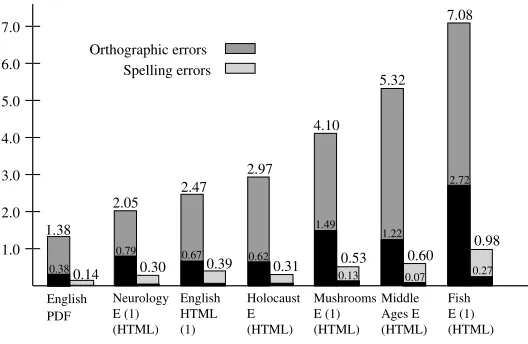
Figure 10 presents the mean error rates for distinct error types found in the general PDF and (primary) HTML corpus for English. The results show that PDF documents in general have a better quality than HTML documents. Whereas we have a mean error rate of 2.47 for orthographic errors in the HTML documents, the corresponding mean is only 1.38 for PDF. For the Best 80% documents the means are 0.67 (HTML) and 0.38 (PDF).
Figure 10
PDF versus HTML: mean error rates for distinct error types in the general corpora (English). Black rectangles describe mean error rates for the Best 80% subclass.
“ss”, a very high number of s-transformation errors led to the effect that the overall mean error rate for the German PDF (3.95) is even larger than the rate for the German HTML (3.86).
7.2 Distribution of Orthographic Errors in Distinct Thematic Corpora
Figure 11 describes the average error rates for orthographic errors and spelling errors in the English corpora. In almost all thematic areas, mean error rates are larger than the corresponding means in the general corpora; the differences are significant and remarkable. With a mean error rate of 2.05 (0.30) for orthographic (spelling) errors, the English Neurology corpus is very clean and represents an exception. For the Fish corpus, even the mean error rate for the Best 80% subclass is 2.72. We conjecture that corpora that are collected without a special thematic focus often contain a large number of “professional” and carefully edited Web pages. Web pages for special thematic areas
Figure 11
[image:26.486.49.313.434.606.2]are perhaps less “publicity oriented.” Furthermore, as a rule of thumb, documents in thematic fields related to hobbies (e.g. Fish) contain more orthographic errors than documents in scientific fields (Holocaust, Neurology). Corpora with a focus on history seem to occupy a middle position.
In the German corpora we have the means for orthographic/spelling error rates presented in Table 21; numbers in brackets refer to the Best 80% subclass. The second column shows that, by and large, the ranking order for thematic areas induced by mean error rates observed in the English corpora is found again in the German part. The German corpus Neurology, with its high error rate, does not follow this line. The high means for the Best 80% subclasses in the German corpora are remarkable and show that the low quality is not caused by a small number of bad documents.
7.3 Differences between the Two Crawling Strategies
Table 22 summarizes the differences for the English corpora retrieved with the simple strategy on the one hand and the corpora retrieved with the refined strategy on the other hand. Numbers represent average error rates for the corpora. Numbers in brackets refer to the Best 80% subclass.
[image:27.486.60.439.422.534.2]Surprisingly, all corpora crawled with the refined strategy always have a better (smaller) average error rate than those retrieved with the simple strategy, pointing to a significant difference between the two types of collection strategies. An analysis of the document genres found in the two types of corpora presented in Section 8 offers a good explanation; see Table 26.
Table 21
Mean error rates for orthographic errors and spelling errors in thematic German corpora.
German Orthographic errors Spelling errors
[image:27.486.55.439.580.664.2]General PDF 3.95 (2.31) 0.41 (0.06) Neurology G (1) (HTML) 6.94 (4.48) 0.51 (0.26) General HTML (1) 3.86 (1.81) 0.45 (0.16) Holocaust G (HTML) 4.97 (3.03) 0.50 (0.27) Mushrooms G (1) (HTML) 7.91 (3.69) 0.78 (0.32) Middle Ages G (HTML) 7.84 (4.30) 0.96 (0.38) Fish G (1) (HTML) 9.34 (4.47) 1.35 (0.52)
Table 22
Dependency of mean error rates on the crawling strategy for distinct English thematic corpora.
Orthographic errors Spelling errors
(1) (2) (1) (2)
English Simple crawl Refined crawl Simple crawl Refined crawl
Table 23
Dependency of mean error rates on the crawling strategy for distinct German thematic corpora.
Orthographic errors Spelling errors
(1) (2) (1) (2)
German Simple crawl Refined crawl Simple crawl Refined crawl
Fish G 9.34 (4.67) 7.71 (3.31) 1.35 (0.52) 1.00 (0.17) Mushrooms G 7.91 (3.69) 8.51 (3.50) 0.78 (0.32) 0.76 (0.08) Neurology G 6.94 (4.48) 7.08 (2.86) 0.51 (0.26) 0.47 (0.00)
Figures 14 and 15 show that the corpora crawled with the refined strategy have a large number of documents with error rate 0. This special effect is caused by the large number of short documents that are obtained. For example, the mean length of all the documents with error rate 0 in the corpus Fish E (2) is 322 (number of lowercase normal tokens), whereas the average length of the documents in the corpus Fish E (1) is 14,196 (cf. Table 2).
The relative order between the three thematic fields was not affected by the crawling strategy. For both crawls, the Neurology corpus achieves the best results, followed by Mushrooms and Fish. The excellent quality of the Best 80% classes obtained with the refined crawl are remarkable.
For the German variant of the corpora, as Table 23 shows, a more shallow picture is obtained. For two thematic areas, the simple crawl even leads to lower error rates, although the difference is small. The ranking order between the three thematic areas obtained from the two crawls is not the same.
Figure 14 presents the error rates for orthographic errors in the English HTML corpora Fish, Mushrooms, and Neurology, comparing the simple strategy (left-hand side diagrams) with the refined strategy (right-hand side diagrams). Figure 15 gives the error rates for spelling errors in the German HTML corpora Fish, Mushrooms, and Neurology, again comparing the simple and the refined strategies.
7.4 Summary So Far
PDF corpora were found to have lower error rates. Corpora covering pages from non-scientific thematic areas often have higher error rates than corpora crawled without a fixed thematic focus. Error rates in the corpora are influenced by the crawling strategy. For English texts, refined crawling strategies that collect pages with a strong thematic focus seem to produce better corpora.
8. Error Rates and Document Genre
Figure 12
Zipf curves with logarithmic frequencies for English (upper diagram, 1,175,894 entries) and German (lower diagram, 454,709 entries) ranked error lists. The diagrams respectively illustrate the frequency of particular orthographic errors in English and German Web pages from a 1.4-terabyte subcorpus of the Web.
hundreds of Web pages, we decided to use the following set of document genres for our investigations:
r
The class Prof contains all Web pages with professional texts from organizations, enterprises, and administrations. Also, scientific texts, professional literature, and fiction are added to this class.r
The class Priv contains private homepages and texts written from a personal point of view. A clue term is the personal pronounI.Texts of this form may dominate in a Web page run by an organization. In this case, the page was classified as Priv.Figure 13
Distribution of error rates in documents (passed/rejected) by the filterF3for thresholdµ=5
(English test corpus). The left (right) diagram describes the distribution of documents passed (rejected) by the filter. The average error rate for accepted (rejected) documents is 1.08 (16.81).
r
The class Junk contains documents where the language is “polluted,” for example, by large lists of erroneous keywords, lists of foreign language expressions, dominating subparts only consisting of program code, archaic language, and so forth.r
The class Other contains all other documents. In practice we tried to assign to each document one of the above four classes, and most documents in the class Other are (almost) empty files.Even with this small number of classes, separation issues were sometimes difficult to address. We did not introduce finer subclasses since we expected that the number of ambiguous and problematic cases would be multiplied.
Our experiments on document genre were restricted to English corpora. We looked at the primary general English HTML corpus and on the English corpora for the domains Fish, Mushrooms, and Neurology. For each of the latter three domains, both the corpus obtained with the simple crawling strategy and the corpus retrieved with the refined crawl were taken into account. Hence, a total of 7 corpora were investigated.
8.1 Genre Distribution of the Four Quality Classes
Figure 14
Figure 15
Table 24
Genre distribution of the four quality classes for the primary general English HTML corpus.
English HTML (1) Worst (%) Bad (%) Good (%) Best (%)
Chat 42.31 56.41 24.00 1.00
Junk 38.46 5.13 1.00 0.00
Priv 3.85 10.26 14.00 9.00
Prof 15.38 28.20 61.00 90.00
[image:33.486.49.450.222.296.2]Other 0.00 0.00 0.00 0.00
Table 25
Genre distribution of the four quality classes for the corpus Fish E (1).
Fish E (1) Worst (%) Bad (%) Good (%) Best (%)
Chat 37.39 20.99 4.00 3.00
Junk 26.09 6.17 0.00 6.00
Priv 8.70 22.22 9.00 3.00
Prof 27.82 50.62 84.00 84.00
Other 0.00 0.00 3.00 4.00
8.2 Genre Distribution: Simple Crawl versus Refined Crawl
The analysis of genres presented in Table 26 illuminates an important difference be-tween the thematic corpora retrieved with the simple and the refined crawling strategy: In the latter corpora, the percentage of documents of type Chat and Junk is lower; differences are significant. At the same time, corpora retrieved with the refined strategy contain more documents of type Prof. We conjecture that the open compounds that were used in the queries for the refined crawl (cf. Section 2.2) represent a kind of “high-level language expressions” that are typically used in a professional or scientific context. With the above background, it is not surprising that the refined crawling strategy leads to better error rates.
8.3 Error Rates for Genres
[image:33.486.54.437.578.663.2]Table 27 presents estimates for the mean error rates obtained for the distinct document genres in the seven corpora. These numbers represent estimates since not all documents
Table 26
Composition of corpora retrieved with the simple (1) and the refined (2) crawling strategies. The refined strategy (2) helps to avoid documents of type Chat and Junk, attracting documents of type Prof at the same time.
Crawls Fish E Fish E Mushr. E Mushr. E Neur. E Neur. E (1) (%) (2) (%) (1) (%) (2) (%) (1) (%) (2) (%)
Chat 13.86 2.69 8.63 3.52 3.87 2.87
Junk 9.10 0.88 5.40 3.15 2.97 0.11
Priv 8.79 16.13 12.70 11.96 7.49 2.44
Prof 66.03 80.30 73.27 80.01 82.83 94.58