HPTLC IN THREE POLYGONUM SPECIES
B. Ezhilan1 and R. Neelamegam2* 1, 2
Department of Botany and Research Centre,S.T. Hindu College, Nagercoil -629 002, Kanyakumari (Dist.), Tamil Nadu, India.
*Corresponding author: Dr. R. Neelamegam, Associate Professor
Abstract
HPTLC analysis was carried out on terpenoid compounds profile in the whole-plant samples of selected Polygonum species (P. chinense, P. glabrum and P. barbatum). The methanol extract of whole-plant samples obtained from Polygonum species (P. chinense, P. glabrum and P. barbatum) showed 8, 10 and 9 compounds, respectively, and were compared with solanesol standard. Among the compounds, 7 compounds in each sample were identified as terpenoids while the others were unknown. Two terpenoid compounds each from P. chinense and P. glabrum showing same peak Rf values (0.41 & 0.77). Similarly, another one unknown compound of P. chinense and P.
barbatum also showed same peak Rf values (0.11), while all other detected compounds of
Polygonum species showed no similarities in their peak Rf values. The HPTLC analysis of
methanol extracts of Polygonum species shows variations in the nature and number of terpenoid compounds.
Key words: Polygonum species, Whole-plant samples, Methanol extracts, HPTLC analysis, Terpenoid compounds.
I. INTRODUCTION
Terpenoids also called “isoprenoids” constitute one of the largest families of natural products. It accounts for more than 40,000 individual compounds of both primary and secondary metabolisms. Most of them are of plant origin, and hundreds of new structures are reported every year1-3. All organisms naturally produce some terpenoids as part of primary metabolism, but many produce terpenoids via secondary metabolism. Plant terpenoids are used extensively for their aromatic qualities and play important role in traditional herbal remedies and are under investigation for antibacterial, antineoplastic and other pharmaceutical functions. Polygonum is a genus in the Polygonaceae family having many medicinal properties. In Chinese medicine, Polygonum extracts used to treat urinary infection4. Traditionally Polygonum species has been used in herbal medicine as a cure for digestive disorders and dandruff in Malaysia despite of its regular uses as food flavoring agent and appetizer in Malays cuisine; the essential oil extracted from Polygonum leaves is applied to hair to remove dandruff, used in aroma therapy5 and in the perfume industry6. Polygonum species has also been reported to possess several pharmacological properties like antimicrobial activity7, cytotoxic activity against HeLa (human cervical carcinoma) 8, antioxidant activity9 and anticancer activity10, 11. In the present study, it is aimed to evaluate the terpenoid compounds profile in the whole-plant samples of three Polygonum species –P. chinense, P. glabrum and P. barbatum.
II. MATERIALS AND METHODS
2.1. Study area
2.2. Polygonum species selected
The three species of Polygonum belongs to Polygonaceae were identified as P. chinense, P. glabrum and P. barbatum based on their morphological features and compared with plant characters described in the Flora of the Presidency of Madras12, Indian Medicinal Plants13 in order to confirm the species identification.
2.3. Preparation of whole plant dry powder of Polygonum species
The three Polygonum species were collected and dried separately at room temperature (30°C±2°C) for about two weeks to get a constant weight. The dried plant materials (as whole plant) were ground to powder by mechanical device and stored for further biochemical analysis.
2.4. Preparation of extract
The dried whole-plant materials of Polygonum samples (5g) from three species (P. chinense, P. glabrum and P. barbatum) were extracted separately with Methanol in Soxhlet apparatus for 3hrs. The extracts were cooled, filtered and concentrated using a vacuum flask evaporator. Finally these extracts were dissolved in 1ml methanol and centrifuged at 3000rpm for 5min. This methanol extract solution was used as test solution for HPTLC analysis.
2.5. HPTLC analysis
Methanol was uses as standard solution. Methanol extracts of Polygonum species (P. chinense, P. glabrum and P. barbatum) were subjected to HPTLC analysis to assess the presence of various terpenoid compounds.
2.5.1. HPTLC analysis for terpenoids
Test solution:Methanol extracts of P. chinense, P. glabrum and P. barbatum. Standard solution: Methanol.
Standard chemical: SOL–Solanesol was used as reference standard compound. Mobile phase:n-Hexane-Ethyl acetate (7.2: 2.9).
Spray reagent:Anisaldehyde sulphuric acid reagent.
2.5.2. Sample loading
About 3µl of the methanol test solution and 2µl of standard solution (1mg in 1ml methanol) were loaded as 5mm band length in the 3 x 10 silica gel 60F254 TLC plate using Hamilton syringe and CAMAG LINOMAT 5 instrument.
2.5.3. Spot development
The samples loaded plate was kept in TLC twin trough developing chamber (after saturated with solvent vapour) with respective mobile phase and the plate was developed in the respective mobile phase up to 90 mm.
2.5.4. Photo-documentation
The developed plate was dried by hot air to evaporate solvents from the plate. The plate was kept in photo-documentation chamber (CAMAG REPROSTAR 3) and the images were captured at white light, UV 254nm and UV366nm or 500nm.
2.5.5. Derivatization
The developed plate was sprayed with respective spray reagent and dried at 100°C in hot air oven. The plate was documented at day light and UV 254nm/UV 366nm, using photo-documentation (CAMAG REPROSTAR 3) chamber.
2.5.6. Scanning
Before derivatization, the plate was fixed in scanner stage and scanning was done at UV
III. RESULTS AND DISCUSSION
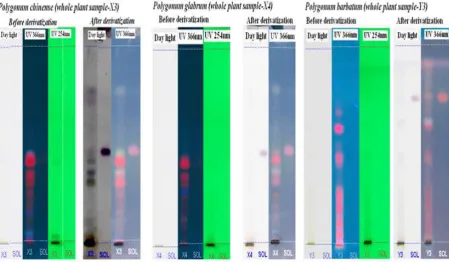
The chromatogram (Figure 1) shows terpenoid profile of whole plant methanol extract of Polygonum species (P. chinense –X3, P. glabrum –X4 and P. barbatum –Y3) and is compared with solanesol standard. Blue-violet coloured zones at day light mode present in the solanesol standard and plant samples track were observed in the chromatogram after derivatization and this confirmed the presence of terpenoid compounds in the whole plant extracts of Polygonum species (P. chinense –X3, P. glabrum –X4 and P. barbatum –Y3) (Figure 1).
Figure 1: Chromatogram for terpenoid compounds in the whole plant methanol extract of Polygonum species.
The 3D display of densitogram for terpenoid profile shows all tracks of Polygonum species (P. chinense –X3, P. glabrum –X4 and P. barbatum –Y3) and solanesol standard scanned at 500nm (Figure 2).
Figure 2: HPTLC densitogram 3D display of all tracks for terpenoid compounds in the whole plant methanol extract of Polygonum species (X3/X4/Y3) and Standards (Solanesol for X3/X4/Y3).
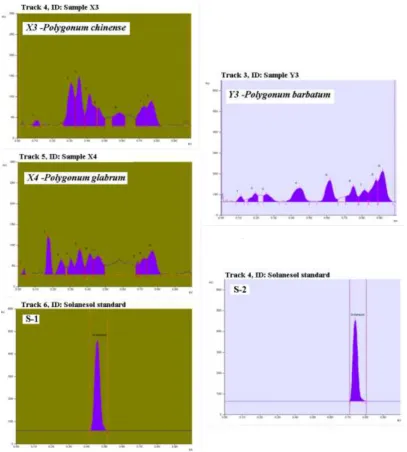
Figure 3: Densitogram showing the HPTLC analysis of terpenoid compounds in the whole plant methanol extracts of Polygonum species (X3/X4/Y3); and Solanesol standard ‘S-1’ (for
X3/X4) scanned at 500nm and Solanesol standard ‘S-2’ (for Y3) scanned at 500nm.
HPTLC analysis for terpenoid profile in the whole plant methanol extract of Polygonum species (P. chinense –X3, P. glabrum –X4 and P. barbatum –Y3) showed several peaks (Rf -values)
of compounds (Table 1; Figure 3) and were compared with solanesol standard.
Table 1: Peak table for HPTLC analysis of terpenoid compound profile in the whole plant methanol extract of Polygonum species.
P. chinense (X3) Peak Rf Height Area Assigned substance
X3 1 0.11 12.8 320.5 Terpenoid 1
X3 2 0.31 103.3 3562.5 Terpenoid 2
X3 3 0.36 117.4 3348.5 Terpenoid 3
X3 4 0.41 77.3 2929.1 Terpenoid 4
X3 5 0.47 43.1 1140.8 Terpenoid 5
X3 6 0.59 31.9 1662.7 Unknown
X3 7 0.73 47.8 192.8 Terpenoid 6
X3 8 0.77 59.4 2273.5 Terpenoid 7
X4 1 0.03 13.7 118.3 Unknown
X4 2 0.17 90.5 1891.8 Terpenoid 1
X4 3 0.25 35.3 1002.7 Terpenoid 2
X4 4 0.30 38.0 929.7 Terpenoid 3
X4 5 0.35 60.3 1818.3 Terpenoid 4
X4 6 0.41 49.8 1510.3 Terpenoid 5
X4 7 0.46 44.4 1839.2 Unknown
X4 8 0.69 31.7 394.7 Unknown
X4 9 0.72 38.8 1234.3 Terpenoid 6
X4 10 0.77 57.0 2291.1 Terpenoid 7
P. barbatum (Y3) Peak Rf Height Area Assigned substance
Y3 1 0.11 27.1 614.0 Terpenoid 1
Y3 2 0.20 39.9 1256.5 Unknown
Y3 3 0.26 36.4 1392.2 Unknown
Y3 4 0.45 66.3 3640.1 Terpenoid 2
Y3 5 0.62 104.1 3986.1 Terpenoid 3
Y3 6 0.75 75.9 2717.1 Terpenoid 4
Y3 7 0.82 56.9 1983.9 Terpenoid 5
Y3 8 0.88 106.5 3279.1 Terpenoid 6
Y3 9 0.92 147.9 5365.2 Terpenoid 7
Control-1 (X3/X4) 1 0.46 434.3 14285.0 Solanesol standard
Control-2 (Y3) 1 0.74 400.9 10819.7 Solanesol standard
The methanol extract of P. chinense (X3) showed 8 compounds with peak Rf values ranging
from 0.11 to 0.77, peak height ranging from 12.8 to 117.4 and peak area ranging from 192.8 to 3565.5 as compared to solanesol standard (0.46, 434.3 and 14285.0, respectively). Out of 8 compounds detected, 6 compounds (peak No. 2-4, 7 & 8) were identified as terpenoids and others were unknown (Table 1-X3; Figure 3-X3).
The whole plant methanol extract of P. glabrum (X4) showed 10 compounds with varied peak Rf values (0.03-0.77), peak height (13.7-90.5) and peak area (118.3-2291.1) as compared to
solanesol standard (0.48, 434.3 and 14285.0, respectively). Out of 10 compounds detected, 7 compounds (peak no. 2-6, 9 & 10) were identified as terpenoids and others were unknown (Table 1-X4; Figure 3-X4).
Polygonum barbatum (Y3) whole plant methanol extract showed 9 compounds (Table 1-Y3) with peak Rf values ranging from (0.11 to 0.92, peak height from 27.1 to 147.9.5 and peak area from
614.0 to 5365.2 as compared to solanesol standard (0.74, 400.9 and 10819.7, respectively) and out of 9 compounds, 7 compounds (peak No. 1, 4-9) were identified as terpenoids and the remaining were unknown (Table 1-Y3; Figure 3-Y3).
In general, the two terpenoid compounds (peak No. 4 & 8) of P. chinense and of P. glabrum (peak No. 6 & 10) showed same peak Rf values (0.41 & 0.77, respectively). Another one terpenoid
compound (peak No. 1) of P. chinense and of P. barbatum (peak No. 1) was also showed similar peak Rf values (0.11). On the other hand, none of the compounds detected in the P. glabrum and P.
barbatum showed similar peak Rf values (Table 1; Figure 3).
The results of present study indicate that the HPTLC analysis of methanol extracts of Polygonum species make certain the presence of terpenoid compounds and the nature and number of terpenoids present in the polygonum species is varied.
IV. ACKNOWLEDGMENT
The authors thank to the Management Authorities, the Principal, S.T Hindu College, and the HOD, Department of Botany and Research Centre, S.T. Hindu College, Nagercoil, Kanyakumari District, India for providing necessary facilities and encouragement.
BIBLIOGRAPHY
[2] Penuelas J, Munne-Bosch S. Isoprenoids: an evolutionary pool for photoprotection. Trends in Plant Science, 2005; 10(4): 166–169.
[3] Withers ST, Keasling JD. Biosynthesis and engineering of isoprenoid small molecules. Applied Microbiology and Biotechnology, 2007; 73(5): 980–990.
[4] https://en.wikipedia.org/wiki/Polygonum.
[5] Almey AAA, Khan CAJ, Zahir IS, Suleiman KM, Aisyah MR, Rahim KK. Total phenolic content and primary antioxidant activity of methanolic and ethanolic extracts of aromatic plants leaves. Int. Food Res. J., 2010; 17: 1077– 1084.
[6] Bunawan, H., Talip, N., Noor NM. Foliar anatomy and micromorphology of Polygonum minus Huds and their taxonomic implications. Aust. J. Crop Sci., 2011; 5: 123–127.
[7] Uyub AM, Nwachukwu IN, Azlan AA, Fariza SS. In-vitro antibacterial activity and cytotoxicity of selected medicinal plant extracts from Penang Island Malaysia on metronidazole-resistant-Helicobacter pylori and some pathogenic bacteria. Ethnobotany Res. Appl., 2010; 8: 95–106.
[8] Mackeen MM, Ali AM, El-Sharkawy SH, Manap MY, Salleh KM, Lajis NH, et al. Antimicrobial and cytotoxic properties of some Malaysian traditional vegetables (Ulam). Pharm. Biol., 1997; 35: 174–178.
[9] Huda-Faujan N, Noriham A, Norrakiah AS, Babji AS. Antioxidant activity of plants methanolic extracts containing phenolic compounds. Afri. J. Biotechnol., 2009; 8(3): 484–489.
[10]Ali M, Mackeen MM, El-Sharkawy SH, Abdul Hamid J, Ismail NH, Ahmad F, et al. Antiviral and cytotoxic activities of some plants used in Malaysian indigenous medicine. Pertanika J. Trop Agric. Sci., 1996; 19: 129–136. [11]Abdullah MZ, Mavaddat MH, Mohd AJ. Antioxidant and anticancer activities of Polygonum minus, Alpinia
galanga and Etlingera elatior. Open Conference Proc. J., 2013; http://dx.doi.org/10.2174/2210289201304010202. [12]Gamble JS. Flora of the Presidency of Madras. Volume 1-III. Published under the authority of the Government of
India. Botanical Survey of India, Calcutta, pp. 1-1390, 1956.
[13]Kirtikar KR, Basu BD. Indian Medicinal Plants. Volume I-IV. 2nd Edi. Bishen Singh Mahendra Pal Singh, 23-A, New Connaught Place, Dehra Dun-248001, pp. 1-2791, 2003.