New Approach for Fuzzy Control and Analysis of
Queueing System with Flexible Service Time
Zafar Zafari, Javad Tavakoli
Abstract1– Fuzzy control of queues is a new method for controlling cost of the system, number of customers waiting in the queue and many other aspects of queues. This paper proposes fuzzy control approach for reducing cost of the system.
M
/
F
/
1
(Poisson arrival and fuzzy service rate) with flexible service time is examined in this paper. All the fuzzy mathematics rules in this paper are based on Zadeh’s extension principle, Mamdani implication, possibility and probability concept. At the end of this paper a simple numerical example is presented.I. INTRODUCTION
Queueing theory is a classical mathematical method for studying the queues such as average waiting time and average number of customers in the system [2], [3]. Fuzzy queueing and fuzzy control of queues would be a new approach for surveying the queueing systems. If we let service time be expressed by possibility rather than probability, then fuzzy queueing method would be a more realistic approach than classical queueing theory methods.
1
/
/
F
M
(Poisson arrival and fuzzy service rate) with flexible service time is examined in this paper, and the objective is to employ a fuzzy policy to reduce the costs of the system and control the average number of customers in the queue. All the fuzzy mathematics rules in this paper are based on Zadeh’s extension principle [1], Mamdani implication, possibility and probability concept. The results of this paper can be extended to other queueing systems.
II.
M
/
F
/
1
QUEUES IN FUZZY ENVIROMENT Consider we have a queueing system with Poisson arrival, one server and fuzzy service time. The arrival rate isλ
and the discipline is first in first served. Suppose that the service time is a fuzzy set denoted byS
~
. ThereforeS
~
={
t
∈
ℜ
+,
µ
s(
t
)
>
0
}
. Imagine after each service completion we have a new state. The number of customers that a person whose service is just completed
Manuscript received January 07, 2011.
Zafar Zafari is graduate student in department of Mathematics at University of British Columbia, 3333 University Way, Kelowna, BC, Canada, V1V 1V7 (email: [email protected]).
Javad Tavakoli is associate professor in department of Mathematics at University of British Columbia, 3333 University Way, Kelowna, BC, Canada, V1V 1V7 (email: [email protected]).
sees in the system is considered as a state of the system. Therefore the Probability that we move from state
i
toj
is identical to the probability that
j
−
i
+
1
customers enter the system during the service timet
. The probability ofi
arrivals during service timet
is denoted byP
~
i. So this is a Markov chain and since all the probabilities are fuzzified, it’s considered as fuzzy Markov chain. We can show this fuzzy Markov chain as follows [5]:
=
.
.
.
.
.
.
.
.
.
.
.
.
.
.
.
.
.
.
.
.
.
.
.
.
.
~
~
0
0
.
.
.
~
~
~
0
.
.
.
~
~
~
~
.
.
.
~
~
~
~
~
1 0 2 1 0 3 2 1 0 3 2 1 0P
P
P
P
P
P
P
P
P
P
P
P
P
P
ijWe need to solve the stationary equations. The stationary equations are as follows:
0
~
P
π
0+P
~
0π
1=π
0,P
~
1π
0+P
~
1π
1+P
~
0π
3=π
1and so on. The results are as follows:,
1
0
λ
t
π
=
−
[
exp(
)
1
]
)
1
(
1
=
−
λ
t
λ
t
−
π
,2
,
)!
1
(
)
(
)!
(
)
(
)
exp(
)
1
(
)
1
(
1 1≥
−
−
+
−
×
−
−
=
− − − = −∑
n
k
n
t
k
k
n
t
k
t
k
t
k n k n n k k n nλ
λ
λ
λ
π
iand therefore
)
1
(
2
)
2
(
t
t
t
L
W
λ
λ
λ
−
−
=
=
.We understand from above formulas that
L
andW
are also fuzzy sets. So,
−
−
=
,
(
)
)
1
(
2
)
2
(
t
t
t
t
L
λ
µ
sλ
λ
and
−
−
=
,
(
)
)
1
(
2
)
2
(
t
t
t
t
W
λ
µ
sλ
III. FUZZY CONTROL
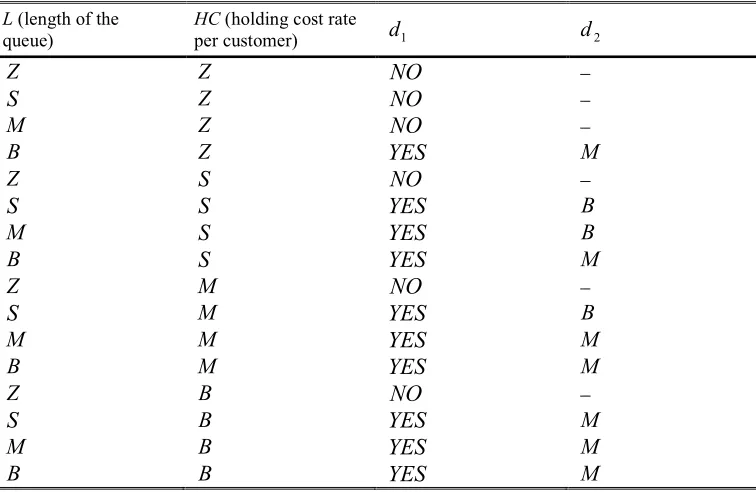
In this part we want to employ a policy to control the service time of queueing system in fuzzy environment. As Heyman has proved the optimal policy for costs, we just keep the server on as long as there is at least one customer in the system [4]. When system gets empty we turn the server off and the only thing we need to specify is when turn the server on. Suppose that in our system we have switching cost denoted by
SC
(whenever we turn the server on), Holding cost rate per customer (HC
) and server running cost rate (RC
). Also suppose that we have a flexible server which can switch from one service time to another one. The important fact in the real world is that running cost rate depends on the service rate (higher service rate=higher service running cost). So we should try to employ a policy to control the service time after turning on the server. Our fuzzy controller has twooutputs. One is
d
1which indicates whether or not the server is on and the other isd
2which determines the service time. Now we need to know our inputs to be able to define our control logic.If there is no switching cost , obviously it will be optimal to turn the server on as soon as one customer enters to the system. But since we have a big switching cost in most of the cases, we turn the server on when the accumulated holding cost (
AHC
)gets big enough to comptete with switching cost (SC
):∑
=
ii
HCS
AHC
,where
S
iis the number of customers in the system in theith
unit of time.Since we have the average arrival rate
λ
, therefore after first unit time we have averageλ
customers in the system. The average accumulated holding cost after first unit of time will beAHC
=
HC
λ
/
2
. Aftern
units of time the average accumulated holding cost will be2
/
2
/
)
1
2
(
...
2
/
5
2
/
3
2
/
2
HC
n
HC
n
HC
HC
HC
AHC
λ
λ
λ
λ
λ
=
−
+
+
+
+
=
.
Since when
AHC
gets equal to switching costSC
, we turn the server on (d
1is on), therefore.
2
2
/
2
HC
SC
n
SC
HC
n
λ
[image:2.612.118.496.492.738.2]λ
=
→
=
TABLE I. Rule base
L (length of the queue)
HC (holding cost rate
per customer)
d
1d
2Z
Z
NO
−S
Z
NO
−M
Z
NO
−B
Z
YES
M
Z
S
NO
−S
S
YES
B
M
S
YES
B
B
S
YES
M
Z
M
NO
−S
M
YES
B
M
M
YES
M
B
M
YES
M
Z
B
NO
−S
B
YES
M
M
B
YES
M
So when accumulated holding cost gets equal to length of the queue is approximately
HC
SC
n
L
λ
λ
λ
=
2
=
.Therefore when the queue length is
λ
2
SC
turn the server on (d
1=
on
). Also we know that higher theh
, the easier it is to make a decision to turn the server on.Now we should define the membership function of and
d
2(service time). We computed that when length of the queue getsλ
2
SC
λ
HC
we turn the dormant server on. Soλ
2
SC
λ
HC
is consideredour normalized interval is [
0
,
6
], we should scaleHC
SC
λ
λ
2
to6
, so the scaling factor willHC
SC
λ
λ
2
6
.
FIGURE I. Membership function: normalized input variable
hen accumulated holding cost gets equal to
SC
, theHC
SC
λ
, we ). Also we know that the , the easier it is to make a decision to turn thewe should define the membership function of
h
,L
time). We computed that when length of rn the dormant
BIG
. Since ], we should scale , so the scaling factor will beThe scaling factor for
HC
is6
SC
functions for
L
andHC
will be like figure I and II, respectively.We computed
)
1
(
2
)
2
(
~
t
t
t
P
i
L
i
i
λ
λ
λ
−
−
=
=
∑
.The service time (
t
) by whichHC
SC
λ
λ
2
), is also consideredshould solve the following equation, which is
)
1
(
2
)
2
(
t
t
t
λ
λ
λ
−
−
HC
SC
λ
λ
2
=
.We denote bigger
t
we get from above equation by and consider it asBIG
. Therefore the scaling factor for2
d
is6
A
(figure III).. Membership function: normalized input variable
L
SC
. The membership be like figure I and II,L
isBIG
(L
=
is also considered as
BIG
. So we should solve the following equation, which is:we get from above equation by
A
FIGURE II. Membership function: normalized input
FIGURE III. The
IV. NUMERICAL EXAMPLE Suppose that we have a queueing system
M
arrival rateλ
=
1
, holding cost rateh
=
88
switching cost
SC
=
100
. Suppose that the length of the queue is1
(L
=
1
). The scaling factor forSC
/
6
. So88
.
88888
is scaled down to333333
.
5
100
6
88888
.
88
×
≈
.
Also the scaling factor for
L
is. Membership function: normalized input
HC
The Membership function: normalized output
d
21
/
/
M
M
with88888
.
88
and. Suppose that the length of the . The scaling factor for
HC
is4
2
6
=
HC
SC
λ
λ
.
So
L
=
1
is scaled to4
.According to figure II,
HC
=
5
.
with grade
0
.
33333
and isBIG
Also from figure I, we understand that
MEDIUM
with grade1
.d
1 will be outputs areYES
. From table 1 Mamdani implication we have the follow3333
.
isMEDIUM
If
HC
isMEDIUM
with grade0
.
33333
andL
isMEDIUM
with grade1
, thend
1 isYES
with grade33333
.
0
.If
HC
isBIG
with grade0
.
66666
andL
isMEDIUM
with grade1
, thend
1 isYES
with grade6666
.
0
. Because all the decisions ond
1 isYES
, then the final decision ond
1 is alsoYES
. [image:5.612.69.267.462.721.2]According to Mamdani implication and fuzzy rule base in table 1, the decision on
d
2(service time) is as follows: IfHC
isMEDIUM
with grade0
.
33333
andL
isMEDIUM
with grade1
, thend
2 isMEDIUM
with grade0
.
33333
.If
HC
isBIG
with grade0
.
6666
andL
isMEDIUM
with grade1
, thend
2
isMEDIUM
withgrade
0
.
6666
.According to figure III and above decisions, the peak values and heights of the fuzzy set are as follows:
e
1=
3
,3
2
=
e
,f
1=
0
.
33333
,f
2=
0
.
6666
. Now by the height method of defuzzification, our final decision on2
d
is3
99
.
2
2
1
2
=
=
≈
∑
=i
i i i
f
e
f
d
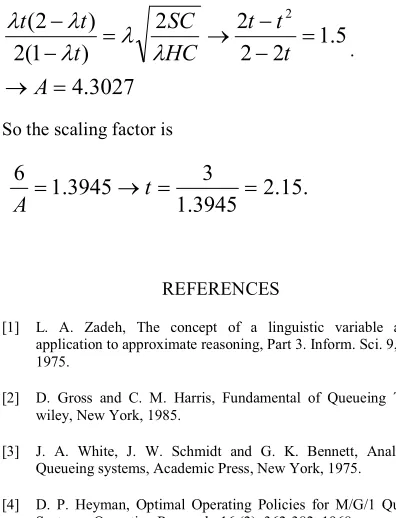
.This is a normalized service time (
t
). For computing the original service time:3027
.
4
5
.
1
2
2
2
2
)
1
(
2
)
2
(
2=
→
=
−
−
→
=
−
−
A
t
t
t
HC
SC
t
t
t
λ
λ
λ
λ
λ
.
So the scaling factor is
.
15
.
2
3945
.
1
3
3945
.
1
6
=
=
→
=
t
A
REFERENCES
[1] L. A. Zadeh, The concept of a linguistic variable and its application to approximate reasoning, Part 3. Inform. Sci. 9, 43-64, 1975.
[2] D. Gross and C. M. Harris, Fundamental of Queueing Theory, wiley, New York, 1985.
[3] J. A. White, J. W. Schmidt and G. K. Bennett, Analysis of Queueing systems, Academic Press, New York, 1975.
[4] D. P. Heyman, Optimal Operating Policies for M/G/1 Queueing Systems, Operation Research, 16 (2), 362-382, 1968.