Please cite this article as: Y. Dorfeshan, S. M. Mousavi, B. Vahdani,V. Mohagheghi, Solving Critical Path Problemin Project Networkby a New Enhanced Multi-objective Optimization of Simple Ratio Analysis Approach with Interval Type-2 Fuzzy Sets, International Journal of Engineering (IJE), TRANSACTIONS C: Aspects Vol. 30, No. 9, (September 2017) 1352-1361
International Journal of Engineering
J o u r n a l H o m e p a g e : w w w . i j e . i rSolving Critical Path Problem
in Project Network
by a New Enhanced
Multi-objective Optimization of Simple Ratio Analysis Approach with Interval Type-2
Fuzzy Sets
Y. Dorfeshana, S. M. Mousavi*a, B. Vahdanib,V. Mohagheghia
a Department of Industrial Engineering, Faculty of Engineering, Shahed University, Tehran, Iran
b Department of Industrial Engineering, Faculty of Industrial and Mechanical Engineering, Qazvin Branch, Islamic Azad University, Qazvin, Iran
P A P E R I N F O
Paper history:
Received 17 February 2017 Received in revised form 12 May 2017 Accepted 07 July 2017
Keywords:
Project Critical Path Problem Relative Preference Relation Interval Type-2 Fuzzy Sets
Multi-objective Optimization of Simple Ratio Analysis Method
A B S T R A C T
Decision making is an important issue in business and project management that assists finding the optimal alternative from a number of feasible alternatives. Decision making requires adequate consideration of uncertainty in projects. In this paper, in order to address uncertainty of project environments, interval type-2 fuzzy sets (IT2FSs) are used. In other words, the rating of each alternative and weight of each criterion are expressed by IT2FSs. Moreover, for obtaining weights of criteria, interval type-2 fuzzy analytic hierarchy process (AHP) method is employed. In addition, a new enhanced model of multi-objective optimization on the basis of simple ratio analysis (MOOSRA) method is developed with IT2F-relative preference relation. Finally, to illustrate applicability of the introduced approach, an existing application from literature is adopted and solved.
doi: 10.5829/ije.2017.30.09c.08
1. INTRODUCTION1
Multi-criteria decision making (MCDM) is one of the fastest growing areas. Since the acceptance of MCDM in areas of operation research and management science, several methodologies have been developed based on this discipline. In the conventional MCDM approaches, evaluation ratings and criteria weights are expressed by exact values. In other words, the problem is considered under certain environments. While in reality, the decision environment is not certain and has vagueness.
To address uncertainty, evaluation ratings and criteria weights in fuzzy MCDM (FMCDM) problems are expressed by imprecision and vagueness. As a result, ratings and weights are displayed by linguistic terms [1-4] which are then transferred into fuzzy
numbers [5-7]. To solve FMCDM problems,
defuzzification or fuzzy generalization was used to generalize classical MCDM methods under fuzzy
*Corresponding Author’s Email: [email protected] (S. M. Mousavi)
environment. As a matter of fact, defuzzification causes loss of fuzzy messages.
One practical approach in FMCDM is using the fuzzy preference relation. It is a total ordering relation, which satisfies reciprocal and transitive laws on fuzzy numbers. Moreover, it satisfies a total ordering relation on fuzzy numbers. Given these facts, it can be concluded that applying preference relation is more reasonable in comparison with defuzzification in ranking fuzzy numbers. In other words, defuzzification cannot present preference degree between two fuzzy numbers and loses some messages of fuzziness [8].
and is less sensitive to large variation in the values of the criteria [11, 12]. In order to avoid negative outcomes, the MOOSRA method applies the simple ratio of the overall scores of the beneficial and non-beneficial criteria. Moreover, this process applies output and input evaluation to assist decision making process [10].
In relation to new research on fuzzy multi-criteria decision making that, Wei [13] has expressed interval valued hesitant fuzzy uncertain linguistic aggregation operators in multiple attribute decision making problems. Lu and Wei [14] have introduced the multiple attribute decision making (MADM) problem based on the arithmetic and geometric aggregation operators with dual hesitant fuzzy uncertain linguistic information. Moreover, interval valued dual hesitant fuzzy linguistic geometric aggregation operators in multiple attributes decision making problem have been presented by Wei et al. [15]. Furthermore, a cross entropy of picture fuzzy sets for multiple attribute decision making problems was introduced by Wei [16].
Apart from applying the right set of decision making methods, an important approach in FMCDM is using proper fuzzy sets. Given the high degree of uncertainty in project environment, applying classic fuzzy sets could cause some issues. Type-1 fuzzy sets (T1FSs) despite their novelty in expressing uncertainty in lack of historical data have several shortcomings. One is that in these sets decision maker (DM) has to use a precise value in a range [0, 1] to express membership degree [17]. One of the approaches used to overcome issues of T1FSs is using T2FS. The concept of type-2 fuzzy sets (T2FSs) initially introduced by Zadeh [18] have fuzzy membership function. In other words, each member of these sets has a fuzzy membership degree [19]. Type-2 fuzzy sets involve more uncertainties in comparison with type-1 fuzzy sets. They provide the DM with additional degrees of freedom to express the uncertainty and the fuzziness of the real world situations. Several scholars have recently applied T2FSs to address uncertain project environment [20, 21].
Critical path method (CPM) is the most commonly used project management technique for planning projects in real-world applications. This method assists project managers to obtain the completion time and critical activities of the project. The main aim is to assist decision makings concerning concentration of resources to reduce project completion time. In other word, critical path is the route in which the total float time equals zero. In past, the time was a determinative criterion to specify the critical path, but gradually cost, quality and safety added to time as effective criteria for determining critical path [22].
Regarding research in project scheduling area, Chanas and Zieliński [23] have expressed a solution for determine critical path by using fuzzy activity times. Moreover, a method for specifying critical path by
means of fuzzy sets theory was presented by Liang and Han [24]. Chen and Hsueh [25] have introduced a simple fuzzy approach to determine critical path by using linear programing. Furthermore, a new method for project scheduling problems by trapezoidal fuzzy numbers was presented by Shanmugasundari and Ganesan [26]. Kaur and Kumar [27] have introduced a linear programing approach for solving critical path problems with fuzzy parameters. Also, a project scheduling method using triangular intuitionistic fuzzy numbers was expressed by Elizabeth and Sujatha [28]. Kazemi et al. [29] have presented an approach to specify critical path with random fuzzy activity times.
To conclude from the above, given the advantages of T2FSs, applying them in project environment is a practical approach. However, only a small number of studies have applied them to address project uncertainty. On the other hand, given the advantages of the relative preference relation and MOOSRA method for decision making, they have not been applied in project decision making problems. This paper, in order to overcome the existing gaps in the literature, presents a new approach that combines the extension of relative preference relation to interval type-2 fuzzy sets and the development of the MOOSRA method under IT2F uncertainty. Moreover, this paper offers a new ranking index based on the aforementioned methods. To illustrate the novelties of this paper, the following is presented:
To properly address the existing uncertainty in the project environment, IT2FSs are applied.
An enhanced MOOSRA under IT2FS uncertainty is introduced to address the multi-criteria decision making problem. This approach provides this decision-making problem with better ability in ranking the alternatives.
An extension of the relative preference relation under IT2F-environment is developed for obtaining priority degree of each alternative by considering efficient criteria.
A hybrid method under IT2FSs is developed to gain a final ranking.
The paper proceeds as follows. Section 2 expresses developed preference relation method under IT2FSs. Section 3 introduces proposed method. Section 4 presents the application of proposed method. Section 5 expresses sensitivity and comparative analysis. Finally, Section 6 concludes the paper.
2. INTRODUCING A NEW IT2F RELATIVE PREFERENCE RELATION METHOD
If A and B are two trapezoidal IT2F numbers, then the fuzzy preference relation P is a fuzzy subset of
R*R with membership function ( , )
p A B
representing
preference degree of A over B . We define:
( , ) 1
( , )
2 ( , )
U U
P
P L L
P A B A B A B
1 4 2 3
3 2 4 1
1 4 2 3
3 2 4 1
( ) ( ) ( ) ( ) 1 1 2 2 1
2 ( ) ( )
( ) ( )
1
1
2 2
U U U U l u h g U U U U g h u l
U
L L L L l u h g L L L L g h u l
L
a b a b
a b a b
T
a b a b
a b a b
T (1) where,
1 4 2 3
3 2 4 1
1 4
1 4 2 3
3 2 4 1
1 4 ( ) ( ) ( ) ( ) 2 ( ) ( ) ( ) ( ) 2 2( )
U U U U
l u h g
U U U U
g h u l
U U
l u
U
U U U U
l u h g
U U U U
g h u l
U U U U
u l l u
t t t t
t t t t
if t t T
t t t t
t t t t
t t if t t
(2)
1 4 2 3
3 2 4 1
1 4
1 4 2 3
3 2 4 1
4 1 1 4
( ) ( ) ( ) ( ) 2 ( ) ( ) ( ) ( ) 2 2( )
L L L L
l u h g
L L L L
g h u l
L L
l u
L
L L L L
l u h g
L L L L
g h u l
L L L L
u l l u
t t t t
t t t t
if t t T
t t t t
t t t t
t t if t t
(3) where,
1 1 1 2 2 2
3 3 3 4 4 4
1 1 1 2 2 2
3 3 3 4 4 4
1 1 1 2 2 2
3 3
max , , max , ,
max , , max ,
min , , min , ,
min , , min ,
max , , max , ,
max
L L L L L L
l l l h h h
L L L L L L
g g g u u u
L L L L L L
l l l h h h
L L L L L L
g g g u u u
U U U U U U
l l l h h h
U
g g
t a b t a b
t a b t a b
t a b t a b
t a b t a b
t a b t a b
t a
3 4 4 4
1 1 1 2 2 2
3 3 3 4 4 4
, , max ,
min , , min , ,
min , , min ,
U U U U U
g u u u
U U U U U U
l l l h h h
U U U U U U
g g g u u u
b t a b
t a b t a b
t a b t a b
(4)
In addition, if
1, 2, ..., n
S X X X indicate a set consisting
of n trapezoidal fuzzy numbers in case:
1 2 3 4 1 2
1 2 3 4 1 2
(( , , , ; ( ), ( )),
( , , , ; ( ), ( )))
U U U U j jl jh jg ju
U U
j j
L L L L L L
jl jh jg ju j j
X x x x x H X H X
x x x x H X H X S
where
j=1,2,..,n. By extension principle,
1 2 1 2 3
4 1 2 1 2 3
4 1 2
(1 / ) ( , ,..., ) (( , , ,
; ( ), ( )), ( , ,
, ; ( ), ( )))
min min
min min
U U U n jl jh jg
U L L L
ju jl jh jg
L ju U U j j j j L L j j j j
X n X X X x x x
x H X H X x x x
x H X H X
which is
assumed to be average of
1, 2, ..., n
X X X . Then, the
relative preference relation p*with membership function
*( j, )
p X X
representing relative preference
degree of
j
X over X in S, where j1, 2,...,n is defined as:
* *
*
1 4 2 3
3 2 4 1
1 4 2 3
3 2 4 1
( , ) 1
( , )
2 ( , )
( ) ( ) ( ) ( ) 1 1 2 2 1
2 ( ) ( )
( ) ( ) 1 1 2 2 U U j p j
p L L
j p
U U U U
jl u jh g
U U U U
jg h ju l
U
S
L L L L
jl u jh g
L L L L
jg h ju l
L
S
X X
X X
X X
x x x x
x x x x
T
x x x x
x x x x
T (5) where
1 4 2 3
3 2 4 1
1 4
1 4 2 3
3 2 4 1
4 1 1 4
( ) ( ) ( ) ( ) 2 ( ) ( ) ( ) ( ) 2 2( )
U U U U
sl su sh sg
U U U U
sg sh su sl
U U
sl su
U
S U U U U
sl su sh sg
U U U U
sg sh su sl
U U U U
su sl sl su
t t t t
t t t t
if t t T
t t t t
t t t t
t t if t t
(6)
1 4 2 3
3 2 4 1
1 4
1 4 2 3
3 2 4 1
4 1 1 4
( ) ( ) ( ) ( ) 2 ( ) ( ) ( ) ( ) 2 2( )
L L L L
sl su sh sg
L L L L
sg sh su sl
L L
sl su
L
S L L L L
sl su sh sg
L L L L
sg sh su sl
L L L L
su sl sl su
t t t t
t t t t
if t t T
t t t t
t t t t
t t if t t
1 1 2 2
3 3 4 4
1 1 2 2
3 3 4 4
1 1 2 2
3 3 4 4
max , max ,
max , max
min , min ,
min , min
max , max ,
max , max
L L L L
Sl jl sh jh
j j
L L L L
sg j jg su j ju
L L L L
sl jl sh jh
j j
L L L L
sg jg su ju
j j
U U U U
sl jl sh jh
j j
U U U
sg j jg su j ju
t x t x
t x t x
t x t x
t x t x
t x t x
t x t x
1 1 2 2
3 3 4 4
min , min ,
min , min
U
U U U U
sl jl sh jh
j j
U U U U
sg jg su ju
j j
t x t x
t x t x
(8)
3. PROPOSED ENHANCED DECISION APPROACH
In this paper, IT2FSs are used to consider uncertainty. Also, the MOOSRA method is extended to IT2FSs. Moreover, the method presented by [30] based on relative preference relation is extended to IT2FSs for obtaining priority degree of each alternative and ranking the IT2F numbers. Finally, an enhanced model based on these two methods is introduced for ranking the alternatives by considering important criteria. IT2F sets are more powerful than type-1 fuzzy sets. Each member of IT2F set has a type-1 fuzzy membership degree. Type-2 fuzzy sets involve more uncertainties in comparison with type-1 fuzzy sets. They provide the DM with additional degrees of freedom to express the uncertainty and the fuzziness of the real-world situations. Also, MOOSRA method in comparison to the MOORA method does not reflect the negative performance scores and is less sensitive to large variation in the values of the criteria. In order to avoid negative outcomes, the MOOSRA method applies the simple ratio of the overall scores of the beneficial and non-beneficial criteria. Moreover, this procedure applies output and input evaluation to assist decision making process. In this paper, to use the advantages of IT2FSs and MOOSRA method, the enhanced MOOSRA method will be developed under an IT2F-environment.
Step 1. Form a team of experts who are responsible to determine the best alternative considering the evaluating criteria. Experts’ judgments on qualitative criteria are converted to their equivalent IT2FNs presented in Table 1.
Step 2. Construct the decision matrix Ypof the pth
DM and construct the average decision matrixes
Y
, respectively. The aggregated IT2F-information of the alternatives on each criterion are obtained via Equation (9).TABLE 1. Linguistic terms and their corresponding interval
type-2 fuzzy sets [31]
Linguistic terms Interval type-2 fuzzy sets
Very Low (VL) ((0,0,0,0.1;1,1), (0,0,0,0.05;0.9,0.9)) Low (L) ((0,0.1,0.1,0.3;1,1), (0.05,0.1,0.1,0.2;0.9,0.9)) Medium Low (ML) ((0.1,0.3,0.3,0.5;1,1), (0.2,0.3,0.3,0.4;0.9,0.9)) Medium (M) ((0.3,0.5,0.5,0.7;1,1), (0.4,0.5,0.5,0.6;0.9,0.9)) Medium High (MH) ((0.5,0.7,0.7,0.9;1,1), (0.6,0.7,0.7,0.8;0.9,0.9)) High (H) ((0.7,0.9,0.9,1;1,1), (0.8,0.9,0.9,0.95;0.9,0.9)) Very High (VH) ((0.9,1,1,1;1,1), (0.95,1,1,1;0.9,0.9))
Integration method is as follows:
1
1
11 1
m 1
( )
n
p p
n p
P ij m n
p p
m mn
A
A
C C
f f
Y f
f f
(9)
( ij)m n
Y f , where,
1 2
...
( )
k ij ij ij ij
f f f
f
k
. fij is an
IT2FS and 1 i m,1 j n,1pk . Also, k
denotes the number of DMs; also, A A1, 2,...,Am are
feasible alternatives and C C1, 2,...,Cn are evaluation
criteria.
Step 3. Compute the normalized IT2F decision matrix. The data are normalized using the following:
1 2 3 4
1 2
1 2 3 4
1 2
( , , , ; ( ), ( ),
( , , , ; ( ), ( )
U U U U
ij ij ij ij U U
i i
j j j j
ij L L L L
ij ij ij ij L L
i i
j j j j
a a a a
H A H A d d d d
f
a a a a
H A H A d d d d
1, 2, , , 1, 2, ,
j n i m
(10)
where
4 4
2 2
1 1 1 1
( ) ( ) ,
1, 2, 3, 4 1, 2,...,
m m
L U
j ijp ijp
i p i p
d a a
p for j n
(11)
Step 4. Determine weight of each criterion by using AHP method.
TABLE 2. Definition and interval type-2 fuzzy scales of the linguistic variables [32]
Linguistic variables Interval type-2 fuzzy scales
Absolutely strong (AS) ((7,8,9,9;1,1), (7.2,8.2,8.8,9;0.9,0.9)) Very strong (VS) ((5,6,8,9;1,1),
(5.2,6.2,7.8,8.8;0.9,0.9)) Fairly strong (FS) ((3,4,6,7;1,1),
(3.2,4.2,5.8,6.8;0.9,0.9)) Slightly strong (SS) ((1,2,4,5;1,1),
(1.2,2.2,3.8,4.8;0.9,0.9)) Exactly equal (E) ((1,1,1,1;1,1),
(1,1,1,1;1,1)) If factor i has one of the above
linguistic variables assigned to it when compared with factor j, then j
has the reciprocal value when compared with i
Reciprocals of the above
Step 4. 1. Construct the IT2F pairwise comparison matrix Ak of the kth DM and construct the average
decision matrix
A
. Each element of the pairwise comparison matrix is an IT2FS that denotes the comparative importance of two criteria. The pairwise comparison matrix is presented as follows:12 1
21 2
1 2
1 1 ( )
1
k k
n
k k
k n
K ij n n
k k
n n
a a
a a
A a
a a
12 1
12 2
1 2
1
1 / 1
1 / 1 / 1
k k
n
k k
n
k k
n n
a a
a a
a a
, A (aij)n n
(12)
Step 4. 2
.
Examine the consistency of the fuzzy pairwise comparison matrices.Let A[ ]aij be a positive reciprocal matrix and A [aij] be a fuzzy positive reciprocal matrix. If the result of the comparisons of[ ]ij
A a is consistent, then it can be concluded that the
outcome of the comparisons of [ ]
ij
A a is also
consistent [33].
Step 4. 3. Calculate the geometric mean of k type-2 fuzzy sets. Compute the fuzzy geometric mean for each criterion. The geometric mean of each row of [ ]
ij
A a is
calculated as:
1 2
n
i i i in
r A A A (13)
Step 4. 4
.
Compute the weights of the criteria by normalization. The IT2F weight of the ith criterion is calculated as:1
1 2
i i n
w
r
r
r
r
(14)Step 5. Construct weighted normalized decision matrix by multiplying weight of each criterion to decision matrix.
11 1 1
1 1
( )
W ij m n
n n
m mn n
Y v Y w
f w f w
f w f w
11 1
1
n
m mn
v v
v v
(15)
Step 6. Compute the overall performance score of each alternative (yi) by using IT2F-MOOSRA. The extension
of MOOSRA to IT2FSs is presented as follows:
1 2 3 4
1 2
1
1 2 3 4
1
1 2
(( , , ,
; ( ), ( )),
(( , , , ;
( ), ( ))
U U U U
g i i i i
U U
ij
i i
j
i n L L L L
i i i i
ij
L L
j g
i i
y y y y V
H y H y y
y y y y V
H y H y
(16)Step 7. Compute the priority of each alternative based on criteria by using the following sub steps:
In this step, a model for obtaining priority of each alternative based on criteria by using the presented method of Wang [30] by using the concept of relative preference relation and IT2FSs is introduced.
At first, by using Equations (5)-(8), the relative preference degree of obtained weight in step 4 over average is calculated. Then, the normalized decision matrix presented in step 3 is changed as follows:
1
1 11 1
1
m
p p
m
p p
n n nm
A A
C f f
C f f
(17)
Here, the priority degree (PD) of each alternative based on evaluation criteria is calculated as follows:
1 2
* 1
11 1
* 2
1 *
( , ,..., ) ( ( , ),
( , ),..., ( , )
1/ ) m
p p
p
m p
p p
n nm p n
PD PD PD
w w f f
w w
f f
w w
n
where,
1, 2,..., m
PD PD PD are the priority degrees of
1, 2,..., m
A A A alternatives based on evaluation criteria, also the
i
PD is obtained as follows:
1 * 1
2 * 2
*
* 1 1
* 2 2
* ( , ), 1
( , ), ..., ( , )
( ( , ) ) 1
( ( , ) ) 1, 2, ..., ... ( ( , ) )
,
i p
i
i p
p n
ni
p i
p i
p n ni
f w w
f
PD w w
n
w w
f
w w f
w w f i m
n
w w f
(19)
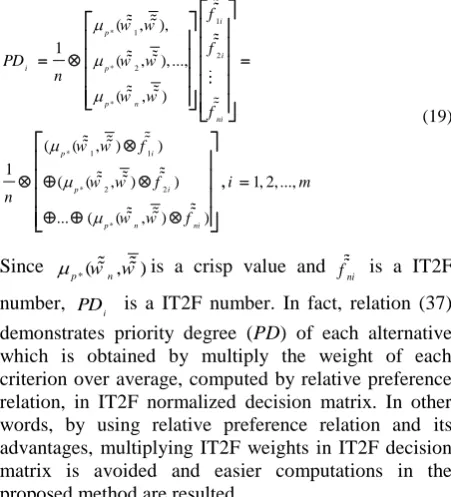
Since
*( , )
p wn w
is a crisp value and
ni
f is a IT2F
number,
i
PD is a IT2F number. In fact, relation (37) demonstrates priority degree (PD) of each alternative which is obtained by multiply the weight of each criterion over average, computed by relative preference relation, in IT2F normalized decision matrix. In other words, by using relative preference relation and its advantages, multiplying IT2F weights in IT2F decision matrix is avoided and easier computations in the proposed method are resulted.
Step 8. Combine the outcome of MOOSRA method in step 6 with the results of step 7 to present a single ranking (SR) as follow:
(1 )
i i
SR y PD (20) The value of is determined according to DM’s opinion. SR illustrates linear combination of MOOSRA method and priority degree of each alternative to obtain a better final ranking by utilization advantages of two methods. In fact, SRuses the advantages of MOOSRA
method and advantages of priority degree,
simultaneously. Some of these advantages are expressed as follows: avoiding negative performance scores (in comparison with MOORA method), being less sensitive to large variation in the values of the criteria (in comparison with MOORA method), considering more uncertainty due to applying IT2FSs, avoiding multiplying two IT2F matrixes by using advantages of relative preference relation and using relative preference relation that does not ignore fuzzy message in comparison to defuzzification.
The value of
is determined by DMs and by means of
DMs can assign various importance to each method. Step 9. This step’s result is IT2F numbers. In order to rank these numbers, relative preference relation is used as follows:1 2 3 4 1
2 1 2 3 4
1 2
(( , , , ; ( )
, ( )), , , , ;
( ), ( )))
U U U U U
i il ih ig iu i
U L L L L
i il ih ig iu
L L
i i
SR sr sr sr sr H SR H SR sr sr sr sr H SR H SR
(21)
Then,
1 2
1 2 3 4 1
2 1 2 3 4
1 2
1
( ... )
(( , , , ; min ( ),
min ( )), ( , , , ;
min ( ), min ( )))
m
U U U U U
il ih ig iu i
i
U L L L L
i il ih ig iu i
L L
i i
i i
SR SR SR SR m
sr sr sr sr H SR
H SR sr sr sr sr
H SR H SR
(22)
Here, by using Equations (5)-(8) the final ranking is obtained via computing relative preference relation of
* i
SR over *
SR .
4. APPLICATION
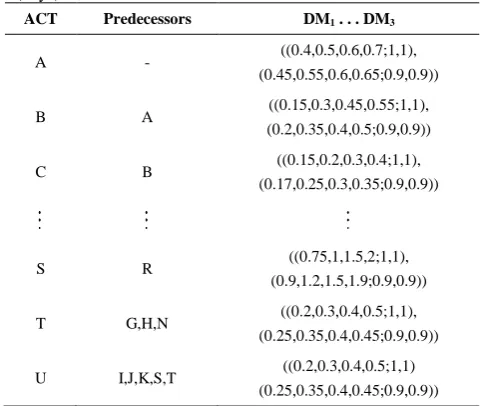
To better demonstrate the applicability of the proposed approach, an existing application example from the literature [22] is adopted and solved in this section. The aim of this application example is to determine the critical path of a project. The main activities of this project are depicted in Figure 1. To find the critical path, four criteria will be considered: time in days, cost in Euros, and quality and safety which will be assessed using the fuzzy linguistic variables are shown in Table 1. The data addressing various criteria for the project, expressed as IT2FSs by three experts, are shown in Tables 3-5.
Ranking the IT2F final results based on relation preference over the average value is carried out. The outcome is illustrated in Table 6.
1 2 3 4 5 6 7 17 18
8 9 10 12
11
13 14
15
16
A B O P Q R S U
D F H
M
C E
G
T L
N
I
J
K
TABLE 3. IT2F information of activities on quality and safety criteria
ACT Quality Safety
DM1 DM2 DM3 DM1 DM2 DM3
A MH MH M ML M ML
B ML MH M ML M ML
C ML ML L L M ML
D H MH M H MH MH
. . .
R MH MH M M M ML
S MH M ML M M ML
T MH MH M M ML ML
U MH MH M ML M ML
TABLE 4. IT2F information of activities on time criterion
(days)
ACT Predecessors DM1 . . . DM3
A - ((0.4,0.5,0.6,0.7;1,1), (0.45,0.55,0.6,0.65;0.9,0.9)) B A ((0.15,0.3,0.45,0.55;1,1),
(0.2,0.35,0.4,0.5;0.9,0.9)) C B ((0.15,0.2,0.3,0.4;1,1),
(0.17,0.25,0.3,0.35;0.9,0.9))
S R ((0.75,1,1.5,2;1,1), (0.9,1.2,1.5,1.9;0.9,0.9)) T G,H,N ((0.2,0.3,0.4,0.5;1,1),
(0.25,0.35,0.4,0.45;0.9,0.9)) U I,J,K,S,T ((0.2,0.3,0.4,0.5;1,1)
(0.25,0.35,0.4,0.45;0.9,0.9))
TABLE 5. IT2F information of activities on cost criterion
(100 euros)
ACT. DMs
A ((7,7.5,7.75,8;1,1), (7.25,7.6,7.7,7.9;0.9,0.9)) B ((2.85,3,3.1,3.25;1,1),
(2.95,3,3.1,3.15;0.9,0.9))
C ((4,5,6,7;1,1),
(4.5,5.5,5.9,6.8;0.9,0.9)) D ((21,22,27,30;1,1),
(21.5,22.5,25.5,28;0.9,0.9))
R ((4,5,6,7;1,1),
(4.5,5,5.5,6.5;0.9,0.9))
S ((7,7.5,8.25,9;1,1), (7.25,7.6,8,8.5;0.9,0.9)) T ((4.5,5,5.75,6.5;1,1),
(4.7,5.2,5.5,6;0.9,0.9)) U ((4.5,5,5.75,6.5;1,1),
(4.7,5.2,5.5,6;0.9,0.9))
TABLE 6. Final ranking
Path Critical Path Preference degree Ranking
1 A-B-L-M-N-T-U 0.5404 4
2 A-B-E-F-G-T-U 0.5559 3
3 A-B-C-D-F-H-T-U 0.5563 2
4 A-B-O-P-Q-R-S-U 0.5573 1
5 A-B-I-U 0.4190 7
6 A-B-J-U 0.4396 5
7 A-B-K-U 0.4315 6
5. SENSITIVITY AND COMPARATIVE ANALYSIS
In order to perform sensitivity analysis of the method, the value of in Equation (20) is changed and the results are presented. In fact, the amount of denotes the importance value of MOOSRA method and 1 depicts the importance of the priority degree of each alternative based on each criterion. At first, the amount of is set to 0.1; therefore, the amount of 1equals 0.9. The value of is increased to 1 in intervals of 0.1. The model is solved by 0.1 in step 1 and 0.2in step 2 and so on, except step 11 in which the amount of is 0. Final results of model over 11 experiments have been shown in Figure 2. Path 4 in 64% of times is the best alternative.
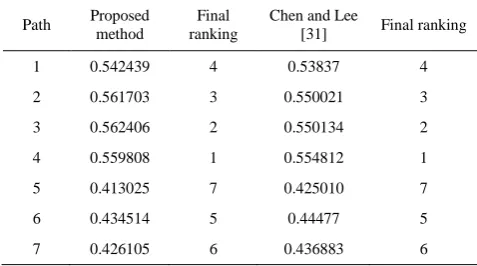
To illustrate the advantages of proposed method, the problem of critical path selection is solved by proposed method under type-1 fuzzy sets which is depicted in Table 7. Moreover, the critical path was also selected by using fuzzy TOPSIS [31]. Using TOPSIS method to find the critical path provided the same results are the presented method. The results demonstrate reliability and capability of the proposed method. Also, the results of solving problem by type-1 fuzzy sets were compared to results of solving problem under IT2FSs which is illustrated in Tables 6 and 7. It can be observed that the results are the same.
Figure 2. Sensitivity analysis
TABLE 7. Results of critical path selection under classic
fuzzy environments
Path Proposed method
Final ranking
Chen and Lee
[31] Final ranking
1 0.542439 4 0.53837 4
2 0.561703 3 0.550021 3 3 0.562406 2 0.550134 2 4 0.559808 1 0.554812 1 5 0.413025 7 0.425010 7
6 0.434514 5 0.44477 5
7 0.426105 6 0.436883 6
Nevertheless, type-2 fuzzy sets involve more uncertainties than type-1 fuzzy sets. In fact, IT2FSs are more flexible and capable than type-1 fuzzy sets and that is the reason why in this paper the proposed method is developed under IT2FS uncertainty.
6. CONCLUSION
Considering uncertainty in real-world situations is an important issue in decision making problems. Since interval type-2 fuzzy sets (IT2FSs) can express uncertainty better than type-1 fuzzy sets, in this paper the fuzzy sets were applied to address uncertainty. Moreover, a new enhanced model based on IT2F-MOOSRA method and IT2F relative preference relation has been presented for decision making and obtaining best alternative by considering efficient criteria. By extending a new method, priority degree of each alternative has been obtained; then, the results of this enhanced method have been combined with the results of MOOSRA method to achieve a ranking. In addition to obtain the final ranking, relative preference relation has been used to compare IT2F numbers. At the end, an example from the literature has been presented and solved by the presented process. Finally, sensitivity analysis and discussion of final results have been
presented. The proposed method can be applied to group decision making problems in many different project management problems. Furthermore, the proposed method provided a useful way to handle fuzzy multiple attributes group decision-making problems in a more flexible and more intelligent manner due to the fact that it used IT2FSs to represent the evaluating values and the weights of attributes. Cross entropy can be added to this method to determine the weight of each criterion. In addition, this method can be developed in hesitant, dual hesitant, interval valued hesitant and interval valued dual hesitant fuzzy sets.
7. REFERENCES
1. Soleymani, P., Mousavi, S.M., Vahdani, B. and Aboueimehrizi, A., "A new fuzzy multi-objective optimisation method with desirability function under uncertainty", International Journal
of Applied Decision Sciences, Vol. 9, No. 1, (2016), 100-120.
2. Vahdani, B., Salimi, M. and Mousavi, S., "A new compromise decision-making model based on topsis and vikor for solving multi-objective large-scale programming problems with a block angular structure under uncertainty", International Journal of
Engineering, Vol. 27, No. 11, (2014).
3. Mousavi, S., Gitinavard, H. and Vahdani, B., "Evaluating construction projects by a new group decision-making model based on intuitionistic fuzzy logic concepts", International
Journal of Engineering-Transactions C: Aspects, Vol. 28, No.
9, (2015), 1312-1320.
4. Gitinavard, H., Mousavi, S.M. and Vahdani, B., "Soft computing based on hierarchical evaluation approach and criteria interdependencies for energy decision-making problems: A case study", Energy, Vol. 118, (2017), 556-577.
5. Gitinavard, H., Mousavi, S. and Vahdani, B., "A new balancing and ranking method based on hesitant fuzzy sets for solving decision-making problems under uncertainty", International
Journal of Engineering-Transactions B: Applications, Vol.
28, No. 2, (2014), 214-222.
6. Moradi, N., Mousavi, S.M. and Vahdani, B., "An earned value model with risk analysis for project management under uncertain conditions", Journal of Intelligent & Fuzzy Systems, Vol. 32, No. 1, (2017), 97-113.
7. Vahdani, B., Salimi, M. and Mousavi, S.M., "A new compromise solution model based on dantzig–wolfe decomposition for solving belief multi-objective nonlinear programming problems with block angular structure",
International Journal of Information Technology & Decision
Making, Vol. 16, No. 02, (2017), 333-387.
8. Wang, Y.-J., "Ranking triangle and trapezoidal fuzzy numbers based on the relative preference relation", Applied mathematical
modelling, Vol. 39, No. 2, (2015), 586-599.
9. Balezentiene, L., Streimikiene, D. and Balezentis, T., "Fuzzy decision support methodology for sustainable energy crop selection", Renewable and Sustainable Energy Reviews, Vol. 17, No., (2013), 83-93.
10. Kumar, R. and Ray, A., "Selection of material under conflicting situation using simple ratio optimization technique", in Proceedings of Fourth International Conference on Soft Computing for Problem Solving, Springer., (2015), 513-519. 11. Ray, A., "Green cutting fluid selection using moosra method",
(2014). 0
5 10
1 2 3 4 5 6 7 8 9 10 11
Sensitivity analysis
12. Adalı, E.A. and Işık, A.T., "The multi-objective decision making methods based on multimoora and moosra for the laptop selection problem", Journal of Industrial Engineering
International, Vol. 13, No. 2, (2017), 229-237.
13. Wei, G., "Interval valued hesitant fuzzy uncertain linguistic aggregation operators in multiple attribute decision making",
International Journal of Machine Learning and Cybernetics,
Vol. 7, No. 6, (2016), 1093-1114.
14. Lu, M. and Wei, G.-W., "Models for multiple attribute decision making with dual hesitant fuzzy uncertain linguistic information", International Journal of Knowledge-based and
Intelligent Engineering Systems, Vol. 20, No. 4, (2016),
217-227.
15. Wei, G.-W., Xu, X.-R. and Deng, D.-X., "Interval-valued dual hesitant fuzzy linguistic geometric aggregation operators in multiple attribute decision making", International Journal of
Knowledge-based and Intelligent Engineering Systems, Vol.
20, No. 4, (2016), 189-196.
16. Wei, G., "Picture fuzzy cross-entropy for multiple attribute decision making problems", Journal of Business Economics
and Management, Vol. 17, No. 4, (2016), 491-502.
17. Mohagheghi, V., Mousavi, S.M. and Vahdani, B., "A new multi-objective optimization approach for sustainable project portfolio selection: A realworld application under interval-valued fuzzy environment", Iranian Journal of Fuzzy Systems, Vol. 13, No. 6, (2016), 41-68.
18. Zadeh, L.A., "The concept of a linguistic variable and its application to approximate reasoning—i", Information sciences, Vol. 8, No. 3, (1975), 199-249.
19. Mendel, J.M., "Type-2 fuzzy sets: Some questions and answers", in IEEE Connections, Newsletter of the IEEE Neural Networks Society. Vol. 1, (2003), 10-13.
20. Kilic, M. and Kaya, I., "Investment project evaluation by a decision making methodology based on type-2 fuzzy sets",
Applied Soft Computing, Vol. 27, (2015), 399-410.
21. Asan, U., Soyer, A. and Bozdag, E., "An interval type-2 fuzzy prioritization approach to project risk assessment",
Multiple-Valued Logic and Soft Computing, Vol. 26, No. 6, (2016),
541-577.
22. San Cristobal, J.R., "Critical path definition using multicriteria decision making: Promethee method", Journal of Management
in Engineering, Vol. 29, No. 2, (2012), 158-163.
23. Chanas, S. and Zieliński, P., "Critical path analysis in the network with fuzzy activity times", Fuzzy sets and systems, Vol. 122, No. 2, (2001), 195-204.
24. Liang, G.-S. and Han, T.-C., "Fuzzy critical path for project network", Information and Management Sciences, Vol. 15, No. 4, (2004), 29-40.
25. Chen, S.-P. and Hsueh, Y.-J., "A simple approach to fuzzy critical path analysis in project networks", Applied
Mathematical Modelling, Vol. 32, No. 7, (2008), 1289-1297.
26. Shanmugasundari, M. and Ganesan, K., "Project scheduling problems under fuzzy environment: A new solution approach",
International Journal of Pure and Applied Mathematics, Vol.
95, No. 3, (2014), 387-399.
27. Kaur, P. and Kumar, A., "Linear programming approach for solving fuzzy critical path problems with fuzzy parameters",
Applied Soft Computing, Vol. 21, (2014), 309-319.
28. Elizabeth, S. and Sujatha, L., "Project scheduling method using triangular intuitionistic fuzzy numbers and triangular fuzzy numbers", Applied Mathematical Sciences, Vol. 9, No. 4, (2015), 185-198.
29. Kazemi, A., Talebi, A. and Oroojeni Mohammad Javad, M., "Analysis of critical paths in a project network with random fuzzy activity times", AUT Journal of Modeling and
Simulation, Vol. 48, No. 2, (2016), 93-102.
30. Wang, Y.-J., "A criteria weighting approach by combining fuzzy quality function deployment with relative preference relation",
Applied Soft Computing, Vol. 14, (2014), 419-430.
31. Chen, S.-M. and Lee, L.-W., "Fuzzy multiple attributes group decision-making based on the interval type-2 topsis method",
Expert systems with applications, Vol. 37, No. 4, (2010),
2790-2798.
32. Cevik Onar, S., Oztaysi, B. and Kahraman, C., "Strategic decision selection using hesitant fuzzy topsis and interval type-2 fuzzy ahp: A case study", International Journal of
Computational intelligence systems, Vol. 7, No. 5, (2014),
1002-1021.
33. Ucal Sary, I., Oztaysi, B. and Kahraman, C., "Fuzzy analytic hierarchy process using type‐2 fuzzy sets: An application to warehouse location selection", Multicriteria Decision Aid and
Solving Critical Path Problem
in Project Network
by a New Enhanced
Multi-objective Optimization of Simple Ratio Analysis Approach with Interval Type-2
Fuzzy Sets
Y. Dorfeshana, S. M. Mousavia, B. Vahdanib,V. Mohagheghia
a Department of Industrial Engineering, Faculty of Engineering, Shahed University, Tehran, Iran
b Department of Industrial Engineering, Faculty of Industrial and Mechanical Engineering, Qazvin Branch, Islamic Azad University, Qazvin, Iran
P A P E R I N F O
Paper history:
Received 17 February 2017 Received in revised form 12 May 2017 Accepted 07 July 2017
Keywords:
Project Critical Path Problem Relative Preference Relation Interval Type-2 Fuzzy Sets
Multi-objective Optimization of Simple Ratio Analysis Method
ديكچ ه
میمصت یاهویتانرتلآ نیب زا هنیهب ویتانرتلآ ندرک ادیپ هب هک تسا هژورپ تیریدم و راک و بسک رد مهم هلاسم کی یریگ
یم کمک یندش میمصت .دنک
اب ههجاوم روظنم هب ،هلاقم نیا رد .دراد اه هژورپ رد تیعطق مدع هب یفاک هجوت هب زاین یریگ
تیعطق مدع هعومجم ،هژورپ رد دوجوم یاه ه
عون یزاف یا 2
هزاب یم هدافتسا یا و اهویتانرتلآ یبایزرا رگید ترابع هب .دوش
عون یزاف دادعا تروص هب رایعم ره نزو 2
هزاب یم نایب یا شور زا اهرایعم نزو ندروآ تسد هب یارب ،نیا رب هولاع .دوش
عون یزاف یهد نزو 2
هزاب یا
AHP
یم هدافتسا یبیکرت لدم کی ،هولاع هب .دوش شور زا
MOOSRA
طابترا هارمه هب
عون یزاف یبسن تیولوا 2
هزاب هداد هعسوت یا یم
ناشن یارب اهتنا رد .دوش نداد
یدربراک لاثم کی هدش یفرعم شور تیلباق
یم لح تایبدا رورم رد دوجوم .دوش
![TABLE 1. Linguistic terms and their corresponding interval type-2 fuzzy sets [31]](https://thumb-us.123doks.com/thumbv2/123dok_us/205846.2014899/4.595.311.539.476.624/table-linguistic-terms-corresponding-interval-type-fuzzy-sets.webp)
![TABLE 2. Definition and interval type-2 fuzzy scales of the linguistic variables [32]](https://thumb-us.123doks.com/thumbv2/123dok_us/205846.2014899/5.595.53.289.118.329/table-definition-interval-type-fuzzy-scales-linguistic-variables.webp)