
Hybrid Model for Packet Scheduling in
Wireless Sensor Network
Sangvikar Praddyumna1, Prof. Kankal Sandip2
1
M.Tech Scholar, Maharashtra Institute of Technology (MIT), Aurangabad, Maharashtra, India.
2
Assistant Prof., Maharashtra Institute of Technology (MIT), Aurangabad, Maharashtra, India.
Abstract: The Wireless Sensor Network (WSN) is the wide area as compared to the others in networking domain. So when we deal with it, there are many things on which we have to concentrate. One of the most important among them is “Scheduling of the packets through the Network”. It is having so much importance for the energy consumption and end to end data transmission delay. So the focused area should be the end to end data transmission delay. There are lot many Schemes used before like First Come First Serve also called as FCFS, Earliest Deadline First that is EDF and others to achieve the less end to end delay while sending the packet from one end to another. Some Schemes like Pre-emptive priority, Non Pre-emptive priority also used. But these Schemes are having certain disadvantages. These Scheduling algorithms incurred high processing overhead and it is not recommended. These Schemes also suffers from the large data transmission delay. In this paper, we are improving the Scheme that is used before named as “Dynamic Multilevel Priority Packet Scheduling Scheme”. In the DMP scheme, except the nodes that are present at the last level of the hierarchy in the topology have the three levels of the priority queues. The three levels are priority one, priority two, and priority three. In this paper we are mostly focused on avoiding the drop of the packets. So we are avoiding this by using taking other queue for non real time packets so that they don’t have to wait long time because of continuous arrival of real time packets. We are also reducing the hop count of the packet while sending to neighbour nodes. Keywords: Multi-hop, Hoping, Non-real time packets, Packet Scheduling, Real time packets, Wireless Sensor Network
I. INTRODUCTION
There are different big design issues in the wireless sensor network such as the data aggregation, routing protocols but among them the most important is Scheduling of the different types of packets through the network. Because of the delivery of the packet is notified through this. So here we are focusing on the packet scheduling with different schemes and priorities for different packets. So there are mainly two types of packets such as Real time packets and the non-real time packets. Real time packets are those which should be used as fast as they can and non-real time packets are those which are not that important as real time packets. These real time packets should have the highest priority. Most of the operating systems in the Wireless Sensor Networks uses First Come First Serve (FCFS) [1] scheme. This scheme processes the data packets as their arrival time. Means that whichever packet comes earlier that packet will process first. So here the drawback of the scheme is that the data packets which are at the back they will have higher processing overhead. Those packets will wait for longer time and it can be expire. So it requires more time to reach the destination. The packets should reach the destination in its given interval of time otherwise they will get expired. Other schemes which are used before are not much effective as compared to our proposed scheme. We also have to take in mind the priorities of the packets regarding type of the packet. Such as real time and non-real time packets. Real time packets should have the higher priority than that of the non-real time [17].
In this paper we are improving the Dynamic Multilevel Priority scheme that is DMP scheme. In which the nodes present there are organized in the manner that they look like hierarchical structure. If the data packets sensed by nodes from different levels then that are processed using the TDMA Scheme. Here we are having priorities for different packets such as (1) Real time (priority 1), (2) Non Real time packets came from Remote nodes (priority 2), (3) Non real time data packets from same node. While dealing with non-real time data packets with the same priorities we are using shortest job first scheme [1]. In the improvisation we are removing the drawback of droping of the packets when real time task holds the resources for long period of time and non-real time tasks have to wait for long time so there is chance of the packets might get drop.
II. FACTORS AND PACKET SCHEDULING SCHEMES
[image:2.612.194.435.130.314.2]Following are some factors through which we are classifying the packet scheduling schemes. The related schemes also described there.
Fig. 1 Classification of packet scheduling schemes [3]
A. Deadline
Deadline is one of the factor through which we are differentiating the scheduling schemes. The packet that is transmitted over the network should reach the destination before its deadline. After the deadline automatically that packet will expire. Based on this factor First come First serve that is FCFS scheme is there and Earliest Deadline First that is EDF scheme is there.
1) First come First Serve (FCFS): FCFS is the most used scheduling scheme in wireless sensor network. The one who comes first that should be served first. This is the mechanism used here. This is very commonly used scheme. The packet that comes at last that served at last. But this scheme has some disadvantages. The packets that come late have to wait for longer enough time to reach the destination. So there is possibility of expiration of packet before reaching the destination. This is also having a lot processing overhead. The execution of the FCFS policy is simply managed with a First In First Out (FIFO) queue. When the process is ready it enters the ready queue, its Process Control Block is linked on to the tail of the queue[16].
2) Earliest Deadline First :The Earliest Deadline First algorithm is basically used in real time applications. This is completely based on the deadline of the packet. Based on the deadline the packets are arranged. The packet should be reach at proper destination before the deadline of the packet. This is very efficient scheme as compared to other in terms of average waiting time. The packet that having the nearest deadline among them should send first. So no packet should expire before their delivery. Lu C. et al. [4] proposes a real-time communication architecture for large-scale sensor networks, whereby they use a priority based scheduler.
B. Priority
This is second important factor regarding the scheduling of packets. Based on the priority the packets are transmitted.
1) Non Preemptive: In non preemptive priority scheduling no packet is preempted even if the other waiting packet is real time. No preemption should happen there. Suppose there is a task. running t1 and the another task t2 is waiting to complete the task which is a real time task. Generally the real time task should preempt. But in this scheme no task is preempted. T2 task should have to wait up to completion of the task t1. This is also one of the important scheduling scheme. But if there are larger no of non real time packets already in ready queue, then real time task have to wait
2) Preemptive: In preemptive priority packet scheduling the real time packets should preempt even other packets are running. The running packets should save and the real time packet should preempt first.
3) Packet Type: On the basis of packet type there are two scheduling techniques that are real time and non-real time scheduling scheme [15].
4) Real time Packet scheduling scheme: Here the type of packet is so important because on that basis they are giving priorities to the packets. If the packet is of real time then that must be high prioritized. As considering the real time packets, it should not having any time related delay while information delivery. Because these are having less time for deadline. These packets are
Classific a-tion of schemes
Data deadline
Data priority
Data type
FCFS EDF Non
preempti ve
Preempti ve
valid for only less amount of time before that they should have to deliver at proper destination. In this packet scheduling scheme the non real time packets are having lower priority than the real time packets. If no any real time packet is waiting in the ready queue then the these non real time packets are ordered by First come first serve basis or the shortest job first. Otherwise these packets can be preempted by real time.
C. Number of Queues
This is another factor regarding scheduling schemes. The single queue and multilevel queue are the two major types of queues. 1) Single level queue: Single queues are having high starvation rate. Each and every node in the hierarchy having single ready
queue. So all the packets enters the queue which includes all types of packets. All these are scheduled then based on the different criteria or based on size, packet type, or priority.
2) Multilevel Queue:In the multilevel queue each node in hierarchy having more than two queues. So the packets are placed in different queues according to their type. The level of the node in hierarchy affects the number of queues in the node. Here scheduling works in 2 phases that are (1)It allocates tasks in different queues. And in second phase (2)It schedules packets in each queue. For the purpose of less data transmission delay the nodes which are present at leaf nodes having less number of queues. Whereas the nodes which are at the top having more number of queues. To eliminate the drawbacks in schemes used before Lee proposed the multi level queue scheduler which used different number of queues based on the location of the node in the network [9].
D. DMP Scheme
[image:3.612.169.461.443.674.2]The given figure shows that the scheduling of the data packets which are sensed from the different nodes. Firstly the sensed packets are scheduled in the ready queue. After that the data packets that are from each level of ready queue is scheduled to the queues. As we can see in the figure different task are scheduled in different queues. Some local tasks or tasks from neighboring nodes are waiting outside the queues. Each task is placed in only one queue. Task one is placed in queue one. Task two is placed in queue three based on different criteria or based on the size. It is also depends upon the real time packets or non-real time packet. Sensor nodes having different queues in which all packets are placed. Figure3[12] shows the working of the Dynamic multilevel priority scheme. This scheme assumes that the nodes are organized hierarchically like a tree. So the nodes which are at same hop distance from the base station then those both nodes are at same level. If node two and node four are at same hop distance from the base station so those both nodes are at same level.
Fig. 2 scheduling of tasks in diff. queues[12]
Fig. 3 Working of DMP Scheme[12].
The real time packet goes to priority 1 because they are having highest priority. After that there are non real time packets now which are local or from other node. So the non real time packets which are from other nodes means non local which goes to pr2. At last the non real time packets which are local which is having lowest priority which goes to pr3. So by using this we can achieve overall goals of WSN. We can also achieve fairness by preempting other tasks. If two packets having same priority then the packet which is generated at low level that packet should have higher priority. So it reduces the delay. But in DMP scheme there is one drawback of chance of occurring deadlock. When there is continuous arrival of real time packets in the network and they are having highest priority so they should be processed first. Because of this there is chance of passing the deadline of non-real time packets. There is also possibility of occurring deadlock.
III.TERMINOLOGIES
In this section we are using some terminologies which needs to discuss before using them in designing of the DMP scheme.
A. Routing Protocol
We are using routing protocol for the purpose of energy efficiency and for the balancing of energy consumption in between the sensor nodes. We used zone based routing protocols[10]. In which they are using zone heads for the identification of the zone. The nodes follows the hierarchical structure based on the number of hops distant they are from the Base. If the nodes are at one hop distance from the base station then they are at level one. If they are two hop distance from the base station they are at level two respectively.
B. TDMA Scheme
Here we are using a TDMA scheme to perform packet scheduling at each node. If we want to transmit the packet from lower level nodes to the upper then they must have to transmit through the intermediate levels. So the higher and intermediate levels required more processing requirements than the lower levels. In case of the real time data, it should reach base station with minimum delay. The TDMA scheme uses timeslots to schedule the packets. So the real time packets should have short timeslots to process it.
C. Fairness
The different tasks having different priorities should carried out with minimum delay in transmission. If there is one task which is having the lower priority and other higher priority task is running. So the lower priority task should have to wait up to completion of the running higher priority task. But because of fairness this lower priority task should not have to wait for long time. After some amount of time it will get processed.
D. Priority
local node which is non real time packet. If there are two packets which are non real time and which are from the local nodes then the packet having smaller in size that should have higher priority[7].
IV.WORKING PRINCIPLE OF PROPOSED WORK
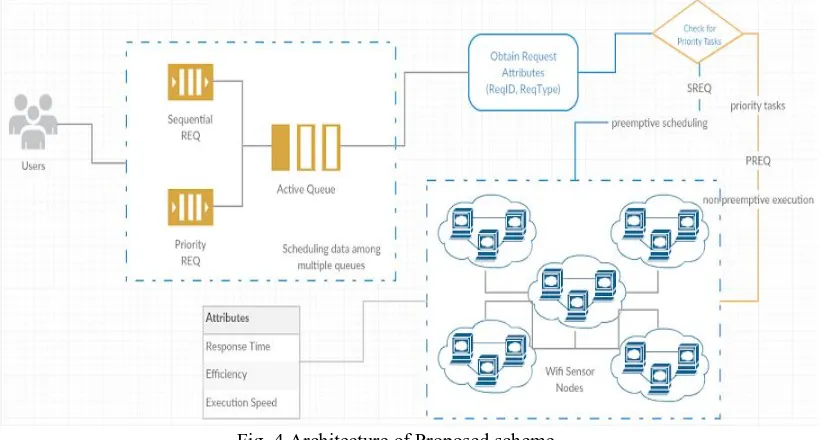
[image:5.612.107.517.207.427.2]In this paper we are using two different queues. The first one is for real time packets and the second one is for non-real time packets. If there is continuous arrival of the real time packets so non real time packets may be goes in to starvation so there will be like a drop of packets which are from non-real time. We are using the second queue for that. Also we have two subsequent queues for it. If the first subsequent queue is busy and not having the enough space to handle the packets so we are using the neighbor queue for it. If the other queue has the enough space or heap space then it can handle the packets. The major aim is not to get the packets drops. We can use neighbor nodes to handle them. Following fig explains the architecture of the application.
Fig. 4 Architecture of Proposed scheme.
At first users will go for sending the request. There are the chances of getting two different types of packets such as real time packets which are generally priority packets and the other one is non-real time packets which are sequential packets. The sequential packets are preemptive one. The priority packets are non-preemptive one. If the packet is of real time packets means it is high priority packet so we will directly process the packets without keeping them waiting. If the packet is non real time packet then we are using our scheme to further process. For non-real time packets we are then checking for heap space of the system. The heap space of the system related to available enough space for processing the packets. Whichever system has higher heap space available we directly send the packet to that neighboring node. Using this we are decreasing the hop count of the packets. Also each time we are checking for the deadline of the packet. If the packet is in range of deadline we are treating that non real time packet as a real time packet and we process it. The advantage of this is there will be no drop of packets while scheduling of data packets.
V. PERFORMANCE EVALUATION
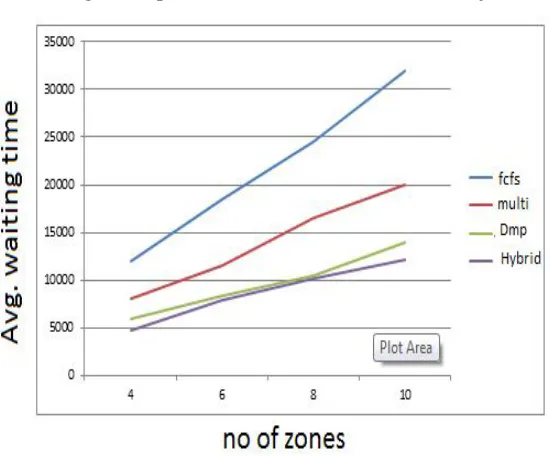
We compare this scheme with the previous schemes. From comparison we can show the performance of Hybrid model scheme is better than that of the FCFS and DMP. We have got the results from other papers and then we have calculated our own results and shown them in the graph. Following are the results which are shown that plotted on a graph.
At first we have given the waiting time for every packet and also the size of the packet. After that by using the arrival time and waiting time we calculate the deadline of the packet
Deadline = Arrival time + given waiting time; After that we then calculate the average total waiting time with following formula
Fig. 5 Comparison of diff. schemes in terms of delay.
Fig. 6 Comparison in terms of Avg. waiting time.
Table I comparison of no of levels with delay in table. Algo./
No.levels
FCF S
Multi - level
DMP Hybrid
4 1100
0
1150 0
9000 7540
6 2200
0
2350 0
1050 0
11310
8 3300
0
3450 0
2100 0
15080
10 4400
0
4550 0
2500 0
18850
Table ii comparison of no of zones with avg. Waiting time in table Algo./ No. of
Zones
FCFS Multi
- level
DMP Hybrid
4 12000 8000 6000 4712
6 18500 11500 8400 7853
8 24500 16500 1040
0
10200
10 32000 20000 1400
0
12094
.
VI.CONCLUSIONS
In this paper we proposed a new scheme called Hybrid model for packet scheduling scheme in wireless sensor network. We removed drawback which is present in previous scheme named Dynamic Multilevel priority packet scheduling scheme and other schemes. We also showed the comparison of FCFS, DMP and Our new scheme through the results. So we can say that the proposed scheme is better than that of previous schemes in terms of delay in data transmission and average waiting time
VII. ACKNOWLEDGMENT
I am very thankful to Prof. Kankal Sandip of Computer science and technology department, MIT Aurangabad who guided me in the right way for completing this work.
REFERENCES
[1] W. Stallings, Operating Systems, 2nd edition. Prentice Hall, 1995
[2] H. Momeni, M. Sharifi, and S. Sedighian, “A new approach to task allocation in wireless sensor actor networks, in Proc. 2009 International Conf. Computational Intelligence”, Commun. Syst. Netw., pp. 73-78.
[3] F. Tirkawi and S. Fischer, “Adaptive tasks balancing in wireless sensor networks”, in Proc. 2008 International Conf. Inf. Commun. Technol.: From Theory Appl., pp. 1-6.
[4] C. Lu, B. M. Blum, T. F. Abdelzaher, J. A. Stankovic, and T. He, ―RAP: a real-time communication architecture for large-scale wireless sensor networks,‖ in
Proc. 2002 IEEE Real-Time Embedded Technol. Appl. Symp., pp. 55–66.
[5] E. M. Lee, A. Kashif, D. H. Lee, I. T. Kim, and M. S. Park, “Location based multi-queue scheduler in wireless sensor network,” in Proc. 2010 International Conf. Advanced Commun. Technol., vol. 1, pp. 551–555.
[6] N. Edalat , W. Xiao, C. Tham, E. Keikha, and L. Ong, “A price-based adaptive task allocation for wireless sensor network,” in proc. 2009 IEEE International Conf. Mobile Adhoc Sensor Syst., pp. 888–893
[7] M. Yu, S. J. Xiahou, and X. Y. Li, “A survey of studying on task scheduling mechanism for TinyOS,” in Proc. 2008 International Conf. Wireless Commun., Netw. Mobile Comput., pp. 1–4
[8] Y.T. Yu, M.F. Lau, "A comparison of MC/DC, MUMCUT and several other coverage criteria for logical decisions", Journal of Systems and Software, 2005, in press.
[9] Y. Zhao, Q. Wang, W. Wang, D. Jiang, and Y. Liu, “Research on the priority-based soft real-time task scheduling in TinyOS,” in Proc. 2009 International Conf. Inf. Technol. Comput. Sci., vol. 1, pp. 562–565.
[10] S. Chachra and M. Marefat, “Distributed algorithms for sleep scheduling in wireless sensor networks,” in Proc. 2006 IEEE International Conf. Robot. Autom., pp. 3101–3107.
[11] Nidal Nasser, Lutful Karim, and Tarik Taleb, “Dynamic Multilevel priority packet scheduling scheme for wireless sensor network” in ieee transactions on wireless communications, vol. 12, no. 4, april 2013, pp1448-1459.
[12] L. Karim, N. Nasser, and T. El Salti, “Efficient zone-based routing protocol of sensor network in agriculture monitoring systems,” in Proc. 2011 International Conf. Commun. Inf. Technol., pp. 167–170.
[13] Available: http://webs.cs.berkeley.edu/tos, accessed June 2010.
[14] Anjali Paul, Robin Cyriac, ―A Review of Packet Scheduling Schemes in Wireless Sensor Networks‖ in Proc.2014 International Journal of Advanced Research in Computer and Communication Engineering Vol. 3, Issue 3, March 2014,pp. 5281-5286.
[15] Caglan Aras & Douglas Reeves, ―Real Time Communication In Packet Switched Networks,‖ in Proc. 1994 IEEE Real time Communication In Packet Switched Networks, pp.122-139.
[17] Yingwei Yao, ―Energy-Efficient Scheduling for Wireless Sensor Networks‖ in Proc. 2005 IEEE TRANSACTIONS ON COMMUNICATIONS, VOL. 53,
NO. 8, pp. 1333-1342.
[18] X. Yu, X. Xiaosong, and W. Wenyong, “Priority-based low-power task scheduling for wireless sensor network,” in Proc. 2009 International Symp. Autonomous Decentralized Syst., pp. 1–5.
![Fig. 1 Classification of packet scheduling schemes [3]](https://thumb-us.123doks.com/thumbv2/123dok_us/1255485.652771/2.612.194.435.130.314/fig-classification-packet-scheduling-schemes.webp)
![Fig. 2 scheduling of tasks in diff. queues[12]](https://thumb-us.123doks.com/thumbv2/123dok_us/1255485.652771/3.612.169.461.443.674/fig-scheduling-tasks-diff-queues.webp)
![Fig. 3 Working of DMP Scheme[12].](https://thumb-us.123doks.com/thumbv2/123dok_us/1255485.652771/4.612.172.449.86.255/fig-working-of-dmp-scheme.webp)
![(E) 1 [(2 Chloro 5 methylpyridin 3 yl)methylene]thiosemicarbazide](data:image/gif;base64,R0lGODlhAQABAIAAAP///wAAACH5BAEAAAAALAAAAAABAAEAAAICRAEAOw==)