STRUCTURED ARROWS:
A TYPE-BASED FRAMEWORK FOR STRUCTURED
PARALLELISM
David Castro
A Thesis Submitted for the Degree of PhD
at the
University of St Andrews
2018
Full metadata for this thesis is available in
St Andrews Research Repository
at:
http://research-repository.st-andrews.ac.uk/
Please use this identifier to cite or link to this thesis:
http://hdl.handle.net/10023/16093
This item is protected by original copyright
This item is licensed under a
Creative Commons Licence
a Type-Based Framework for
Structured Parallelism
by
David Castro
This thesis is submitted in partial fulfilment for the
degree of
Doctor of Philosophy (PhD)
at the
University of St Andrews
Abstract
This thesis deals with the important problem of parallelising sequential code. Despite the importance of parallelism in modern computing, writ-ing parallel software still relies on many low-level and often error-prone approaches. These low-level approaches can lead to serious execution prob-lems such as deadlocks and race conditions. Due to the non-deterministic behaviour of most parallel programs, testing parallel software can be both tedious and time-consuming. A way of providing guarantees of correctness for parallel programs would therefore provide significant benefit. Moreover, even if we ignore the problem of correctness, achiving good speedups is not straightforward, since this generally involves rewriting a program to consider a (possibly large) number of alternative parallelisations.
This thesis argues that new languages and frameworks are needed. These language and frameworks must not only support high-level parallel pro-gramming constructs, but must also provide predictable cost models for these parallel constructs. Moreover, they need to be built around solid, well-understood theories that ensure that: (a) changes to the source code will not change the functional behaviour of a program, and (b) the speedup obtained by doing the necessary changes is predictable. Algorithmic skele-tonsare parametric implementations of common patterns of parallelism that provide good abstractions for creating new high-level languages, and also support frameworks for parallel computing that satisfy the correctness and predictability requirements that we require.
I, David Castro, do hereby certify that this thesis, submitted for the degree of PhD, which is approximately 75,000 words in length, has been written by me, and that it is the record of work carried out by me, or principally by myself in collaboration with others as acknowledged, and that it has not been submitted in any previous application for any degree.
I was admitted as a research student at the University of St Andrews in September 2013.
I received funding from an organisation or institution and have acknowl-edged the funder(s) in the full text of my thesis.
Signature of Candidate: . . . .
Date: 27 July 2017
Supervisor’s Declaration
I hereby certify that the candidate has fulfilled the conditions of the Reso-lution and Regulations appropriate for the degree of PhD in the University of St Andrews and that the candidate is qualified to submit this thesis in application for that degree.
Signature of Supervisor: . . . .
Permission for Publication
In submitting this thesis to the University of St Andrews we understand that we are giving permission for it to be made available for use in accor-dance with the regulations of the University Library for the time being in force, subject to any copyright vested in the work not being affected thereby. We also understand, unless exempt by an award of an embargo as requested below, that the title and the abstract will be published, and that a copy of the work may be made and supplied to any bona fide library or research worker, that this thesis will be electronically accessible for personal or re-search use and that the library has the right to migrate this thesis into new electronic forms as required to ensure continued access to the thesis.
I, David Castro, confirm that my thesis does not contain any third-party material that requires copyright clearance.
The following is an agreed request by candidate and supervisor regarding the publication of this thesis:
Printed copy
No embargo on print copy.
Electronic copy
No embargo on electronic copy.
Signature of Candidate: . . . .
Date: 27 July 2017
Signature of Supervisor: . . . .
Candidate’s declaration
I, David Castro, hereby certify that no requirements to deposit original research data or digital outputs apply to this thesis and that, where ap-propriate, secondary data used have been referenced in the full text of my thesis.
Signature of Candidate: . . . .
Acknowledgements
I am very grateful to my supervisor Kevin Hammond. We first spoke about the ideas behind this thesis in informal conversations during the DSL 2013 summer school in Cluj-Napoca, and I would have never guessed back then that they would turn into a full PhD thesis! I would have never achieved this if Kevin had not supported me and helped me learn.
I am very grateful to the members of the St Andrews FP group: to Chris B. and Vladimir for our conversations, coffee and lunch breaks; to Edwin, Susmit and all my fellow PhD students, Adam, Chris S., Matus, Franck, Chat, Franta and Yasir, for all the insights and ideas they shared with me.
My special thanks also to the biologists, Pau and Karim, for all the “inter-disciplinary culinary workshops” (i.e. lunch breaks).
A big thank you to Victor Gulías for introducing me into the academic world, and to Laura Castro for helping me and encouraging me when I was searching for PhD positions. I also extend my thanks to Henrique and Macias, for all the conversations and coffees we had.
I want to express my enormous gratitude to my family, specially my grand-mother, my parents, and my brother Jesus and Irina (and Jacobo!), for supporting me in my every single step. A big thank you to Ezequiel and Ana, specially for all the spanish delicacies you sent to Scotland!
Finally, Ana Inés, I am so grateful for everything that you have done for me, that I would need to write another thesis to explain it properly: Moi mal cho fixen pasar! Estoy aqui gracias a ti.
This work was supported by the University of St Andrews (School of Com-puter Science); by the EU FP7 grant “ParaPhrase:Parallel Patterns for Adaptive Heterogeneous Multicore Systems” (n. 288570); by the EU H2020 grant “RePhrase: Refactoring Parallel Heterogeneous Resource-Aware Ap-plications - a Software Engineering Approach” (ICT-644235), by COST Action IC1202 (TACLe), supported by COST (European Cooperation in Science and Technology); and by EPSRC grant “Discovery: Pattern Dis-covery and Program Shaping for Manycore Systems” (EP/P020631/1).
Contents
Contents xi
1 Introduction 1
1.1 The Importance of Parallel Programming . . . 2
1.1.1 Challenges of Parallel Programming . . . 2
1.1.2 Models of Parallelism and Concurrency . . . 3
1.2 Structured Parallelism . . . 4
1.3 Structured Recursion . . . 6
1.4 Structured Recursion and Structured Parallelism . . . 8
1.5 Cost Models for Parallel Constructs . . . 9
1.6 Aim of the Thesis . . . 10
1.7 Contributions . . . 14
1.7.1 Main Contributions . . . 14
1.7.2 Minor Contributions . . . 16
1.8 Thesis Outline . . . 17
1.9 Publications . . . 19
2 Structured Approaches to Parallelism and Recursion 21 2.1 Classes of Architectures . . . 21
2.2 Structured Parallel Programming . . . 25
2.2.1 Functional Parallel Programming . . . 25
2.2.2 Dataflow Languages . . . 27
2.2.3 Coordination Languages . . . 28
2.2.4 Type-Based Parallel Programming . . . 29
2.2.5 Algorithmic Skeletons . . . 30
2.2.6 Advantages of Structured Parallel Programming . . . 37
2.3 Structured Recursion . . . 38
2.3.1 A Categorical Interpretation . . . 38
2.3.2 Basic Types and Combinators . . . 40
2.3.3 Recursion Patterns . . . 43
2.3.4 Hylomorphisms . . . 48
2.3.5 Program Calculation Approaches . . . 50
2.4 Algorithmic Skeleton Frameworks . . . 52
2.4.1 The Need for a General Framework . . . 53
2.4.2 Cost Models for Algorithmic Skeletons . . . 63
2.4.3 Algorithmic Skeletons and Recursion Patterns . . . . 67
2.5 Summary . . . 68
3 Structured Arrows: A Type System for Parallelism 69 3.1 Overview . . . 69
3.2 Structured Parallel Programs . . . 72
3.2.1 Structured Parallel Processes . . . 72
3.2.2 Hylomorphisms . . . 75
3.2.3 Structured Expressions . . . 77
3.3 A Type System for Introducing Parallelism . . . 78
3.3.1 The Structure-Annotated Type System . . . 81
3.3.2 Functional Equivalence . . . 84
3.4 Determining Functional Equivalence . . . 86
3.4.1 Reforestation . . . 87
3.4.2 Structure Unification . . . 91
3.5 Examples . . . 96
3.5.1 Image Merge . . . 96
3.5.2 Quicksort . . . 99
3.5.3 N-Body Simulation . . . 101
3.5.4 Iterative Convolution . . . 103
3.6 Discussion . . . 104
4 Operational Semantics 107 4.1 An Operational Semantics for Queues . . . 107
4.2 Queue-Based Skeleton Semantics . . . 112
CONTENTS xiii
4.2.2 Queue-Based Parallel Structures . . . 115
4.3 Predicting Parallel Performance . . . 124
4.3.1 Costs and Sizes . . . 124
4.3.2 Costing Traces of Parallel Processes . . . 127
4.3.3 Deriving Cost Equations from the Operational Se-mantics . . . 129
4.4 Real vs. Predicted Speedups . . . 134
4.5 Discussion . . . 138
5 SKI-ing Skeletons: Parallelising Explicit Recursive Func-tions using Applicative Expressions 143 5.1 Parallelising HHFunctions . . . 144
5.1.1 Translating between HH and Hylo . . . 146
5.1.2 Stages of the Translation . . . 147
5.2 The HHand Applicative Languages . . . 148
5.2.1 The HH Language . . . 148
5.2.2 Algebraic Data Types . . . 151
5.2.3 Syntax of HH . . . 151
5.2.4 Applicative Structures . . . 154
5.3 Structure Checking Relation . . . 160
5.3.1 Associated Applicative Structures . . . 162
5.4 Properties of Associated Structure Relation . . . 170
5.4.1 Semantic Equivalence of λ-expressions . . . 172
5.4.2 Soundness . . . 173
5.4.3 Structure Rewriting . . . 174
5.5 Converting A to Hylo . . . 177
5.5.1 Deriving Hylomorphisms . . . 180
5.5.2 Currying-Uncurrying . . . 182
5.5.3 Flattening Transformation . . . 186
5.6 Examples . . . 189
5.7 Discussion . . . 198
6 Conclusions and Future Work 201 6.1 Contributions of this Thesis . . . 204
6.3 Further Work . . . 211 6.4 Summary . . . 215
A Reforestation Confluence 217
B Soundness of the Structure-Checking Relation 223
Chapter 1
Introduction
This thesis deals with the important problem of writingefficientandcorrect
parallel software. Parallel programming has become increasingly important. Parallel hardware is now ubiquitous, and there are major questions that need to be solved to ease the task of developing parallel software. On one hand, there is the problem ofperformance, i.e. writing parallel software that achieves good speedups. On the other hand, there is the problem of cor-rectness, i.e. ensuring that a parallel program produces the correct results. The former has been addressed mostly by the high performance comput-ing community, while the latter has been addressed mostly by the static analysis community. However, there has been little research on providing a general framework for achieving both of these simultaneously.
This thesis presents a novel framework,Structured Arrows (StA), which allows reasoning simultaneously about both correctness and performance of parallel programs. We developed theStAframework for a purely functional language that can be described as a subset of Haskell [Jon03], and it is based on well-understood theories of patterns of parallelism and patterns of recur-sion, specificallyalgorithmic skeletons[Col89] andhylomorphisms[MFP91].
StA provides a mechanism for: (a) reasoning about the sound introduction of parallelism to sequential functions; and (b) statically predicting the run-time performance of alternative parallelisations of functions.
1.1
The Importance of Parallel
Programming
Software systems require ever increasing amounts of computing power. Single-processor systems are no longer able to cope with these growing demands. Less than two decades ago, we witnessed that clock-speeds have stalled, and a trend towards increasingly parallel architectures has started. Almost ev-ery hardware system nowadays is either a multicore, or incorporates highly parallel processing units such as Graphic Processing Units (GPUs). Par-allel hardware is now no longer constrained to very specific fields, such as supercomputers or high-performance computing.
The shift in hardware systems has also brought a shift in the way that software systems are developed. Developers can no longer rely on increasing clock speeds to make their programs run faster, and learn new models, languages and frameworks. This requires a different mind-set. Developers have been used to writing highly optimised code for processor, single-core architectures. Consequently, the source code that is written is often inherently sequential, and hard to parallelise. In contrast to sequential programming, writing an optimised parallel application requires focusing on different aspects of the program structure, from the early stages of the software development process.
1.1.1
Challenges of Parallel Programming
Writing parallel applications is an inherently hard task that requires to focus on many low-level implementation details. Concurrency techniques are prevalent. Concurrency theories address the problem of decomposing a program into several components. These components can be run in parallel
to speed up the program’s run-time, provided that these components are
re-1.1. THE IMPORTANCE OF PARALLEL PROGRAMMING 3
search [FKNS14, NY16, LZC+02]. However, even when a parallel program
is correct, achieving good speedups is not easy.
Developers must perform a number of steps in order to parallelise a program. As a minimum, they need to
1. identify the different components that can be parallelised; and
2. choose which components to run in parallel, to achieve good speedups.
This means that developers must think not only about the correctness of their implementations, but also about how to decompose a program into multiple order-independent components, and simultaneously how to run in parallel those components that would improve the application’s perfor-mance.
1.1.2
Models of Parallelism and Concurrency
In order to ease the task of writing parallel software, new models of par-allel computing have been created, as well as programming languages and libraries, some of which have been adopted by industry (see, for example, the survey by Diaz et al. [DMCN12]). The main idea behind most of these models is to raise the level of abstraction. This is the same idea that un-derlies any successful attempt at tackling a problem that is too large, and that contains too many dimensions.
An example of model of parallelism is the fork-join model. Fork-join parallelism focuses on the control flow of the program, abstracting away the communication details. Examples include the Cilk programming lan-guage [BJK+96], which included thespawn and syncprimitives1.
Another example is the concept of futures and promises. The key idea is to decouple a value (future) from a computation (promise). The com-putation can then be parallelised, and the value later “demanded” where needed. An example of programming with futures in Haskell [Jon03, Hut16] is Glasgow Parallel Haskell, with the par and pseq constructs [THLJ98].
In contrast, message passing models of concurrency are aimed at de-scribing the interactions between components as messages exchanged be-tween them. They abstract away the specific low-level details involved in
the actual communication. Creating a component, and sending/receiving messages are generally considered primitives. Process calculi are examples of this. Some of these process calculi are Hoare’s CSP [Hoa78], or Milner’s
π-calculus [Mil99]. Another example is the Actor Model, which originated in 1973 [HBS73] and that has influenced the creation of a number of pro-gramming languages and libraries, such as Erlang [CT09, AV90].
All of these approaches provide a simpler way of writing parallel soft-ware, but they still require programmers to focus on low-level details, and achieving good speedups can still be hard. The underlying problem is that the two questions that a developer must answer to parallelise a program still need to be answered for each parallel program: i.e. the components still need to be identified; and some of them parallelised, ensuring that the resulting program is both correct and efficient. One potential solution to those questions comes from the field of structured parallelism, which con-sists on programming parallel applications by combining implementations of common patterns of parallel computation [Pel98, RG03]. This thesis uses
structured parallelism viaalgorithmic skeletons [Col89] as a means to avoid these problems.
1.2
Structured Parallelism
Algorithmic skeletons [Col89] are parametric implementations of common patterns of parallel programming. Using a pattern/skeleton approach, the programmer can design and implement a parallel program in a top-down manner. For example, the programmer could first identify the parallel pat-terns that occur in a particular piece of software, then select the patpat-terns that potentially lead to the best speedups, and finally select a suitable im-plementation for those patterns, as a composition of one or more algorithmic skeletons. In other words, algorithmic skeletons focus on the structure of the computation. Moving from a lower-level send/receive approach to a higher-level structured approach has been compared to moving away from
1.2. STRUCTURED PARALLELISM 5
and implements some pattern of parallelism. There are many examples of algorithmic skeleton libraries, frameworks and languages [GzVL10].
Examples of algorithmic skeleton frameworks include:
1. FastFlow [ADK+11] is a skeletal parallel programming library for
C++ that is targeted to the development of streaming computations.
2. eSkel [BCGH05] is a library for structured parallelism for C, and im-plemented in C+MPI.
3. The Skel [EBDH12] library provides an implementation of common algorithmic skeletons in the Erlang programming language.
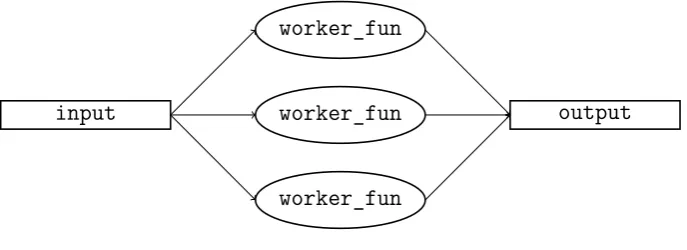
An example algorithmic skeleton is the task farm skeleton, which cap-tures a pattern that is also known as master-slave parallelism. The task-farm pattern captures worker replication, where a task task-farm takes a worker, and replicates it a number of times. An input collection of tasks is then dis-tributed between the workers, and each of the workers operates on different tasks independently. An example of a skeletal program using a task farm, in a Haskell-like language is:
-- run :: Skel a b -> a -> b
-- fun :: (a -> b) -> Skel a b
-- farm :: Int -> Skel a b -> Skel a b
-- filterImage :: Image -> Image
parallelFilter :: Skel [Image] [Image] parallelFilter = farm 3 (fun filterImage) output :: [Image]
output = run skel_fun images
input
worker_fun worker_fun worker_fun
output
Figure 1.1: Task Farm
sequentialFilter :: [Image] -> [Image] sequentialFilter = map filterImage
Algorithmic skeletons can be nested and composed in many ways, each of which represents a different parallelisation. In this thesis, the term parallel structure is used to refer to arbitrary nestings of algorithmic skeletons.
1.3
Structured Recursion
The previous section presented structured parallelism using algorithmic skeletons. Algorithmic skeletons provide a good high-level framework for writing parallel software, but they do not provide a mechanism for de-composing a program into components. This decomposition must usu-ally be done manuusu-ally by the developers. However, algorithmic skeletons have been linked to different recursion patterns in a number of different ways [RG03, Ski93b, SFLD15, Col93]. The connection between algorithmic skeletons and recursion patterns provides a mechanism for decomposing a program into components that can then be run in parallel, once a suitable parallel structure has been determined.
[image:20.595.85.429.113.238.2]1.3. STRUCTURED RECURSION 7
using direct recursive calls in favour of calls to higher-order functions that implement some pattern of recursion. That is, abstraction is improved by moving from explicit to implicit recursion.
This style of programming recursive functions was pioneered by Richard Bird [Bir88] and Lambert Meertens [Mee86]. It has been promoted by several authors, such as Bird and Wadler [BW88], Gibbons [Gib02a], and Cunha [Cun05]. However, this style of programming is still not widely used. Barwell’s forthcoming thesis [Bar17] considers the problem of identi-fying patterns of recursion in arbitrary Haskell code, in order to introduce parallelism.
Simple examples of recursion patterns include the map and fold func-tions in functional languages. For example, in Haskell, map can be defined as follows:
map :: (a -> b) -> [a] -> [b]
map f [] = []
map f (x:xs) = f x : map f xs
A parallel map can be implemented by using a task farm, by replicating a worker function f, carefully distributing the “tasks” in the input list, and finally collecting the results. This connection will be exploited in depth in this thesis.
The mathematical properties of recursion patterns provide a way to rewrite, or refactor a program into an extensionally equal form. A well-known example of this is the map-fusion rule:
map f (map g xs) = map (f.g) xs
Two functions are extensionally equal if, when given the same input, they both produce the same result. The terms functionally/extensionally equiv-alent are used in this thesis as synonyms of extensionally equal. The term
1.4
Structured Recursion and Structured
Parallelism
This thesis builds on the connection betweenstructured parallelism, in terms of combinations of algorithmic skeletons [Col89], and structured recursion, as combinations of recursion schemes [MFP91]. Several authors have pro-posed a change in programming techniques in favour of more structured approaches [Col04, RG03, Gor04, BW88, CPP06]. They advocate a shift from less structured programming, towards the usage of more structured programming constructs.
In the functional programming community, this “more structured ap-proach” is represented by thepoint-freestyle of programming [BW88, CPP06]. This style of programming consists of programming without using variables, and creating complex functions by combining simpler functions using a num-ber of primitive combinators. In the point-free style of programming, the data-flow of a program is made explicit. The most basic operation in the point-free style is function composition. For example, the following func-tions in Haskell are equivalent. One is programmed using a pointed style, the other using the composition operator, ‘.’:
-- (f . g) x = f (g x)
pointed x = f (g x) pointFree = f . g
The pointedversion uses the variablexexplicitly. In contrast, the function
pointFree is built using the composition operator. Recursion in the point-free style is generally implemented by using common patterns of recursion, or recursion schemes [MFP91]. Abandoning explicit recursion in favour of using recursion schemes has been compared to moving fromgotostatements to structured iteration in imperative programming.
sim-1.5. COST MODELS FOR PARALLEL CONSTRUCTS 9
plify programming, enhance portability, improve performance, and offer scope for optimisations [Col04]. Algorithmic skeletons are not the only form of structured parallelism. Evaluation strategiesare functions in Haskell that describe how the output of a function is computed [THLJ98]. These func-tions can be combined, using higher-order funcfunc-tions, to describe complex patterns of parallelism.
Gorlatch, in his paper “Send-Receive Considered Harmful” [Gor04], ar-gues against the usage ofsend/receiveoperations, in favour ofMPI collective operations, in an analogy to Dijkstra’s famous “goto considered harmful”. Gorlatch’s argument is that the usage of low-level send/receive operations in MPI [GLS99] programs leads to code with a more complex, error prone communication structure. In contrast, Gorlatch points out the simplicity and compositionality of collective operations. These MPI collective opera-tions are equivalent to algorithmic skeletons.
Several authors have pointed out, and even exploited the correspon-dence between common patterns of recursion, and common patterns of parallelism, such as [RG03, Ski93b, SFLD15, HTC98, SHMB05]. These authors all build on the results of the functional programming community to (semi-) automate the parallelisation of functions. These approaches show the feasibility of the approach, and represent important steps towards the automatic parallelisation of functions. However, they are either targeted at some specific architecture, and therefore not general, or do not consider the issue of statically reasoning about the performance of their parallel code. Our previous work [CHS16, CHSA17] builds on this connection between patterns of recursion and parallelism. We provide a general framework, in which programmers can reason simultaneously about program rewritings and performance.
1.5
Cost Models for Parallel Constructs
Acost model is a static estimation of the run-time performance of a pro-gram, based on the characteristics of the propro-gram, the architecture where it is going to be run, and possibly some dynamic information, that may be obtained via profiling. The regular structure of algorithmic skeletons makes it possible to define predictable cost models. An early example of this is Skillicorn’s cost calculus [SC95]. Brown et al. [BDH+13] define a
number of cost models to direct refactorings of parallel Erlang programs. Hammond et al. [HBS16] derive a number of cost models for common algo-rithmic skeletons from their implementation on x86-64 architectures that include micro-architectural details that model the relaxed memory consis-tency approach taken by modern CPU architectures.
The focus of this thesis is on statically predicting how to parallelise a program. Therefore, the cost models that are used in this thesis need to be derived from a predictable implementation of the parallel constructs. The definition of predictable is, however, quite vague. In this thesis, our notion of predictability is that the operational semantics of the algorithmic skeletons must allow the automatic derivation of cost equations. A number of examples are then run to gain evidence that the operational semantics accurately captures sufficient information to make realistic predictions of the overall performance of the program.
1.6
Aim of the Thesis
1.6. AIM OF THE THESIS 11
cost solution is chosen using some well-defined cost model. Within that model, one should be able to define new parallel structures, and derive cost equations from them. If the model is reasonably accurate, a program should achieve real speedups that are close to the predicted ones. Therefore, a pro-gram that is proved to be optimal in the cost model is likely to be close to the real optimal program.
The second problem is rewriting the structure of a program. Predicting speedups is powerful, but only when coupled with a mechanism for system-atically exploring the space of functionally equivalent program structures. Without such a mechanism, a programmer needs to manually change the structure of a program in order to generate the alternative parallelisations. In our opinion, the problem of systematically exploring the functionally equivalent structures should be restricted to structured parallel programs, which use a known set of algorithmic skeletons. Even in this case, it is impossible to explore all of the alternative implementations for a complex program, since this would lead to a very large search space. In order to solve this problem, a characterisation of what kind of automatic parallelisations can be explored, and a mechanism for doing so are needed.
Finally, any mechanism for automatically rewriting a program must en-sure that the resulting program is functionally equivalent to the original one. Without strong static guarantees that the parallel program is functionally equivalent to the original program, programs that either deadlock or that give inconsistent results might be generated or an incorrect parallelisation could be produced.
This thesis takes a type-based approach, and is the first known attempt at representing the potential parallelisation of a program as a type. Type-systems offer many advantages for statically enforcing properties on pro-grams. For example, in the field of behavioural types [ABB+16], types are
used to enforce that components of communication-centric software com-municate according to given protocol specifications. Statically enforcing properties of communicating systems has also been studied by Brady in the context of the dependently-typed language Idris [Bra17, Bra13]. Type systems are not just useful for enforcing functional properties of programs, but also of non-functional properties, such as cost [Vas08].
The aim of this thesis is to develop novel state-of-the-art mechanisms for reasoning simultaneously about run-time performance of parallel programs, and correctness of program transformations transformations. Additionally, a mechanism for systematically exploring (a subset of) the space of func-tionally equivalent parallel implementations must be provided. This thesis represents the first attempt to develop a general type-based framework for parallel programming in which a programmer would write a program once, and then parallelise their program by providing a minimal amount of type annotations to instantiating different parameters in the framework.
A good general framework needs to address the following questions:
• How can a program structure be extracted, i.e. how can a program be split into the different components that can be parallelised?
• What are all the different ways in which a program structure can be rewritten into functionally equivalent parallel forms?
• How can a program’s run-time behaviour be statically predicted, based on its parallel structure?
In order to answer the first and the second questions, this thesis presents a novel type-based framework, Structure-annotated Arrows2, StA or
Struc-tured Arrows, which annotate function types with an abstraction of the un-derlying function structure. The type-system that is presented in this thesis describes how to extract a program structure, and annotates function types
1.6. AIM OF THE THESIS 13
with the corresponding structure. A novelty of this type-based framework is that it uses a common recursion pattern, hylomorphisms, as a single uni-fying construct to guide the rewritings that can be applied to a program. Any attempt to rewrite a program starts by converting its structure into a canonical form as a composition of hylomorphisms. This type-system is then extended to deal not only with patterns of recursion, but also with arbitrary recursive functions. This extension is built on top of combinatory logic, exploiting the close correspondence between λ-calculus and combi-natory logic [Bar84]. By tying the combinators to hylomorphisms, a full framework that can extract a program structure from explicitly recursive function has been developed.
These program structures can be used to guide any possible rewritings to the underlying function, thus answering the second question: What are all the different ways in which a program structure can be rewritten into
functionally equivalent parallel forms?. The system is proven sound, and the space of functionally equivalent programs is characterised by a set of properties that was used to prove the system complete.
Finally, to answer the third question,How can a program’s run-time be-haviour be statically predicted, based on its parallel structure?, a mechanism for specifying the operational semantics of parallel structures has been de-veloped. This mechanism consists of a simple but predictable queue-based language that comprises a number of processes that communicate by writing elements to shared queues. The operational semantics of a number of rep-resentative algorithmic skeletons can be specified in this language, and cost models can be automatically derived from these skeletons. These cost mod-els can be shown to be accurate with respect to the underlying operational model, and therefore can be used to generate provably optimal programs, with respect to this model.
al-Applicative Expressions
Den. Sem. of Alg. Skels
Structured Arrows
Cost Models
Op. Sem. of Alg. Skels
Chapter 4
Chapter 3
Chapter 5
Figure 1.2: Contributions of the thesis
gorithm has been developed for the Structured Arrows framework, which is available at https://bitbucket.org/david_castro/skel. A number of examples have been compiled using the queue-based operational semantics. The cost models were compared to the real speedups on a 24-core and a 64-core system, both of which use a x86-64 architecture. Our results show not only a theoretical improvement to the state-of-the-art, but additionally provide preliminary results on how to turn this approach into a practical toolset.
1.7
Contributions
1.7.1
Main Contributions
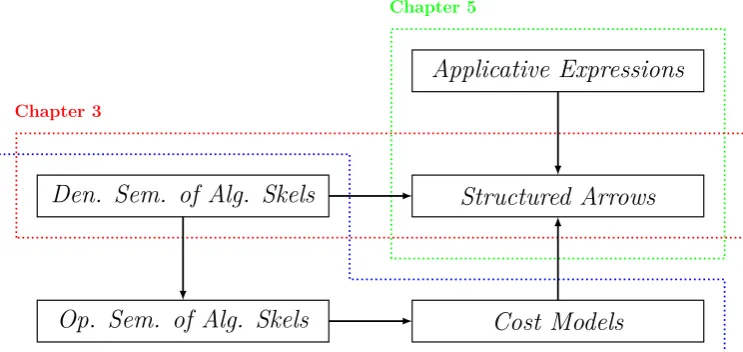
The main novel contributions of this thesis are illustrated in Figure 1.2 on page 14. Specifically:
[image:28.595.91.463.116.292.2]compu-1.7. CONTRIBUTIONS 15
tation performed, this type system is the first known attempt at capturing the parallel structure program as a type. We prove soundness and com-pleteness against a set of program equivalences derived from the laws of hylomorphisms, and the framework is illustrated by a number of common benchmarks for parallel programming systems. Finally, this thesis discusses the generality of the StA framework, which is not necessarily constrained to parallelising functions, and which has the potential of being used for studying general program optimisation.
•A denotational semantics for common algorithmic skeletons in terms of hylomorphisms (Chapter 3). By using the hylomorphism recursion pattern as a general unifying construct, the functional behaviour of different parallel programs can be compared by simply reducing the problem to comparing that they have the samecanonical representation. Moreover, the alternative parallelisations of a program can be explored by systematically applying any possible rewriting, starting from its canonical representation. Although the relation between hylomorphisms and algorithmic skeletons has been previously noted, this is the first attempt at using it systematically.
•An operational semantics of common algorithmic skeletons, in terms of a simple but predictable queue-based language, with a precise and well-known
operational semantics (Chapter 4). This queue-based language is designed so that synchronisation and communication between different components of algorithmic skeletons can be specified and reasoned about. The operational semantics of the algorithmic skeletons is shown to be sound with respect to the denotational semantics. This operational semantics is used to compile several examples, which are run on 24 and 64-core systems with x86-64 architectures, achieving speedups of up to 20 and 56 respectively.
shows that the cost models derived from the operational semantics predict a tight lower bound on the speedups, and therefore that a provably optimal
program is likely to represent a good parallelisation.
•An extension of the Structured Arrows framework to deal not just with point-free programs, but also with pointed programs that are written using
explicit recursion (Chapter 5). The extension of this framework consists on a type and effect system that annotates the types of letdefinitions with the underlying structure. This is done by building on well-known translations between λ-terms and combinatory logic, or applicative expressions, and the translation between applicative expressions and hylomorphisms. The former can be described in a compositional way, which is a requirement for using a type-based approach; and the latter can be done by applying a number of rewritings to the applicative expression in a systematic way, until it is in a “hylomorphism form”. As usual, the soundness of the approach is proven, and a number of examples are provided to illustrate the usefulness of the transformations.
1.7.2
Minor Contributions
In addition, this thesis makes the following minor contributions:
• A decision procedure for the functional equivalence of alternative par-allel implementation (Chapter 3). The decision procedure is developed and illustrated within the Structured Arrow framework. It boils down to rewrit-ing any two parallel programs into some canonical representation by: (a) removing any parallel construct by replacing it with a sequential equivalent; (b) extracting a program structure from the resulting program in terms of hylomorphisms; and finally (c) rewriting the hylomorphism structure into a canonical representation. For obvious reasons, this decision procedure can-not be complete, but by extending the normalisation procedure, a larger class of programs can be compared. The decision procedure is illustrated by showing several fully worked examples.
1.8. THESIS OUTLINE 17
illustrates how these approaches can be applied to real programming lan-guages, and also show that formalising this framework as a type-and-effect system has, as a side benefit, that most of the techniques described can be implemented as simple extensions of standard type-checking, inference and unification techniques. The prototype implementation is available at
https://bitbucket.org/david_castro/skel/.
1.8
Thesis Outline
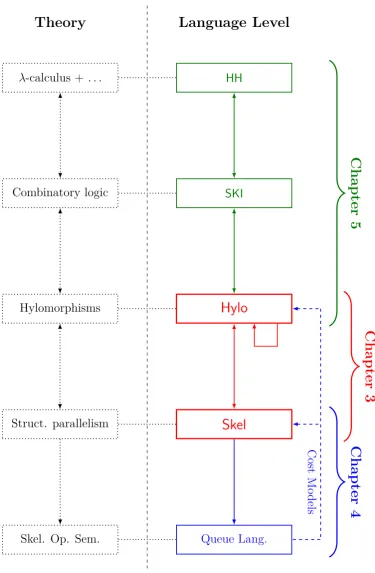
• Chapter 2presents an overview of structured approaches to both paral-lelism and recursion. The necessary background is provided to understand these theories, and a survey is given of a number of relevant algorithmic skeleton frameworks and recursion scheme libraries and frameworks. A survey of cost models for structured parallelism, or different models of par-allelism is also provided. Finally, state-of-the-art approaches on using re-cursion patterns for parallelism are also surveyed, e.g. the Bird-Meertens formalism as a parallel programming framework, Skillicorn’s cost calculus and automatic parallelism based on the Third List Homomorphism theorem. Finally, the work presented in this thesis is situated in the larger context.
• Chapter 3 presents the Structured Arrow type-based framework for structured parallelism. The type-based framework consists of a type-and-effect system for a functional point-free language, Hylo. A Hylo expression represents the functionality of a program, while a structured arrow is used to introduce a parallel structure. The benefits of this separation are ex-plored. The main benefits are: (a) a programmer can focus first on an initial sequential implementation, and later use the types to reason about how to parallelise it; (b) parallel structure can be changed by swapping type annotations. Proofs of soundness and completeness are presented, and a number of examples are shown that illustrate the technique with common benchmarks. The discussion of a prototype implementation is presented.
Hylo
SKI HH
Skel
Queue Lang. Hylomorphisms
λ-calculus + . . .
Combinatory logic
Struct. parallelism
Skel. Op. Sem.
Theory
Language Level
Chapter
5
Chapter
3
Chapter
4
Cost
Mo
dels
[image:32.595.83.459.123.697.2]1.9. PUBLICATIONS 19
used to parallelise a number of programs. This illustrates the generality of the approach, since these parallel structures are simply parameters of the type-based framework. Together, Chapters 3 and 4 describe a full frame-work that provides a mechanism for deriving parallel implementations from high-level specifications of a program’s parallel structure and functional-ity. The approach is evaluated by comparing real and predicted speedups for several examples, showing that we can predict tight lower bounds on speedups.
•Chapter 5 describes an extension of the StAframework that is built on top of a relation that extracts program structures from functions defined in a subset of Haskell, HH. This is based on the close connection between combinatory logic andλ-calculus, which provides a mechanism for annotat-ing expressions in HHwith a “structure” in terms ofapplicative expressions, which are expressions that are built on top of combinatory logic. A set of simple transformations derives hylomorphisms from these applicative ex-pressions. This is a novel usage of combinatory logic, which is aimed at performing source-to-source transformations, instead of using it for compi-lation. The expected soundness proof is provided for the novel relation, and it is illustrated by a number of common parallel programming examples.
•Finally, Chapter 6 concludes the thesis, summarises the key results, points out achievements and limitations, and suggests how it could be im-proved thereafter.
1.9
Publications
The work that is described in this thesis has formed the subject of a number of papers.
• David Castro and Kevin Hammond. Skeletor: A DSL for Describing Type-based Specifications of Parallel Skeletons. InProc. Workshop on High-Level Programming for Heterogeneous and Hierarchical Parallel
Systems (HLPGPU 2014), 2014.
paper, the work is presented as an embedded DSL in a dependently typed language. The dependently typed approach, although useful and interesting, was quickly abandoned due to the lack of flexibility of the approach.
• David Castro, Kevin Hammond, and Susmit Sarkar. Farms, Pipes, Streams and Reforestation: Reasoning About Structured Parallel Pro-cesses using Types and Hylomorphisms. InProceedings of ICFP 2016: ACM International Conference on Functional Programming, pages 4– 17, Nara, Japan, September 2016.
Most of the work in Chapter 3 is based on this paper. The paper omits some standard technical development which is provided in this thesis in full detail. Additionally, the results presented in that paper are discussed in more depth in Chapter 3. The term Structured Arrows
for the type-based framework that is described in this paper is coined in this paper.
• David Castro, Kevin Hammond, Susmit Sarkar, and Yasir Alguwaifli. Automatically deriving Cost Models for Structured Parallel Processes using Hylomorphisms. Future Generation Computer Systems, 2017. Most of the work in Chapter 4 is based on this paper. In the paper, the mechanism for deriving automatically cost models from the oper-ational semantics is sketched superficially. More details are provided in Chapter 4 of this thesis. The results are also described in more depth in this chapter.
• Adam D Barwell, Christopher Brown, David Castro, and Kevin Ham-mond. Towards Semi-Automatic Data-Type Translation for Paral-lelism in Erlang. In Proceedings of the 15th International Workshop on Erlang, pages 60–61, Nara,Japan, 2016. ACM.
Chapter 2
Structured Approaches to
Parallelism and Recursion
This thesis builds on the connection between structured parallelism and structured recursion, as was stated in Chapter 1. This Chapter provides an overview of the common techniques in structured parallelism (Section 2.2) and recursion (Section 2.3), contains a survey of state-of-the-art techniques in structured parallelism frameworks (Section 2.4), and presents a compari-son of the characteristics of current state-of-the-art approaches, and situates the work developed for this thesis in the larger context.
2.1
Classes of Architectures
Unstructured techniques of parallelism consist of implementing parallel pro-grams by using some suitable model of concurrency, in which programmers need to specify the individual components of their parallel program, and have a direct control over how communication between components hap-pens. Traditionally, a suitable model of concurrency is chosen based on the characteristics of the target architecture.
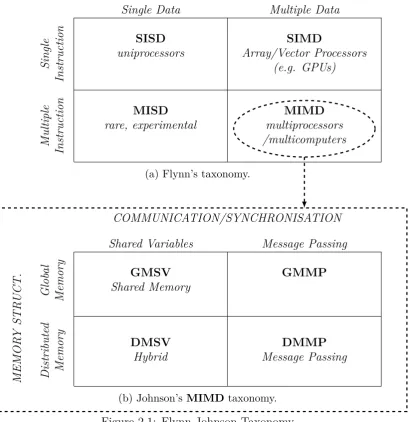
In 1966, Michael Flynn proposed a taxonomy of computer architec-tures [Fly72], which was used to explain the different kinds of parallelism available depending on the characteristics of the underlying architecture. The original taxonomy comprises four classifications that are shown in in Figure 2.1a on page 23. In Flynn’s original taxonomy, a sequential computer
architecture is called SISD, i.e. a computer architecture in which a single instruction stream operates on a single data stream. A SIMD architecture exploits multiple data streams against a single instruction stream. Graphics Processing Units (GPUs) are examples of SIMD architectures. They exploit the natural parallelism that arises from performing an operation on differ-ent, independent data points. The MISD class of architectures exploits the parallelism of performing multiple, independent instruction streams on a single data stream. However, this architecture is not very common. Finally, MIMD architectures can operate multiple instruction streams, possibly on different data streams. This is the class of architectures of modern (possible heterogeneous) multi-processor and multi-core machines.
The MIMD class of architectures is too general. Johnson completes Flynn’s taxonomy with a further classification of MIMD architectures, based on the memory structure of the architecture and how communication/syn-chronisation is done in such architectures [Joh88]. Figure 2.1b on page 23 presents Johnson’s taxonomy, which consists of four different classes of MIMD architectures. The class of GMSV systems are classical shared-memory multiprocessors. There are not many examples of GMMP systems, and the few that exist are experimental. The class of DMSV architectures correspond to distributed shared memory systems. Finally, the class of DMMP architectures correspond to distributed-memory systems.
Classes of Parallelism and Concurrency
The Flynn-Johnson taxonomy illustrates one of the main difficulties of par-allel programming. Generally, different parpar-allel programming models and techniques are better suited for programming different classes of architec-tures. A common classification of different parallel programming models differentiates data parallelism from task parallelism.
2.1. CLASSES OF ARCHITECTURES 23
Single Data Multiple Data
Single
Instruction
SISD
uniprocessors
SIMD
Array/Vector Processors (e.g. GPUs)
Multiple
Instruction
MISD
rare, experimental
MIMD
multiprocessors /multicomputers
(a) Flynn’s taxonomy.
COMMUNICATION/SYNCHRONISATION
Shared Variables Message Passing
MEMOR
Y
STR
U
CT. Glob
al
Memory
GMSV
Shared Memory
GMMP
Distribute
d
Memory
DMSV
Hybrid
DMMP
Message Passing
(b) Johnson’sMIMD taxonomy.
Figure 2.1: Flynn-Johnson Taxonomy
support data parallelism, by applying the same instruction stream on mul-tiple data streams in parallel. An example of data parallel programming environments is the CUDA programming model [Coo12]. From a func-tional programming perspective, data parallelism arises, for example, from instances of mapfunctions. A representative example of data parallelism in the functional paradigm is Data Parallel Haskell [CLPJ+07].
[image:37.595.120.533.110.533.2]Tra-ditional approaches to task parallelism involve using different concurrency mechanisms, again depending on the underlying architecture. For shared-memory parallel programming, for example, a common approach is the
OpenMP API extension for C/C++ and Fortran languages [DM98]. In OpenMP, a parallel program is implemented by using a number of direc-tives and pragmas for thread creation, specifying parallel regions, barriers for synchronisation, etc. Communication between the different threads or processes of a parallel application is implicit, and relies on the usage of variables that point to shared memory locations. By default, variables are shared, and programmers must declare which variables are private.
A common approach for programming distributed-memory systems is the Message Passing Interface (MPI), a parallel programming library avail-able for C/C++ and Fortran [GLS99]. Parallel programs in MPI, in contrast to OpenMP, are programmed by explicitly defining how the communication between components happens. This communication is implemented by us-ing a number of functions, which range from point-to-point communication functions, such as MPI_Send, to collective functions, MPI_Reduce.
For hybrid systems that combine shared-memory with distributed-memory architectures, such as clusters of SMP nodes, a combination of MPI+OpenMP can be used [RHJ09]. This approach would use message passing to explic-itly specify the communication between SMP nodes, and rely on shared variables for the parallelisation of the specific tasks performed at each SMP node.
The OpenMP and MPI libraries correspond to thefork-joinand message-passing models of concurrency. In general, in the fork-join model of con-currency, a programmer focuses on specifying the control flow of a parallel program. On the contrary, in the message-passing model of concurrency, a programmer focuses on specifying not only the different components of a parallel program, but also their specific interactions in terms of the messages exchanged between them. Examples of the fork-join model of parallelism also include the Cilk language [BJK+96], or the .NET Task Parallel
2.2. STRUCTURED PARALLEL PROGRAMMING 25
2.2
Structured Parallel Programming
This section presents the notion of structured parallel programming, focus-ing onstructured parallelism in terms ofalgorithmic skeletons. An approach to parallel programming can be considered structured if it provides abstrac-tions to the programmer that correspond tocommon patternsof parallelism. Structured parallel approaches, such as algorithmic skeletons [Col89], offer many advantages in terms of built-in safety and parallelism by con-struction. They can eliminate by design common but hard-to-debug prob-lems including deadlock and race conditions. As discussed in the previous section, such problems are prevalent in typical low-level concurrency based
designs for parallel systems. A survey of different key algorithmic skeleton approaches is provided later in Section 2.4.
2.2.1
Functional Parallel Programming
Higher-Order Functionsare important to functional programming languages. The ability to use and define new HOFs, when coupled with a model of parallel programming, provides the necessary components for a structured approach to parallelism. An example of this is GpH and Haskell’sevaluation strategies [THLJ98]. The idea of evaluation strategies is to fully separate the implementation of an algorithm from behavioural code, i.e. code that represents how the output is computed. The key ingredients of evaluation strategies are the parand pseqconstructs1:
1 par :: a → b → b
2 pseq :: a → b → b
3
4 type Strategy a = a → ()
5
6 using :: a → Strategy a → a
7 x ‘using‘ s = s x ‘pseq‘ x
Briefly, par and pseqare used to control how evaluation happens. The ex-pression par x y“marks” the first argument xas potentially parallelisable by adding it to a spark queue, and returns the second argument y. GHC’s run-time system will select some of the sparks, and run them in parallel. The expression pseq x y evaluates the first argumentx to weak head nor-mal form, and then returns the second argument y. Note that not every call to par will result in a computation being performed in parallel, since this is decided by GHC’s runtime system. Combinations of par and pseq
can be used to define complex patterns of parallelism, known as strategies. Below we show an example of evaluation strategy:
1 parList :: Strategy a -> Strategy [a]
2 parList strat [] = ()
3 parList strat (x:xs) = strat x ‘par‘ parList strat xs
The strategy parListapplied to a strategystrattakes a list as input, and triggers the evaluation of each of the elements in parallel, using the strategy
strat.
TheParmonad [MNPJ11] is a monad fordeterministic parallelism that provides more low-level control to programmers on how parallelism hap-pens. The Par monad is built on top of the fork-join model of parallelism, and provides control over the necessary side effects that are required to parallelise a program. In this monad, computations of type Par a are com-putations that return a value of typea. The word deterministicmeans that any computation in the Par monad will return the same value, indepen-dently of the evaluation order. Therefore, a function runPar can be safely provided:
1 runPar :: Par a → a
The Parmonad is implemented on top of the IOmonad. Therefore,runPar
must be implemented using the functionunsafePerformIO. Despite the low-level structure exposed by the basic operations of the Par monad, higher-level structures can be defined thanks to the usage of Haskell’s type classes and HOFs [MNPJ11].
2.2. STRUCTURED PARALLEL PROGRAMMING 27
construct, process for explicit process creation, and the operator # for process instantiations.
1 process :: (Trans a, Trans b) ⇒ (a → b) → Process a b
2 ( # ) :: (Trans a, Trans b) ⇒ Process a b → a → b
Processes communicate using unidirectional communication channels, so the values used by processes must be transmissible. This is handled by the
Trans type class.
The advantages of the purely functional programming paradigm for par-allel computing are very important for finding a model of parpar-allel tation that scales to larger problems [HM00]. Purity ensures that compu-tations that are run in parallel do not interfere with each others results. Therefore, pure computations can be run in parallel. Although the Par
monad does expose side-effecting computations to the programmer, they do so in a controlled way. This controlled way ensures that computations are deterministic, i.e. side effects do not affect the result of the parallel computations. The existence of higher-order functions provides a tool for defining higher-level structures that can be used to simplify the development of parallel programs.
However, these solutions rely on particular low-level models of parallel computing: e.g. futures with par and pseq in GpH, process in Eden, or
forkin theParmonad. They all rely on built-in support from the run-time system.
2.2.2
Dataflow Languages
In dataflow languages, programs are specified in terms of how data flows
through the instructions. In LUSTRE [CPHP87], for example, a program comprises a series of node definitions. Nodes are implemented as sets of equations, and are connected to form larger programs. Lucid [AW77] is an-other example of synchronous dataflow language, where variables represent streams of values that are modified using transformers and filters.
In the functional programming community, the language pH [NAA+95]
reduced using lenient evaluation. Lenient evaluation is a non-strict evalua-tion order that lies somewhere between lazy and eager evaluaevalua-tion [Tra88], in which the evaluation of the expressions is delayed until their input data is available, but not necessarily any longer. Roughly, lenient evaluation exposes a large amount of fine-grained parallelism, since as soon as some expression has its inputs available, it can be evaluated in parallel to other independent expressions.
The main problem with dataflow languages is precisely that they expose too fine-grained parallelism to achieve good speedups.
2.2.3
Coordination Languages
Coordination languages [GC92] follow a model of computation in which the
computation model is separated from the coordination model. The compu-tation model is used to represent sequential components of a program, and the coordination model is used tocreatecomputation activities, and provide a mechanism for them to communicate. Most of the coordination languages offer low-level primitives for the coordination model. These low-level primi-tives can be combined into higher-level constructs. However, providing this low-level control over how the computation units communicate makes it possible to write incorrect programs that deadlock or have race conditions.
An example of coordination language is the SCL language [DGTY95]. In SCL, coordination is implemented using HOFs that are split into three categories: configuration, elementary and computational skeletons. Con-figuration skeletons provide a mechanism for specifying data alignment, elementary skeletons are basic data-parallel operations, and computational skeletons abstract common parallel control-flow patterns.
2.2. STRUCTURED PARALLEL PROGRAMMING 29
2.2.4
Type-Based Parallel Programming
A type system comprises a set of rules that assign a property, atype, to the syntactic constructs of a languages. These properties, types, can be checked statically, dynamically or a combination of both [Pie02]. Types are generally related to correctness or consistency properties, “well-typed programs do not go wrong”, but they can also be used to check non-functional properties (see, e.g. Vasconcelos thesis on statically checking the space cost of programs using sized types. [Vas08]).
Type systems and type-based approaches have been used for parallel computing. By using types to ensure correctness properties or guide the parallelisation process, types add some form of structure on top of paralleli-sation techniques. For example,sized-types have been used to reason about termination and productivity of parallel programs [PnS05, PnS01] written in Eden. In this line of work, types are used to ensure two important prop-erties of parallel programs, termination and productivity, but the question ofhowto parallelise sequential implementations, or statically predicting the run-time performance of parallel programs was not addressed.
Few type-based approaches have been applied to parallelise programs. Xu et al. [XKCH03] developed and formalised the PType system, the first ever type system that is used to guide the parallelisation of sequential imple-mentations. However,PTypeis just used to determine the parallelisability of recursive functions. The parallelisation is done in terms of parallel skeletons that correspond to list/tree homomorphisms. ThePTypesystem offers little control to the programmer on how parallelisation is done. The PType sys-tem does not provide abstractions for selecting alternative parallelisations of list/tree homomorphisms, or reasoning about the cost of the resulting parallel programs.
annotations to tune parallel programs in the PGAS model, but does not use types to explore alternative parallel structures. In Brown’s approach, whenever type annotations are not provided, the type system selects de-fault values and proceeds as usual, and does not provide cost models for estimating the run-time performance of the alternative parallelisations.
2.2.5
Algorithmic Skeletons
Algorithmic skeletons offer many advantages, such as correctness and pre-dictability, since the communication and computation structure of algo-rithmic skeletons is generally known statically. Good structural cost mod-els that predict the run-time performance of skeletal programs have been previously studied [HM00, HC02, LL10]. A number of common skeletal approaches are surveyed later in Section 2.4. In this section, a brief back-ground on algorithmic skeletons is provided. The notation for algorithmic skeletons that is used in this chapter is roughly the one used in the rest of this thesis. The following distinct terminology is used:
1. Pattern or parallel pattern: a common form of parallelism, or a com-mon way of implementing the computation and communication struc-ture of a number of parallel programs.
2. Skeleton,algorithmic skeleton orparallel skeleton: a particular imple-mentation of a common pattern of parallelism.
3. Skeletal program: a parallel program implemented as a composition of algorithmic skeletons.
4. Worker: the components of skeletal programs. Workers are small skeletal programs, used in the implementation of a larger skeletal pro-gram.
5. Task: an independent unit of computation. Tasks are distributed to the different workers of a skeletal program, according to its parallel structure.
In this section, a brief overview of a small but representative [DT13] set of
2.2. STRUCTURED PARALLEL PROGRAMMING 31
. . . x12 x11 x10 f
f
f
f x2 f x1 f x3 . . .
x7
x9
x8
f x5
f x6
f x4
(a) Task-Farm Skeleton
. . . x13
x12
x11
f
f x8
f x7
f x6
g
f (g x3)
f (g x2)
f (g x1)
. . . x10
f x9
f x5
f (g x4)
(b) Pipeline Skeleton
. . . x8 x7 x6 f f (f x1) f x2 . . .
f x3
x5 f x4
(c) Feedback Skeleton
[image:45.595.140.497.131.727.2]div
x
div div
x1 xn
div · · · div · · · div · · · div
x11 x1n xn1 xnn
conq · · · conq · · · conq · · · conq
· · · ·
conq conq
y11 y1n yn1 ynn
conq
y1 yn
y
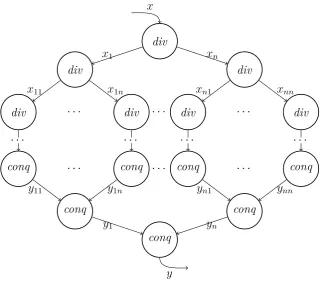
Figure 2.3: Divide and Conquer Skeleton
skeletons and skeletal programs is the one that will be used throughout this thesis.
Task Farm Skeleton
A common pattern of parallel computation is the task farm pattern, also known as master-slave ormaster-worker. In this pattern, aworker is repli-cated n times, each of which operating in parallel over independent tasks. Task independence is crucial; if tasks are not independent, the result of a worker might affect the result of another worker, and therefore leading to unpredictability and inconsistencies in the result.
The implementation details of task-farms vary between different skele-ton implementations. A common example of skeleskele-ton implementation relies on a master process that is in charge of: (a) creating the worker processes,
[image:46.595.116.440.113.394.2]pro-2.2. STRUCTURED PARALLEL PROGRAMMING 33
cesses for task distribution and collection. In FastFlow, a task farm skeleton is a streaming skeleton that receives a stream of independent input tasks, and returns a stream of output tasks. Roughly, a task farm in Fastflow com-prises: a) an emitter process that receives the input tasks, and distributes them to the different workers; b) a number of workers that perform some computation on the tasks, and send the results to a collector process; and, c) acollector process returns a stream of output tasks, possibly performing some computation, e.g. reordering them to match the order in which they were received by the emitter.
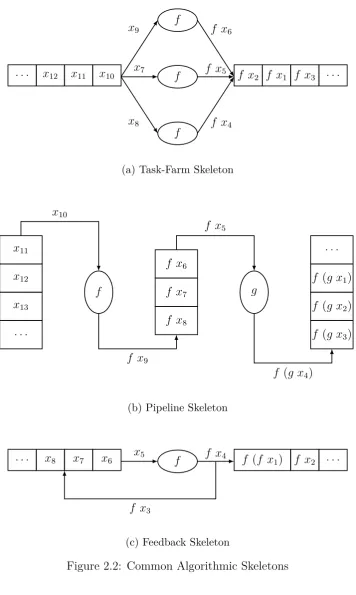
In this thesis, we use the queue-based task-farm implementation illus-trated by Figure 2.2a on page 31, which is based on [HBS16]. In this im-plementation, the master worker enqueues tasks into a shared queue, from which all the workers read the tasks. The workers then enqueue the results in the output queue. The resulting tasks do not necessarily respect the ordering of the input, and this must be handled by the master worker.
An example of usage of the task-farm skeleton is an image stream pro-cessing program, that applies a series of filters to all the elements of an input stream of images, followed by an edge detection algorithm. In a Haskell-like functional language, this program would be:
process :: Stream Img -> Stream Img process (img : imgs)
= edge (filter2 (filter1 img)) : process imgs
This program can be parallelised using a task-farm skeleton, for example, as follows:
-- fun :: (a -> b) -> Stream a -> Stream b
-- farm :: Int -> (Stream a -> Stream b) -> Stream a -> Stream b
process’ :: Img -> Img
process’ img = edge (filter2 (filter1 img)) process :: Stream Img -> Stream Img
The fun construct lifts functions into workers: process’ is a function,
fun process’ is a worker that computesprocess’. The constructfarm 5
replicates 5 times the worker fun process’. More examples of task farms can be found in a number of papers on algorithmic skeletons, e.g. [ADK+11,
BDH+13].
Pipeline Skeleton
The notion of pipelines is common from low-level hardware architectures, to high-level parallel programming. A pipeline is series of processing elements, where the output of one element is the input of the next one. In the parallel programming community, each of these processing elements is a worker of a parallel process.
The synchronisation details between the different stages of a pipeline depend again on the particular implementation of a pipeline skeleton. A common approach (e.g. Fastflow [ADK+11]) uses an intermediate buffer
between the stages of a parallel pipeline. In [HBS16], an intermediate queue is used, used concurrently by the first and second workers. This is illustrated in Figure 2.2b on page 31. For each input, the stages in a pipeline are activated sequentially, as the tasks flow through the pipeline. However, both stages of the pipeline can perform their operations in parallel to the different inputs.
An example of parallel pipeline is an image stream processing application that applies a series of filters, followed by an edge detection algorithm, to each element of an input stream of images:
process :: Stream Img -> Stream Img
process = fun filter1 k fun filter2 k fun edge
In this example, process proceeds as follows:
1. The first worker, fun filter1 takes an image from the input stream of images, applies filter1to it, and puts the result into an interme-diate queue.