doi:10.4236/ajcm.2011.12012 Published Online June 2011 (http://www.scirp.org/journal/ajcm)
Application of Multi-Step Differential Transform Method
on Flow of a Second-Grade Fluid over a Stretching or
Shrinking Sheet
Mohammad Mehdi Rashidi1, 2, Ali J. Chamkha3, Mohammad Keimanesh1 1
Mechanical Engineering Department, Engineering Faculty, Bu-Ali Sina University, Hamedan, Iran 2
Department of Genius Mechanical, University of Sherbrooke, Sherbrooke, Canada 3
Manufacturing Engineering Department, The Public Authority for Applied Education and Training, Shuweikh, Kuwait E-mail: [email protected]
Received April 8, 2011; revised May 20, 2011; accepted June 1, 2011
Abstract
In this study, a reliable algorithm to develop approximate solutions for the problem of fluid flow over a stretching or shrinking sheet is proposed. It is depicted that the differential transform method (DTM) solu-tions are only valid for small values of the independent variable. The DTM solusolu-tions diverge for some dif-ferential equations that extremely have nonlinear behaviors or have boundary-conditions at infinity. For this reason the governing boundary-layer equations are solved by the Multi-step Differential Transform Method (MDTM). The main advantage of this method is that it can be applied directly to nonlinear differential equa-tions without requiring linearization, discretization, or perturbation. It is a semi analytical-numerical tech-nique that formulizes Taylor series in a very different manner. By applying the MDTM the interval of con-vergence for the series solution is increased. The MDTM is treated as an algorithm in a sequence of intervals for finding accurate approximate solutions for systems of differential equations. It is predicted that the MDTM can be applied to a wide range of engineering applications.
Keywords: Non-Newtonian Fluid, Stretching Surface, Shrinking Sheet, Multi-Step Differential Transform Method (MDTM)
1. Introduction
A number of industrially important fluids such as molten plastics, polymer solutions, pulps, foods and slurries, fos-sil fuels, special soap solutions, blood, paints, certain oils and greases display a rheologically-complex non-New-tonian fluid behavior. Non-Newnon-New-tonian fluids exhibit a non-linear relationship between shear stress and shear rate. The Navier-Stokes equations governing the flow of these fluids are complicated due to their highly non-lin-ear nature. The non-linnon-lin-earity nature of the equations comes from the constitutive equations which represents the material properties of rheological fluids. It is, there-fore, not easy to find their exact solutions because the superposition principle for non-linear partial differential equations does not hold. Numerous models have been developed to simulate a wide variety of rheological flu-ids, including viscoelastic differential models [1], couple stress fluid models [2] and micropolar fluid models [3].
Magnetohydrodynamic flows also arise in many applica-tions including materials processing [4] and Magneto- Hydro-Dynamic (MHD) energy generators [5].
Boundary-layer flows of non-Newtonian fluids have been of great interest to researchers during the past three decades. These investigations were for non-Newtonian fluids of the differential type [6]. In the case of fluids of differential type, the equations of motion are of order higher than that of the Navier–Stokes equations, and thus, the adherence boundary condition is insufficient to de-termine the solution completely [7-9]. The same is also true for the boundary-layer approximations of the equa-tions of motion.
In this paper, a reliable algorithm of the DTM, namely MDTM [10] is used to explain the behavior of the fluid such as stream function profile, velocity profile and variations of the velocity profile.
sion. Finally, the conclusions are summarized in Section 7.
2. Basic Concepts of the Differential
Transform Method
Transformation of the kth derivative of a function in one variable is as follows [15]
0 1 d ( ) ( ) ! d k k t t f t F k
k t
(1)
and the inverse transformation is defined by
0 0
( ) ( )( )k
k
f t F k t t
, (2)From Equations (1) and (2), we get:
0 0
0
( ) d ( ) ( ) ! d k k k k t t
t t f t f t
k t
(3)which implies that the concept of the differential trans-form method is resulting from Taylor series expansion, but the method does not calculate the derivatives repre-sentatively. However, the relative derivatives are calcu-lated by an iterative way which is described by the trans- formed equations of the original function. For imple-mentation purposes, the function f t( ) is expressed by a finite series and Equation (2) can be written as
0 0 ( ) ( )( ) i k k
f t F k t t
, (4)where F k( ) is the differential transform of f t( ).
3. Basic Concepts of the Multi-Step
Differential Transform Method
When the DTM is used for solving differential equations
the solution of the initial-value problem (5). In actual applications of the DTM, the approximate solution of the initial value problem (5) can be expressed by the follow-ing finite series:
0 ( ) N n n n
f t a t
t[0, ]T . (6)The multi-step approach introduces a new idea for constructing the approximate solution. Assume that the interval [0, T] is divided into M subintervals [tm1,
m
t ], 1, 2,m ,M of equal step size hT M/ by using the nodes tm mh . The main ideas of the multi-step DTM are as follows. First, we apply the DTM to Equation (5) over the interval [0, t1], we will obtain the following approximate solution,
1 1 0 ( ) K n n n
f t a t
t[0, ]t1 , (7)using the initial conditions ( ) 1 (0)
k k
f c . For m2 and at each subinterval [tm1, tm] we will use the initial
con-ditions ( ) ( )
1 1 1
( ) ( )
k k
m m m m
f t f t and apply the DTM to Equation (5) over the interval [tm1, tm], where t0 in Equation (1) is replaced by tm1. The process is repeated and generates a sequence of approximate solutions
( )
m
f t , m1, 2,,M, for the solution f t( ), 1
0
( ) ( )
K
n
m mn m
n
f t a t t
, t[ , ]tm tm1 , (8)where N K M . In fact, the multi-step DTM assumes the following solution:
1 1
2 1 2
1 ( ), [0, ]
( ), [ , ] ( )
( ), [ , ]
M M M
f t t t
f t t t t f t
n
f t t t t
. (9)
Figure 1. Variation f( ) with respect to η K, when M= 2,
1
s = , = 1a , for the stretching sheet.
Figure 2. Variation f( ) with respect to η K, when M= 2,
1
s = , = 1a , for the stretching sheet.
easily observed that if the step size hT, then the multi-step DTM reduces to the classical DTM. As we will see in the next section, the main advantage of the new algo-rithm is that the obtained series solution con-verges for wide time regions and can approximate non-chaotic or chaotic solutions.
4. Mathematical Formulation
[image:3.595.308.538.79.529.2]Consider the flow of a second-order fluid following Equations (10-12) as
Figure 3. Variation f( ) with respect to η K , when
= 2
M , 1s = , = 1a , for the stretching sheet.
Figure 4. Variation f( ) with respect to η M , when
= 1
K , s =1, = 1a , for the stretching sheet.
2 1 1 2 2 1
A A A ,
T pI (10)
where A1 (gradv)+(gradv)
T
, and
2 1 1 1
A =dA /d +A (gradv) A ,t T (11)
1 1 2
0, 0, 0.
(12) The flow past a flat sheet coinciding with the plane
0
[image:3.595.57.285.80.284.2] [image:3.595.58.285.330.533.2]Figure 5. Variation f( ) with respect to η M , when = 1
[image:4.595.310.538.81.286.2]K , 1s = , = 1a , for the stretching sheet.
Figure 6. Variation f( ) with respect to η M , when
= 1
K , s =1, = 1a , for the stretching sheet.
this fluid in the primitive usual notation are
0, u
x y
(13)
2 2
0 0 2
2 2 3
2 3
B
u u
u u
x y y
u u u u
u
x y y x y y
(14)
The precise mathematical problem considered is [16]
Figure 7. Variation f( ) with respect to η s, when K= 1,
= 0
[image:4.595.58.289.327.544.2]M , = 1a , for the stretching sheet.
Figure 8. Variation f( ) with respect to η s, when K= 1,
= 0
M , = 1a , for the stretching sheet.
2 2
(f) ffMf fK[2f f (f) ffi]
(15)
The appropriate boundary conditions for the problem are
(0) , (0) ,
f s f a (15)
( ) 0, ( ) 0.
f f (16)
5. Analytical Solution be the MDTM
Applying the MDTM to Equation (15) gives the follow-ing recursive relation in each sub-domain (ti,ti1), 0,i
[image:4.595.310.537.331.537.2]Figure 9. Variation f( ) with respect to η s, when K= 1, = 0
[image:5.595.310.538.231.433.2]M , = 1a , for the stretching sheet.
Table 1. The operations for the one-dimensional DTM.
Original function Transformed function
( ) ( ) ( )
f t u t v t ( )F k U k( )V k( ) ( ) ( )
f t u t ( )F k U k( ) d ( )
( ) d n n u t f t t ( ) ( )! ( ) ! k n
F k U k n
k
d ( ) d ( ) ( )
d d
u t u t
f t
t t
0
( ) ( 1)( 1) ( 1) ( 1)
k
r
F k r k r U r U k r
2 2 2 2
d ( ) d ( ) ( )
d d
u t u t
f t
t t
0
( 1)( 2)( 2)
( )
( 1) ( 2) ( 2)
k
r
r r k r
F k
k r U r U k r
2 2d ( ) ( ) ( )
d
u t
f t u t
t
0
( ) ( 2)( 1) ( ) ( 2)
k
r
F k k r k r U r U k r
d ( )( ) ( ) d
v t
f t u t
t
0
( ) ( 1) ( ) ( 1).
k
r
F k k r U r V k r
0 0 0 0( 1)( 2)( 3) ( 3)
( ) ( 2)( 1)( 2)
( 1) ( 1)( 1)( 1)
( 1) ( 1)
( 1) ( 3)( 1) 2
( 1)( 2)( 3)
( 2) ( 2)( 1)
( 2)( 1)( 2)
k r k r k r k r
k k k F k
F r F k r k r k r
F r F k r r k r
M k F k
F r F k r r
k r k r k r
F r F k r r
k
r k r k r
0 0( ) ( 4)( 1)
( 2)( 3)( 4)
k
r
F r F k r k r
k r k r k r
, (17)
where F k( ) is the differential transforms of f( ) . We can consider the boundary conditions [Equations. (15) and (16)] as follows:
(0)
f s, f(0)a, (18)
(0)
f , f(0) . (19)
The differential transform of the above initial condi-tions are as follows
(0)
F s, F(1)a, (20)
(2) / 2
F , F(3)/ 6. (21)
Moreover, substituting Equations (20) and (21) into Equation (17) and by using the recursive method, we can calculate other values of F k( ). Hence, substituting all
( )
F k , into Equation (4), we obtain series solutions. By
Figure 10. Variation f( ) with respect to η K , when
= 2
M , 1s = , a= 1 , for the shrinking sheet.
Figure 11. Variation f( ) with respect to η K, when
= 2
M , 1s = , a= 1 , for the shrinking sheet.
[image:5.595.58.289.344.681.2] [image:5.595.307.538.478.686.2]7.5 –1360.3 0.00552703 0.00542273 –2513.06 0.0126421 0.0126049
8.0 –2477.92 0.00397796 0.00382971 –4609.63 0.00947179 0.00941688
8.5 –4341.63 0.0029083 0.00270467 –8127.06 0.00711334 0.0070352 9.0 –7353.9 0.00218163 0.00191012 –13843.1 0.00536369 0.00525588
9.5 –12090.3 0.00170165 0.00134899 –22874.4 0.00407131 0.00392658
[image:6.595.93.505.97.328.2]10 –19357.2 0.00140031 0.000952703 –36792.3 0.00312311 0.00293349
Table 3. Comparison of obtained results for f (η), when M= 2, 1s = and a= 1 and various values of parameter K .
( )
f
1.
K K2
DTM Padé [5, 5] MDTM DTM Padé [5, 5] MDTM
0.0 0.695621 0.695621 0.695621 0.583156 0.583156 0.583156
0.5 0.437262 0.49127 0.49127 0.359195 0.435667 0.435667
1.0 0.202525 0.346951 0.346951 0.116804 0.325479 0.325479
1.5 0.00605472 0.245028 0.245028 –0.109835 0.24316 0.24316
2.0 –0.173392 0.173047 0.173047 –0.343373 0.181661 0.181661
2.5 –0.290258 0.122211 0.122211 –0.505173 0.135716 0.135716
3.0 –0.0223928 0.0863097 0.0863097 –0.0537612 0.101391 0.101391
3.5 1.65387 0.0609548 0.0609548 2.78564 0.0757477 0.0757477
4.0 7.24184 0.0430483 0.0430482 12.4698 0.0565899 0.0565899
4.5 22.024 0.0304023 0.0304021 38.5972 0.0422774 0.0422774
5.0 56.0808 0.0214713 0.0214709 99.7758 0.0315848 0.0315847
5.5 127.258 0.0151642 0.0151635 229.359 0.0235966 0.0235964
6.0 265.338 0.0107103 0.010709 483.575 0.0176288 0.0176285
6.5 517.708 0.00756533 0.00756301 952.633 0.0131705 0.01317 7.0 956.839 0.00534496 0.00534125 1775.47 0.00984004 0.00983907 7.5 1689.93 0.00377781 0.00377216 3158.83 0.00735216 0.0073506 8.0 2871.07 0.00267225 0.00266403 5401.49 0.00549389 0.00549152 8.5 4716.41 0.00189295 0.00188142 8924.45 0.0041061 0.00410262 9.0 7522.61 0.00134434 0.00132872 14308. 0.00306991 0.003065 9.5 11689.3 0.000958921 0.000938387 22336.5 0.00229654 0.00228981
10 17745.6 0.000689019 0.00066272 34052.4 0.00171964 0.00171068
using the asymptotic boundary condition F(2)/ 2
and f ( ) 0, we can obtain , . For analytical solution of the considered problem, the convergence analysis was performed and in Equation (4), the i value is selected equal to 10 and the interval was set equal to 0.01.
6. Results and Discussion
Equation (15) with transformed boundary conditions was
solved analytically using the DTM and the MDTM. In order to give a comprehensive approach of the problem, a comparison between DTM, MDTM and DTM-Padé solutions for various parameters is presented.
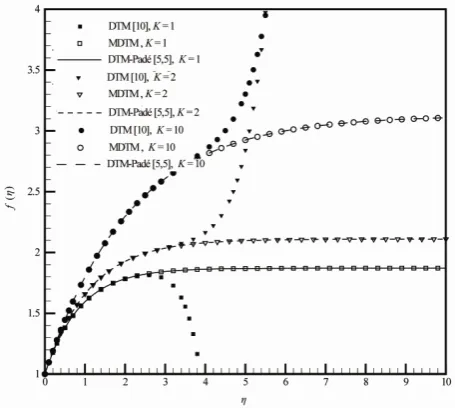
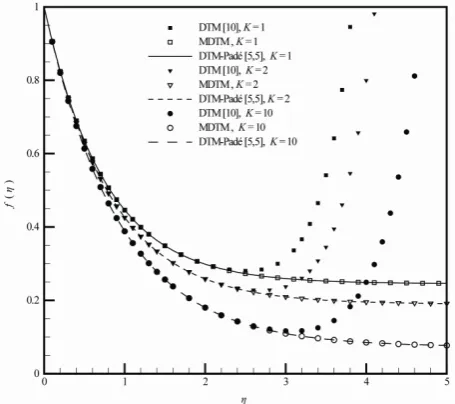
In Figures 1-9, solutions for the stretching sheet are illustrated. Figures 1-3 show the variation of f( ) ,
( )
f , f( ) for various values of K. It is observed that increasing the parameter K. causes increases in
( )
[image:6.595.84.514.361.589.2]Figure 12. Variation f( ) with respect to η K , when = 2
[image:7.595.57.285.79.290.2]M , 1s = , a= 1 , for the shrinking sheet.
Figure 13. Variation f( ) with respect to η M, when
= 1
K , 5s = , a= 1 , for the shrinking sheet.
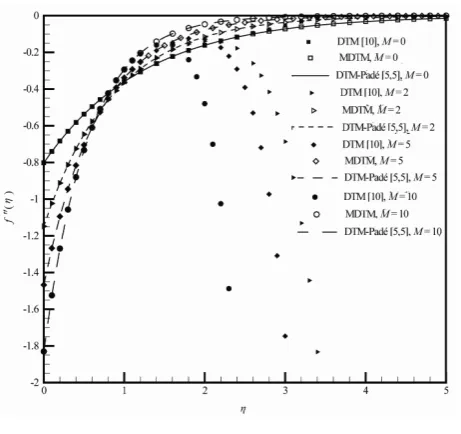
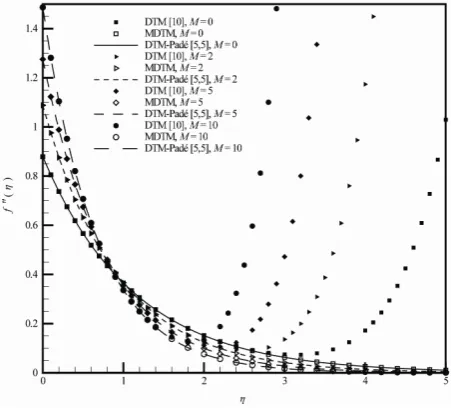
is presented in Figures 4-6. It can be concluded that, an increase in the magnetic parameter decreases f( ) ,
( )
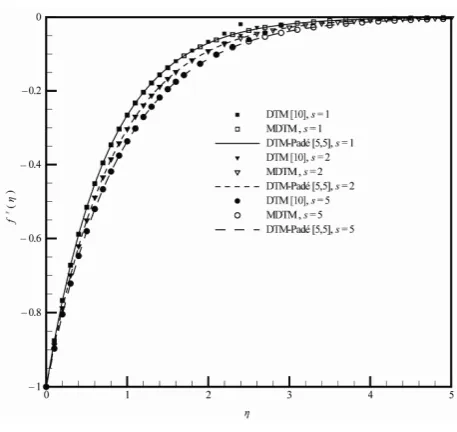
f , profiles. The effects of the parameter s are shown in Figures 7-9. It is clear that an increase in this parameter causes a remarkable rise in f( ) profile.
Conversely, an increase in the value of
s
,
causes acorresponding decrease in f( ) profile.
In Figures 10-18, solutions for the shrinking sheet are shown. Figures 10-12 show the variations of f( ) ,
( )
f , f( ) for various values of K. It is observed that increasing the parameter K. causes decreases in
( )
[image:7.595.56.286.327.537.2]f , f( ) , profiles, respectively. The influence of
Figure 14. Variation f( ) with respect to η M, when
= 1
K , s =5, a= 1 , for the shrinking sheet.
Figure 15. Variation f( ) with respect to η M, when
= 1
K , 5s = , a= 1 , for the shrinking sheet.
the magnetic parameter M , on f( ) , f( ) , f( )
is presented in Figures 13-15. It can be concluded that, an increase in the magnetic parameter increases f( ) ,
In Figures 10-18, solutions for the shrinking sheet are shown. Figures 10-12 show the variations of f( ) ,
( )
f , f( ) for various values of K. It is observed that increasing the parameter K. causes decreases in
( )
f , f( ) , profiles, respectively. The influence of the magnetic parameter M , on f( ) , f( ) , f( )
is presented in Figures 13-15. It can be concluded that, an increase in the magnetic parameter increases f( ) ,
( )
[image:7.595.310.536.332.536.2]Figure 16. Variation f( ) with respect to η s, when K= 1, = 2
[image:8.595.309.537.81.287.2]M , a= 1 , for the shrinking sheet.
Figure 17. Variation f( ) with respect to η s , when
= 1
K , M= 2, a= 1 , for the shrinking sheet.
,
s
are shown in Figures 16-18. It is clear that increas-ing this parameter causes a remarkable rise in f( )profile. Conversely, increasing the value of s,
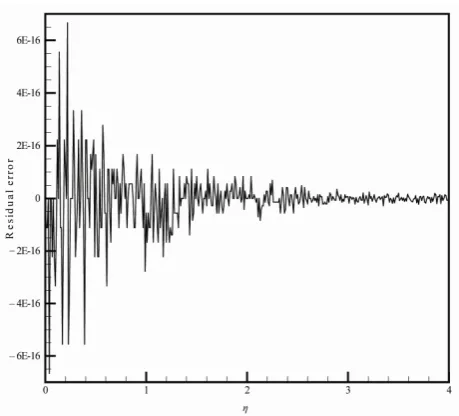
causes a decrease in f( ) profile. The Residual
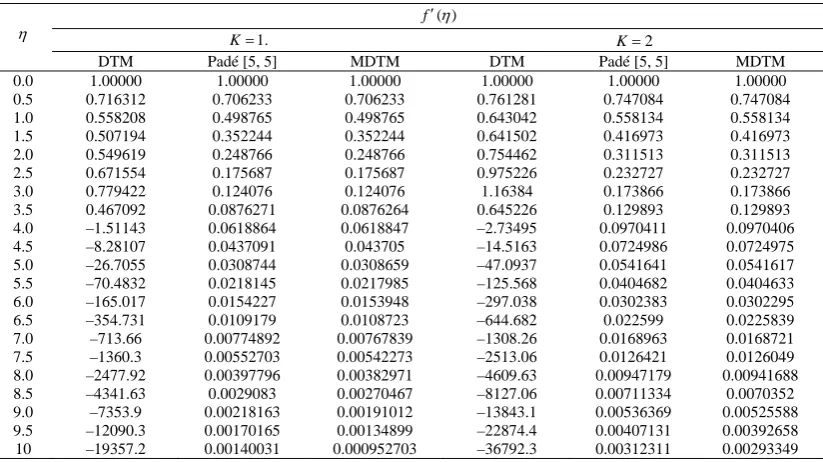
errors for Equation 15 are plotted in Figures 19-20 using the DTM and MDTM respectively. In order to verify the efficiency of the proposed method in comparison with the DTM and DTM-Padé solutions, we report the ob-tained results in Tables 2 and 3 for f( ) and f( )
[image:8.595.56.285.325.541.2]when M 2, s1 and x1 and various values of the parameter K. for f( ) and f( ) , respectively. It is obvious from Tables 2 and 3 that the MDTM is a
Figure 18. Variation f( ) with respect to η s , when
= 1
K , M= 2, a= 1 , for the shrinking sheet.
Figure 19. Residual error for Equation (15) using the DTM
approximations when K= 1, M= 2, 5s = and a= 1 .
reliable algorithm method.
7. Conclusions
[image:8.595.309.538.326.535.2]Figure 20. Residual error for Equation (15) using the
MDTM approximations when K= 1, M= 2, 5s = and
= 1
a .
VIM, ADM and HPM). The method has been applied directly without requiring linearization, discretization, or perturbation. The accuracy of the method is excellent. The obtained results demonstrate the reliability of the algorithm and give it a wider applicability to non-linear differential equations.
8. References
[1] S. K. Ghosh, O. A. Bég, R. Bhargava, S. Rawat and T. A. Bég, “Mathematical Modelling of Transient Magnetohy-drodynamic Couple Stress Biofluid Flow in a Rotating Channel,” International Journal of Applied Mathematics and Mechanics, Vol. 6, No. 6, 2010, pp. 23-45.
[2] O. Anwar Bég, H. S. Takhar, R. Bharagava, S. Rawat and V. R. Prasad, “Numerical Study of Heat Transfer of a Third Grade Viscoelastic Fluid in Non-Darcian Porous Media with Thermophysical Effects,” Physica Scripta, 2008, Vol. 77, No. , pp. 1-11.
[3] D. A. S. Rees and A. P. Bassom, “Boundary Layer Flow of a Micropolar Fluid,” International Journal of Engi-neering Science, Vol. 34, No. 1, 1996, pp. 113-124.
doi:10.1016/0020-7225(95)00058-5
[4] O. A. Bég, A. Y. Bakier and V. R. Prasad, “Numerical Study of Free Convection Magnetohydrodynamic Heat and Mass Transfer from a Stretching Surface to a Satu-rated Porous Medium with Soret and Dufour Effects,” Computational Materials Science, Vol. 46, No. 1, 2009, pp. 57-65. doi:10.1016/j.commatsci.2009.02.004
[5] S. K. Ghosh, O. Anwar Bég and M. Narahari, “Hall Ef-fects on MHD Flow in a Rotating System with Heat Transfer Characteristics,” Meccanica, Vol. 44, No. 6, 2009, pp. 741-765. doi:10.1007/s11012-009-9210-6
[6] C. Truesdell and W. Noll, “The Non-Linear Field Theo-ries of Mechanics,” In: S. Flügge, Ed., Encyclopedia of Physics, III/3, Springer, Berlin, 1965, pp. 1-591.
[7] K. R. Rajagopal, “On Boundary Conditions for Fluids of the Differential Type,” In: A. Sequeira, Ed., Navier- Stokes Equations and Related Non-linear Problems, Ple-num Press, New York, 1995, pp. 273-278.
[8] K. R. Rajagopal and P. N. Kaloni, “Some Remarks on Boundary Conditions for Fluids of the Differential Type,” In: G.A.C. Graham and S. K. Malik, Eds., Continuum Mechanics and Its Applications, Hemisphere, New York, 1989, pp. 935-942.
[9] K. R. Rajagopal and A. S. Gupta, “An Exact Solution for The Flow of a Non-Newtonian Fluid Past an Infinite Plate,” Meccanica, Vol. 19, No. 2, 1984, pp. 158-160.
doi:10.1007/BF01560464
[10] Z. M. Odibat, C. Bertelle, M. A. Aziz-Alaoui, G. H. E. Duchamp, “A Multi-Step Differential Transform Method and Application to Non-Chaotic or Chaotic Systems,” Computers and Mathematics with Applications, Vol. 59, No. 4, 2010, pp. 1462-1472.
doi:10.1016/j.camwa.2009.11.005
[11] J. K. Zhou, “Differential Transformation and Its Applica-tions for Electrical Circuits,” Huazhong University of Science and Technology Press, Wuhan, 1986, (in Chi-nese).
[12] M. M. Rashidi and M. Keimanesh, “Using Differential Transform Method and the Padé Approximant for Solv-ing MHD Flow in a Laminar Liquid Film from a Hori-zontal Stretching Surface,” Mathematical Problem in En-gineering, Vol. 2010,Article ID 491319.
[13] M. M. Rashidi, M. Keimanesh, O. Anwar Bég and T. K. Hung, “Magnetohydrodynamic BioRheological Transport Phenomena in a Porous Medium: A Simulation of Mag-netic Blood Flow Control and Filtration,” International Journal for Numerical Methods in Biomedical Engineer-ing, Vol. 27, No. 6, 2011, pp. 805-821.
doi:10.1002/cnm.1420
[14] M. M. Rashidi, “The Modified Differential Transform Method for Solving MHD Boundary-Layer Equations,” Computer Physics Communications, Vol. 180, No. 11, 2009, pp. 2210-2217. doi:10.1016/j.cpc.2009.06.029
[15] I. H. Abdel-Halim Hassan, “Comparison differential Transformation Technique with Adomian Decomposition Method for Linear and Nonlinear Initial Value Prob-lems,” Chaos Solitons and Fractals, Vol. 36, No. 1, 2008, pp. 53-65. doi:10.1016/j.chaos.2006.06.040
[16] A. Robert Van Gorder, “High-order Nonlinear Boundary Value Problems Admitting Multiple Exact Solutions with Application to The Fluid Flow over a Sheet,” Applied Mathematics and Computation, Vol. 216, No. 7, 2010, pp. 2177-2182. doi:10.1016/j.amc.2010.03.053
[17] M. M. Rashidi and H. Shahmohamadi, “Analytical Solu-tion Of Three-Dimensional Navier-Stokes EquaSolu-tions for the Flow Near an Infinite Rotating Disk,” Communica-tions in Nonlinear Science and Numerical Simulation, Vol. 14, No. 7, 2009, pp. 2999-3006.
Nomenclature
0
B uniform magnetic field along the y-axis M magnetic parameter
R suction parameter
viscoelastic parameter
kinematic viscosity
0