Honours Report
Active Network Security
Theuns V erwoerd
5 November, 1999
Abstract
Most discussions of network security focus on the tools and techniques used to fortify networks: firewalls, biometrics, access controls, encryption. This paper presents an outline of tools that assist an administrator in verifying and maintaining the security of a networked system - Active Security tools. It discusses why there is a need for such tools and how security mechanisms are attacked. The report also describes the main tools available in this field, with particular emphasis on Intrusion Detection tools - how they work, what is available, and how they are changing. Finally, it demonstrates some of the concepts in a practical firewall network simulation.
Keywords: Network Security, Intrusion Detection, Firewalls,
Cryptography, Network Attacks
1. INTRODUCTION ...
5
1.1 The need for active nehvork security ... 5
1.2 Active security mechanisms ... 6
1.3 The History of Intrusion Detection ... 7
1.4 Structure of this report ... 7
2. THE LIMITATIONS OF STATIC SECURITY ... 9
2.1 What static security mechanisms are available ... 9
2.2 What do static methods offer ... 10
2.3 The limitations of static security ... 10
3. OUTLINE OF AN ATTACK ... 12
3.1 Sources of attack ... 12
3.2 Outline of an attack···!···"··· .. ··· 13
3.3 Typical attack techniques ... 15
4. POLICY ISSUES FOR ACTIVE SECURITY ... 17
4.1 What is Security Policy ... 17
4.2 The relationship between Active Security and Security Policy ... 18
4.3 Intrusion Response Policy ... 18
4.4 Policy Revie,v ... 19
5. HOW INTRUSION DETECTION WORKS ... 20
5.1 The goals of Intrusion Detection ... 20
5.2 An architectural outline ... 20
5.3 Intrusion Detection Techniques ... 21
5.4 Capabilities of Intrusion Detection Systems ... ; ... 23
5.5 Limitations of current Intrusion Detection ... 24
5.6 Current areas of development ... 26
6.1 Manual review techniques ... 27
6.2 Shadow/Step/CIDER [Shadow98] ... 27
6.3 Network Flight Recorder (NFR) ... 29
6.4 BlackICE ... 30
6.5 BR0 ...•...•...•...•...••... 30
6.6 DIDS ... 31
6.7 GrIDS ... 31
6.8 AAFID ... 31
6.9 Emerald ...•..•...•...•...•...•... 32
7. STANDARDISATION EFFORTS IN INTRUSION DETECTION ... 33
7.1 Common Intrusion Detection Format (CIDF) ... 33
7.2 IETF Intrusion Detection Exchange Format Working Group (IDWG) ... 34
7.3 Intrusion Detection Systems Consortium (IDSC) ... 36
8. TOOLS SUPPORTING ACTIVE SECURITY ... 37
8.1 Network Mappers ... 37
8.2 Network Security Scanners ... 37
8.3 System Integrity Checkers ... 38
8.4 Password Crackers ... 39
8.5 Sniffer Detection ... ; ... 39
8.6 Honeytrap Systems ... 40
9. INTRUSION DETECTION EXPERIMENTS ... 42
9.1 Testbed Configuration ... 42
9.2 Experimental Results ... 43
9.3 Conclusions ... 46
10. CONC~USION ... 49
11. GLOSSARY ... 50
Introduction
A network could be likened to a medieval town; with clusters of houses ( systems) connected by roadways, separated by perilous terrain. Like any town, different landmarks can be seen: private homes, businesses, warehouses, stronghouses and fortifications.
The function of this simile is to illustrate two main points. The first is to note that walls do not adapt well with change. As the town grows, walls become constrictive, and do not provide sufficient protection. Secondly, while walls make frontal assault more difficult, they do not prevent all attacks - and unmanned walls do not prevent burglary. In networks, Active Security takes the role of a policing force: ensuring the integrity of the town's defences, while curbing excesses by the town's residents.
Computer networks are becoming fundamental to the functioning of modern organisations. As the dependency on networks increases, the need to control networked resources becomes increasingly critical. At the same time, networks are becoming ever more valuable - in terms of their function, the resources they offer, and the information they contain. In this way, they become not only more valuable to an organisation itself - they also become an attractive target for hostile parties (both in and outside of an organisation).
The concepts of protecting assets are not new; security of physical assets is a well-developed part of any organisational structure. With the rampant growth of intemetworks typified by the Internet - the logical assets of an organisation are increasingly exposed, however. It is now possible for an attacker to penetrate a system, steal or vandalise a company's most valuable assets, and leave - all without leaving any physical trace.
In the past decade, a wide variety of security mechanisms have been developed, aimed at safeguarding the logical assets of an organisation: access controls, firewall technologies, encryption and
cryptographic authentication, biometrics and the like. These measures have one common factor in that they attempt to prevent unauthorised access to resources - they could be likened to the locks and secure doors used in physical security. What is missing is a responsive element - the security guards,
monitoring and alarm systems present in physical security structures.
Active Network Security is comprised ofa number of techniques that address this shortcoming. The goal is not only to reduce the number of successful abuses of a system, but also to give early warning of abuses in progress. Finally, the objective is to ensure that misuse of the system does not go unnoticed - that, should all of the security mechanisms fail, a record exists to allow corrective action.
The mechanisms involved fall into two main groups: those aimed at inspecting a system to ensure its security, and those aimed at monitoring a system in use. The first group, that of System Verification Tools, is discussed in Section 8. The second, that oflntrusion Detection Systems, is the focus of much of the remainder of this report.
1. 1 The need for active network security
I
1: ..As noted, a wide variety of security tools and mechanisms are currently available. This begs the question: Why is there a need for active security? In order to answer this, let us consider the 1999 CSI/FBI Computer Crime and Security Survey [CSI99] 1•
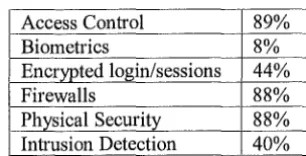
[image:6.600.218.371.175.253.2]The survey ( dated March 1999) was conducted over 521 US companies from a range of industry sectors, with sizes ranging from under 100 employees to over 10,000. These companies had a variety of security structures in place, as shown in Table 1.
Table 1 Security Measures in Place
Access Control 89%
Biometrics 8%
Encrypted login/sessions 44%
Firewalls 88%
Physical Security 88% Intrusion Detection 40%
In spite of these measures, 61 % of these companies reported experiencing unauthorised use of their computer systems. Twenty percent did not know if their systems had been abused. While 30% of organisations reported outside penetration of their systems, 55% reported insider abuse. Many of the organisations were unable to quantify their losses due to intrusions - for the 163 organisations that were, the total losses exceeded US$123 million. Clearly, in spite the presence of security mechanisms ( with the vast majority of organisations having access controls and firewalls in place), abuse of systems continue - sometimes without the organisation even being aware of the breach.
As a specific case, consider an organisational Web site. As an organisation's most visible Internet system, these have long been favoured points of attack. With the development of e-commerce and the increasing use of the Internet as a source of information, an organisation's Web site is developing a significant commercial value. By the same token, attacks on these sites could do significant harm to an organisation in loss of revenue, loss of customer confidence and damage to information systems.
A good illustration of the risks involved is the "Solar Sunrise" attacks on US government sites [Herald99] [CNN99]. During this series of attacks, a wide variety of web sites were defaced or disabled- including such sites as the FBI, the US Army main Web site, a number of government departments and universities, the US Information Agency, and the US Senate (twice).
Returning to the CSI/FBI survey, it is notable that 94% of those organisations have Web sites (29% offering electronic commerce via these sites, for annual revenues ofUS$6 l 7 million). Again, figures on the abuse of these sites are startling: 18% report abuse -while 30% do not know.
Clearly conventional, static security mechanisms such as firewalls are incapable of offering complete protection ( discussed in more detail in Section 2). Active Security mechanisms such as Intrusion Detection should have a place in any secure network.
1.2 Active security mechanisms
Active network security, as described in this document, encompasses networking tools and systems that allow system administrators to observe, inspect and improve the security of their networks. Many conventional security mechanisms are effective in enforcing security in a system, but lack the responsiveness necessary to maintain security on an ongoing basis.
In recent years, a number of security tools have been developed that may best be classified under this heading: while these tools often have no direct effect in preventing misuse, they allow administrators to improve the overall security of their systems. Examples include:
I
• Intrusion Detection Systems (IDS) - Intrusion Detection Systems monitor the state of a system, attempting to recognise and report improper behaviour. These systems protect a network in much the same way as security cameras protect buildings: by letting security personnel keep an eye on what is going on.
• Network Security Scanners - Security scanning systems inspect a network or host system, looking for known weaknesses and possible misconfigurations. The best known example is probably the Satan system - it scans hosts and connected networks for a specific series of weaknesses, reporting any found, and suggesting solutions.
• System Integrity Checkers - Many of the ways in which systems are attacked involve changes to the host's software and data. Integrity checkers compare the contents of a system to a known safe state - allowing administrators to know exactly what has been changed.
• Honeytrap systems - If an IDS is a security camera, this is a burglar alarm; systems whose sole purpose is to be attacked. By closely monitoring these systems, network administrators can observe attackers in action - allowing them to repair, learn and strengthen security against future attacks.
• Special purpose tools - Specific tools have been developed to address security weaknesses present in systems. While not as generally applicable as those listed above, still deserve a place in every security administrator's toolkit. In Section 8, we will touch on two examples: password cracking systems and sniffer detector software.
In a world where security mechanisms were infallible, none of these systems would be necessary. In fact, none of these systems can, in itself, prevent an attack from succeeding. The function of these tools is to minimise the effect of an attack, mitigate resulting damage, enhance the effectiveness of other mechanisms, and ensure that future similar attacks do not succeed.
1.3
The History of Intrusion Detection
The subject field oflntrusion Detection is generally considered to have originated with a 1980 technical document by James Anderson [Anderson80]. In this he proposed a way in which audit information could be used to identify abuses occurring in systems - the original anomaly detection concept. In 1987 Dorothy Denning published a paper [Denning87] presenting a model of how an anomaly detection system could be implemented - a model that was applied in the IDES system. Interestingly, this paper also mentions the possibility of misuse detection but discards the possibility as requiring too much world-knowledge.
Over the following years, a number of IDS tools were developed: IDES (1988), Haystack (1988), Wisdom & Sense (1989), ComputerWatch (1990), Distributed IDS (1991), Network Security Monitor (1990- the original network-based IDS), UST AT (1992), IDIOT (1995), NIDES (1995), EMERALD ( 1997), Bro ( 1998), AAFID ( 1998) and Graph IDS ( 1999). In addition, a number of commercial offerings have been released such as Netranger [NetRanger99], Network Flight Recorder [NFR97], BlackICE Defender [BlackICE99], and numerous others. 2
In spite of the large body of research that has been compiled in this field, Intrusion Detection is only starting to reach maturity. Many of the systems and techniques developed remain academic exercises, and a number of issues remain to be addressed.
1.4 Structure of this report
This report attempts to give a brief outline of the basic concepts and principles involved in applying active security mechanisms to a network. The first section, the introduction, briefly outlines the need for network security, and gives background information on some of the basic concepts.
Section 2 gives a description of the dominant types of static security mechanisms currently available, and describes why these tools do not address all of the security needs of modern networks.
2
Michael Sobirey maintains an extensive list ofIDS systems at http://www-rnks.informatik.
Section 3 focuses on the attackers: who they are, how they attack, and what tools and attacks an administrator might expect to see used against his or her networks.
Section 4 describes a number of issues regarding security policy that are especially pertinent in the context of active security: aspects of the security policy that support active security, intrusion response policy, and the need for a dynamic review process in network security.
Section 5 is the first section that focuses directly on Intrusion Detection. In this section, the basic concepts underlying modern IDS techniques are described: anomaly and misuse detection, host vs. network IDS, sensors, monitors and distributed IDS.
Section 6 applies the concepts from Section 5 to a number of current and historical IDS systems. It describes how they work; strengths, weaknesses and innovations in their design; and where they fit into the framework outlined.
Section 7 gives an overview of the standardisation attempts currently in progress for Intrusion
Detection; the Common Intrusion Detection Framework, the IETF Intrusion Detection Working Group, and the Intrusion Detection Systems Consortium.
Section 8 discusses Active Security tools: it outlines the main categories of tools available, with specific descriptions of some of the most popular examples.
Section 9 applies the principles described in this report to a specific example: the effect of a firewall in the interaction between network security·scanning tools and intrusion detection. Some of the problems with static security are illustrated - specifically with the use of firewalls. We also demonstrate the effectiveness of specific Active Security techniques.
Section 10 contains a summary of the main points covered in this report, a few thoughts on the state of Active Security, and possible directions for future work.
2. The limitations of Static Security
2. 1 What static security mechanisms are available
3Authentication. The core of many current security mechanisms, authentication encompasses the technologies used to identify and verify the authenticity of users, network components and processes. This ranges from simple password based schemes through to biometric and cryptographic mechanisms. The ultimate goal is to uniquely associate an entity external to a system with an identity stored inside the system. In most systems, this is done by requesting some identifying information from a client, for example a password, biometric reading or response to some challenge. This information is then verified against information held inside the system. Should the identifier and stored information match, the user is authenticated; otherwise the user is denied. Extensions of this scheme include the addition of timing or locality information in the identification data, and encrypting the dialogue - all aimed at making the synthesis of a counterfeit identification token more difficult.
Cryptography. With the recent increase in dependence on shared resources, especially public networks, the security of information in storage and transit has become a concern. Strong
authentication may prevent active use of restricted resources, but passive interception of information can be as great a risk. In addition, where information is held in an untrusted system, ensuring that data remains unchanged in transit is also a concern. Cryptographic techniques are becoming increasingly prevalent in resolving these issues: ensuring that only authorised users can interpret sensitive information (encryption); and ensuring that vulnerable information is communicated intact (authentication) [Schneier96].
Encryption is the process of applying a transformation to data that can only be reversed using secret information. Depending on the application, one of two forms of encryption may be used: secret-key cryptography, where the transform and its reverse make use of the same secret, and public-key cryptography, where the encrypting transform does not require the use of secret information. Public-key cryptography bears a close resemblance to the authentication problem: a user may be defined as anyone capable ofreversing a given transform, thereby authenticating a communication partner. Cryptographic authentication involves the derivation of a message signature from a message, based on the use of secure hashing techniques. Should the message be modified in transit, the signature and resulting message will no longer match. In order to ensure that the message signature is not modified, encryption techniques are used (restricting the set of users capable of generating a message to those sharing a specific secret). In the case of a modified message, it is infeasible to generate a new encrypted signature that would decrypt to validate that modification. Therefore, if the signature matches the message, it is unlikely that the message was changed or counterfeited.4
Access controls. Authentication verifies the internal identity of external parties. Access controls define which resources those parties have access to - limiting the capabilities of those users. These controls are no stronger than the authentication mechanism underlying them, and have potential weaknesses independently of authentication failure. 5
Firewalls. While firewalls could be considered a specific application of the mechanisms described above, they form one of the main pillars of current network security, and merit separate consideration. The function of a firewall is to separate networks with different security needs and policies - in the most general case, to separate the internal, controlled network and any external public networks. Effectively, a firewall acts as a filter on network traffic - controlling what goes into, or comes out of, a network.6
3 A few good references on these subjects include [Sandhu96], [Harris98], [Schneier96] and [Siyan95] 4 See [Bellovin96] [Schneier98] and [RSAFAQ] for details on how these methods can be attacked.
5 See [Tanenbaum92] Section 4.5 for more details on different models of Access Control. 6 Full information on the techniques and implications of firewalls can be found in [Cheswick94],
[Chapman95], [Siyan95] or [Hunt98].
f
2.2 What do static methods offer
The static methods described here, perfectly applied, are effective in ensuring the security of any network. Even in realistic environments, static security mechanisms are capable of significantly improving the security of networked resources.
• Static mechanisms can increase the security of networks in the context where they apply.
• These mechanisms can increase the technical expertise and resources required to compromise the security of a network.
• Static methods can reduce the range of attacks that Active Security mechanisms must deal with. • Static methods can combine with Active methods to provide a synergetic improvement in security. • Static methods can prevent attacks from succeeding.
2.3 The limitations of static security
In spite of the wide variety of security mechanisms available, intrusions continue to occur. Based on this fact, a number of limitations in static security mechanisms can be identified:
• The protection offered by these mechanisms is limited in scope. While these mechanisms may be effective in the context in which they are applied, they do not offer universal protection. For example, firewalls, while being effective against external attack, offer no protection against internal abuse - which, as shown in a previous section, is a significant risk factor. The same type of argument applies to other mechanisms: authentication is vulnerable to trust networks, where the authentication mechanisms are bypassed. Encryption only protects information while in an encrypted form. All of the cun-ent static mechanisms can be bypassed, negating their effect. • The security mechanisms themselves are sensitive to technical and implementation problems.
Such systems can become vulnerable due to theoretical advances (such as the DES encryption standard, which can no longer be considered completely secure [RSAF AQ]), or poor
implementation (for example Microsoft PPTP [Schneier99]).7
• Even if theoretically sound and correctly implemented, security mechanisms must be correctly applied in order to be effective. [Gula99] describes an organisation that had its web server defaced -while their firewall was hidden deep inside their network, acting as a log server. Many of the security mechanisms available are very complex (both in structure and in application), and a single mistake may be enough to nullify the efficacy of the system. An example of this is the use of dial-in ldial-ines allowdial-ing direct access to a trusted network. No matter how good the firewall blockdial-ing official connections to that network is, it is still vulnerable.
• Static security mechanisms, by their very nature, are prone to silent failure. Often, the first sign that your security has failed comes when it is far too late (such as when an entire server is wiped clean - an effective method for an intruder to erase a history of his actions). Even when a system's security has not yet been penetrated, that may lead to a mistaken sense of security. In general, these mechanisms also cannot recognise when they are under attack - at best, an attack is logged as a series of failed transactions.
• Associated with the previous point is the issue of remedial information. Once a failure is identified, it may be difficult or impossible to trace the cause of that failure. Information on the identity and methods of an intruder may allow the effects of an intrusion to be mitigated - but none of the mechanisms described offer any such capabilities inherently. The audit information
collected by some tools, while being useable, does not have sufficient detail to allow this type of diagnostic8.
• Finally, the security mechanisms can themselves be subject to attack. Authentication servers can be corrupted, firewalls crashed or circumvented, and cryptographic distribution channels can be compromised. In many cases it is a simple exercise to disable system by attacking its underlying infrastructure. A good illustration of this is the number of tools that are freely available, aimed at allowing users to circumvent the restrictions applied by security mechanisms - anonymous proxies, network tunnelling applications and the like.
7
An entertaining review of insecure security is available in [Wietse96].
3. Outline of a.n Atta.ck
3. 1 Sources of attack
Script Kiddies: This is the name given to the masses of relatively unskilled hackers that use the tools written by others, without necessarily having any real skill. They are typified by having endless time to spend probing networks for victims to their latest exploit tool9 - it is on these that the common
perception of hackers is based.
This is not to say that they do not pose a risk, however - far from it. These hackers often have an array of tools available, and keep up to date with the latest new exploit software that becomes available. In
addition, since they often have no specific aims in mind (beyond the trophy of having hacked a system), they will not necessarily target the most visible or valuable machines - obscurity is no defence.10
Employees: Possibly the most dangerous group of potential attackers are the very people who use the networks every day the staff. They know what in a network is of value, what defences are in place, and have a ready foothold from which to escalate their control. It is a telling statistic that, in the CSI/FBI survey [CSI99] discussed in Section 1, 86% ofrespondents consider disgruntled employees as a likely source of attack (compared with 74% for independent hackers). Also, recall that 55% of respondents reported inside abuse of their networks.
Mistakes: Not all anomalies in your network have hostile intent. Many "attacks" might be result from a lack of user expertise or from simple user error. This is does not imply that such errors are not dangerous: the case of the 1980 ARPAnet collapse [RFC789] is a clear example of how devastating a simple mistake can be.
Automated Agents: This category includes such things as worms (such as the infamous 1988 Internet Worm[Spafford91 ]), automated hacking tools, viruses, and trojan software. There does not need to be a human active in order to attack systems - a good example of this is the recent Melissa [Melissa99] macro virus. With minimal modification, the Melissa virus would be capable of sending whatever document is being worked on to an email address - effectively leaking information. 11
Expert hackers: A number of expert hacker groups have been in the media over the past few years -as government witnesses, software developers [cDc98], and network security experts [Schneier99]. These groups do not merely use exploits written by others; they produce tools of their own 12• They
constitute the highest skill level that network security will be faced with; an administrator can expect to see completely new attacks, if any signs remain at all.
The reason behind a given attack may differ wildly: recreation, industrial espionage, fraud, and attempts by foreign governments to destabilise national infrastructure have all been proposed as causes for intrusions. [Joyal96] [Kyas97 Chapter 2] [Law&Net99]
To place this discussion into context, consider some specific reports:
• "However, the hackers of the cases on which this paper is based are known. All of them were male, and computer science students doing their master's. They all had access to the Internet, and were reasonable well acquainted with UNIX. All of the hackers, except one, had the level of an ordinary UNIX programmer with a little bit more understanding of network software" [Doorn94] • "A sixteen year-old from the U.K. entered a plea bargain and paid a $1900 fine while another
twenty-two year old pled not guilty and was acquitted on all charges in February 1998. The 16
9
Getting hold of such tools is surprisingly simple - for example, see ftp://technotronics.com.
10
See [Remsing96], [Doorn94], [BlackICE99] or [Shadow98] for descriptions of attack patterns that could be expected.
11
See [Kyas97] for the differences between worms, viruses and trojans.
12
year old was operating on a home computer in his parents' house and had a "C" grade average in his high-school computer class" - Rome Labs, March 1994 [DOD99]
• "The attackers were two teenagers from California and one teenager from Israel. Their motivations were ego, power, and the challenge of hacking into U.S. DoD computer systems." -SOLAR SUNRISE, February 1998 [DOD99]
It would appear as if the common preconception of hackers being young, male and bored holds. However, real information is scarce - though a question would be whether experienced hackers get caught.
3.2 Outline of an attack
The process involved in gaining control of a system generally follows a number of discrete stages [Ruiu99], outlined below. One of the aspects that make internal abuse so dangerous is that the attacker can often bypass the early (and from an intruder's point of view, dangerous) stages, and proceed directly to escalating their control over a system 13.
1.
Exploring the target. The first step in any intrusion is generally to build up an image of what potential targets a network contains. A number of different techniques are available to hackers, including:• Network scanners. These tools send specially constructed packets to addresses in the range being scanned. Based on the nature of the reply, it can be deduced which addresses
correspond to active machines, and often even more information can be extracted: the operating system running on such systems, open ports, and the presence of intermediary network filters (such as firewalls). Detecting such sweeps has, in the past, been relatively simple: they generate a large number of similar events in system logs, within a short period of time. Increasingly, however, more complex tools are becoming effective in obscuring the details of such scans. ·
Tools exist that allow scans to be conducted slowly, using only a few packets per hour or day [Shadow98] [ZDNet99], or conduct a scan co-operatively from different source addresses [Coord98]. One common tool, nmap [NMap], allows the source ofa scan to be masked by generating a number of fake scans (from spoofed addresses), and has a number of stealth scan mechanisms. One of these, a TCP ACK scan (described in Section 3.3), has been found to be effective in penetrating our testbed firewall.
• DNS Zone Transfer. By retrieving all information available for a network from the DNS hierarchy, an attacker can retrieve a list of all externally accessible points for that network. In addition, if the internal DNS servers are accessible externally, an attacker has access to a wealth of information: a map of the host names and addresses of all machines on the network, and possibly even account details for the system maintainer.14 [Ruiu99]
• Tracing the system neighbourhood. Using the DNS and addressing information and tools such as traceroute, an attacker can determine what machines are in a network neighbourhood. Compromising a machine on the external path of a target network, a number of attack forms become available - ranging from simple traffic snooping to TCP session hijacking [Harris98]. Compromising a machine that the target network depends on, such as a DNS cache server, similarly opens the door for attacks on the target network - and that machine may be significantly less secure than the protected network [Bellovin95].
• Public Information. The information on an organisation's external presence can offer a significant amount of information. From the services and formats offered, an attacker can deduce which operating system may be in use, and identify possible weaknesses. From URLs and email addresses, an attacker can deduce machine names, accounts that may have
administrative privileges, and naming schemes used. Based on the header information on emails and HTTP requests from a site, an attacker can extract the operating systems used, and a wealth of information on the SMTP structure of a network. In addition, some sites offer
13 ZD Net's [ZDNet99-2] describes an expert attack on a web server in detail.
details on the systems they run on their web sites - greatly simplifying this step for an attacker.
e Predictable names. Host and service names are often chosen to maximise their convenience:
using sequenced host names, naming themes, NIS domain names that correspond to Internet domain names, predictable account names and details (e.g. root), and IP allocations based on the service hosted. Any such features allow attackers to make intelligent guesses as to network structures. [Remsing98]
Once an attacker has a map of a target network, an attack may not be immediately forthcoming: such network maps are often stored, distributed, and used at a later stage.
2. Vulnerability Identification. The second step in preparing for an attack consists of determining
which of the machines located in the initial exploration may have exploitable vulnerabilities. These often take the form of wide sweeps, looking for machines vulnerable to a given attack -often using an exploit script just released15• An alternative mechanism is to match the network information from Step 1 against the set of available exploits - picking viable attacks for a specific network.
Favourite targets for these sweeps are the external and support services offered by a network: FTP, DNS, SMTP and HTTP servers. Recognising these sweeps can be simple, using local knowledge of a network: repeated probes on port 143 (IMAP) (for example), on machines not running mail
ft · ~ · · 16
so ware 1s reason 1or susp1c10n .
3. Penetration. The goal of this step is'to gain an executing process on the target system. A vast
number of exploits are known (with more being discovered every month) allowing an unauthorised user to gain a foothold on the victim host. Examples include server buffer overflows [Spafford91], poorly written CGI scripts 17, system backdoors (such as the BackOrifice trojan [cDc98]), and weak
authentication or access control mechanisms [Doorn94]. Section 3.3 discusses some specific examples of well known attack techniques.
It is this phase that IDS attempts to recognise - therefore it is also at this point that monitoring systems are likely to be attacked. Using denial of service (DoS) attack, or customised exploits, an attacker may attempt to disable the security mechanisms in a network. Alternatively, an attacker would use his knowledge of the organisation's traffic patterns to hide the attacking traffic in normal traffic streams - making filtering and detection more difficult. For example, a CGI exploit disguised as a normal HTTP request is likely to bypass any filtering mechanisms in place (as demonstrated in the firewall experiments).
4. Escalation. Once an attacker has a foothold on a system, the next step is to escalate to control over
the system. In this step, the goal is to gain sufficient administrative privileges to allow the next step, Embedding, to proceed - or to do damage. This often takes the form of a bootstrapping process: initially, the attacker starts with minimal privileges. Then, using a succession of exploits and attacks, an attacker gains successively greater privileges until he has complete control over the system [Farmer93]. Alternatively, this could be bound to the Penetration step: many services run with extensive privileges, and grant an attacker those privileges when compromised (effectively allowing an attacker to bypass this step - which is why most services run with as few privileges as possible).
5. Embedding. Having gained control of a system, an attacker will cement his control over a system,
so that later intrusions do not require the dangerous Penetration and Escalation steps to be repeated. This step involves removing all records of the initial intrusion, bypassing or disabling the reporting mechanisms, and building access routes that will allow the attacker to resume control of the compromised system at a later time. This ensures that the attack and access routes are not detected - ensuring that backdoors remain accessible.
Examples of embedding techniques include: modifying access control files to allow the attacker access (e.g. adding accounts to a system); modifying access control mechanisms so that they do
15
not apply to the attacker (e.g. adding a master password to the login program). Another
mechanisms is to place tools that allow rapid escalation into low-privilege accounts (and ensuring that those remain accessible) - these may be harder to detect. An example of this method is the placement of SUID-root command shells (under Unix) - allowing the user to instantly gain complete control over a system. [Backdoor97] A final mechanism is placing a server process on the machine that will accept commands from the attacker - Back Orifice [ cDc98] is a good example.18
6. Extraction. At this point, the attacker has effectively gained complete control over the system. In
many cases it is at this point that an attacker would extract information from the system, or attack the information held on the system (such as vandalising a web site hosted from a compromised server). Security systems such as firewalls may no longer hinder an attacker -many techniques exist for communicating invisibly through filtering systems.
7. Relay. Once an attacker has completed modifying or extracting information from a system, he will often retain that system for use as a springboard for further attacks. Tracing an attacker backward through the complex interconnected networks available is very difficult - attackers make use of multiple systems to obscure the true source of attack. In addition, tools are emerging that allow distributed attack and scanning of systems -not only obscuring the attacker, but making the attacks harder to detect and counter.
An emerging trend is for attackers to target home machines permanently connected to the Internet. Such machines often have very low security, and are ideal as staging areas for further attacks. Who would be liable for damage done from such a compromised machine is unclear what is clear is that systems need protection, whether or not they contain critical resources.
3.3 Typical attack techniques
• Scanning a network. The first step
m
an attack is reconnaissance - finding out as much as possible about the target. Many tools are available for investigating a network - ranging from simple scripts to commercial network mapping tools, to dedicated scanning applications 19• In essence, these tools send a packets to a potential host, and deduce information about that host from any reply. Mapping a network consists of checking every possible address for that host. In particular, a number of scan types can be distinguished [Nmap99]:• Ping scan: The simplest form of scan, an attacker sends an ICMP echo request packet to every candidate machine (which is the same way the ping tool works). Any addresses that respond are noted as active.
• TCP Connect() scan: Another simple scan, an attacker attempts to open a standard TCP connection to a typical port on the candidate machine (such as the HTTP port 80). Any machine where such a connection succeeds is noted as active. Since many systems log any connection attempts, this type of scan is relatively easy to recognise from standard audit data. • TCP SYN (Stealth) scan: This scan sends a connect request to every candidate machine
(similar to the Connect() scan), but does not complete the connection by sending a final SYN/ ACK packet. In this way, the connection fails and does not generally show up in the system logs - hence a "stealth" scan. Since this scan has a similar signature to a SYN flood attack [Schuba96], many security systems now log such occurrences.
• Stealth FIN, Xmas, ACK and NULL scans: These scans all form part of the same family of variations on the SYN scan techniques. Each sends a special packet to a candidate address, deducing whether a port is open or not from RST reply packets (which indicate a closed port).
If not reply is received the port is open - or the request lost in transit, such as being discarded by a firewall. FIN scans consists of packets with the FIN flag set, Xmas scans of packets with the FIN, URG and PUSH flags set, and NULL scans of packets with no set flags. The ACK scan consists of packets with the ACK flag set (generally denoting replies), and so are often capable of penetrating firewalls - as demonstrated in section 9.
• UDP scans: This scan consists of sending UDP packets to likely ports on candidate machines - at worst, scanning for any open UDP ports. Since UDP is connectionless, such attempts are
18
See also [Ruiu99] for details on how these services function through firewalls and filters. 19 An example of this type of tool, nmap, is described in section 8.1 and in [Nmap], [NMap98] and
harder to control using filtering firewalls, and may be capable of finding unprotected services and hosts.
Many variations on these scanning techniques exists - including scans using fragmented packets, and scans spread across a long period or a number of source machines. In practice, completely blocking scans is probably infeasible - but may give an administrator early warning of an impending attack.
• Buffer Overflows. This is actually rich category of specific attacks, all using similar weaknesses
in software. The core of the attack is to pass an unusually structured ( often very long) value as a parameter to a system, when it is expecting something else - for example, requesting an FTP server to change the working directory to an extremely long filename. What happens, in general, is that the parameter overflows its storage buffer, overwriting commands that would later be executed- allowing an attacker to have arbitrary commands executed by the remote server. These commands can then be used to do any number of things - typically, creating an interactive shell, modifying access restrictions, or retrieving sensitive information, such as a password list. Refer to [ spyrit99] for details on this technique.
• Open doors and abused trust. In order to simplify authentication and access control, many
systems accept assertions made by trusted systems. For example, the rsh series of commands accepts the remote machine's claims to user identity, if the remote machine is authorised to make such claims. This allows a number of attack techniques, based around abusing the assumptions made in such systems. One technique described in [Bellovin95] involves an attacker assuming the identity of a trusted machine, allowing it access to the trusting system. Another is based on the fact that under some systems (such as some Unix variants), users can control which other machines are trusted (using the .rhosts file). A common escalation step in attacking such a host is to modify this file, to allow the attacker free access. See [Farmer93] for an example of the process involved. • Social Engineering. This type of attack is one of the oldest, and most effective way of bypassing
security mechanisms: fool somebody with the ability to do it for you. Variations range from guessing information based on the attacker's knowledge of the target involved (see [Remsing98]), to impersonating personnel, and more. The only way to protect an organisation is to ensure that it has a sufficiently clear security policy, and that its users are educated- no technical measures can prevent this type of attack. For a good example of how effective this can be, see [Hafuer91]. • Application Attacks. These attacks depend on convincing an application to do something it was
not expected to - overwrite files, execute commands it should not, or give away information that should be hidden. In addition, these attacks are notable since they can often penetrate even the best developed security mechanisms - the only defence is to keep the applications themselves secure. Examples include requesting password files via FTP or HTTP, attempting to overwrite sensitive files via the same, or passing unexpected information to server applications - such as any of the range of CGI exploits available. For a good example of how this type of attack proceeds, refer to [ZDNet99-2].
• Trojan software. The problem of computer viruses is well-known; but the techniques used for
4. Policy issues for Active Security
4. 1 What is Security Policy
An organisation's Security Policy defines and outlines the measures present to ensure that the confidentiality, integrity and availability of systems remain intact2°. This includes such items as:
• System review: What systems are in place and in need of protection.
• Risk assessment: What the risk factors affecting such systems are, and how vulnerable the organisation is to hann should one of these risks be realised.
• General intent: How the policy is to be interpreted, and how to resolv~ issues not directly covered in the policy.
• Measure selection: A listing of what measures are in place, describing their placement, configuration, and operational parameters.
• Operational protocols: What steps are to be taken under specific circumstances, such as system update protocols and change management, intrusion response and general operations.
• Responsibility allocation and authority: Who is responsible for specific actions or parts of the systems, and what authority they bear.
• Security policy information: When and how the policy is reviewed, where it is kept, and what authority underwrites it
In effect, the security policy of an organisation circumscribes the measures taken by an organisation to ensure that computing systems are protected under operational and adverse circumstances. Two main techniques are generally used to ensure that resources are adequately protected: baseline protection and customised protection [ITSEC99].
Baseline protection implies the application of security mechanisms across the entirety of a system or subsystem, without regard for the specific needs of components. This requires minimal risk
assessment, and may offer acceptable security in low-risk environments, but generally will not offer the most cost-effective protection or adequately protect sensitive systems. In addition, certain safeguards may actually reduce the security of a system ( in terms of the critical factors mentioned above). For example, encryption improves the confidentiality of systems, but decreases availability. Therefore, for systems where high availability supersedes confidentiality (e.g. internal email systems), the use of this mechanism reduces overall security.
Customised protection is the application of security mechanisms based on a detailed risk assessment, in order to address the particular needs of a system. This ensures the most efficient allocation of
resources, and avoids the problem of inappropriate security measures, but requires a more complex assessment of the needs of an organisation. In addition, an incomplete assessment would result in a mismatch between the actual and estimated needs of a system, creating gaps in the security present.
A method that is often used is to combine the techniques described above: using baseline security to increase overall protection, and protecting critical or sensitive systems with custom measures. This offers many of the advantages of both worlds: a common base of protection system-wide, sufficient protection for vulnerable systems, protection against changes in risk patterns, and simplified administration.
Intrusion Detection and Active Security mechanisms lend themselves to both baseline and customised security. Applying these measures system-wide allows the system to be protected against general misuse, but may require significant resources. By optimising the placement and configuration of these tools, it is possible to offer both increased protection for sensitive systems, and more context-sensitive detection, at the cost of general protection. For example, IDS deployment often concentrates monitors in high-risk areas, such as network ingress points (e.g. adjacent to firewalls), or in the presence of valuable resources (such as network server farms) [Medina98].
2° For more detail on creating a Security Policy, refer to [DSD98], [Hunt98], [ITSEC99], [Kyas97] and
4.2 The relationship between Active Security and Security Policy
The Active Security tools discussed in this document are capable of being used as part of a baseline security strategy. This is also effectively what an organisation defaults to, when no formal Security Policy is set out. In order to be used to greatest effect, however, these tools need to be deployed and configured with knowledge of the needs and behaviour of the specific systems involved. [Ranum97]
As an illustration, IDS can function on any network or host system, attempting to recognise generally known abusive behaviour (such as invalid network traffic). Such a system will not be capable of recognising misuse, where such misuse does not correspond to anomalous or illegal activity. For example, such an IDS would offer no protection against users attempting to access resources in an inappropriate manner: for example, Joe from Sales attempting to read the personnel database (using a syntactically legal query).
Embedding information from the security policy into such tools can greatly improve their efficacy. To extend the example, if it is known that certain actions are precluded by the security policy, the IDS and other tools could be configured to include this information. Knowing that nobody outside the
personnel department can access that database, an IDS could easily detect Joe's attempt. The IDS can report the problem to security personnel - whether this is a case of internal abuse, or Joe's identity has been compromised and abused.
In addition, Active Security tools can only function correctly if they are constantly maintained and monitpred. As such, they depend on a se.curity policy that defines how, and by whom, they are to be cared for - these tools rapidly lose their function if they are ignored. As described more fully in the next section, the reporting capabilities of these tools also imply the need for policies to be set out, in order to handle the changing system.
The security policy may also develop from the results gained from Active Security measures. These tools offer rich detail on the security state of a system: which areas are weak, which areas are being attacked, and the general behaviour of a system. This allows the system administration to extract system-specific information on the real security needs of the system, and modify the security policy accordingly. The information gained from these tools can show not only security problems - but also performance, management and configuration problems, and may give early warning of system failures [Tripwire94].
4.3 Intrusion Response Policy
Active Security in general, and Intrusion Detection in particular, is aimed at identifying problems in computer network systems. In order to make effective use of the results of this type of tool, an organisation needs to have policies and procedures in place before an intrusion occurs. This ensures that critical systems are not mistakenly disconnected, that personnel handling an intrusion have authority and guidance for appropriate corrective action, and avoids later problems in the admissibility of evidence gathered during the episode.
In order to ensure that an intrusion has minimal impact on the functioning of an organisation, a number of specific decisions must be made and documented [CERT99]21:
• First, determine the basic stance to be taken: to protect and restore the system, or to gather
information to allow future prosecution and repair. [Siyan95] lists a number of factors influencing this decision; for non-critical systems, allowing an intrusion to proceed (for the time being) may allow entry techniques, and other resources compromised, to be identified.
• What series of actions should be taken in response to an intrusion, and the relative priorities of such actions. Options include notifying a security administrator, documenting the intrusion22,
identifying the point of entry, ejecting ( or restricting) an intruder, repairing damage and bringing the system back online. Information on how the priorities of these options depend on the situation should also be present.
21 For more information, refer to [Siyan95] pg.109-116, [Chapman95] pg.413-434, and [DSD98]
section 14.
22
II What authority an intrusion handling team has - what actions they may take without further
authorisation, what actions they require authorisation for, and how authorisation could be obtained.
II What resources are available to response teams: links to organisations such as CERT, local law
enforcement, system vendors and ISPs; administrative staff with specialised skills; tools and documentation available on the system.
• How and when affected systems should be repaired ( or replaced) and restored to use: restoring a machine may destroy evidence and leave it open to a repeat of the intrusion, but disconnecting critical systems would have an additional impact.
In order for such policies to be effective, personnel monitoring security should be trained in the prescribed procedures, and should have ready access to the security policy during an attack23. [DOD99] In addition, this policy should be maintained on a regular basis, as software and systems deployed change.
A particular problem in responding to intrusions involves ensuring that the evidence gathered during the course of an intrusion is acceptable in a court of law. Intrusion Detection systems, in principle, should provide a solution to this problem. In order for the information produced by an IDS to be effective, however, it needs to be complete, accurate, and have a clear chain of custody. In particular, [Sommer98] notes a number of specific requirements:
II Evidence should take the form of multiple independent corroborating streams, rather than a single
unified stream.
II Some form of synchronisation between streams is necessary, typically a synchronised clock
record.
• The defence may require disclosure of the complete details of an evidence-gathering tool, including configuration details. With commercial tools and sensitive network information, this may be problematic.
• The evidence would have to be formally "produced" by responsible parties - this includes rules as to the production of information generated on a team basis.
GI An IDS would need to ensure that information gathered during an attack cannot be compromised
by attackers, drawing its applicability into doubt.
GI Where evidence is based on derived data, the raw data must be available for disclosure - possibly
requiring the collection oflarge volumes of system logs or network traces. • There needs to be a clear "continuity of evidence" from gathering to presentation.
These requirements need to be taken into account when drafting an intrusion response policy, in order to ensure that legal action is possible, if the need arises. For more details, refer to [Sommer97], [Sommer98], [IDS-Faq99] section 3.7-9, [DSD98] section 14, [Siyan95] chapter 3, [Chapman95] chapter 13 or such organisations as CERT24 and FIRST25.
4.4
Policy Review
Security in computer networks is a rapidly changing field: tools such as firewalls and IDS have only entered the mainstream in the last few years, and new challenges are emerging on a monthly basis. In
addition, the network structure and systems used by organisations continually evolve. For this reason, it is critical that the security policy be reviewed on a regular basis.
For Active Security, the need for regular review is even more fundamental. Firstly, the field is at the forefront of current development, with new tools and problems being developed continually. An out-of-date system offers a false sense of security, as techniques develop that bypass it. Secondly, active security tools have close ties to the configuration and behaviour of the system it aims to protect. In order for changed systems to be offered correct protection, active security systems need to be changed to reflect the change in network configuration.
23 An example of how an Intrusion Response should work can be found in [ICSA98] Case
1.
24
http://www.cert.org
25
5. How Intrusion Detection works
5. 1 The goals of Intrusion Detection
Intrusion Detection has as its primary goal the detection of abuse of computer systems. The ideal IDS would be capable of detecting intrusive behaviour in progress, notify security personnel of the problem, and be capable of taking independent action to minimise the risk posed by such abuse.
A second, less obvious goal oflDS is to collect data on system behaviour, in order to facilitate recovery after intrusions, identify the source and methods involved in an attack, and serve as legal evidence in the case of a prosecution in the aftermath of an episode.
These goals can be broken down into the following specific points:
• IDS must be capable of accurately differentiating normal or acceptable user behaviour from potentially damaging actions.
• IDS should be capable of scaling across the large composite networks increasingly present in the real world.
• IDS should be capable of handling the complex structures and interaction typical of modern heterogeneous networks, and should be capable of deployment across a variety of network and
system architectures. .
• IDS should be capable of adapting in response to new attacks and usage patterns, ideally with minimal administrative intervention.
• IDS should offer reports of attacks in real time, ideally as the intrusion is in progress - allowing security personnel to take corrective action.
• IDS should co-operate with other security mechanisms, increasing the overall security of systems. Ideally, IDS should be capable of detecting failures or attacks on other security mechanisms, forming a second level of defence.
• IDS should be capable of responding to intrusive behaviour: by increasing its monitoring in the relevant sections, increasing the security in relevant sections, or by excluding or restricting intrusive behaviour.
• IDS should recognise abusive behaviour in all sections of a system.
• An IDS should protect itself against attacks, ensuring that the integrity of the greater system, and audit information up to the point of compromise remains intact, and ensuring that a compromised or hostile component cannot adversely affect the functioning of the system as a whole.
• An IDS should continue to function in the presence of network failures, unreliable transmission, high system loads, and denial of service attacks.
• IDS should have a minimal impact on normal system behaviour: it should use limited system and communication resources and it should not interfere with legal behaviour. This implies that the level of false positives should be minimised, especially in the presence ofresponse capabilities. • IDS should generate audit information in a manner and form that is amenable to later use for
network profiling and use in the recovery of intrusions - in particular, IDS should generate information in a manner that would allow it to be admissible as evidence in a court of law. • IDS should reflect the security policy of the organisation in which it is deployed, allowing the
priorities of that organisation to shape the level and form of monitoring present.
5.2 An architectural outline
~
SensorD
HostMonitor
LJ
Server© )
ResolverD
Host SensorIntrusion Detection Network Structure
A typical IDS structure consists of the following components:
[)
D
tJ
Firewall Router Modem
• Sensors: These components form the data-gathering section of an IDS. Sensor modules take the form of monitoring processes on networked hosts ( extracting information from the hosts' event logs, audit information; application logs, and general state), or of dedicated network monitors connected to an observation point on a network segment. From there, a network monitor inspects all visible network traffic, synthesising event logs from observed traffic. These systems also filter the event logs, generating summaries that are forwarded to IDS Monitors.
• Monitors: The processing segment of an IDS, these systems receive and interpret event summaries received from sensors. These event summaries are then inspected for anomalous or suspicious activity, and suspicion reports are generated. The suspicion reports are forwarded to higher level monitors, or to resolver units.
• Resolver: These modules receive suspicion reports from monitors, and are responsible for determining appropriate responses - reporting to an administrator, changing the behaviour of lower level components (for example, increasing sensitivity or logging on subsidiary monitors or sensors) or reconfiguring other security mechanisms such as firewalls.
• Controller: In a distributed IDS, configuration of components is possible via centralised controllers. These modules, while not involved in the ongoing functioning of an IDS, simplify administration, and allow administrative personnel to rapidly reconfigure IDS components (for example, increasing the records kept in the case of an intrusion).
The division between these modules in contemporary IDS is often indistinct. Early, single-system IDS had all four components functioning as a single unit. With the development of distributed IDS, however, these components are becoming more distinct. Systems such as GrIDS ( section 6. 7), AAFID (section 6.8), and EMERALD (seciton 6.9) extend this model by applying these components in a cascading fashion - allowing higher level system overviews to be gained as a user ascends through the tree.
5.3
Intrusion Detection Techniques
Misuse Detection (M-IDS) attempts to match observed behaviour against known intrusive behavioural
patterns. A variety of techniques have been used to model and recognise attack patterns, such as expert systems [PBEST99], signature analysis (used in [NFR97], [NetRanger99], [BlackICE99), Petri nets [Kumar95], state-transition analysis, and genetic algorithms [GASSATA98]. A common element between these techniques is that they attempt to represent the essential nature of a known attack in such a way that variations on that attack can be distinguished from normal behaviour. Anything that is not recognised as an attack is accepted as legal behaviour.
In commercial systems, the dominant form of misuse detection used is signature analysis, due to the simplicity ofrepresentation and efficiency of implementation possible. A limitation of this approach, and M-IDS in general, is that the signature set requires constant review as new attacks develop. In
addition, as more attacks and attack variations become available, the number of rules against which an event stream must be checked becomes larger - leading to scaling difficulties [IDSList].
Anomaly Detection (A-IDS) attempts to model the expected behaviour of objects (users, processes,
network hosts and the like). Any action that does not correspond to expectations is considered suspicious. The strength of these methods lies in their ability to differentiate normal user behaviour, anomalous acceptable behaviour, and intrusive behaviour. Techniques used for constructing models include statistical measures (static or adaptive) [Anderson95], expert systems [Frank92], neural networks [Debar92], and user behaviour patterning [Lane97]. Any observed behaviour is compared to known patterns or expected behaviour - large deviations are noted as suspicious.
Few commercial systems currently use this approach systems using these methods generally stem from academic projects (e.g. IDES, EMERALD). The main reasons for this include:
• System overhead involved in maintaining and checking complex behavioural models.
II Overhead involved in maintaining profiles for every object involved in large systems. II Difficulty distinguishing valid changes in user behaviour from intrusive behaviour. II Problems modelling complex heterogeneous systems accurately.
II Generation of large numbers of false positives as models adapt to behaviour changes.
• The ability for attackers to train adaptive models to ignore intrusive behaviour. • Difficulty in customising a system to take security policy into account.
Location of sensors: IDS sensors are generally either network or host-based. Network based sensors
form the mainstay of current commercial IDS products, since they place no processing overhead on network hosts, and no audit or logging requirements for hosts monitored. In addition, network sensors are more difficult to compromise in the event of an attack, and can monitor an entire network segment from a single sensor. [Ptacek98] shows, however, that an intruder can generate traffic that is observed differently by a sensor and attacked host. In addition, network sensors have difficulty in handling modem networking technologies, such as switched networks, high-speed network links, and encrypted communication.
Host based detection avoids many of the difficulties of network sensors, since the sensor is guaranteed to observe the same traffic as the host monitored (bypassing insertion and encryption problems, and scaling issues on high-speed networks). In addition, a host sensor has access to event and audit information local to the host system, allowing localised misuse to be detected. However, host-based monitoring places an additional overhead on every system monitored, requires platform-specific sensors, and may become a liability if a host becomes compromised. In any case, sensor reports from a compromised host are, at best, unusable - at worst, it serves as a springboard for attacking other IDS modules.
Due to the costs involved in monitoring every host or segment on a network, IDS sensors are often deployed selectively, focusing on locations that contain valuable or high-risk resources. Examples include placing sensors near gateways between trusted and untrusted networks ( e.g. just inside a firewall), placing sensors near valuable network resources (such as critical servers), or placing network sensors in natural network convergence points (such as on a central router or backbone) [Medina98]. While such limited coverage reduces the capabilities ofIDS tools to recognise and trace distributed attacks, this allows a more cost-effective deployment of security mechanisms. Refer to section 5.2 for a diagram illustrating possible IDS component placements.
'.
Monitor processing patterns: The ideal IDS would be capable of detecting all attacks in real time, and offer comprehensive historical summaries. In practice, IDS systems often break down into real-time or batch-oriented systems. Real-time systems, while offering quicker response to intrusions, suffer from performance issues (such systems must be capable of inspecting large amounts of information in real time), and have difficulty recognising complex or distributed attack patterns. The ability ofreal-time detection to observe and respond to intrusions in progress, potentially preventing or minimising resulting damage, can however be of great value. Most commercial products appear to fall within this group: a notable exception is the Shadow system (refer to Section 6.2). In addition, real-time systems effectively require a sensor and its primary monitor to reside on the same host, due to communication overheads.
Batch or periodic review systems collect event data and inspect the collected traces at regular intervals. Such inspections allow more complex analysis, since a large window of information is available, and do not suffer from many of the performance problems inherent in real-time processing. Since this technique places a delay between the occurrence and detection of intrusive behaviour, it is most appropriate to low-threat environments, and where security personnel are not continually available. In addition, this style of review places a lower processing load on sensor modules, and allows storage overhead (which can be significant) to be centralised. Finally, the availability of historical information surrounding an intrusion may greatly simplify the repair and strengthening of security weaknesses.
Distributed correlation: Many of the emerging IDS products offer distributed correlation of attack results. This correlation ranges from simple composition, where results from different resolver units are presented via the same interface (e.g. Shadow), to hierarchical structures where higher level views of attacks are available (e.g. GrIDS, EMERALD). Composition ofresults offers slightly greater convenience, but no improvement in the resulting output (e.g. Shadow). The next tier, where a centralised resolver compounds results ( e.g. DIDS) allows recognition of distributed trends, but suffers from scaling issues. At the cutting edge, systems are being developed where resolver systems are deployed in a hierarchic fashion, each abstracting lower level information to offer a more general image (e.g. EMERALD, AAFID, GrIDS).
5.4 Capabilities of Intrusion Detection Systems
Intrusion Detection and Active Security mechanisms offer a number of benefits to an organisation:
• Intrusion Detection systems can offer a second level of security for other security mechanisms. In many cases, an attack will target security mechanisms directly. Should the mechanism or the system underlying it fail, Intrusion Detection systems can trigger alerts, allowing the problem to be repaired and resulting damage to be minimised.
• Intrusion Detection systems allow system administrators to form a clearer view of what the true security state of their systems is. Audit trails and system logs often contain valuable information, but are generally in a format that are unusable to all but the most expert of users. As a side effect of their interpretation of this information, IDS can offer comprehensible summaries of this information, possibly alerting operators to problems even before they happen26•
• Intrusion Detection systems are designed to extract information useful in tracing intrusions. This enables them to identify when system abuse occurs, as well as trace the abuse to an entry point to the system: either to some external network host or, in the case of an internal malefactor, directly to the responsible party.
• In addition to recognising the source of abuse, IDS can often identify the exact nature of that abuse. This allows steps to be taken to repair or mitigate the effects of such abuse, and to update procedures and systems to prevent future recurrences. For example, intrusions commonly include the modification of system files to facilitate future access [Backdoor97], and to erase signs of the intrusion. In addition, the aim of the intrusion itself might be sabotage or alteration of information; such changes can be extremely difficult to identify and repair. IDS, and particularly System
26 For example, [Tripwire94] describes an Integrity Checker detecting a hard drive failure where even