ISSN Online: 2165-3925 ISSN Print: 2165-3917
DOI: 10.4236/ojapps.2019.93011 Mar. 29, 2019 121 Open Journal of Applied Sciences
The Lump Solutions of the (1 + 1)-Dimensional
Ito-Equation
Xiangmin Meng, Hongcai Ma
Department of Applied Mathematics, Donghua University, Shanghai, China
Abstract
In this paper, several kinds of lump solutions for the (1 + 1)-dimensional Ito-equation are introduced. The proposed method in this work is based on a Hirota bilinear differential equation. The form of the solutions to the equa-tion is constructed and the soluequa-tions are improved through analysis and symbolic computations with Maple. Finally, figure of the solution is made for specific examples for the lump solutions.
Keywords
Ito-Equation, Lump Solution, Solitons, Hirota’s Bilinear Method
1. Introduction
In recent years, the study to the exact solutions of nonlinear equation is one of the hot topics in nonlinear science. A variety of nonlinear complex physical phenomena appear in many fields, such as chemistry, biology, engineering and social sciences. So, seeking exact solutions of nonlinear partial differential equa-tions (NLPDEs) has become more and more attractive. In order to solve the ex-act solutions of NLPDEs, sciences have come up with lots of ways, for example Backlund transformation [1] [2], Darboux transformation [3] and Hirota bili-near methods [4]. Among these ways, Hirota bilinear method plays an impor-tant role in presenting lump solutions owing to its simplicity and directness. In these solutions, lump solutions are a kind of regular and rationally function so-lutions, localized in all directions in the space [5]. Lump solutions are very im-portant in fluid dynamic, propagation of surface waves, and many other fields of physics and some engineering fields. Some lump solutions to many integrable equation, for example the Benjamin-Ono equation [6], the KP equation [7] and (2 + 1)-dimensional Ito-equation [8], have been found. The lump solution which
How to cite this paper: Meng, X.M. and Ma, H.C. (2019) The Lump Solutions of the (1 + 1)-Dimensional Ito-Equation. Open Journal of Applied Sciences, 9, 121-125.
https://doi.org/10.4236/ojapps.2019.93011
Received: March 5, 2019 Accepted: March 26, 2019 Published: March 29, 2019 Copyright © 2019 by author(s) and Scientific Research Publishing Inc. This work is licensed under the Creative Commons Attribution International License (CC BY 4.0).
http://creativecommons.org/licenses/by/4.0/
DOI: 10.4236/ojapps.2019.93011 122 Open Journal of Applied Sciences
is called the vortex and anti-vortex solution for Ito-equation was firstly put for-ward by Zakharov [9] and later by Craik [10]. The aim of this study is using the bilinear equations to search the solutions of (1 + 1)-dimensional Ito-equation. The Ito-equation is usually written as
2 3 , 6 3 , 3 2 d 0.
x
t x t x t x t x t
u +u + u u + uu + u
∫
−∞u x′= (1.1)which is an extension of the K-dV(mK-dV) type to higher orders. Ito-equation is usually used to predict the rolling behavior of ships in regular sea. It also can be used to describe the interaction process of two internal long waves where
( )
,u x t is an analytic function.
In this paper, we would like to present the lump solutions of (1 + 1)-dimensional Ito-equation. In Section 2, we mainly introduce the bilinear form of the Ito-equation through tedious transformation. In Section 3, based on the bilinear forms, we will get the lump solutions of the Equation (1.1) via analysis and symbolic computations in Section 3. And plots with different parameters will be made to show the change of the equation. In section 4, we will give the conclusions.
2. The Bilinear Equation for Ito-Equation
Hirota bilinear forms are one of the integrability characteristics of nonlinear partial differential equations and the bilinear equation can be solved by the Wronskian technique [11]. Hirota bilinear equation plays an important role in generating the lump solutions. By Painleve analysis [12], we assume that the lump solution of Equation (1.1) as
2 2 ln .x
u= ∂ f (2.1) where f x t
( )
, is unknown real function. Through transformation Equation (2.1), the bilinear equation of Equation (1.1) can be presented2 3 0.
t x t
D D D f f
+ ⋅ =
(2.2) where Dt, Dx are all the bilinear derivative operators and D-operator [13] is
defined by
( ) ( ) (
) (
) ( ) (
)
,
, , n m , , .
m n
x t t t x x
x x t t
D D a x t b x t ′ ′ a x t b x t
′= ′=
′ ′
⋅ = ∂ − ∂ ∂ − ∂ (2.3)
where m and n are the positive integers, a x t
( )
, is the function of x andt, and b x t
( )
, is the function of the formal variables x and t.3. Lump Solutions for Ito-Equation
Based on analysis and symbolic computations with Maple, we can show that the (1 + 1)-dimensional bilinear Ito-equation has a class of solutions determined by
( )
,f x t . Inthis section, we make f x t
( )
, as a combination of positive quadratic function, that is( )
(
) (
2)
21 2 3 4 5 6 7
, .
DOI: 10.4236/ojapps.2019.93011 123 Open Journal of Applied Sciences
where a ii, =1,2, ,7 are some constants to be determined. Substituting
Equa-tion (3.1) into EquaEqua-tion (2.1) yields the exact soluEqua-tion of EquaEqua-tion (1.1)
( )
(
)
(
) (
)
(
)
(
)
(
)
(
) (
)
(
)
2 2 2 5 2 21 2 3 4 5 6 7
2
2 3 4 2 5 6 7 5
2
2 2
1 2 3 4 5 6 7
2 2 2
,
2 2 2
a a
u x t
a a x a t a a x a t a
a x a t a a a x a t a a
a a x a t a a x a t a
+ = + + + + + + + + + + + − + + + + + +
. (3.2)
Substituting Equation (3.1) into Equation (2.2) leads to
(
)
(
(
)
) (
)
(
)
4 2 2 4 2 3 2 2 3 3
3 3 6 6 2 3 2 3 6 3 5 6 5 6 3 4
2 2 3 2 2 2 2 2 2 2 2 2
3 6 7 3 4 6 6 7 2 3 2 6 2 3 5 6 3 5 5 6
2 2 2 2
2 3 4 2 3 6 7 2 4 6 3 5 7 3 4 5 6 5 6 7
2 2
4 8 4 8 8 8 8 8
8 8 8 4 4 16 4 4
8 16 8 8 16 8
24
a a a a t a a a a a a a a a a x a a
a a a a a a a a t a a a a a a a a a a a a x a a a a a a a a a a a a a a a a a a a a x
a a
− − − + − − − − −
− − − + − + − + −
+ − − + + − −
+ 2 2 2 2 2 2 2 2 3
3 2 5 6 2 3 5 3 4 3 7 3 4 6 7 4 6 5 6
2 2 2 2
6 7 1 3 1 6
24 24 4 4 16 4 24
4 4 4 0
a a a a a a a a a a a a a a a a a a a a a a a a
+ + − + − + +
− + + =
(3.3) Next equating all coefficients of different powers of x x t t2, , ,2 to zero, through
the coefficients of the Equation (3.3), we can get the following relations between the parameters:
3 0, 6 0
a = a = . (3.4) where a a a a1, , ,2 4 5 and a7 are some free real numbers. Substituting Equation
(3.4) into Equation (3.2), we have
( )
(
)
(
) (
)
(
)
(
)
(
)
(
) (
)
(
)
2 2 22 5 2 4 2 5 7 5
2 2
2 2 2
1 2 4 5 7 1 2 4 5 7
2 2 2 2 2 2
, a a a x a a a a a
u x t
a a x a a x a a a x a a x a
+ + + +
= −
+ + + + + + + + (3.5)
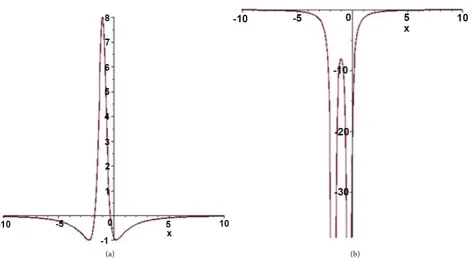
Similarly, solution Equation (3.5) is also a lump solution, which contains five free parameters a a a a1, , ,2 4 5 and a7. When the values of these parameters are
changed, the structure of the lump solutions will also change accordingly. Here, we give two plots with particular choice of the involved parameters for lump so-lutions (Figure 1).
4. Conclusions
DOI: 10.4236/ojapps.2019.93011 124 Open Journal of Applied Sciences
[image:4.595.66.537.65.323.2](a) (b)
Figure 1. When the Equation (3.5) selects the following parameters, the equation will be rendered with the lump solutions of a and b.
( )
a a: 1=1,a2=1,a4=1,a5=1,a7=1;( )
b a: 1= −1,a2= −1,a4= −1,a5= −1,a7= −1.Next, we would like to discuss that there is any other solutions to the Ito-equation. Furthermore, we can extend this method to solve other equations and learn their lump solutions. Those problems may be also interesting and be worthy to study.
Conflicts of Interest
The authors declare no conflicts of interest regarding the publication of this paper.
References
[1] Miura, R.M. (1978) Backlund Transformation. Springer-Verlag, Berlin.
[2] Rogers, C. and Shadwick, W.F. (1982) Backlund Transformations and Their Appli-cations.
[3] Matveev, V.B. and Salle, M.A. (1991) Darboux Transformation and Solitons. Jour-nal of Neurochemistry, 42, 1667-1676.
[4] Hirota, R. (2004) The Direct Method in Soliton Theory. Cambridge University Press, Cambridge. https://doi.org/10.1017/CBO9780511543043
[5] Ma, W.X. (2015) Lump Solutions to the Kadomtsev-Petviashvili Equation. Physics Letters A, 379, 1975-1978.
[6] Tan, W. and Dai, Z. (2017) Spatiotemporal Dynamics of Lump Solution to the (1 + 1)-Dimensional Benjamin-Ono Equation. Nonlinear Dynamics, 89, 2723–2728. https://doi.org/10.1007/s11071-017-3620-0
[7] Yu, J.P. and Sun, Y.L. (2016) Study of Lump Solutions to Dimensionally Reduced Generalized KP Equations. Nonlinear Dynamics, 87, 1-9.
DOI: 10.4236/ojapps.2019.93011 125 Open Journal of Applied Sciences (2 + 1)-Dimensional Ito Equation. Analysis. Mathematical Physics, No. 1, 1-10. [9] Zaharov, V.E. (1976) Exact Solutions in the Problem of Parametric Interaction of
Three-Dimensional Wave Packets. Doklady Akademii Nauk Sssr, 228, 1314-1316. [10] Craik, A.D.D. (1978) Evolution in Space and Time of Resonant Wave Triads. II. A
Class of Exact Solutions. Proceedings of the Royal Society A, 363, 257-269. https://doi.org/10.1098/rspa.1978.0167
[11] Ma, W.X. and You, Y. (2005) Solving the Korteweg-de Vries Equation by Its Bili-near Form: Wronskian Solutions. Transactions of the American Mathematical So-ciety, 357, 1753-1778. https://doi.org/10.1090/S0002-9947-04-03726-2
[12] Weiss, J., Tabor, M. and Carnevale, G. (1983) The Painleve Property for Partial Dif-ferential Equations. Journal of Mathematical Physics, 24, 522-526.
https://doi.org/10.1063/1.525721
[13] Liu, H., Li, J. and Liu, L. (2013) The Recursion Operator Method for Generalized Symmetries and Bäcklund Transformations of the Burgers’ Equations. Journal of Applied Mathematics and Computing, 42, 159-170.