Spatial memory and cognitive flexibility trade-offs: to be or not to be flexible, that is the 1
question 2
3
Maria Cristina Tello-Ramos1, Carrie L Branch2, Dovid Y Kozlovsky2, Angela M Pitera2, 4
and Vladimir V Pravosudov1 5
6
7
Department of Biology and Graduate Program in Ecology, Evolution, and Conservation 8
Biology 9
University of Nevada, Reno 10
Reno, NV 89557 11
12
13
14
1Corresponding authors 15
Email: [email protected]; [email protected] 16
2Equal contribution 17
18
Word count: 5,833 19
Abstract 21
Cognitive flexibility allows animals to readily acquire new information even when learning 22
contingencies may rapidly change, as is the case in highly variable, but predictable 23
environments. While cognitive flexibility is broadly thought to be beneficial, animals 24
exhibit inter- and intra-specific variation, with higher levels of flexibility associated with 25
reduced memory retention and vice versa. In this review, we discuss when and why such 26
variation may exist and focus specifically on memory and memory flexibility. We argue 27
that retained memories may negatively affect the acquisition of new information, most 28
likely via proactive interference, and available data suggest that there may be a trade-off 29
between memory retention and acquiring new memories. We discuss neurogenesis-30
mediated forgetting as the mechanism reducing memory interference, as new neurons 31
enhance learning new information, but also cause forgetting of older memories. Selection 32
may be expected to favor either end of the continuum between memory retention and 33
memory flexibility depending on life history and environment. More stable environments 34
may favor memory retention over flexibility whereas rapidly changing environments may 35
favor flexibility over retention. Higher memory capacity also seems to be associated with 36
higher memory interference, so higher neurogenesis rates associated with forgetting of 37
unnecessary information may be favored when higher capacity is beneficial such as in 38
food-caching species. More research is necessary to understand if inter- and intra-specific 39
differences in the association between memory retention and flexibility are related to some 40
general ecological patterns, whether this association is heritable, and whether 41
developmental conditions and experience have different effects on this association in 42
different species. 43
Keywords: cognitive flexibility; reversal learning, interference, forgetting, neurogenesis, 45
food caching birds, migratory birds 46
47
Introduction 48
Animals are able to modify their behavior due in part to their ability to learn new 49
information associated with relevant contingencies in their environment. However, relevant 50
contingencies often change and animals must be able to switch their behavioral responses 51
to fit new contingencies and this is usually referred to as cognitive flexibility. Behavioral or 52
cognitive flexibility has been defined by psychologists as the ability to reverse 53
contingencies while learning new information (Badre & Wagner, 2006). More flexible 54
animals can readily learn continuously changing contingencies. Traditionally, within a 55
laboratory context, an animal is thought to be cognitively flexible if it can successfully 56
learn new information while either keeping or forgetting older information. To test 57
cognitive flexibility, the “reversal-learning task” is often used. This task uses an 58
experimental paradigm where contingencies of previously learned associations are changed 59
or reversed (Anderson & Neely, 1996; Strang & Sherry, 2014). For example, in a color 60
association reversal-learning task an animal may be presented with two different color 61
handles, and is first trained that pressing the blue handle will result in reinforcement, while 62
pressing the green handle results in no reinforcement. After the animal has reached a set 63
performance criterion, the relationship is reversed, such that pressing the green handle now 64
results in reinforcement and pressing the blue handle results in no reinforcement. An animal 65
that scores highly on a cognitive flexibility task is one that takes fewer trials to extinguish 66
the previously reinforced behavior and only responds to the new contingency. Similarly, in 67
testing for cognitive flexibility. In this case, a flexible individual is expected to learn the 69
new locations and stop visiting the location that no longer provides reward (e.g. Croston et 70
al. 2017). A standard serial reversal task frequently involves just a binary choice that keeps 71
changing between the same two available options with each reversal (two colors or two 72
spatial locations). An alternative version involves non-repeatable choices at each reversal 73
(e.g. different color at each reversal or different spatial location at each reversal). 74
Behavioral ecologists have greatly expanded the use of the term ‘behavioral 75
flexibility’ to include any behaviors that allow animals to adjust to changing environments, 76
including behavioral innovations and problem solving. Such diversification of the term has 77
produced confusion as different behaviors used to describe behavioral flexibility often have 78
different underlying neural and physiological mechanisms. This confusion prompted Audet 79
and Lefebvre (2017) to suggest that we should stop using the term flexibility and instead 80
focus on specific behaviors associated with flexibility. 81
Traditionally, cognitive flexibility has been viewed as a highly adaptive ability 82
(Dukas, 2004; Lefebvre, Reader, & Sol, 2004) that increases survival and reproductive 83
success (Snell-Rood, 2013). However, available data shows both inter- and intra-species 84
variation, with higher levels of flexibility associated with reduced memory retention and 85
vice versa. Throughout this review, we will consider (1) potential trade-offs among 86
memory retention, memory capacity, memory load, and cognitive flexibility, (2) forgetting 87
as a mechanism allowing this trade-off, (3) adult neurogenesis as a mechanism of 88
forgetting, and (4) future directions to investigate the proposed trade-offs. We will 89
specifically focus on memory and memory flexibility, which we define as the ability to 90
successfully learn new information when learning contingencies keep changing. 91
Why are some animals less flexible? 93
One of the major questions in understanding the evolution of cognitive flexibility is why 94
there is inter- or intra-specific variation in cognitive flexibility and what are the 95
mechanisms underlying such variation. One of the earliest studies on this subject reported 96
that pigeons (Columba livia) were better at learning a reversal task (e.g. more flexible) but 97
showed worse memory retention, while goldfish (Carassius auratus) performed worse on 98
the reversal task (e.g. less flexible) but showed better memory retention (Gonzalez, 99
Behrend, & Bitterman, 1967). This study suggested that (a) species differ in memory 100
flexibility and (b) there appears to be a trade-off between cognitive flexibility and memory 101
retention. 102
Inter-specific variation in cognitive flexibility suggests that there should be a cost to 103
being cognitively flexible. Some of these costs may be energy-related, such that the energy 104
needed to maintain a long-term memory (Plaçais & Preat, 2013) or to process information 105
(Dukas, 1999; Mery & Kawecki, 2003). The physiological costs of cognition can affect 106
other traits like reproduction. For example, fruit fly (Drosophila melanogaster) lines 107
selected for enhanced learning abilities also showed a decline in larval competitive ability 108
(Mery & Kawecki, 2003). 109
Other costs might be related to potential trade-offs associated with cognitive 110
flexibility. While there is a paucity of comparative studies including both aspects of 111
cognitive flexibility (e.g. memory retention and memory flexibility), the few that do exist 112
are consistent with the idea of a trade-off between flexibility and memory retention and 113
suggest that a better ability in one is associated with a worse ability in the other. 114
Research on food-caching species exemplifies this trade-off. Food-caching black-115
non-caching dark-eyed juncos (Junco hyemalis), were less capable at learning a new 117
contingency after reversal, suggesting that older memories interfered with acquiring new 118
memories (Hampton, Shettleworth, & Westwood, 1998). Clark’s nutcrackers (Nucifraga 119
columbiana), which are known for their extremely long lasting spatial memory, performed 120
significantly worse on a spatial reversal-learning task compared to their performance on an 121
initial spatial learning task (Lewis & Kamil, 2006). Finally, mountain chickadees (Poecile 122
gambeli) inhabiting high elevations performed worse on a spatial reversal-learning task 123
compared to low elevation chickadees (Croston et al., 2017; Tello-Ramos et al. 2018). At 124
the same time, our previous studies documented that high elevation chickadees performed 125
significantly better on an initial spatial memory task (both acquisition and retention), had a 126
larger hippocampus with more neurons, and exhibited higher rates of adult hippocampal 127
neurogenesis (Freas, LaDage, Roth, & Pravosudov, 2012). All of these findings are also 128
consistent with the idea of a potential trade-off between the ability to retain older memories 129
and the ability to rapidly acquire new memories. 130
131
Memory interference resulting in a major trade-off 132
The cost of learning new information reflects the fact that the brain and the neural networks 133
that store memory patterns are finite, with networks eventually reaching saturation (i.e., 134
memory load or capacity). Because memory storage or capacity is limited, the acquisition 135
of new memories may interfere with old memories, and vice versa, specifically when new 136
and old memories are similar (Anderson & Neely, 1996; Wixted, 2004). The essential 137
problem associated with interference is that the retrieval cues available at the time of recall 138
fail to access the target memory (Anderson & Neely, 1996). One way to explain this 139
compete for access during the recall processes (Bjork, 1989). Interference should increase 141
with the number of competitors or distractors associated with the same cues. In humans, for 142
example, memory recall performance decreases when the number of memories that are 143
paired with the same cue increases - the cue-overload principle (Watkins & Watkins, 1976). 144
On the other hand, when cues and contexts used to learn are more dissimilar, interference 145
should decrease. For example, in Clark's nutcrackers, memory performance improved in a 146
spatial reversal learning task when given new spatial cues during the reversal phase 147
compared to performance in a reversal task with the same spatial cues as during the initial 148
learning (Lewis, Kamil, & Webbink, 2013). Similarly, lab rats showed significant 149
interference after learning a second task but such interference was significantly reduced 150
when the context, such as light, size of arena, and texture of arena, of each task was made 151
increasingly different from each other (Rodriguez, Borbely, & Garcia, 1993). Interference 152
is thought to occur specifically during memory retrieval (or recall) and depending on 153
whether old memories or the formation of new ones is impaired, interference can be 154
classified as retroactive or proactive interference. 155
Retroactive interference occurs when previously learned information is affected, or 156
forgotten, by learning new, similar information. For example, honeybees (Apis mellifera) 157
that were trained to turn right on a green land mark first and then trained to turn left on a 158
blue landmark, decreased their performance on a later test for the first task (Cheng & 159
Wignall, 2006). 160
Proactive interference occurs when previously learned information interferes with 161
learning and remembering new information. Proactive interference appears to be one of the 162
main mechanisms affecting cognitive flexibility because it may directly influence learning 163
reversals and serial learning reversal tasks. When serial reversal task is used with just two 165
possible choices (e.g. Cauchloix, Hermer, Chaine, Morand-Ferron, 2017), animals are 166
expected to learn the rule that they need to switch when the previously rewarding choice is 167
no longer rewarding. Such task does not allow testing for memory retention and how 168
memory retention may affect learning of new associations via proactive interference. A 169
more appropriate reversal task (whether single or serial reversal) should require an animal 170
to learn new associations that have not been used before during each reversal stage. Such 171
approach allows direct assessment of both retention of memories of previously rewarded 172
associations and acquisition rates of new associations. 173
For instance, highly specialized food-caching Clark’s nutcrackers that were given 174
either one or two “lists” of rewarded locations performed worse during recall of the second 175
list than during the recall for the first list, demonstrating proactive interference (Lewis & 176
Kamil, 2006). Likewise, Florida scrub-jays (Aphelocoma coerulescens) that performed 177
better in an initial learning task did worse in a reversal task and vice versa, again suggesting 178
there may be a trade-off between initial and reversal learning ability (Bebus, Samll, Jones, 179
Elderbrock, & Schoech, 2016). If learning a useful association in the environment interferes 180
with learning a new association in the future, animals would not be able to quickly adjust 181
their behavior in a rapidly changing environment. 182
Based on human studies, it appears that retroactive interference is stronger when the 183
delay between learning new information and recalling old information is short. When more 184
time has passed between learning new information and recalling the older information, 185
retroactive interference decreases. Conversely, proactive interference increases with more 186
accurately than the newer information as more time has passed (Postman, Stark, & Fraser, 188
1968; Storm & Bjork, 2016). 189
Overall, it appears that the extent of proactive interference is a critical mechanism 190
involved in the trade-off between memory retention and the ability to acquire new 191
memories. Better memory retention seems to be associated with a higher level of proactive 192
interference and hence with less cognitive flexibility while higher cognitive flexibility 193
appears to be associated with less proactive interference and with worse memory retention. 194
As such, the rest of this review will focus on proactive interference. 195
196
Forgetting as a mechanism reducing interference and increasing cognitive flexibility 197
At least one mechanism known to reduce proactive interference is forgetting, as forgetting 198
allows the acquisition of new memories without interference with older memories 199
(Anderson & Neely, 1996). Forgetting, described as the absence of expression for 200
memories that once caused expression, is no longer regarded as memory failure (Kuhl & 201
Wagner, 2009). Instead, given the dynamic nature of the environment, forgetting is likely 202
an essential component of any adaptive memory system that increases behavioral and 203
cognitive flexibility and therefore, remembering and forgetting are intimately related (e.g. 204
Kraemer & Golding 1997). Although forgetting might reflect actual memory loss (decay), it 205
can also be explained as a failure to retrieve existing memories (interference) and can 206
reduce memory load. In humans, deliberate attempts to forget specific information can 207
improve learning new information (Festini & Reuter-Lorenz, 2014). Imagine for example 208
the memory task of a restaurant cook, for whom it would be advantageous to forget an 209
reduces confusion (proactive interference) when trying to remember other current orders 211
(Bjork, 1970). Work on animals implicated adult neurogenesis as one of the main neural 212
mechanisms that facilitate forgetting (Frankland, Köhler, & Josselyn, 2013). 213
214
Neurogenesis as a mechanism of forgetting and reducing proactive interference 215
Adult neurogenesis is a process of neuronal replacement during adulthood first described 216
by Altman and Das in the 1960´s (Altman & Das, 1965,1967). Adult neurogenesis consists 217
of neuron proliferation, migration, survival, and finally incorporation into the existing 218
neural circuits, usually in the hippocampus, a brain region involved in memory (van Praag, 219
Christie, Sejnowski, & Gage, 1999). Adult hippocampal neurogenesis does not result in 220
increasing the total number of neurons – instead adult neurogenesis and apoptosis, or 221
neuron death, operate simultaneously and result in adult neuron replacement (Barnea & 222
Pravosudov, 2011; Olson, Eadoe, Ernst, & Christie, 2006; van Praag et al., 1999). The 223
majority of new neurons actually die without being recruited into neural circuits, and it is 224
hypothesized that new neurons may form a neurogenic reserve that can provide new 225
neurons when needed (Kempermann, 2008). 226
Most research on adult neurogenesis has been focused on its role in facilitating new 227
learning and almost all existing hypotheses about the function of neurogenesis suggest that 228
it improves learning (Gould et al. 1999; van Praag et al., 1999; Kempermann 2008). 229
Ecological research, in particular, primarily considers neurogenesis as the neural 230
mechanism that enhances learning of new information (Barnea & Pravosudov, 2011). 231
More recently, however, it was discovered that adult neurogenesis is also directly 232
neurogenesis appears to be, at least in part, due to forgetting of older information (Akers et 234
al., 2014; Epp et al. 2016). New findings show that new neurons enhance the acquisition of 235
new memories, but at the same time death of old neurons associated with incorporation of 236
new neurons appears to cause forgetting of older memories which decreases proactive 237
interference (Akers et al., 2014; Epp et al. 2016). Interestingly, it seems that apoptosis of 238
old neurons is not random, but rather a targeted replacement of old memories that are no 239
longer useful with new neurons produced by neurogenesis. 240
Learning and memory, and the decrease in proactive interference are positively 241
associated with adult neurogenesis rates because at least one function of neurogenesis 242
represents a decay process that continually clears out old memories from the hippocampus 243
(Frankland et al., 2013). Newly born cells are different compared to older neurons; they are 244
both more excitable and more sparse, which is why adult neurogenesis seems to promote 245
pattern separation, a process by which overlapping patterns of neural activation are mapped 246
to less overlapping representations, effectively reducing interference (Becker, 2005). 247
Computational models of neural networks also show that neuronal turnover should improve 248
learning of new information specifically by discarding older memories (e.g. forgetting) 249
(Chambers, Potenza, Hoffman, & Miranker, 2004; Crick & Miranker, 2006; Weisz & 250
Argibay, 2012). 251
It appears that hippocampal neurogenesis directly mediates the continuous process 252
of forgetting older hippocampus-dependent memories by reconfiguring neural circuits and 253
resulting in the dissociation of memory cues with previously stored memories (Akers et al., 254
2014). Neurogenesis is more active in younger animals, which are also more forgetful (and 255
more flexible), but experimentally reduced hippocampal neurogenesis rates in adulthood 256
adult mice, experimentally increasing neurogenesis rates induced forgetting, while in young 258
animals with naturally occurring higher neurogenesis rates, experimental reduction in 259
neurogenesis increased memory retention (Akers et al., 2014; Kitamura et al., 2009). In a 260
different study, increased neurogenesis rates associated with more running resulted in 261
reduced memory retention, but also resulted in better performance in a reversal learning 262
task (Epp et al. 2016). Experimental suppression of adult neurogenesis resulted in better 263
memory retention but also in worse performance in a reversal learning task (Epp et al. 264
2016). These findings support the idea that increased neurogenesis reduces proactive 265
interference and enhance learning of new information, but at a cost of reduction in memory 266
retention (e.g. forgetting), while reduced neurogenesis enhances memory retention but 267
impedes learning new information because of proactive intereference. 268
As mentioned earlier, the neurogenic reserve hypothesis (Kempermann, 2008) 269
suggests that new neurons form a pool that may be used when needed. This hypothesis is 270
consistent with the idea of adult neurogenesis aiding forgetting and not just the idea that 271
new neurons are recruited only to increase memory ability (e.g. Johnson et al., 2010). 272
Incorporation of new neurons into the existing circuits should disrupt older memories (e.g. 273
forgetting), therefore, at the time when animals may consistently acquire new memories, 274
such as the case with food-caching animals when they actively store food, they would not 275
benefit from higher neurogenesis as it will result in forgetting existing caches as memories 276
of new caches are being constantly formed. 277
Overall, there is mounting evidence that adult hippocampal neurogenesis improves 278
the acquisition of new information while at the same time causing forgetting and increasing 279
cognitive flexibility (Akers et al. 2014; Swan et al. 2014; Garthe, Behr, & Kempermann, 280
& Nadel, 2013; Kitamura et al. 2009; Guskjolen, Epp, & Frankland, 2017; Feng et al. 2001; 282
Martinez-Canabal 2015; Becker, MacQueen, & Wojtowicz, 2009; Epp, Mera, 283
Kohler,Jesselyn & Frankland, 2016; Yau, Li, & So, 2015). 284
285
Need to re-evaluate how we view neurogenesis in many ecologically relevant paradigms 286
Most of research on forgetting and neurogenesis have been conducted with model systems 287
such as lab rodents and focused directly on the mechanistic relationship between 288
neurogenesis, memory and forgetting. At the same time, there is great historical paucity of 289
research addressing inter- and intra-specific variation in this relationship and how such 290
variation might be associated with different selection pressures despite great interest in 291
inter- and intra-specific variation in adult neurogenesis rates (Barnea & Pravosudov 2011). 292
293
Food-caching animals 294
Recent advances in our understanding of adult neurogenesis involvement in forgetting 295
requires reconsideration of most current ecologically-based hypotheses about role of adult 296
neurogenesis. Previously, adult hippocampal neurogenesis has always been considered only 297
as a mechanism enhancing spatial learning (Barnea & Pravosudov, 2011). Starting with 298
Barnea and Nottebohm’s (1994) study reporting seasonal differences in hippocampal 299
neurogenesis and connecting these differences to variation in food caching activity, all 300
studies of neurogenesis in food-caching birds and mammals attempted to explain any 301
differences in hippocampal neurogenesis rates by memory benefits associated with 302
increased neurogenesis rates (Barnea & Nottebohm, 1994; Hoshooley & Sherry, 2007; 303
Roth et al., 2012; LaDage et al., 2010, 2011; Barker et al., 2005; Johnson et al., 2010). 304
caches indeed have higher hippocampal neurogenesis rates (Roth et al., 2012; Freas et al., 306
2012), these results might also be explained by both improvements in memory flexibility 307
allowing learning new information and forgetting associated with retrieval of more food 308
caches. 309
A lack of any significant associations between adult hippocampal neurogenesis rates 310
and food-caching activity in all previous seasonal comparisons (review in Pravosudov & 311
Roth 2013; Pravosudov et al., 2015) is inconsistent with the previous hypotheses. If 312
hippocampal neurogenesis is involved specifically in memory improvements associated 313
with more food caching, it is expected that within a year, higher food caching activity 314
should be associated with higher neurogenesis rates (e.g. Barnea & Nottebohm, 1994). 315
None of the available data match these predictions (Hoosholey & Sherry, 2004; Hoshooley 316
et al., 2007; Hoosholey & Sherry, 2007). Even the first landmark study (Barnea & 317
Nottebohm, 1994), which is always used as an example of association between adult 318
hippocampal neurogenesis and food caching, actually showed highest neuron incorporation 319
rates by end of November-December in birds injected with a new neuron marker in October 320
(Pravosudov et al., 2015). The peak of food caching, on the other hand, is usually in 321
September-early October (e.g. Pravosudov, 2006), so these new neurons were not likely 322
there during the peak of food caching. 323
The observed seasonal patterns, however, fit much better if we assume that higher 324
neurogenesis rates are associated with cache retrieval-based forgetting. Chickadees start 325
retrieving caches in late fall and likely continue through spring (e.g. Pravosudov, 2006). At 326
the same time, the actual cache retrieval pattern may depend on weather, availability of 327
other food, etc. – and so variation in highest neurogenesis rates between November and 328
In the lab, chickadees that were allowed to cache and retrieve food on a daily basis 330
had higher hippocampal neurogenesis rates than birds experimentally prevented from 331
caching (LaDage et al., 2010). Again, this finding is consistent with neurogenesis-based 332
forgetting as chickadees were both caching and retrieving caches. Interestingly, in non-333
caching, parasitic cowbirds (Molothrus ater), which use spatial memory for host nests 334
throughout the breeding season, the highest neurogenesis was reported in late summer after 335
breeding (Guigueno et al. 2016), which is also consistent with the idea of neurogenesis-336
based forgetting of no longer relevant information. 337
338
Migratory behavior 339
It has been hypothesized that migratory behavior is associated with more spatial memory 340
use and at least some comparisons indeed showed that compared to non-migratory 341
subspecies, migratory subspecies performed better in a spatial memory task (Cristol et al., 342
2003; Pravosudov et al., 2006). Migratory birds were hypothesized to have higher reliance 343
on spatial memory similar to food-caching birds since they may need to remember details 344
of permanent stopover locations as well as details of both breeding and wintering areas. 345
Migratory species/subspecies have larger hippocampus than non-migratory species, but at 346
least in one comparison of migratory and non-migratory white-crowned sparrows 347
(Zonotrichia leucophrys), adult migratory birds had higher hippocampal neurogenesis rates 348
than adult non-migratory sparrows, but similar to that in juveniles from both subspecies 349
(LaDage et al., 2011). Non-migratory adults, on the other hand, had lower hippocampal 350
neurogenesis rates than the juveniles from both subspecies. Reduction in hippocampal 351
neurogenesis rates with age is a well-known phenomenon and it has also been associated 352
opposite relationship in older animals (Akers et al. 2014). Migratory adults, however, did 354
not have reduced neurogenesis rates compared to juveniles, at least at the time of sampling 355
during fall after they arrived at the wintering grounds. Higher neurogenesis at that time 356
might be associated with discarding past memories formed during migration allowing for 357
higher memory flexibility at wintering grounds. Since no comparative data are available on 358
either memory retention or memory flexibility in migratory and non-migratory 359
species/subspecies, it is too early to make any conclusions about potential trade-offs among 360
memory retention, memory capacity/load, memory flexibility and adult neurogenesis. But 361
we can make predictions based on hypothesized associations that migratory species (1) 362
should have higher memory capacity and larger memory load and (2) should be less 363
cognitively flexible compared to non-migratory species. Higher neurogenesis rates in 364
migratory birds may be associated with the need to reduce memory load and to reduce 365
proactive interference. In this case, similar to that in food-caching species, neurogenesis 366
might function to reduce the negative effects of proactive interference associated with 367
stronger memories. 368
369
Memory capacity, proactive interference and neurogenesis
370
So far, available data suggest that better memory retention is associated with reduced 371
cognitive flexibility, and higher cognitive flexibility is associated with worse memory 372
retention. At the same time, adult neurogenesis-mediated forgetting appears to be one of the 373
mechanisms involved in maintaining cognitive flexibility – higher neurogenesis rates 374
decrease memory retention but increase cognitive flexibility, while lower neurogenesis 375
rates seem to increase memory retention but decrease cognitive flexibility (Akers et al. 376
Existing evidence connecting adult neurogenesis with memory retention and 378
flexibility comes from a few model species, primarily lab rodents. A big question is 379
whether this relationship is maintained across species with different life histories or even 380
across populations experiencing different environments and hence differential selection 381
pressures. In other words, can we expect that species/populations with higher hippocampal 382
neurogenesis rates have worse memory retention and higher memory flexibility than 383
species/populations with lower neurogenesis rates? While there are little data available on 384
this question, they actually seem to show the opposite. For example, food-caching species 385
seem to have higher hippocampal neurogenesis rates (Hoshooley & Sherry, 2007) than non-386
caching species, but they have better spatial memory (Biegler, McGregor, Krebs, & Healy, 387
2001; Pravosudov & Roth 2013) and also show more proactive interference/less cognitive 388
flexibility (Hampton et al. 1998; Lewis & Kamil 2006; Croston et al. 2017). In food-389
caching chickadees, birds in harsher winter environments have better spatial memory 390
(Pravosudov & Clayton 2002; Roth et al. 2012), including longer memory retention (Freas 391
et al. 2012), but they also have higher hippocampal neurogenesis rates compared to birds 392
from milder environments (Chancellor et al., 2011; Roth et al. 2012; Freas et al. 2012). At 393
the same time, chickadees in harsher environments seem to show less cognitive flexibility 394
compared to chickadees from milder environments (Croston et al. 2017). 395
Indeed, in food-caching species, it appears that better spatial memory is associated 396
with higher hippocampal neurogenesis rates, but with lower memory flexibility due to 397
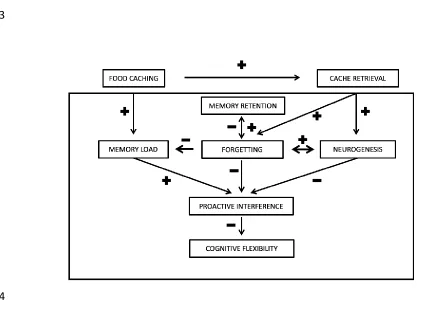
higher levels of proactive interference. We propose memory capacity and load as the 398
missing, but crucial component in interspecies comparisons (Fig. 1). Higher memory 399
capacity has been suggested to increase proactive interference (Steinwascher & Meiser, 400
Species with high demands on memory, such as food-caching species, are likely to 402
have higher memory capacity than non-caching species, as they need to store an enormous 403
number of memories for food cache locations. Chickadee populations in harsher 404
environments also cache more food compared to chickadees from milder winter 405
environments (Roth et al., 2012; Freas et al., 2012), which is likely associated with larger 406
memory load. Higher memory capacity and the need to remember more caches (e.g. more 407
memory load) are likely mediated by a larger hippocampus and a larger total number of 408
hippocampal neurons (Pravosudov & Roth, 2013). However, food-caching species and 409
populations in harsher environments also have higher neurogenesis rates (Hoshooley & 410
Sherry, 2007; Roth et al., 2012; Freas et al., 2012), which is thought to reduce memory 411
retention and increase memory flexibility. We hypothesize that increased hippocampal 412
neurogenesis is a mechanism to reduce negative effects of proactive interference associated 413
with larger memory capacity and load without affecting the retention of relevant memories 414
by mediating forgetting of no longer relevant memories. If cognitive flexibility is 415
advantageous and older memories associated with larger memory load should increase 416
proactive interference and reduce cognitive flexibility, it can be expected that selection 417
should favor some mechanisms that would allow reducing proactive interference while still 418
maintaining long-lasting memories. Rapid neurogenesis-assisted forgetting specifically of 419
no longer relevant memories, such as memories of retrieved caches, may serve as such a 420
mechanism. 421
Species with specialized memory, such as food-caching species, deal with 422
constantly changing information making some memories irrelevant while other memories 423
remain relevant. Considering that selection for memory retention of relevant memories in 424
irrelevant memories associated with recovered food caches should be rapidly discarded, 426
which should reduce memory load and hence reduce proactive interference. Therefore, 427
higher neurogenesis rates in species or populations that cache more food may serve a 428
critical function of constantly clearing memories of recovered caches. At the same time, 429
higher neurogenesis rates might not fully compensate for higher memory retention and 430
higher memory capacity and load, which might explain why food-caching 431
species/populations with better memory may still have lower memory flexibility and higher 432
levels of proactive interference compared to species/populations with less memory use 433
associated with less caching. 434
Finally, all scatter-hoarding species, such as chickadees and jays, space their food 435
caches so that they are not close together. Such a strategy which was previously argued to 436
reduced cache pilferage (Waite & Reeve, 1993), should also reduce proactive interference, 437
as different caches would be associated with a different set of cues (Croston et al., 2017; 438
Lewis et al., 2013). 439
The extent of memory flexibility and proactive interference might be a trade-off 440
among memory retention, memory capacity and load, and adult neurogenesis rates. Given 441
the same memory capacity/load, memory retention and adult neurogenesis might determine 442
the extent of memory flexibility, but the need for larger memory capacity associated with 443
larger memory load should change the association between memory retention and memory 444
flexibility. To test these ideas, we need more comparative analyses of different 445
species/different populations with different degrees of specialization of memory in 446
combination with experiments manipulating memory load. 447
Memory specialization and better memory retention versus memory generalization and 449
higher cognitive flexibility– which is better? 450
The predictability of the environment and ecology of different species should be the main 451
factors predicting whether cognitive flexibility should be advantageous. When the 452
environment is predictably variable, meaning that a change in the environment is to be 453
expected, animals should benefit the most from being cognitively flexible (Lefebvre et al., 454
2004; Pravosudov & Roth, 2013). Conversely, completely unpredictable environments that 455
do not provide reliable cues should select against learning altogether (Dunlap & Stephens, 456
2009). Results from cross-generational studies with the fruit fly showed that certain 457
regimens of environmental changes will favor the evolution of learning while others will 458
select against it (Dunlap & Stephens, 2009). At the other extreme, when the environment is 459
very predictable, natural selection should favor the evolution of innate behaviors rather than 460
learning. 461
In between these two extremes, the degree of environmental unpredictability likely 462
determines whether cognitive flexibility would be advantageous. The key here is whether 463
memory retention and cognitive flexibility indeed represent a trade-off. If there is no cost of 464
flexibility it should always be favored, but species and populations do differ in degree of 465
cognitive flexibility (Lefebvre et al. 2004; Croston et al. 2017; Bond, Kamil & Balda, 466
2007), suggesting some costs must exist. If there is a trade-off between memory retention 467
and memory flexibility, different conditions would favor either longer retention or higher 468
flexibility. If the environment changes rapidly and rather unpredictably, the value of 469
previously learned information should be low and the ability to rapidly learn new 470
associations should be favored. If the environment changes more predictably and 471
retention should be favored over memory flexibility. For example, in food-caching species, 473
food caches may be used for months after they were originally stored, therefore, memory 474
retention is essential for successful cache retrieval. At the same time, food-caching species 475
seem to exhibit more proactive interference than non-caching species (Hampton et al. 1998) 476
and so appear less cognitively flexible. In contrast, it may be predicted that nomadic species 477
that constantly move should have the highest degree of cognitive flexibility as the value of 478
being able to learn and then discard new information as they move should be higher than 479
retaining past memories which are no longer relevant. 480
481
482
483
[image:21.612.62.495.339.653.2]484
Figure 1. Hypothesized relationships among memory components thought to influence 485
proactive interference and reduce cognitive flexibility while forgetting should reduce 487
memory load and to increase flexibility. Higher memory retention may reduce forgetting, 488
while retrieval of memories resulting in no longer relevant information should increase 489
forgetting via increased hippocampal neurogenesis rates. Above the frame is the example 490
of food caching where more food caching increases memory load and provides more 491
opportunities for cache retrieval. More cache retrieval, in turn, should increase forgetting of 492
retrieved caches and so should reduce memory load and reduce interference while also 493
being associated with increased adult hippocampal neurogenesis rates. 494
495
Future directions 496
Unfortunately, most existing studies on the relationship among memory retention, memory 497
interference, memory capacity/load, forgetting and neurogenesis are based on just a few 498
model species, such as humans and lab rodents. Historically, psychologists studying animal 499
learning have focused on general principles of learning, which is well suited to study in a 500
few model species. While inter- and intra-specific variation in spatial memory (mainly 501
acquisition and retention) has received considerable attention (e.g. Sherry 2006; 502
Pravosudov & Roth 2013), there is lack of comparative studies investigating such variation 503
in memory flexibility and only a handful of studies attempted comparative analyses of 504
memory flexibility in different species/populations that differ in their life history traits and 505
in their memory needs and use (e.g. Gonzalez et al., 1967; Hampton et al., 1998; Bond et 506
al., 2007; Croston et al., 2017). Most cognitive traits including memory appear to have 507
genetic basis (e.g. Croston et al. 2015), which suggests that they may be affected by natural 508
Comparing multiple species has many challenges considering numerous species 510
differences that may affect cognitive performance (e.g. Pravosudov & Roth 2013) and so it 511
is critical to consider these differences when designing comparative studies. Within-512
species, population comparisons seem to provide a good alternative which allows 513
comparing cognition in the same species, which is likely to respond similarly to 514
experimental procedures (Pravosudov & Roth 2013). At the same time, comparing 515
populations that may be under different selection pressures should allow better 516
understanding of suggested trade-offs between memory and memory flexibility. 517
Experimental manipulations now possible with wild animals in their natural environment 518
should also allow direct tests for such trade-offs. Small resident birds in particular provide a 519
convenient model to test many of the questions discussed here and link individual variation 520
in cognitive traits to variation in fitness (Croston et al. 2017; Cauchoix 2017). Finally, some 521
traits such as forgetting, might be difficult to measure, but, on the other hand, memory 522
retention can be measured and memory load can also be manipulated experimentally both 523
in the lab and in the field. So, a combination of memory retention, performance in reversal 524
tasks and manipulation of memory load should allow testing the hypotheses discussed here. 525
In the end, however, only comparative analyses in combination with careful 526
experimentation can provide the answers to the following questions: 527
(1) Do memory retention and memory flexibility indeed represent a trade-off? A 528
few existing studies seem to support the idea of such trade-off as a few species compared 529
and studies of lab rodents suggest that animals that retain memories longer do worse in a 530
reversal learning task (less flexible) and animals that do better at reversal learning are 531
worse at memory retention (Akers et al., 2014). Moreover, experimental studies 532
retention by reducing neurogenesis rates leads to less memory flexibility and improving 534
flexibility by increasing neurogenesis rates leads to reduced memory retention (Akers et al., 535
2014; Epp et al. 2016). More studies comparing species/populations that differ in either 536
memory retention or memory flexibility are needed to address the generality of this 537
hypothesis and, most importantly, whether potential inter and intra-specific differences in 538
the association between memory retention and memory flexibility have been shaped by 539
natural selection. It is also important to use reversal tasks that do not rely on binary and re-540
usable choices (e.g. Cauchoix et al. 2017) as such tasks mainly test animals’ ability to learn 541
the rules that the rewarding choices always alternate. To test for potential trade-offs 542
between memory retention and flexibility, reversal or serial reversal tasks should involve 543
learning non-repeatable associations during each reversal, which will allow testing both 544
memory retention and memory flexibility as a function of increasing memory load. 545
(2) Does memory load directly affect memory retention, proactive interference and 546
memory flexibility? It is difficult to test for potential differences in memory capacity, but it 547
is possible to experimentally manipulate memory load. Even when we see the suggested 548
relationship between memory retention and memory flexibility, it might potentially be a 549
product of differences in memory experiences and, more specifically, memory load. If 550
individuals have higher memory load (e.g. food-caching species/populations with higher 551
food caching rates), such load might directly affect memory flexibility. By experimentally 552
increasing memory load, it should be possible to test (a) whether larger memory load 553
increases proactive interference and (b) whether such effect is the same or different among 554
different species with potentially different memory demands (e.g. food-caching vs non-555
caching species). Combining experimentation with memory load and comparative approach 556
understanding of the relationship between these memory components and relative 558
contributions of experience and natural selection. 559
(3) Does variation in developmental conditions affect the relationship between 560
memory retention, proactive interference and memory flexibility? There are studies 561
showing that developmental stress negatively affects hippocampal neurogenesis rates 562
throughout life (Lemaire, Koehl, Le Moal, & Abrous, 2000). As adult neurogenesis seems 563
to be involved in forgetting/memory retention/proactive interference relationship, it is thus 564
possible that developmental stress might also affect all memory components. 565
(4) Finally, new research focused on neurogenesis in ecologically-relevant 566
comparisons addressing inter- and intra-specific variation should consider neurogenesis 567
role in forgetting and in reducing proactive interference associated with memory flexibility 568
within the memory retention-memory flexibility paradigm. Measuring neurogenesis rates in 569
all suggested above studies would bring better understanding of how neurogenesis may be 570
involved in mediating memory and memory flexibility trade-offs. 571
572
Acknowledgements 573
VVP was supported by the NSF IOS1351295 and CLB was supported by the NSF DDIG 574
1600845. 575
576
References 577
578
Akers, K. G., Martinez-Canabal, A., Restivo, L., Yiu, A. P., de Cristofaro, A., Hsiang, H.- 579
L., Wheeler, A. L., Guskjolen, A., Niibori, Y., Shoji, H., Ohira, K., Richards, B. A., 580
neurogenesis regulates forgetting during adulthood and infancy. Science, 344, 598-582
602. 583
Altman, J., & Das, G. (1967). Postnatal neurogenesis in the guinea-pig. Nature, 214, 1098– 584
1101. 585
Altman, J., & Das, G. D. (1965). Post-natal origin of microneurons in the rat brain. Nature, 586
207, 953–956. 587
Anderson, M. C., & Neely, J. H. (1996). Interference and inhibition in memory retrieval. In 588
E. L. Bjork & R. A. Bjork (Eds.), Memory. Handbook of perception and cognition 589
(pp. 237–332). San Diego, CA: Academic Press. 590
Audet, J.-N., & Lefebvre, L. (2017). What’s flexible in behavioral flexibility? Behavioral 591
Ecology, 28, 943-947. 592
Badre, D., & Wagner, A. D. (2006). Computational and neurobiological mechanisms 593
underlying cognitive flexibility. Proceedings of the National Academy of Sciences 594
of the United States of America, 103, 7186–7191. 595
Barker, J. M., Wojtowicz, J. M., & Boonstra, R. (2005). Where’s my dinner? Adult 596
neurogenesis in free-living food-storing rodents. Genes Brain and Behavior, 4, 89-597
98. 598
Barnea, A., & Pravosudov, V. V. (2011). Birds as a model to study adult neurogenesis: 599
bridging evolutionary, comparative and neuroethological approaches. European 600
Journal of Neuroscience, 34, 884-907. 601
Barnea, A., & Nottebohm, F. (1994). Seasonal recruitment of hippocampal neurons in adult 602
free-ranging black-capped chickadees. Proceedings of the National Academy of 603
Bebus, S. E., Small, T. W., Jones, B. C., Elderbrock, E. K., & Schoech, S. J. (2016). 605
Associative learning is inversely related to reversal learning and varies with nestling 606
corticosterone exposure. Animal Behaviour, 111, 251–260. 607
Becker, S. (2005). A computational principle for hippocampal learning and neurogenesis. 608
Hippocampus, 15, 722–738. 609
Becker, S., MacQueen, G., & Wojtowicz, J. M. (2009). Computational modeling and 610
empirical studies of hippocampal neurogenesis-dependent memory: Effects of 611
interference, stress and depression. Brain Research, 1299, 45–54. 612
Biegler, R., McGregor, A., Krebs, J. R., & Healy, S. D. (2001). A larger hippocampus is 613
associated with longer-lasting memory. Proceedings of the National Academy of 614
Sciences of the United States of America, 98, 6941-6944. 615
Bjork, R. A. (1970). Positive Forgetting: The noninterference of items intentionally 616
forgotten. Journal of Verbal Learning and Verbal Behavior, 9, 255–268. 617
Bjork, R. A. (1989). Retrieval inhibition as an adaptive mechanism in human memory. In 618
H. L. Roediger III & F. I. M. Craik (Eds.), Varieties of memory and consciousness: 619
Essays in honour of Endel Tulving (pp. 309–330). Hillsdale: NJ: Erlbaum. 620
Bond, A. B., Kamil, A. C., & Balda, R. P. (2007). Serial reversal learning and the evolution 621
of behavioral flexibility in three species of North American Corvids (Gymnorhinus 622
cyanocephalus, Nucifraga columbiana, Aphelocoma californica). Journal of 623
Comparative Psychology, 121, 372-379. 624
Burghardt, N. S., Park, E. H., Hen, R., & Fenton, A. A. 2012. Adult-born hippocampal 625
Cauchoix, M., Hermer, E., Chaine, A. S., Morand-Ferron, J. 2017. Cognition in the field: 627
comparison of reversal learning performance in captive and wild passerines. 628
Scientific Reports, 7, 12945. 629
Chambers, R. A., Potenza, M. N., Hoffman, R. E., & Miranker, W. (2004). Simulated 630
apoptosis/neurogenesis regulates learning and memory capabilities of adaptive 631
neural networks. Neuropsychopharmacology, 29, 747–758. 632
Chancellor, L. V., Roth II, T. C., LaDage, L. D., & Pravosudov, V. V. (2011). The effect of 633
environmental harshness on neurogenesis: a large scale comparison. Developmental 634
Neurobiology, 71, 246-252. 635
Cheng, K., & Wignall, A. E. (2006). Honeybees (Apis mellifera) holding on to memories: 636
response competition causes retroactive interference effects. Animal Cognition, 9, 637
141–150. 638
Crick, C., & Miranker, W. (2006). Apoptosis, neurogenesis, and information content in 639
Hebbian networks. Biological Cybernetics, 94, 9–19. 640
Cristol, D.A., Reynolds, E.B., LeClerc, J.E., Donner, A.H., Farabaugh, C.S. & Ziegenfus, 641
C.W.S. (2003). Migratory dark-eyed juncos, Junco hyemalis, have better spatial 642
memory and denser hippocampal neurons than nonmigratory conspecifics. Animal 643
Behaviour, 66, 317-328. 644
Croston, R., Branch, C. L., Kozlovsky, D. Y., Dukas, R., Pravosudov, V. V. (2015). 645
Heritability and the evolution of cognitive traits. Behavioral Ecology, 26, 1447-646
1459. 647
Croston, R., Branch, C. L., Pitera, A. M., Kozlovsky, D. Y., Bridge, E. S., Parchman, T. L., 648
reduced cognitive flexibility in wild food-caching mountain chickadees. Animal 650
Behaviour, 123, 139–149. 651
Dukas, R. (1999). Costs of memory: ideas and predictions. Journal of Theoretical Biology, 652
197, 41–50. 653
Dukas, R. (2004). Evolutionary Biology of Animal Cognition. Annual Review of Ecology, 654
Evolution, and Systematics, 35, 347–374. 655
Dunlap, A. S., & Stephens, D. W. (2009). Components of change in the evolution of 656
learning and unlearned preference. Proceedings of the Royal Society B: Biological 657
Sciences, 276, 3201–3208. 658
Epp, J. R., Mera, R. S., Kohler, S., Jesselyn, S. A., & Frankland, P. W. (2016). 659
Neurogenesis-mediated forgetting minimizes proactive interference. Nature 660
Communications, 7, 10838. 661
Feng, R., Rampon, C., Tang, Y.-P., Shrom, D., Jin, J., Kyin, M., Sopher, B., Martin,G. M., 662
Kim, S.-H., Langdon, R. B., Sisodia, S. S., & Tsien, J. Z. (2001). Deficient 663
neurogenesis in forebrain-specific Presenlin-1 knockout mice is associated with 664
reduced clearance of hippocampal memory traces. Neuron, 32, 911-926. 665
Festini, S. B., & Reuter-Lorenz, P. A. (2014). Cognitive control of familiarity: directed 666
forgetting reduces interference in working memory. Cognitive Affective & 667
Behavioral Neuroscience, 14, 78-89. 668
Frankland, P. W., Köhler, S., & Josselyn, S. A. (2013). Hippocampal neurogenesis and 669
forgetting. Trends in Neurosciences, 36, 497–503. 670
Freas, C., LaDage, L. D., Roth II, T. C., & Pravosudov, V. V. (2012). Elevation related 671
differences in memory and the hippocampus in food-caching mountain chickadees. 672
Garthe, A., Behr, J., & Kempermann, G. (2009). Adult-generated hippocampal neurons 674
allow the flexible use of spatially precise learning strategies. PLoS ONE 4: e5464. 675
Gonzalez, R. C., Behrend, E. R., & Bitterman, M. E. (1967). Reversal learning and 676
forgetting in bird and fish. Science, 158, 519–521. 677
Gould, E., Beylin, A., Tanapat, P., Reeves, A. & Shors, T.J. (1999) Learning enhances 678
adult neurogenesis in the hippocampal formation. Nature Neuroscience, 2, 260-265. 679
Guigueno, M. F., MacDougall-Shackleton, S. A., & Sherry, D. F. (2016). Sex and seasonal 680
differences in hippocampal volume and neurogenesis in brood-parasitic brown-681
headed cowbirds (Molothrus ater). Developmental Neurobiology, 76, 1275-1290. 682
Guskjolen, A., Epp, J. R., & Frankland, P. W. (2017). Hippocampal neurogenesis and 683
forgetting. In: The Hippocampus from Cells to Systems, Structure, Connectivity, 684
and Functional Contributions to Memory and Flexible Cognition. D. E. Hannula & 685
M. C. Duff, (Eds), Springer International Publishing. 686
Hampton, R. R., Shettleworth, S. J., & Westwood, R. P. (1998). Proactive interference, 687
recency, and associative strength: comparisons of black-capped chickadees and 688
dark-eyed juncos. Animal Learning and Behavior, 26, 475-485. 689
Hardt, O., Nader, K., & Nadel, L. (2013). Decay happens: The role of active forgetting in 690
memory. Trends in Cognitive Sciences, 17, 111–120. 691
Hoshooley, J. S., & Sherry, D. F. (2007). Greater hippocampal neuronal recruitment in 692
food-storing than in non-food-storing species. Developmental Neurobiology, 67, 693
406-414. 694
Hoshooley, J. S., & Sherry, D. F. (2004). Neuron production, neuron number, and structure 695
size are seasonally stable in the hippocampus of the food-storing black-capped 696
Hoshooley, J. S., Phillmore, L. S., Sherry, D. F., & MacDougall-Shackleton, S. A. (2007). 698
Annual cycle of the black-capped chickadee: seasonality of food-storing and the 699
hippocampus. Brain Behavior and Evolution, 69, 161-168. 700
Hoshooley, J. S., Phillmore, L. S., & MacDougall-Shackleton, S. A. (2005). An 701
examination of avian hippocampal neurogenesis in relationship to photoperiod. 702
Neuroreport, 16, 987-991. 703
Jacoby, L. L., Hay, J. F., & Debner, J. A. (2001) Proactive interference, accessibility bias, 704
and process dissociations: valid subjective reports of memory. Journal of 705
Experimental Psychology, 27, 686-700. 706
Johnson, K. M., Boonstra, R., & Wojtowiccz, J. M. (2010). Hippocampal neurogenesis in 707
food-storing red squirrels: the impact of age and spatial behavior. Genes, Brain and 708
Behavior, 9, 583-591. 709
Kempermann, G. (2008). The neurogenic reserve hypothesis: what is adult hippocampal 710
neurogenesis good for? Trends in Neurosciences, 4, 163-169. 711
Kitamura, T., Saitoh, Y., Takashima, N., Murayama, A., Niibori, Y., Ageta, H., Sekiguchi, 712
M., Sugiyama, H., & Inokuchi, K. (2009). Adult neurogenesis modulates the 713
hippocampus-dependent period of associative fear memory. Cell, 139, 814-827. 714
Kramer, P. J., & Golding, J. M. (1997). Adaptive forgetting in animals. Psychonomic 715
Bulletin & Review, 4, 480-491. 716
Kuhl, B. A., & Wagner, A. D. (2009). Forgetting and retrieval. In: Handbook of 717
Neuroscience for the Behavioral Sciences, G. G. Berntson & J. T. Cacioppo, (Eds.), 718
John Wiley & Sons. 719
LaDage, L., Roth II, T. C., & Pravosudov, V. V. (2011). Hippocampal neurogenesis is 720
sparrows (Zonotrichia leucophrys ssp.). Proceedings of the Royal Society B: 722
Biological Sciences, 278, 138-143. 723
LaDage, L. D., Roth II, T. C., Fox, R. A., & Pravosudov, V. V. (2010). Ecologically-724
relevant spatial memory use modulates hippocampal neurogenesis. Proceedings of 725
the Royal Society B: Biological Sciences, 277, 1071-1079. 726
Lefebvre, L., Reader, S. M., & Sol, D. (2004). Brains, innovations and evolution in birds 727
and primates. Brain, Behavior and Evolution, 63, 233–246. 728
Lemaire, V., Koehl, M., Le Moal, M., & Abrous, D. N. (2000). Prenatal stress produces 729
learning deficits associated with an inhibition of neurogenesis in the hippocampus. 730
Proceedings of the National Academy of Sciences of the United States of America, 731
97, 11032-11037. 732
Lewis, J. L., Kamil, A. C., & Webbink, K. E. (2013) Changing room cues reduces the 733
effects on proactive interference in Clark’s nutcrackers, Nucifraga columbiana. 734
Journal of Experimental Psychology, 39, 187-192. 735
Lewis, J. L., & Kamil, A. C. (2006). Interference effects in the memory for serially 736
presented locations in Clark’s nutcrackers, Nucifraga columbiana. Journal of 737
Experimental Psychology: Animal Behavior Processes, 32, 407–418. 738
Martinez-Canabal, A. (2015). Rewiring, forgetting and learning. Commentary: a critical 739
period for experience-dependent remodeling of adult-born neuron connectivity. 740
Frontiers in Neuroscience. 9, 298. 741
Mery, F., & Kawecki, T. J. (2003). A fitness cost of learning ability in Drosophila 742
melanogaster. Proceedings of the Royal Society B: Biological Sciences, 270, 2465– 743
Olson, A. K., Eadie, B., Ernst, C., & Christie, B. R. (2006). Environmental enrichment and 745
voluntary exercise massively increase neurogenesis in the adult hippocampus via 746
dissociable pathways. Hippocampus, 16, 250–260. 747
Patel, S. N., Clayton, N. S., & Krebs, J. R. (1997). Spatial learning induces neurogenesis in 748
the avian brain. Behavioural Brain Research, 89, 115–128. 749
Plaçais, P. Y., & Preat, T. (2013). To favor survival under food shortage, the brain disables 750
costly memory. Science, 339, 440–442. 751
Postman, L., Stark, K., & Fraser, J. (1968). Temporal changes in interference. Journal of 752
Verbal Learning and Verbal Behavior, 7, 672–694. 753
Pravosudov, V. V., & Roth II, T. C. (2013). Cognitive ecology of food hoarding: the 754
evolution of spatial memory and the hippocampus. Annual Reviews of Ecology, 755
Evolution and Systematics, 44, 18.1-18.21. 756
Rodriguez, W. a., Borbely, L. S., & Garcia, R. S. (1993). Attenuation by contextual cues of 757
retroactive interference of a conditional discrimination in rats. Animal Learning & 758
Behavior, 21, 101–105. 759
Pravosudov, V. V., Roth II, T. C., LaDage, L. D., & Freas, C. A. (2015). Environmental 760
influences on spatial memory and the hippocampus in food-caching chickadees. 761
Comparative Cognition and Behavior Reviews, 10, 25-43. 762
Pravosudov, V. V. & Roth II, T. C. (2013). Cognitive ecology of food hoarding: the 763
evolution of spatial memory and the hippocampus. Annual Reviews of Ecology, 764
Evolution and Systematics, 44,173-193. 765
Pravosudov, V. V. (2006). On seasonality of food caching behavior in parids: do we know 766
Pravosudov, V. V. & Clayton, N. S. (2002). A test of the adaptive specialization 768
hypothesis: population differences in caching, memory and the hippocampus in 769
black-capped chickadees (Poecile atricapilla). Behavioral Neuroscience, 116, 515-770
522. 771
Roth II, T.C., LaDage, L. D., Freas, C., & Pravosudov, V. V. (2012). Variation in memory 772
and the hippocampus across populations from different climates: a common garden 773
approach. Proceedings of the Royal Society B: Biological Sciences, 279, 402-410. 774
Sherry, D. F. 2006. Neuroecology. Annual Reviews in Psychology, 57, 167-169. 775
Snell-Rood, E. C. (2013). An overview of the evolutionary causes and consequences of 776
behavioural plasticity. Animal Behaviour, 85, 1004–1011. 777
Steinwascher, M. A., & Meiser, T. (2016). How a high working memory capacity can 778
increase proactive interference. Consciousness and Cognition, 44, 130-145. 779
Storm, B. C., & Bjork, R. A. (2016). Do learners predict a shift from recency to primacy 780
with delay? Memory & Cognition, 44, 1204–1214. 781
Strang, C. G., & Sherry, D. F. (2014). Serial reversal learning in bumblebees (Bombus 782
impatiens). Animal Cognition, 17, 723–734. 783
Swan, A. A., Clutton, J. E., Chary, P. K., Cook, S. G., Liu, G. G., & Drew, M. R. (2014). 784
Characterization of the role of adult neurogenesis in touch-screen discrimination 785
learning. Hippocampus, 24, 1581-1591. 786
van Praag, H., Christie, B. R., Sejnowski, T. J., & Gage, F. H. (1999). Running enhances 787
neurogenesis, learning, and long-term potentiation in mice. Proceedings of the 788
National Academy of Sciences of the United States of America, 96, 13427–13431. 789
Waite, T. A., & Reeve, J. D. (1993). Food storage in gray jays: source type and cache 790
Watkins, M. J., & Watkins, O. C. (1976). Cue-overload theory and the method of 792
interpolated attributes. Bulletin of the Psychonomic Society, 7, 289–291. 793
Weisz, V. I., & Argibay, P. F. (2012). Neurogenesis interferes with the retrieval of remote 794
memories: Forgetting in neurocomputational terms. Cognition, 125, 13–25. 795
Wixted, J. T. (2004). The psychology and neuroscience of forgetting. Annual Review of 796
Psychology, 55, 235–269. 797
Yau, S. Y., Li, A., & So, K. F. (2015). Involvement of adult hippocampal neurogenesis in 798