Acta Cryst.(2001). E57, o35±o36 DOI: 101107/S1600536800018808 Swaleh and Ziemer C16H12N4O
o35
organic papers
Acta Crystallographica Section E
Structure Reports
Online
ISSN 1600-5368
2-[(2-Phenyl-1,3-oxazol-4-yl)methyl]-2H-1,2,3-benzo-triazole
Sauda Swaleh and Burkhard Ziemer*
Institut fuÈr Chemie, Humboldt-UniversitaÈt zu Berlin, Hessische Straûe 1-2, 10115 Berlin, Germany
Correspondence e-mail:
Key indicators
Single-crystal X-ray study
T= 180 K
Mean(C±C) = 0.003 AÊ
Rfactor = 0.040
wRfactor = 0.082 Data-to-parameter ratio = 8.3
For details of how these key indicators were automatically derived from the article, see http://journals.iucr.org/e.
#2001 International Union of Crystallography Printed in Great Britain ± all rights reserved
The title compound, C16H12N4O, was obtained through a two-step process. There are two molecules in the asymmetric unit with essentially equal bond lengths. The phenyl and oxazole rings are essentially coplanar. Steric interactions between the two halves of the molecule produce a wide angle at the central C atom.
Comment
The title compound, (I), was obtained through a two-step process. By reaction of 5-bromo-4-(bromomethyl)-2-phenyl-1,3-oxazole and a mixture of N -(1-cyanoethyl)benzene-sulfonamide and benzotriazole in the presence of a base and small traces of DMSO, the N-alkylation took place with the more reactive benzotriazole. A halogen±lithium exchange reaction was conducted on the obtained product resulting in the formation of (I).
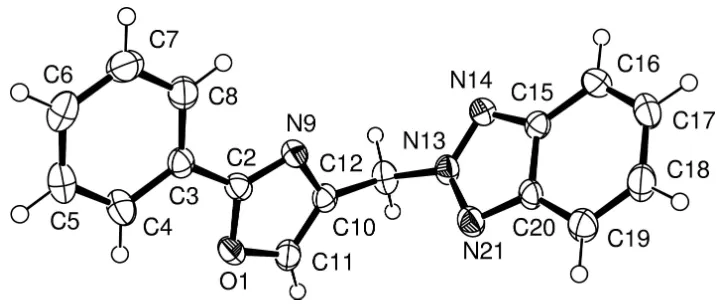
There are two molecules in the asymmetric unit. All corresponding bond lengths are equal within 2 and in accordance with the chemical diagram. In both molecules, the dihedral angle between the phenyl and oxazole rings (less than 5) indicates communicatingsystems. The steric demand of
the ring systems on the two sides of the molecule seems to have the effects (i) that the tetrahedral angle at the centre of the molecule formed by the non-H atoms is signi®cantly enlarged to 112.0 (3) and 111.0 (3) in the two molecules,
respectively, and (ii) that the halves of the molecule are inclined to each other by about 43 and 33 in the two
mol-ecules.
Experimental
Following the method of Lesbosquain & Decruix (1993), 5-bromo-4-(bromomethyl)-2-phenyl-1,3-oxazole, K2CO3and a mixture ofN
-(1-cyanoethyl)benzenesulfonamide and benzotriazole in the presence of traces of DMSO were re¯uxed in acetonitrile for 1 h. The resulting suspension was cooled, ®ltered and concentrated under reduced pressure, and the obtained compound was puri®ed by column
matography. Br±Li exchange reaction was further carried out on the puri®ed compound at 173 K for 2 h, as already described by Swaleh & Liebscher (1999). The compound isolated by subsequent column chromatography was recrystallized from absolute ethanol, affording (I).
Crystal data C16H12N4O Mr= 276.30
Monoclinic,P21 a= 14.880 (2) AÊ b= 4.6251 (5) AÊ c= 20.043 (3) AÊ = 100.963 (19) V= 1354.2 (3) AÊ3 Z= 4
Dx= 1.355 Mg mÿ3
MoKradiation Cell parameters from 4003
re¯ections = 3.1±24.3 = 0.09 mmÿ1 T= 180 (2) K Prism, colorless 0.520.240.12 mm Data collection
Stoe IPDS diffractometer Scans:'-rotation,'-incr. = 1.2, 183
exposures
9269 measured re¯ections 2943 independent re¯ections 2202 re¯ections withI> 2(I)
Rint= 0.068
max= 25.9 h=ÿ18!18 k=ÿ5!5 l=ÿ24!24
Re®nement Re®nement onF2 R[F2> 2(F2)] = 0.040 wR(F2) = 0.082 S= 0.95 2943 re¯ections 356 parameters
H-atom parameters not re®ned
w= 1/[2(F
o2) + (0.0401P)2]
whereP= (Fo2+ 2Fc2)/3
(/)max= 0.001
max= 0.17 e AÊÿ3
min=ÿ0.16 e AÊÿ3
Extinction correction:SHELXL97 Extinction coef®cient: 0.009 (2)
To save variable parameters, both monosubstituted benzene rings were re®ned as rigid ideal hexagons. This seems to be justi®ed, because every ring is bonded to a C atom; and in such a case, according to Domenicanoet al.(1975), the ideal symmetry of the C6
-hexagon is maintained. 2235 Friedel pairs were measured,i.e.75.2% of those possible, and they were merged in the data set.
Data collection: IPDS-2.87 (Stoe & Cie, 1997); cell re®nement:
IPDS-2.87; data reduction: IPDS-2.87; program(s) used to solve structure: SHELXS97 (Sheldrick, 1990); program(s) used to re®ne structure: SHELXL97 (Sheldrick, 1997); molecular graphics:
OPTEP-3 (Farrugia, 1997); software used to prepare material for publication:SHELXL97.
References
Domenicano, A., Vaciago, A. & Coulson, C. A. (1975).Acta Cryst.B31, 221± 233.
Farrugia, L. J. (1997).J. Appl. Cryst.30, 565.
Lesbosquain, D. & Decruix, B. (1993).Heterocycles,36, 2303±2314. Sheldrick, G. M. (1990).Acta Cryst.A46, 467±473.
Sheldrick, G. M. (1997).SHELXL97. University of GoÈttingen, Germany. Stoe & Cie (1997).IPDS-2.87. Stoe & Cie, Darmstadt, Germany. Swaleh, S. M. & Liebscher, J. (1999).Tetrahedron Lett.40, 2099±2100. Figure 1
supporting information
sup-1
Acta Cryst. (2001). E57, o35–o36supporting information
Acta Cryst. (2001). E57, o35–o36 [doi:10.1107/S1600536800018808]
2-[(2-Phenyl-1,3-oxazol-4-yl)methyl]-2
H
-1,2,3-benzotriazole
Sauda Swaleh and Burkhard Ziemer
S1. Comment
The title compound, (I), was obtained through a two-step process. By reaction of 5-bromo-4-(bromomethyl)-2-phenyl-1,3-oxazole and a mixture of N-(1-cyanoethyl)benzenesulfonamide and benzotriazole in the presence of a base and small traces of DMSO, the N-alkylation took place with the more reactive benzotriazole. A halogen–lithium exchange reaction was conducted on the obtained product resulting in the formation of (I).
There are two molecules in the asymmetric unit. All corresponding bond lengths are equal within 2σ and in accordance with the chemical diagram. In both molecules, the dihedral angle between the phenyl and oxazole rings (less than 5°) indicates communicating π systems. The steric demand of the ring systems on the two sides of the molecule seems to have the effects (i) that the tetrahedral angle at the centre of the molecule formed by the non-H atoms is significantly enlarged to 112.0 (3) and 111.0 (3)° in the two molecules, respectively, and (ii) that the halves of the molecule are inclined to each other by about 43 and 33° in the two molecules.
S2. Experimental
Following the method of Lesbosquain & Decruix (1993), 5-bromo-4(bromomethyl)-2-phenyl-1,3-oxazole, K2CO3 and a
mixture of N-(1-cyanoethyl)benzenesulfonamide and benzotriazole in the presence of traces of DMSO were refluxed in acetonitrile for 1 h. The resulting suspension was cooled, filtered and concentrated under reduced pressure, and the obtained compound was purified by column chromatography. Br–Li exchange reaction was further carried out on the purified compound at 173 K for 2 h, as already described by Swaleh & Liebscher (1999). The compound isolated by subsequent column chromatography was recrystallized from absolute ethanol, affording (I).
S3. Refinement
To save variable parameters, both monosubstituted benzene rings were refined as rigid ideal hexagons. This seems to be justified, because every ring is bonded to a C atom; and in such a case, according to Domenicano et al. (1975), the ideal symmetry of the C6-hexagon is maintained. 2235 Friedel pairs were measured, i.e. 75.2% of those possible, and they were
Figure 1
The structure of one molecule OF (I) showing 50% probability ellipsoids.
1-[(2-phenyl-1,3-oxazol-4-yl)methyl]-1H-1,2,3-benzotriazole
Crystal data
C16H12N4O
Mr = 276.30 Monoclinic, P21
a = 14.880 (2) Å
b = 4.6251 (5) Å
c = 20.043 (3) Å
β = 100.963 (19)°
V = 1354.2 (3) Å3
Z = 4
F(000) = 576
Dx = 1.355 Mg m−3
Melting point: 376(1) K Mo Kα radiation, λ = 0.71073 Å Cell parameters from 4003 reflections
θ = 3.1–24.3°
µ = 0.09 mm−1
T = 180 K Prism, colorless 0.52 × 0.24 × 0.12 mm
Data collection
Stoe IPDS diffractometer
Radiation source: fine-focus sealed X-ray tube Planar graphite monochromator
Detector resolution: 6.667 pixels mm-1
φ–rotation, φ–incr. = 1.2°, 183 exposures scans 9269 measured reflections
2943 independent reflections 2202 reflections with I > 2σ(I)
Rint = 0.068
θmax = 25.9°, θmin = 2.3°
h = −18→18
k = −5→5
l = −24→24
Refinement
Refinement on F2
Least-squares matrix: full
R[F2 > 2σ(F2)] = 0.040
wR(F2) = 0.082
S = 0.95 2943 reflections 356 parameters 1 restraint
Primary atom site location: structure-invariant direct methods
Secondary atom site location: difference Fourier map
Hydrogen site location: inferred from neighbouring sites
H-atom parameters not refined
w = 1/[σ2(F
o2) + (0.0401P)2]
where P = (Fo2 + 2Fc2)/3
(Δ/σ)max = 0.001
Δρmax = 0.17 e Å−3
Δρmin = −0.16 e Å−3
Extinction correction: SHELXL97, Fc*=kFc[1+0.001xFc2λ3/sin(2θ)]-1/4
supporting information
sup-3
Acta Cryst. (2001). E57, o35–o36Special details
Experimental. Recrystallized from ethanol. During data collection the crystal was in cold N2 gas of the Cryostream
Cooler (Oxford Cryosystems, 1992) mounted on a φ-axis diffractometer supplied with an area detector.
Geometry. All e.s.d.'s (except the e.s.d. in the dihedral angle between two l.s. planes) are estimated using the full covariance matrix. The cell e.s.d.'s are taken into account individually in the estimation of e.s.d.'s in distances, angles and torsion angles; correlations between e.s.d.'s in cell parameters are only used when they are defined by crystal symmetry. An approximate (isotropic) treatment of cell e.s.d.'s is used for estimating e.s.d.'s involving l.s. planes.
Refinement. Refinement of F2 against ALL reflections. The weighted R-factor wR and goodness of fit S are based on F2,
conventional R-factors R are based on F, with F set to zero for negative F2. The threshold expression of F2 > σ(F2) is used
only for calculating R-factors(gt) etc. and is not relevant to the choice of reflections for refinement. R-factors based on F2
are statistically about twice as large as those based on F, and R- factors based on ALL data will be even larger.
Fractional atomic coordinates and isotropic or equivalent isotropic displacement parameters (Å2)
x y z Uiso*/Ueq
H35 0.1963 −0.4027 0.6703 0.060* C36 0.11415 (14) −0.4811 (5) 0.57853 (10) 0.0525 (10) H36 0.0748 −0.6145 0.5948 0.063* C37 0.09956 (12) −0.4118 (5) 0.50984 (9) 0.0493 (9) H37 0.0502 −0.4978 0.4792 0.059* C38 0.15710 (13) −0.2166 (5) 0.48599 (7) 0.0402 (8) H38 0.1471 −0.1692 0.4390 0.048* C40 0.35437 (17) 0.4084 (8) 0.44633 (13) 0.0301 (7) C41 0.39498 (19) 0.4419 (8) 0.51185 (13) 0.0365 (8) H41 0.4438 0.5709 0.5284 0.044* C42 0.37294 (19) 0.5678 (8) 0.38533 (12) 0.0339 (7) H42A 0.3168 0.6707 0.3631 0.041* H42B 0.4214 0.7136 0.3998 0.041* C45 0.39843 (17) 0.1057 (7) 0.25065 (13) 0.0289 (7) C46 0.37797 (18) −0.0470 (8) 0.18831 (13) 0.0347 (8) H46 0.3214 −0.0214 0.1577 0.042* C47 0.44326 (19) −0.2325 (8) 0.17417 (13) 0.0371 (8) H47 0.4317 −0.3381 0.1328 0.045* C48 0.5284 (2) −0.2719 (8) 0.21994 (13) 0.0390 (8) H48 0.5717 −0.4050 0.2084 0.047* C49 0.54947 (19) −0.1230 (8) 0.28005 (13) 0.0359 (8) H49 0.6067 −0.1478 0.3099 0.043* C50 0.48256 (18) 0.0686 (7) 0.29570 (12) 0.0289 (7) O1 −0.00585 (11) 0.1743 (5) 0.12147 (8) 0.0339 (5) O31 0.35385 (12) 0.2580 (5) 0.55065 (8) 0.0370 (5) N9 0.14449 (14) 0.0937 (6) 0.13455 (10) 0.0312 (6) N13 0.23177 (14) 0.2829 (6) 0.01091 (10) 0.0297 (6) N14 0.32274 (14) 0.2526 (6) 0.02065 (10) 0.0324 (6) N21 0.18141 (15) 0.1361 (6) −0.04007 (11) 0.0353 (7) N39 0.28587 (15) 0.1994 (6) 0.44192 (10) 0.0316 (6) N43 0.40198 (14) 0.3690 (6) 0.33659 (10) 0.0295 (6) N44 0.34733 (14) 0.3007 (6) 0.27797 (10) 0.0323 (6) N51 0.48369 (14) 0.2369 (6) 0.35103 (10) 0.0316 (6)
Atomic displacement parameters (Å2)
U11 U22 U33 U12 U13 U23
supporting information
sup-5
Acta Cryst. (2001). E57, o35–o36C16 0.0268 (14) 0.046 (2) 0.0372 (15) −0.0009 (15) 0.0063 (11) 0.0022 (15) C17 0.0365 (16) 0.040 (2) 0.0407 (15) 0.0038 (16) 0.0182 (12) 0.0041 (16) C18 0.0443 (18) 0.051 (3) 0.0368 (15) −0.0085 (17) 0.0171 (13) −0.0099 (15) C19 0.0341 (16) 0.053 (3) 0.0375 (15) −0.0121 (16) 0.0112 (12) −0.0099 (16) C20 0.0278 (14) 0.034 (2) 0.0287 (13) −0.0053 (13) 0.0120 (11) 0.0008 (13) C32 0.0321 (15) 0.028 (2) 0.0340 (14) 0.0076 (14) 0.0084 (12) −0.0020 (13) C33 0.0370 (16) 0.032 (2) 0.0370 (14) 0.0093 (15) 0.0179 (12) 0.0029 (14) C34 0.0557 (19) 0.042 (3) 0.0400 (16) 0.0029 (18) 0.0196 (14) 0.0038 (16) C35 0.066 (2) 0.047 (3) 0.0452 (17) 0.009 (2) 0.0301 (17) 0.0077 (17) C36 0.058 (2) 0.039 (3) 0.073 (2) 0.0071 (18) 0.0421 (18) 0.0106 (19) C37 0.0434 (18) 0.044 (3) 0.065 (2) 0.0016 (17) 0.0224 (16) 0.0014 (19) C38 0.0408 (16) 0.038 (2) 0.0456 (16) 0.0040 (16) 0.0184 (13) 0.0029 (16) C40 0.0254 (14) 0.031 (2) 0.0345 (15) 0.0036 (13) 0.0064 (11) −0.0049 (13) C41 0.0332 (15) 0.039 (2) 0.0384 (16) −0.0007 (15) 0.0101 (12) −0.0038 (15) C42 0.0373 (16) 0.031 (2) 0.0346 (14) 0.0017 (15) 0.0099 (12) 0.0015 (14) C45 0.0262 (14) 0.033 (2) 0.0297 (13) 0.0001 (14) 0.0111 (11) 0.0062 (13) C46 0.0331 (15) 0.041 (2) 0.0313 (14) −0.0033 (15) 0.0087 (12) 0.0036 (14) C47 0.0421 (16) 0.043 (2) 0.0301 (13) −0.0053 (17) 0.0154 (12) −0.0013 (15) C48 0.0434 (17) 0.040 (2) 0.0388 (15) 0.0059 (16) 0.0213 (13) 0.0069 (16) C49 0.0341 (15) 0.042 (2) 0.0330 (14) 0.0048 (15) 0.0098 (12) 0.0063 (15) C50 0.0292 (14) 0.0314 (19) 0.0276 (13) −0.0003 (14) 0.0096 (11) 0.0071 (13) O1 0.0243 (10) 0.0412 (16) 0.0376 (10) 0.0033 (9) 0.0099 (8) 0.0029 (10) O31 0.0407 (11) 0.0414 (15) 0.0288 (9) 0.0010 (11) 0.0067 (8) −0.0010 (10) N9 0.0256 (11) 0.0378 (18) 0.0312 (12) 0.0016 (12) 0.0079 (9) −0.0030 (12) N13 0.0305 (12) 0.0317 (17) 0.0291 (11) −0.0044 (12) 0.0117 (9) −0.0013 (11) N14 0.0279 (12) 0.0392 (18) 0.0309 (11) −0.0016 (12) 0.0074 (9) 0.0018 (12) N21 0.0292 (12) 0.042 (2) 0.0362 (12) −0.0055 (12) 0.0107 (10) −0.0055 (12) N39 0.0330 (13) 0.0344 (18) 0.0283 (11) 0.0033 (12) 0.0079 (9) −0.0016 (11) N43 0.0293 (12) 0.0318 (17) 0.0288 (11) 0.0019 (11) 0.0090 (9) 0.0036 (11) N44 0.0273 (12) 0.0398 (19) 0.0297 (11) −0.0029 (12) 0.0049 (9) 0.0046 (11) N51 0.0316 (12) 0.0348 (17) 0.0289 (11) 0.0045 (12) 0.0072 (9) 0.0039 (12)
Geometric parameters (Å, º)
C10—C11 1.343 (4) C40—C42 1.498 (4) C10—N9 1.397 (4) C41—O31 1.372 (4) C10—C12 1.504 (4) C41—H41 0.950 C11—O1 1.382 (3) C42—N43 1.465 (4) C11—H11 0.950 C42—H42A 0.990 C12—N13 1.470 (4) C42—H42B 0.990 C12—H12A 0.990 C45—N44 1.360 (4) C12—H12B 0.990 C45—C50 1.408 (4) C15—N14 1.364 (4) C45—C46 1.417 (4) C15—C20 1.410 (4) C46—C47 1.366 (4) C15—C16 1.422 (4) C46—H46 0.950 C16—C17 1.358 (4) C47—C48 1.428 (4) C16—H16 0.950 C47—H47 0.950 C17—C18 1.423 (4) C48—C49 1.371 (4) C17—H17 0.950 C48—H48 0.950 C18—C19 1.379 (4) C49—C50 1.412 (4) C18—H18 0.950 C49—H49 0.950 C19—C20 1.413 (4) C50—N51 1.352 (4) C19—H19 0.950 N13—N21 1.332 (3) C20—N21 1.356 (4) N13—N14 1.338 (3) C32—N39 1.308 (3) N43—N44 1.333 (3) C32—O31 1.373 (3) N43—N51 1.342 (3)
supporting information
sup-7
Acta Cryst. (2001). E57, o35–o36C10—C11—H11 126.1 H42A—C42—H42B 108.0 O1—C11—H11 126.1 N44—C45—C50 108.6 (2) N13—C12—C10 112.0 (3) N44—C45—C46 130.0 (2) N13—C12—H12A 109.2 C50—C45—C46 121.4 (3) C10—C12—H12A 109.2 C47—C46—C45 117.0 (2) N13—C12—H12B 109.2 C47—C46—H46 121.5 C10—C12—H12B 109.2 C45—C46—H46 121.5 H12A—C12—H12B 107.9 C46—C47—C48 121.8 (3) N14—C15—C20 108.4 (2) C46—C47—H47 119.1 N14—C15—C16 130.6 (2) C48—C47—H47 119.1 C20—C15—C16 121.0 (3) C49—C48—C47 121.8 (3) C17—C16—C15 117.0 (3) C49—C48—H48 119.1 C17—C16—H16 121.5 C47—C48—H48 119.1 C15—C16—H16 121.5 C48—C49—C50 117.2 (3) C16—C17—C18 122.4 (3) C48—C49—H49 121.4 C16—C17—H17 118.8 C50—C49—H49 121.4 C18—C17—H17 118.8 N51—C50—C45 109.1 (2) C19—C18—C17 121.5 (3) N51—C50—C49 130.1 (2) C19—C18—H18 119.3 C45—C50—C49 120.8 (3) C17—C18—H18 119.3 C2—O1—C11 104.5 (2) C18—C19—C20 117.0 (3) C41—O31—C32 104.5 (2) C18—C19—H19 121.5 C2—N9—C10 104.5 (2) C20—C19—H19 121.5 N21—N13—N14 117.7 (2) N21—C20—C15 109.1 (2) N21—N13—C12 120.8 (2) N21—C20—C19 129.9 (2) N14—N13—C12 121.5 (2) C15—C20—C19 121.1 (2) N13—N14—C15 102.3 (2) N39—C32—O31 113.1 (3) N13—N21—C20 102.5 (2) N39—C32—C33 128.9 (2) C32—N39—C40 104.8 (2) O31—C32—C33 118.0 (2) N44—N43—N51 117.3 (2) C34—C33—C38 120.0 N44—N43—C42 121.9 (2) C34—C33—C32 121.02 (16) N51—N43—C42 120.8 (2) C38—C33—C32 118.97 (15) N43—N44—C45 102.6 (2) C35—C34—C33 120.0 N43—N51—C50 102.5 (2)