www.wjpr.net 76
FORMULATION DEVELOPMENT AND IN-VITRO EVALUATION OF
RAMIPRIL MICROPELLETS
*
Raju Nuka1, Appa Rao Potu2, Raghu Nandan. N3
Department of Pharmaceutics, Balaji Institute of Pharmaceutical Sciences, Warangal, India
ABSTRACT
The present study was undertaken with an aim to develop immediate
release micro pellets of Ramipril by powder layering technique by
using various supper disintegrating agents sodium starch
clycolate(SSG), cross carmellose sodium(CCS) and cross povidone
(CP). Ramipril which is a antihypertensive drug and is one of the
most widely used drugs for treating mild and moderate hypertension
and congestive heart failure .Ramipril has a long biological half life
(3-16 hrs), and along with elimination half –life ( 9-18 hours )
suggests its immediate action for treating hypertension . More
particularly, the present investigation was directed for stabilizing the
Ramipril against decomposition into degradation products, namely,
Ramipril-DKP(diketopiperzine) and Ramipril-diacid during
formulation and storage conditions. The prepared micropellets were
charecterized for their bulk density ,tapped density , carr’s index and Hausner ratio and
in-vitro drug release studies. The particle size and moRamiprilhology of the pellet were
evaluated by using sieve analysis and Scanning electron microscopy (SEM). Drug –
excipient compatability studies were investigated by Fourier –transform infrared
spectroscopy(FTIR). In-vitro drug release studies of the micro pellets revealed immediate
drug release behaviour. Nine formulations were prepared of which pellets containing SSG (
FR 8) (4 % ) exhibited maximum drug release in 15 minutes i.e 98.81 % compared to other
formulations.
Keywords: Ramipril, micropellet, diketopiperzines, immediate release.
Volume 2, Issue 1, 76-87. Research Article ISSN 2277 – 7105
Article Received on 01 November 2012,
Revised on 18 November 2012, Accepted on 03 December 2012
*Correspondence for Author:
* Raju Nuka
Department of Pharmaceutics,
Balaji Institute of
Pharmaceutical Sciences,
Warangal, A.P., India
www.wjpr.net 77 INTRODUCTION
Hypertension, commonly referred to as “high blood pressure”, is a medical condition and is
one of the common disorder affecting people worldwide. ACE inhibitors are commonly
prescribed drugs for treating hypertension either alone or in combination with diuretics.
Conventional immediate release drug delivery system are based on single or multiple-unit
reservoir or matrix system, which are designed to provide immediate drug levels in short
period of time. Immediate release drug delivery is desirable for drugs having long biological
half life, high bioavailability, lower clearance and lower elimination half life(ref).
RAMIPRIL is a prodrug and is converted to the active metabolite by liver esterase enzymes
and is an angiotensin converting enzyme (ACE) inhibitor, used to treat hypertension and
congestive heart failure. Its long biological Half life (3-16hours) and its dose (10 mg / day)
and long elimination phase (9-18hours) suggest it’s immediate action. The maintenance of a
constant plasma level of a cardiovascular drug is important in ensuring the desired
therapeutic response.1
As RAMIPRIL needs special care during manufacturing stage as it it has a tendency for
decomposition due to the physical stress associated with various oprations stages involved in
manufacturing processes leading to increase in the rate the decomposition. The factors that
influence the stability of ramipril formulations are mechanical stress, compression,
manufacturing processes, excipients, storage conditions, heat and moisture2,3,4. Micropellets,
gives more stability from compression and other stress conditions during formulation and
storage conditions. Moreover, pellets being multi-unit particulate dosage forms, can offer
some additional advantages such as easy dispersion in GI tract, increased drug
absoRamipriltion, and minimum poptential for local irritation of the drug5,6. The
micropellets can be filled into hard gelatin capsules or be compressed into tablets. The
compression of multiparticulates into tablets is becoming more popular, because of no
problems of tampering7,8,9. So, this study focused on the development of immediate release
tablets containing pellets.
MATERIALS & METHODS
Ramipril was a gift sample from Hetero labs, India, .SSG was gift sample from sigma
chemicals, India, CCS and CP were procured from Unique labs, India. HPMC -5 was
www.wjpr.net 78 Preparation of Micro Pellets
The RAMIPRIL micro pellets were prepared by powder layering technique. Non-pareil seeds
were taken into the coating pan and coated with drug and binder solution along with supper
disintegrating agents with a spray rate of 4.32 gm/min /kg. The prepared pellets were dried at
45 0 c for 8 hrs in a stainless steel tray drier. After completion of drying process, the
micro-pellets were passed through sifter to remove the lumped micro-pellets and subsequently were coated
with sub-coating solution (HPMC -5).The sub-coating solution was sprayed through nozzle
on pellets along with continuous flow of warm air to dry the coat as soon as it forms for
uniform coating. This process was continued till minimum weight gain of pellets was
achieved.
EVALUATION OF PELLETS Bulk Density
The bulk density of each formulation was then obtained by dividing the weight of sample in
grams by the final volume in cm3 of the sample contained in the cylinder. It was calculated by
using equation given below:
Df = M /Vp Where, Df = bulk density
M = weight of sample in grams
Vp = final volume of powder in cm3
Tapped Density
Tapped density is determined by placing a graduated cylinder containing known mass of
blends on a mechanical tapped apparatus, which is operated for a fixed number of taps until
the powder bed volume has reached a minimum volume. Using the weight of the drug in the
cylinder and this minimum volume, the tapped density may be computed.
Tapped Density = Weight of Blends /Tapped Volume of Blends
Carr’s Index
Carr’s Index is calculated using the values of the bulk density and tapped density with th
help of the following equation.
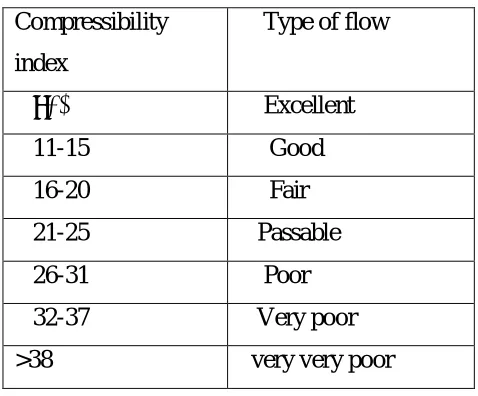
www.wjpr.net 79 Table no.1:Compressibility Index and flow property
Compressibility
index
Type of flow
≤10 Excellent
11-15 Good
16-20 Fair
21-25 Passable
26-31 Poor
32-37 Very poor
>38 very very poor
Angle of Repose
The manner in which stresses are transmitted through a bed and beds response to applied
stress reflected in the various angles of friction and response. The most commonly used of
these is angles of response. The method used to find the angles of response is to pour the
powder in a conical heap on a level flat surface and measure the inclined angle with the
horizontal pile.
Tan θ =
Where h = Height of the heap.
[image:4.595.173.412.103.301.2]R = Radius of the heap.
Table No.2: Angle of repose and flow property
Hausner’s Ratio
Haussner’s ratio was determined as the ratio between the tapped density to that of the bulk
density.
Hausner’s ratio =Tapped density / Bulk Density
Angle of repose Type of flow
<20 Excellent
20-30 Good
30-34 Passable
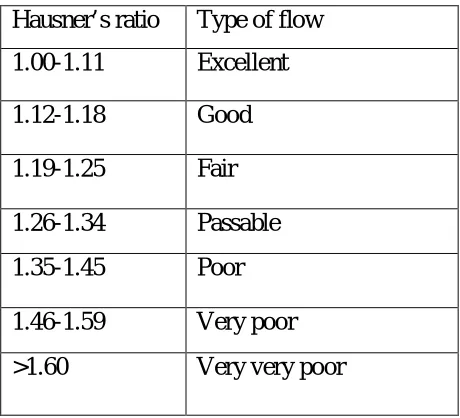
www.wjpr.net 80 Table No.3: Hausner’s Ratio and flow property
Hausner’s ratio Type of flow
1.00-1.11 Excellent
1.12-1.18 Good
1.19-1.25 Fair
1.26-1.34 Passable
1.35-1.45 Poor
1.46-1.59 Very poor
>1.60 Very very poor
The formulated micro-pellets were evaluated for compatibility, particle size and shape
analysis using scanning electron microscopy,bulk density ,tapped density angle of repose and
carr’s index.
In-vitro dissolution Studies: The release of the drug from the developed formulations was
determined using the USP -1 dissolution apparatus–1(Basket).Capsules containing
micropellets equivalent to 10 mg of RAMIPRIL in beaker containing 900 ml of 0.1 HCL
maintained at 37+ 0.5 and 100 Ramiprilm. 2ml of aliquot were withdrawn at specified
intervals and after suitable , assayed by Shimadzu Uv-Vis Spectrophoto meter at 208 nm .
The FR8 (RAMIPRIL + SSG) showed maximum drug release of 98.84 % in 15 minutes.
FT-IR study
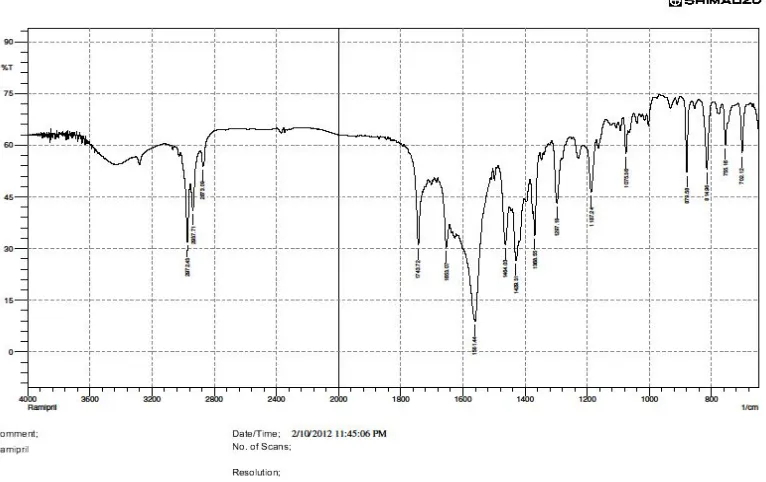
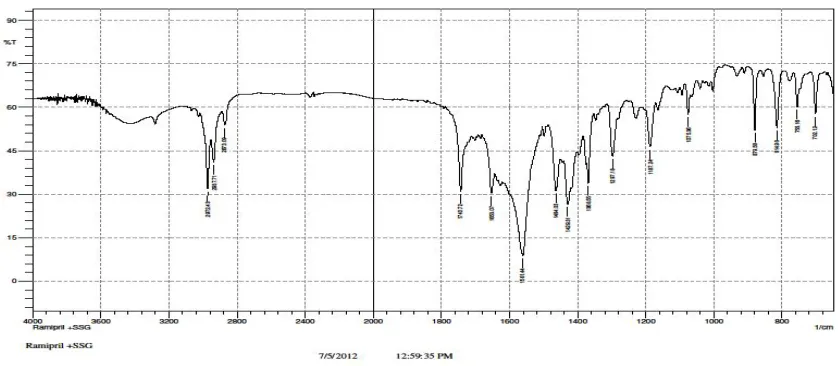
The Fourier transform –infrared spectra of Ramipril, mixures Ramipril and SSG, Ramipril
and CP , Ramipril and CCS, They showed the characteristic peaks of individual Ramipril ,
excipients and their mixtures. The spectra showed no extra peakes indicating that there is no
interaction between RAMIPRIL, excipients and their mixture.
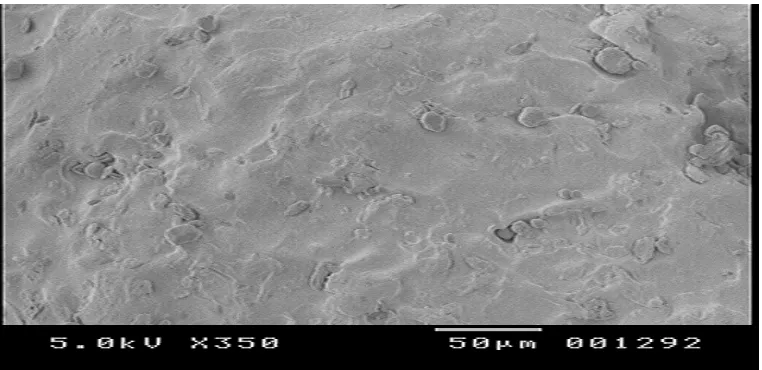
Scanning electron microscope: The shape and surface characteristics were determined by scanning electron microscopy. SEM was performed using Hitachi (MODEL :S-3400 N,
www.wjpr.net 81 Accelerated Stability study of the optimized formulation
Formulation were stored at various temperature viz.250C/60% RH,30oC/65%RH and
40oC/75 %RH as per ICH guidlines and various physicochemical parameter (apperence ,
percentage drug content and release profile ) were monitored periodically for 3 months10 .
RESULTS AND DISCUSSIONS
The present study was undertaken to formulate Ramipril immediate release(IR) micro pellets
.The study involved,formulation development along with evaluation of pellets for the
optimized one . Finally immediate release pellets were evaluated by in-vitro methods for drug
release, and its mechanism, size and surface moRamiprilhology and stability assessment.
Calibration Curve of Ramipril
The study started with the construction of standard calibration curve of Ramipril. The
scanning of the volumetric solution of Ramipril in the ultraviolet range against 0.1 N HCl
determined the max of absorbance is 208 nm.
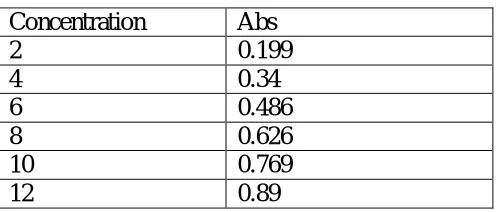
Table No.4:Calibration curve of Ramipril Concentration Abs
2 0.199
4 0.34
6 0.486
8 0.626
10 0.769
12 0.89
The standard graph of Ramipril in 0.1N HCl was plotted by taking concentration ranging
from 2 to 12 µg/ml and showed good linearity with R2 value of 0.9993, which suggests that it
[image:6.595.175.424.401.507.2]obeys the Beer-Lamberts law.
www.wjpr.net 82 FORMULATION STUDIES
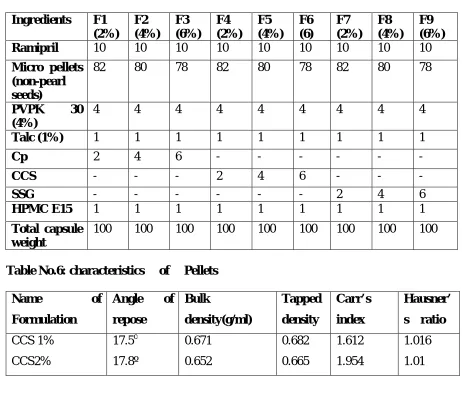
The contents showed in the table are weighed accurately sieved thoroughly through sieve 100.non pareil seeds were taken into the coating pan and coated with drug and binder solution
along with super disintegrating agents (CCS,CP,SSG) with a spray rate of 4.32
gm/min/kg.The second stage in the preparation of pellets includes drying. The stage 1 pellets
were dried at 45º C for 8 hrs in a SS Tray drier. After completion of drying process moisture
content were checked for moisture content and found to be below 1%. The dried pellets
were passed through sifter to remove the lumped pellets.This stage 3 process includes seal
coating. In this, in a clean and dry vessel HPMC E5 was taken and iso propyl alcohol was
added and stirred the solution to form a clear colloidal sub coating solution. The coating pan
was charged in with dried pellets. The above coating solution was sprayed through nozzle on
pellets along with continuous flow of warm air to dry the coat as soon as it forms for uniform
coating. The coating process was continued till minimum weight gain of coated pellets is
achieved.
Table No.5: Composition of Ramipril Micro Pellets
Ingredients F1 (2%) F2 (4%) F3 (6%) F4 (2%) F5 (4%) F6 (6) F7 (2%) F8 (4%) F9 (6%)
Ramipril 10 10 10 10 10 10 10 10 10
Micro pellets (non-pearl seeds)
82 80 78 82 80 78 82 80 78
PVPK 30
(4%)
4 4 4 4 4 4 4 4 4
Talc (1%) 1 1 1 1 1 1 1 1 1
Cp 2 4 6 - - - -
CCS - - - 2 4 6 - - -
SSG - - - 2 4 6
HPMC E15 1 1 1 1 1 1 1 1 1
Total capsule weight
[image:7.595.66.528.384.784.2]100 100 100 100 100 100 100 100 100
Table No.6: characteristics of Pellets
Name of
Formulation
www.wjpr.net 83
CCS3% 18.82º 0.66 0.673 1.93 1.01
[image:8.595.72.532.71.221.2]CP1% CP2% CP3% 17.9o 18.8º 18º 0.631 0.592 0.648 0.652 0.604 0.661 3.22 1.98 1.966 1.033 1.02 1.02 SSG1% SSG2% SSG3% 20.8o 19.3º 21º 0.368 0.226 0.656 0.375 0.230 0.670 1.866 1.7391 2.81 1.019 1.017 1.028 Dissolution profile:
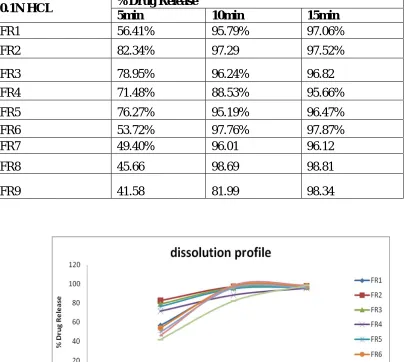
Table No.7: Cumulative percent drug release from pellets:
0.1N HCL %Drug Release
5min 10min 15min
FR1 56.41% 95.79% 97.06%
FR2 82.34% 97.29 97.52%
FR3 78.95% 96.24% 96.82
FR4 71.48% 88.53% 95.66%
FR5 76.27% 95.19% 96.47%
FR6 53.72% 97.76% 97.87%
FR7 49.40% 96.01 96.12
FR8 45.66 98.69 98.81
FR9 41.58 81.99 98.34
[image:8.595.77.485.297.659.2]www.wjpr.net 84 Fig :3 Cumulative percent drug release from immediate release micropellets
Accelerated Stability study of the optimized batch
The selected formulations were subjected for accelerated stability studies as per ICH
guidelines .There were no changes in appearance and percentage drug content of pellets
stored at different temperatures for drug remaining vs. Time at 250C/60% RH , 30oC/65%RH
and 40oC/75 %RH. All the parameters were within the limit after 90 days.
[image:9.595.106.489.464.705.2]RAMIPRIL PURE DRUG
www.wjpr.net 85 Fig: 5 RAMIPRIL + CROSS POVIDONE :
Fig : 6 RAMIPRIL+CROSSCARMELLOSE SODIUM:
[image:10.595.90.509.532.715.2]www.wjpr.net 86 SCANNING ELECTRON MICROSCOPY
[image:11.595.115.483.342.506.2]Fig : 8 scanning electron micrograph of developed pellets .
Fig: 9 SEM photomicrograph of Ramipril micropellets in spherical shape.
[image:11.595.108.489.548.733.2]www.wjpr.net 87 CONCLUSION
From the present study,it was concluded that immediate release Ramipril micro pellets were
prepared by using various supper disintegrating agents in order to improve dissolution of the
drug and hence improve patient compliance and effective therapy. Therefore, it can
concluded that from our results,SSG showed better dissolution properties then that of CP and
CCS .
REFERENCES
1. Rang HP, Dale MM, Pharmacology, 4th edition, Churchill living stone, NY, 1999, 375.
2. Koytchchev R, Ozalp Y , Erenmemisoglu A, vander Meer MJ , alphan RS ,effect of the
combination of lisonopril and hydrochlorothiazide on the bioequivalence of tablet
formulations , Arzneimittelforschung. Asian jps, 2004: 54(9a); 605-10
3.Stabilized indivudially coated Ramipril particles, compostions and methods,
Wo2006050533, 2006, 11-16.
4. St1abilized Ramipril compositions and methods of making ,wo2006052968, 2006 11-16 .
5.M.jalal ,H.J .malinowski ,and W.E .smith , tablet granulations composed of spherical
shaped particals , j.pharm .sci.,1972,61;1466-790
6.Parikh ,B,M .alternatives for processing spherical granules ,paper presented at
inteRamiprilhex usa ,newyork ,ny ,usa,1990
7. Bodmeier R. Tableting of coated pellets. Eur. J. Pharm. Biopharm. 1997; 43:1,8.
8. Celik M. Compaction of multiparticulate oral dosage forms. In I. Ghebre-Sellasie (ed.),
Multiparticulate oral drug delivery. Marcel Dekker, New York, 1994.
9. Juslin M, Turakka L, Puumalainen P. Controlled release tablets. Pharm. Ind. 1980;
42:829,832
10. paulo costa . and jose manuel sausalobe .,modelling and compression of dissolution