Subgroup Detection in Ideological Discussions
Amjad Abu-JbaraEECS Department University of Michigan
Ann Arbor, MI, USA
Mona Diab
Center for Computational Learning Systems Columbia University
New York, NY, USA
Pradeep Dasigi
Department of Computer Science Columbia University New York, NY, USA
Dragomir Radev
EECS Department University of Michigan
Ann Arbor, MI, USA
Abstract
The rapid and continuous growth of social networking sites has led to the emergence of many communities of communicating groups. Many of these groups discuss ideological and political topics. It is not uncommon that the participants in such discussions split into two or more subgroups. The members of each sub-group share the same opinion toward the dis-cussion topic and are more likely to agree with members of the same subgroup and disagree with members from opposing subgroups. In this paper, we propose an unsupervised ap-proach for automatically detecting discussant subgroups in online communities. We analyze the text exchanged between the participants of a discussion to identify the attitude they carry toward each other and towards the various as-pects of the discussion topic. We use attitude predictions to construct an attitude vector for each discussant. We use clustering techniques to cluster these vectors and, hence, determine the subgroup membership of each participant. We compare our methods to text clustering and other baselines, and show that our method achieves promising results.
1 Introduction
Online forums discussing ideological and political topics are common1. When people discuss a dis-puted topic they usually split into subgroups. The members of each subgroup carry the same opinion
1www.politicalforum.com, www.createdebate.com,
www.forandagainst.com, etc
toward the discission topic. The member of a sub-group is more likely to show positive attitude to the members of the same subgroup, and negative atti-tude to the members of opposing subgroups.
For example, let us consider the following two snippets from a debate about the enforcement of a new immigration law in Arizona state in the United States:
(1) Discussant 1: Arizona immigration law is good. Illegal immigration is bad.
(2) Discussant 2: I totally disagree with you. Ari-zona immigration law is blatant racism, and quite unconstitutional.
In (1), the writer is expressing positive attitude regarding the immigration law and negative attitude regarding illegal immigration. The writer of (2) is expressing negative attitude towards the writer of (1) and negative attitude regarding the immigration law. It is clear from this short dialog that the writer of (1) and the writer of (2) are members of two opposing subgroups. Discussant 1 is supporting the new law, while Discussant 2 is against it.
In this paper, we present an unsupervised ap-proach for determining the subgroup membership of each participant in a discussion. We use linguistic techniques to identify attitude expressions, their po-larities, and their targets. The target of attitude could be another discussant or an entity mentioned in the discussion. We use sentiment analysis techniques to identify opinion expressions. We use named
tity recognition and noun phrase chunking to iden-tify the entities mentioned in the discussion. The opinion-target pairs are identified using a number of syntactic and semantic rules.
For each participant in the discussion, we con-struct a vector of attitude features. We call this vec-tor thediscussant attitude profile. The attitude pro-file of a discussant contains an entry for every other discussant and an entry for every entity mentioned in the discission. We use clustering techniques to cluster the attitude vector space. We use the clus-tering results to determine the subgroup structure of the discussion group and the subgroup membership of each participant.
The rest of this paper is organized as follows. Sec-tion 2 examines the previous work. We describe the data used in the paper in Section 2.4. Section 3 presents our approach. Experiments, results and analysis are presented in Section 4. We conclude in Section 5
2 Related Work
2.1 Sentiment Analysis
Our work is related to a huge body of work on sen-timent analysis. Previous work has studied senti-ment in text at different levels of granularity. The first level is identifying the polarity of individual words. Hatzivassiloglou and McKeown (1997) pro-posed a method to identify the polarity of adjec-tives based on conjunctions linking them. Turney and Littman (2003) used pointwise mutual infor-mation (PMI) and latent semantic analysis (LSA) to compute the association between a given word and a set of positive/negative seed words. Taka-mura et al. (2005) proposed using a spin model to predict word polarity. Other studies used Word-Net to improve word polarity prediction (Hu and Liu, 2004a; Kamps et al., 2004; Kim and Hovy, 2004; Andreevskaia and Bergler, 2006). Hassan and Radev (2010) used a random walk model built on top of a word relatedness network to predict the semantic orientation of English words. Hassan et al. (2011) proposed a method to extend their random walk model to assist word polarity identification in other languages including Arabic and Hindi.
Other work focused on identifying the subjectiv-ity of words. The goal of this work is to
deter-mine whether a given word is factual or subjective. We use previous work on subjectivity and polar-ity prediction to identify opinion words in discus-sions. Some of the work on this problem classi-fies words as factual or subjective regardless of their context (Wiebe, 2000; Hatzivassiloglou and Wiebe, 2000; Banea et al., 2008). Some other work no-ticed that the subjectivity of a given word depends on its context. Therefor, several studies proposed using contextual features to determine the subjec-tivity of a given word within its context (Riloff and Wiebe, 2003; Yu and Hatzivassiloglou, 2003; Na-sukawa and Yi, 2003; Popescu and Etzioni, 2005).
The second level of granularity is the sentence level. Hassan et al. (2010) presents a method for identifying sentences that display an attitude from the text writer toward the text recipient. They de-fine attitude as the mental position of one partici-pant with regard to another participartici-pant. A very de-tailed survey that covers techniques and approaches in sentiment analysis and opinion mining could be found in (Pang and Lee, 2008).
2.2 Opinion Target Extraction
Several methods have been proposed to identify the target of an opinion expression. Most of the work have been done in the context of product re-views mining (Hu and Liu, 2004b; Kobayashi et al., 2007; Mei et al., 2007; Stoyanov and Cardie, 2008). In this context, opinion targets usually refer to product features (i.e. product components or at-tributes, as defined by Liu (2009)). In the work of Hu and Liu (2004b), they treat frequent nouns and noun phrases as product feature candidates. In our work, we extract as targets frequent noun phrases and named entities that are used by two or more dif-ferent discussants. Scaffidi et al. (2007) propose a language model approach to product feature extrac-tion. They assume that product features are men-tioned more often in product reviews than they ap-pear in general English text. However, such statistics may not be reliable when the corpus size is small.
Participant A posted: I support Arizona because they have every right to do so. They are just upholding well-established federal law. All states should enact such a law.
Participant B commented on A’s post:
I support the law because the federal government is either afraid or indifferent to the issue. Arizona has the right and the responsibility to protect the people of the State of Arizona. If this requires a possible slight inconvenience to any citizen so be it.
Participant C commented on B’s post:
That is such a sad thing to say. You do realize that under the 14th Amendment, the very interaction of a police officer asking you to prove your citizenship is Unconstitutional? As soon as you start trading Constitutional rights for ”security”, then you’ve lost.
Table 1: Example posts from the Arizona Immigration Law thread
pairing as shown in Section 3 below.
2.3 Community Mining
Previous work also studied community mining in so-cial media sites. Somasundaran and Wiebe (2009) presents an unsupervised opinion analysis method for debate-side classification. They mine the web to learn associations that are indicative of opinion stances in debates and combine this knowledge with discourse information. Anand et al. (2011) present a supervised method for stance classification. They use a number of linguistic and structural features such as unigrams, bigrams, cue words, repeated punctuation, and opinion dependencies to build a stance classification model. This work is limited to dual sided debates and defines the problem as a clas-sification task where the two debate sides are know beforehand. Our work is characterized by handling multi-side debates and by regarding the problem as a clustering problem where the number of sides is not known by the algorithm. This work also uti-lizes only discussant-to-topic attitude predictions for debate-side classification. Out work utilizes both discussant-to-topic and discussant-to-discussant at-titude predictions.
In another work, Kim and Hovy (2007) predict the results of an election by analyzing discussion threads in online forums that discuss the elections. They use a supervised approach that uses unigrams, bigrams, and trigrams as features. In contrast, our work is unsupervised and uses different types infor-mation. Moreover, although this work is related to ours at the goal level, it does not involve any opinion analysis.
Another related work classifies the speakers side in a corpus of congressional floor debates, using the speakers final vote on the bill as a labeling for side (Thomas et al., 2006; Bansal et al., 2008;
Yessenalina et al., 2010). This work infers agree-ment between speakers based on cases where one speaker mentions another by name, and a simple al-gorithm for determining the polarity of the sentence in which the mention occurs. This work shows that even with the resulting sparsely connected agree-ment structure, the MinCut algorithm can improve over stance classification based on textual informa-tion alone. This work also requires that the de-bate sides be known by the algorithm and it only identifies discussant-to-discussant attitude. In our experiments below we show that identifying both discussant-to-discussant and discussant-to-topic at-titudes achieves better results.
2.4 Data
In this section, we describe the datasets used in this paper. We use three different datasets. The first dataset (politicalforum, henceforth) consists of 5,743 posts collected from a political forum2. All the posts are in English. The posts cover 12 dis-puted political and ideological topics. The discus-sants of each topic were asked to participate in a poll. The poll asked them to determine their stance on the discussion topic by choosing one item from a list of possible arguments. The list of participants who voted for each argument was published with the poll results. Each poll was accompanied by a discussion thread. The people who participated in the poll were allowed to post text to that thread to justify their choices and to argue with other partic-ipants. We collected the votes and the discussion thread of each poll. We used the votes to identify the subgroup membership of each participant.
The second dataset (createdebate, henceforth) comes from an online debating site3. It consists of
2
http://www.politicalforum.com
3
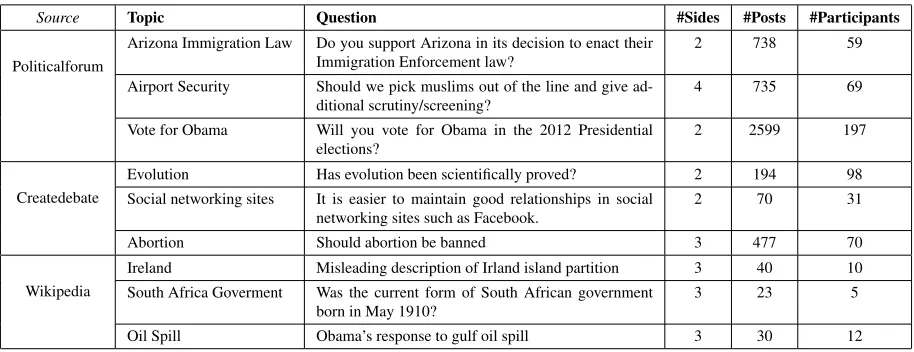
Source Topic Question #Sides #Posts #Participants
Politicalforum
Arizona Immigration Law Do you support Arizona in its decision to enact their Immigration Enforcement law?
2 738 59
Airport Security Should we pick muslims out of the line and give ad-ditional scrutiny/screening?
4 735 69
Vote for Obama Will you vote for Obama in the 2012 Presidential elections?
2 2599 197
Createdebate
Evolution Has evolution been scientifically proved? 2 194 98 Social networking sites It is easier to maintain good relationships in social
networking sites such as Facebook.
2 70 31
Abortion Should abortion be banned 3 477 70
Wikipedia
Ireland Misleading description of Irland island partition 3 40 10 South Africa Goverment Was the current form of South African government
born in May 1910?
3 23 5
[image:4.612.78.535.56.232.2]Oil Spill Obama’s response to gulf oil spill 3 30 12
Table 2: Example threads from our three datasets
30 debates containing a total of 2,712 posts. Each debate is about one topic. The description of each debate states two or more positions regarding the de-bate topic. When a new participant enters the discus-sion, she explicitly picks a position and posts text to support it, support a post written by another partici-pant who took the same position, or to dispute a post written by another participant who took an opposing position. We collected the discussion thread and the participant positions for each debate.
The third dataset (wikipedia, henceforth) comes from the Wikipedia4 discussion section. When a topic on Wikipedia is disputed, the editors of that topic start a discussion about it. We collected 117 Wikipeida discussion threads. The threads contains a total of 1,867 posts.
Thepoliticalforumandcreatedebatedatasets are self labeled as described above. To annotate the Wikipedia data, we asked an expert annotator (a professor in sociolinguistics who is not one of the authors) to read each of the Wikipedia discussion threads and determine whether the discussants split into subgroups in which case he was asked to deter-mine the subgroup membership of each discussant.
Table 2 lists few example threads from our three datasets. Table 1 shows a portion of discussion thread between three participants about enforcing a new immigration law in Arizona. This thread ap-peared in the polictalforum dataset. The text posted by the three participants indicates that A’s position
4
http://www.wikipedia.com
is with enforcing the law, that B agrees with A, and that C disagrees with both. This means that A and B belong to the same opinion subgroup, while belongs to an opposing subgroup.
We randomly selected 6 threads from our datasets (2 frompoliticalforum, 2 fromcreatedebate, and 2 fromWikipedia) and used them as development set. This set was used to develop our approach.
3 Approach
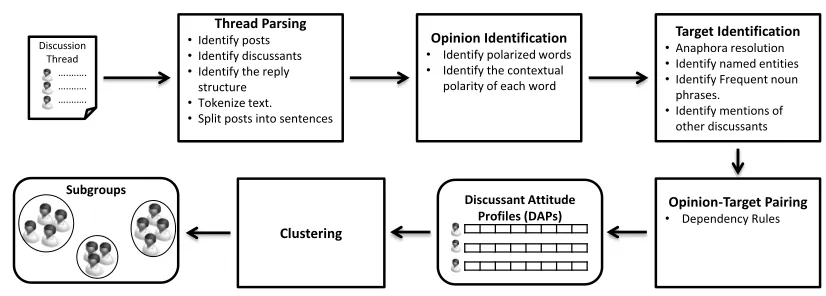
In this section, we describe a system that takes a discussion thread as input and outputs the subgroup membership of each discussant. Figure 1 illustrates the processing steps performed by our system to tect subgroups. In the following subsections we de-scribe the different stages in the system pipeline.
3.1 Thread Parsing
We start by parsing the thread to identify posts, par-ticipants, and the reply structure of the thread (i.e. who replies to whom). In the datasets described in Section 2.4, all this information was explicitly avail-able in the thread. We tokenize the text of each post and split it into sentences using CLAIRLib (Abu-Jbara and Radev, 2011).
3.2 Opinion Word Identification
use OpinionFinder (Wilson et al., 2005a) to identify polarized words and their polarities.
The polarity of a word is usally affected by the context in which it appears. For example, the wordfineis positive when used as an adjective and negative when used as a noun. For another example, a positive word that appears in a negated context becomes negative. OpinionFinder uses a large set of features to identify the contextual polarity of a given polarized word given its isolated polarity and the sentence in which it appears (Wilson et al., 2005b). Snippet (3) below shows the result of applying this step to snippet (1) above (O means neutral; POS
means positive;NEGmeans negative).
(3) Arizona/O Immigration/O law/O good/POS ./O Illegal/O immigration/O bad/NEG ./O
3.3 Target Identification
The goal of this step is to identify the possible tar-gets of opinion. A target could be another discus-sant or an entity mentioned in the discussion. When the target of opinion is another discussant, either the discussant name is mentioned explicitly or a second person pronoun is used to indicate that the opinion is targeting the recipient of the post. For example, in snippet (2) above the second person pronounyou
indicates that the opinion worddisagreeis targeting
Discussant 1, the recipient of the post.
The target of opinion can also be an entity mentioned in the discussion. We use two methods to identify such entities. The first method uses shallow parsing to identify noun groups (NG). We use the Edinburgh Language Technology Text Tokenization Toolkit (LT-TTT) (Grover et al., 2000) for this pur-pose. We consider as an entity any noun group that is mentioned by at least two different discussants. We replace each identified entity with a unique placeholder (EN T IT YID). For example, the noun group Arizona immigration law is mentioned by
Discussant 1and Discussant 2in snippets 1 and 2 above respectively. Therefore, we replace it with a placehold as illustrated in snippets (4) and (5) below.
(4) Discussant 1: EN T IT Y1 is good. Illegal
im-NER NP Chunking
Barack Obama the Republican nominee
Middle East the maverick economists
Bush conservative ideologues
Bob McDonell the Nobel Prize
[image:5.612.334.516.57.153.2]Iraq Federal Government
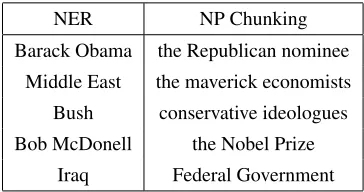
Table 3: Some of the entities identified using NER and NP Chunking in a discussion thread about the US 2012 elections
migration is bad.
(5) Discussant 2: I totally disagree with you.EN T IT Y1
is blatant racism, and quite unconstitutional.
We only consider as entities noun groups that contain two words or more. We impose this require-ment because individual nouns are very common and regarding all of them as entities will introduce significant noise.
In addition to this shallow parsing method, we also use named entity recognition (NER) to identify more entities. We use the Stanford Named Entity Recognizer (Finkel et al., 2005) for this purpose. It recognizes three types of entities: person, location, and organization. We impose no restrictions on the entities identified using this method. Again, we re-place each distinct entity with a unique re-placeholder. The final set of entities identified in a thread is the union of the entities identified by the two aforemen-tioned methods. Table 3
Finally, a challenge that always arises when performing text mining tasks at this level of gran-ularity is that entities are usually expressed by anaphorical pronouns. Previous work has shown that For example, the following snippet contains an explicit mention of the entityObamain the first sentence, and then uses a pronoun to refer to the same entity in the second sentence. The opinion word unbeatable appears in the second sentence and is syntactically related to the pronoun He. In the next subsection, it will become clear why knowing which entity does the pronounHerefers to is essential for opinion-target pairing.
Discussion Thread
….……. ….……. ….…….
Opinion Identification
• Identify polarized words
• Identify the contextual polarity of each word
Target Identification
•Anaphora resolution
•Identify named entities
•Identify Frequent noun phrases.
•Identify mentions of other discussants
Opinion-Target Pairing
• DependencyRules
Discussant Attitude Profiles (DAPs)
Clustering
Subgroups
Thread Parsing
•Identify posts
•Identify discussants
•Identify the reply structure
•Tokenize text.
[image:6.612.96.509.60.208.2]•Split posts into sentences
Figure 1: An overview of the subgroups detection system
He is unbeatable.
Jakob and Gurevych (2010) showed experi-mentally that resolving the anaphoric links in the text significantly improves opinion target extraction. We use the Beautiful Anaphora Resolution Toolkit (BART) (Versley et al., 2008) to resolve all the anaphoric links within the text of each post sepa-rately. The result of applying this step to snippet (6) is:
(6) It doesn’t matter whether you vote for Obama. Obama is unbeatable.
Now, both mentions of Obama will be recog-nized by the Stanford NER system and will be identified as one entity.
3.4 Opinion-Target Pairing
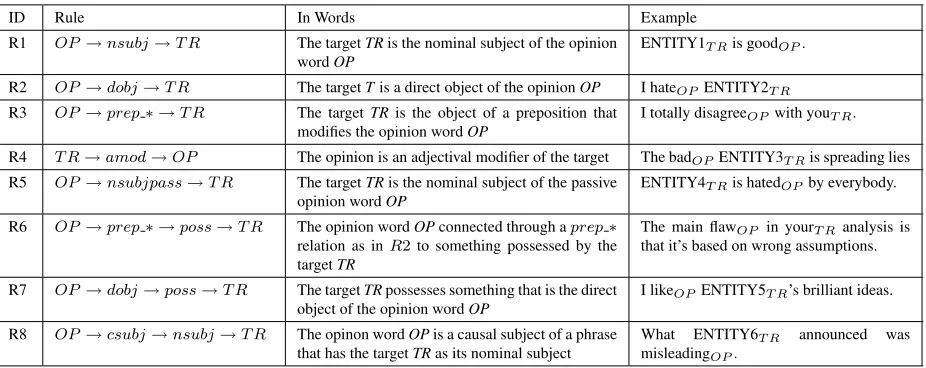
At this point, we have all the opinion words and the potential targets identified separately. The next step is to determine which opinion word is target-ing which target. We propose a rule based approach for opinion-target pairing. Our rules are based on the dependency relations that connect the words in a sentence. We use the Stanford Parser (Klein and Manning, 2003) to generate the dependency parse tree of each sentence in the thread. An opinion word and a target form a pair if they stratify at least one of our dependency rules. Table 4 illustrates some
of these rules 5. The rules basically examine the types of the dependencies on the shortest path that connect the opinion word and the target in the de-pendency parse tree. It has been shown in previous work on relation extraction that the shortest depen-dency path between any two entities captures the in-formation required to assert a relationship between them (Bunescu and Mooney, 2005).
If a sentence S in a post written by participant
Picontains an opinion wordOPjand a targetT Rk, and if the opinion-target pair satisfies one of our de-pendency rules, we say thatPiexpresses an attitude
towardsT Rk. The polarity of the attitude is deter-mined by the polarity ofOPj. We represent this as
Pi →+ T RkifOPjis positive andPi→− T RkifOPj
is negative.
It is likely that the same participant Pi express
sentiment toward the same target T Rk multiple times in different sentences in different posts. We keep track of the counts of all the instances of posi-tive/negative attitudePi expresses towardT Rk. We
represent this asPi −−→m+
n− T Rk wherem(n) is the
number of timesPiexpressed positive (negative) at-titude towardT Rk.
3.5 Discussant Attitude Profile
We propose a representation of discussants´attitudes towards the identified targets in the discussion thread. As stated above, a target could be another discussant or an entity mentioned in the discussion.
5The code will be made publicly available at the time of
ID Rule In Words Example R1 OP→nsubj→T R The targetTRis the nominal subject of the opinion
wordOP
ENTITY1T Ris goodOP.
R2 OP→dobj→T R The targetTis a direct object of the opinionOP I hateOP ENTITY2T R
R3 OP→prep∗ →T R The targetTRis the object of a preposition that modifies the opinion wordOP
I totally disagreeOP with youT R.
R4 T R→amod→OP The opinion is an adjectival modifier of the target The badOPENTITY3T Ris spreading lies
R5 OP→nsubjpass→T R The targetTRis the nominal subject of the passive opinion wordOP
ENTITY4T Ris hatedOPby everybody.
R6 OP→prep∗ →poss→T R The opinion wordOPconnected through aprep∗
relation as inR2to something possessed by the targetTR
The main flawOP in yourT R analysis is
that it’s based on wrong assumptions.
R7 OP→dobj→poss→T R The targetTRpossesses something that is the direct object of the opinion wordOP
I likeOP ENTITY5T R’s brilliant ideas.
R8 OP→csubj→nsubj→T R The opinon wordOPis a causal subject of a phrase that has the targetTRas its nominal subject
What ENTITY6T R announced was
[image:7.612.76.539.56.240.2]misleadingOP.
Table 4: Examples of the dependency rules used for opinion-target pairing.
Our representation is a vector containing numeri-cal values. The values correspond to the counts of positive/negative attitudes expressed by the discus-sant toward each of the targets. We call this vector thediscussant attitude profile (DAP). We construct a DAP for every discussant. Given a discussion thread withddiscussants andeentity targets, each attitude profile vector hasn = (d+e)∗3dimensions. In other words, each target (discussant or entity) has three corresponding values in the DAP: 1) the num-ber of times the discussant expressed positive atti-tude toward the target, 2) the number of times the discussant expressed a negative attitude towards the target, and 3) the number of times the the discussant interacted with or mentioned the target. It has to be noted that these values are not symmetric since the discussions explicitly denote the source and the tar-get of each post.
3.6 Clustering
At this point, we have an attitude profile (or vec-tor) constructed for each discussant. Our goal is to use these attitude profiles to determine the subgroup membership of each discussant. We can achieve this goal by noticing that the attitude profiles of discus-sants who share the same opinion are more likely to be similar to each other than to the attitude profiles of discussants with opposing opinions. This sug-gests that clustering the attitude vector space will achieve the goal and split the discussants into sub-groups according to their opinion.
4 Evaluation
In this section, we present several levels of evalu-ation of our system. First, we compare our sys-tem to baseline syssys-tems. Second, we study how the choice of the clustering algorithm impacts the re-sults. Third, we study the impact of each component in our system on the performance. All the results reported in this section that show difference in the performance are statistically significant at the 0.05 level (as indicated by a 2-tailed paired t-test). Be-fore describing the experiments and presenting the results, we first describe the evaluation metrics we use.
4.0.1 Evaluation Metrics
We use two evaluation metrics to evaluate sub-groups detection accuracy: Purity and Entropy. To compute Purity (Manning et al., 2008), each clus-ter is assigned the class of the majority vote within the cluster, and then the accuracy of this assignment is measured by dividing the number of correctly as-signed members by the total number of instances. It can be formally defined as:
purity(Ω, C) = 1
N
X
k
max
j |ωk∩cj| (1)
whereΩ = {ω1, ω2, ..., ωk}is the set of clusters
the set of documents incj. The purity increases as the quality of clustering improves.
The second metric is Entropy. The Entropy of a cluster reflects how the members of thek distinct subgroups are distributed within each resulting clus-ter; the global quality measure is computed by aver-aging the entropy of all clusters:
Entropy =−
j
Xnj
n
i
X
P(i, j)×log2P(i, j)
(2) whereP(i, j)is the probability of finding an ele-ment from the categoryiin the clusterj, nj is the
number of items in clusterj, and n the total num-ber of items in the distribution. In contrast to purity, the entropy decreases as the quality of clustering im-proves.
4.1 Comparison to Baseline Systems
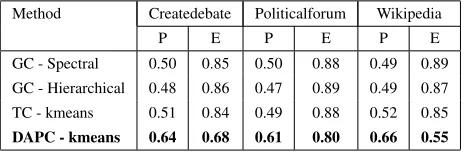
We compare our system (DAPC) that was described in Section 3 to two baseline methods. The first base-line (GC) uses graph clustering to partition a net-work based on the interaction frequency between participants. We build a graph where each node represents a participant. Edges link participants if they exchange posts, and edge weights are based on the number of interactions. We tried two methods for clustering the resulting graph: spectral partition-ing (Luxburg, 2007) and a hierarchical agglomera-tion algorithm which works by greedily optimizing the modularity for graphs (Clauset et al., 2004).
The second baseline (TC) is based on the premise that the member of the same subgroup are more likely to use vocabulary drawn from the same lan-guage model. We collect all the text posted by each participant and create a tf-idf representations of the text in a high dimensional vector space. We then cluster the vector space to identify subgroups. We use k-means (MacQueen, 1967) as our clustering algorithm in this experiment (comparison of vari-ous clustering algorithms is presented in the next subsection). The distances between vectors are Eculidean distances. Table 5 shows that our sys-tem performs significantly better the baselines on the three datasets in terms of both the purity (P) and the entropy (E) (notice that lower entropy values indi-cate better clustering). The values reported are the
Method Createdebate Politicalforum Wikipedia
P E P E P E
[image:8.612.313.545.58.134.2]GC - Spectral 0.50 0.85 0.50 0.88 0.49 0.89 GC - Hierarchical 0.48 0.86 0.47 0.89 0.49 0.87 TC - kmeans 0.51 0.84 0.49 0.88 0.52 0.85 DAPC - kmeans 0.64 0.68 0.61 0.80 0.66 0.55
Table 5: Comparison to baseline systems
Method Createdebate Politicalforum Wikipedia
P E P E P E
DAPC - EM 0.63 0.71 0.61 0.82 0.63 0.61 DAPC - FF 0.63 0.70 0.60 0.83 0.64 0.59 DAPC - kmeans 0.64 0.68 0.61 0.80 0.66 0.55
Table 6: Comparison of different clustering algorithms
average results of the threads of each dataset. We believe that the baselines performed poorly because the interaction frequency and the text similarity are not key factors in identifying subgroup structures. Many people would respond to people they disagree with more, while others would mainly respond to people they agree with most of the time. Also, peo-ple in opposing subgroups tend to use very similar text when discussing the same topic and hence text clustering does not work as well.
4.2 Choice of the clustering algorithm
4.3 Component Evaluation
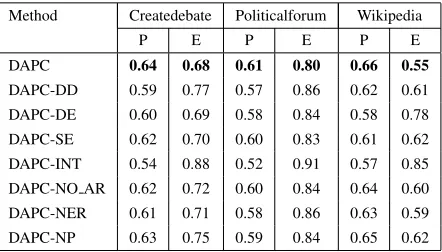
In this subsection, we evaluate the impact of the dif-ferent components in the pipeline on the system per-formance. We do that by removing each component from the pipeline and measuring the change in per-formance. We perform the following experiments: 1) We run the full system with all its components included (DAPC). 2) We run the system and in-clude only discussant-to-discussant attitude features in the attitude vectors (DAPC-DD). 3) We include only discussant-to-entity attitude features in the atti-tude vectors (DAPC-DE). 4) We include only senti-ment features in the attitude vector; i.e. we exclude the interaction count features (DAPC-SE). 5) We in-clude only interaction count features to the attitude vector; i.e. we exclude sentiment features (DAPC-INT). 6) We skip the anaphora resolution step in the entity identification component (DAPC-NO AR). 7) We only use named entity recognition to identify en-tity targets; i.e. we exclude the entities identified through noun phrasing chunking (DAPC-NER). 8) Finally, we only noun phrase chunking to identify entity targets (DAPC-NP). In all these experiments k-means is used for clustering and the number of clusters is set as explained in the previous subsec-tion.
The results show that all the components in the system contribute to better performance of the sys-tem. We notice from the results that the performance of the system drops significantly if sentiment fea-tures are not included. This is result corroborates our hypothesis that interaction features are not suffi-cient factors for detecting rift in discussion groups. Including interaction features improve the perfor-mance (although not by a big difference) because they help differentiate between the case where par-ticipants A and B never interacted with each other and the case where they interact several time but never posted text that indicate difference in opin-ion between them. We also notice that the perfor-mance drops significantly in DD and DAPC-DD which also supports our hypotheses that both the sentiment discussants show toward one another and the sentiment they show toward the aspects of the discussed topic are important for the task. Al-though using both named entity recognition (NER) and noun phrase chunking achieves better results, it
Method Createdebate Politicalforum Wikipedia
P E P E P E
[image:9.612.316.537.57.183.2]DAPC 0.64 0.68 0.61 0.80 0.66 0.55 DAPC-DD 0.59 0.77 0.57 0.86 0.62 0.61 DAPC-DE 0.60 0.69 0.58 0.84 0.58 0.78 DAPC-SE 0.62 0.70 0.60 0.83 0.61 0.62 DAPC-INT 0.54 0.88 0.52 0.91 0.57 0.85 DAPC-NO AR 0.62 0.72 0.60 0.84 0.64 0.60 DAPC-NER 0.61 0.71 0.58 0.86 0.63 0.59 DAPC-NP 0.63 0.75 0.59 0.84 0.65 0.62
Table 7: Impact of system components on the perfor-mance
can also be noted from the results that NER con-tributes more to the system performance. Finally, the results support Jakob and Gurevych (2010) find-ings that anaphora resolution aids opinion mining systems.
5 Conclusions
In this paper, we presented an approach for subgroup detection in ideological discussions. Our system uses linguistic analysis techniques to identify the at-titude the participants of online discussions carry to-ward each other and toto-ward the aspects of the discus-sion topic. Attitude prediction as well as interaction frequency to construct an attitude vector for each participant. The attitude vectors of discussants are then clustered to form subgroups. Our experiments showed that our system outperforms text clustering and interaction graph clustering. We also studied the contribution of each component in our system to the overall performance.
Acknowledgments
References
Amjad Abu-Jbara and Dragomir Radev. 2011. Clairlib: A toolkit for natural language processing, information retrieval, and network analysis. InProceedings of the ACL-HLT 2011 System Demonstrations, pages 121– 126, Portland, Oregon, June. Association for Compu-tational Linguistics.
Pranav Anand, Marilyn Walker, Rob Abbott, Jean E. Fox Tree, Robeson Bowmani, and Michael Minor. 2011. Cats rule and dogs drool!: Classifying stance in online debate. InProceedings of the 2nd Workshop on Computational Approaches to Subjectivity and Sen-timent Analysis (WASSA 2.011), pages 1–9, Portland, Oregon, June. Association for Computational Linguis-tics.
Alina Andreevskaia and Sabine Bergler. 2006. Mining wordnet for fuzzy sentiment: Sentiment tag extraction from wordnet glosses. InEACL’06.
Carmen Banea, Rada Mihalcea, and Janyce Wiebe. 2008. A bootstrapping method for building subjec-tivity lexicons for languages with scarce resources. In LREC’08.
Mohit Bansal, Claire Cardie, and Lillian Lee. 2008. The power of negative thinking: Exploiting label disagree-ment in the min-cut classification framework.
Razvan Bunescu and Raymond Mooney. 2005. A short-est path dependency kernel for relation extraction. In Proceedings of Human Language Technology Confer-ence and ConferConfer-ence on Empirical Methods in Nat-ural Language Processing, pages 724–731, Vancou-ver, British Columbia, Canada, October. Association for Computational Linguistics.
Aaron Clauset, Mark E. J. Newman, and Cristopher Moore. 2004. Finding community structure in very large networks.Phys. Rev. E, 70:066111.
Sanjoy Dasgupta. 2002. Performance guarantees for hierarchical clustering. In 15th Annual Conference on Computational Learning Theory, pages 351–363. Springer.
Jenny Rose Finkel, Trond Grenager, and Christopher Manning. 2005. Incorporating non-local informa-tion into informainforma-tion extracinforma-tion systems by gibbs sam-pling. InProceedings of the 43rd Annual Meeting on Association for Computational Linguistics, ACL ’05, pages 363–370, Stroudsburg, PA, USA. Association for Computational Linguistics.
Claire Grover, Colin Matheson, Andrei Mikheev, and Marc Moens. 2000. Lt ttt - a flexible tokenisation tool. InIn Proceedings of Second International Con-ference on Language Resources and Evaluation, pages 1147–1154.
Ahmed Hassan and Dragomir Radev. 2010. Identifying text polarity using random walks. InACL’10.
Ahmed Hassan, Vahed Qazvinian, and Dragomir Radev. 2010. What’s with the attitude?: identifying sentences with attitude in online discussions. InProceedings of the 2010 Conference on Empirical Methods in Natural Language Processing, pages 1245–1255.
Ahmed Hassan, Amjad AbuJbara, Rahul Jha, and Dragomir Radev. 2011. Identifying the semantic orientation of foreign words. In Proceedings of the 49th Annual Meeting of the Association for Compu-tational Linguistics: Human Language Technologies, pages 592–597, Portland, Oregon, USA, June. Associ-ation for ComputAssoci-ational Linguistics.
Vasileios Hatzivassiloglou and Kathleen R. McKeown. 1997. Predicting the semantic orientation of adjec-tives. InEACL’97, pages 174–181.
Vasileios Hatzivassiloglou and Janyce Wiebe. 2000. Ef-fects of adjective orientation and gradability on sen-tence subjectivity. InCOLING, pages 299–305. Hochbaum and Shmoys. 1985. A best possible heuristic
for the k-center problem. Mathematics of Operations Research, 10(2):180–184.
Minqing Hu and Bing Liu. 2004a. Mining and summa-rizing customer reviews. InKDD’04, pages 168–177. Minqing Hu and Bing Liu. 2004b. Mining and
summa-rizing customer reviews. InProceedings of the tenth ACM SIGKDD international conference on Knowl-edge discovery and data mining, KDD ’04, pages 168– 177, New York, NY, USA. ACM.
Niklas Jakob and Iryna Gurevych. 2010. Using anaphora resolution to improve opinion target identification in movie reviews. InProceedings of the ACL 2010 Con-ference Short Papers, pages 263–268, Uppsala, Swe-den, July. Association for Computational Linguistics.
Jaap Kamps, Maarten Marx, Robert J. Mokken, and Maarten De Rijke. 2004. Using wordnet to measure semantic orientations of adjectives. InNational Insti-tute for, pages 1115–1118.
Soo-Min Kim and Eduard Hovy. 2004. Determining the sentiment of opinions. InCOLING, pages 1367–1373. Dan Klein and Christopher D. Manning. 2003. Accu-rate unlexicalized parsing. InIN PROCEEDINGS OF THE 41ST ANNUAL MEETING OF THE ASSOCIA-TION FOR COMPUTAASSOCIA-TIONAL LINGUISTICS, pages 423–430.
Nozomi Kobayashi, Kentaro Inui, and Yuji Matsumoto. 2007. Extracting aspect-evaluation and aspect-of re-lations in opinion mining. In Proceedings of the 2007 Joint Conference on Empirical Methods in Natu-ral Language Processing and Computational NatuNatu-ral Language Learning (EMNLP-CoNLL.
Bing Liu. 2009. Web Data Mining: Exploring Hyper-links, Contents, and Usage Data (Data-Centric Sys-tems and Applications). Springer, 1st ed. 2007. corr. 2nd printing edition, January.
Ulrike Luxburg. 2007. A tutorial on spectral clustering. Statistics and Computing, 17:395–416, December. J. B. MacQueen. 1967. Some methods for classification
and analysis of multivariate observations. In L. M. Le Cam and J. Neyman, editors,Proc. of the fifth Berkeley Symposium on Mathematical Statistics and Probabil-ity, volume 1, pages 281–297. University of California Press.
Christopher D. Manning, Prabhakar Raghavan, and Hin-rich Schtze. 2008. Introduction to Information Re-trieval. Cambridge University Press, New York, NY, USA.
Qiaozhu Mei, Xu Ling, Matthew Wondra, Hang Su, and ChengXiang Zhai. 2007. Topic sentiment mixture: modeling facets and opinions in weblogs. In Pro-ceedings of the 16th international conference on World Wide Web, WWW ’07, pages 171–180, New York, NY, USA. ACM.
Soo min Kim and Eduard Hovy. 2007. Crystal: Ana-lyzing predictive opinions on the web. InIn EMNLP-CoNLL 2007.
Tetsuya Nasukawa and Jeonghee Yi. 2003. Sentiment analysis: capturing favorability using natural language processing. InK-CAP ’03: Proceedings of the 2nd international conference on Knowledge capture, pages 70–77.
Bo Pang and Lillian Lee. 2008. Opinion mining and sentiment analysis. Foundations and Trends in Infor-mation Retrieval, 2(1-2):1–135.
Ana-Maria Popescu and Oren Etzioni. 2005. Extracting product features and opinions from reviews. In HLT-EMNLP’05, pages 339–346.
Ellen Riloff and Janyce Wiebe. 2003. Learning extraction patterns for subjective expressions. In EMNLP’03, pages 105–112.
Swapna Somasundaran and Janyce Wiebe. 2009. Rec-ognizing stances in online debates. In Proceedings of the Joint Conference of the 47th Annual Meeting of the ACL and the 4th International Joint Conference on Natural Language Processing of the AFNLP, pages 226–234, Suntec, Singapore, August. Association for Computational Linguistics.
Veselin Stoyanov and Claire Cardie. 2008. Topic iden-tification for fine-grained opinion analysis. InIn Col-ing.
Hiroya Takamura, Takashi Inui, and Manabu Okumura. 2005. Extracting semantic orientations of words using spin model. InACL’05, pages 133–140.
Matt Thomas, Bo Pang, and Lillian Lee. 2006. Get out the vote: Determining support or opposition from con-gressional floor-debate transcripts. InIn Proceedings of EMNLP, pages 327–335.
Peter Turney and Michael Littman. 2003. Measuring praise and criticism: Inference of semantic orientation from association. ACM Transactions on Information Systems, 21:315–346.
Yannick Versley, Simone Paolo Ponzetto, Massimo Poe-sio, Vladimir Eidelman, Alan Jern, Jason Smith, Xi-aofeng Yang, and Alessandro Moschitti. 2008. Bart: A modular toolkit for coreference resolution. In Pro-ceedings of the ACL-08: HLT Demo Session, pages 9–12, Columbus, Ohio, June. Association for Compu-tational Linguistics.
Janyce Wiebe. 2000. Learning subjective adjectives from corpora. In Proceedings of the Seventeenth National Conference on Artificial Intelligence and Twelfth Conference on Innovative Applications of Ar-tificial Intelligence, pages 735–740.
Theresa Wilson, Paul Hoffmann, Swapna Somasun-daran, Jason Kessler, Janyce Wiebe, Yejin Choi, Claire Cardie, Ellen Riloff, and Siddharth Patward-han. 2005a. Opinionfinder: a system for subjectiv-ity analysis. InProceedings of HLT/EMNLP on Inter-active Demonstrations, HLT-Demo ’05, pages 34–35, Stroudsburg, PA, USA. Association for Computational Linguistics.
Theresa Wilson, Janyce Wiebe, and Paul Hoffmann. 2005b. Recognizing contextual polarity in phrase-level sentiment analysis. InHLT/EMNLP’05, Vancou-ver, Canada.
Ainur Yessenalina, Yisong Yue, and Claire Cardie. 2010. Multi-level structured models for document-level sen-timent classification. InIn Proceedings of the Confer-ence on Empirical Methods in Natural Language Pro-cessing (EMNLP.