A LOGICAL SEMANTICS FOR FEATURE S T R U C T U R E S
Robert T. Kasper and William C. RoundsElectrical Engineering and Computer Science Department University of Michigan
Ann Arbor, Michigan 48109
A b s t r a c t
Unification-based g r a m m a r formalisms use struc- tures containing sets of features to describe lin- guistic objects. Although computational algo- rithms for unification of feature structures have been worked out in experimental research, these algcwithms become quite complicated, and a more precise description of feature structures is desir- able. We have developed a model in which de- scriptions of feature structures can be regarded as logical formulas, and interpreted by sets of di- rected graphs which satisfy them. These graphs are, in fact, transition graphs for a special type of deterministic finite automaton.
This semantics for feature structures extends the ideas of Pereira and Shieber [11], by providing an interpretation for values which are specified by disjunctions and p a t h values embedded within disjunctions. Our interpretati6n differs from that of Pereira and Shieber by using a logical model in place of a denotational semantics. This logical model yields a calculus of equivalences, which can be used to simplify formulas.
Unification is attractive, because of its gener- ality, but it is often computations/]), inefficient. Our mode] allows a careful examination of the computational complexity of unification. We have shown that the consistency problem for for- mulas with disjunctive values is NP-complete. To deal with this complexity, we describe how dis- junctive values can be specified in a way which delays expansion to disjunctive normal form.
1
B a c k g r o u n d :
U n i f i c a t i o n in G r a m m a r
Several different approaches to natural lan- guage g r a m m a r have developed the notion of feature structures to describe linguistic objects. These approaches include linguistic theories, such as Generalized Phrase Structure G r a m m a r (GPSG) [2],temic G r a m m a r [3]. They also include grammar formalisms which have been developed as com- putational tools, such as Functional Unification G r a m m a r (FUG) [7], and PATR-II [14]. In these computational formalisms, unificat/on is the pri- m a r y operation for matching and combining fea- ture structures.
Feature structures are called by several differ- ent names, including f-structures in LFG, and functional descriptiona in FUG. Although they differ in details, each approach uses structures containing sets of attributes. Each attribute is composed of a label/value pair. A value may be an atomic symbol, hut it may also be a nested feature structure.
The intuitive interpretation of feature struc- tures may be clear to linguists who use them, even in the absence of a precise definition. Of- ten, a precise definition of a useful notation be- comes possible only after it has been applied to the description of a variety of phenomena. Then, greater precision m a y become necessary for clari- fication when the notation is used by many differ- ent investigators. Our model has been developed in the context of providing a precise interpreta- tion for the feature structures which are used in F U G and PATR-II. Some elements of this logi- cal interpretation have been partially described in Kay's work [8]. Our contribution is to give a more complete algebraic account of the logi- cal properties of feature structures, which can be used explicitly for computational manipulation and m a t h e m a t i c a l analysis. Proofs of the math- ematical soundness and completeness of this log- ical treatment, along with its relation to similar logics, can be found in [12].
2
D i s j u n c t i o n a n d
N o n - L o c a l V a l u e s
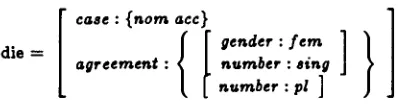
die :
,,¢reement : number : 8ia¢
aumber : pl ]
Figure 1: A Feature Structure containing Value Disjunction.
phenomena. He discusses specifying attributes by disjunctive values, as shown in Figure 1. A ~alue disjuactioa specifies alternative values of a single attribute. These alternative values may be either atomic or complex. Disjunction of a more gen- eral kind is an essential element of FUG. Geaera/
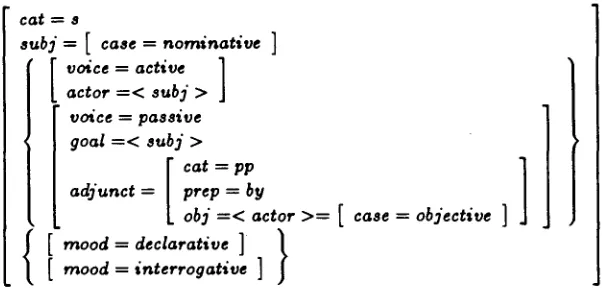
disjunction is used to specify alternative groups of multiple attributes, as shown in Figure 2.
Karttunen describes a method by which the ba- sic unification procedure can be extended to han- dle negative and disjunctive values, and explains some of the complications that result from intro- ducing value disjunction. When two values, A and B, are to be unified, and A is a disjunction, we cannot actually unify B with both alternatives of A, because one of the alternatives may become incompatible with B through later unifications. Instead we need to remember .a constraint that at least one of the alternatives of A must remain compatible with B.
An additional complication arises when one of the alternatives of a disjunction contains a value which is specified by a non-local path, a situa- tion which occurs frequently in Functional Unifi-
cation Grammar. In Figure 2 the obj attribute in
the description of the adjunct attribute is given
the value < actor >, which means that the obj
attribute is to be unified with the value found at the end of the path labeled by < actor > in
the outermost enclosing structure. This unifica- tion with a non-local value can be performed only when the alternative which Contains it is the only alternative remaining in the disjunction. Oth-
erwise, the case = objective attribute might be
added to the value of < actor > prematurely, when the alternative containing a d j u n c t is not used. Thus, the constraints on alternatives of a disjunction must also apply to any non-local val- ues contained within those alternatives. These complications, and the resulting proliferation of constraints, provide a practical motivation for the logical treatment given in this paper. We suggest a solution to the problem of representing non-
local path values in Section 5.4.
3
L o g i c a l F o r m u l a s f o r
F e a t u r e S t r u c t u r e s
The feature structure of Figure 1 can also be represented by a type of logical formula:
die = case : (hOrn V acc)
A a ~ ' e e m e n t : (
(gender : f e r n A n u m b e r : sing) V n u m b e r : pl)
This type of formula differs from standard propo- sitional logic in that a theoretically unlimited set of atomic values is used in place of boolean val- ues. The labels of attributes bear a superficial resemblance to modal operators. Note that no information is added or subtracted by rewriting the feature matrix of Figure 1 as a logical formula. These two forms may be regarded as notational variants for expressing the same facts. While fea- ture matrices seem to be a more appealing and natural notation for displaying linguistic descrip- tions, logical formulas provide a precise interpre- tation which can be useful for computational and mathematical purposes.
Given this intuitive introduction we proceed to a more complete definition of this logic.
4
A L o g i c a l S e m a n t i c s
As Pereira and Shieber [11] have pointed out, a grammatical formalism can be regarded in a way similar to other representation languages. Often it is useful to use a representation language which is disctinct from the objects it represents. Thus, it can be useful to make a distinction between the domain of feature structures and the domain of their descriptions. As we shall see, this distinc- tion allows a variety of notational devices to be used in descriptions, and interpreted in a consis- tent way with a uniform kind of structure.
4.1
D o m a i n of Feature
Structures
The PATR-II system uses directed acyclic graphs (dags) as an underlying representation for
feature structures. In order to build complex
[image:2.612.102.301.72.124.2]c a t ~ S
s u b j = [ case = n o m i n a t i v e ]
actor = < sub.7' >
voice = passive goal = < s u b j >
cat = pp a d j u n c t = prep = by
obj = < actor > = [ case = objective ] mood = declarative ]
[image:3.612.141.442.63.211.2]mood interrogative ]
f
Figure 2: Disjunctive specification containing non-local values, using the notation of F U G .
1. atoms (A)
2. labels (L)
The elements of both domains are symbols, usu-
ally denoted by character strings. Attribute I ~
belt (e.g., acase~) are used to mark edges in a dag, and atoms (e.g., "gen z) are used as prim- itive values at vertices which have no outgoing edges.
A dag may also be regarded as a transition graph for a partially specified deterministic fi- nite automaton (DFA). This automaton recog- nises strings of labels, and has final states which are atoms, as well as final states which encode no information. An automaton is formally described by a tuple
.~ = ( Q , L , 5,qo, F )
where L is the set of labels above, 6 is a partial function from Q × L to Q, and where certain el- ements of F m a y be atoms from the set A. W e require that ~ be connected, acyclic, and have no transitions from any final states.
D F A s have several desirable properties as a do- main for feature structures:
1. the value of any defined path can be denoted by a state of the automaton;
2. finding the value of a path is interpreted by running the automaton on the path string;
3. the automaton captures the crucial proper- ties of shared structure:
(a) two paths which axe unified have the same state as a value,
(b) unification is equivalent to a state-
merge operation;
4. the techniques of automata theory become available for use with feature structures.
A consequence of item 3 above is that the dis- ," tinction between type identity and token identity it clearly revealed by an automaton; two objects are necessarily the same token, if and only if they are represented by the same state.
One construct of a u t o m a t a theory, the Nerode relation, is useful to describe equivalent paths. If #q is an automaton, we let P(A) be the set of all paths of ~4, namely the set {z E L* : 5(q0, z) is defined }. The Nerode relation N ( A ) is the equivalence relation defined on paths of P(~) by letting
4 . 2 D o m a i n o f D e s c r i p t i o n s : L o g i c a l F o r m u l a s
We now define the domain FML of logical for- mulas which describe feature structures. Figure 3 defines the syntax of well formed formulas. In the following sections symbols from the Greek alpha- bet axe used to stand for arbitrary formulas in FML. The formulas N I L and T O P axe intended to convey gno information z and ~inconsistent in-
formation s respectively. Thus, N I L corresponds
N I L T O P a E A
~< 191 > , . . . , < 19, > ] where each 19~ E L* l : ~ b w h e r e l E L a n d ~ b E F M L
¢ v ¢
Figure 3: T h e domain, FML, of logical formulas.
Conjunction and disjunction will have their or- dinary logical meaning as operators in formulas. An interesting result is t h a t conjunction can be used to describe unification. Unifying two struc- tures requires finding a structure which has all features of b o t h structures; the conjunction of two formulas describes the structures which sat- isfy all conditions of b o t h formulas.
One difference between feature structures and their descriptions should be noted. In a feature structure it is required t h a t a particular a t t r i b u t e have a unique value, while in descriptions it is p o u i b l e to specify, using conjunction, several val- ues for the same attribute, as in the formula
s bj : (19e.so. : 3) ^ s bj: :
A feature s t r u c t u r e satisfying such a description will contain a unique value for the attribute, which can be found by unifying all of the values t h a t are specified in the description.
Formulas m a y also contain sets of paths, de- noting equivalence classes. Each element of the set represents an existing p a t h starting from the initial state of an a u t o m a t o n , and all paths in the set are required to have a c o m m o n endpoint. If E = I < z >, < y >~, we will sometimes write E as < z > = < y >. This is the n o t a t i o n of P A T R - II for pairs of equivalent paths. In subsequent sections we use E (sometimes with subscripts) to stand for a s e t of paths t h a t belong to the same equivalence class.
4 . 3
I n t e r p r e t a t i o n of F o r m u l a s
We can now state inductively the exact con- ditions under which an a u t o m a t o n Jl satisfies a formula:
1. A ~ N I L always;
2. 11 ~ T O P never;
3. /l ~ a ¢ = ~ /I is the one-state a u t o m a t o n a with no transitions;
4. A ~ E ¢ = ~ E is a subset of an equivalence class of
N(~);
5. A ~ l : cb ¢=~ A / l is defined
and A / I ~ ~;
where ~ / I is defined by a subgraph of the au- t o m a t o n A with start state 5(qo, l), t h a t is
ira = (Q,L, 6, qo, F),
then .~/l = (Q', L, 6, 6(qo, l), f ' ) ;
where Qi and F ' are formed from Q and F by removing any states which are unreachable from
6(q0,
0.
A n y formula can be regarded as a specification for the set of a u t o m a t a which satisfy it. In the case of conjunctive formulas (containing no oc- curences of disjunction) the set of a u t o m a t a satis- fying the formula has a unique minimal element,
with respect to subsumption.* For disjunctive
formulas there m a y be several minimal elements, but always a finite number.
4 . 4 C a l c u l u s o f F o r m u l a s
It is possible to write m a n y formulas which have an identical interpretation. For example, the formulas given in the equation below are satisfied by the same set of a u t o m a t a .
case : (gen V ace V dat) A case : ace = case : ace
In this simple example it is clear t h a t the right side of the formula is equivalent to the left side, and t h a t it is simpler. In more complex examples it is not always obvious when two formulas are equivalent. Thus, we are led to state the laws of equivalence shown in Figure 4. Note t h a t equiv- alence (26) is added only to make descriptions of cyclic structures unsatisfiable.
Failure:
l : T O P = T O P
Conjunction (unification}:
¢ A T O P = T O P
C A N I L = ~b
a A b = T O P , Va, b 6 A a n d a # b
a A l : ¢ = T O P
/:¢AZ:,#,
=t:(¢A¢)
Disjunction:¢ v N I L = N I L
¢ v T O P =
z : ¢ v ~ : ¢ = t : ( ¢ v ¢ ) Commutative:
¢A¢
=¢ ^ ¢
¢ v ¢ = ¢ v ¢
Associative:( ¢ ^ ¢ ) ^ x = ¢ ^ ( ¢ ^ x )
( ¢ v ¢ ) v x = ¢ , v ( ¢ v x )
Idempotent:
¢A~
= ~b4 v 4 = @
Distributive:
( ~ v ¢ ) ^ x = (~^x) v ( ¢ ^ x )
( ~ , A ¢ ) V x = ( ~ V X ) ^ ( ¢ V X )
Absorption:
(¢A¢)V~
= ~,(¢v¢)A¢
= 4,Path Equivalence:
E1
A E 2E, ^ E2
E A z : c
E
l : E
{,)
E--- E2 whenever E1 _C E2 = E1 ^ (E2 u { z y I ~ e El})
for any y such that 3 z : z ~ E l and z y E E2 -- E A ( A y : c ) w h e r e x e E
glEE
= E A {z} if" z is a prefix of a string in E
= N I L
= T O P for any E such that there are strings
z, z y E E a n d y # e
(1)
(2)
(3)
(4)
(s}
(6}
(7)
is)
(9)
(1o)
(11)
( n )
(13)
(14) (15)
(16) (17)
(18)
(19)
(20) (21)
(22)
(23) (24)
(2s)
[image:5.612.131.519.88.626.2](26)
5
C o m p l e x i t y o f D i s j u n c t i v e
D e s c r i p t i o n s
To date, the p r i m a r y benefit of using logical formulas to describe feature structures has been the clarification of several problems that arise with disjunctive descriptions.
5 . 1 N P - c o m p l e t e n e s s o f c o n s i s t e n c y
problem
f o r f o r m u l a sOne consequence of describing feature struc- tures by logical formulas is t h a t it is now rel- atively easy to analyse the computational com- plexity of various problems involving feature structures. It turns out that the satisfiability problem for C N F formulas of propositional logic can be reduced to the consistency (or satisfia- bility) problem for formulas in FML. Thus, the consistency problem for formulas in FML is NP- complete. It follows t h a t any unification algo- r i t h m for FML formulas will have non-polynomial worst-case complexity (provided P ~ NP!), since a correct unification algorithm must check for consistency.
Note t h a t disjunction is the source of this com- plexity. If disjunction is eliminated from the do- main of formulas, then the consistency problem is in P. Thus systems, such as the original PATR-II, which do not use disjunction in their descriptions of feature structures, do not have to contend with this source of NP-completeness.
5 . 2 D i s j u n c t i v e N o r m a l F o r m A formula is in disjt, neti,~s normal f o r m (DNF) if and only if it has the form ~1 V . . . v ~bn, where each ~i is either
1. s E A
2. ~bx A . . . A ~bm, where each ~bl is either (a) lx : . . . : lk : a, where a E A, and no
p a t h occurs more than once
(b) [ < pl > , . . . , < p~ >], where each p~ E L*, and each set denotes an equivalence class of paths, and all such sets disjoint. The formal equivalences given in Figure 4 al- low us to transform any satisfiable formula into its disjunctive normal form, or to T O P if it is not satisfiable. The algorithm for finding a nor- m a l form requires exponential time, where the
exponent depends on the number of disjunctions in the formula (in the worst case).
5.3 Avoiding expansion to DNF
Most of the systems which are currently used to implement unification-based grammars depend on an expansion to disjunctive normal form in order to compute with disjunctive descriptions. 2 Such systems are exemplified by Definite Clause G r a m m a r [10], which eliminates disjunctive terms by multiplying rules which contain them into al- ternative clauses. Kay's parsing procedure for Functional Unification G r a m m a r [8] also requires expanding functional descriptions to DNF before they are used by the parser. This expansion m a y not create much of a problem for grammars con- tainlng a small number of disjunctions, but if the g r a m m a r contains 100 disjunctions, the expan- sion is clearly not feasible, due to the exponential sise of the DNF.
Ait-Kaci [1] has pointed out that the expan- sion to D N F is not always necessary, in work with type structures which are very similar to the fea- ture structures t h a t we have described here. Al- though the NP-completeness result cited above indicates t h a t any unification algorithm for dis- junctive formulas will have exponential complex- ity in the worst case, it is possible to develop algo- rithms which have an average complexity that is less prohibitive. Since the exponent of the com- plexity function depends on the number of dis- junctions in a formula, one obvious way to im- prove the unification algorithm is to reduce the number of disjunctions in the formula be/ors ez- pan.sion to D N F . Fortunately the unification of two descriptions frequently results in a reduction of the number of alternatives t h a t remain consis- tent. Although the fully expanded formula m a y be required as a final result, it is expedient to de- lay the expansion whenever possible, until after any desired unifications are performed.
The algebraic laws given in Figure 4 provide a sound basis for simplifying formulas contain- ing disjunctive values without expanding to DNF. Our calculus differs from the calculus of Ait- Kaci by providing a uniform set of equivalences for formulas, including those t h a t contain dis- junction. These equivalences make it possible to ~
eliminate inconsistent terms before expanding to DNF. Each term thus eliminated may reduce, by as much as half, the sise of the expanded formula.
5 . 4
R e p r e s e n t i n g N o n - l o c a l P a t h s
The logic contains no direct representation for non-local paths of the type described in Sec- tion 2. The reason is that these cannot be in- terpreted without reference to the global con- text of the formula in which they occur. Recall that in Functional Unification G r a m m a r a non- local p a t h denotes the value found by extracting each of the attributes labeled by the path in suc- cessively embedded feature structures, beginning with the entire structure currently under consid- eration. Stated formally, the desired interprets- tion of I :< p > is
A ~ l : < p > in the context o f ~ 3B ~ and 3 w E L * :
E / t o = A a n d 5 ( q o , , l) = 5 ( q o , , p ) .
This interpretation does not allow a direct com- parison of the non-local path value with other values in the formula. It remains an unknown quantity unless the environment is known.
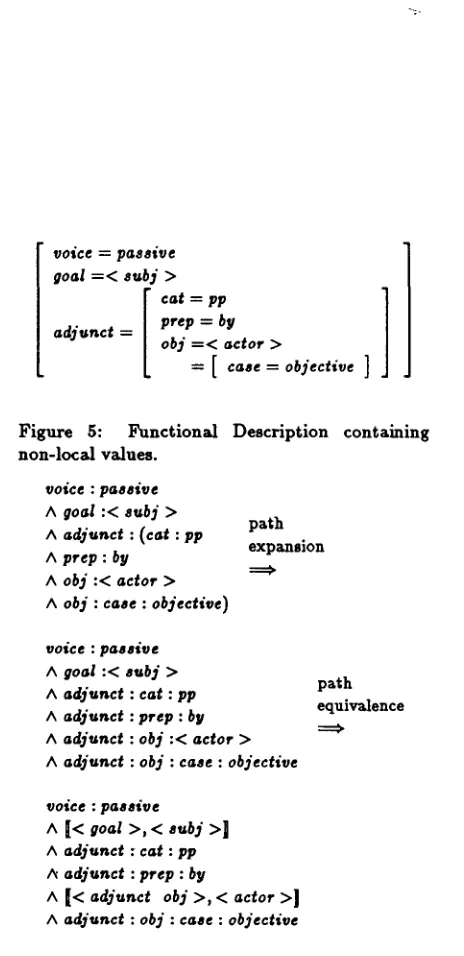
Instead of representing non-local paths directly in the logic, we propose that they can be used within a formula as a shorthand, but that all paths in the formula must be expanded before any other processing of the formula. This p a t h e x p a n s i o n is carried out according to the equiva~ lences 9 and 6.
After p a t h expansion all strings of labels in a formula denote transitions from a common origin, so the expressions containing non-local paths can be converted to the equivalence class notation, using the schema
11 : . . . : I n : < p > = [<11 . . . . ,In > , < p >]. Consider the passive voice alternative of the de- scription of Figure 2, shown here in Figure 5. This description is also represented by the first formula of Figure 6. The formulas to the right in Figure 6 are formed by
1. applying p a t h expansion,
2. converting the attributes containing non- local p a t h values to formulas representing equivalence classes of paths.
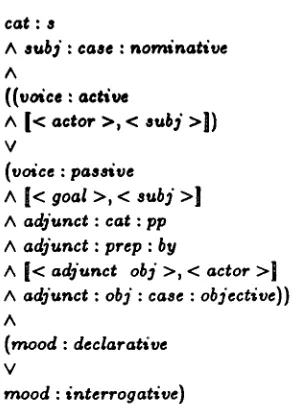
By following this procedure, the entire functional description of Figure 2 can be represented by the logical formula given in Figure 7.
voice = p a s s i v e goal = < s u b j >
cat = pp prep = by a d j e n c t =
obj = < actor >
= [ case----objective ]
Figure 5: Functional non-local values.
voice : p a s s i v e ^ goal :< s u b j > ^ a d j u n c t : (eat : pp ^ prep : by
^ obj :< actor > ^ obj : ease : o b j e c t i v e )
Description containing
path expansion
voice : p a s s i v e ^ goal :< sub3" >
^ a d j u n c t : eat : pp ^ a d j u n c t : prep : by ^ a d j u n c t : obj :< actor >
^ a d j u n c t : obj : ease : o b j e c t i v e
path equivalence ==~
voice : p a s s i v e
^ [< goat >, < s u b j >]
^ a d j u n c t : cat : pp /~ a d j u n c t : prep : by
^ [< a d j u n c t obj >, < actor >]
^ a d j u n c t : obj : case : o b j e c t i v e
[image:7.612.297.529.77.555.2]c a t : s
A s u b j : c a s e : n o m i n a t i v e
A
( ( v d c e :
ac~ve
^ [< acto,. >, < subj >i)
V
(voice :
pas~ve
^
|<
goal
>, < subj>]
A a d j u n c t : c a t : pp A adjunct : p r e p : by
A [ < a d j u n c t obj >, < a c t o r > ]
^ a d j u n c t : o b j : case : o b j e c t i v e ) } ^
( m o o d : d e c l a r a t i v e
V
m o o d : i n t e r r o g a t i v e )
Figure 7: Logical formula representing the de- scription of Figure 2.
It is now possible to unify the description of Figure 7 (call this X in the following discus- sion) with another description, making use of the equivalence classes to simplify t h e result. Con- sider unifTing X with the description
Y = a c t o r : case : n o m i n a t i v e .
The commutative law (10) makes it possible to unify Y with any of the conjuncts of X. If we unify Y with the disjunction which contains the vo/ce attributes, we can use the distributive law (16) to unify Y with both disjuncts. When Y is unified with the term containing
[< a d j u n c t o b j >, < a c t o r >],
the equivalence (22) specifies that we can add the term
a d j u n c t : o b j : case : n o m i n a t i v e .
This term is incompatible with the term
a d j u n c t : o b j : case : o b j e c t i v e ,
and by applying the equivalences (6, 4, 1, and 2) we can transform the entire disjunct to T O P .
Equivalence (8) specifies that this disjunction can be eliminated. Thus, we are able to use the p a t h equivalences during unification to reduce the
number of disjunctions in a formula without ex- panding to DNF.
Note that p a t h expansion does not require an expansion to full DNF, since disjunctions are not multiplied. While the DNF expansion of a for- mula m a y be exponentially larger than the origi- nal, the p a t h expansion is at most quadratically larger. The size of the formula with paths ex- panded is at most n x p, where n is the length of the original formula, and p is the length of the longest path. Since p is generally much less than n the size of the p a t h expansion is usually not a very large quadratic.
5 . 5 V a l u e D i s j u n c t i o n a n d
General Disjunction
The p a t h expansion procedure illustrated in Figure 6 can also be used t o transform formulas containing value disjucntion into formulas con- taining general disjunction. For the reasons given above, value disjunctions which contain non-local p a t h expressions must be converted into general disjunctions for further simplification.
While it is possible to convert value disjunc- tions into general disjunctions, it is not always possible to convert general disjunctions into value disjunctions. For example, the first disjunction in the formula of Figure 7 cannot be converted into a value disjunction. The left side of equiva- lence (9) requires both disjuncts to begin with a common label prefix. The terms of these two disjuncts contain several different prefixes
(voice, actor, s u b j , goat, a n d a d j u n c t ) , so they cannot be combined into a common value.
[image:8.612.123.270.91.293.2]6
I m p l e m e n t a t i o n
T h e calculus described here is currently being implemented as a program which selectively ap-
plies the equivalences of Figure 4 to simplify for-
mulas. A strategy (or algorithm) for simplifying formulas corresponds to choosing a particular or- der in which to apply the equivalences whenever more than one equivalence matches the form of the formula. T h e program will m a k e it possi- ble to test and evaluate different strategies, with the correctness of any such strategy following di- rectly from the correctness of the calculus. While this program is primarily of theoretical interest, it might yield useful improvements to current meth- ods for processing feature structures.
T h e original motivation for developing this treatment of feature structures came from work on an experimental parser based on Nigel [9], a large systemic g r a m m a r of English. The parser is being developed at the USC/Information Sciences Institute by extending the PATR-II system of SRI International. T h e systemic g r a m m a r has been translated into the notation of Functional Uni- fication Grammar, as described in [6]. Because this grammar contains a large number (several hundred) of disjunctions, it has been necessary to extend the unification procedure so that it han- dles disjunctive values containing non-local paths without expansion to DNF. We now think that this implementation of a relatively large grammar can be made more tractable by applying some of the transformations to feature descriptions which have been suggested by the logical calculus.
7 Conclusion
W e have given a precise logical interpreta- tion for feature structures and their descriptions which are used in unification-based g r a m m a r for- malisms. This logic can be used to guide and im- prove implementations of these g r a m m m m , and the processors which use them. It has allowed a closer examination of several sources of com- plexity that are present in these grammars, par- ticularly w h e n they m a k e use of disjunctive de- scriptions. W e have found a set logical equiva- lences helpful in suggesting ways of coping with this complexity.
It should be possible to augment this logic to include characterizations of negation and implica- tion, which we are n o w developing. It m a y also be worthwhile to integrate the logic of feature struc-
tures with other grammatical formalisms based on logic, such as DCG [10] and LFP [13].
References
[1] Ait-Kaci, H. A New Model of Computa- tion Based on a Calculus of Type Subsump-
tion. P h D thesis, University of Pennsylva-
nia, 1984.
[2] Gazdar, G., E. Klein, G.K. Pullum, and I.A. Sag. Generalized Phrase Structure Gram- mar. BlackweU Publishing, Oxford, Eng- land, and Harvard University Press, Cam- bridge, Massachusetts, 1985.
[3] G.R. Kress, editor. Halliday: System and Function in Language. Oxford University Press, London, England, 1976.
[4] Kaplan, R. and J. Bresnan. Lexical Func- tional Grammar: A Formal System for Grammatical Representation. In J. Bresnan, editor, The Mental Representation of Gram- matical Relations. MIT Press, Cambridge, Massachusetts, 1983.
[5] Karttunen, L. Features and Values. In Pro-
ceedings of the Tenth International Confer-
ence on Computational Linguistics, Stanford University, Stanford, California, July 2-7, 1984.
[6] Kasper, R. Systemic Grammar and Func- tional Unification Grammar. In J. Ben- son and W. Greaves, editors, Proceedings of
the I ~ h International Systemics Workshop,
Norwood, New Jersey: Ablex (forthcoming). [7] Kay, M. Functional Grammar. In Pro- ceedings of the Fifth Annual Meeting of the Berkeley Linguistics Society, Berkeley Lin- guistics Society, Berkeley, California, Febru- ary 17-19, 1979.
[8] Kay, M. Parsing in Functional Unification Grammar. In D. Dowty, L. Kartunnen, and A. Zwicky, editors, Natural Language Parsing. Cambridge University Press, Cam- bridge, England, 1985.
[10] Pereira, F. C. N. and D. H. D. Warren. Defi- nite clause grammars for language analysis - a survey of the formalism and a comparison with augmented transition networks. Arh'~-
¢ial Intelligence, 13:231-278, 1980.
[11] Pereira, F. C. N. and S. M. Shieber. The se- mantics of grammar formalisms seen as com- puter languages. In Proceedings of the Tenth International Conference on Computational Linguist,s, Stanford University, Stanford, California, July 2-7, 1984.
[12] Rounds, W. C. and R. Kasper. A Complete Logical Calculus for Record Strucutres Rep- resenting Linguistic Information. Submitted to the ~ymposium on Logic in Computer Sci-
ence, to be held June 16-18, 1986.
[13] Rounds, W. C. LFP: A Logic for Linguis- tic Descriptions and an Analysis of its Com- plexlty. Submitted to Computational Lir,- Cui.~tics.
[14] Shieber, S. M. The design of a computer lan- guage for linguistic information. In Proceed- ing8 o[ t ~ Tenth International Con/erence on Computational Linguistics, Stanford Uni- versity, Stanford, California, July 2-7, 1984. [15] Shieber, S. M. An Introduction to
Uai~ation-bo~ed Approaches to Grammar.