A Logic for S e m a n t i c I n t e r p r e t a t i o n I
Eugene Charniak and Robert G o l d m a n
Department of Computer Science
Brown University,
Box 1910
Providence RI 02912
A b s t r a c t
We propose that logic (enhanced to encode probability information) is a good way of characterizing semantic in- terpretation. In support of this we give a fragment of an axiomatization for word-sense disambiguation, noun- phrase (and verb) reference, and case disambiguation. We describe an inference engine (Frail3) which actually takes this axiomatization and uses it to drive the semantic interpretation process. We claim three benefits from this scheme. First, the interface between semantic interpreta- tion and pragmatics has always been problematic, since all of the above tasks in general require pragmatic infer- ence. Now the interface is trivial, since both semantic interpretation and pragmatics use the same vocabulary and inference engine. The second benefit, related to the first, is that semantic guidance of syntax is a side effect of the interpretation. The third benefit is the elegance of the semantic interpretation theory. A few simple rules capture a remarkable diversity of semantic phenomena.
I . I n t r o d u c t i o n
The use of logic to codify natural language syntax is well known, and many current systems can parse directly off their axiomatizations (e.g.,)[l]. Many of these systems simultaneously construct an intermediate "logical form" using the same machinery. At the other end of language processing, logic is a well-known tool for expressing the pragmatic information needed for plan recognition and speech act recognition [2-4]. In between these extremes logic appears much less. There has been some movement in the direction of placing semantic interpretation on a more logical footing [5,6], but it is nothing like what has happened at the extremes of the ~anguage understanding process.
To some degree this is understandable. These "mid- dle" parts, such as word-sense disambiguation, noun phrase reference, case disambiguation, etc. are notori- ously difficult, and poorly understood, at least compared to things like syntax, and the construction of interme- diate logical form. Much of the reason these areas are
l This work has been s u p p o r t e d in p a r t by the National Science Foundation under grants IST 8416034 and IST 8515005 and Office
~)f Nav~l Research under grant N00014-79-C-0529.
so dark is that they are intimately bound up with prag- matic reasoning. The correct sense of a word depends on context, as does pronoun resolution, etc.
Here we rectify this situation by presenting an ax- iomatization of fragment of semantic interpretation, no- tably including many aspects previously excluded: word- sense disambiguation, noun-phrase reference determina- tion, case determination, and syntactic disambiguation. Furthermore we describe an inference engine, Frail3, which can use the logical formulation to carry out seman- tic interpretation. The description of Frail3 is brief, since the present paper is primarily concerned with semantic interpretation. For a more detailed description, see [7]. The work closest to what we present is that by Hobbs [5]; however, he handles only noun-phrase reference from the above list, and he does not consider intersentential influences at all.
Our system, Wimp2 (which uses Frail3), is quite pretty in *,wo respects. First, it integrates semantic and pragmatic processing into a uniform whole, all done in the logic. Secondly, it provides an elegant and concise way to specify exactly what has to be done by a seman- tic interpreter. As we shall see, a system that is roughly comparable to other state-of-the-art semantic interpreta- tion systems [6,8] can be written down in a pagc or so of logical rules.
Wimp2 has been implemented and works on all of the examples in this paper.
I I . V o c a b u l a r i e s
87
Let us start by giving an informal semantics for the spe- cial predicates and terms used by the system. Since we are doing semantic interpretation, we are translating be- tween a syntactic tree on one hand and the logical, or in- ternal, representation on the other. Thus.we distinguish three vocabularies: one for trees, one for the internal rep- resentation, and one to aid in the translation between the two.
(word-inst word-instance part-ofospeech lexwal-item).
For example, (word-inst case26 noun case). (We use "part of speech" to denote those syntactic categories t h a t are directly above the terminal symbols in the grammars, that is, directly above words.)
The relations between word instances are encoded with two predicates: syn-pos, and syn-pp. Syn-pos
(syn-pos relation head sub-constituent),
indicates t h a t the sub-constituent is the relation of the head. We distinguish between positional relations and those indicated by prepositional phrases, which use the predicate syn-pp, but otherwise look the same. T h e propositions denoting syntactic relations are generated during the parse. T h e parser follows all possible parses in a breadth-first search and outputs propositions on a word-by-word basis. If there is more than one parse and they disagree on the propositional output, a disjunction of the o u t p u t s is a.~ert.ed into the database. T h e corre- spondence between trees and formulas is as follows:
Trees s - - up (vp ... head-v
...)
vp . . . . head-v np ... vp ~ ... head-v npl
np2 ...
vp . . . . head-v ... (pp prep ...) pp ~ prep np
Formulas
(syn-pos subject
head-v
np) head-v symbol is s symbol(syn-pos object
head-v up)
(syn-pos indirect-object
head-v npl)
(syn-pos object
head-v npg)
(syn-pp head-prep
head-v
prep)(-yn-pp prel>-np
preprip)
np - - ... head-n ... head-n symbol is np symbol np - - pronoun pronoun symbol isnp symbol
np - - propernoun propernoun symbol is np symbol
np . . . . adj head-n ... (syn-pos adj
adj
head-n) np . . . . head-n ...(pp prep ...) up t h a t s
s - - np (vp ... copula (pp prep ...)) s
--
np (vp ... copulaadj)
(syn-pp head-prep
head-nprep)
s symbol is np symbol (syn-pp head-prep np prep)
(syn-pos adj
ad3 np)
This is enough to express a wide variety of simple declar- ative sentences. Furthermore, since our current parser implements a transformational account of imperatives, questions (both yes-no and wh), complement construc- tions, and subordinate clauses, these are automatically handled by the above as well. For example, given an ac- count of "Jack wants to borrow the book." as derived from "Jack wants (np t h a t (s Jack borrow the book))." or something similar, then the above rules would produce the following for both (we also indicate after what word the formula is produced):
88
Words Jack wants
to borrow
the book
I"ornnl la.s
(word-inst jackl propernoun
jack)
(word-inst want1 verb want)
(syn-pos subject want1
jackl)
(word-inst borrowl verb borrow)
(syn-pos object want1 borrowl)
(syn-pos subject borrow1 jack1)
(word-inst bookl noun book)
(syn-pos object borrowl bookl)
This is, of course, a fragment, and most things are not handled by this analysis: negation, noun-noun combina- tions, particles, auxiliary verbs, etc.
Now let us consider the internal representation used for inference about the world. Here we use a simple predicate-calculus version of frames, and slots. We as- sume only two predicates for this: == and inst. Inst,
(inst instance frame),
is a two-place predicate on an instance of a frame and the frame itself, where a "frame" is a set of objects, all of which are of the same natural kind. T h u s (inst boyl boy-) asserts that boyl is a member of the set of boys, de- noted by boy-. (Frames are symbols containing hyphens, e.g., supermarket-shoping. Where a single English word is sufficiently descriptive, the hyphen is put at the end.)
T h e other predicate used to describe the world is the % e t t e r name" relation = = :
(---- worse-name better-name).
This is a restricted use of equality. T h e second a r g u m e n t is a "better name" for the first, and thus m a y be freely substituted for it (but not the reverse). Since slots are represented as functions, - - is used to fill slots in frames. To fill the agent slot of a particular action, say borrowl, with a particular person, say jackl, we say
( = = (agent borrow1)jack1).
At an implementation level, - = causes everything known about its first argument (the worse name) to be asserted about the second (the better name). This has the effect. of concentrating all knowledge about all of an
object's
names as facts about the best name.
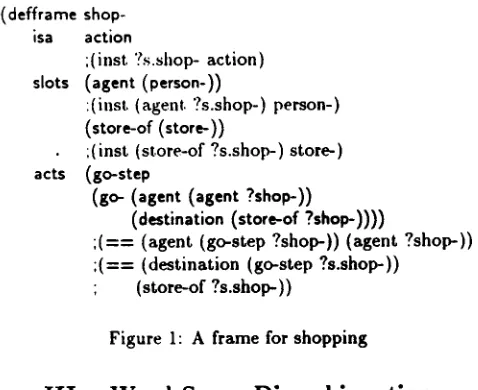
Frail will take as input a simple frame representation and translate it into predicate-calculus form. Figure 1 shows a frame for shopping along with the predicate- calculus translation.
(defframe
isa
slots
acts
shop-
action
;(inst
?s.shop- action)(agent
(person-))
:(inst (agent. ?s.shop-) person-)
(store-of (store-))
;( inst ( store-of ?s.shop-) store-)
(go-step
(go- (agent (agent ?shop-))
(destination (store-of ?shop-))))
; ( = = (agent (go-step ?shop-)) (agent ?shop-))
;(==
(destination (go-step ?s.shop-)); (store-of ?s.shop-))
Figure 1: A frame for shopping
I I I . W o r d - S e n s e D i s a m b i g u a t i o n
We can now write down some s e m a n t i c interpretation rules. Let us assume that all words in English have one or more word senses as their meaning, that these word senses correspond to frames, and that any particular word in- stance has as its meaning exactly one of these senses. We can express this fact for the instances of any particular lexical entry as follows:
(word-inst
inst part-of.speech word) =~
(inst rest
sense1)
V ... V (instinst sense,=)
where
sense1
throughsense,=
are senses of word when it is used as apart.of.speech
(i.e., as a noun, verb, etc.)Not all words in English have meanings in this sense. "The" is an obvious example. Rather than complicate the above rules, we assign such words a "null" mean- ing, which we represent by the term garbage*. Nothing is known about garbage* so this has no consequences. A better axiomatization would also include words which seem to correspond to functions (e.g., age), but we ignore such complications.
A minor problem with the above rule is t h a t it re- quires us to be able to say at the outset (i.e., when we load the program) what all the word senses are, and new senses cannot be added in a modular fashion. To fix this we introduce a new predicate, word-sense:
(word-sense
lez-item part-of-speech frame)
(word-sense straw noun drink-straw)
(word-sense straw noun animal-straw).
This states that
let-item
when used as apart.of.speech
can mean
frame.
We also introduce a pragmatically difl'erent form of disjunction, - - O R :
( ~ O R
formulal formula2).
In terms of implementation, think of this as inferring
formula1
in all possible ways and then asserting the dis- junction of theformula,s
with each set of bindings. So if there are two seLs of bindings, the result will be to assert89
(OR
f ormula2/biltdingsl f ormula2/bindings~ ).
Logically, the meaning of - - O R is that if xl ... x , are unbound variables i,
for'rnulal,
then there nmst exist xl ... z , that makeformulal
andformula2
true.We can now express our rule of word-sense ambiguity
a s :
(word-inst ?instance ?part-of-speech ?lex-item) =:,
(--OR (word-sense ?lex-item ?part-of-speech
?frame)
(inst ?instance
?frame))
I V . T h e I n f e r e n c e E n g i n e
While it seems clear t h a t the above rule expresses a rather simple-minded idea of how words relate to their mean- ings, its computational i m p o r t m a y not be so clear. T h u s we now discuss Wimp2, our language comprehension pro- gram, and its inference engine, Frail3.
Like most rule-based systems, Frail distinguishes for- ward a n d backward-chaining use of modus-ponens. All of our semantic interpretation rules are forward-chaining rules'.
(--- (word-inst ?instance ?part-of-speech ?lex-item)
(--OR (word-sense ?lex-item ?part-of-speech
?frame)
(inst ?instance ?frame)))Thus, whenever a new word instance is asserted, we forward-chain to a statement that the word denotes an instance of one of a set of frames.
Next, Frail uses an A T M S [9,10] to keep track of disjunctions. That is, w h e n we assert ( O R f o r m u l a l
... formula,=) we create n assumptions (following D e K - leer, these are simply integers) and assert each formula into the data-base, each with a label indicating that the formula is not true but only true given some assumptions. Here is an example of h o w some simple disjunctions c o m e out.
A (-- A (OR B C))
(--
B (OR D
El)
Formulas Assumptions
A
B
1
¢
2
D
3
E
4
Labels
(0)
((1))
((2))
((1 3))
((1 4))
[image:3.612.52.291.82.277.2]t A
D
Figure 2: Pictorial representation of d i s j u . c t i o . s
We said "best" ill the last sentence deliberately. When alternatives can be ruled out on logical grounds the corresponding assumptions become nogoods, and conclu- sions from them go away. But it is rare that.
all
of the can- didate interpretations (of words, of referents, etc.) reduce to only one that is logically possible. Rather, there are ilsually several which are logically .co,sistent, but some are more "probable" than others, For this rea.so,, Frail associates probabilities with sets of assumptions ("alter- native worlds") and Wimp eventually "garbage collects" statements which remain low-probability alter,atives be- cause their assumptions are unlikely. Probabilities also guide which interpretation to explore. Exactly how this works is described in [7]. Here we will simply note that the probabilities are designed to capture the following intuitions:1. Uncommon vs. common word-senses {marked vs. unmarked) are indicated by probabilities input by the system designer and stored in the lexicon.
2. Wimp prefers to find referents for entities (rather than not finding referents).
3. Possible reasons for actions and entities are preferred the more specific they are to. the action or entity. (E.g., "shopping" is given a higher probability than "meeting someone" as an explanation for going to the supermarket.)
4. Formulas derived in two differents ways are more probable than they would have been if derived in either way alone.
5. Disjunctions which lead to already considered "'worlds" are preferred over those which do not hook up in this way. (We will illustrate this later.}
V . C a s e D i s a r n b i g u a t i o n
Cases are indicated by positional relations (e.g., subject) and prepositional phrases. We make the simplifying as- sumption that prepositional phrases only indicate case relations. As we did for word-sense disambiguation, we introduce a new predicate that allows us to incrementally specify how a particular head (a noun or verb) relates to its syntactic roles. The new predicate,
(case
head syntactic-relation slot),
90
states that
head
can have itsslol
filled by things which stand itlsyntacttc.lvlation
to it. For example0nst
?g go-) =~
(case
?g
subject agent).
This Call also be expressed in Frail using the typed vari- ables
(case
?g.go-
subject agent).
This says that any instance of a go- can use the subject position to indicate the agent of the go- event. These facts can be inherited in the typical way via the isa hierarchy, so this fact would more generally be expressed as
(case ?a.action- subject agent),
Using case and the previously introduced - - O R connec- tive, we can express the rule of case relations. Formally, it says that for all syntactic positional relations and all meanings of the head, there must exist a case relation which is the significance of that syntactic position:
(syn-pos ?tel ?head ?val) A (inst ?head ?frame)
=~
('--*OR (case ?hea~l ?tel ?slot)
(==
(?slot ?hesd) ?val)))
So, we might have(syn-pos
subject gol
jackl) A (inst gol go-)h (case gol subject agent)
::~ ( ' - - -
(agent gol)jackl).
A similar rule holds for case relations indicated by prepositional phrases.
(syn-pp head-prep ?head ?pinst)
A (syn-pp prep-np ?pinst ?np)
A (word-inst ?pinst prep ?prep) A (inst ?head ?frame)
=~ (--"OR (case ?head ?prep ?slot)
(=---
(7slot ?head) ?np))
For example, "Jack went to the supermarket." would give us
(syn-pp head-prep gol tol) A (case gol to
destination)
A (syn-pp prep-np to1 supermarket1)
A (word-inst tol prep to) A (;nst gol go-)
=~ ( = =
(destination go1) supermarketl).
We now have enough machinery to describe two ways in which word senses and case relations can help disam- biguate each other. First consider the sentence
Jack went to the supermarket.
Wimp currently knows two meanings of "go," to travel and to die. After "Jack went" Wimp prefers travel (based upon probability rule 1 and the probabilities assigned to these two readings in the lexicon) but both are possible. After "Jack went to" the die reading goes away. This is because the only formulas satisfying
(case gol to ?slot)
all require gol to be a travel rather than a die. Thus "die" cannot be a reading since it makes
(~OR (case ?head ?prep ?slot)
[image:4.612.56.268.75.185.2]false (a disjunction of zero disjuncts is
false).
We also have enough machinery to see how "'selec- tional restrictions" work in Wimp2. Consider the sen- tence
Jack fell at the store.
and suppose t h a t W i m p knows two case relatious for "'at," Ioc and time. This will initially lead to the following disjunction:
((1))
.(== (Ioc fell1) store1)
(syn-pp head-prep
fell1at1)<((2) )
(==
(time fell1) store1). However, W i m p will know t h a t(inst (time ?a.aetion) time-).
As we mentioned earlier, = = statements cause everything known about the first argument to be asserted about the second. T h u s W i m p will try to believe that store1 is a time, so (2) becomes a nogood and (1) becomes just
tmte.
It is i m p o r t a n t to note that both of these disam- biguation methods fall o u t from the basics of the system. Nothing had to be added.
V L
Reference and E x p l a n a t i o n
Definite noun phrases (rip's) typically refer to something already mentioned. Occasionally they do not, however, and some, like proper names may or may not refer to an already mentioned entity. Let us simplify by saying t h a t all rip's may or m a y not refer to something already mentioned. (We will return to indefinite np's later.) We represent np's by always creating a new instance which represents the entity denoted by the np. Should there be a referent we assert equality between the newly minted object and the previously mentioned one. Thus, in "Jack went to the supermarket. He found some milk on the shelf.", the recognition t h a t "He" refers to Jack would be indicated by
( = =
he24
jack3).(Remember t h a t = = is a best name relation, so this says t h a t jack3 is a better name for the new instance we cre- ated to represent the "he," he24.)
As for representing the basic rule of reference, the idea is to see the call for a referent, as a statement t h a t something exists. Thus we might try to say
(inst
?x ?frame)
=~ (Exists
(y \ ?frame) (== ?x ?y)).
This is intended to say, if we are told of an object of type ?frame then there must exist an earlier one y of this same type to which the new one can be set equal.T h e trouble with this formula is t h a t it does not say "earlier one." Exists simply says t h a t there has to be one, whether or not it was mentioned. Furthermore, since we intend to represent an np like "the taxi" by (inst taxi27
91
taxi-) and then look for an earlier taxi. the Exists would be trivially satisfied by taxi27 itself.
Our solution is to introduce a new quantifier called "previously exists" or PExists. (In [5] a similar end is achieved by putting weights on formula and looking for a minimum-weight proof.) Using this new quantifier, we h a y e
(inst
?x ?frame)
=~ (PExists
(y \ ?frame) (== ?x ?y)).
If there is more than one a disjunction of equality state- ments is created. For example, consider the storyJack went to the supermarket. He found the milk on the shelf. He paid for it.
T h e "it" in the last sentence could refer to any of the three inanimate objects mentioned, so initially the following disjunction is created:
(==
it8 shelf(}) (inst it8 i n a n i m a t e - ) ~ - ( = = it8 milk5)• " \ ( = = it8 supermarket2).
This still does not allow for the case when there is no referent for the np. To understand our solution to this problem it is necessary to note that we originally set out to create a plan-recognition system. T h a t is to say, we wanted a program which given a sentence like "Jack got a rope. He wanted to kill himself." would recognize t h a t Jack plans to hang himself. We discuss this aspect of W i m p 2 in greater detail in [7]. Here we simply note t h a t plans in Wimp2 are represented as frames (as shown in Figure 1.) and t h a t sub tasks of plans are actions which fill certain slots of the frame. So the shop- plan has a go-step in Figure 1. and recognizing the import of "Jack went to the supermarket." would be to infer t h a t ( = = (go-step shop-74) go61) where go61 represented the verb in "Jack went to the supermarket." We generalize this slightly and say that all inputs must be "explained"; by this we mean that we must find (or postulate) a frame in which the input fills a slot. Thus the go-step state- ment explains go61. T h e presence of a supermarket in the story would be explained by (== (store-of shop-74) super- market64). T h e rule t h a t everything mentioned must be explained looks like this:
(inst?x ?frame) ::~
(---,OR (roJe-inst ?x ?slot ?superfrm)
creating a new instance. The impact of this will be seen i, a moment.
We said that all inputs must be explained, and that we explain by seeing that the entity fills a slot in a pos- tulated frame. There is one exception to this. if a newly mentioned entity refers to an already extant one, then there is no need to explain it, since it was presumably explained the first time it was seen. Thus we combine our rule of reference with our rule of explanation. Or, to put it. slightly differently, we handle the exceptions to the rule of reference (some things do not refer to entities al- ready present) by saying that those which do not so refer must be explained instead. This gives the following rule:
(inst ?x ?frame) A (not
(=
?frame garbage*)) :=~
(OR (PExists (y \ ?frame) (== ?x ?y)) .9
(--,OR (role-inst ?x ?superfrm ?slot)
(Exists (s \ ?superfrm)
(== ( slot ?s)
Here we added the restriction that the frame in question cannot be the garbage* frame, which has no properties by definition. We have also added probabilities to the dis- junctions that are intended to capture the preference for previously existing objects (probability rule 2). The rule of reference has several nice properties. First, it might seem odd that our rule for explaining things is expressed in terms of the Exists quantifier, which we said always cre- ates a new instance. W h a t about a case like "Jack went to the supermarket. He found the milk on the shelf." where we want to explain the second line in terms of the shopping plan created in the first? As we have things set up, it simply creates a new shopping plan. But note what then occurs. First the system asserts (inst new-shopping5 shopping-). This activates the above rule, which must ei- ther find a referent for it, or try to explain it in terms of a frame for which it fills a role. In this case there is a referent, namely the shopping created in the course of the first line. Thus we get ( = = new-shopping5 shopping4) and we have the desired outcome. This example also shows that the reference rule works on event reference, not just np reference.
This rule handles reference to "related objects" rather well. Consider "Jack wanted to play the stereo. He pushed the on-off button." Here "the on-off button" is to be understood as the button "related" to the stereo mentioned in the first line. In Wimp this falls out from the rules already described. Upon seeing "the on-off but- ton" Wimp creates a new entity which must then either have a referent or an explanation. It does not have the first, but one good explanation for the presence of an on- off button is that it fills the on-off-switch slot for some power-machine. Thus Wimp creates a machine and the machine then has to be explained. In this case a referent is found, the stereo from the first sentence.
92
V I I . P r a g m a t i c I n f l u e n c e
We iinish with three examples illustrating how our se- mantic interpretation process easily integrates pragmatic influences: one example of pronoun reference, one of word-sense disambiguatiom and one of syntactic ambi- guity. First pronoml reference:
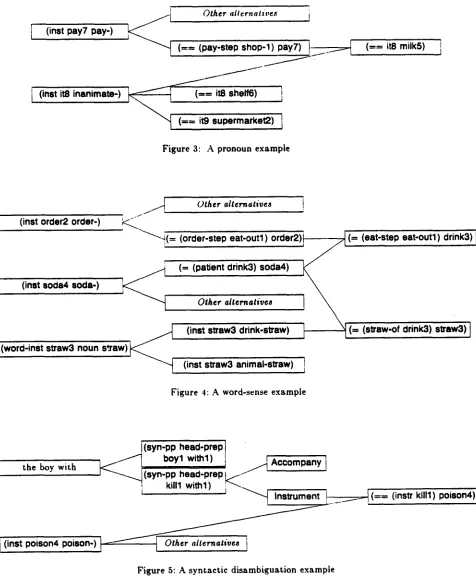
Jack went to the supermarket. He found the milk on the shelf. He paid for it.
In this example the "milk" of sentence two is seen as the
purchased
ofshop-1 and the "pay" of sentence three is
postulated to be the pay-step of a shopping event, and then further postulated to be the same shopping event as that created earlier. (In each case other possibilities will be considered, but their probabilities will be much lower.) Thus when "it" is seen Wimp is in the situation shown in Figure 3. The important thing here is that the statement ( = = it7 milk5) can be derived in two different ways, and thus its probability is much'higher than the other possible refereuts for "'it" (probability rule 4). (One derivation has it that since one pays for what one is shopping for, and Jack is shopping for milk, he mdst be paying for the milk. The other derivation is that "it" must refer to something, and tile milk is one alternative.)The second example is one of word-sense disam- biguation:
Jack ordered a soda. He picked up the straw.
Here sentence one is seens as the order-step of a newly postulated eaboutl. The soda suggests a drinking event, which in turn can be explained as the eat-step of
cab
outl. The straw in line two can be one of two kinds of straw, but the drink-straw interpretation suggests (via a role-inst statement) a straw-drinking event. This is postu- lated, and Wimp looks for a previous such event (using the normal reference rule) and finds the one suggested by the soda. Wimp prefers to assume that the drink- ing event suggested by "soda" and that from "straw" are the same event (probability rule 2) and this preference is passed back to become a preference for the drink-straw meaning of "straw" (by probability rule 5). The result is shown in Figure 4.Our third and last example shows how semantic guidance of syntax works:
Janet wanted to kill the boy with some poison.
! O t h e r allernative,9
(inst pay7 pay-) ~
1== (pay-step shop-l) ~ : . . . / {
(inst it8 inanimate-)
l ~ ~
(== it8 shelf6)
(== it9 supermarket2)
Figure 3: -k pronoun example
(== it8 milk5)
]
i ~
~
Other alternatives
i
(inst
orcler2 orcler-)
:~-~(=~" (orcler-step eat-outl) orcler2)
(= (eat-step eat-outl) clrink3) I
<
(= (patient clrink3) socla4)
Y
(inst soda4
soda-)
Other alternatives
I
(word-inst straw3 noun s ~ ' a w ) ~
(inst
~straw3~animal-straw)~ J]]
~ (= (straw-of clrink3) Straw3) I
Figure 4: A word-sense example
L
the boy with
I
l(syn-pp head-prep I
boy1 with1) ~ . . ~
Accompany
(syn-pp head-prep
killl withl) I " ~
Instrument ... ~ _ [(== (instr killl) poison4) I
(inst poison4 poison-) ~
e
s
J
Figure 5: A syntactic disambiguation example
[image:7.612.67.543.85.673.2]higher probability is passed back to the disjuncts repre- senting a) t, he choice of
instrument
overaccompanyment,
and b) the choice of attaching to ~kill" over "boy" (prob- ability rule 5). This last has the effect of telling the parser where to attach the pp.VIII. Future Research
This work can be extended in many ways: increased syn- tactic coverage, more realistic semantic rules, improved search techniques for possible explanations, etc. Here we will simply look at some fairly straightforward extensions to the model.
Our rule preferring finding a referent to not finding a referent is not reasonable for indefinite np's. Thus Wimp currently misinterprets
3ack bought a gun. Mary bought a gun.
since it wants to interpret the second gun as coreferen- tial with the first. A simple change would be to have two rules of reference/explanation. The rule for indefi- nite np's would look like this:
(inst ?x ?frame) A (not ( = ?frame garbage*))
A (syn-pos indef-det ?x ?det)
=~ (OR (PExists (y \ ?frame) (== ?x ?y)) .1
(--*OR (role-inst ?x ?superfrm ?slot)
(Exists (s \ ?superfrm)
(== (?s=ot ?s) ?x))) .9)
This looks just like our earlier rule, except a check for an indefinite determiner is added, and the probabilities are reversed so as to prefer a new object over an already existing one. The earlier reference rule would then be modified to make sure that the object did not have an indefinite determiner.Another aspect of language which fits rather nicely into this framework is metonymy. We have already noted that the work closest to ours is [5], and in fact we can adopt the analysis presented there without a wrinkle. This analysis assumes that every np corresponds to two objects in the story, the one mentioned and the one in- tended. For example:
I read Proust over summer vacation.
The two objects are the entity literally described by the np (here the person " P r o u s t ' ) and that intended by the speaker (here a set of books by Proust). The syntactic analysis would be modified to produce the two objects, here proustl and read-objl respectively~
(syn-pos direct-object read1 read-objl)
(word-inst proustl propernoun proust)
(syn-pos metonymy
rea6-objl proustl)
It is then assumed that there are a finite number of relations that may hold between these two entities, most notably equality, but others as well. The rule relating the two entities would look like this:
( - ,
(syn-pos metonymy ?intended ?given)
(OR ( = - ?intended ?given)
.9
(---
(creator-of ?intended) ?given) .02)
...)).
This rule would prefer assuming that the two individuals are the same, but would allow other possibilities.
I X . C o n c l u s i o n "
We have presented logical rules for a fragment of the semantic interpretation (and plan recognition) process. The four simple rules we gave already capture a wide variety of semantic and pragmatic phenomena. We are currently working on diverse aspects of semantics, such as definite vs. indefinite np's, noun-noun combinations, adjectives, non-case uses of prepositions, metonymy and relative clauses.
P ~ t ~ e r e n c e s
[1] F. Pereira & D. Warren, "Definite clause grammar for language analysis - a survey of the formalism and a comparison with augmented transition networks,"
Artificial Intelligence
13 (1980), 231-278.[2] Philip K. Cohen ~ C. Raymond Perrault, "Elements of a plan-based theory of speech acts,"
Cognitive Sci-
ence
3 (1979),
177-212.[3] Eugene Charniak, "A neat theory of marker passing,"
AAAI-86 (1986).
[4] Henry Kautz & James Allen, "Generalized plan recog- nition,"
AAAI-86
(1986).[5] Jerry R. Hobbs & Paul Martin, "Local pragmatics,"
ljcai-87 (1987).
[6] Graeme Hirst,
Semantic Interpretation and the Res-
olution of Ambiguity,
Cambridge University Press, Cambridge, 1987.[7] Robert Goldman & Eugene Charniak, "A probabilis- tic ATMS for plan recognition," forthcomming. [8] Barbara J. Grosz, Douglas E. Appelt, Paul A. Mar-
tin ~ Fernando C.N. Pereira, "Team: an experiment in the design of transportable natural-language inter- faces,"
Artificial Intelligence
32 (1987), 173-243. [9] Drew V. McDermott, "Contexts and data depen-dencies: a synthesis,"
IEEE Transactions on Pattern
AnaJysis and
MachineIntelligence
PAMI-5 (1983). [10] Johan deKleer, "An assumption-based TMS,"Artifi-
cial Intelligence
28 (1986), 127-162.