Proceedings of the 49th Annual Meeting of the Association for Computational Linguistics:shortpapers, pages 514–518,
Typed Graph Models for Semi-Supervised Learning of Name Ethnicity
Delip Rao
Dept. of Computer Science Johns Hopkins University
David Yarowsky
Dept. of Computer Science Johns Hopkins University
Abstract
This paper presents an original approach to semi-supervised learning of personal name ethnicity from typed graphs of morphophone-mic features and first/last-name co-occurrence statistics. We frame this as a general solu-tion to an inference problem over typed graphs where the edges represent labeled relations be-tween features that are parameterized by the edge types. We propose a framework for parameter estimation on different construc-tions of typed graphs for this problem us-ing a gradient-free optimization method based on grid search. Results on both in-domain and out-of-domain data show significant gains over 30% accuracy improvement using the techniques presented in the paper.
1 Introduction
In the highly relational world of NLP, graphs are a natural way to represent relations and constraints among entities of interest. Even problems that are not obviously graph based can be effectively and productively encoded as a graph. Such an encoding will often be comprised of nodes, edges that repre-sent the relation, and weights on the edges that could be a metric or a probability-based value, and type information for the nodes and edges. Typed graphs are a frequently-used formalism in natural language problems including dependency parsing (McDonald et al., 2005), entity disambiguation (Minkov and Co-hen, 2007), and social networks to just mention a few.
In this paper, we consider the problem of iden-tifying a personal attribute such as ethnicity from
only an observed first-name/last-name pair. This has important consequences in targeted advertising and personalization in social networks, and in gathering intelligence for business and government research. We propose a parametrized typed graph framework for this problem and perform the hidden attribute in-ference using random walks on typed graphs. We also propose a novel application of a gradient-free optimization technique based on grid search for pa-rameter estimation in typed graphs. Although, we describe this in the context of person-attribute learn-ing, the techniques are general enough to be applied to various typed graph based problems.
2 Data for Person-Ethnicity Learning
Name ethnicity detection is a particularly challeng-ing (and practical) problem in Nigeria given that it has more than 250 ethnicities1 with minor vari-ations. We constructed a dictionary of Nigerian names and their associated ethnicity by crawling baby name sites and other Nigerian diaspora web-sites (e.g. onlinenigeria.com) to compile a name dic-tionary of 1980 names with their ethnicity. We re-tained the top 4 ethnicities – Yoruba, Igbo, Efik Ibibio, and Benin Edo2. In addition we also crawled Facebook to identify Nigerians from different com-munities. There are more details to this dataset that
1
https://www.cia.gov/library/publications/the-world-factbook/geos/ni.html
2
Although the Hausa-Fulani is a populous community from the north of Nigeria, we did not include it as our dictionary had very few Hausa-Fulani names. Further, Hausa-Fulani names are predominantly Arabic or Arabic derivatives and stand out from the rest of the ethnic groups, making their detection easier.
will be made available with the data itself for future research.
3 Random Walks on Typed Graphs
Consider a graphG = (V, E), with edge setE de-fined on the vertices in V. A typed graph is one where every vertex v in V has an associated type
tv ∈ TV. Analogously, we also use edge types TE ⊆ TV × TV. Some examples of typed edges and vertices used in this paper are shown in Table 1. These will be elaborated further in Section 4.
Vertices POSITIONAL BIGRAM, BIGRAM, TRIGRAM, FIRST NAME, LAST NAME, . . . Edges POSITION (POSITIONAL BIGRAM→BIGRAM),
32BACKOFF (TRIGRAM→BIGRAM),
CONCURRENCE (FIRST NAME→LAST NAME), . . .
Table 1: Example types for vertices and edges in the graph for name morpho-phonemics
With every edge typete∈ TE we associate a
real-valued parameterθ ∈ [0,1]. Thus our graph is pa-rameterized by a set of parameters Θ with |Θ| = |TE|. We will need to learn these parameters from
the training data; more on this in Section 5. We re-lax the estimation problem by forcing the graph to be undirected. This effectively reduces the number of parameters by half.
We now have a weighted graph with a weight matrix W(Θ). The probability transition matrix P(Θ) for the random walk is derived by noting P(Θ) =D(Θ)−1W(Θ)whereD(Θ)is the diagonal weighted-degree matrix, i.e,dii(Θ) =Pjwij(Θ).
From this point on, we rely on standard label-propagation based semi-supervised classification techniques (Zhu et al., 2003; Baluja et al., 2008; Talukdar et al., 2008) that work by spreading proba-bility mass across the edges in the graph. While tra-ditional label propagation methods proceed by con-structing graphs using some kernel or arbitrary sim-ilarity measures, our method estimates the appro-priate weight matrix from training data using grid search.
4 Graph construction
Our graphs have two kinds of nodes – nodes we want to classify – called target nodes and feature nodes
which correspond to different feature types. Some of the target nodes can optionally have label infor-mation, these are called seed nodes and are excluded from evaluation. Every feature instance has its own node and an edge exists between a target node and a feature node if the target node instantiates the fea-ture. Features are not independent. For example the trigram aba also indicates the presence of the bi-grams ab and ba. We encode this relationship between features by adding typed edges. For in-stance, in the previous case, a typed edge (32BACK-OFF) is added between the trigram aba and the bi-gram ab representing the backoff relation. In the absence of these edges between features, our graph would have been bipartite. We experimented with three kinds of graphs for this task:
First name/Last name (FN LN) graph
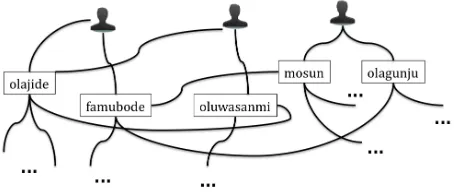
[image:2.612.314.541.454.550.2]As a first attempt, we only considered first and last names as features generated by a name. The name we wish to classify is treated as a target node. There are two typed relations 1) between the first and last name, called CONCURRENCE, where the first and last names occur together and 2) Where an edge, SHARED NAME, exists between two first (last) names if they share a last (first) name. Hence there are only two parameters to estimate here.
Figure 1: A part of the First name/Last name graph: Edges indicate co-occurrence or a shared name.
Character Ngram graph
Figure 2: A part of the character n-gram graph: Ob-serve how the suffix osun contributes to the inference ofadeosunas a Yoruba name even though it was never seen in training. The different colors on the edges rep-resent edge types whose weights are estimated from the data.
bigrams to 5-grams and all orders in-between. We further distinguish n-grams that appear in the begin-ning (corresponding to prefixes), middle, and end (corresponding to suffixes). Thus the last name,
mosun in the graph is connected to the follow-ing positional trigrams mos-BEG, osu-MID,
sun-END besides positional n-grams of other or-ders. The positional trigram mos-BEG connected to the position-independent trigram mos using the typed edge POSITION. Further, the trigram mos
is connected to the bigrams mo and os using a 32BACKOFF edge. The resulting graph has four typed relations – 32BACKOFF, 43BACKOFF, 45BACKOFF, and POSITION – and four corre-sponding parameters to be estimated.
Combined graph
Finally, we consider the union of the character n-gram graph and the FirstName-LastName graph. Ta-ble 2 lists some summary statistics for the various graphs.
#Vertices #Edges Avg. degree FN LN 22.8K 137.2K 3.6 CHAR. NGRAM 282.6K 1.2M 8.7 COMBINED 282.6K 1.3M 9.2
Table 2: Graphs for person name ethnicity classification
5 Grid Search for Parameter Estimation
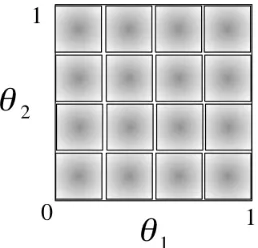
The typed graph we constructed in the previous sec-tion has as many parameters as the number of edge types, i.e,|Θ|=|TE|. We further constrain the val-ues taken by the parameters to be in the range[0,1]. Note that there is no loss of representation in doing so, as arbitrary real-valued weights on edges can be normalized to the range[0,1]. Our objective is to find a set of values forΘthat maximizes the classi-fication accuracy. Towards that effect, we quantize the range [0,1] into k equally sized bins and con-vert this to a discrete-valued optimization problem. While this is an approximation, our experience finds that relative values of the variousθi ∈ Θare more
[image:3.612.363.492.317.441.2]important than the absolute values for label propa-gation.
Figure 3: Grid search on a unit 2-simplex withk= 4.
The complexity of this search procedure isO(kn)
for k bins and n parameters. For problems with small number of parameters, like ours (n = 4 or
[image:3.612.85.285.656.695.2]coarse grained search first using a small k on the range [0,1]and use that result to shrink the search range. Perform grid search again on this smaller range. We simply search exhaustively given the na-ture of our problem.
6 Experiments & Results
We evaluated our three different model variants un-der two settings: 1) When only a weak prior from the dictionary data is present; we call this ‘out-of-domain’ since we don’t use any labels from Face-book and 2) when both the dictionary prior and some labels from the Facebook data is present; we call this ‘in-domain’. The results are reported using 10-fold cross-validation. In addition to the proposed typed graph models, we show results from a smoothed-Na¨ıve Bayes implementation and two standard base-lines 1) where labels are assigned uniformly at ran-dom (UNIFORM) and 2) where labels are assigned according the empirical prior distribution (PRIOR).
The baseline accuracies are shown in Table 3.
Out-of-domain In-domain UNIFORM 25.0 25.0
PRIOR 42.6 42.6
[image:4.612.340.512.219.301.2]Na¨ıve Bayes 75.1 77.2
Table 3: Ethnicity-classification accuracy from baseline classifiers.
We performed similar in-domain and out-of-domain experiments for each of the graph models proposed in Section 4 and list the results in Table 4,
withoutusing grid search.
Out-of-domain In-domain
FN LN 57.6 60.2
CHAR. NGRAM 73.2 76.8 %gain overFN LN 27% 27.6%
COMBINED 77.1 78.7
[image:4.612.107.264.375.415.2]%gain over CHAR. NGRAM 5.3% 2.5%
Table 4: Ethnicity-classification accuracy without grid search
Some points to note about the results reported in Table 4: 1) These results were obtained without us-ing parameters from the grid search based optimiza-tion. 2) The character n-gram graph model performs better than the first-name/last-name graph model by itself, as expected due to the smoothing induced by
the backoff edge types. 3) The combination of first-name/last-name graph and the n-gram improves ac-curacy by over 30%.
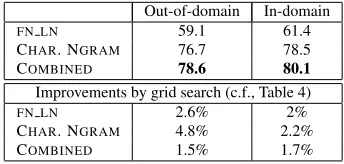
Table 5 reports results from using parameters es-timated using grid search. The parameter estimation was done on a development set that was not used in the 10-fold cross-validation results reported in the table. Observe that the parameters estimated via grid search always improved performance of label prop-agation.
Out-of-domain In-domain
FN LN 59.1 61.4
CHAR. NGRAM 76.7 78.5 COMBINED 78.6 80.1
Improvements by grid search (c.f., Table 4)
FN LN 2.6% 2%
CHAR. NGRAM 4.8% 2.2% COMBINED 1.5% 1.7%
Table 5: Ethnicity-classification accuracy with grid search
7 Conclusions
We considered the problem of learning a person’s ethnicity from his/her name as an inference prob-lem over typed graphs, where the edges represent la-beled relations between features that are parameter-ized by the edge types. We developed a framework for parameter estimation on different constructions of typed graphs for this problem using a gradient-free optimization method based on grid search. We also proposed alternatives to scale up grid search for large problem instances. Our results show a sig-nificant performance improvement over the baseline and this performance is further improved by param-eter estimation resulting over 30% improvement in accuracy using the conjunction of techniques pro-posed for the task.
References
Shumeet Baluja, Rohan Seth, D. Sivakumar, Yushi Jing, Jay Yagnik, Shankar Kumar, Deepak Ravichandran, and Mohamed Aly. 2008. Video suggestion and dis-covery for youtube: taking random walks through the view graph. InProceeding of the 17th international conference on World Wide Web.
[image:4.612.79.290.531.593.2]so-cial networks. In Proceedings of the International Conference in Weblogs and Social Media (ICWSM). Ryan McDonald, Fernando Pereira, Kiril Ribarov, and
Jan Hajiˇc. 2005. Non-projective dependency pars-ing uspars-ing spannpars-ing tree algorithms. InProceedings of the conference on Human Language Technology and Empirical Methods in Natural Language Processing. Association for Computational Linguistics.
Einat Minkov and William Cohen. 2007. Learning to rank typed graph walks: local and global approaches. InProceedings of the 9th WebKDD and 1st SNA-KDD 2007 workshop on Web mining and social network analysis, New York, NY, USA. ACM.
Partha Pratim Talukdar, Joseph Reisinger, Marius Pas¸ca, Deepak Ravichandran, Rahul Bhagat, and Fernando Pereira. 2008. Weakly-supervised acquisition of la-beled class instances using graph random walks. In
Proceedings of the Conference on Empirical Meth-ods in Natural Language Processing. Association for Computational Linguistics.