A Best-First Probabilistic Shift-Reduce Parser
Kenji Sagae and Alon Lavie Language Technologies Institute
Carnegie Mellon University Pittsburgh, PA 15213
{sagae,alavie}@cs.cmu.edu
Abstract
Recently proposed deterministic classifier-based parsers (Nivre and Scholz, 2004; Sagae and Lavie, 2005; Yamada and Mat-sumoto, 2003) offer attractive alternatives to generative statistical parsers. Determin-istic parsers are fast, efficient, and sim-ple to imsim-plement, but generally less ac-curate than optimal (or nearly optimal) statistical parsers. We present a statis-tical shift-reduce parser that bridges the gap between deterministic and probabilis-tic parsers. The parsing model is essen-tially the same as one previously used for deterministic parsing, but the parser performs a best-first search instead of a greedy search. Using the standard sec-tions of the WSJ corpus of the Penn Tree-bank for training and testing, our parser has 88.1% precision and 87.8% recall (us-ing automatically assigned part-of-speech tags). Perhaps more interestingly, the pars-ing model is significantly different from the generative models used by other well-known accurate parsers, allowing for a simple combination that produces preci-sion and recall of 90.9% and 90.7%, re-spectively.
1 Introduction
Over the past decade, researchers have devel-oped several constituent parsers trained on an-notated data that achieve high levels of accu-racy. Some of the more popular and more ac-curate of these approaches to data-driven parsing (Charniak, 2000; Collins, 1997; Klein and Man-ning, 2002) have been based on generative
mod-els that are closely related to probabilistic context-free grammars. Recently, classifier-based depen-dency parsing (Nivre and Scholz, 2004; Yamada and Matsumoto, 2003) has showed that determin-istic parsers are capable of high levels of accu-racy, despite great simplicity. This work has led to the development of deterministic parsers for con-stituent structures as well (Sagae and Lavie, 2005; Tsuruoka and Tsujii, 2005). However, evaluations on the widely used WSJ corpus of the Penn Tree-bank (Marcus et al., 1993) show that the accuracy of these parsers still lags behind the state-of-the-art.
A reasonable and commonly held assumption is that the accuracy of deterministic classifier-based parsers can be improved if determinism is aban-doned in favor of a search over a larger space of possible parses. While this assumption was shown to be true for the parser of Tsuruoka and Tsu-jii (2005), only a moderate improvement resulted from the addition of a non-greedy search strategy, and overall parser accuracy was still well below that of state-of-the-art statistical parsers.
We present a statistical parser that is based on a shift-reduce algorithm, like the parsers of Sagae and Lavie (2005) and Nivre and Scholz (2004), but performs a best-first search instead of pursuing a single analysis path in deterministic fashion. The parser retains much of the simplicity of determin-istic classifier-based parsers, but achieves results that are closer in accuracy to state-of-the-art statis-tical parsers. Furthermore, a simple combination of the shift-reduce parsing model with an existing generative parsing model produces results with ac-curacy that surpasses any that of any single (non-reranked) parser tested on the WSJ Penn Tree-bank, and comes close to the best results obtained with discriminative reranking (Charniak and
son, 2005).
2 Parser Description
Our parser uses an extended version of the basic bottom-up shift-reduce algorithm for constituent structures used in Sagae and Lavie’s (2005) terministic parser. For clarity, we will first de-scribe the deterministic version of the algorithm, and then show how it can be extended into a proba-bilistic algorithm that performs a best-first search.
2.1 A Shift-Reduce Algorithm for Deterministic Constituent Parsing
In its deterministic form, our parsing algorithm is the same single-pass shift-reduce algorithm as the one used in the classifer-based parser of Sagae and Lavie (2005). That algorithm, in turn, is sim-ilar to the dependency parsing algorithm of Nivre and Scholz (2004), but it builds a constituent tree and a dependency tree simultaneously. The al-gorithm considers only trees with unary and bi-nary productions. Training the parser with arbi-trary branching trees is accomplished by a sim-ple procedure to transform those trees into trees with at most binary productions. This is done by converting each production with n children, where n > 2, into n − 1 binary productions. This binarization process is similar to the one de-scribed in (Charniak et al., 1998). Additional non-terminal nodes introduced in this conversion must be clearly marked. Transforming the parser’s out-put into arbitrary branching trees is accomplished using the reverse process.
The deterministic parsing algorithm involves two main data structures: a stack S, and a queue W. Items in S may be terminal nodes (part-of-speech-tagged words), or (lexicalized) subtrees of the final parse tree for the input string. Items inW are terminals (words tagged with parts-of-speech) corresponding to the input string. When parsing begins,S is empty andW is initialized by insert-ing every word from the input strinsert-ing in order, so that the first word is in front of the queue.
The algorithm defines two types of parser ac-tions, shift and reduce, explained below:
• Shift: A shift action consists only of remov-ing (shiftremov-ing) the first item (part-of-speech-tagged word) from W (at which point the next word becomes the new first item), and placing it on top ofS.
• Reduce: Reduce actions are subdivided into unary and binary cases. In a unary reduction, the item on top of S is popped, and a new item is pushed ontoS. The new item consists of a tree formed by a non-terminal node with the popped item as its single child. The lex-ical head of the new item is the same as the lexical head of the popped item. In a binary reduction, two items are popped from S in sequence, and a new item is pushed ontoS. The new item consists of a tree formed by a non-terminal node with two children: the first item popped fromSis the right child, and the second item is the left child. The lexical head of the new item may be the lexical head of its left child, or the lexical head of its right child.
IfS is empty, only a shift action is allowed. If W is empty, only a reduce action is allowed. If both S andW are non-empty, either shift or re-duce actions are possible, and the parser must de-cide whether to shift or reduce. If it dede-cides to re-duce, it must also choose between a unary-reduce or a binary-reduce, what non-terminal should be at the root of the newly created subtree to be pushed onto the stackS, and whether the lexical head of the newly created subtree will be taken from the right child or the left child of its root node. Fol-lowing the work of Sagae and Lavie, we consider the complete set of decisions associated with a re-duce action to be part of that rere-duce action. Pars-ing terminates whenW is empty and S contains only one item, and the single item inSis the parse tree for the input string.
2.2 Shift-Reduce Best-First Parsing
A deterministic shift-reduce parser based on the algorithm described in section 2.1 does not handle ambiguity. By choosing a single parser action at each opportunity, the input string is parsed deter-ministically, and a single constituent structure is built during the parsing process from beginning to end (no other structures are even considered).
simply as the product of the probabilities of each action in the path that resulted in that parse tree (the derivation of the tree). This produces a prob-abilistic shift-reduce parser that resembles a gen-eralized probabilistic LR parser (Briscoe and Car-roll, 1993), where probabilities are associated with an LR parsing table. In our case, although there is no LR table, the action probabilities are associ-ated with several aspects of the current state of the parser, which to some extent parallel the informa-tion contained in an LR table. Instead of having an explicit LR table and pushing LR states onto the stack, the state of the parser is implicitly de-fined by the configurations of the stack and queue. In a way, there is a parallel between how mod-ern PCFG-like parsers use markov grammars as a distribution that is used to determine the proba-bility of any possible grammar rules, and the way a statistical model is used in our parser to assign a probability to any transition of parser states (in-stead of a symbolic LR table).
Pursuing every possible sequence of parser ac-tions creates a very large space of acac-tions for even moderately sized sentences. To find the most likely parse tree efficiently according to the prob-abilistic shift-reduce parsing scheme described so far, we use a best-first strategy. This involves an extension of the deterministic shift-reduce algo-rithm into a best-first shift-reduce algoalgo-rithm. To describe this extension, we first introduce a new data structure Ti that represents a parser state,
which includes a stack Si and a queue Wi. In
the deterministic algorithm, we would have a sin-gle parser state T that contains S and W. The best-first algorithm, on the other hand, has a heap H containing multiple parser states T1 ... Tn.
These states are ordered in the heap according to their probabilities, so that the state with the highest probability is at the top. State probabilities are de-termined by multiplying the probabilities of each of the actions that resulted in that state. Parser ac-tions are determined from and applied to a parser state Ti popped from the top of H. The parser
actions are the same as in the deterministic ver-sion of the algorithm. When the item popped from the top of the heap H contains a stack Si with a
single item and an empty queue (in other words, meets the acceptance criteria for the determinis-tic version of the algorithm), the item on top of Si is the tree with the highest probability. At that
point, parsing terminates if we are searching for
the most probable parse. To obtain a list ofn-best parses, we simply continue parsing once the first parse tree is found, until eitherntrees are found, orHis empty.
We note that this approach does not use dy-namic programming, and relies only on the best-first search strategy to arrive at the most prob-able parse efficiently. Without any pruning of the search space, the distribution of probability mass among different possible actions for a parse state has a large impact on the behavior of the search. We do not use any normalization to ac-count for the size (in number of actions) of dif-ferent derivations when calculating their probabili-ties, so it may seem that shorter derivations usually have higher probabilities than longer ones, causing the best-first search to approximate a breadth-first search in practice. However, this is not the case if for a given parser state only a few actions (or, ide-ally, only one action) have high probability, and all other actions have very small probabilities. In this case, only likely derivations would reach the top of the heap, resulting in the desired search behavior. The accuracy of deterministic parsers suggest that this may in fact be the types of probabilities a clas-sifier would produce given features that describe the parser state, and thus the context of the parser action, specifically enough. The experiments de-scribed in section 4 support this assumption.
2.3 Classifier-Based Best-First Parsing
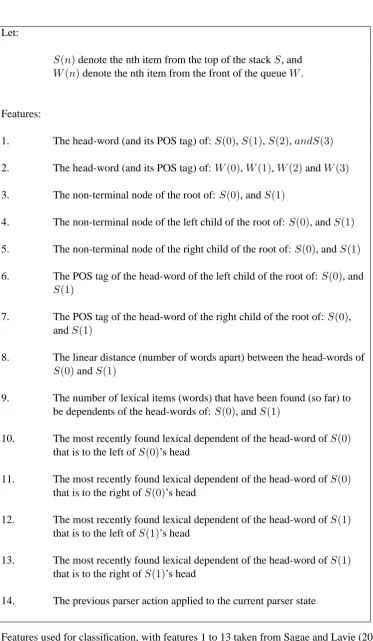
To build a parser based on the deterministic al-gorithm described in section 2.1, a classifier is used to determine parser actions. Sagae and Lavie (2005) built two deterministic parsers this way, one using support vector machines, and one using k-nearest neighbors. In each case, the set of fea-tures and classes used with each classifier was the same. Items 1 – 13 in figure 1 shows the features used by Sagae and Lavie. The classes produced by the classifier encode every aspect of a parser action. Classes have one of the following forms:
SHIFT : represents a shift action;
REDUCE-UNARY-XX : represents a unary
re-duce action, where the root of the new sub-tree pushed ontoS is of type XX (where XX is a non-terminal symbol, typicallyN P,V P, P P, for example);
REDUCE-LEFT-XX : represents a binary
sub-tree pushed onto S is of non-terminal type
XX. Additionally, the head of the new subtree
is the same as the head of the left child of the root node;
REDUCE-RIGHT-XX : represents a binary
re-duce action, where the root of the new sub-tree pushed onto S is of non-terminal type
XX. Additionally, the head of the new
sub-tree is the same as the head of the right child of the root node.
To implement a parser based on the best-first al-gorithm, instead of just using a classifier to de-termine one parser action given a stack and a queue, we need a classification approach that pro-vides us with probabilities for different parser ac-tions associated with a given parser state. One such approach is maximum entropy classification (Berger et al., 1996), which we use in the form of a library implemented by Tsuruoka1 and used in his classifier-based parser (Tsuruoka and Tsujii, 2005). We used the same classes and the same fea-tures as Sagae and Lavie, and an additional feature that represents the previous parser action applied the current parser state (figure 1).
3 Related Work
As mentioned in section 2, our parsing approach can be seen as an extension of the approach of Sagae and Lavie (2005). Sagae and Lavie eval-uated their deterministic classifier-based parsing framework using two classifiers: support vector machines (SVM) and k-nearest neighbors (kNN). Although the kNN-based parser performed poorly, the SVM-based parser achieved about 86% preci-sion and recall (or 87.5% using gold-standard POS tags) on the WSJ test section of the Penn Tree-bank, taking only 11 minutes to parse the test set. Sagae and Lavie’s parsing algorithm is similar to the one used by Nivre and Scholz (2004) for de-terministic dependency parsing (using kNN). Ya-mada and Matsumoto (2003) have also presented a deterministic classifier-based (SVM-based) de-pendency parser, but using a different parsing al-gorithm, and using only unlabeled dependencies.
Tsuruoka and Tsujii (2005) developed a classifier-based parser that uses the chunk-parsing algorithm and achieves extremely high parsing speed, but somewhat low recall. The algorithm
1The SS MaxEnt library is publicly available from
http://www-tsujii.is.s.u-tokyo.ac.jp/ tsuruoka/maxent/.
is based on reframing the parsing task as several sequential chunking tasks.
Finally, our parser is in many ways similar to the parser of Ratnaparkhi (1997). Ratnaparkhi’s parser uses maximum-entropy models to deter-mine the actions of a parser based to some extent on the shift-reduce framework, and it is also capa-ble of pursuing several paths and returning the top-nhighest scoring parses for a sentence. However, in addition to using different features for parsing, Ratnaparkhi’s parser uses a different, more com-plex algorithm. The use of a more involved algo-rithm allows Ratnaparkhi’s parser to work with ar-bitrary branching trees without the need of the bi-narization transform employed here. It breaks the usual reduce actions into smaller pieces (CHECK and BUILD), and uses two separate passes (not including the part-of-speech tagging pass) for de-termining chunks and higher syntactic structures separately. Instead of keeping a stack, the parser makes multiple passes over the input string, like the dependency parsing algorithm used by Ya-mada and Matsumoto. Our parser, on the other hand, uses a simpler stack-based shift-reduce (LR-like) algorithm for trees with only unary and bi-nary productions.
4 Experiments
Let:
S(n)denote the nth item from the top of the stackS, and W(n)denote the nth item from the front of the queueW.
Features:
1. The head-word (and its POS tag) of:S(0),S(1),S(2),andS(3)
2. The head-word (and its POS tag) of:W(0),W(1),W(2)andW(3)
3. The non-terminal node of the root of:S(0), andS(1)
4. The non-terminal node of the left child of the root of:S(0), andS(1)
5. The non-terminal node of the right child of the root of:S(0), andS(1)
6. The POS tag of the head-word of the left child of the root of:S(0), and S(1)
7. The POS tag of the head-word of the right child of the root of:S(0), andS(1)
8. The linear distance (number of words apart) between the head-words of S(0)andS(1)
9. The number of lexical items (words) that have been found (so far) to be dependents of the head-words of:S(0), andS(1)
10. The most recently found lexical dependent of the head-word ofS(0)
that is to the left ofS(0)’s head
11. The most recently found lexical dependent of the head-word ofS(0)
that is to the right ofS(0)’s head
12. The most recently found lexical dependent of the head-word ofS(1)
that is to the left ofS(1)’s head
13. The most recently found lexical dependent of the head-word ofS(1)
that is to the right ofS(1)’s head
[image:5.595.114.488.55.697.2]14. The previous parser action applied to the current parser state
algorithm is simply run over all sentences in the training set, and since the correct trees are known in advance, we can simply record the features and correct parser actions that lead to the construction of the correct tree.
Training the maximum entropy classifier with such a large number (1.9 million) of training in-stances and features required more memory than was available (the maximum training set size we were able to train with 2GB of RAM was about 200,000 instances), so we employed the training set splitting idea used by Yamada and Matsumoto (2003) and Sagae and Lavie (2005). In our case, we split the training data according to the part-of-speech (POS) tag of the head-word of the item on top of the stack, and trained each split of the training data separately. At run-time, every trained classifier is loaded, and the choice of classifier to use is made by looking at the head-word of the item on top of the stack in the current parser state. The total training time (a single machine was used and each classifier was trained in se-ries) was slightly under nine hours. For compar-ison, Sagae and Lavie (2005) report that train-ing support vector machines for one-against-all multi-class classification on the same set of fea-tures for their deterministic parser took 62 hours, and training a k-nearest neighbors classifier took 11 minutes.
When given perfectly tagged text (gold part-of-speech tags extracted from the Penn Treebank), our parser has labeled constituent precision and re-call of 89.40% and 88.79% respectively over all sentences in the test set, and 90.01% and 89.32% over sentences with length of at most 40 words. These results are at the same level of accuracy as those obtained with other state-of-the-art statisti-cal parsers, although still well below the best pub-lished results for this test set (Bod, 2003; Char-niak and Johnson, 2005). Although the parser is quite accurate, parsing the test set took 41 minutes. By implementing a very simple pruning strategy, the parser can be made much faster. Pruning the search space is done by only adding a new parser state to the heap if its probability is greater than
1/b of the probability of the most likely state in the heap that has had the same number of parser actions. By settingbto 50, the parser’s accuracy is only affected minimally, and we obtain 89.3% precision and 88.7% recall, while parsing the test set in slightly under 17 minutes and taking less
than 60 megabytes of RAM. Under the same con-ditions, but using automatically assigned part-of-speech tags (at 97.1% accuracy) using the SVM-Tool tagger (Gimenez and Marquez, 2004), we obtain 88.1% precision and 87.8% recall. It is likely that the deterioration in accuracy is aggra-vated by the training set splitting scheme based on POS tags.
A deterministic version of our parser, obtained by simply taking the most likely parser action as the only action at each step (in other words, by set-tingbto 1), has precision and recall of 85.4% and 84.8%, respectively (86.5% and 86.0% using gold-standard POS tags). More interestingly, it parses all 2,416 sentences (more than 50,000 words) in only 46 seconds, 10 times faster than the deter-ministic SVM parser of Sagae and Lavie (2005). The parser of Tsuruoka and Tsujii (Tsuruoka and Tsujii, 2005) has comparable speed, but we obtain more accurate results. In addition to being fast, our deterministic parser is also lean, requiring only about 25 megabytes of RAM.
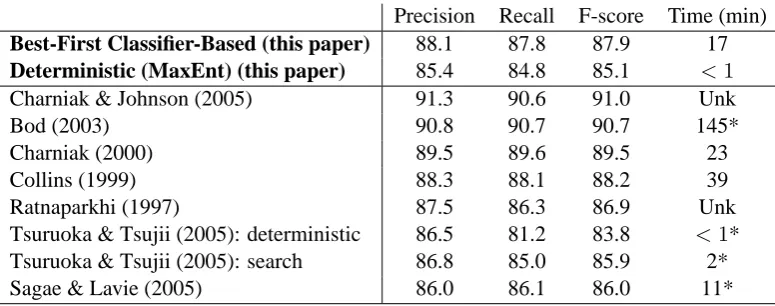
A summary of these results is shown in table 1, along with the results obtained with other parsers for comparison purposes. The figures shown in table 1 only include experiments using automat-ically assigned POS tags. Results obtained with gold-standard POS tags are not shown, since they serve little purpose in a comparison with existing parsers. Although the time figures reflect the per-formance of each parser at the stated level of ac-curacy, all of the search-based parsers can trade accuracy for increased speed. For example, the Charniak parser can be made twice as fast at the cost of a 0.5% decrease in precision/recall, or ten times as fast at the cost of a 4% decrease in preci-sion/recall (Roark and Charniak, 2002).
4.1 Reranking with the Probabililstic Shift-Reduce Model
Precision Recall F-score Time (min)
Best-First Classifier-Based (this paper) 88.1 87.8 87.9 17
Deterministic (MaxEnt) (this paper) 85.4 84.8 85.1 <1
Charniak & Johnson (2005) 91.3 90.6 91.0 Unk
Bod (2003) 90.8 90.7 90.7 145*
Charniak (2000) 89.5 89.6 89.5 23
Collins (1999) 88.3 88.1 88.2 39
Ratnaparkhi (1997) 87.5 86.3 86.9 Unk
Tsuruoka & Tsujii (2005): deterministic 86.5 81.2 83.8 <1* Tsuruoka & Tsujii (2005): search 86.8 85.0 85.9 2*
[image:7.595.103.491.61.214.2]Sagae & Lavie (2005) 86.0 86.1 86.0 11*
Table 1: Summary of results on labeled precision and recall of constituents, and time required to parse the test set. We first show results for the parsers described here, then for four of the most accurate or most widely known parsers, for the Ratnaparkhi maximum entropy parser, and finally for three recent classifier-based parsers. For the purposes of direct comparisons, only results obtained with automatically assigned speech tags are shown (tags are assigned by the parser itself or by a separate part-of-speech tagger). * Times reported by authors running on different hardware.
derivations (not the constituents themselves) based on the sequence of parser shift/reduce actions. PCFG-like models, on the other hand, assign prob-abilities to the trees directly. With models that dif-fer in such fundamental ways, it is possible that the probabilities assigned to different trees are in-dependent enough that even a very simple combi-nation of the two models may result in increased accuracy.
We tested this hypothesis by using the Char-niak (2000) parser inn-best mode, producing the top 10 trees with corresponding probabilities. We then rescored the trees produced by the Charniak parser using our probabilistic LR model, and sim-ply multiplied the probabilities assigned by the Charniak model and our LR model to get a com-bined score for each tree2. On development data this resulted in a 1.3% absolute improvement in f-score over the 1-best trees produced by the Char-niak parser. On the test set (WSJ Penn Treebank section 23), this reranking scheme produces preci-sion of 90.9% and recall of 90.7%, for an f-score of 90.8%.
2
The trees produced by the Charniak parser may include the part-of-speech tags AUX and AUXG, which are not part of the original Penn Treebank tagset. See (Charniak, 2000) for details. These are converted deterministically into the ap-propriate Penn Treebank verb tags, possibly introducing a small number of minor POS tagging errors. Gold-standard tags or the output of a separate part-of-speech tagger are not used at any point in rescoring the trees.
5 Conclusion
We have presented a best-first classifier-based parser that achieves high levels of precision and recall, with fast parsing times and low memory re-quirements. One way to view the parser is as an extension of recent work on classifier-based deter-ministic parsing. It retains the modularity between parsing algorithms and learning mechanisms asso-ciated with deterministic parsers, making it simple to understand, implement, and experiment with. Another way to view the parser is as a variant of probabilistic GLR parsers without an explicit LR table.
Finally, we have shown that by multiplying the probabilities assigned by our maximum entropy shift-reduce model to the probabilities of the 10-best trees produced for each sentence by the Char-niak parser, we can rescore the trees to obtain more accurate results than those produced by ei-ther model in isolation. This simple combination of the two models produces an f-score of 90.8% for the standard WSJ test set.
Acknowledgements
We thank John Carroll for insightful discussions at various stages of this work, and the reviewers for their detailed comments. This work was supported in part by the National Science Foundation under grant IIS-0414630.
References
A. Berger, S. A. Della Pietra, and V. J. Della Pietra. 1996. A maximum entropy approach to natural language processing. Computational Linguistics,
22(1):39–71.
D. Bikel. 2002. Design of a multi-lingual, parallel-processing statistical parsing engine. In
Proceed-ings of HLT2002. San Diego, CA.
R. Bod. 2003. An efficient implementation of a new dop model. In Proceedings of the European chapter
of the 2003 meeting of the Association for Computa-tional Linguistics. Budapest, Hungary.
E. Briscoe and J. Carroll. 1993. Generalised proba-bilistic lr parsing of natural language (corpora) with unification-based grammars. Computational Lin-guistics, 19(1):25–59.
Eugene Charniak and Mark Johnson. 2005. Coarse-to-fine n-best parsing and maxent discriminative reranking. In Proceedings of the 43rd meeting of
the Association for Computational Linguistics. Ann
Arbor, MI.
Eugene Charniak, Sharon Goldwater, and Mark John-son. 1998. Edge-based best-first chart parsing. In
Proceedings of the Sixth Workshop on Very Large Corpora. Montreal, Canada.
Eugene Charniak. 2000. A
maximum-entropy-inspired parser. In Proceedings of the First
Meet-ing of the North American Chapter of the Associa-tion for ComputaAssocia-tional Linguistics, pages 132–139.
Seattle, WA.
Michael Collins. 1997. Three generative, lexicalized models for statistical parsing. In Proceedings of the
35th Annual Meeting of the Association for Compu-tational Linguistics, pages 16–23.
M. Collins. 1999. Head-Driven Models for Natural
Language Parsing. Phd thesis, University of
Penn-sylvania.
J. Gimenez and L. Marquez. 2004. Svmtool: A gen-eral pos tagger generator based on support vector machines. In Proceedings of the 4th International
Conference on Language Resources and Evaluation.
Lisbon, Portugal.
Dan Klein and Christopher D. Manning. 2002. Fast exact inference with a factored model for natural language parsing. In Advances in Neural
Informa-tion Processing Systems 15 (NIPS 2002). Vancouver,
BC.
D. E. Knuth. 1965. On the translation of lan-guages from left to right. Information and Control, 8(6):607–639.
M. P. Marcus, B. Santorini, and M. A. Marcinkiewics. 1993. Building a large annotated corpus of english: The penn treebank. Computational Linguistics, 19.
Joakim Nivre and Mario Scholz. 2004. Deterministic dependency parsing of english text. In Proceedings
of the 20th International Conference on Computa-tional Linguistics, pages 64–70. Geneva,
Switzer-land.
Adwait Ratnaparkhi. 1997. A linear observed time sta-tistical parser based on maximum entropy models. In Proceedings of the Second Conference on
Empir-ical Methods in Natural Language Processing.
Prov-idence, RI.
B. Roark and E. Charniak. 2002. Measuring effi-ciency in high-accuracy, broad coverage statistical parsing. In Proceedings of the Efficiency in
Large-scale Parsing Systems Workshop at COLING-2000.
Luxembourg.
Kenji Sagae and Alon Lavie. 2005. A classifier-based parser with linear run-time complexity. In
Proceed-ings of the Ninth International Workshop on Parsing Technologies. Vancouver, BC.
Masaru Tomita. 1987. An efficient augmented context-free parsing algorithm. Computational
Lin-guistics, 13:31–46.
Masaru Tomita. 1990. The generalized lr
parser/compiler - version 8.4. In Proceedings of
the International Conference on Computational Lin-guistics (COLING’90), pages 59–63. Helsinki,
Fin-land.
Y. Tsuruoka and K. Tsujii. 2005. Chunk parsing revisited. In Proceedings of the Ninth
Interna-tional Workshop on Parsing Technologies.
Vancou-ver, Canada.
H. Yamada and Yuji Matsumoto. 2003. Statistical de-pendency analysis using support vector machines. In Proceedings of the Eighth International