Focus to Emphasize Tone Structures for Prosodic Analysis in Spoken
Language Generation
Lalita Narupiyakul
Faculty of Computer Science, Dalhousie University 6050 University Avenue, Halifax, Nova Scotia, Canada B3H 1W5
Tel. +1-902-494-6441, Fax. +1-902-494-3962
Abstract
We analyze the concept of focus in speech and the relationship between focus and speech acts for prosodic generation. We determine how the speaker’s utterances are influenced by speaker’s intention. The re-lationship between speech acts and focus information is used to define which parts of the sentence serve as the focus parts. We propose the Focus to Emphasize Tones (FET) structure to analyze the focus com-ponents. We also design the FET grammar to analyze the intonation patterns and pro-duce tone marks as a result of our anal-ysis. We present a proof-of-the-concept working example to validate our proposal. More comprehensive evaluations are part of our current work.
1 Introduction
A speaker’s utterance may convey different mean-ing to a hearer. Such ambiguities can be resolved by emphasizing accents in different positions. Fo-cus information is needed to select correct posi-tions for accent information. To determine fo-cus information, a speaker’s intentions must be revealed. We apply speech act theory to written sentences, our input, to determine a speaker’s in-tention. Subsequently our system will produce a speaker utterance, the result of analysis.
Several research publications, such as (Steed-man and Prevost, 1994) and (Klein, 2000), ex-plore prosodic analysis for spoken language gen-eration (SLG). Klein (2000) designs constraints for prosodic structures in the HPSG framework. His approach is based on an isomorphism of
syntactic and prosodic trees. This approach
is heavily syntax-driven and involves making prosodic trees by manipulation of the syntactic trees. This approach results in increased complex-ity since the type hierarchy of phrases must cross-classify prosodic phrases under syntactic phrases. Haji-Abdolhosseini (2003) extended Klein’s ap-proach. Rather than referring to syntax, Haji-Abdolhosseini sets the information domain to in-teract between the syntactic-semantic domain and the prosodic domain. His work reduces the com-plexity of type hierarchies and constraints which are not related to the syntactic structure. He de-signs the information structure and defines con-straints for the HPSG framework. However his work limits the number of tone selections because he only defines two tone marks: rise-fall-rise and fall to annotate a sentence.
Our work is inspired by Haji-Abdolhosseini’s
work. We design the focus structure for
spo-ken language generation. Based on the focus the-ory (Von Heusinger, 1999), the focus part identi-fies what part of the sentence can be marked with the strong accent or emphasized by a high tone. By analyzing speech acts, we can understand how speech with prosody can convey distinct speaker intentions to a hearer. In the next section, we present an overview of our FET (Focus to Empha-size Tone) system and its processes. We will ex-plain how to analyze focus information, design the FET structure, and find the relationships of focus with speech acts to prosodic marks in section 3. We implement our FET grammar for the Linguis-tic Knowledge Base (LKB) system (Copestake, 2002), generate a set of focus words, explain the FET environment, and show an example in sec-tion 4. In the last secsec-tion, we conclude the current state of our work and the future work.
2 Overview of FET System for Prosodic Analysis in SLG
Our system generates the prosodic structure
de-pending on the focus analysis. We use this
prosodic structure to modify synthetic speech for SLG. Our FET structure is constrained by the speaker’s intention. To define prosody, we ex-plore the relationships of focus and speech acts from various sentence types. The diagram of our FET system is shown in figure 1 and we present an overview of the FET system based on the LKB system below.
Input: “Kim bought a flower”
LKB system with ERG
MRS representation of “Kim bought a flower”
Transforming MRS to Focus words
Focus Words
LKB with FET Analysis
FET structure with prosodic marks
Extracting the tone marks
Speech Synthesis &
Prosodic
Modification Modified Synthetic Speech of “Kim bought a flower” - Scan the MRS representation - Keep any relations of each components - Transform Structure
- Create a set focus words for a sentence
Words + Tone Marks
Step 1
Step 2
Focus Words
Step 3
Step 4
I. Prepocessing
II. FET System
III. Postprocessing
FET structure with prosodic
marks
FET Envoronment
[image:2.595.74.290.241.445.2]- FET typed hierarchy - FET structure - FET constraints - FET rules The relationship of focus with speech acts to prosody
Figure 1: A diagram of the FET system
Our input is a sentence and its focus criterion obtained from a user. In figure 1, the example sen-tence is “Kim bought a flower” and the focus cri-terion is G (see table 2). Our system is composed of four main steps.
The first step is preprocessing. The LKB
system with the English Resource Grammar (ERG) (Copestake, 2002) parses a sentence. The LKB system analyzes the syntactic and semantic structures and generates the Minimal Recursive Semantic (MRS) (Copestake et al., 1995) repre-sentation. This step occurs before invoking the FET system.
In the second step, we scan the MRS struc-ture and collect any components and their relations among them obtained from the preprocessing step. We select only required information, such as sen-tence mood, from the MRS representation, assign a speech act code referring to a main verb of a sen-tence, and obtain from the MRS structure a set of focus words. These focus words are an input for the focus information analysis in the FET system.
The third step is the FET analysis. This step generates the prosodic components inside the FET structure. Using our FET grammar, we input the focus words into the LKB system with the FET en-vironment. This environment consists of the FET type hierarchy, constraints, rules, and structures including the focus and prosodic features. Since the LKB system with FET environment can an-alyze the focus relations corresponding to speech acts and sentence moods, the system completes the FET structure by generating a set of appropriate prosodic structures containing prosodic marks as a result.
The last step is the postprocessing process. We extract words and their prosodic marks as Tone and Break Index (ToBI) representations (Silver-man et al., 1992) from the FET structure. The tracting system processes the FET structure, ex-tracts only our required prosodic fields. These fields are a set of words and their tone marks for a sentence. We use the set of words with tone marks to modify synthetic speech, which is generated by speech synthesis. We use the PRAAT (Boersma and Weenink, 2005) to modify the prosody of the synthetic speech for a sentence. Our output is an audio file of the sentence with modified prosody. Modifying prosody follows the tone marks which are analyzed by the FET system.
3 FET Analysis
3.1 FET Constraints
[image:3.595.317.520.332.651.2]Our FET analysis uses a constraint-based ap-proach. We find what part (actor, act, actee or their combinations) must be in the focus from the the MRS structure. If the focus is marked at a position in a sentence then the speaker wants the hearer to recognize the content at that position in the sentence. For example, the speaker utters the sentence “Kim bought a flower” by emphasizing at the different positions in the sentence as shown table 1. Then we transform the MRS structures to our FET content structure which is represented by a set of focus words. This structure contains “ac-tor” (a person or a thing that acts something in a sentence), “act” (an activity in that sentence), and “actee” (the response of the activity) parts.
Table 1: The different focuses in the sentence
Focus Speaker wants to focus at . . .
[a] [KIM]F bought a flower. (Who bought a flower?)
[b] Kim bought[a FLOWER]F. (What did Kim buy?)
[c] Kim[BOUGHT a flower]F. (What did Kim do?)
Considering a focus part, our focus model will
acknowledge two focus types: w-focus, and
s-focus. Thew-focusrepresents wide focus, which
[image:3.595.73.291.529.624.2]covers a phrase or a word. Thes-focusrepresents single focus, which is placed on a word in the sen-tence. We assign the actor and actee parts as single or wide focus while the act part is only ans-focus. Normally, the focus does not cover only the act part. If the focus covers the act part, then the focus must cover at least one of the related parts (actor or actee). Therefore, we set the focus types fol-lowing all situations that occur and call the focus criteria. Eight focus criteria are shown in table 2.
Table 2: The focus parts and the focus types
No. Focus Parts Focus Types
A actor+act+actee {
w-focus(actor),s-focus(act),w-focus(actee)}or undefined
B actor+act {w-focus(actor),s-focus(act)}
C actor+actee {w-focus(actor),s-focus(actee)}
or{w-focus(actee),s-focus(actor)}
D actor w-focus(actor) or s-focus(actor)
E act+actee {s-focus(act),w-focus(actee)}
F act s-focus(act)
G actee w-focus(actee) or s-focus(actee)
H undefined
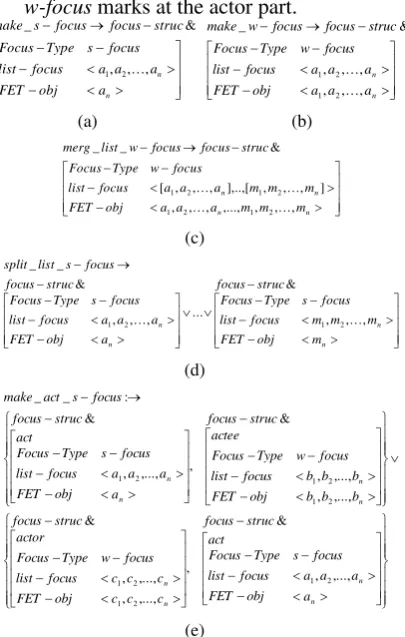
We define constraints to select the focus types following the different situations. We categorize the conditions for focus types to five cases. These conditions cover all possible situations. These sit-uations define the focus based on the focus parts for most simple sentences. We illustrate the at-tribute value matrix (AVM) structure to represent these situations in figure 2.
(a) An s-focus of the actor or actee parts. The
last node in the list of objects is defined as
the focus position to emphasize tone (FET-obj), see figure 2(a).
(b) A w-focus at the actor or actee parts.The list
of objects is the FET-obj in the sentence as shown in figure 2(b).
(c) A w-focus at actor or actee parts
contain-ing the multiple lists of objects. The lists are
merged together to be theFET-obj as shown in figure 2(c).
(d) An s-focus at actor or actee parts containing
the multiple lists of objects. If the focus type
is ans-focus and there are msets of lists of objects (multiple lists of objects), then these lists of objects can be split into thes-focusof each list of objects, see figure 2(d).
(e) A focus on the act part.Two cases of defining
the focus types are shown in figure 2(e). The first case, thes-focusmarks the act part while
thew-focusmarks the actee part. The second
case, thes-focus marks the act part and the
w-focusmarks at the actor part.
⎥ ⎥ ⎥ ⎦ ⎤ ⎢ ⎢ ⎢ ⎣ ⎡ > < − > < − − − − → − n n a obj FET a a a focus list focus s Type Focus struc focus focus s make , , , & _ 2 1 K (a) ⎥ ⎥ ⎥ ⎦ ⎤ ⎢ ⎢ ⎢ ⎣ ⎡ > < − > < − − − − → − n n a a a obj FET a a a focus list focus w Type Focus struc focus focus w make , , , , , , & _ 2 1 2 1 K K (b) ⎥ ⎥ ⎥ ⎦ ⎤ ⎢ ⎢ ⎢ ⎣ ⎡ > < − > < − − − − → − n n n n m m m a a a obj FET m m m a a a focus list focus w Type Focus struc focus focus w list merg , , , ,..., , , , ] , , , [ ],.., , , , [ & _ _ 2 1 2 1 2 1 2 1 K K K K (c) ⎥ ⎥ ⎥ ⎦ ⎤ ⎢ ⎢ ⎢ ⎣ ⎡ > < − > < − − − − ∨ ∨ ⎥ ⎥ ⎥ ⎦ ⎤ ⎢ ⎢ ⎢ ⎣ ⎡ > < − > < − − − − → − n n n n m obj FET m m m focus list focus s Type Focus struc focus a obj FET a a a focus list focus s Type Focus struc focus focus s list split , , , & ... , , , & _ _ 2 1 2
1 K K
(d) ⎪ ⎪ ⎪ ⎭ ⎪⎪ ⎪ ⎬ ⎫ ⎪ ⎪ ⎪ ⎩ ⎪⎪ ⎪ ⎨ ⎧ ⎥ ⎥ ⎥ ⎥ ⎦ ⎤ ⎢ ⎢ ⎢ ⎢ ⎣ ⎡ > < > < − − − − ⎥ ⎥ ⎥ ⎥ ⎦ ⎤ ⎢ ⎢ ⎢ ⎢ ⎣ ⎡ > < − > < − − − − − ∨ ⎪ ⎪ ⎪ ⎭ ⎪⎪ ⎪ ⎬ ⎫ ⎪ ⎪ ⎪ ⎩ ⎪⎪ ⎪ ⎨ ⎧ ⎥ ⎥ ⎥ ⎥ ⎦ ⎤ ⎢ ⎢ ⎢ ⎢ ⎣ ⎡ > < − > < − − − ⎥ ⎥ ⎥ ⎥ ⎦ ⎤ ⎢ ⎢ ⎢ ⎢ ⎣ ⎡ > < > < − − − − − − → − n n n n n n n n a a a a focus s obj FET focus list Type Focus act c c c obj FET c c c focus list focus w Type Focus actor struc focus struc focus b b b obj FET b b b focus list focus w Type Focus actee a a a a focus s obj FET focus list Type Focus act struc focus struc focus focus s act make ,..., , , ,..., , ,..., , & & ,..., , ,..., , , ,..., , & & : _ _ 2 1 2 1 2 1 2 1 2 1 2 1 (e)
Figure 2: The AVM structure of focus marking: For actor or actee part, (a)s-focus(b)w-focus(c)
w-focusof the multiple lists (d)s-focusof the
mul-tiple lists and, (e)s-focusfor act part
3.2 The Relationships of Focus with Speech
Acts to Prosody
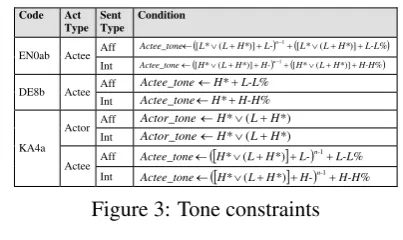
these codes, we consider the main verb (known as the act part inside the FET content structure). These codes define what the speech act cate-gories can be in each sentence. A sentence can be marked by more than one code according to speech act classification (Ballmer and Brennen-stuhl, 1981). We mark the speech act codes for 62 sentences from a part of the CMU communicator dataset (2002). Considering the relationships be-tween speech acts and focus parts, we found some common patterns for marking tones in a sentence. For example, the tone mark L-L%, analyzed as low phrase tone (L-) to low boundary tone (L%), is marked at the last word of a sentence for any affir-mative sentence. The tone marks H- (high phrase tone) and L- are marked at the last word before conjunction (such as “and”, “or”, “but”, and so on) or are marked at the last word of the current phrase (following the next phrase). We know that the tone mark H* (high accent tone) is used to em-phasize a word or a group of words in a sentence. If we want strong emphasis at a word or a group of words then we use the tone mark L+H* (rising accent tone) instead of H*. The groups of speech acts, that we consider in this paper, include intend-ing (EN0ab), want (DE8b), and victory (KA4a), to explore tone patterns. We analyze the relation-ships of speech acts and tone marks grouping by focus parts as shown in figure 3. Since our ex-ample sentence has focus at actee part, speech act code is en0ab, and the sentence mood is affirma-tive sentence (aff), we define the tone marks for a set of words in the actee part as L+H* L-L%, fol-lowing figure 3. The outcome of this process is the FET structure including the prosodic structure.
Code Act Type
Sent Type
Condition
Aff Actee_tone L* L H* L-n L* L H* L-L%
m
)] ( [ )] (
[ 1
EN0ab Actee
Int Actee_tone H* L H* H-n H* L H* H-H%
m
)] ( [ )] (
[ 1
Aff Actee_tonemH*L-L%
DE8b Actee
Int Actee_tonemH*H-H%
Aff Actor_tonemH*(LH*)
Actor
Int Actor_tonemH*(LH*)
Aff Actee_tonem>H*(LH*)@L-n-1L-L%
KA4a Actee
Int Actee_tone >H* L H @ H-n- H-H%
*) ( 1
[image:4.595.78.280.545.665.2]m
Figure 3: Tone constraints
4 An Example of FET Implementation
with LKB System
In this section, we implement our system using the LKB system with the FET environment. We ana-lyze an example sentence “Kim bought a flower” using the FET system. The system contains the FET environment (see section 4.2) and constrains
focus and prosodic features based on FET analysis in section 3. We introduce the FET type hierarchy and describe the components of FET structure.
4.1 Interpreting the MRS representation for
Focus Words
In the preprocessing process, the LKB system with ERG parses a sentence and generates the MRS representation (see step 1, figure 1). By scan-ning each object inside the MRS representation, we keep all reference numbers, mapped with their objects and record every connection that is related to this object and this reference number. We ex-tract only necessary information to generate a set of focus words (see step 2, figure 1). These focus words are generated to correspond to the LKB sys-tem. For a sentence, we define a speech act code referring to a main verb and obtain a focus crite-rion from a user.
Each focus word, as shown in figure 4, is
marked by a focus part (focus-part). A focus
word structure (focus-word) contains the focus cri-terion (fcgroup), speech act code (spcode), sen-tence mood (stmood) and focus position (focus-pos) in a focus part. In figure 4, the focus crite-rion is defined as group G (see table 2) while the speech acts code is en0ab (intending). The tence mood referring from MRS is affirmative sen-tence and focus position is the last node (ls). We will describe the focus-word and its components in the next section. In figure 4, “Kim” is a actor part while “bought” is an act part. The words “a” and “flower” are the actee parts.
bought := focus-word & [ ORTH "bought",
HEAD act-part & [ AGR1 ls-act_G-aff-en0ab ], SPR < [HEAD actor-part &
[ AGR1 ls-actor_G-aff-en0ab ] ] >, COMPS < focus-phrase & [HEAD actee-part & [AGR1 ls-actee_G-aff-en0ab ]] > ]. a := focus-word &
[ ORTH "a", HEAD actee-part &
[AGR1 pv-actee_G-aff-en0ab ], SPR < >,
COMPS < > ].
flower := focus-word & [ ORTH "flower", HEAD actee-part &
[AGR1 ls-actee_G-aff-en0ab ], SPR < [ HEAD actee-part & [AGR1 pv-actee_G-aff-en0ab ]] >, COMPS < focus-phrase & [HEAD actee-part & [AGR1 ls-actee_G-aff-en0ab ]]> ]. Kim := focus-word &
[ ORTH "Kim", HEAD actor-part &
[ AGR1 ls-actor_G-aff-en0ab], SPR < >,
COMPS < > ].
Figure 4: A set of focus words
4.2 FET Tone Environment
In FTE system, we provide a set of focus words to the LKB system with the FET environment (see step 3, figure 1). This environment contains the constraints, rules, type hierarchy, a set of features,
and their structures for the FET analysis. We
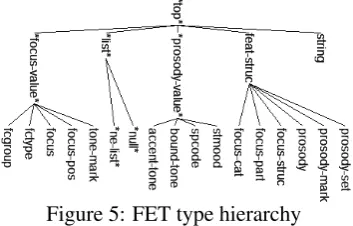
design the FET type hierarchy as shown in fig-ure 5. We define three main groups of featfig-ure structures: *focus-value*, *prosodic-value* and
*focus-value*represents the focus structures. It is com-posed of five subfeature structures: focus crite-rion, focus type (fctype), focus name (focus), fo-cus position (fofo-cus-pos), and checking whether a tone mark can be marked at a word (tone-mark).
*prosody-value*represents the prosodic structure.
Four prosodic subfeature structures are sentence mood, speech act code, accent tone (accent-tone), and boundary tone (bound-tone). feat-struc con-tains the core FET structure that constrains the re-lationships between focus and prosodic features.
The feat-strucstructure is composed of six main
[image:5.595.315.516.227.372.2]subfeature structures: (i) focus category structure (focus-cat) is a set of constraints which are the combinations of a focus part and a focus criterion such as act g, actor g, actee g, and so on, (ii) fo-cus part structure (fofo-cus-part) classifies act part and non-act part as actor part or actee part, (iii) focus structure (focus-struc) is a subfeature struc-ture offocus-wordandfocus-phrase, (iv) checking whether prosodic marks can be marked (prosody), (v) prosodic mark (prosody-mark) structure maps between types of prosodic mark and accent and boundary tones: no-mark, hEm Sh-break, etc, (vi) a set of prosodic marks (prosody-set) is a set of combinations between accent and boundary tones.
Figure 5: FET type hierarchy
4.2.1 Focus Structure
In figure 6(a), the focus-phrase inherits the
focus-strucwith a feature ARGS. The ARGS
rep-resents a list of words in the sentence. The focus rules parse thefocus-phrasewith their constraints and define whether tone can be marked at a word in each focus part. The focus-word inherits the
focus-struc with orthography of a word (ORTH)
as string. Thefocus-word, as shown in 6(b), repre-sents the focus content structure and corresponds to the LKB system. The focus-struc, as show in figure 6(c), consists of HEAD, specifier (SPR) and
complement (COMPS) (Ivan et al., 2003).
In-side the focus-struc, HEAD refers to focus-part which is shown in figure 6(d). SPR and COMP are used to specify the components of previous
nodes and following nodes in a sentence. Each
focus-partcontains focus and prosodic structures.
We classify focus following the possible focus-catfor the FET structure. Thefocus-cat controls the constraints for the actor, act and actee parts.
Thefocus-catcontains both the focus and prosodic
features as a set of subfeatures of the FET struc-ture. This structure contains focus position, fo-cus group, fofo-cus type, a set of prosody marks and prosodic structure (prosody). The focus-cat is shown in figure 6(e).
[ * *] &
:
list ARGS
struc focus
phrase focus
− = −
(a)
[ORTH string]
struc focus
word focus
& : −
= −
(b)
⎥ ⎥ ⎥
⎦ ⎤
⎢ ⎢ ⎢
⎣
⎡ − −
= −
* *
* * &
:
list COMPS
list SPR
part focus HEAD
struc feat
struc focus
(c)
⎥ ⎦ ⎤ ⎢
⎣ ⎡
− −
= −
cat focus AGR
focus FOCUS
struc feat
part focus
1 &
:
(d)
⎥ ⎥ ⎥ ⎥ ⎥ ⎥
⎦ ⎤
⎢ ⎢ ⎢ ⎢ ⎢ ⎢
⎣
⎡ − − −
= −
prosody PROSODY
addtone ADDTONE
fctype FCTYPE
fcgroup FCGROUP
pos focus POS FOCUS
struc feat
cat focus
& :
(e)
Figure 6: Type feature structure of: (a)
focus-phrase (b) focus-word (c) focus-struc (d)
focus-part(e)focus-cat
4.2.2 Prosodic Structure
The prosodic structure consists of these subfea-tures: sentence mood, speech act code, and a set of prosodic mark structures. This structure controls the prosodic marks following the FET constraints. These constraints depend on the relationships of focus with speech acts to intonation patterns. The prosody structure is shown in figure 7(a). The accent and boundary tones are mapped with the
prosody-markwhich is illustrated in figure 7(b).
⎥ ⎥ ⎥ ⎥
⎦ ⎤
⎢ ⎢ ⎢ ⎢
⎣ ⎡
− −
− −
− =
mark prosody MARK PROSODY
mark prosody MARK PROSODY
spcode SPCODE
stmood STMOOD
struc feat prosody
2 1 & :
(a)
⎥ ⎦ ⎤ ⎢
⎣ ⎡
− −
− −
− = −
tone bound TONE BOUND
tone accent TONE ACCENT
struc feat
mark prosody
& :
(b)
Figure 7: Type feature structure of: (a) Prosodic structure (b) Prosodic mark structure
[image:5.595.94.271.424.537.2]and prosodic information. The FET structure of the word “Kim” is shown in figure 8.
Figure 8: FET structure of the word “Kim”
4.3 Modifying Prosody for Synthetic Speech
In the postprocessing process (see step 4, figure 1), we extract a set of words with tone marks from the FET structure. An example of these words with tone marks is shown in figure 9. Finally we trans-fer this data to generate the synthesized speech by the speech synthesis and modify prosody.
ORTH: Kim Focus: actor-part ACCENT_TONE1: NOACCENT BOUND_TONE1: NOBOUND
ORTH: bought Focus: act-part ACCENT_TONE1: NOACCENT BOUND_TONE1: NOBOUND
ORTH: a
Focus: actee-part ACCENT_TONE1: NOACCENT BOUND_TONE1: NOBOUND
ORTH: flower Focus: actee-part ACCENT_TONE1: L+H* BOUND_TONE1: L-L%
Figure 9: A set of words and their tone marks
5 Concluding Remarks
We design the FET system based on the small number of sentences from a part of the CMU com-municator dataset (2002). These simple sentences relate to traveling information. In this paper, we use the MRS representation from the LKB system to determine actor, act and actee parts. Since the LKB has a limited grammar and produces multi-ple parses, then we assume that our input sentence can be parsed by the HPSG parser and only a cor-rect output is provided to the LKB system with the FET environment. We analyze the relation-ships of focus with speech acts to tone marks. To mark tone, we group the tone patterns by speech acts and focus parts. We implement the FET sys-tem using LKB and an example is illustrated in section 4 in this paper. Using the LKB with the FET grammar, the system can parse most simple sentences from the CMU communicator dataset and generate the complete FET structure including prosodic marks for each sentence. We are evaluat-ing the FET system with respect to three aspects: appreciation of listeners to tone based on the tone
marks from the FET system, conveying the focus content in a sentence to listeners and the correct-ness of prosodic annotation. In the future, we will finish the evaluations and analyze more relation-ships of focus with speech acts to tones to support the various sentences.
Acknowledgement
This work is supported by NSERC, Canada, Royal Golden Jubilee Ph.D. program, Thailand Research Fund, Thailand, and King Mongkut’s University of Technology Thonburi, Thailand.
References
Mohammad Haji-Adolhosseini. 2003. A Constraint-Based Approach to Information Structure and Prosody Correspondence. Proc. of The HPSG-2003 Conf., In Stefan Muller (ed.), CSLI Pub., Michigan State Univ., East Lansing, pp. 143-162.
Ewan Klein. 2000. Prosodic constituency in HPSG, Grammatical Interfaces in HPSG. In Ronnie Cann, and Philip Miller, ed., CSLI Pub., pp 169-200.
Copestake A. 2002. Implementing Typed Feature Structure Grammars. CSLI Pub., Stanford, CA.
Copestake A., Flickinger D., Malouf R., Riehemann S. and Sag I.A. 1995. Translation using Minimal Re-cursion Semantics. Proc. of the The 6th Int’l Conf. on Theoretical and Methodological Issues in Ma-chine Translation (TMI-95), Belgium.
Silverman K., Beckman M. B., Pirelli J., Ostendorf M., Wightman C., Price P., Pierrehumbert J., and Hirschberg J. 1992. ToBI: A Standard for Label-ing English Prosody. In Proc. of ICSLP’92, Banff, Canada, pages. 867-870.
Steedman M. and Prevost, S. 1994. Specifying Into-nation from Context for Speech Synthesis. Speech Comm., 15, 1994, 139-153.
Von Heusinger K. 1999. Intonation and Information Structure. The Representation of Focus in Phonol-ogy and Semantics. Habilitationsschrift, University Konstanz, pp. 125-155.
Paul Boersma and David Weenink 2005. Praat: doing phonetics by computer. Inst. of Pho-netic Sciences, Univ. of Amsterdam, Netherlands, http://www.praat.org, Oct. 2005.
Ballmer T. and Brennenstuhl W. 1981. Speech Act Classification. A study in the Lexical analysis of English speech activity verbs. Springer Series in Language and Comm., Vol.8. Springer Verlag, New York, 1981.
CMU Communicator KAL limited domain. 2002.
Language Technologies Inst., Carnegie Mellon Univ., www.festvox.org, Oct 2005.