Proceedings of the 49th Annual Meeting of the Association for Computational Linguistics, pages 541–550,
Knowledge-Based Weak Supervision for Information Extraction
of Overlapping Relations
Raphael Hoffmann, Congle Zhang, Xiao Ling, Luke Zettlemoyer, Daniel S. Weld Computer Science & Engineering
University of Washington Seattle, WA 98195, USA
{raphaelh,clzhang,xiaoling,lsz,weld}@cs.washington.edu
Abstract
Information extraction (IE) holds the promise of generating a large-scale knowledge base from the Web’s natural language text. Knowledge-based weak supervision, using structured data to heuristically label a training corpus, works towards this goal by enabling the automated learning of a potentially unbounded number of relation extractors. Recently, researchers have developed multi-instance learning algorithms to combat the noisy training data that can come from heuristic labeling, but their models assume relations are disjoint — for example they cannot extract the pair Founded(Jobs, Apple)andCEO-of(Jobs, Apple).
This paper presents a novel approach for multi-instance learning with overlapping re-lations that combines a sentence-level extrac-tion model with a simple, corpus-level compo-nent for aggregating the individual facts. We apply our model to learn extractors for NY Times text using weak supervision from Free-base. Experiments show that the approach runs quickly and yields surprising gains in accuracy, at both the aggregate and sentence level.
1 Introduction
Information-extraction (IE), the process of generat-ing relational data from natural-language text, con-tinues to gain attention. Many researchers dream of creating a large repository of high-quality extracted tuples, arguing that such a knowledge base could benefit many important tasks such as question an-swering and summarization. Most approaches to IE
use supervised learning of relation-specific exam-ples, which can achieve high precision and recall. Unfortunately, however, fully supervised methods are limited by the availability of training data and are unlikely to scale to the thousands of relations found on the Web.
A more promising approach, often called “weak” or “distant” supervision, creates its own training data by heuristically matching the contents of a database to corresponding text (Craven and Kum-lien, 1999). For example, suppose thatr(e1, e2) =
Founded(Jobs,Apple)is a ground tuple in the database ands =“Steve Jobs founded Apple, Inc.” is a sentence containing synonyms for both e1 =
Jobs and e2 = Apple, then s may be a natural
language expression of the fact thatr(e1, e2) holds
and could be a useful training example.
While weak supervision works well when the tex-tual corpus is tightly aligned to the database con-tents (e.g., matching Wikipedia infoboxes to as-sociated articles (Hoffmann et al., 2010)), Riedel
et al. (2010) observe that the heuristic leads to noisy data and poor extraction performance when the method is applied more broadly (e.g., matching Freebase records to NY Times articles). To fix this problem they cast weak supervision as a form of multi-instance learning, assuming only thatat least one of the sentences containing e1 and e2 are
ex-pressing r(e1, e2), and their method yields a
sub-stantial improvement in extraction performance. However, Riedel et al.’s model (like that of previous systems (Mintz et al., 2009)) assumes that relations do not overlap — there cannot exist two facts r(e1, e2) and q(e1, e2) that are
both true for any pair of entities, e1 and e2.
for example bothFounded(Jobs, Apple)and CEO-of(Jobs, Apple) are clearly true. In-deed, 18.3% of the weak supervision facts in Free-base that match sentences in the NY Times 2007 cor-pus have overlapping relations.
This paper presents MULTIR, a novel model of weak supervision that makes the following contri-butions:
• MULTIR introduces a probabilistic, graphical model of multi-instance learning which handles overlapping relations.
• MULTIR also produces accurate sentence-level predictions, decoding individual sentences as well as making corpus-level extractions.
• MULTIR is computationally tractable. Inference reduces to weighted set cover, for which it uses a greedy approximation with worst case running time O(|R| · |S|) where R is the set of possi-ble relations andSis largest set of sentences for any entity pair. In practice, MULTIR runs very quickly.
• We present experiments showing that MULTIR outperforms a reimplementation of Riedel
et al.(2010)’s approach on both aggregate (cor-pus as a whole) and sentential extractions. Additional experiments characterize aspects of MULTIR’s performance.
2 Weak Supervision from a Database
Given a corpus of text, we seek to extract facts about
entities, such as the company Apple or the city Boston. A ground fact (or relation instance), is an expressionr(e) where r is a relation name, for exampleFoundedorCEO-of, ande=e1, . . . , en is a list of entities.
Anentity mentionis a contiguous sequence of tex-tual tokens denoting an entity. In this paper we as-sume that there is anoraclewhich can identify all entity mentions in a corpus, but the oracle doesn’t normalize or disambiguate these mentions. We use
ei ∈ E to denote both an entity and its name (i.e., the tokens in its mention).
A relation mention is a sequence of text (in-cluding one or more entity mentions) which states that some ground fact r(e) is true. For example, “Steve Ballmer, CEO of Microsoft, spoke recently
at CES.” contains three entity mentions as well as a relation mention forCEO-of(Steve Ballmer, Microsoft). In this paper we restrict our atten-tion to binary relaatten-tions. Furthermore, we assume that both entity mentions appear as noun phrases in a single sentence.
The task ofaggregate extractiontakes two inputs,
Σ, a set of sentences comprising the corpus, and an extraction model; as output it should produce a set of ground facts,I, such that each fact r(e) ∈ I is expressed somewhere in the corpus.
Sentential extraction takes the same input and likewise producesI, but in addition it also produces a function, Γ : I → P(Σ), which identifies, for eachr(e)∈I, the set of sentences inΣthat contain a mention describingr(e). In general, the corpus-level extraction problem is easier, since it need only make aggregate predictions, perhaps using corpus-wide statistics. In contrast, sentence-level extrac-tion must justify each extracextrac-tion witheverysentence which expresses the fact.
Theknowledge-based weakly supervised learning
problem takes as input (1)Σ, a training corpus, (2)
E, a set of entities mentioned in that corpus, (3)R, a set of relation names, and (4),∆, a set of ground facts of relations in R. As output the learner pro-duces an extraction model.
3 Modeling Overlapping Relations
We define an undirected graphical model that al-lows joint reasoning about aggregate (corpus-level) and sentence-level extraction decisions. Figure 1(a) shows the model in plate form.
3.1 Random Variables
There exists a connected component for each pair of entities e = (e1, e2) ∈ E×E that models all of
the extraction decisions for this pair. There is one Boolean output variableYr for each relation name
r ∈ R, which represents whether the ground fact
r(e) is true. Including this set of binary random variables enables our model to extract overlapping relations.
Let S(e1,e2) ⊂ Σ be the set of sentences which contain mentions of both of the entities. For each sentencexi ∈ S(e1,e2) there exists a latent variable
E × E
𝑌 R
S
𝑍𝑖
(a)
Steve Jobs was founder of Apple.
Steve Jobs, Steve Wozniak and Ronald Wayne founded Apple.
Steve Jobs is CEO of Apple.
founder
𝑍1
founder none
0
𝑌bornIn
1 0 0
𝑍2 𝑍3
...
...
... 𝑌founderOf 𝑌locatedIn 𝑌capitalOf
(b)
Figure 1: (a) Network structure depicted as plate model and (b) an example network instantiation for the pair of entities Steve Jobs,Apple.
importantly, also the distinct valuenone.Zishould be assigned a valuer ∈ R only whenxi expresses the ground fact r(e), thereby modeling sentence-level extraction.
Figure 1(b) shows an example instantiation of the model with four relation names and three sentences.
3.2 A Joint, Conditional Extraction Model
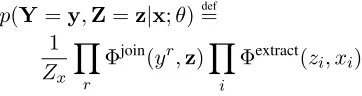
We use a conditional probability model that defines a joint distribution over all of the extraction random variables defined above. The model is undirected and includes repeated factors for making sentence level predictions as well as globals factors for ag-gregating these choices.
For each entity pair e = (e1, e2), define x to
be a vector concatenating the individual sentences
xi ∈ S(e1,e2), Y to be vector of binaryY
r random
variables, one for eachr ∈R, andZto be the vec-tor ofZi variables, one for each sentence xi. Our conditional extraction model is defined as follows:
p(Y=y,Z=z|x;θ)=def 1
Zx Y
r
Φjoin(yr,z)Y
i
Φextract(zi, xi)
where the parameter vectorθis used, below, to de-fine the factorΦextract.
The factorsΦjoinare deterministic OR operators
Φjoin(yr,z)def=
(
1 ifyr=true∧ ∃i:zi=r
0 otherwise
which are included to ensure that the ground fact
r(e) is predicted at the aggregate level for the as-signment Yr = yr only if at least one of the
sen-tence level assignmentsZi = zi signals a mention ofr(e).
The extraction factorsΦextractare given by
Φextract(zi, xi)
def
= exp
X
j
θjφj(zi, xi)
where the features φj are sensitive to the relation name assigned to extraction variablezi, if any, and cues from the sentencexi. We will make use of the Mintzet al.(2009) sentence-level features in the ex-peiments, as described in Section 7.
3.3 Discussion
This model was designed to provide a joint approach where extraction decisions are almost entirely driven by sentence-level reasoning. However, defining the
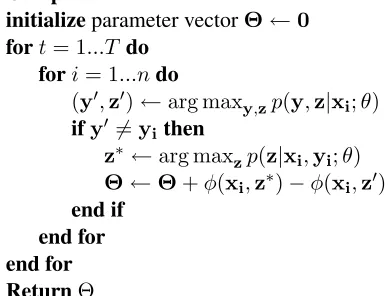
Yrrandom variables and tying them to the sentence-level variables, Zi, provides a direct method for modeling weak supervision. We can simply train the model so that theY variables match the facts in the database, treating theZias hidden variables that can take any value, as long as they produce the correct aggregate predictions.
[image:3.612.82.536.69.206.2] [image:3.612.95.276.535.583.2]Inputs:
(1)Σ, a set of sentences,
(2)E, a set of entities mentioned in the sentences, (3)R, a set of relation names, and
(4) ∆, a database of atomic facts of the form
r(e1, e2)forr∈Randei∈E.
Definitions:
We define the training set {(xi,yi)|i= 1. . . n}, where i is an index corresponding to a particu-lar entity pair (ej, ek) in ∆, xi contains all of the sentences inΣwith mentions of this pair, and
yi = relVector(ej, ek).
Computation:
initializeparameter vectorΘ←0 fort= 1...T do
fori= 1...ndo
(y0,z0)←arg maxy,zp(y,z|xi;θ) ify06=yithen
z∗ ←arg maxzp(z|xi,yi;θ) Θ←Θ+φ(xi,z∗)−φ(xi,z0) end if
end for end for
[image:4.612.80.276.252.400.2]ReturnΘ
Figure 2: The MULTIR Learning Algorithm
only the deterministic OR nodes. Perhaps surpris-ing, we are still able to improve performance at both the sentential and aggregate extraction tasks.
4 Learning
We now present a multi-instance learning algo-rithm for our weak-supervision model that treats the sentence-level extraction random variablesZi as la-tent, and uses facts from a database (e.g., Freebase) as supervision for the aggregate-level variablesYr.
As input we have (1) Σ, a set of sentences, (2)
E, a set of entities mentioned in the sentences, (3)
R, a set of relation names, and (4) ∆, a database of atomic facts of the formr(e1, e2)forr ∈R and ei ∈ E. Since we are using weak learning, theYr variables inYare not directly observed, but can be approximated from the database∆. We use a proce-dure, relVector(e1, e2) to return a bit vector whose jth bit is one ifrj(e1, e2)∈∆. The vector doesnot
have a bit for the specialnonerelation; if there is no relation between the two entities, all bits are zero.
Finally, we can now define the training set to be pairs {(xi,yi)|i = 1. . . n}, where i is an index corresponding to a particular entity pair(ej, ek),xi contains all of the sentences with mentions of this pair, andyi = relVector(ej, ek).
Given this form of supervision, we would like to find the setting forθwith the highest likelihood:
O(θ) =Y
i
p(yi|xi;θ) = Y
i X
z
p(yi,z|xi;θ)
However, this objective would be difficult to op-timize exactly, and algorithms for doing so would be unlikely to scale to data sets of the size we con-sider. Instead, we make two approximations, de-scribed below, leading to a Perceptron-style addi-tive (Collins, 2002) parameter update scheme which has been modified to reason about hidden variables, similar in style to the approaches of (Liang et al., 2006; Zettlemoyer and Collins, 2007), but adapted for our specific model. This approximate algorithm is computationally efficient and, as we will see, works well in practice.
Our first modification is to do online learning instead of optimizing the full objective. Define the feature sumsφ(x,z) = P
jφ(xj, zj) which range over the sentences, as indexed by j. Now, we can define an update based on the gradient of the local log likelihood for examplei:
∂logOi(θ)
∂θj =Ep(z|xi,yi;θ)[φj(xi,z)]
−Ep(y,z|xi;θ)[φj(xi,z)]
where the deterministic ORΦjoinfactors ensure that the first expectation assigns positive probability only to assignments that produce the labeled factsyibut that the second considers all valid sets of extractions. Of course, these expectations themselves, espe-cially the second one, would be difficult to com-pute exactly. Our second modification is to do a Viterbi approximation, by replacing the expecta-tions with maximizaexpecta-tions. Specifically, we compute the most likely sentence extractions for the label factsarg maxzp(z|xi,yi;θ)and the most likely ex-traction for the input, without regard to the labels,
5 Inference
To support learning, as described above, we need to compute assignments arg maxzp(z|x,y;θ) and
arg maxy,zp(y,z|x;θ). In this section, we describe algorithms for both cases that use the deterministic OR nodes to simplify the required computations.
Predicting the most likely joint extraction
arg maxy,zp(y,z|x;θ) can be done efficiently given the structure of our model. In particular, we note that the factorsΦjoinrepresent deterministic de-pendencies betweenZandY, which when satisfied do not affect the probability of the solution. It is thus sufficient to independently compute an assignment for each sentence-level extraction variableZi, ignor-ing the deterministic dependencies. The optimal set-ting for the aggregate variablesYis then simply the assignment that is consistent with these extractions. The time complexity isO(|R| · |S|).
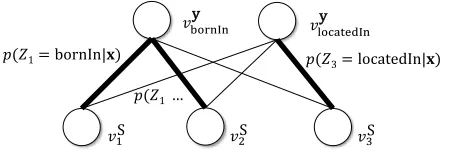
Predicting sentence level extractions given weak supervision facts, arg maxzp(z|x,y;θ), is more challenging. We start by computing extraction scoresΦextract(xi, zi)for each possible extraction as-signment Zi = zi at each sentence xi ∈ S, and storing the values in a dynamic programming table. Next, we must find the most likely assignmentzthat respects our output variables y. It turns out that this problem is a variant of the weighted, edge-cover problem, for which there exist polynomial time op-timal solutions.
Let G = (E,V = VS ∪ Vy) be a complete
weighted bipartite graph with one nodeviS∈ VSfor
each sentencexi ∈Sand one nodevyr ∈ Vyfor each relationr ∈Rwhereyr = 1. The edge weights are given byc((viS, vyr))
def
= Φextract(x
i, zi). Our goal is to select a subset of the edges which maximizes the sum of their weights, subject to each nodeviS ∈ VS
being incident to exactly one edge, and each node
vry∈ Vybeing incident to at least one edge.
Exact Solution An exact solution can be obtained by first computing the maximum weighted bipartite matching, and adding edges to nodes which are not incident to an edge. This can be computed in time
O(|V|(|E|+|V|log|V|)), which we can rewrite as
O((|R|+|S|)(|R||S|+ (|R|+|S|) log(|R|+|S|))).
Approximate Solution An approximate solution
can be obtained by iterating over the nodes in Vy,
𝑣bornIny 𝑣locatedIny
𝑣1S 𝑣2S 𝑣3S
𝑝(𝑍1= bornIn|𝐱) 𝑝(𝑍3= locatedIn|𝐱)
[image:5.612.314.539.72.152.2]𝑝(𝑍1 …
Figure 3: Inference ofarg maxzp(Z=z|x,y)requires solving a weighted, edge-cover problem.
and each time adding the highest weight incident edge whose addition doesn’t violate a constraint. The running time isO(|R||S|). This greedy search guarantees each fact is extracted at least once and allows any additional extractions that increase the overall probability of the assignment. Given the computational advantage, we use it in all of the ex-perimental evaluations.
6 Experimental Setup
We follow the approach of Riedelet al. (2010) for generating weak supervision data, computing fea-tures, and evaluating aggregate extraction. We also introduce new metrics for measuring sentential ex-traction performance, both relation-independent and relation-specific.
6.1 Data Generation
We used the same data sets as Riedelet al.(2010) for weak supervision. The data was first tagged with the Stanford NER system (Finkel et al., 2005) and then entity mentions were found by collecting each continuous phrase where words were tagged iden-tically (i.e., as a person, location, or organization). Finally, these phrases were matched to the names of Freebase entities.
Given the set of matches, defineΣto be set of NY Times sentences with two matched phrases,E to be the set of Freebase entities which were mentioned in one or more sentences,∆to be the set of Freebase facts whose arguments,e1ande2were mentioned in
a sentence inΣ, andR to be set of relations names used in the facts of∆. These sets define the weak supervision data.
6.2 Features and Initialization
de-veloped by Mintz et al. (2009). These include in-dicators for various lexical, part of speech, named entity, and dependency tree path properties of entity mentions in specific sentences, as computed with the Malt dependency parser (Nivre and Nilsson, 2004) and OpenNLP POS tagger1. However, unlike the previous work, we did not make use of any features that explicitly aggregate these properties across mul-tiple mention instances.
The MULTIR algorithm has a single parameterT, the number of training iterations, that must be spec-ified manually. We usedT = 50 iterations, which performed best in development experiments.
6.3 Evaluation Metrics
Evaluation is challenging, since only a small per-centage (approximately 3%) of sentences match facts in Freebase, and the number of matches is highly unbalanced across relations, as we will see in more detail later. We use the following metrics.
Aggregate Extraction Let ∆e be the set of
ex-tracted relations for any of the systems; we com-pute aggregate precision and recall by comparing
∆ewith∆. This metric is easily computed but un-derestimates extraction accuracy because Freebase is incomplete and some true relations in∆e will be marked wrong.
Sentential Extraction Let Se be the sentences
where some system extracted a relation andSF be the sentences that match the arguments of a fact in
∆. We manually compute sentential extraction ac-curacy by sampling a set of 1000 sentences from
Se∪SF and manually labeling the correct extrac-tion decision, either a relaextrac-tionr ∈ R ornone. We then report precision and recall for each system on this set of sampled sentences. These results provide a good approximation to the true precision but can overestimate the actual recall, since we did not man-ually check the much larger set of sentences where no approach predicted extractions.
6.4 Precision / Recall Curves
To compute precision / recall curves for the tasks, we ranked the MULTIR extractions as follows. For sentence-level evaluations, we ordered according to
1
http://opennlp.sourceforge.net/
Recall
P
re
cis
io
n
0.00 0.05 0.10 0.15 0.20 0.25 0.30 0.0
0.2 0.4 0.6 0.8 1.0
SOLOR
[image:6.612.314.528.81.229.2]Riedel et al., 2010 MULT IR
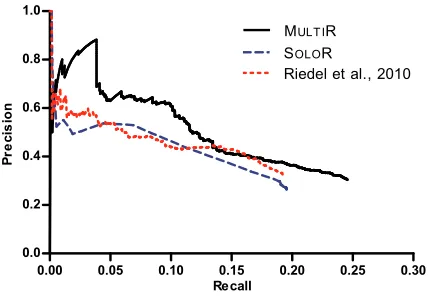
Figure 4: Aggregate extraction precision / recall curves for Riedelet al. (2010), a reimplementation of that ap-proach (SOLOR), and our algorithm (MULTIR).
the extraction factor scoreΦextract(zi, xi). For aggre-gate comparisons, we set the score for an extraction
Yr = true to be the max of the extraction factor scores for the sentences whererwas extracted.
7 Experiments
To evaluate our algorithm, we first compare it to an existing approach for using multi-instance learning with weak supervision (Riedel et al., 2010), using the same data and features. We report both aggregate extraction and sentential extraction results. We then investigate relation-specific performance of our sys-tem. Finally, we report running time comparisons.
7.1 Aggregate Extraction
Figure 4 shows approximate precision / recall curves for three systems computed with aggregate metrics (Section 6.3) that test how closely the extractions match the facts in Freebase. The systems include the original results reported by Riedel et al. (2010) as well as our new model (MULTIR). We also compare with SOLOR, a reimplementation of their algorithm, which we built in Factorie (McCallum et al., 2009), and will use later to evaluate sentential extraction.
con-Recall
P
re
cis
io
n
0.0 0.1 0.2 0.3 0.4 0.5 0.6 0.0
0.2 0.4 0.6 0.8 1.0
SOLOR MULT IR
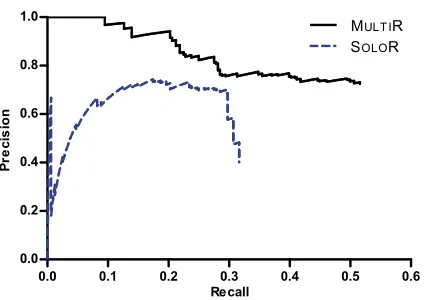
Figure 5: Sentential extraction precision / recall curves for MULTIR and SOLOR.
fidence extractions produced by MULTIR that were marked wrong. We found that all ten were true facts that were simply missing from Freebase. A manual evaluation, as we perform next for sentential extrac-tion, would remove this dip.
7.2 Sentential Extraction
Although their model includes variables to model sentential extraction, Riedelet al.(2010) did not re-port sentence level performance. To generate the precision / recall curve we used the joint model as-signment score for each of the sentences that con-tributed to the aggregate extraction decision.
Figure 4 shows approximate precision / recall curves for MULTIR and SOLOR computed against manually generated sentence labels, as defined in Section 6.3. MULTIR achieves significantly higher recall with a consistently high level of precision. At the highest recall point, MULTIR reaches 72.4% pre-cision and 51.9% recall, for an F1 score of 60.5%.
7.3 Relation-Specific Performance
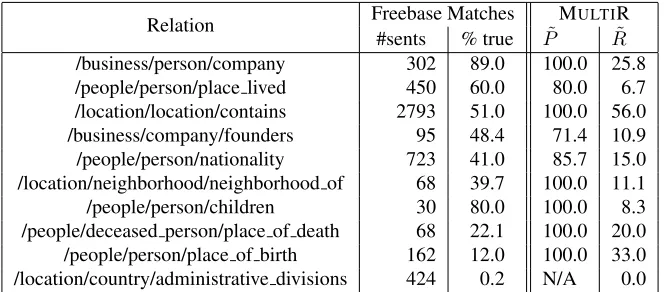
Since the data contains an unbalanced number of in-stances of each relation, we also report precision and recall for each of the ten most frequent relations. Let
SrM be the sentences where MULTIR extracted an instance of relation r ∈ R, and let SrF be the sen-tences that match the arguments of a fact about re-lationrin∆. For eachr, we sample 100 sentences from both SrM and SrF and manually check accu-racy. To estimate precisionP˜rwe compute the ratio of true relation mentions inSrM, and to estimate re-callR˜rwe take the ratio of true relation mentions in
[image:7.612.74.287.78.228.2]SrF which are returned by our system.
Table 1 presents this approximate precision and recall for MULTIR on each of the relations, along with statistics we computed to measure the qual-ity of the weak supervision. Precision is high for the majority of relations but recall is consistently lower. We also see that the Freebase matches are highly skewed in quantity and can be low quality for some relations, with very few of them actually cor-responding to true extractions. The approach gener-ally performs best on the relations with a sufficiently large number of true matches, in many cases even achieving precision that outperforms the accuracy of the heuristic matches, at reasonable recall levels.
7.4 Overlapping Relations
Table 1 also highlights some of the effects of learn-ing with overlapplearn-ing relations. For example, in the data, almost all of the matches for the administra-tive divisions relation overlap with the contains re-lation, because they both model relationships for a pair of locations. Since, in general, sentences are much more likely to describe a contains relation, this overlap leads to a situation were almost none of the administrate division matches are true ones, and we cannot accurately learn an extractor. However, we can still learn to accurately extract the contains rela-tion, despite the distracting matches. Similarly, the place of birth and place of death relations tend to overlap, since it is often the case that people are born and die in the same city. In both cases, the precision outperforms the labeling accuracy and the recall is relatively high.
To measure the impact of modeling overlapping relations, we also evaluated a simple, restricted baseline. Instead of labeling each entity pair with the set of all true Freebase facts, we created a dataset where each true relation was used to create a dif-ferent training example. Training MULTIR on this data simulates effects of conflicting supervision that can come from not modeling overlaps. On average across relations, precision increases 12 points but re-call drops 26 points, for an overall reduction in F1 score from 60.5% to 40.3%.
7.5 Running Time
Relation Freebase Matches MULTIR #sents % true P˜ R˜
[image:8.612.141.473.71.217.2]/business/person/company 302 89.0 100.0 25.8 /people/person/place lived 450 60.0 80.0 6.7 /location/location/contains 2793 51.0 100.0 56.0 /business/company/founders 95 48.4 71.4 10.9 /people/person/nationality 723 41.0 85.7 15.0 /location/neighborhood/neighborhood of 68 39.7 100.0 11.1 /people/person/children 30 80.0 100.0 8.3 /people/deceased person/place of death 68 22.1 100.0 20.0 /people/person/place of birth 162 12.0 100.0 33.0 /location/country/administrative divisions 424 0.2 N/A 0.0
Table 1: Estimated precision and recall by relation, as well as the number of matched sentences (#sents) and accuracy (% true) of matches between sentences and facts in Freebase.
Riedel et al. (2010) approach required approxi-mately 6 hours to train on NY Times 05-06 and 4 hours to test on the NY Times 07, each without pre-processing. Although they do sampling for infer-ence, the global aggregation variables require rea-soning about an exponentially large (in the number of sentences) sample space.
In contrast, our approach required approximately one minute to train and less than one second to test, on the same data. This advantage comes from the decomposition that is possible with the determinis-tic OR aggregation variables. For test, we simply consider each sentence in isolation and during train-ing our approximation to the weighted assignment problem is linear in the number of sentences.
7.6 Discussion
The sentential extraction results demonstrates the advantages of learning a model that is primarily driven by sentence-level features. Although previ-ous approaches have used more sophisticated fea-tures for aggregating the evidence from individual sentences, we demonstrate that aggregating strong sentence-level evidence with a simple deterministic OR that models overlapping relations is more effec-tive, and also enables training of a sentence extractor that runs with no aggregate information.
While the Riedel et al.approach does include a model of which sentences express relations, it makes significant use of aggregate features that are primar-ily designed to do entity-level relation predictions and has a less detailed model of extractions at the individual sentence level. Perhaps surprisingly, our
model is able to do better at both the sentential and aggregate levels.
8 Related Work
Supervised-learning approaches to IE were intro-duced in (Soderland et al., 1995) and are too nu-merous to summarize here. While they offer high precision and recall, these methods are unlikely to scale to the thousands of relations found in text on the Web. Open IE systems, which perform self-supervised learning of relation-independent extrac-tors (e.g., Preemptive IE (Shinyama and Sekine, 2006), TEXTRUNNER (Banko et al., 2007; Banko and Etzioni, 2008) and WOE(Wu and Weld, 2010)) can scale to millions of documents, but don’t output canonicalized relations.
8.1 Weak Supervision
taxon-omy. Mintzet al.(2009) used Freebase facts to train 100 relational extractors on Wikipedia. Hoffmann
et al. (2010) describe a system similar to KYLIN, but which dynamically generates lexicons in order to handle sparse data, learning over 5000 Infobox relations with an average F1 score of 61%. Yao
et al.(2010) perform weak supervision, while using selectional preference constraints to a jointly reason about entity types.
The NELLsystem (Carlson et al., 2010) can also be viewed as performing weak supervision. Its ini-tial knowledge consists of a selectional preference constraint and 20 ground fact seeds. NELL then matches entity pairs from the seeds to a Web cor-pus, but instead of learning a probabilistic model, it bootstraps a set of extraction patterns using semi-supervised methods for multitask learning.
8.2 Multi-Instance Learning
Multi-instance learning was introduced in order to combat the problem of ambiguously-labeled train-ing data when predicttrain-ing the activity of differ-ent drugs (Dietterich et al., 1997). Bunescu and Mooney (2007) connect weak supervision with multi-instance learning and extend their relational extraction kernel to this context.
Riedel et al. (2010), combine weak supervision and multi-instance learning in a more sophisticated manner, training a graphical model, which assumes only that at least one of the matches between the arguments of a Freebase fact and sentences in the corpus is a true relational mention. Our model may be seen as an extension of theirs, since both models include sentence-level and aggregate random vari-ables. However, Riedelet al.have only a single ag-gregate variable that takes valuesr ∈R∪ {none}, thereby ruling out overlapping relations. We have discussed the comparison in more detail throughout the paper, including in the model formulation sec-tion and experiments.
9 Conclusion
We argue that weak supervision is promising method for scaling information extraction to the level where it can handle the myriad, different relations on the Web. By using the contents of a database to heuris-tically label a training corpus, we may be able to
automatically learn a nearly unbounded number of relational extractors. Since the processs of match-ing database tuples to sentences is inherently heuris-tic, researchers have proposed multi-instance learn-ing algorithms as a means for coplearn-ing with the result-ing noisy data. Unfortunately, previous approaches assume that all relations are disjoint — for exam-ple they cannot extract the pairFounded(Jobs, Apple)andCEO-of(Jobs, Apple), because two relations are not allowed to have the same argu-ments.
This paper presents a novel approach for multi-instance learning with overlapping relations that combines a sentence-level extraction model with a simple, corpus-level component for aggregating the individual facts. We apply our model to learn extrac-tors for NY Times text using weak supervision from Freebase. Experiments show improvements for both sentential and aggregate (corpus level) extraction, and demonstrate that the approach is computation-ally efficient.
Our early progress suggests many interesting di-rections. By joining two or more Freebase tables, we can generate many more matches and learn more relations. We also wish to refine our model in order to improve precision. For example, we would like to add type reasoning about entities and selectional preference constraints for relations. Finally, we are also interested in applying the overall learning ap-proaches to other tasks that could be modeled with weak supervision, such as coreference and named entity classification.
The source code of our system, its out-put, and all data annotations are available at http://cs.uw.edu/homes/raphaelh/mr.
Acknowledgments
References
Michele Banko and Oren Etzioni. 2008. The tradeoffs between open and traditional relation extraction. In
Proceedings of 46th Annual Meeting of the Associ-ation for ComputAssoci-ational Linguistics (ACL-08), pages 28–36.
Michele Banko, Michael J. Cafarella, Stephen Soderland, Matthew Broadhead, and Oren Etzioni. 2007. Open information extraction from the web. InProceedings of the 20th International Joint Conference on Artificial Intelligence (IJCAI-07), pages 2670–2676.
Kedar Bellare and Andrew McCallum. 2007. Learn-ing extractors from unlabeled text usLearn-ing relevant databases. InSixth International Workshop on Infor-mation Integration on the Web.
Razvan Bunescu and Raymond Mooney. 2007. Learning to extract relations from the web using minimal super-vision. InProceedings of the 45th Annual Meeting of the Association for Computational Linguistics (ACL-07).
Andrew Carlson, Justin Betteridge, Bryan Kisiel, Burr Settles, Estevam R. Hruschka Jr., and Tom M. Mitchell. 2010. Toward an architecture for never-ending language learning. InProceedings of the AAAI Conference on Artificial Intelligence (AAAI-10). Michael Collins. 2002. Discriminative training
meth-ods for hidden markov models: Theory and experi-ments with perceptron algorithms. InProceedings of the 2002 Conference on Empirical Methods in Natural Language Processing (EMNLP-2002).
Mark Craven and Johan Kumlien. 1999. Constructing biological knowledge bases by extracting information from text sources. InProceedings of the Seventh Inter-national Conference on Intelligent Systems for Molec-ular Biology, pages 77–86.
Thomas G. Dietterich, Richard H. Lathrop, and Tom´as Lozano-P´erez. 1997. Solving the multiple instance problem with axis-parallel rectangles. Artificial Intel-ligence, 89:31–71, January.
Jenny Rose Finkel, Trond Grenager, and Christopher Manning. 2005. Incorporating non-local informa-tion into informainforma-tion extracinforma-tion systems by gibbs sam-pling. In Proceedings of the 43rd Annual Meeting of the Association for Computational Linguistics (ACL-05), pages 363–370.
Raphael Hoffmann, Congle Zhang, and Daniel S. Weld. 2010. Learning 5000 relational extractors. In Pro-ceedings of the 48th Annual Meeting of the Associ-ation for ComputAssoci-ational Linguistics (ACL-10), pages 286–295.
Percy Liang, A. Bouchard-Cˆot´e, Dan Klein, and Ben Taskar. 2006. An end-to-end discriminative approach to machine translation. InInternational Conference on
Computational Linguistics and Association for Com-putational Linguistics (COLING/ACL).
Andrew McCallum, Karl Schultz, and Sameer Singh. 2009. Factorie: Probabilistic programming via imper-atively defined factor graphs. InNeural Information Processing Systems Conference (NIPS).
Mike Mintz, Steven Bills, Rion Snow, and Daniel Juraf-sky. 2009. Distant supervision for relation extrac-tion without labeled data. InProceedings of the 47th Annual Meeting of the Association for Computational Linguistics (ACL-2009), pages 1003–1011.
Joakim Nivre and Jens Nilsson. 2004. Memory-based dependency parsing. InProceedings of the Conference on Natural Language Learning (CoNLL-04), pages 49–56.
Sebastian Riedel, Limin Yao, and Andrew McCallum. 2010. Modeling relations and their mentions without labeled text. In Proceedings of the Sixteenth Euro-pean Conference on Machine Learning (ECML-2010), pages 148–163.
Yusuke Shinyama and Satoshi Sekine. 2006. Preemptive information extraction using unrestricted relation dis-covery. InProceedings of the Human Language Tech-nology Conference of the North American Chapter of the Association for Computation Linguistics (HLT-NAACL-06).
Stephen Soderland, David Fisher, Jonathan Aseltine, and Wendy G. Lehnert. 1995. Crystal: Inducing a concep-tual dictionary. InProceedings of the Fourteenth In-ternational Joint Conference on Artificial Intelligence (IJCAI-1995), pages 1314–1321.
Fei Wu and Daniel S. Weld. 2007. Autonomously se-mantifying wikipedia. In Proceedings of the Inter-national Conference on Information and Knowledge Management (CIKM-2007), pages 41–50.
Fei Wu and Daniel S. Weld. 2008. Automatically refin-ing the wikipedia infobox ontology. InProceedings of the 17th International Conference on World Wide Web (WWW-2008), pages 635–644.
Fei Wu and Daniel S. Weld. 2010. Open information extraction using wikipedia. InThe Annual Meeting of the Association for Computational Linguistics (ACL-2010), pages 118–127.
Limin Yao, Sebastian Riedel, and Andrew McCallum. 2010. Collective cross-document relation extraction without labelled data. InProceedings of the 2010 Con-ference on Empirical Methods in Natural Language Processing (EMNLP-2010), pages 1013–1023. Luke Zettlemoyer and Michael Collins. 2007. Online