Multiword Expression Processing: A Survey
Mathieu Constant
∗ATILF, Université de Lorraine & CNRS
Gül¸sen Eryiˇgit
∗∗Istanbul Technical University
Johanna Monti
†“L’Orientale” University of Naples
Lonneke van der Plas
‡ University of MaltaCarlos Ramisch
§Aix Marseille University, CNRS
Michael Rosner
‡ University of MaltaAmalia Todirascu
k LiLPa, Strasbourg UniversityMultiword expressions (MWEs) are a class of linguistic forms spanning conventional word boundaries that are both idiosyncratic and pervasive across different languages. The structure of linguistic processing that depends on the clear distinction between words and phrases has to be re-thought to accommodate MWEs. The issue of MWE handling is crucial for NLP applications, where it raises a number of challenges. The emergence of solutions in the absence of guiding principles motivates this survey, whose aim is not only to provide a focused review
∗ATILF, Université de Lorraine & CNRS, 44 avenue de la Libération, 45000, Nancy, France. E-mail:[email protected].
∗∗ITU Department of Computer Engineering, 34469, Istanbul, Turkey. E-mail:
†“L’Orientale” University of Naples, Palazzo Santa Maria Porta Coeli, Via Duomo, 219 80138 Naples, Italy. E-mail:[email protected].
‡University of Malta, Tal-Qroqq, Msida MSD2080, Malta. E-mail:{lonneke.vanderplas, mike.rosner}@um.edu.mt.
§Aix Marseille University, CNRS, LIF, 163 av de Luminy – case 901, 13288, Marseille Cedex 9, France. E-mail:[email protected].
kLiLPa, Strasbourg University, 22, rue René Descartes, BP 80010, 67084, Strasbourg Cedex, France. E-mail:[email protected].
Submission received: 26 May 2016; revised version received: 24 March 2017; accepted for publication: 2 June 2017.
of MWE processing, but also to clarify the nature of interactions between MWE processing and downstream applications. We propose a conceptual framework within which challenges and research contributions can be positioned. It offers a shared understanding of what is meant by “MWE processing,” distinguishing the subtasks of MWE discovery and identification. It also elucidates the interactions between MWE processing and two use cases: Parsing and machine translation. Many of the approaches in the literature can be differentiated according to how MWE processing is timed with respect to underlying use cases. We discuss how such orchestration choices affect the scope of MWE-aware systems. For each of the two MWE processing subtasks and for each of the two use cases, we conclude on open issues and research perspectives.
1. Introduction
Traditional formal descriptions of individual human languages typically divide labor between a repository of words and their properties, called alexicon, and a description of how such words combine to form larger units, called agrammar.1These two elements provide a systematic but finite basis for computing the properties of any syntactically legitimate sentence. Although grammatical theories differ about the nature of lexical versus grammatical information and their manner of interaction, a particular theory must establish what counts as a word in order to pin down what the lexicon should contain.
As Baldwin and Kim (2010), among others, have pointed out, the question of what constitutes a word is surprisingly complex, and one reason for this is the predominance in everyday language of elements known as multiword expressions(MWEs). MWEs consist of several words (in the conventionally understood sense) but behave as single words to some extent. This is well illustrated by an expression likeby and large, which any English speaker knows can have roughly equivalent meaning and syntactic func-tion tomostly, an adverb. Among the problematic characteristics of this expression are (1) syntactic anomaly of the part-of-speech (POS) sequence preposition + conjunction + adjective, (2) non-compositionality: semantics of the whole that is unrelated to the individual pieces, (3) non-substitutability of synonym words (e.g.,by and big), and (4) ambiguity between MWE and non-MWE readings of a substring by and large(e.g.,by and large we agreeversushe walked by and large tractors passed him).
Although these characteristics by no means exhaust the list of peculiarities, the idiosyncratic nature of the expression is plain, leading us to ask where its pertinent characteristics should be stored. The traditional division of labor gives us two options— the lexicon or the grammar—but MWEs disrupt the tradition precisely because they are more than one word long (Sag et al. 2002). Their idiosyncrasy suggests that they belong in the lexicon, yet, being constructed out of more than one word, they would also fall within the traditional scope of grammar, even if constituted (cf. by and large) from non-standard sequences of syntactic categories. As we shall soon see, the glue that can hold an MWE together often involves grammatical relations between the sub-parts, so that the structure of linguistic processing tasks such as parsing and machine translation (MT), which depends on a normally clear distinction between word tokens and phrases, has to be re-thought to accommodate MWEs. The issue of MWE handling goes to the heart of natural language processing (NLP) where it raises a number of
Constant et al. MWE Processing: A Survey
fundamental problems with a frequency that cannot be ignored. Not surprisingly, it has been and still is a main item on the agenda of several working groups such as the PARSEME network (Savary and Przepiorkowski 2013), of which the authors of this article are members.
The main aim of this survey is to shed light on how MWEs are handled in NLP applications. More particularly, it tries to clarify the nature of interactions between MWE processing and downstream applications such as MWE-aware parsing and MT. There is no shortage of proposed approaches for MWE processing and MWE-aware NLP applications. In fact, it is the emergence of approaches in the absence of guiding principles that motivates this article.
There have been other surveys and reviews about MWEs with different scopes. Some concentrate primarily on their linguistic characteristics (Mel’ˇcuk et al. 1999; Calzolari et al. 2002; Sag et al. 2002; Wray 2002). Although this is a valid area of linguistic research, it is not of primary interest to researchers who are addressing the design of computational solutions to the spectrum of problems that MWEs bring into focus. Others are bibliographical reviews/state-of-the-art overviews done in the context of Ph.D. theses (Evert 2005; Pecina 2008) or book chapters (Manning and Schütze 1999; McKeown and Radev 1999; Baldwin and Kim 2010; Seretan 2011; Ramisch 2015), with a narrow scope focusing only on a specific part of MWE processing. In these studies, the subject area is relevant, but the work surveyed tends to be on the micro scale and misses the higher-level insights that one hopes might emerge from the study of such a pervasive phenomenon. Several journal special issues on MWEs (Villavicencio et al. 2005; Rayson et al. 2010; Bond et al. 2013; Ramisch, Villavicencio, and Kordoni 2013) are a showcase for outstanding research in the field, but do not provide a broad overview. In short, abig picture is missing from existing reviews and without one it is difficult to compare individual solutions or to reveal that ostensibly different solutions might actually share similar characteristics.
To overcome these shortcomings we felt that it was necessary to create aconceptual frameworkwithin which both the problems and the different research contributions could be positioned. The goals of this survey are the following:
r
Provide a focused overview of how MWEs are handled in NLPapplications, thereby focusing on MWE processing rather than MWEs as a linguistic phenomenon,
r
Clearly define the task of MWE processing and delineate its two mainsubtasks, discovery and identification,
r
Elaborate on the interaction between MWE processing and two selectedNLP use cases, that is, parsing and MT,
r
Explain how the key MWE properties, such as discontiguity, variability,and non-compositionality, give rise to challenges and opportunities for MWE processing and MWE-aware applications such as parsing and MT.
r
Differentiate previous work according to how MWE processing is timed(“orchestrated”) with respect to the underlying application.
1.1 Definitions and Categories
and their surprising frequency. The awkwardness arises from the way in which they transcend boundaries imposed by the different subfields of morphology, lexicology, syntax, and semantics. Their lack of homogeneity has led to various categorization schemes that we discuss further subsequently. Definitions observed in the literature are not exactly in disagreement, but tend to stress different aspects according to the identified MWE categories under consideration. Here is an illustrative selection:
r
“a multiword unit or a collocation of words that co-occur togetherstatistically more than chance” (Carpuat and Diab 2010)
r
“a sequence of words that acts as a single unit at some level of linguisticanalysis” (Calzolari et al. 2002)
r
“idiosyncratic interpretations that cross word boundaries” (Sag et al. 2002)r
“lexical items that: (a) can be decomposed into multiple lexemes; and (b)display lexical, syntactic, semantic, pragmatic and/or statistical idiomaticity” (Baldwin and Kim 2010)
The first two focus mainly on the essentialstructuralaspects of MWEs evidenced by the unusual co-occurrence of two or more elements within a template of some kind. The complexity of the template can vary widely, from a simple sequence of two fixed words, to longer sequences of less tightly specified elements (e.g., lexemes) constrained by syntactic and/or semantic relationships, with the possibility of intervening gaps.
The third definition emphasizes the essentially idiosyncratic semantic aspect of MWEs, evidenced by degrees of non-compositionality in arriving at the interpretation of the whole from the several parts.
In this article we subscribe to the fourth definition, by Baldwin and Kim (2010), which captures both of these aspects—that is, outstanding co-occurrence (i.e., collo-cation or statistical idiomaticity) and generalized non-compositionality (i.e., lexical, syntactic, semantic, and pragmatic idiomaticity). This definition also emphasizes that the anomalies of MWEs are manifest over different linguistic levels.
As mentioned earlier, MWEs are not homogeneous and have been categorized using different schemes. The following list defines categories of MWEs commonly seen in the literature. These categories are non-exhaustive and can overlap. They cover the examples mentioned in this article:
r
Anidiomis a group of lexemes whose meaning is established byconvention and cannot be deduced from the individual lexemes composing the expression (e.g.,to kick the bucket).
r
Alight-verb constructionis formed by a head verb with light semanticsthat becomes fully specified when combined with a (directly or indirectly) dependent predicative noun (e.g.,to take a shower).2
r
Averb-particle constructioncomprises a verb and a particle, usually apreposition or adverb, which modifies the meaning of the verb and which needs not be immediately adjacent to it (e.g.,to give up). Verb-particle
Constant et al. MWE Processing: A Survey
constructions are also referred to asphrasal verbsin this article and elsewhere.
r
Acompoundis a lexeme formed by the juxtaposition of adjacent lexemes,occasionally with morphological adjustments (e.g.,snowman).3
Compounds can be subdivided according to their syntactic function. Thus,
nominal compoundsare headed by a noun (e.g.,dry run) whereasnoun compoundsandverb compoundsare concatenations of nouns (e.g.,bank robbery) or verbs (e.g.,stir fry). The literature tends to be ambiguous about the necessity of spaces and hyphens for separating the parts of an MWE. Some authors refer toclosed compoundswhen they are formed from a single token (e.g.,banknote), andopen compoundswhen they are formed from lexemes separated by spaces or hyphens.
r
Acomplex function wordis a function word formed by more than onelexeme, encompassing multiword conjunctions (e.g.,as soon as), prepositions (e.g.,up until), and adverbials (e.g.,by and large).
r
Amultiword named entityis a multiword linguistic expression thatrigidly designates an entity in the world, typically including persons, organizations, and locations (e.g.,International Business Machines).
r
Amultiword termis a multiword designation of a general concept in aspecific subject field4(e.g.,short-term scientific mission).5
For further examples and discussion on the phenomenon itself, the reader is re-ferred to existing surveys (Sag et al. 2002; Baldwin and Kim 2010), workshop proceed-ings,6and Web sites.7
1.2 Properties of MWEs
MWEs can be characterized by a number of properties that on the one hand present chal-lenges for MWE processing and the two use cases, namely, parsing and MT, but on the other hand create opportunities for the correct handling of MWEs. We briefly describe the main properties, focusing on those that represent challenges and/or opportunities for NLP applications, in particular, for the NLP applications under consideration in this survey, parsing and MT, that are presented in more detail in the next section (Section 1.3).8
Arbitrarily prominent co-occurrence, that is,collocation, is one of the outstanding properties of MWEs. For example, although the wordsstrong,powerful,intense, and vig-orousare (near) synonyms, onlystrongis usually used to magnify the nouncoffee(Pearce 2001). This property has been heavily used by MWE discovery methods partly because
3 Compounding is a general linguistic phenomenon and not all compounds are MWEs. Compounds can be fully compositional, in which case they are not MWEs (e.g.,paper card), conventionalized, in which case they are statistically idiomatic MWEs (e.g.,credit card) or non-compositional MWEs, usually showing some level of semantic idiomaticity (e.g.,green card).
4 The definition comes from ISO 1087-1:2000.
5 In this article we do not cover single-word named entities and terms, which are by definition not MWEs. 6 The MWE workshop series:http://multiword.sf.net.
7 For example:http://mwe.stanford.edu/,http://collocations.deandhttp://parseme.eu.
it is easy to capture using statisticalassociation measures (Section 2.2.1). Conversely, prominent co-occurrence is problematic for MT, because word-for-word translation might lead to translations of words that are suitable individually, but that yield non-fluent or ambiguous translations of MWEs. For instance, the Italian expressioncompilare un modulohas to be translated into English asto fill in a formrather than the word-for-word translationto compile a module.
Discontiguity, whereby alien elements can intervene between core MWE compo-nents, is a challenge for MWE processing. For instance, the Portuguese expressionlevar em conta (to take into account) licenses a direct object that can either appear after the idiom, like inele levou em conta minha opinião(he took into account my opinion) or between the verb and the fixed prepositional complement, like inele levou minhão opinião em conta (he took my opinion into account). Discriminating the intervening words from the core can be non-trivial but if they form a single syntactic constituent, as in the example, the task can be facilitated by syntactic analysis, thus creating an opportunity for parsing.
Non-compositionalityis prototypical in idioms such as the French nominal com-poundfleur bleue(lit.blue flower). This expression is used to characterize a sentimental and often naive person, so its meaning is completely opaque to speakers who only know the meanings of the individual words. This property is a challenge for MT because translating non-compositional MWEs through the individual words or structures will very often yield an inappropriate translation. The problem of non-compositionality of MWEs requires a strategy aiming to correctly identify the borders of MWEs and to find the associated sense of the expression. For example, the Romanian idioma i-o coace cuiva (lit. to bake it for someone) should be translated in English asto prepare a trap/prank/ambush. Several strategies use external resources, often the fruits of MWE discovery, to identify MWEs and their equivalents. Conversely, non-literal translations can serve as a cue for ranking non-compositional MWEs such as idioms during MWE discovery.
Ambiguityis a challenge for many NLP tasks. The type of ambiguity that impacts MWE processing the most is the choice between a compositional and an MWE reading of a sequence of words, as illustrated by the sentenceI am struck by the way the rest of the world is confident of a better future.In most cases the sequence of wordsby the way is an MWE with the approximate meaning of incidentally. However, in the example it is a regular prepositional complement of the verb struck. In some cases, syntactic analysis can aid in determining whether the sequence of words should be recognized as an MWE. An analysis that takesby the wayto be an MWE and thus an adverb in this case, will yield an ungrammatical sentence (which becomes clear when we replaceby the waywithincidentally:I am struck incidentally the rest of the world . . .). Parsing can help reveal the relevant subcategorization frame that includes the preposition selected by the verb.
Constant et al. MWE Processing: A Survey
many different surface forms such askafaları çekelim(lit. let’s pull the heads),kafayı çektim (lit.I pulled the head),kafayı çektin(lit. You pulled the head),kafaları çekecekler(lit.They will pull the heads), among many more under different number and person agreements and tenses.
1.3 Conceptual Framework
The conceptual framework we propose has several features. It offers a clear definition of what we mean by the term MWE processing. It also shows how the inherent properties of MWEs give rise to shared challenges as well as opportunities across MWE processing tasks and use cases, thus revealing the complex pattern of interactions between MWE processing and the two use cases. Finally, it explains how these interactions, and in particular the directions in which they operate, give rise to a number of orchestration scenarios (how MWE processing is scheduled with respect to the use cases).
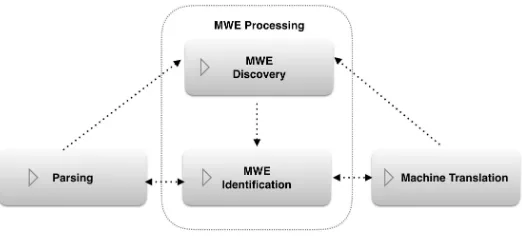
1.3.1 MWE Processing. MWE processing is composed of two main subtasks that are often confused in the literature:MWE discoveryandMWE identification(as shown in Figure 1). MWE discovery is concerned with findingnewMWEs (types) in text corpora, and storing them for future use in a repository of some kind such as a lexicon. In contrast, MWE identification is the process of automatically annotating MWEs (tokens) in running text by associating them with known MWEs (types).
The delineation of the two tasks seems fundamental to us because the results of both processes are distinct. The output of discovery is a list of MWE lexical entries, whereas for identification it is a list of annotations. We also distinguish them because they often use different approaches and evaluation strategies. Authors of new discovery methods tend to apply unsupervised techniques that are evaluated in terms of the quality of MWEs discovered. On the other hand, identification approaches are often based on supervised learning models whose results are evaluated by comparing automatically tagged text to reference annotations. An earlier proposal to define MWE processing listed classification and disambiguation as component tasks (Anastasiou et al. 2009). Our framework incorporates both of these concepts, with classification being included in discovery and disambiguation within identification. The two subtasks of MWE pro-cessing are further explained in Sections 2 and 3.
[image:7.486.58.319.518.637.2]We have observed much vagueness and high variability in the definition and nomenclature of these two subtasks in the literature, and hope that this survey will contribute to a more stable terminology in the future, thus easing comparisons between related approaches.
Figure 1
1.3.2 Use Cases.The article focuses on two use cases of MWE processing at the heart of language technology for which the correct handling of MWEs is equally crucial: parsing and MT. These uses were chosen because they are representative of past and current efforts to develop MWE-awareapplications. There have been some attempts to integrate MWE processing into other applications such as information retrieval and sentiment analysis, but we do not cover them in this survey.
Parsingis generally concerned with the definition of algorithms that map strings to grammatical structures. Although MWE-aware parsers represent only a small portion of the total parsing literature, we argue that proper MWE identification can improve parser performance (Cafferkey, Hogan, and van Genabith 2007). In particular, complex function words that have a key role in syntax may be ambiguous (e.g., by the way). Failing to identify MWEs will lead to parsing errors. Clearly, a key characteristic of all MWE-aware parsing algorithms is that theymustin some way have access to pre-existing MWE resources. There are many ways to represent such resources and to incorporate them into the parsing process and this gives rise to the observed variation in the design of such algorithms (Section 4).
MTis more complex than parsing insofar as it involves not only the identification of source MWEs but also their translation into the target language. Although phrase-based approaches aimed at capturing the translation of multiword units and may in principle handle contiguous MWE categories such as compounds, these approaches will certainly not be able to handle discontiguous MWEs, and neither will they cater for variants of MWEs, unseen in the training data. Attempts at MWE-aware MT have shown variable results, according to the category of MWE under consideration and the given language pair, but have proved beneficial in a number of cases (Pal, Naskar, and Bandyopadhyay 2013; Cap et al. 2015). As with parsing, pre-existing resources are necessary and there are several ways to integrate such resources in the translation process (Section 5).
Because the properties of MWEs represent challenges to one process, but opportuni-ties for another (Section 1.2), they induce a complex pattern of bidirectional interactions. Figure 1 gives an overview of the main support relations between the two processes involved in MWE processing and our two selected use cases.
The single arrows in Figure 1 indicate a support relationship. So the arrow from discovery to identification means that discovery supports identification in virtue of the lexical resources that discovery yields. Similarly, the arrows from MT and parsing to discovery indicate that the outputs of both parsing and MT have been shown to support discovery. Syntactic analysis can help deal with discontiguity, as exemplified above, and non-literal translations can serve as a cue for ranking non-compositional MWEs for discovery.9
The bidirectional arrows indicate two-way support. Parsing can support identifi-cation, for example, when a grammatical relationship must hold between MWE com-ponents. Translation can also support identification on the target side given a pair of parallel texts. The converse relations also hold. Identification can support parsing in that the identified MWE legitimates special treatment by the parser. It can also support the correct translation of an MWE identified on the source side.
Note that this picture shows the main support relations found in previous work only. Additional arrows are possible and in Section 6 we argue for a large-scale
Constant et al. MWE Processing: A Survey
evaluation over a systematic set of experiments that cover the less populated areas of the interaction landscape as well.
1.3.3 Orchestration. This complex set of interactions, and in particular the directions in which they operate, give rise to a variety of architectures that differ in how MWE processing is scheduled with respect to the use case. More precisely, they define whether MWE processing is done before (as preprocessing), after (aspostprocessing), or during (jointlywith) the given use case. Although joint systems perform both tasks simulta-neously, preprocessing and postprocessing can be seen as pipelines, in which the output of one process constitutes the input of the next one.
The following sections on MWE discovery, MWE identification, parsing, and MT further explain how the core tasks of MWE processing are incorporated into the use cases and vice versa. In particular, they develop the notion oforchestration, the effort of trying to find the best entry-point for one process to help the other—for example, the optimum moment to introduce MWE identification into the parsing pipeline.
The parsing literature reveals that authors have chosen different entry-points for MWE identification in the process. The choice of MWE identification before parsing, where methods are used to partly annotate words and sequences in advance, can reduce the search space of the parsing algorithm. Otherwise one can opt to do MWE identifi-cationafterparsing, allowing it to benefit from the available syntactic analysis. MWE identificationduringparsing has the benefit that several alternatives can be maintained and resolved with joint learning models.
We see alternative approaches to orchestration in the literature on MT as well. On the one hand, we find MWE identification before translation methods (the so-called static approaches) that concatenate MWEs as a preprocessing step or conversely split compositional closed compounds in Germanic languages to distinguish them from non-compositional compounds. On the other hand, we find MWE identificationduringthe translation process itself (so-called dynamic approaches).
1.3.4 Resources.Much of the glue that holds together the network of interactions shown in Figure 1 is composed of resources, which in the case of MWEs fall into three basic categories: lexical resources, (parallel) corpora, and treebanks. Lexical resources are essentially databases, and include MWE lexicons and general-purpose dictionaries con-taining MWE material. Both are useful for handling specific categories of MWE, such as multiword named entities (Steinberger et al. 2013), multiword terms, or idioms. Lexical resources are particularly effective for the identification of highly fixed MWEs. Otherwise, they may be combined with rules describing possible syntactic constraints within MWEs.
Corporaconsist of natural text, and may be annotated in different ways. Minimally, tags are simply used to delimit MWEs. Further information, concerning MWE cate-gories, for example, can be added as tag features. Progressively more refined informa-tion can approach the level of expressiveness found in treebanks. Examples of annotated corpora with MWE tags include Wiki50 (Vincze, Nagy, and Berend 2011), STREUSLE (Schneider et al. 2014b), and the PARSEME shared task corpora (Savary et al. 2017). Two or more corpora can also be set in correspondence. For example,parallel corpora
in different languages include sentence-level alignment and are used to detect many-to-many, one-many-to-many, or many-to-one translations. An example of MWE-annotated parallel corpus is the English–Hungarian SzegedParallelFX corpus (Vincze 2012).
systems and syntax-aware MT systems. In the literature, there exist different opinions on whether syntactically regular but semantically idiomatic MWEs should be identified in syntactic treebanks. Although the Penn Treebank designers prefer not to annotate verbal MWEs (Marcus, Marcinkiewicz, and Santorini 1993), these are annotated in the Prague Treebank (Bejˇcek et al. 2012). For example, whereas the syntactic structure within light-verb constructions such asto make a decisionis annotated with special MWE relations in the Prague Treebank, they are annotated as regular verb–object pairs in the Penn Treebank. Although, at the time of writing this survey, there is still not a universal standard for MWE annotation, one of the main goals of the PARSEME network is to develop annotation guidelines for MWE representation in both constituency and dependency treebanks. For an up-to-date status of the current annotations for different languages, see Rosén et al. (2015, 2016). Appendix A provides a complementary list of resources and tools for MWE processing.
Identification relies on lexical resources that can be either the fruit of discovery or hand-built. Both parsing and MT rely on lexical resources as well, either through a separate identification step or by using them internally. For example, MWE lexicons are important for MT within preprocessing, postprocessing, and translation phases of different paradigms: They are mainly used to delimit MWEs, replacing them by either a single token, a sense identifier, or by a translation equivalent before alignment takes place. In addition to lexicons, statistical parsing depends on treebanks annotated with MWEs, and MT relies on parallel corpora (or treebanks for syntax-aware MT) to retrieve translation equivalents for the MWEs it has identified.
1.4 Evaluation
The application of MWE identification in parsing and MT opens up possibilities for extrinsic evaluation of the former. By assessing the quality of parsers and MT sys-tems that incorporate various automatic MWE identification methods, and comparing results, the contribution of individual MWE identification methods can be estimated. Similarly, MWE discovery can be evaluated extrinsically by testing the usefulness of (semi-)automatically created MWE lists for identification. The intrinsic evaluation of MWE discovery and MWE identification, on which more details can be found in Sec-tions 2 and 3, is non-trivial, among other things because of the lack of available test data. Evaluating MWE processing extrinsically through the use cases of parsing and MT is an attractive alternative. However, as Sections 4 and 5 will further specify, caution is needed when measuring the impact of MWE identification on, for example, parsing quality. Depending on the type of orchestration at hand, different evaluation strategies should be adopted in order to avoid misleading conclusions.
1.5 Structure of This Article
Constant et al. MWE Processing: A Survey
to several possible orchestration scenarios and position previous work with respect to this timing issue. The final section (Section 6) offers conclusions and future perspectives.
2. MWE Discovery
Our survey focuses on interactions of MWE processing with parsing and MT. However, we cannot discuss these interactions without providing an overview of approaches in discovery and identification. Other surveys on these tasks have been previously pub-lished (Baldwin and Kim 2010; Seretan 2011; Ramisch 2015). Our main contributions are to cover the latest advances and group references across languages and MWE categories according to each method’s characteristics. Hence, the goal of this section is to define MWE discovery and provide a concise overview of the current state of affairs.
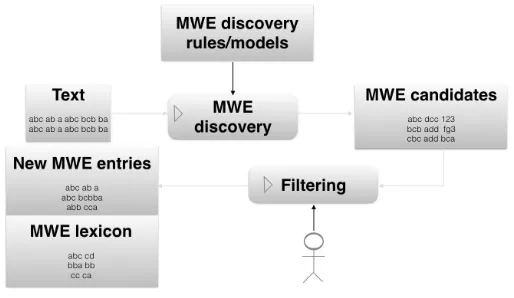
This section describes existing approaches for MWE discovery. As defined in Sec-tion 1.3, discovery is a process that takes as input a text and generates a list of MWE candidates, which can be further filtered by human experts before their integration into lexical resources. This process is depicted in Figure 2.
Automatic MWE discovery (hereafter simply referred to asdiscovery) has been an active research topic since the end of the 1980s when a number of seminal papers were published (Choueka 1988; Church and Hanks 1990). The famous “pain-in-the-neck” paper (Sag et al. 2002) and the related MWE workshops (Bond et al. 2003) have put discovery in focus as one of the main bottlenecks of NLP technology. Since then, con-siderable progress has been made, notably in the context of national and international research projects like PARSEME (Savary et al. 2015).
[image:11.486.63.320.488.637.2]Whereas discovery methods generate lists of MWE types out of context, MWE identification marks MWE tokens in running text. However, several terms have been used to designate what we have defined asdiscoveryin our conceptual framework (Sec-tion 1.3), such asidentification,extraction,acquisition, dictionary induction, and learning. Because one of the aims of this article is to clearly delineate the tasks of, on the one hand, discovering MWE types, and on the other, identifying MWE tokens in running text (Section 3), discovery seemed the most suitable term at the right level of specificity. Our survey focuses on empirical strategies for MWE discovery as opposed to expert lexicon constructionby human language experts.Empiricalmethods try to automatically learn lexical information from textual data. In practice, empirical and expert methods
Figure 2
are complementary and both can be combined when one builds a lexical resource, as indicated by the human intervention in Figure 2.
Most discovery methods leverage characteristics of MWEs (Section 2.1) to design measures, rules, and heuristics for discovering new MWEs in data. For example, col-location strength is exploited by methods measuring the association between tokens to distinguish MWEs from regular phrases. In addition, supervised machine learning relies on annotated data, using linguistic knowledge for feature engineering.
2.1 Motivations and Challenges for MWE Discovery
Because of the prevalence and productivity of MWEs, discovery methods are indispens-able. They are used to speed up expert lexicon creation or to update existing lexicons with novel entries that are created constantly. Robust NLP systems rely on unsupervised or semi-supervised methods to discover new expressions as they are coined or become popular. Discovery enables identification, as shown by the arrow going from discovery to identification in Figure 1. In other words, discovery helps extending and creating lexicons that are used in identification. However, there are also some challenges in MWE discovery, the most relevant of which arediscontiguityandvariability.
Discontiguity.Discovering flexible constructions, like verbal expressions, is a chal-lenge because of their discontinuous nature. A discovery method must be able to locate all the elements of the MWE even if they are separated by arbitrary intervening material. Discontiguity is generally dealt with when parsing the input corpus prior to MWE discovery (Section 4.1). However, syntactic analysis may introduce ambiguities because some MWEs do not allow arbitrary modification and will be wrongly merged with literal uses or accidental cooccurrence (to take turns does not mean that one deviates from a straight trajectory several times. It means that two or more people do something alternately).10
Variability. Especially in morphologically rich languages, variability poses prob-lems at various levels. Returning several variants of the same MWE slows down manual filtering as the same MWE is presented several times to lexicographers. For empirical methods, variability increases data sparsity. For example, conflating all variants into a single MWE candidate results in more reliable association estimators. Variability can also be partly addressed by linguistic analysis. For example, variant conflation often requires lemmatization in order to merge inflections. Nonetheless, some problems remain because automatic POS taggers, lemmatizers, and parsers are not perfect. As a consequence, current discovery methods generally yield rough material for lexicon construction that generally requires a good deal of polishing before becoming useful.
2.2 Main MWE Discovery Methods
Some methods are designed to deal with specific categories of MWEs, for instance, focusing on noun compounds (Girju et al. 2005; Salehi, Cook, and Baldwin 2015), light-verb constructions (Stevenson, Fazly, and North 2004), or light-verb-particle constructions (McCarthy, Keller, and Carroll 2003; Ramisch et al. 2008b). Others are generic and deal uniformly with many MWE categories (da Silva et al. 1999; Seretan 2011). In any case,
Constant et al. MWE Processing: A Survey
discovery methods can be differentiated according to the linguistic properties of MWEs that they leverage, some of which have already been discussed (Section 1.2).
r
Collocation. Words that are part of an MWE tend to co-occur more oftenthan expected by chance. This property is generally modeled by methods based on association measures such as prominent co-occurrence
(Section 2.2.1).
r
Non-substitutability. It is not possible to replace part of an expression bya synonym or similar word. This property is generally modeled by variability or fixedness measures (Section 2.2.2).
r
Non-compositionality. The meaning of the whole expression cannot beinferred from the meanings of its parts. This property is generally leveraged by models based on vector-space semantic similarity (Section 2.2.3).
r
Non-literal translatability. Word-for-word translation tends to generateunnatural, ungrammatical and sometimes nonsensical results.
Monolingual and multilingual discovery methods based on translation asymmetries use techniques inspired from MT, and are thus presented later (Section 5.2.1).
These properties are not orthogonal. For example, non-literal translation and substitutability are side-effects of compositionality, and because non-compositionality is hard to model, such derived properties are additionally used in discovery.
The use of morphosyntactic and syntactic patterns is quite common to generate a first list ofMWE candidates11 of a specific category. For instance, a list of candidate nominal compounds in English can be obtained by looking for nouns preceded by other nouns or adjectives. Justeson and Katz (1995) suggest a limited set of seven bigram and trigram POS patterns, combining nouns and adjectives, in order to discover nominal compound candidates in English. Baldwin (2005) investigates the use of increasingly sophisticated morphosyntactic and syntactic patterns to discover new verb-particle constructions in English.
Because such patterns are used as a preprocessing technique by many discovery strategies presented in the remainder of this section, we do not discuss them in detail. The benefits of using POS-taggers and parsers to help discovery is represented by the unidirectional arrow from parsing to discovery in Figure 1 and will be discussed further in Section 4.2.1.
2.2.1 Association Measures.Prominent co-occurrence, that is, collocation, is the simplest MWE property to model in computational systems. It can be accurately captured by statisticalassociation measures, which estimate the association strength between words in a corpus based on their co-occurrence count and on their individual word counts. Most measures take into account the observed co-occurrence count of a group of n words w1, w2 . . .wn compared with its expected count. The expected co-occurrence
count is based on the assumption that words are independent, that is, it equals the product of their individual word probabilities.12
A popular association measure in MWE discovery ispointwise mutual informa-tion. It was first proposed in terminology discovery by Church and Hanks (1990), and can be expressed as the log-ratio between observed and expected counts. Values close to zero indicate independence and the candidate words are discarded, whereas large values indicate probable MWEs. Other measures are based on hypothesis testing. If we assume as null hypothesis that words are independent, their observed and expected counts should be identical. Using a test statistic like Student’s t, large values are strong evidence to reject the independence null hypothesis, that is, the candidate words are not independent and probably form an MWE.
More sophisticated test statistics for two-word MWE candidates take into account theircontingency table. Examples of such measures areχ2and the more robust likelihood ratio (Dunning 1993). Pedersen (1996) suggests using Fisher’s exact test in automatic MWE discovery, and this measure is implemented among others in the Text:NSP pack-age.13Another measure for MWE discovery is the average and standard deviation of the distance between words, implemented in Xtract (Smadja 1993). Because these measures are based on frequency counts, there have been some studies to use Web hits as an alternative to corpus counts, in order to avoid low-frequency estimates (Keller and Lapata 2003; Ramisch et al. 2008a).
Although association measures work quite well for two-word expressions, they are hard to generalize to arbitrary n-word MWE candidates. One simple approach is to merge two-word MWEs as single tokens and then apply the measure recursively. For instance, in French, the MWE faire un faux pas (lit. to make a false step, ’to make a blunder’) can be modeled as the verb faire(to make) combined with the compound faux_pas(blunder), which had been merged due to high association in a previous pass (Seretan 2011). The LocalMaxs algorithm finds optimal MWE boundaries by recursively including left and right context words, stopping when the association decreases (da Silva et al. 1999).14A similar approach, using a lexical tightness measure, was proposed to segment Chinese MWEs (Ren et al. 2009).
Association measures can be adapted according to the morphosyntactic nature of lexical elements. Hoang, Kim, and Kan (2009) propose new measures where very frequent words such as prepositions are weighted differently from regular tokens. Com-parisons between different association measures have been published, but to date no single best measure has been identified (Pearce 2002; Evert 2005; Pecina 2008; Ramisch, De Araujo, and Villavicencio 2012).
2.2.2 Substitution and Insertion. A French kiss cannot be referred to as a kiss that is French, akiss from France, or aFrench smack, unlike non-MWE combinations likeFrench painter and passionate kiss. Because of their non-compositionality, MWEs exhibit
non-substitutability, that is, limited morphosyntactic and semantic variability. Thus, the replacement or modification of individual words of an MWE often results in unpre-dictable meaning shifts or invalid combinations. This property is the basis of discovery methods based on substitution and insertion (including permutation, syntactic alterna-tions, etc.).
12 For more details on association measures, seehttp://www.collocations.de, Evert (2005), and Pecina
(2008).
13http://search.cpan.org/dist/Text-NSP/.
Constant et al. MWE Processing: A Survey
Pearce’s (2001) early synonym substitution method replaces parts of the MWE by synonyms obtained from WordNet, and then obtains frequencies for the artificially generated MWE variants from external sources. Instead of using variant frequencies directly, it is possible to estimate an MWE candidate’s frequency using a weighted sum of variant corpus frequencies (Lapata and Lascarides 2003) or Web-based frequencies (Keller and Lapata 2003). A similar approach is used by Villavicencio et al. (2007) and Ramisch et al. (2008a), but instead of synonym variations, the authors generate syntactic permutations by reordering words inside the MWE, combining frequencies using an entropy measure. Artificially generated variants can be transformed into features for supervised discovery methods, as we will see in Section 2.2.4 (Lapata and Lascarides 2003; Ramisch et al. 2008a).
Methods based on variant generation and/or lookup were used to discover several MWE categories, such as English verb-particle constructions (McCarthy, Keller, and Carroll 2003; Ramisch et al. 2008b), English verb-noun idioms (Fazly and Stevenson 2006; Cook, Fazly, and Stevenson 2007), English noun compounds (Farahmand and Henderson 2016), and German noun-verb and noun-PP idioms (Weller and Heid 2010). Such methods often require external lexicons or grammars describing possible vari-ants, like synonym lists or local reorderings (e.g.,Noun1Noun2→Noun2of Noun1). Syn-onyms or related words in substitution methods can come from thesauri like a WordNet and VerbNet (Pearce 2001; Ramisch et al. 2008b). Related words can be found in auto-matically compiled thesauri built using distributional vectors (Riedl and Biemann 2015; Farahmand and Henderson 2016). When compared with association measures, most of these methods are hard to generalize, as they model specific limitations that depend on the language and MWE category.
2.2.3 Semantic Similarity.Models based onsemanticsaccount for the fact that many MWE categories are partly or fullynon-compositional. Because the meaning of the parts does not add up to the meaning of the whole, there should be little similarity between the computational-semantic representation of MWEs and of words that constitute them. For instance, let us consider the itemscat,dog,hot dog, andsandwich. We would expect thatdogis similar tocat,dogis not similar tohot dog, andhot dogis similar tosandwich.
Semantic similarity methods differ mainly in how they represent word and MWE senses, how they combine senses, and how they measure similarity. Word and MWE senses can be modeled using entries of semantic lexicons like WordNet synsets (McCarthy, Venkatapathy, and Joshi 2007). However, most discovery methods use dis-tributional models (or word embeddings) instead, where senses are represented as vectors of co-occurring context words (Baldwin et al. 2003; Korkontzelos 2011). The creation of such vectors in distributional models has several parameters that affect the performance of MWE discovery, such as the number of vector dimensions and the type of context window (Cordeiro et al. 2016). The evaluation of discovery methods based on distributional similarity can use dedicated test sets (Reddy, McCarthy, and Manandhar 2011; Farahmand and Henderson 2016) or use handbuilt resources such as WordNet (Baldwin et al. 2003).
distributional neighbors tend to be single words. Therefore, their method can be classi-fied both as a substitution-based method (replace an MWE by a single word in context) and as a semantic similarity method.
There are several ways to combine and compare distributional vectors for MWE discovery. McCarthy, Keller, and Carroll (2003) consider the overlap between the set of distributional neighbors of a verb-particle construction and its single-verb counterpart. For instance, if to break up and to breakshare many neighbors, then to break up must be more compositional than to give up, which has no shared neighbor with to give (Baldwin et al. 2003). A popular measure to discover idiomatic MWEs is the cosine similarity between the MWE vector and the member word vectors (Baldwin et al. 2003; Reddy, McCarthy, and Manandhar 2011). Salehi, Cook, and Baldwin (2015) compare two similarity measures: (a) the weighted average similarity of the MWE vector with its member word vectors, and (b) the similarity between the MWE vector and the average vector of the component words.
Semantic similarity methods have been successfully evaluated on small samples of verb-particle constructions (Baldwin et al. 2003; Bannard 2005), verb-noun idioms (McCarthy, Venkatapathy, and Joshi 2007), and noun compounds (Reddy, McCarthy, and Manandhar 2011; Yazdani, Farahmand, and Henderson 2015; Cordeiro et al. 2016). Their adaptation to large-scale discovery remains to be demonstrated.
2.2.4 Supervised Learning.Supervised learning approaches for discovery use annotated data sets as training material to learn how to distinguish regular word combinations from MWEs. Often, the features used in supervised methods include scores derived from unsupervised methods discussed above, such as association measures and seman-tic similarity.
The use of these as features has proven to be an effective way to combine scores, giving more weight to more discriminating features and reducing the weight of redun-dant ones (Ramisch et al. 2008a). It also provides a workaround for the problem of choosing a scoring method for a given data set among dozens of methods proposed in the literature. Furthermore, the learned models can provide insight into features’ informativeness (Ramisch et al. 2008b).
One of the first experiments using a supervised approach was proposed by Lapata and Lascarides (2003). The authors use a C4.5 decision tree to classify noun-noun compounds into true MWEs and random co-occurrence. Logistic regression, linear discriminant analysis, support vector machines, and neural networks have been used as classifiers for collocation discovery in Czech and German (Pecina 2008). Rondon, Caseli, and Ramisch (2015) propose an iterative method for the perpetual discovery of novel MWEs. The system requires some initial supervision to build a seed MWE lexicon and classifier, and incrementally enriches it by mining texts in the web and bootstrapping from its results.
Constant et al. MWE Processing: A Survey
2.3 Evaluation of MWE Discovery
Discovery is a process whose goal is to findnewlexical entries. Its evaluation is tricky because the utility and relevance of these entries is hard to assess. Most discovery methods output ranked MWE lists, which can be evaluated as follows:
r
Post hoc human judgments: Given the topnMWEs retrieved by amethod, experts select the relevant ones. The proportion of positive entries found is used to evaluate the method (da Silva et al. 1999; Seretan 2011).
r
Dictionaries: The returned list can be automatically evaluated by checkingthe entries already present in a gold standard dictionary. This assumes that entries absent from the dictionary are wrong (Ramisch, De Araujo, and Villavicencio 2012; Riedl and Biemann 2015).
r
Dedicated data sets: Given a list of known positive and negative MWEexamples, true MWEs should be ranked first. This can be seen as an information retrieval problem, and measures like average precision, precision atk, recall, and F1 can be used to evaluate the discovery method (Evert 2009; Pecina 2008; Yazdani, Farahmand, and Henderson 2015).
r
Extrinsic evaluation: Because evaluating discovered lexical entries istricky, we can evaluate the performance of downstream tasks that use them, such as identification (Riedl and Biemann 2016), parsing (Villavicencio et al. 2007), and MT (Costa-Jussà, Daudaravicius, and Banchs 2010). In this case, not only discovery but also integration into the target application is evaluated. Noise in discovery’s output often prevents integrated systems from showing significant performance gains. Extrinsic evaluation is further discussed in the following sections.
2.4 Open Issues in MWE Discovery
Association measures work well with two-word MWEs, but not straightforwardly for longer chunks, especially for measures relying on contingency tables (Banerjee and Pedersen 2003). Nesting and variability also pose problems for their use. Moreover, results are not systematically corroborated and the success of an association measure seems to be heavily dependent on corpus size, nature, and MWE category (Dunning 1993; Pearce 2002; Evert 2005; Pecina 2010).
Substitution and semantic similarity methods require large corpora with many occurrences of the target MWEs. In this kind of approach, discovery is often modeled as a task that consists of finding non-compositional combinations among a list of candidate MWEs. Therefore, their evaluation often requires data sets annotated with semantic compositionality, which are not easy to build. Even though such resources do exist, they are rare and often quite small, mainly available for English, with a few exceptions including nominal compounds in German (Schulte im Walde, Müller, and Roller 2013) and French (Cordeiro et al. 2016).
Figure 3
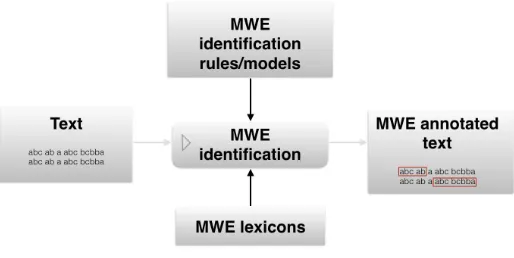
MWE identification: find occurrences of MWEs in running text.
languages. Finally, there has been little work on placing discovery methods back into the bigger picture—in other words, comparing discovery with manual lexicon construction. Therefore, it remains unclear whether discovery is required or even useful to support and/or replace lexicographic work in production scenarios.
One promising alternative is the extrinsic evaluation of discovery to help down-stream tasks. Although some authors show that discovery can help MT quality (Costa-Jussà, Daudaravicius, and Banchs 2010), research on identification and MWE-aware parsing strongly relies on handcrafted lexicons (Schneider et al. 2014a; Constant and Nivre 2016) and rarely uses discovery results (Riedl and Biemann 2016). This is often due to a mismatch between discovered MWEs and test sets, and to the difficulty in integrating such noisy lexicons into applications. As a consequence, it is rare to observe convincing performance gains in downstream tasks. We believe that future research should focus on developing extrinsic evaluation measures, test sets, and guidelines for MWE discovery.
3. MWE Identification
The last section reviewed previous work in discovery, the first subtask of MWE process-ing as defined in the framework presented in Section 1.3. We now turn to MWE identi-fication, the second subtask that, together with discovery, constitutes MWE processing. It has often been considered as a preprocessing step for parsing and MT systems. Many NLP systems perform some sort of MWE identification using a lexicon and direct string matching. This, is often not enough however (Section 3.1). MWE identification takes a corpus as input and adds a layer of annotation indicating where MWE instances occur. The identification process sometimes requires additional input, in the form of MWE lexicons and rules (or models) for detecting MWE instances, as shown in Figure 3. These lexicons may result from automatic MWE discovery (see Figure 1). Identification is in some ways similar to named entity recognition, but MWEs must have at least two words,15and some MWEs can be discontiguous.
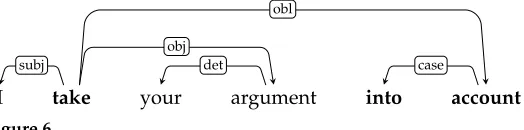
A system that performs automatic MWE identification is often called an MWE tagger. Suppose the input of an MWE tagger is the first row of Figure 4 (which for
Constant et al. MWE Processing: A Survey
[image:19.486.55.434.67.105.2]Computational Linguistics Volume xx, Number xx
Figure 3
MWE identification - find occurrences of MWEs in running text.
Now that I looked the dirty word up , I understand .
1 1 2 3 3 2
B I O B o b i I O O O O
Figure 4
Example of sentence in which MWEs are identified (in bold) - and corresponding IOB encoding after Schneider et al. (2014a). The first token of an MWE is tagged with uppercaseB, the following ones with uppercaseI, uppercaseOmarks tokens not belonging to any MWE, lowercaseoindicates non-MWE tokens inside MWE gaps and lowercasebandiare used for embedded MWEs. The second row shows token-based MWE identifiers, after Savary et al. (2017).
should focus on developing extrinsic evaluation measures, test sets, and guidelines for MWE discovery.
3. MWE Identification
The last section reviewed previous work in discovery, the first subtask of MWE process-ing as defined in the framework presented in Section 1.3. We now turn to MWE identi-fication, the second subtask that, together with discovery, constitutes MWE processing. It has often been considered as a preprocessing step for parsing and MT systems. Many NLP systems perform some sort of MWE identification using a lexicon and direct string matching. This, however, is often not enough (Sec. 3.1). MWE identification takes a corpus as input and adds a layer of annotation indicating where MWE instances occur. The identification process sometimes requires additional input, in the form of MWE lexicons and rules (or models) for detecting MWE instances, as shown in Figure 3. These lexicons may result from automatic MWE discovery (see Figure 1). Identification is in some ways similar to named entity recognition, but MWEs must have at least two words,15and some MWEs can be discontiguous.
A system that performs automatic MWE identification is often called an MWE tagger. Suppose the input of an MWE tagger is the first row of Figure 4 (which for clarity omits output from initial annotation layers like automatic POS tags or syntactic
15 Note that some MWEs are formed by two or more words but form only one token, such as closed compounds.
18
Figure 4
Example of sentence in which MWEs are identified (inbold) - and corresponding IOB encoding after Schneider et al. (2014a). The first token of an MWE is tagged with uppercaseB, the
following ones with uppercaseI, uppercaseOmarks tokens not belonging to any MWE,
lowercaseoindicates non-MWE tokens inside MWE gaps, and lowercasebandiare used for
embedded MWEs. The second row shows token-based MWE identifiers, after Savary et al. (2017).
clarity omits output from initial annotation layers like automatic POS tags or syntactic trees). The expected output is an annotation layer indicating which tokens are part of MWEs (words in bold). The second row provides identifiers that distinguish different MWEs occurring in the same sentence. The MWE tagger might also provide some sort of classification, for example, indicating that the first MWE is acomplex conjunction, the second one is averb-particle construction, and so on. However, to obtain such output, certain challenges must be addressed.
3.1 Motivations and Challenges for MWE Identification
Identification is important for many NLP applications including both parsing and MT. A parser will have to deal with less ambiguity if some MWEs are identified. For in-stance, the wordgreenhas two possible attachments ingreen card office, but if we identify green cardas a single unit, the ambiguity is eliminated. An MT system can also benefit from MWE identification since many MWEs have no word-for-word translation. For instance, translatinggreen cardas a phrase prevents invalid reordering likegreen office for cards.
More generally, identification benefits other tasks involving semantic processing. Semantic parsing and role-labeling systems can consider light-verb constructions and idioms to build predicate-argument structures (Bonial et al. 2014; Jagfeld and van der Plas 2015). For example, in the light-verb construction to take care, the noun care ex-presses the actual semantic predicate, whereas the verb only links the subject with the nominal predicate (it is semantically “light”). Whereas a syntactic parser should con-sider thatcareis a syntactic argument ofto take, a semantic parser predicting argument structure would preferably identify the nouncareas the predicate rather than consider-ing the verbto takeas a predicate, withcareas one of its semantic arguments. Information retrieval systems can use MWEs as indexing keyphrases. Word sense disambiguation systems can avoid assigning spurious labels to individual words of MWEs (e.g.,dryin dry run). The issue of what stage to introduce identification into the processing pipeline of these applications leads to several orchestration scenarios that are discussed in detail in Sections 4.2 and 5.2.
Overlaps. A discontiguous MWE can have other nested MWEs in between its components, likedirty wordas the direct object oflook up. This is especially problematic for systems that use IOB encoding, as exemplified in row 3, which addresses the segmentation problem with tagsB, for begin,Ifor inside,O, for outside (Ramshaw and Marcus 1995). Often, nesting demands multi-level tags, otherwise different segments could be mixed up. For instance,wordandupwould have subsequentItags, although they are not part of the same MWE. In the example, outer MWEs use capitalIOBtags and inner MWEs use lowercaseiobtags, following the tagging scheme proposed by Schneider et al. (2014a).
Nesting is a particular case of overlap, whereby MWEs can also share tokens in a sentence. For instance, the verb-particle construction to let out can be contained in the idiomto let the cat out of the bag. If the MWE tagger cannot output more than one MWE identifier per token, it cannot model overlap. One possible workaround would be always choosing the longest sequence. However, this will not work if MWEs share several tokens, but one MWE is not a factor of the other one despite sharing some elements, as in coordinated structures such asHe took a walk and a shower.
Ambiguity.Even if an MWE tagger has access to a lexicon containing the MWEs now that,look up, anddirty word, it may be totally plausible to use these expressions with their literal meaning: for example,I realize now that he never looks up at me when I speak. The use of parsers often helps solve these ambiguities (Section 4.1).
Variability. Some expressions have variable parts or impose non-lexicalized con-straints on other elements of the sentence. It might be hard to distinguish elements that are part of an MWE from those that are not. For example, in have one’s sayand give oneself up, it is unclear whether the possessive and reflexive clitics are part of the MWE. Morphological analysis and parsing may help identify canonical forms and normalize word order (Section 4.1).
3.2 Main MWE Identification Methods
We distinguish four techniques used in the literature for MWE identification. Rule-based methodsapply rules of various levels of sophistication to project MWE lexicons onto corpora (Section 3.2.1).Classifierstypically used for word sense disambiguation can be adapted to token-based MWE classification using contextual features (Sec-tion 3.2.2).Sequence tagging models, inspired by POS-tagging, chunking, and named entity recognition, can be learned from manually annotated corpora using supervised techniques (Section 3.2.3). Identification can also be performed as a by-product of pars-ing, as discussed further in Section 4.
3.2.1 Rule-Based Methods.Rules can be as simple as direct matching, but can also use more sophisticated, context-sensitive constraints encoded as finite-state transducers for instance. Historically, rules based on finite-state transducers offered a simple generic framework to deal with variability, discontiguity, and ambiguity (Gross 1989; Breidt, Segond, and Valetto 1996). Identification methods for contiguous MWEs such as open compounds are generally based on dictionaries compiled into finite-state transducers. Standard pattern matching algorithms for finite-state transducers are then applied to the text to identify MWEs. These approaches have two advantages: Dictionaries are compressed using minimization algorithms and matching is extremely efficient in terms of time complexity.
Constant et al. MWE Processing: A Survey
rules. An example of this approach is integrated in the MT system Apertium (Forcada et al. 2011). The variable part of MWE lexical entries, as the verbecharin the Spanish expressionechar de menos(lit.throw from less, ’to miss’), is inflected according to a regular verbal inflection paradigm. The inflection process may be based on finite-state trans-ducers as in Silberztein (1997), possibly augmented with a unification mechanism for handling agreement between the MWE components (Savary 2009). These approaches are extremely precise, but costly. The manual assignment of inflection rules may be eased by tools like Leximir for predicting inflection classes (Krstev et al. 2013).
Another approach comprises two processing stages: morphological analysis of sim-ple words followed by a composition of regular rules to identify MWEs, as in Oflazer, Çetino˘glu, and Say (2004) for Turkish. Breidt, Segond, and Valetto (1996) design regular rules that handle morphological variations and restrictions like the French idiomperdre ADV* :la :tˆete (lit. lose ADV* :the :head, ’to lose one’s mind’),16 lexical and structural variations (birth date = date of birth). Copestake et al. (2002) design an MWE lexicon for English based on typed feature structures that may rely on analysis of internal words of MWE. Silberztein (1997) also proposes the use of local grammars in the form of equivalence graphs. These approaches are very efficient in dealing with variability and short-distance discontiguity.
Constraints encoded in the lexicon, such as obligatory or forbidden transformations, can be projected on text to disambiguate idiomatic constructions. Hashimoto, Sato, and Utsuro (2006) encode in a lexicon detailed properties of 100 Japanese verb-noun ambiguous idioms such as voice, adnominal modifications, modality, and selectional restrictions. Then, they only classify as idioms those occurrences that match the con-straints in a dependency-parsed test set.
More recent approaches to rule-based identification use dictionaries containing canonical MWE forms with no additional constraints. They consist of two stages: (1) POS tagging and lemmatizing the text and (2) performing dictionary lookup (Carpuat and Diab 2010; Ghoneim and Diab 2013). The lookup relies on a maximum forward matching algorithm that locates the longest matching MWE. This simple method han-dles morphological variants of the MWEs, but tends to overgenerate them. This over-generation is due to strong morphological constraints on some elements or agreement. For instance, the French idiomprendre la porte(lit. take the door) meaningget sackedhas a strong morphological constraint: the nounporte(door) must be in the singular; if it is in the plural, the sequence has its literal meaning. Therefore, using lemmas to identify variants is a potential source of mistakes.
To handle discontiguity, it is possible to apply patterns on such preprocessed texts, including wildcards. For instance, Ramisch, Besacier, and Kobzar (2013) identify discon-tiguous verb-particle constructions in English made of a verb + at most five words + a particle, adapting the discovery method proposed by Baldwin (2005). General tools for deterministic MWE annotation like the mwetoolkit (Ramisch 2015)17allow fine tuning of matching heuristics, minimum and maximum gap size, surrounding POS patterns, and local variants. For example, it is possible to identify verb-particle constructions in which the particlesup ordown appear not further than five words after a content verb, constraining intervening words not to be verbs and the next word not to be the wordthere(to avoid regular verbs followed byup/down there). The corresponding
multi-level regular expression in the mwetoolkit syntax would be [pos∼/VV.*/] [pos!∼/V.*/]{repeat={0,5}} [lemma∼/(up|down)/] [lemma!=there].18
Some rule-based identification approaches output ambiguous MWE segmentation, postponing disambiguation until more linguistic context is available (Chanod and Tapanainen 1996). The MWE identification process often generates acyclic finite-state automata representing all possible segmentations for a given input sentence. Some finite state preprocessing tools allow ambiguous lexical analyses, like Intex, Macaon, Nooj, SxPipe, and Unitex.19 This approach can be used as a preprocessing stage of MWE-aware parsing (Section 4) and as a source of features for sequence-tagging identification (Section 3.2.3).
3.2.2 Sense Disambiguation Methods. Methods inspired by word sense disambiguation treat MWE identification as a specialized in-context classification task. Given a candi-date combination in context, the classifier must decide whether it is a true MWE or just a regular co-occurrence. Common features for this task include surrounding words, their POS, lemmas, syntactic characteristics, and distributional information. Such methods often do not cover the identification of candidates. They assume that another process pre-identifies potentially idiosyncratic combinations, and instead focus on detecting which of these are true MWEs. We discuss both supervised and unsupervised classifiers. Uchiyama, Baldwin, and Ishizaki (2005) tackle the problem of identifying Japanese verb compounds. Sense labels correspond to the meaning added by the second verb (as-pectual, spatial, adverbial) with respect to the first verb. Their support vector machine guesses the possible semantic classes of a given verb combination, using the semantic classes of other co-occurring verbs as features. Then, in a second step, identification proper is done simply by taking the most frequent sense.
Hashimoto and Kawahara (2008) propose a supervised disambiguation system able to distinguish literal from idiomatic uses of Japanese idioms. Fothergill and Baldwin (2012) perform an extended evaluation using the same data set and methodology, including new features, a feature ablation study, and cross-idiom tests. Similar ap-proaches based on support vector machines and surface-level features have also been proposed for English light-verb constructions and verb-particle constructions (Tu 2012). Birke and Sarkar (2006) present a nearly unsupervised system capable of distin-guishing literal from non-literal verb uses. It uses a clustering strategy that tries to maximize transitive similarity with the seed set of literal or non-literal sentences using standard features. Sporleder and Li (2009) propose a completely unsupervised method based on lexical chains and text cohesion graphs. Their classifier considers an expression as literal if its presence in the sentence does not have a negative impact on cohesion, de-fined as the similarity between co-occurring words. For instance,play with firereinforces cohesion in a sentence containinggrilling,coals, andcookingbut it would reduce lexical cohesion in a chain containingdiplomacy,minister, andaccuse.
18 This pattern describes a sequence of lexical items. Every lexical item is defined between square brackets by using different linguistic features (e.g.,lemma,pos). The feature value can be set using exact string matching (operator=) or regular expression matching (operator∼), and both can be negated (operator !). For instance, [pos!∼/V.*/] indicates any item whose part of speech is not prefixed byV; [lemma!=there] indicates any item whose lemma is not the stringthere. Every lexical item occurs once by default. In case of potential multiple occurrences, it is followed by arepeatfeature (between curly brackets) indicating the number of times it can occur as a range (here, [pos!∼/V.*/] can occur between 0 and 5 times).
Constant et al. MWE Processing: A Survey
Katz and Giesbrecht (2006), detecting idiomatic verb-noun expressions in German, assume that the context of an idiomatic MWE differs from the contexts of its literal uses. Given two distributional vectors representing literal and idiomatic instances, a test instance is classified according to its similarity to the respective vectors. Cook, Fazly, and Stevenson (2007) propose a similar method based on canonical forms learned automatically from large corpora. Once a canonical form is recognized, distributional vectors for canonical and non-canonical forms are learned and then an instance is classified as idiomatic if it is closer to the canonical form vectors.
Boukobza and Rappoport (2009) mix the supervised and unsupervised approach of Fazly, Cook, and Stevenson (2009) into a single supervised method to identify English verbal MWEs. In addition to literal and idiomatic uses, they also discuss and model accidental co-occurrence in which the member words of an MWE appear together only by chance, proposing the use of specialized multi-way support vector machines for each target candidate. Besides surface contextual features, they exploit the use of automatically obtained syntactic dependencies as features, which sometimes improves precision.
3.2.3 Sequence Tagging.It is possible to build MWE taggers from annotated corpora using supervised structured learning. MWE taggers that model identification as a tagging problem use stochastic models such as conditional random fields, structured percep-tron, or structured support vector machines combined with an IOBlabeling scheme (see Figure 4) to predict MWE labels, given the local context, token-level features, and sometimes external resources.
Blunsom and Baldwin (2006), whose work’s main purpose is to acquire new tagged lexical items for two head-driven phrase structuregrammars (ERG for English and JACY for Japanese), propose a supertagging approach based on conditional random fields to assign lexical types to the tokens of an input sequence using a pseudo-likelihood method that accommodates large tag sets. The proposed approach only enables the identification of contiguous MWEs.
This work is very close to methods for joint (contiguous) MWE identification and POS tagging based on linear conditional random fields (Constant and Sigogne 2011; Shigeto et al. 2013). Their tagging scheme concatenates lexical segmentation information (B and I tags for the IOB tag set) with the POS tag of the lexical unit to which the current token belongs. Constant and Sigogne (2011) trained and evaluated their models on the French Treebank, and Shigeto et al. (2013) worked on a modified version of the Penn Treebank onto which complex function words from Wiktionary were projected.
Some MWE taggers concentrate on the identification task only, using an IOB-like annotation scheme (Vincze, Nagy, and Berend 2011; Constant, Sigogne, and Watrin 2012; Schneider et al. 2014a). Vincze, Nagy, and Berend (2011) and Constant, Sigogne, and Watrin (2012) handle contiguous MWEs using conditional random fields. Diab and Bhutada (2009) use sequential taggers based on support vector machines to identify idiomatic verb-noun constructions. In addition to traditional features like left and right words, lemmas, and charactern-grams, they also use multiword named entity place-holders. Schneider et al. (2014a) introduce a slightly more complex tagging scheme, allowing gaps and one-level nesting as shown in Figure 4. They use a linear model trained with the perceptron algorithm.