The Impact of Multiword Expression Compositionality on Machine
Translation Evaluation
Bahar Salehi,♠♣Nitika Mathur,♠Paul Cook♥and Timothy Baldwin♠♣ ♣NICTA Victoria Research Laboratory
♠Department of Computing and Information Systems The University of Melbourne
Victoria 3010, Australia ♥Faculty of Computer Science
University of New Brunswick Fredericton, NB E3B 5A3, Canada
{bsalehi,nmathur}@student.unimelb.edu.au, [email protected], [email protected]
Abstract
In this paper, we present the first attempt to integrate predicted compositionality scores of multiword expressions into automatic ma-chine translation evaluation, in integrating compositionality scores for English noun compounds into the TESLA machine trans-lation evaluation metric. The attempt is marginally successful, and we speculate on whether a larger-scale attempt is likely to have greater impact.
1 Introduction
While the explicit identification of multiword ex-pressions (“MWEs”: Sag et al. (2002), Baldwin and Kim (2009)) has been shown to be useful in various NLP applications (Ramisch, 2012), recent work has shown that automatic prediction of the degree of compositionality of MWEs also has util-ity, in applications including information retrieval (“IR”: Acosta et al. (2011)) and machine transla-tion (“MT”: Weller et al. (2014), Carpuat and Diab (2010) and Venkatapathy and Joshi (2006)). For instance, Acosta et al. (2011) showed that by con-sidering non-compositional MWEs as a single unit, the effectiveness of document ranking in an IR sys-tem improves, and Carpuat and Diab (2010) showed that by adding compositionality scores to the Moses SMT system (Koehn et al., 2007), they could im-prove translation quality.
This paper presents the first attempt to use MWE compositionality scores for the evaluation of MT system outputs. The basic intuition underlying this work is that we should sensitise the relative reward
associated with partial mismatches between MT out-puts and the reference translations, based on com-positionality. For example, an MT output of white tower should not be rewarded for partial overlap with ivory tower in the reference translation, as
tower here is most naturally interpreted composi-tionally in the MT output, but non-composicomposi-tionally in the reference translation. On the other hand, a par-tial mismatch betweentraffic signalandtraffic light
should be rewarded, as the usage oftrafficis highly compositional in both cases. That is, we ask the question: can we better judge the quality of trans-lations if we have some means of automatically es-timating the relative compositionality of MWEs, fo-cusing on compound nouns, and the TESLAmachine translation metric (Liu et al., 2010).
2 Related Work
In this section, we overview previous work on MT evaluation and measuring the compositionality of MWEs.
2.1 Machine Translation Evaluation
Automatic MT evaluation methods score MT system outputs based on similarity with reference transla-tions provided by human translators. This scoring can be based on: (1) simple string similarity (Pap-ineni et al., 2002; Snover et al., 2006); (2) shallow linguistic information such as lemmatisation, POS tagging and synonyms (Banerjee and Lavie, 2005; Liu et al., 2010); or (3) deeper linguistic informa-tion such as semantic roles (Gim´enez and M`arquez, 2008; Pad´o et al., 2009).
In this research, we focus on the TESLAMT
uation metric (Liu et al., 2010), which falls into the second group and uses a linear programming frame-work to automatically learn weights for matching n-grams of different types, making it easy to incor-porate continuous-valued compositionality scores of MWEs.
2.2 Compositionality of MWEs
Earlier work on MWE compositionality (Bannard, 2006) approached the task via binary classification (compositional or non-compositional). However, there has recently been a shift towards regression analysis of the task, and prediction of a continuous-valued compositionality score (Reddy et al., 2011; Salehi and Cook, 2013; Salehi et al., 2014). This is the (primary) approach we take in this paper, as outlined in Section 3.2.
3 Methodology
3.1 Using compositionality scores in TESLA
In this section, we introduce TESLAand our method for integrating compositionality scores into the method.
Firstly, TESLA measures the similarity between the unigrams of the two given sentences (MT out-put and reference translation) based on the following three terms for each pairing of unigramsxandy:
Sms =
1 iflemma(x) =lemma(y) a+b
2 otherwise
Slem(x, y) = I(lemma(x) =lemma(y))
Spos(x, y) = I(POS(x) =POS(y))
where:
a = I(synset(x)∩synset(y))
b = I(POS(x) =POS(y))
lemma returns the lemmatised unigram, POS re-turns the POS tag of the unigram,synset returns the WordNet synsets associated with the unigram, and I(.)is the indicator function.
The similarity between twon-gramsx=x1,2,...,n
andy=y1,2,...,nis measured as follows:
s(x, y) =
0 if∃i, s(xi, yi) = 0
1
n Pn
i=1s(xi, yi)) otherwise
TESLA uses an integer linear program to find the phrase alignment that maximizes the similarity scores over the three terms (Sms,SlemandSpos) for
alln-grams.
In order to add the compositionality score to TESLA, we first identify MWEs in the MT output and reference translation. If an MWE in the ref-erence translation aligns exactly with an MWE in the MT output, the weight remains as 1. Other-wise, we replace the computed weight computed for the noun compound with the product of com-puted weight and the compositionality degree of the MWE. This forces the system to be less flexible when encountering less compositional noun com-pounds. For instance, in TESLA, if the reference sentence contains ivory tower and the MT output containswhite building, TESLAwill align them with a score of 1. However, by multiplying this weight with the compositionality score (which should be very low for ivory tower), the alignment will have a much lower weight.
3.2 Predicting the compositionality of MWEs In order to predict the compositionality of MWEs, we calculate the similarity between the MWE and each of its component words, using the three ap-proaches detailed below. We calculate the overall compositionality of the MWE via linear interpola-tion over the component word scores, as:
comp(mwe) = αcompc(mwe, w1) +
(1−α)compc(mwe, w2)
wheremweis, without loss of generality, made up of component wordsw1andw2, andcompcis the
com-positionality score betweenmwe and the indicated component word. Based on the findings of Reddy et al. (2011), we setα= 0.7.
All sentences Contains NC
METEOR 0.277 0.273
BLEU 0.216 0.206
TESLA 0.238 0.224
TESLA-DS 0.238 0.225
[image:3.612.76.294.57.154.2]TESLA-SS+DS 0.238 0.225 TESLA-0/1 0.238 0.225
Table 1: Kendall’s (τ) correlation over WMT 2013 (all-en), for the full dataset and also the subset of the data containing a noun compound in both the reference and the MT output
All sentences Contains NC
METEOR 0.436 0.500
BLEU 0.272 0.494
TESLA 0.303 0.467
TESLA-DS 0.305 0.464
TESLA-SS+DS 0.305 0.464 TESLA-0/1 0.308 0.464
Table 2: Pearson’s (r) correlation results over the WMT all-en dataset, and the subset of the dataset that contains noun compounds
SS+DS: the arithmetic mean of DS and string sim-ilarity (“SS”), based on the findings of Salehi et al. (2014). SS is calculated for each component using the LCS-based string similarity between the MWE and each of its components in the original lan-guage as well as a number of translations (Salehi and Cook, 2013), under the hypothesis that com-positional MWEs are more likely to be word-for-word translations in a given language than non-compositional MWEs. Following Salehi and Cook (2013), the translations were sourced from PanLex (Baldwin et al., 2010; Kamholz et al., 2014).
In Salehi and Cook (2013), the best translation languages are selected based on the training data. Since, we focus on NCs in this paper, we use the translation languages reported in that paper to work best for English noun compounds, namely: Czech, Norwegian, Portuguese, Thai, French, Chi-nese, Dutch, Romanian, Hindi and Russian.
4 Dataset
We evaluate our method over the data from WMT 2013, which is made up of a total of 3000
transla-tions for five to-English language pairs (Bojar et al., 2013). As our judgements, we used: (1) the original pairwise preference judgements from WMT 2013 (i.e. which of translation A and B is better?); and (2) continuous-valued adequacy judgements for each MT output, as collected by Graham et al. (2014).
We used the Stanford CoreNLP parser (Klein and Manning, 2003) to identify English noun com-pounds in the translations. Among the 3000 sen-tences, 579 sentences contain at least one noun com-pound.
5 Results
We performed two evaluations, based on the two sets of judgements (pairwise preference or continuous-valued judgement for each MT output). In each case, we use three baselines (each applied at the seg-ment level, meaning that individual sentences get a score): (1) METEOR(Banerjee and Lavie, 2005), (2) BLEU(Papineni et al., 2002), and (3) TESLA (with-out compositionality scores). We compare these with TESLA incorporating compositionality scores, based on DS DS”) and SS+DS (“TESLA-SS+DS”). We also include results for an exact match method which treats the MWEs as a single token, such that unless the MWE is translated exactly the same as in the reference translation, a score of zero results (“TESLA-0/1”). We did not experiment with the string similarity approach alone, because of the high number of missing translations in PanLex.
In the first experiment, we calculate the segment level Kendall’sτ following the method used in the WMT 2013 shared task, as shown in Table 1, in-cluding the results over the subset of the data which contains a compound noun in both the reference and the MT output (“contains NC”). When comparing TESLA with and without MWE compositionality, we observe a tiny improvement with the inclusion of the compositionality scores (magnified slightly over the NC subset of the data), but not great enough to boost the score to that of METEOR. We also ob-serve slightly lower correlations for TESLA-0/1 than TESLA-DS and TESLA-SS+DS, which consider de-grees of compositionality, for fr-en, de-en and es-en (results not shown).
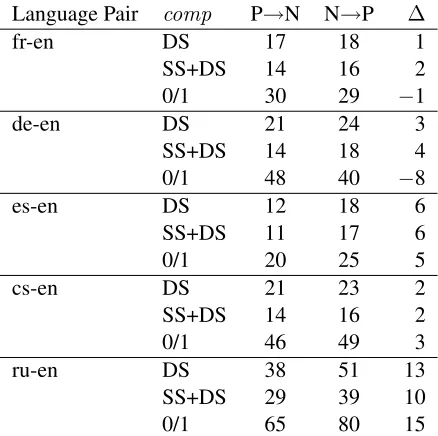
[image:3.612.76.294.227.324.2]Language Pair comp P→N N→P ∆
fr-en DS 17 18 1
SS+DS 14 16 2
0/1 30 29 −1
de-en DS 21 24 3
SS+DS 14 18 4
0/1 48 40 −8
es-en DS 12 18 6
SS+DS 11 17 6
0/1 20 25 5
cs-en DS 21 23 2
SS+DS 14 16 2
0/1 46 49 3
ru-en DS 38 51 13
SS+DS 29 39 10
[image:4.612.76.295.57.275.2]0/1 65 80 15
Table 3: The number of judgements that were ranked cor-rectly by TESLA originally, but incorrectly with the
in-corporation of compositionality scores (“P→N”) and vice versa (“N→P”), and the absolute improvement with com-positionality scores (“∆”)
judgements, as shown in Table 2, again over the full dataset and also the subset of data containing compound nouns. The improvement here is slightly greater than for our first experiment, but not at a level of statistical significance (Graham and Bald-win, 2014). Perhaps surprisingly, the exact compo-sitionality predictions produce a higher correlation than the continuous-valued compositionality predic-tions, but again, even with the inclusion of the com-positionality features, TESLA is outperformed by METEOR. The correlation over the subset of the data containing compound nouns is markedly higher than that over the full dataset, but ther values with the inclusion of compositionality values are actually all slightly below those for the basic TESLA.
As a final analysis, we examine the relative impact on TESLAof the three compositionality methods, in terms of pairings of MT outputs where the ordering is reversed based on the revised TESLA scores. Ta-ble 3 details, for each language pairing, the number of pairwise judgements that were ranked correctly originally, but incorrectly when the compositional-ity score was incorporated (“P→N”); and also the number of pairwise judgements that were ranked in-correctly originally, and corrected with the
incorpo-ration of the compositionality judgements (“N→P”). Overall, the two compositionality methods per-form better than the exact match method, and utilis-ing compositionality has a more positive effect than negative. However, the difference between the num-bers is, once again, very small, except for the ru-en language pair. The exact match method (“0/1”) has a bigger impact, both positively and negatively, as a result of the polarisation of n-gram overlap scores for MWEs. We also noticed that the N→P sentences for SS+DS are a subset of the N→P sentences for DS. Moerover, the N→P sentences for DS are a sub-set of the N→P sentences for0/1; the same is true for the P→N sentences.
6 Discussion
As shown in the previous section, the incorporation of compositionality scores can improve the quality of MT evaluation based on TESLA. However, the improvements are very small and not statistically significant. Part of the reason is that we focus ex-clusively on noun compounds, which are contigu-ous and relatively easy to translate for MT systems (Koehn and Knight, 2003). Having said that, prelim-inary error analysis would suggest that most MT sys-tems have difficulty translating non-compositional noun compounds, although then again, most noun compounds in the WMT 2013 shared task are highly compositional, limiting the impact of composition-ality scores. We speculate that, for the method to have greater impact, we would need to target a larger set of MWEs, including non-contiguous MWEs such as split verb particle constructions (Kim and Baldwin, 2010).
Further error analysis suggests that incorrect iden-tification of noun compounds in a reference sentence can have a negative impact on MT evaluation. For example,year studentis mistakenly identified as an MWE in... a 21-year-old final year student at Tem-ple ....
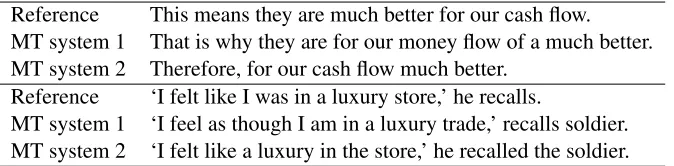
sys-Reference This means they are much better for our cash flow. MT system 1 That is why they are for our money flow of a much better. MT system 2 Therefore, for our cash flow much better.
Reference ‘I felt like I was in a luxury store,’ he recalls.
[image:5.612.140.477.57.140.2]MT system 1 ‘I feel as though I am in a luxury trade,’ recalls soldier. MT system 2 ‘I felt like a luxury in the store,’ he recalled the soldier.
Table 4: Two examples from the all-en dataset. Each example shows a reference translation, and the outputs of two machine translation systems. In each case, the output of MT system 1 is annotated as the better translation.
tem 2. However, since the former translation does not contain an exact match forcash flow, our method decreases the alignment score by multiplying it by the compositionality score forcash flow. As a result, the overall score for the first translation becomes less than that of the second, and our method incorrectly chooses the latter as a better translation.
Incorrect estimation of compositionality scores can also have a negative effect on MT evaluation. In the second example in Table 4, the similarity score between luxury store andluxury trade given by TESLAis 0.75. The compositionality score, how-ever, is estimated as 0.22. The updated similarity between luxury trade andluxury store is therefore 0.16, which in this case results in our method in-correctly selecting the second sentence as the better translation.
7 Conclusion
This paper described the first attempt at integrating MWE compositionality scores into an automatic MT evaluation metric. Our results show a marginal im-provement with the incorporation of compositional-ity scores of noun compounds.
Acknowledgements
We thank the anonymous reviewers for their insight-ful comments and valuable suggestions. NICTA is funded by the Australian government as repre-sented by Department of Broadband, Communica-tion and Digital Economy, and the Australian Re-search Council through the ICT Centre of Excel-lence programme.
References
Otavio Acosta, Aline Villavicencio, and Viviane Moreira. 2011. Identification and treatment of multiword
ex-pressions applied to information retrieval. In Proceed-ings of the Workshop on Multiword Expressions: from Parsing and Generation to the Real World, pages 101– 109, Portland, USA.
Timothy Baldwin and Su Nam Kim. 2009. Multiword expressions. In Nitin Indurkhya and Fred J. Damerau, editors, Handbook of Natural Language Processing. CRC Press, Boca Raton, USA, 2nd edition.
Timothy Baldwin, Jonathan Pool, and Susan M. Colow-ick. 2010. PanLex and LEXTRACT: Translating all words of all languages of the world. InProceedings of the 23rd International Conference on Computational Linguistics: Demonstrations, pages 37–40, Beijing, China.
Satanjeev Banerjee and Alon Lavie. 2005. METEOR: An automatic metric for MT evaluation with improved correlation with human judgments. InProceedings of the acl workshop on intrinsic and extrinsic evaluation measures for machine translation and/or summariza-tion, pages 65–72.
Colin James Bannard. 2006.Acquiring Phrasal Lexicons from Corpora. Ph.D. thesis, University of Edinburgh. Ondˇrej Bojar, Christian Buck, Chris Callison-Burch,
Christian Federmann, Barry Haddow, Philipp Koehn, Christof Monz, Matt Post, Radu Soricut, and Lucia Specia. 2013. Findings of the 2013 Workshop on Statistical Machine Translation. InProceedings of the Eighth Workshop on Statistical Machine Translation, pages 1–44, Sofia, Bulgaria.
Marine Carpuat and Mona Diab. 2010. Task-based eval-uation of multiword expressions: a pilot study in statis-tical machine translation. InHuman Language Tech-nologies: The 2010 Annual Conference of the North American Chapter of the Association for Computa-tional Linguistics, pages 242–245, Los Angeles, USA. Jes´us Gim´enez and Llu´ıs M`arquez. 2008. A smorgas-bord of features for automatic MT evaluation. In Pro-ceedings of the Third Workshop on Statistical Machine Translation, pages 195–198.
Empirical Methods in Natural Language Processing (EMNLP 2014), pages 172–176, Doha, Qatar. Yvette Graham, Timothy Baldwin, Alistair Moffat, and
Justin Zobel. 2014. Is machine translation getting bet-ter over time? InProceedings of the 14th Conference of the EACL (EACL 2014), pages 443–451, Gothen-burg, Sweden.
David Kamholz, Jonathan Pool, and Susan Colowick. 2014. PanLex: Building a resource for panlingual lex-ical translation. InProceedings of the Ninth Interna-tional Conference on Language Resources and Eval-uation (LREC’14), pages 3145–3150, Reykjavik, Ice-land.
Su Nam Kim and Timothy Baldwin. 2010. How to pick out token instances of English verb-particle con-structions. Language Resources and Evaluation, 44(1-2):97–113.
Dan Klein and Christopher D. Manning. 2003. Fast exact inference with a factored model for natural language parsing. InAdvances in Neural Information Process-ing Systems 15 (NIPS 2002), pages 3–10, Whistler, Canada.
Philipp Koehn and Kevin Knight. 2003. Feature-rich sta-tistical translation of noun phrases. InProceedings of the 41st Annual Meeting of the Association for Com-putational Linguistics (ACL 2003), Sapporo, Japan. Philipp Koehn, Hieu Hoang, Alexandra Birch, Chris
Callison-Burch, Marcello Federico, Nicola Bertoldi, Brooke Cowan, Wade Shen, Christine Moran, Richard Zens, Chris Dyer, Ondrej Bojar, Alexandra Con-stantin, and Evan Herbst. 2007. Moses: Open source toolkit for statistical machine translation. In Proceed-ings of the 45th Annual Meeting of the Association for Computational Linguistics Companion Volume Pro-ceedings of the Demo and Poster Sessions, pages 177– 180, Prague, Czech Republic.
Chang Liu, Daniel Dahlmeier, and Hwee Tou Ng. 2010. Tesla: Translation evaluation of sentences with linear-programming-based analysis. In Proceedings of the Joint Fifth Workshop on Statistical Machine Transla-tion and Metrics (MATR), pages 354–359.
Sebastian Pad´o, Michel Galley, Dan Jurafsky, and Chris Manning. 2009. Robust machine translation evalua-tion with entailment features. InProceedings of the Joint Conference of the 47th Annual Meeting of the ACL and the 4th International Joint Conference on Natural Language Processing of the AFNLP: Volume 1-Volume 1, pages 297–305.
Kishore Papineni, Salim Roukos, Todd Ward, and Wei-Jing Zhu. 2002. BLEU: a method for automatic eval-uation of machine translation. InProceedings of the 40th Annual Meeting of the Association for Computa-tional Linguistics (ACL 2002), pages 311–318. Carlos Ramisch. 2012. A generic framework for
multi-word expressions treatment: from acquisition to
appli-cations. InProceedings of ACL 2012 Student Research Workshop, pages 61–66, Jeju Island, Korea.
Siva Reddy, Diana McCarthy, and Suresh Manandhar. 2011. An empirical study on compositionality in com-pound nouns. InProceedings of IJCNLP, pages 210– 218, Chiang Mai, Thailand.
Ivan Sag, Timothy Baldwin, Francis Bond, Ann Copes-take, and Dan Flickinger. 2002. Multiword expres-sions: A pain in the neck for NLP. In Proceed-ings of the 3rd International Conference on Intelligent Text Processing Computational Linguistics (CICLing-2002), pages 189–206, Mexico City, Mexico.
Bahar Salehi and Paul Cook. 2013. Predicting the compositionality of multiword expressions using translations in multiple languages. In Second Joint Conference on Lexical and Computational Semantics (*SEM), Volume 1: Proceedings of the Main Confer-ence and the Shared Task: Semantic Textual Similarity, pages 266–275, Atlanta, Georgia, USA, June.
Bahar Salehi, Paul Cook, and Timothy Baldwin. 2014. Using distributional similarity of multi-way transla-tions to predict multiword expression compositional-ity. In Proceedings of the 14th Conference of the European Chapter of the Association for Computa-tional Linguistics, pages 472–481, Gothenburg, Swe-den, April.
Hinrich Sch¨utze. 1997. Ambiguity Resolution in Lan-guage Learning. CSLI Publications, Stanford, USA. Matthew Snover, Bonnie Dorr, Richard Schwartz,
Lin-nea Micciulla, and John Makhoul. 2006. A study of translation edit rate with targeted human annotation. InProceedings of Association for Machine Translation in the Americas, pages 223–231.
Sriram Venkatapathy and Aravind K Joshi. 2006. Us-ing information about multi-word expressions for the word-alignment task. InProceedings of the Workshop on Multiword Expressions: Identifying and Exploiting Underlying Properties, pages 20–27.