T w o S o u r c e s o f C o n t r o l o v e r t h e G e n e r a t i o n o f S o f t w a r e
I n s t r u c t i o n s *
A n t h o n y
H a r t l e y L a n g u a g e C e n t r eU n i v e r s i t y o f B r i g h t o n , F a l m e r B r i g h t o n B N 1 9 P H , U K
afh@it ri. bton. a c . uk
C 6 c i l e
P a r i s tI n f o r m a t i o n T e c h n o l o g y R e s e a r c h I n s t i t u t e U n i v e r s i t y o f B r i g h t o n , L e w e s R o a d
B r i g h t o n B N 2 4 A T , U K clp@itri, brighton, ac. uk
1
I n t r o d u c t i o n
Our work addresses the generation of software manu- als in French and English, starting from a
semantic
model of the task to be documented (Paris et al., 1995). Our prime concern is to be able to exercise control over the mapping from the task model to the generated text. We set out to establish whether the task model Mone is sufficient to control the linguis- tic o u t p u t of a text generation system, or whether additional control is required. In this event, an ob- vious source to explore is the communicative pur- pose of the author, which is not necessarily constant t h r o u g h o u t a manuM. Indeed, in a typical software manual, it is possible to distinguish at least three sections, each with a different purpose: a tutorial containing exercises for new users, a series of step- by-step instructions for the m a j o r tasks to be ac- complished, and a ready-reference s u m m a r y of the commands.We need, therefore, to characterise the linguis- tic expressions of the different elements of the task model, and to establish whether these expressions are sensitive or not to their context, that is, the functional section in which they appear. This pa- per presents the results of an analysis we conducted to this end on a corpus of software instructions in French.
2 M e t h o d o l o g y
T h e methodology we employed is similar to that en- dorsed by (Biber, 1995). It is summarised as follows:
1. Collect the texts and note their situational char- acteristics. We consider two such character-
* This work is partially supported by the Engineering and Physical Sciences Research Council (EPSRC) Grant J19221, by BC/DAAD ARC Project 293, by the Commis- sion
of the
European Union Grant LRE-62009, and by the Office of Naval Research Grant N00014-96-1-0465.t Starting this fall, Dr. Paris' address will be CSIRO, Division of Information Technology, Sydney Laboratory, Building E6B, Macquarie University Campus, North Ryde, Sydney, NSW 2113, Australia.
istics:
task structure and communicative pur- pose.2. Identify the range of linguistic features to be included in the analysis;
3. Code the corpus in terms of the selected fea- tures;
4. C o m p u t e the frequency count of each linguistic feature;
5. Identify co-occurrences between linguistic fea- tures and the situational characteristics under consideration.
We first carried out a classical sublanguage analy- sis on our corpus as a whole, without differentiating between any of the situational characteristics (Hart- ley and Paris, 1995). This initial description was necessary to give us a clear statement of the lin- guistic potentiM required of our text generator, to which we could relate any restrictions on language imposed by situational variables. Thus we can ac- count for language restrictions by appealing to gen- eral discourse principles, in keeping with the recom- mendations of (Kittredge, 1995) and (Biber, 1995) for the definition of sublanguages.
We then correlated task elements with grammati- cM features. Finally, where linguistic realisation was under-determined by task structure alone, we estab- lished whether the communicative purpose provided more discriminating control over the linguistic re- sources available.
3 L i n g u i s t i c F r a m e w o r k :
S y s t e m i c
F u n c t i o n a l L i n g u i s t i c seach s t r a t u m constrain the choices available in the s t r a t u m beneath. Context thus constrains language. This framework was chosen for several reasons. First, the organisation of linguistic resources accord- ing to this principle is well-suited to natural lan- guage generation, where the starting point is nec- essarily a communicative goal, and the task is to find the most appropriate expression for the in- tended meaning (Matthiessen and Bateman, 1991). Second, a functional perspective offers an advan- tage for multilingual text generation, because of its ability to achieve a level of linguistic description which holds across languages more effectively than do structurally-based accounts. The approach has been shown capable of supporting the sharing of lin- guistic resources between languages as structurally distinct as English and Japanese (Bateman et al., 1991a; B a t e m a n et at., 1991b). It is therefore rea- sonable to expect that at least the same degree of commonality of description is achievable between English and French within this framework. Finally, KPML (Bateman, 1994), the tactical generator we employ, is based on SFL, and it is thus appropriate for us to characterise the corpus in terms immedi- ately applicable to our generator.
4 C o d i n g f e a t u r e s
Our lexico-grammatical coding was done using the networks and features of the Nigel g r a m m a r (Hal- liday, 1985). We focused on four main concerns, guided by previous work on instructional texts, e.g., (Lehrberger, 1986; P l u m et at., 1990; Ghadessy, 1993; Kosseim and Lapalme, 1994).
• Relations between processes: to determine whether textual cohesion was achieved through conjunctives or through relations implicit in the task structure elements. Among the features considered were clause dependency and conjunction type.
• Agency: to see whether the actor perform- ing or enabling a particular action is clearly identified, and whether the reader is explic- itly addressed. We coded here for features such as voice and agent types.
• Mood, modality and polarity: to find out the extent to which actions are presented to the reader as being desirable, possible, mandatory, or prohibited. We coded for both true and implicit negatives, and for both personal and impersonal expressions of modality.
• Process types: to see how the domain is construed in terms of actions on the part of the user and the software. We coded for sub-categories of material, mental, verbal and relational processes.
5 T h e C o r p u s
T h e analysis was conducted on the French version of the Macintosh MacWrite manual (Kaehler, 1983). The manual is derived from an English source by a process of adaptive translation (Sager, 1993), i.e., one which loealises the text to the expectations of the target readership. T h e fact that the translation is adaptive rather than literal gives us confidence in using this manual for our analysis. 1 Furthermore, we know that Macintosh documentation undergoes thorough local quality control. It certainly conforms to the principles of good documentation established by current research on technical documentation and on the needs of end-users, e.g., (Carroll, 1994; Ham- mond, 1994), in that it supplies clear and concise information for the task at hand. Finally, we have been assured by French users of the software that they consider this particular manual to be well writ- ten and to bear no unnatural trace of its origins.
Technical manuals within a specific domain con- stitute a sublanguage, e.g., (Kittredge, 1982; Sager et al., 1980). An i m p o r t a n t defining property of a sublanguage is that of closure, both lexieal and syn- tactic. Lexical closure has been demonstrated by, for example, (Kittredge, 1987), who shows that after as few as the first 2000 words of a sublanguage text, the number of new word types increases little if at all. Other work, e.g., (Biber, 1988; Biber, 1989) and (Grishman and Kittredge, 1986) illustrates the prop- erty of syntactic closure, which means t h a t generally available constructions just do not occur in this or that sublanguage. In the light of these results, we considered a corpus of 15000 words to be adequate for our purposes, at least for an initial analysis.
The MacWrite manual is organised into three chapters, corresponding to the three different sec- tions identified earlier: a tutorial, a series of step- by-step instructions for the m a j o r word-processing tasks, and a ready-reference s u m m a r y of the com- mands. We omitted the tutorial because the gen- eration of such text is not our concern, retaining the other two chapters which provide the user with generic instructions for performing relevant tasks, and descriptions of the commands available within MacWrite. The overlap in information between the two chapters offers opportunities to observe differ- ences in the linguistic expressions of the same task structure elements in different contexts.
Goals:
Functions:
Constraints:
Results:
Substeps:
La s~lection Gloss: Selection
Pour sdlectionner un mot, (faites un double-clic sur le mot) Gloss: To select a word, (do a double-click on the word)
(Fermer - ) Cet article permet de fermer une fen~tre activ~e
Gloss: (Close - ) This c o m m a n d enables you to close the active window
Si vous donnez ~ votre document le titre d'un document ddj~ existant, (une zone de dialogue apparait)
Gloss: If you give your document the title of an existing document, (a dialog box appears)
(Choisissez Coller dans le menu Edition - ) Une copie du contenu du presse-papiers apparait Gloss: (Choose Paste from the Edit menu - ) A copy of the content of the clipboard appears
Ferrnez la fen@tre Rechercher Gloss: Close the Find window
Ensuite, on ouvre le document de destination Gloss: Next, one opens the target document
Figure 1: Examples of task element expressions
6 T a s k S t r u c t u r e
Task structure is constituted by five types of task elements, which we define below. We used the no- tion of task structure element both as a contextual feature for the analysis and to determine the seg- mentation of the text into units. Each unit is taken to be the expression of a single task element.
Our definition of the task elements is based on the concepts and relations commonly chosen to repre- sent a task structure (a goal and its associated plan), e.g., (Fikes and Nilsson, 1971; Sacerdoti, 1977), and on related research, e.g., (Kosseim and Lapalme, 1994). Our generator produces instructions from an underlying semantic knowledge base which uses this representation (Paris et al., 1995). To generate an instruction for performing a task is to chose some task elements to be expressed and linearise them so that they form a coherent set for a given goal the user might have. We distinguish the following ele- ments, and provide examples of them in Figure 1:2
g o a l s : actions t h a t users will adopt as goals and which motivate the use of a plan.
functions: actions that represent the functionality of an interface object (such as a menu item). A
2The text in parentheses in the Figure is part of the linguistic context of the task element rather than the element itself.
function is closely related to a goal, in t h a t it is also an action t h a t the user m a y want to per- form. However, the function is accessed through the interface object, and not through a plan.
constraints and preconditions:
states which must hold before a plan can be employed successfully. T h e domain model dis- tinguishes constraints (states which cannot be achieved through planning) and preconditions (states which can be achieved through plan- ning). We do not make this distinction in the linguistic analysis and regroup these related task structure elements under one label. We decided to proceed in this way to determine at first how constraints in general are expressed. Moreover, it is not always clear from the text which type of constraint is expressed. Drawing too fine distinctions i n the corpus analysis at this point, in the absence of a test for assigning a unit to one of these constraint types, would have rendered the results of the analysis more subjective and thus less reliable.
r e s u l t s : states which arise as planned or unplanned effects of carrying out a plan. While it might be i m p o r t a n t to separate planned and un- planned effects in the underlying representa- tion, we again abstract over t h e m in the lexico- grammatical coding.
s u b - s t e p s : actions which contribute to the execu- tion of the plan. If the sub-steps are not prim- itive, they can themselves be achieved through other plans.
7 T h e C o d i n g P r o c e d u r e
No tools exist to a u t o m a t e a functional analysis of text, which makes coding a large body of text a time- consuming task. We first performed a detailed cod- ing of units of texts on approximately 25% of the corpus, or about 400 units, 3 using the WAG coder (O'Donnell, 1995), a tool designed to facilitate a functional analysis.
We then used a public-domain concordance pro- gram, MonoConc (Barlow, 1994), to verify the rep- resentativeness of the results. We enumerated the realisations of those features that the first analysis had shown as marked, and produced KWIC 4 list- ings for each set of realisations. We found that the second analysis corroborated the results of the first, consistent with the nature of sublanguages.
8 D i s t r i b u t i o n o f G r a m m a t i c a l
F e a t u r e s o v e r T a s k S t r u c t u r e a n d C o m m u n i c a t i v e P u r p o s e
We examined the correlations between lexico- grammatical realisations and task elements and com- municative purpose. T h e results are best expressed using tables generated by WAG: given any system, WAG splits the codings into a number of sets, one for each feature in that system. Percentages and means are computed, and the sets are compared statisti- cally, using the standard T-test. WAG displays the results with an indicator of how statistically signifi- cant a value is compared to the combined means in the other sets. T h e counts were all done using the local mean, that is, the feature count is divided by the total number of codings which select that fea- ture's system. Full definitions of the features can be found in (Halliday, 1985; B a t e m a n et al., 1990).
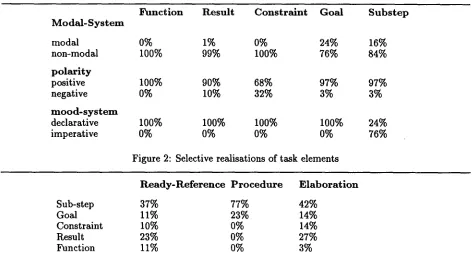
In some cases, the type of task element is on its own sufficient to determine, or at least strongly con- strain, its linguistic realisation. The limited space available here allows us to provide only a small num- ber of examples, shown in Figure 2. We see that the use of modals is excluded in the expression of func- tion, result and constraint, whereas goal and sub- step do admit modals. As far as the polarity sys- tem is concerned, negation is effectively ruled out for function, goal and substep. Finally, with respect to the m o o d system, only substep can be realised through imperatives.
3The authors followed guidelines for identifying task element units which had yielded consistent results when
used by students coding other corpora. 4Key Word In Context
In other cases, however, we observe a diversity of realisations. We highlight here three cases: modality in goal, polarity in constraint, and m o o d in substep. In such cases, we must appeal to another source of control over the apparently available choices. We have looked to the construct of genre (Martin, 1992) to provide this additional control, on two grounds: (1) since genres are distinguished by their commu- nicative purposes, we can view each of the functional sections already identified as a distinct genre; (2) genre is presented as controlling text structure and realisation. In Martin's view, genre is defined as a staged, goal-oriented social process realised through register, the context of situation, which in turn is realised in language to achieve the goals of a text. Genre is responsible for the selection of a text struc- ture in terms of task elements. As part of the re- alisation process, generic choices preselect a register associated with particular elements of text structure, which in turn preselect lexico-grammatical features. The coding of our text in terms genre and task el- ements thus allows us to establish the role played by genre in the realisations of the task elements. It will also allow us to determine the text structures appropriate in each genre, a study we are currently undertaking. This is consistent with other accounts of text structure for text generation in technical do- mains, e.g., (McKeown, 1985; Paris, 1993; Kittredge et al., 1991).
For those cases where the realisation remains under-determined by the task element type, we con- ducted a finer-grained analysis, by overlaying a genre partition on the undifferentiated data. We distin- guished earlier two genres with which we are con- cerned: ready-reference and step-by-step. In the manual analysed, we recognised two more specific communicative purposes in the step-by-step section: to enable the reader to perform a task, and to in- crease the reader's knowledge about the task, the way to achieve it, or the properties of the system as a whole. Because of their distinct communica- tive purposes, we again feel justified in calling these genres. We label them respectively procedure and
elaboration. The intention that the reader should recognise the differences in function of each section is underscored by the use of distinctive typographi- cal devices, such as fonts and lay-out. 5
T h e first step at this stage of the analysis was to establish whether there was an effective overlap in task elements among the three genres under consid- eration. T h e results of this step is shown in Figure 3. Sub-step and goal are found in all three genres, while constraint, result and function occur in both ready- reference and elaboration but are absent from pro- cedure.
The next step was to undertake a comparative
Function
Result
Constraint Goal
Substep
Modal-System
modal 0% 1% 0% 24% 16%
non-modal 100% 99% 100% 76% 84%
polarity
positive 100% 90% 68% 97% 97%
negative
0% 10% 32% 3% 3%mood-system
declarative 100% 100% 100% 100% 24%
imperative 0% 0% 0% 0% 76%
Figure 2: Selective realisations of task elements
Ready-Reference
P r o c e d u r eElaboration
Sub-step 37%
77%
42%Goal 11% 23% 14%
Constraint
10% 0% 14%Result 23% 0% 27%
Function 11% 0% 3%
Figure 3: Distribution of task structure elements over genres
analysis of the lexico-grammatical features found in the three genres. This analysis indicated that the language employed in these different sections of the text varies greatly. We summarise here the two genres that are strongly contrasted: procedure and ready-reference. Elaboration shares features with both of these.
p r o c e d u r e : The top-level goM of the user is ex- pressed as a nominMisation. Actions to be achieved by the reader are almost exclusively reMised by imperatives, directly addressing the reader. These actions are mostly materiM di- rected actions, and there are no causatives. Few modals are employed, and, when they are, it is to express obligation impersonally. The polar- ity of processes is always positive. Procedure employs mostly independent clauses, and, when clause complexes are used, the conjunctions are mostly purpose (linking a user goal and an ac- tion) and alternative (linking two user actions or two goals).
r e a d y - r e f e r e n c e : In this genre, M1 task elements are always realised through clauses. The declar- ative mood predominates, with few impera- tives addressing the reader. Virtually all the causatives occur here. On the dimension of modality, the emphasis is on personal possi- bility, rather than obligation, and on inclina- tion. We find in this genre most of the ver- bM processes, entirely absent from procedure. Ready-reference is more weighted than proce-
dure towards dependent clauses, and is partic- ularly marked by the presence of temporal con- junctions.
The analysis so far demonstrates that genre, like task structure, provides some measure of control over the linguistic resources but that neither of these alone is sufficient to drive a generation system. The finM step was therefore to look at the realisations of the task elements differentiated by genre, in cases where the realisation was not strongly determined by the task element.
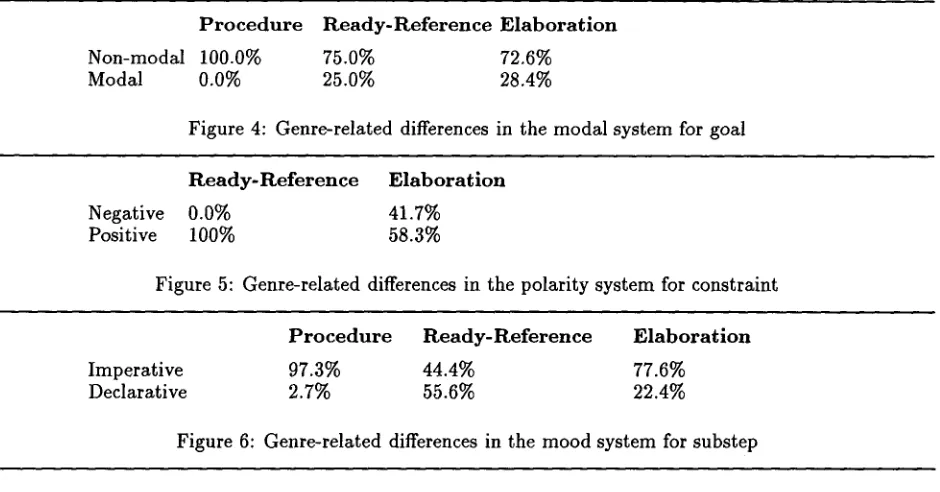
We refer the reader back to Figure 2, and the under-constrained cases of modality in goal, polar- ity in constraint, and mood in substep. Figure 4 shows the realisations the task element goal with re- spect to the modal system, which brings into sharp relief the absence of modality from procedure. Fig- ure 5 presents the reaiisations by genre of the po- larity system for constraint. We observe that only positive polarity occurs in ready-reference. Finally, we note from Figure 6 that the realisation of sub- steps is heavily loaded in favour of imperatives in procedure.
These figures show that genre does indeed provide useful additional control over the expression of task elements, which can be exploited by a text genera- tion system. Neither task structure nor genre alone is sufficient to provide this control, but, taken to- gether, they offer a real prospect of adequate control over the output of a text generator.
[image:5.612.73.545.79.341.2]Non-modal Modal
Procedure Ready-Reference Elaboration
100.0% 75.0% 72.6%
0.0% 25.0% 28.4%
Figure 4: Genre-related differences in the modal system for goal
Negative Positive
Ready-Reference Elaboration
0.0%
41.7%
100% 58.3%
Figure 5: Genre-related differences in the polarity system for constraint
Imperative Declarative
Procedure Ready-Reference Elaboration
97.3%
44.4%
77.6%
2.7%
55.6%
22.4%
Figure 6: Genre-related differences in the mood system for substep
9 R e l a t e d W o r k
The results from our linguistic analysis are con- sistent with other research on sublanguages in the instructions domain, in both French and English, e.g., (Kosseim and Lapalme, 1994; Paris and Scott, 1994). Our analysis goes beyond previous work by identifying within the discourse context the means for exercising explicit control over a text generator.
An interesting difference with respect to previous descriptions is the use of the true (or direct) imper- ative to express an action in the procedure genre, as results from (Paris and Scott, 1994) seem to in- dicate that the infinitive-form of the imperative is preferred in French. These results, however, were obtained from a corpus of instructions mostly for domestic appliances as opposed to software manuals. Furthermore the use of the infinitive-form in instruc- tions in general as observed by (Kocourek, 1982) is declining, as some of the conventions already com- mon in English technical writing are being adopted by French technical writers, e.g., (Timbal-Duclaux, 1990).
We also note that the patterns of realisations un- covered in our analysis follow the principle of good technical writing practice known as the minimal- ist approach, e.g., (Carroll, 1994; Hammond, 1994). Moreover, we observe that our corpus does not ex- hibit shortcomings identified in a Systemic Func- tional analysis of English software manuals (Plum et al., 1990), such as a high incidence of agentless passive and a failure to distinguish the function of informing from that of instructing.
Other work has focused on the cross-linguistic re- alisations of two specific semantic relations (gener- ation and enablement) (Delin et al., 1994; Delia et
al., 1996), in a more general corpus of instructions for household appliances. Our work focuses on the single application domain of software instructions. However, it takes into consideration the whole task structure and looks at the realisation of semantic el- ements as found in the knowledge base, instead of two semantic relations not explicitly present in the underlying semantic model.
10 C o n c l u s i o n
In this paper we have shown how genre and task structure provide two essential sources of control over the text generation process. Genre does so by constraining the selection of the task elements and the range of their expressions. These elements, which are the procedural representation of the user's tasks, constitute a layer of control which mediates between genre and text, but which, without genre, cannot control the grammar adequately.
The work presented here is informing the devel- opment of our text generator by specifying the nec- essary coverage of the French grammar to be imple- mented, the required discourse structures, and the mechanisms needed to control them. We continue to explore further situational and contextual factors which might allow a system to fully control its avail- able linguistic resources.
R e f e r e n c e s
Michael Barlow. 1994. A Guide to MonoConc.
Athelston, Houston, TX.
John A. Bateman, Robert T. Kasper, Johanna D. Moore, and Richard Whitney. 1990. A general or-
[image:6.612.69.539.84.330.2]ganization of knowledge for natural Language pro- cessing: The Penman Upper Model. Technical report, USC/ISI, March.
John A. Bateman, Christian M.I.M. Matthiessen, Keizo Nanri, and Licheng Zeng. 1991a. The re-use of linguistic resources across languages in multilin- gual generation components. In Proceedings of the 1991 International Join~ Conference on Artificial Intelligence, Volume 2, Sydney, Australia, pages 966 - 971. Morgan Kaufmann Publishers.
John A. Bateman, Christian M.I.M. Matthiessen, Keizo Nanri, and Licheng Zeng. 1991b. Multi- Lingual text generation: an architecture based on functional typology. In International Conference on Current Issues in Computational Linguistics,
Penang, Malaysia.
John A. Bateman. 1994. KPML: The KOMET- Penman (Multilingual) Development Environ- ment. Technical report, Institut fiir Integrierte Publikations- und Informationssysteme (IPSI), GMD, Darmstadt, September. Release 0.6. Douglas Biber. 1988. Variation Across Speech and
Writing. Cambridge University Press, Cambridge UK.
Douglas Biber. 1989. A typology of English texts.
Linguistics, 27:3-43.
Douglas Biber. 1995. Dimensions of Register Vari- ation: A Cross-linguistic comparison. Cambridge University Press, Cambridge UK.
John Carroll. 1994. Techniques for minimalist doc- umentation and user interface design. In Quality of Technical Documentation, pages 67-75. Rodopi, Amsterdam.
Judy Delin, Anthony Hartley, C@cile Paris, Donia Scott, and Keith Vander Linden. 1994. Ex- pressing procedural relationships in multilingual instructions. In Proceedings of the Seventh In- ternational Workshop on Natural Language Gen- eration, Kennebunkport, MN, 21-24 June 1994, pages 61-70.
Judy Delin, Donia Scott, and Anthony Hartley. 1996. Language-specific mappings from seman- tics to syntax. In Proceedings of the 16th Interna- tional Conference on Computational Linguistics (COLING-96), Copenhagen, Denmark, August. R. E. Fikes and Nils Nilsson. 1971. STRIPS: a new
approach to the application of theorem proving to problem solving. Artificial Intelligence, 2:189- 208.
Mohsen Ghadessy, editor. 1993. Register Analysis: Theory and Practice. Frances Pinter, London. Ralph Grishman and Richard Kittredge, editors.
1986. Analyzing Language in Restricted Domains.
Lawrence Erlbaum Associates, Hillsdale, New Jer- sey.
Michael A. K. Halliday. 1978. Language as a Social Semiotic: The Social Interpretation of Language and Meaning. Edward Arnold, London.
Michael A. K. Halliday. 1985. An Introduction to Functional Grammar. Edward Arnold, London. Nick Hammond. 1994. Less is More: The Mini-
malist Approach. Usability Now! A Guide to Us- ability. Published by the Open University and the Department of Trade and Industry.
Anthony Hartley and C@cile Paris. 1995. French cor- pus analysis and grammatical description. Techni- cal Report Project IED/4/1/5827, ITRI, Novem- ber.
Carol Ka~hler. 1983. Macintosh MacWrite. Apple Seedrin, Les Ulis, France.
Richard Kittredge, Tanya Korelsky, and Owen Ram- bow. 1991. On the Need for Domain Commu- nication Knowledge. Computational Intelligence,
7(4):305-314, November.
Richard Kittredge. 1982. Variation and Homogene- ity of Sublanguages. In Richard Kittredge and J. Lehrberger, editors, Sublanguage: Studies of
language in restricted semantic domains, pages 107-137. de Gruyter, Berlin and New York. Richard Kittredge. 1987. The significance of sub-
language for automatic translation. In Sergei Nirenburg, editor, Machine Translation: Theoret- ical and methodological issues, pages 59-67. Cam- bridge University Press, London.
Richard Kittredge. 1995. Efficiency vs. Generality in InterlinguaL Design: Some Linguistic Consid- erations. In the Working notes of the IJCAI-95 Workshop on Multilingual Text Generation, Au- gust 20-21, Montr@M, Canada.
Rostislav Kocourek. 1982. La langue frangaise de la technique et de la science. Brandstetter Verlag, Wiesbaden, Germany.
Leila Kosseim and Guy Lapalme. 1994. Content and rhetorical status selection in instructional texts. In Proceedings of the Seventh International Work- shop on Natural Language Generation, Kenneb- unkport, MN, 21-24 June 1994, pages 53-60. John Lehrberger. 1986. Sublanguage Analysis. In
RMph Grishman and Richard Kittredge, editors,
Analyzing Language in Restricted Domains, pages 19-38. Lawrence Erlbaum Associates, Hillsdale, New Jersey.
James R. Martin. 1992. English text: systems and structure. Benjamins, Amsterdam.
Christian M.I.M. Matthiessen and John A. Bate- man. 1991. Text generation and systemic- functional linguistics: experiences from English and Japanese. Frances Pinter Publishers and St. Martin's Press, London and New York.
Kathleen 1%. McKeown. 1985. Text Generation.
Cambridge University Press, New York.
Michael O'Donnell. 1995. From Corpus to Cod- ings: Semi-Automating the Acquisition of Lin- guistic Features. Proceedings of the AAAI Spring Symposium on Empirical Methods in Discourse Interpretation and Generation, Stanford Univer- sity, California, March 27 - 29, March.
C~cile Paris and Donia Scott. 1994. Stylistic vari- ation in multilingual instructions. In Proceedings of the Seventh International Workshop on Nat- ural Language Generation, Kennebunkport, MN, 21-24 June 1994, pages 45 - 52.
C@cile Paris, Keith Vander Linden, Markus Fischer, Anthony Hartley, Lyn Pemberton, Richard Power, and Donia Scott. 1995. A support tool for writ- ing multilingual instructions. In Proceedings of the Fourteenth International Joint Conference on Artificial Intelligence, August 20-25, Montr@al, Canada, pages 1398-1404.
C~cile L. Paris. 1993. User Modelling in Text Gen- eration. Frances Pinter, London.
Guenter A. Plum, Christian M.I.M. Matthiessen, Michael A.K. Halliday, and Natalie Shea. 1990. The Electronic Discourse Analyzer Project: Re- port on Textual Analysis of FJ Manuals. Techni- cal report, Fujitsu Australia Limited, Documen- tation Engineering Division. EDA Project Deliv- erables; Output 7.
Earl D. Sacerdoti. 1977. A Structure for Plans and Behavior. Elsevier, New York.
Juan C. Sager, David Dungworth, and Peter F. Mc- Donald. 1980. English Special Languages. Brand- stetter Verlag, Wiesbaden, Germany.
Juan C. Sager. 1993. Language Engineering and Translation: Consequences of Automation. John Benjamins Publishing Company, Amsterdam. Louis Timbal-Duclaux. 1990. La communica-
tion dcrite seientifique et technique. ESF, Paris, France.