INTRODUCTION
A country is created by the complex of objects, living or not-living elements. Population is a specific part of the country because it is both object and subject at the same time. As an object, it has a passive function, but as a subject, it possesses an active role. This means that peo-ple, to a certain extent, interfere with the nature and they have an influence on it. One would say that people are not living in accordance with the nature.
In this paper, we are going to deal with nature and man, who must to choose how (s)he is going to react in the country system.
SUBJECT
In this work, we are concentrating on the methods of region specification. We are going to provide examples
from the Košice self-governing region that is herewith described via the available characteristics. Our main aim is to reconsider the enhancement of those characteris-tics by endogenous factors such as altruism or social capital. It is these endogenous characteristics we want
to examine within the model of Public Private Partnership2
(PPP) that is also being labelled as Common Public Pro-curement.
METHODOLOGY
In order to classify the region, we will use the method of points, which we want to extend by two criteria. These two criteria are examined by the survey of materials. By means of their systematisation in the diagram, we deduce the conclusions valid for Public Private Partnership mod-el (PPP). Since we consider making use of this modmod-el in
Altruism, social potential and regional development
1Altruizmus, sociálny potenciál a regionálny rozvoj
G. K
OĽVEKOVÁTechnical University of Košice, Košice, Slovak Republic
Abstract: This paper is devoted to methods for specification of region. We provide examples for the Košice region that is described by the accessible characteristics. Our main objective is to consider broadening of these characteristics for more endogenous factors such as altruism or social capital. We would like to examine these endogenous characteristics within the model of Public Private Partnership also called Common Public Procurement. Furthermore, we analyze the pure and impure altruism in the context of the application of Public Private Partnership. This short study results in the conceptual diagram that shows how the social capital works in general, the description of the diagram gives further important details and allows understanding of the evolved concept.
Key words: social capital, altruism, Public Private Partnership, regional development, rural development, less-favoured areas
Abstrakt: Príspevok je venovaný metóde špecifikácie regiónu. Uvádzame príklady z Košického regiónu, ktorý charakteri-zujeme. Naším hlavným cieľom je zvážiť rozšírenie jednotlivých charakteristík o niektoré endogénne charakteristiky v rám-ci modelu Verejno-súkromného partnerstva (PPP). Navyše analyzujeme nečistý altruizmus v kontexte PPP. Výsledkom tejto krátkej štúdie je schéma pojmov, ktorá ukazuje ako funguje sociálny kapitál vo všeobecnosti. Opis diagramu pojmov
umož-ňuje ďalšie pochopenie dôležitých detailov konceptu sociálneho kapitálu.
Kľúčové slová: sociálny kapitál, altruizmus, Verejno-súkromné vlastníctvo, regionálny rozvoj, rurálny rozvoj, znevýhodnené oblasti
1 The paper was elaborated within the project VEGA 1/9182/02 – “Economic, ecological and social issues of Eastern Slovakia region”.
The paper is also a part of the scientific activity leading towards dissertation thesis.
2 An exact definition of the Public Private Partnership (PPP) still does not exist. Nevertheless, my assumption is that if we are going
the examined region characteristics of which are studied by the method of points, it is appropriate to evaluate the region from the standpoint of preconditions for the PPP model application, to which among others also social capital and altruism belong.
The implementation of the determined aim required the acquisition of basic data from various sources, mostly
the studies of the VUEPP3, the magazine Agricultural
Economics and Statistical Yearbooks etc. We grouped the basic materials into the analytical tables and for the pur-pose of region classification, we made use of the method of points.
“The basic method of the region specification is the method of points. It enables to calculate the value of cri-teria in reality mutually uncountable by means of trans-forming the values of these criteria to a specific number of points” (Matoušková et al., 2000: 74–75).
According to Hrabánková, these criteria are as follows: 1. Natural:
1.1 natural conditions (the area of farmland, percentage of arable land, soil productivity, production region, territorial slope average over 7°)
1.2 environmental conditions (National Protected Areas, National Trust Estate (in ha, %), Natural Water Ac-cumulation Protected Areas (in ha, %), Hygienic
Pro-tection Zones (in ha, %), emission of SO2 (in ha, %))
1.3 demographic conditions (average population, struc-ture of population (0–14, productive age, post-pro-ductive age), natural population growth, migration rate in years, total migration rate
1.4 “countryside” indicators (countryside population) 2. Social:
2.1 socio-territorial conditions [area of the district, struc-ture of settlement (number of categories), popula-tion density per sq km, level of infrastructure (number of flat categories), percentage of commuters] 2.2 socio-economic conditions (unemployment rate,
to-tal number of job applicants, number of new jobs, possibility to place the applicants, total number of economically active population, share of workers in agriculture in the total economically active popula-tion, decrease of workers in agriculture, average sal-ary in agriculture)
3. Economic:
3.1 gross agricultural production in comparable prices in the year 19XX
3.2 gross agricultural production per 1 ha of farmland 3.3 gross agricultural production per 1 inhabitant 3.4 market potential – non-agricultural branches
(indus-try, construction, services) (Hrabánková 1996: 74–75).
Hrabánková as well as Matoušková agree on the points necessary to be determined at the beginning of the re-gion delimitation:
– the purpose of region specification and description, – appropriate criteria assigned to this purpose, – particular indicators corresponding to the criteria.
By means of criteria supplement we would adopt the method of points of region classification to the purpose, which is the constitution of PPP.
RESULTS
Proposal of methodology
The selection of region is determined by the fact, that this region is marginal and backward. It is the area known
[image:2.595.296.524.212.719.2]3 Research Institute of Agriculture and Food Industry Economics.
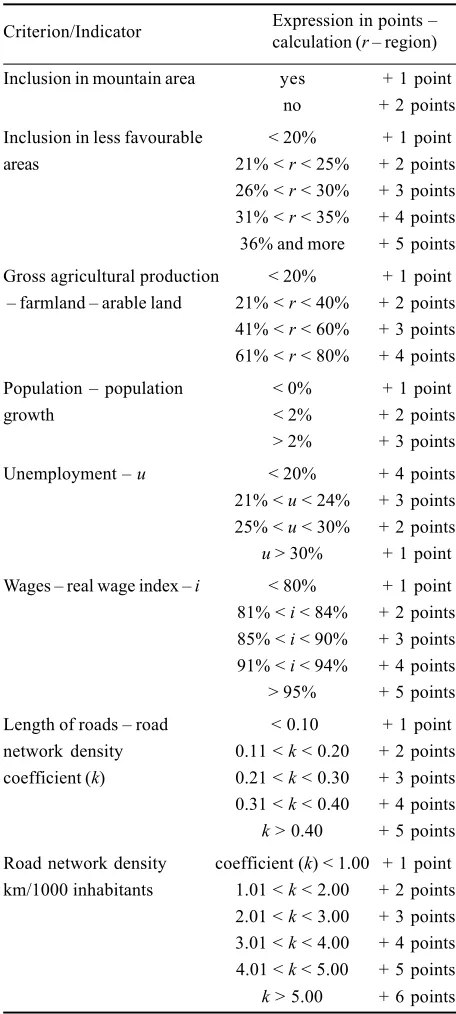
Table 1. Criteria overview
Criterion/Indicator Expression in points –calculation (r – region) Inclusion in mountain area yes + 1 point
no + 2 points
Inclusion in less favourable < 20% + 1 point
areas 21% < r < 25% + 2 points
26% < r < 30% + 3 points 31% < r < 35% + 4 points 36% and more + 5 points Gross agricultural production < 20% + 1 point – farmland – arable land 21% < r < 40% + 2 points 41% < r < 60% + 3 points 61% < r < 80% + 4 points Population – population < 0% + 1 point
growth < 2% + 2 points
> 2% + 3 points
Unemployment – u < 20% + 4 points
21% < u < 24% + 3 points 25% < u < 30% + 2 points u > 30% + 1 point Wages – real wage index – i < 80% + 1 point 81% < i < 84% + 2 points 85% < i < 90% + 3 points 91% < i < 94% + 4 points > 95% + 5 points Length of roads – road < 0.10 + 1 point network density 0.11 < k < 0.20 + 2 points coefficient (k) 0.21 < k < 0.30 + 3 points 0.31 < k < 0.40 + 4 points k > 0.40 + 5 points Road network density coefficient (k) < 1.00 + 1 point km/1000 inhabitants 1.01 < k < 2.00 + 2 points
2.01 < k < 3.00 + 3 points 3.01 < k < 4.00 + 4 points 4.01 < k < 5.00 + 5 points k > 5.00 + 6 points
Therefore, it is crucial that we include in the specifica-tion of the region the examinaspecifica-tion also from the point of view of less favoured areas (LFA), which are important for new endowment of the European Union. This possi-bility would also bring new stimulus for the development in the sphere of economy, living standard of its inhabit-ants and so on.
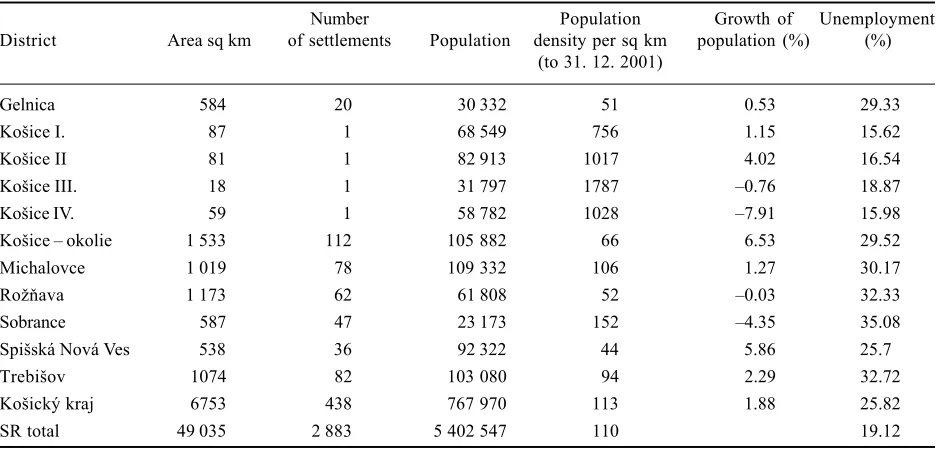
The brief and tabular introduction of the Košice self-governing region is to be found in Table 2.
Examples of the characteristics – use of point evaluation or methods of points
Due to the extend of this paper, we are unable to present the precise data for the LFA, unemployment, infrastruc-ture etc. (the data are available upon request, they were elaborated on the basis of the above mentioned studies of the Research Institute of Agriculture and Food Indus-try Economics and other sources). After all, we would like to modify them by the means of new characteristics of social capital and altruism.
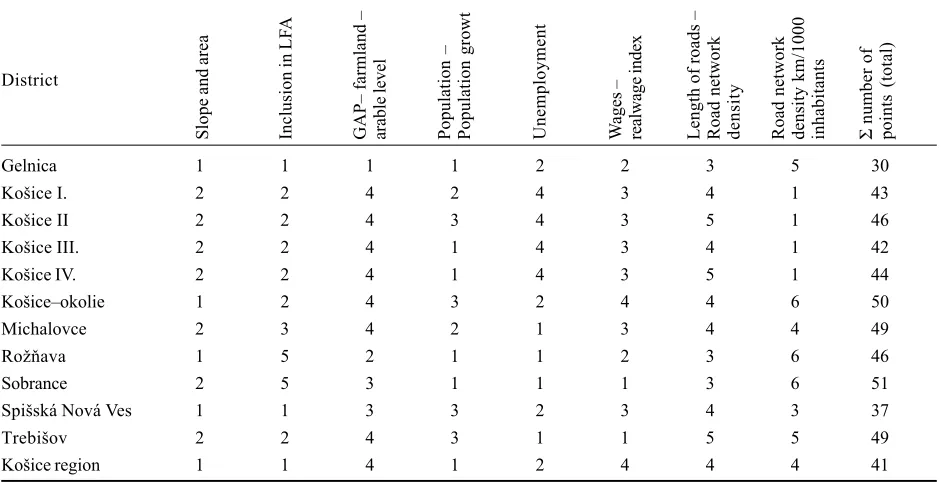
We have elaborated evaluation in points according to the above-described methodology. The results of the evaluation in points are specified in Table 3. The total of points determines how much backward the region is. The most backward seems to be the district of Sobrance and Košice-surroundings (suburban areas) (51–50 points). A relatively good is the socio-economic situation in Gelni-ca and Spišská Nová Ves (30–37 points).
DISCUSSION ON METHODOLOGY
The already mentioned indicators (Table 1) are current-ly used. I reconsidered their completion by the criteria of for its fertile East-Slovak lowland. Therefore, the
exami-nation from the perspective of less favoured areas (LFA) should be included in the specification of the region. We want to assess the possibilities of the region develop-ment in relation to agriculture and infrastructure. Accord-ing to the determined purpose of the region delimitation, we specify the criteria and their indicators as follows in Table 1.
1. The calculation in points is listed in Table 1.
– criteria evaluating agriculture were assessed by val-ue 3
– criteria evaluating demography were assessed by value 1
– criteria evaluating infrastructure were assessed by value 2
2. Marginal number of points is when the region can be classified among marginal and backward ones, i. e. re-gions with certain socio-economic problems. This num-ber equals to 43 and more points.
3. Thus we can find out how homogeneous is our select-ed region.
[image:3.595.57.525.517.742.2]Examples of characteristics – basic criteria The region suffers from unfavourable geographical position and in economic terms, it is lagging behind. These two features are accurate, though it can sound conflicting. The accuracy of these characteristics lies in the fact, that the backwardness of the region can be solved by its marginal location. In the history of the area development, this marginal location already played a significant role and it will have to be made use of in socio-economic development of the region. Until recent-ly, this region was well known for its East-Slovak lowland and distribution of vegetable and animal production.
Table 2. Basic indicators for the Košice self-governing region
Number Population Growth of Unemployment
District Area sq km of settlements Population density per sq km population (%) (%) (to 31. 12. 2001)
Gelnica 584 20 30 332 51 0.53 29.33
Košice I. 87 1 68 549 756 1.15 15.62
Košice II 81 1 82 913 1017 4.02 16.54
Košice III. 18 1 31 797 1787 –0.76 18.87
Košice IV. 59 1 58 782 1028 –7.91 15.98
Košice – okolie 1 533 112 105 882 66 6.53 29.52
Michalovce 1 019 78 109 332 106 1.27 30.17
Rožňava 1 173 62 61 808 52 –0.03 32.33
Sobrance 587 47 23 173 152 –4.35 35.08
Spišská Nová Ves 538 36 92 322 44 5.86 25.7
Trebišov 1074 82 103 080 94 2.29 32.72
Košický kraj 6753 438 767 970 113 1.88 25.82
SR total 49 035 2 883 5 402 547 110 19.12
altruism or social capital as it is suggested in the intro-duction. Especially in the case of altruism, it is stated that this concept is “difficult to measure” as trust and coop-eration are difficult to measure. We do not posses any reliable indicator for its measurement partly because al-truism is difficult to be observed. But the game theory is being used very often to observe altruism.
According to sociologic dictionary, the definition of altruism is the following: “ moral principle prescribing to inhibit own egoism, un-venal service for neighbour, will-ingness to offer own interests in favour of others, decent principle according to which the welfare of other and the other her/himself is morally more important than your ‘own I’ and own welfare i.e. real behaviour knowingly or unconsciously based upon those principle or relevant to them” (Maříková et al. 1996: 51, translated).
The encyclopaedia of general psychology mentions altruism as the behaviour that is tending to be social : “It is the behaviour in favour of another person, often joined with own suffering, it is seen either as a part of coopera-tion, or in case when a high need (reward) can be expect-ed in return for cooperation or you can expect the punishment for not cooperating” (Nakonečný 1997: 337, translated).
The understanding of altruism is different, we can dis-tinguish two poles: “pure altruism, where the actual act of giving improves the welfare of the giver, and impure altruism, where the improved welfare of the recipient is a term in the utility function of the altruist” (Wicinas 2001). In the given context, we are going to look at what is the sense of the Adam Smith’s utterance: “Because the en-trepreneur follows his/her own egoistic interests thus (s)he is producing more altruism than (s)he would have deliberately wanted”. This quotation is shortened and
extracted from the context as well as it was done in the book of P. Samuelson. We will quote here the original version that P. Samuelson is quoting from Smith’s Wealth of the Nations.
“Every individual endeavours to employ his capital so that its produce may be of the greatest value. He gen-erally neither intends to promote the public interest, nor knows how much he is promoting it. He intends only his own security, only his own gain. And he is in this led by an invisible hand to promote an end, which was no part of his intention. By pursuing his own interest he frequently promotes that of the society more effec-tually than he really intends to promote it” (Smith, in: Rankin 1998a).
In order to compare, here follows the original of A. Smith chapter II, book IV in Wealth of the Nations:
[image:4.595.56.531.78.319.2]“As every individual, therefore, endeavours as much as he can both to employ his capital in the support of domestic industry, and so to direct that industry that its produce may be of the greatest value; every individual necessarily labours to render the annual revenue of the society as great as he can. He generally, indeed, neither intends to promote the public interest, nor knows how much he is promoting it. By preferring the support of domestic to that of foreign industry, he intends only his own security; and by directing that industry in such a manner as its produce may be of the greatest value, he intends only his own gain, and he is in this, as in many other cases, led by an invisible hand to promote an end which was no part of his intention. Nor is it always the worse for the society that it was no part of it. By pursu-ing his own interest he frequently promotes that of the society more effectually than when he really intends to promote it” (Smith, in: Rankin 1998b).
Table 3. The overall evaluation in points of districts in the Košice region
District
Gelnica 1 1 1 1 2 2 3 5 30
Košice I. 2 2 4 2 4 3 4 1 43
Košice II 2 2 4 3 4 3 5 1 46
Košice III. 2 2 4 1 4 3 4 1 42
Košice IV. 2 2 4 1 4 3 5 1 44
Košice–okolie 1 2 4 3 2 4 4 6 50
Michalovce 2 3 4 2 1 3 4 4 49
Rožňava 1 5 2 1 1 2 3 6 46
Sobrance 2 5 3 1 1 1 3 6 51
Spišská Nová Ves 1 1 3 3 2 3 4 3 37
Trebišov 2 2 4 3 1 1 5 5 49
Košice region 1 1 4 1 2 4 4 4 41
Source: Own elaboration
Slope and area Inclusion in LF
A
Rankin points out the omitment in quotation of the important author of economic publication – P. Samuelson: “Smith’s (but not Samuelson’s) invisible hand directed individuals to favour the domestic rather than the inter-national economy, even on occasions when the profits to be gained from international trade were higher. He believed that a nation’s development depended on in-vestment in local manufacturing and agriculture taking precedence over the international ‘carrying trade’ ” (Rankin 1998b, translation of the author).
We believe that A. Smith is pointing out “impure altru-ism”, which is bringing a benefit for entrepreneurs. There is a certain parallel in nature e.g. the woodpecker and a tree. While the first one is actively eating the worms (ego-ism), the other is passively cleaned from pests (impure altruism or unconscious, involuntary altruism as an ex-ternality). Rankin also acknowledges this when he moti-vates: “Smith is arguing that the guidance of the invisible hand is an amelioration of the problem of greed rather than an absolution of it” (Rankin 1998b). In other part of
the paper, this economist – Rankin4, who is working at
the Institute of Technology in Auckland, states further Smith’s ideas: “Smith argued that capitalists have a deep-er sense of their true self-intdeep-erest than to greedily follow market signals as the only indicator of self-interest. It is clear from Smith’s three references to the word “society” that the metaphorical hand is guiding capitalists towards their true self-interest; a self-interest which contains a social component that the capitalists may not be fully conscious of” (Rankin 1998b).
As several researches are indicating, altruism is defi-nitely influenced by environment, especially by culture. Jean Ensminger from the University of California has devoted her research to altruism, because she is of the same opinion on the mentioned concept. She adds to the
concept that the trust and cooperation are crucial facts for economy to operate. Those endogenous factors are also very important in our research on Public Private Partnership. This is why the conclusions of J. Ensmin-ger’s research are valuable for my work. J. E. had been using the game theory to measure altruism. Furthermore, her results are being compared with the researches car-ried out in other parts of the world. This gives us the op-portunity to assume this (almost fully confirmed) hypothesis: “People living the way of life that has the character of market oriented economy have a greater pro-pensity to altruism than the community of people, who are following the principles of e.g. hunters and gather-ers.“ (Amazon, New Guinea ...)” (Ensminger 2003, abridged). From that we can also derive the difference of rural and urban areas, where the people apply the Smith’s market principles only to a certain extent.
In my dissertation work on the topic of “The develop-ment of frontier regions”, there is the intent to analyse the conditions leading towards the establishment of PPP and the possible impact of PPP in the above mentioned region.
Yet, we have found out what are the obstacles5 when
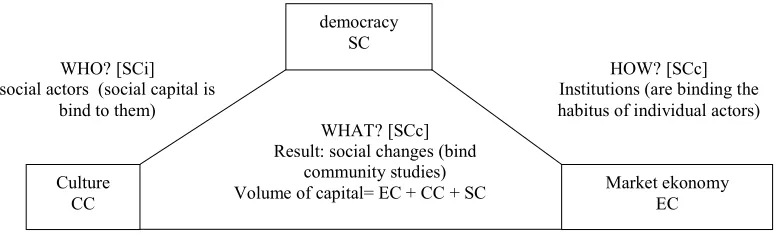
es-tablishing the PPP. Those findings are reflected in the gen-eral theoretic framework – scheme of notions – for social networks (as the PPP becomes one network). The scheme of notions (Figure 1) itself in general is why we have fo-cused on social capital of individual (SCi) and social cap-ital of collective (SCc) from the perspective of social network analysis. In this paper, we are trying to examine altruism, which is crucial for providing public goods (such as highways, hospitals, education, waste management etc.), which is supposed to be provided by PPP.
M. Novak in his book “The Spirit of Democratic
Capi-talism”6 unifies three systems: economy, polity and
cul-ture. Those three systems are joined with one common
4 He is concerned about policy and history of economics, he lives in New Zealand
5 More In: Koľveková G. (2003): Spôsob spolupráce pri použití modelu verejno-súkromného partnerstva.In: Ľudský kapitál
[image:5.595.104.491.511.630.2]a problematika trhu práce [CD/ROM]. Košice, ISBN 80-7099-628-5 Figure 1. Scheme of notions
Source: Own work
democracy SC
Market ekonomy EC Culture
CC
HOW? [SCc] Institutions (are binding the habitus of individual actors) WHO? [SCi]
social actors (social capital is bind to them)
WHAT? [SCc] Result: social changes (bind
community studies) Volume of capital= EC + CC + SC
WHERE? [SCi] Social networks (bind the social
denominator called freedom. For the needs of this paper, I combine these three systems with the approach of Pierre Bourdieu who states that there is a volume of capital. This volume is equal to the sum of three types: social (SC), cultural (CC) and economic capital (EC). This inter-section of two approaches is shown in the Figure 1, where we agree on that the regional development means an im-portant change or several and incremental changes that are possible only with social capital – meaning people (or better residents) of the given area who own some social capital.
SC – we understand the sum of real and potential re-sources that certain person can use by the means of knowing other people. This means that the actors of re-gional development and above all the central people such as official deputies of a county i.e. the chairmen of the Higher Territorial Units, deputies of the public sector should be initiating the establishment of networks with high quality. This network ought to be able to finish the social changes with success – we can say with “public-profitable” outcome that has an utility for individual cit-izens.
We can agree upon the fact that the changes are im-portant for the regional development. Particularly such changes that are enabled due to social capital, which we have already defined. I emphasize that social capital of collective has got the strongest share in the social changes of the community. But the community has got individual members, in our case the actors of regional development, who have certain “amount of social capi-tal” and this volume spools from the institutions to which the actor is an active or passive member.
The last question in the Figure 1 is “WHERE?” The meaning here is: Where can we find the social capital? We can found it when we examine the actor of regional development in her/his social network – network of rela-tionships of the formal as well as the informal character. We have come to the conclusion that the SC and CC can be researched by the means of inquiring. There are questions to be used:
– typical for Scott, who is quoting the Moreno (“Please specify four of your closest friends”–Scott 2003), – and questions typical for the game theory (“How would
you share this money – 2$ – with your partner?“ – Ens-minger 2003).
A special stress should be put on “corruption”, also
called “pork barrel”7. For public procurement it is a
“com-mon“ phenomenon and not only in our neighbourhood territories.
FINDINGS
By the means of research, we reached the following conclusions:
– By the means of a detailed questionnaire (for non-stan-dardized interviews) aimed at examination of altruism and confidence in a group of potential partners of PPP, it is possible to represent better the network of suitable partners for well operating PPP.
– The alternative of the questionnaire might be games, which will evaluate their “altruistic” interests.
The problem is the preservation of anonymity of par-ticipants.
Thus we would manage to reach a real “blood count” of
PPP8. We would find out: “three major variables
describ-ing the features and type of relations in the social network; reciprocity, intensity and stability. (The degree of reci-procity influences transactional costs of exchange. Stabil-ity of a relation is determined by the frequency of contacts of people involved in it (activation of relationship). Family commitments for instance last for the lifetime, another com-mitments are time-limited. Intensity of a relation means a degree of strength in the relation. Or it is a degree of the relation multiplicity – then the ramifying relations are more intense since having a more diffuse character.)” (Buštík-ová 1999, translated).
With such a knowledge of conditions of the arising partnership, we know how to influence its weakest sub-jects so that they do not represent a threat to the com-mon goal – generally regional development.
CONCLUSION
In London, where they have real and positive experi-ences with PPP, there was a conference on Public Private Partnerships that took place on October 16, 2002. I would like to quote from the speech of the chief secretary to the Treasury at the UK: “...(the named) who, recognising the need to harness the best of the private and public sec-tors to deliver on our commitment to better public servic-es, have shown a willingness to take up the challenge to use and develop this significant mechanism for deliver-ing high quality investment and improved outcomes for the benefit of users” (OGC 2002).
“ ... what counts is what works[PPP]. It’s time for ev-eryone to accept that Public-Private Partnerships are here to stay and begin to appreciate the scale of their impact across the country” (OGC 2002).
6 Novák M. (1992). Duch demokratického kapitalizmu, Občanský institut, Praha, ISBN 80-900190-1-3.
7 Pork in fact played such a central a role in 19th century rural life that the word was generally used as a synonym for wealth, and in
particular, wealth derived form political graft and corruption. It was not that great a leap, therefore, to apply the image of a pork barrel to legislation aimed at benefiting politician’s own constituents (either figuratively or literally filling their “pork barrels”) and thus ensuring his re-election.
8 “It is possible to make use of the methods proposed by the analysis social networks also in the analysis of the communities in
These words would be nice to be heard spoken by one of our actors of regional development in a few forthcom-ing years.
REFERENCES
Buštíková L. (1999): Analýza sociálních sítí. Sociologický
časopis, 35 (2), Praha; ISSN - 0038-0288.
Ensminger J. (2003): Altruism. ABC – Australian Broadcast-ing Corporation. Radio National. Radio Programs. The sci-ence show [online] Publikované 2003 [4. 5. 2004]; <http:// www.abc.net.au/rn/science/ss/stories/s800726.htm >. Hrabánková M., Trnková V. (1996): Hodnocení území z pozice
agrární regionální politiky a rozvoje venkova. VÚZE Praha: 74–75; ISBN 80-85898-42-X.
Hudečková H., Lošťák M. (2002): Sociologie a její aplikace v regionálním/rurálním rozvoji.ČZU PEF Praha; ISBN 80-213-0952-0.
Maříková H., Petrusek M., Vodáková A. (1996): Velký socio-logický slovník. Praha, Karolinum; ISBN 80-7184-310-3. Matoušková Z., Macháček J., Postránecký J., Toth P.
(2000):Re-gionální a municipální ekonomika. VŠE Praha: 74–75; 245-0052-3.
Nakonečný M. (1997): Encyklopedie obecné psychologie. Academia Praha; ISBN 80-200-0625-7.
OCG (2002): The Office of Government Commerce. Corpo-rate Information. Media Centre. Speeches. Delivery: The partnership approach. [online] Publikované 2002. [31.03.2004]; <http://www.ogc.gov.uk/index.asp?id=60>. Profil Košického kraja (2002). www.mesa 10.sk.
Rankin K. (1998a): Adam Smith and the Ethics of Economic Liberalism. [online] Publikované 1998. [5. 5. 2004]. Dos-tupné z <http://pl.net/~keithr/rf98_AdamSmithLiberal. html>.
Rankin K. (1998b): What Adam Smith really said about the “Invisible Hand”. [online] Publikované 1998. [5. 5. 2004]. <www.ak.planet.gen.nz/~keithr/rf98_InvisibleHandQuote. html >.
Scott J. (2003): Social Network Analysis: A Handbook, Ana-lytic technologies, USA. [online] Publikované 2003. [26.06.2003]. Dostupné z <http://www.analztictech.com/ mb119/tableof.htm>.
Wicinas J. (2001): The Provision of Public Goods Through Cooperative Altruism: An Experimetnal Economics Approach. The Pennsylvania State University. Department of Agricul-tural Economics & Rural Sociology. [online] Publikované 2001. [4. 05. 2004]. Dostupné z <http://coldfusion.aers. psu.edu/aerec/ab.cfm?nameyear=wicinas2001 >.
Arrived on 14th September 2004
Contact address:
Ing. Gabriela Koľveková, Technická univerzita v Košiciach, Ekonomická fakulta, Němcovej 32, 040 01 Košice, Slovenská Republika