Changes in Quality Parameters of Vodka Filtered
through Activated Charcoal
Lucie Siříšťová
1, šárka PřinoSiLová
2, Kateřina RiddeLLová
2,
Jana HaJšLová
2and Karel MeLzocH
11department of Biotechnology and 2department of Food analysis and nutrition, Faculty of Food
and Biochemical Technology, institute of chemical Technology Prague, Prague, czech Republic
Abstract
Siříšťová L., PřinosilováŠ., Riddellová K., HajšlováJ., MelzochK. (2012):Changes in quality parameters of vodka filtered through activated charcoal. Czech J. Food Sci., 30: 474–482.
The production technology of high-quality vodka used in Russia involves filtration through activated charcoal. To approach the quality of renowned Russian vodka, one prominent Czech spirit-producing company installed on its production premises a filtration device including a charcoal column, and launched test runs during which different filtration conditions were tested. Samples collected during the test runs were analysed by GC-FID and GC-MS with the aim to compare their composition; sensory analysis was an integral part of the evaluation. The results documented a positive effect of charcoal filtration on the quality of produced vodka, which was not reduced when higher flow rates were applied.
Keywords: vodka; spirit; ethanol; activated carbon; GC-FID; GC-MS; sensory analysis; volatile organic compounds
The current situation in the spirits market in Europe can be characterised as supersaturated. For spirits producers it is thus increasingly difficult not only to increase but also to keep up the sale of their produce. New ways how to attract consumers are therefore sought. These include e.g. production of new products made from exotic raw materials according to special recipes, alternatively, the attention is focused on the quality and originality of raw materials. In the case of well-established and highly regarded kinds of spirits such as vodka, the producers can try to achieve, or at least approach, the renowned quality of brands such as the Russian Standard.
By European law, vodka is a spirit produced by rectifying ethyl alcohol of agricultural origin, or by filtering it through activated charcoal, after which
a straightforward distillation or an equivalent treatment follows. These procedures selectively reduce the original organoleptic characteristics of used raw materials. Flavouring may be added to give the product special organoleptic charac-teristics (EC 110/2008).
Traditional Russian vodka deviates from this gen-eral definition due to the raw materials used, and the technologies employed for fermentation, distillation and subsequent processing. Traditional raw materials for vodka production were cereals, especially maize and wheat (Lachenmeier et al. 2008; Art Maski Company 2010). Currently, other raw materials can be also found on the bottle labels: potatoes, molas-ses or sugar beet (Ng et al. 1996; Lachenmeier et al. 2003; Art Maski Company 2010).
In addition to the source of sugar, water is another very important raw material which has to have low hardness and, prior to use, typically undergoes several purification steps (e.g. sand filtration, deep filtration or various membrane filtrations etc.) (Blecha 2008; Lachenmeier et al. 2003, 2008). However, the appropriate parameters cannot be achieved by boiling or distilling, since water would then acquire the so-called distillation off-flavour (Art Maski Company 2010).
The most important technological step in the production of classical vodka is assumed to be its contact with activated charcoal, which eliminates organic admixtures from the ethanol solution and ensures the catalysis of a number of chemical reactions (oxidation, esterification, isomerisa-tion, hydraisomerisa-tion, etc.) (Fillipova 1994; Ng et al.
1996; Fillipova & Fillipova 1997; Blecha 2008; Mukhin et al. 2009; Siříšťová & Melzoch 2009). The simplest setup of the process based on the adsorption of substances on activated charcoal involves stirring of a certain amount of charcoal into an ethanol solution. The process is terminated by filtering the solid particles off. The amount of activated charcoal and the duration of the treat-ment depend on the type and quality of charcoal (Uher & Grégr 1964; Il’inich & Il’inich 2006; Siříšťová & Melzoch 2009).
Another possibility is the filtration of the etha-nol solution through a large amount of activated charcoal packed in a contact column or several columns in series. The solution flows through the columns at a certain velocity that assures a sufficient contact of the solid and liquid phase (Dudetskij et al. 2001; Eliseev et al. 2006; Ko-valev et al. 2007).
The quality of the resulting product is checked not only by sensory analysis, but also by a num-ber of analytical characteristics such as alcoholic strength by volume, total acidity, dry extract (EC 2870/2000) and content of esters, aldehydes, higher alcohols and methanol. A very important char-acteristic is the content of volatile compounds. A traditional method for analysing volatiles in colourless liquids containing no extract is gas chromatography with a flame ionisation detec-tor (GC-FID); samples can be injected without any pre-treatments. Contemporary production technologies achieve a high degree of alcohol puri-fication resulting in only trace amounts of volatile substances. Since GC-FID does not enable to do an analysis of trace components and has a limited
identification capability, analytical approaches with a higher potential for characterisation of alcoholic beverages are applied, such as isotope analysis (NMR or mass spectrometry based) or ion chromatography (Lachenmeier et al. 2003, 2008). Quality vodka should contain a minimal amount of any organoleptic compounds, includ-ing volatiles. Because of low concentrations the analyses of volatiles in vodka are performed after using some of the pre-concentration techniques (Ng et al. 1996; Lachenmeier et al. 2003). These include mainly solid-phase extraction (SPE) or solid-phase microextraction (SPME) in the direct (DI) or head-space (HS) mode (Ng et al. 1996; Lachenmeier et al. 2003, 2008; Reshetnikova
et al. 2007). A suitable solution for the determina-tion of volatile compounds with high sensitivity is the connection of solid-phase microextraction with gas chromatography coupled with mass spec-trometric detection (HS-SPME/GC-MS). This technique allows the detection of trace amounts of analytes and, also, their identification based on the comparison of measured mass spectrum with the spectra stored in spectra library.
The present study was aimed at determining the effect of introduction of a new technological step represented by the filtration through a column of activated charcoal on the quality of vodka. It in-volved the optimisation of a pilot-plant operation, and testing the analytical and sensory parameters of vodka purified in this way. The economics of the introduction of the new technological step was also assessed.
MATERIAL AND METHODS
Processing of vodka on the pilot plant filtration
device. The filtration device consisted of two 600 l
sand filters and the actual 1500 l filtration charcoal column (Figure 1) packed with 100 kg activated charcoal BAU-A. The charcoal was fabricated from ecologically pure birchwood (Siberian birch). Bulk density of the charcoal was 240 kg/m3.
Samples collected from the pilot plant filtra-tion device:
S1 – vodka that was left in contact with charcoal in the filtration device for 3 days;
S2 – vodka before filtration;
S3 – vodka filtered at 400 l/h flow rate; S4 – vodka filtered at 700 l/h flow rate.
Samples of commercial products (vodkas): K1 – Alexander Pushkin vodka 40% vol., original
packaging, Czech origin, produced from rye alcohol and treated with a dose of charcoal powder with subsequent filtration on a plate filter;
K2 – Alexander Pushkin vodka 40% vol., original packaging, Czech origin, produced from rye alcohol and treated on the filtration device with charcoal;
K3 – Kaiser Franz Joseph vodka 40% vol., original packaging, Czech origin, produced from molasses alcohol and untreated;
K4 – Tsar Golden vodka 40% vol., original packag-ing, imported from Russia, special recipe.
Targeted analysis of volatile organic
com-pounds (GC-FID). To 1 ml vodka sample 50 ml
solution of internal standard (1,4-dioxan, 99+%; Sigma-Aldrich, Steinheim, Germany, 2 g/l 100% ethanol) was added. The sample was then directly analysed using an HP 5890 gas chromatograph equipped with a flame-ionization detector (Agilent Technologies Inc., Carlsbad, USA) and a fused-silica capillary column DB 624 (30 m × 0.32 mm ×
1.8 mm) (J & V Scientific Inc., St. Louis, USA). Split
injection (ratio 1:50) at 250°C and a flow rate of 20 ml/min of helium carrier gas were used. Detector temperature was held at 300°C; the oven tempera-ture was programmed as follows: 40°C (4 min), 4°C/min to 80°C, 20°C/min to 220°C (2 min); the total analysis time 23 minutes. Detection and quantification limits and repeatability limits were determined and calculated according to Eurachem Guide (1998).
Fingerprinting head-space analysis of
vola-tile organic compounds (HS-SPME/ GC-MS). All
samples were diluted with distilled water to obtain the same content of ethanol (20%, v/v). The diluted sample (3 ml) was placed into a 10 ml vial (Supelco, Bellefonte, USA) and sealed by a magnetic cap with a PTFE/silicon septum (Sigma-Aldrich®, St. Louis,
USA). After the equilibration at 35°C for 10 min, the extraction of volatile organic compounds from the head-space was performed by a fused silica fibre coated with PDMS/CX/DVB (30/50 µm; Supelco, Bellefonte, USA). The sorption (30 min at 35°C) was conducted using a multifunction auto-sampler CombiPal (CTC Analytics, Salem, USA). The ex-tracted compounds were thermally desorbed (1 min at 230°C, splitless mode) in the injection port of a gas chromatograph (GC System 7890 A; Agilent Technologies, Santa Clara, USA), separated on an INNOWAX column (30 m × 0.25 mm × 0.25 µm; Agilent Technologies, Santa Clara, USA) and de-tected by a mass spectrometric detector equipped with a time-of-flight mass analyser (TruTOFMS; LECO Corporation, St. Joseph, USA).
GC separation. Oven temperature program:
40°C (1 min), 8°C/min to 250°C (2.75 min); the total run time 30 min; carrier gas helium, constant flow 1 ml/minute.
TOFMS detection. The GC MS interface and ion
source temperature were maintained at 230°C and 220°C, respectively. Mass spectra were acquired in electron ionisation mode (70 eV) across the range of 30–500 amu.
ChromaTOF software (Vers. 4.24) was used for the data evaluation; a tentative identification of deconvoluted peaks was based on NIST® library
2008 mass spectra search. The identification of some selected analytes was confirmed by deter-mination of retention indices using a mixture of
n-alkanes (C8–C20) dissolved in n-hexane (Su-pelco, Bellefonte, USA).
Sensory analysis. The samples from the pilot
plant and the samples of commercial vodkas were
1 – first sand filter; 2 – second sand filter; 3 – filtration charcoal column
Figure 1. Scheme of the pilot plant filtration device
input from the distillery
flow meter
valve
evaluated by sensory analysis. The evaluators (sensory panel) assessed the aroma and flavour intensity, purity and harmony, and, also, the mild-ness and length of aftertaste. The overall impres-sion was then evaluated by a point score. The point scale ranged from 0 (unacceptable) to 5 (excellent). The tasting was conducted indepen-dently by two evaluator panels, both panels had 7 to 10 evaluators. The resulting point score was obtained as the sum of nine mean values awarded to the particular criteria.
RESULTS AND DISCUSSION
On the basis of initial laboratory tests, a pilot plant filtration device was installed on the prem-ises of Fruko-Schulz, Ltd.(Jindřichův Hradec, Czech Republic). The device that included an AC packed column (Figure 1) was then tested within the frames of conventional production operation. The tested parameters included mainly the effect of the residence time and sample flow rate on the sensory quality and composition of volatiles of the vodka. The results of GC-FID, HS-SPME/GC-MS and sensory analyses of the two selected sets of samples, which document the influence of intro-ducing the filtration device into the production process in Fruko-Schulz, Ltd., are presented below.
Table 1 summarises the results obtained by GC-FID targeted on acetaldehyde, methanol, 1-propanol, 2-butanol, ethyl acetate, 2-methyl-1-propanol, 1-butanol, 3-methyl-1-butanol, 2-me-thyl-1-butanol, and sensory analysis of samples S1–S4. At the validation procedure of GC-FID, the limits of detection of the above-mentioned compounds were between 0.4 and 1.4 mg/l, limits of quantification 1.1 and 4.7 mg/l, and repeatability limits 0.2 and 1.0 mg/l.
The GC/FID analysis did not reveal any sig-nificant differences between these samples. It showed only trace concentrations of methanol
and acetaldehyde, which were comparable in all the samples. The reason for these negligible dif-ferences between the samples was that the test operation of the filtration device was performed with a high-quality superfine alcohol. In terms of obtaining more significant experimental results it would be better to use lower-quality alcohol in which the concentrations of accompanying volatile compounds would be higher. However, this was not feasible because it would not have been pos-sible to compromise the quality of the products intended for the market. The sensory analysis revealed more significant differences between the samples (Table 1). The evaluators clearly preferred samples S3 and S4 (samples filtered through the AC column at different flow rates) over samples S1 (sample left 3 days in contact with AC) and S2 (sample before filtration). These results have clearly shown a positive effect of the filtration through AC on the quality of resulting vodka. In terms of their significance for the producer, the results of sensory analysis are more important than the chemical composition of the ultrafine alcohol because the organoleptic properties of the product are an important indicator connected with a position of product on its market. The change in the concentration of compounds during the filtration process can be relatively small, but still having an effect on the sensory perception of the product, which is influenced in most cases by a mixture of many compounds, often present at low concentrations.
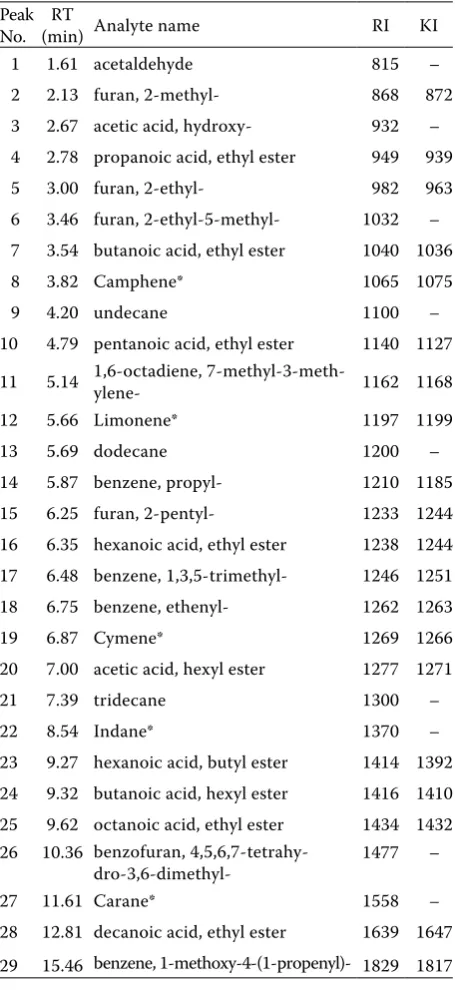
[image:4.595.62.533.657.735.2]Since the GC-FID analysis has been shown to be an unsatisfactory tool for monitoring the chemi-cal composition of the samples treated with AC filtration, we adopted a more sensitive HS-SPME/ GC-MS method, which allowed us to identify the compounds adsorbed by AC. A list of the main volatile organic compounds (VOC) identified in the samples of spirit S1–S4 is shown in Table 2. The compounds were numbered from 1 to 29 according to their retention time (RT) obtained
Table 1. Results of GC-FID and sensory analysis of samples S1–S4 collected during the test of the filtration device
Sample Acetaldehyde (mg/l) Methanol (mg/l) Tasting (points)*
S1 (3 days in AC column) 1.0 11.1 24
S2 (unfiltered) < 0.5 10.5 22
S3 (filtered, 400 l/h) 0.8 10.9 30
S4 (filtered, 700 l/h) < 0.5 10.0 33
on an HP-INNOWAX column. Retention indices (RI), calculated by using the mixture of n-alkanes C8–C20, were compared with the Kovats retention indices for polar columns listed in the NIST® library
2008. Peak areas of VOC are shown in Figure 2. Acetaldehyde, glycolic acid and limonene were the substances with the highest abundance in the samples (Figure 2). The significantly high content
of glycolic acid in ample S1 (spirit left in the filtra-tion column for 3 days) may have occurred because a large part of the adsorption area in the filtration column was already occupied, and the spirit, during a long-term contact, re-extracted this compound from the sorbent. The same applies to 2-pentylfuran and hexyl esters of carboxyl acids C2 and C4.
Terpenic compounds camphene and cymene,
together with ethyl esters of carboxylic acids C6, C8, and C10, were completely removed from the raw material (S2) by continuous filtration through the column at both tested flow rates (4 hl/h – S3 or 7 hl/h – S4). The amount of some other compounds, such as limonene and hexyl esters of carboxylic acids C2 and C4, was reduced. Generally, the efficiency of charcoal filtration did not decrease at a higher flow rate (7 hl/h – S4). This is a surprising finding which contradicts the literature (Uher & Grégr 1964; Dunnet 1975). The reason for the discrepancy may be the quality of the raw alcohol used. The publications that recommend the use of lower flow rates are older, i.e. they were based on the use of alcohol with a higher content of accompanying volatile compounds, removal of which required a longer contact time with AC and, consequently, lower flow rates during the filtration.
[image:5.595.64.292.114.610.2]Table 3 shows the results of GC-FID and sensory analysis of the second set of samples tested to confirm the relevance of the preceding results of the project. The samples used for these analyses were three Czech commercial vodkas in original packaging and one vodka of Russian origin. Like in the preceding set of samples, the GC-FID analysis showed only trace concentrations of acetaldehyde and methanol. The concentrations of methanol in these samples were not as uniform as in samples
Table 2. Volatile organic compounds identified in samples S1-S4 and K1-K4 analysed by HS-SPME/GC-MS
Peak
No. (min) Analyte nameRT RI KI
1 1.61 acetaldehyde 815 –
2 2.13 furan, 2-methyl- 868 872 3 2.67 acetic acid, hydroxy- 932 – 4 2.78 propanoic acid, ethyl ester 949 939 5 3.00 furan, 2-ethyl- 982 963 6 3.46 furan, 2-ethyl-5-methyl- 1032 – 7 3.54 butanoic acid, ethyl ester 1040 1036
8 3.82 Camphene* 1065 1075
9 4.20 undecane 1100 –
10 4.79 pentanoic acid, ethyl ester 1140 1127 11 5.14 1,6-octadiene, 7-methyl-3-meth-ylene- 1162 1168
12 5.66 Limonene* 1197 1199
13 5.69 dodecane 1200 –
14 5.87 benzene, propyl- 1210 1185 15 6.25 furan, 2-pentyl- 1233 1244 16 6.35 hexanoic acid, ethyl ester 1238 1244 17 6.48 benzene, 1,3,5-trimethyl- 1246 1251 18 6.75 benzene, ethenyl- 1262 1263
19 6.87 Cymene* 1269 1266
20 7.00 acetic acid, hexyl ester 1277 1271
21 7.39 tridecane 1300 –
22 8.54 Indane* 1370 –
23 9.27 hexanoic acid, butyl ester 1414 1392 24 9.32 butanoic acid, hexyl ester 1416 1410 25 9.62 octanoic acid, ethyl ester 1434 1432 26 10.36 benzofuran,
4,5,6,7-tetrahy-dro-3,6-dimethyl- 1477 –
27 11.61 Carane* 1558 –
28 12.81 decanoic acid, ethyl ester 1639 1647 29 15.46 benzene, 1-methoxy-4-(1-propenyl)- 1829 1817
*trivial name; RI – calculated retention indices; KI – Kovats in-dices listed in the NIST® library 2008; – not found in the library
Table 3. Results of GC-FID and sensory analysis of com-mercial vodka samples K1–K4
Sample Acetaldehyde (mg/l) Methanol (mg/l) (points)*Tasting
K1 < 0.5 11.4 26
K2 < 0.5 10.7 32
K3 1.1 15.9 21
K4 < 0.5 6.4 38
[image:5.595.304.532.614.702.2]S1–S4. This is due to the use of different qual-ity alcohol in the production of vodkas K1–K4 (K1, K2 – cereal alcohol produced in the Czech Republic, K3 – molasses alcohol produced in the Czech Republic, K4 – cereal alcohol produced in Russia). Information on organoleptic properties
of the products was obtained by sensory analysis, according to which the evaluators preferred vodka produced from cereal alcohol and filtered through AC (samples K2 and K4).
[image:6.595.87.521.86.302.2]Samples K1–K4 were also analysed by the HS-SPME/GC-MS method. The profiles of VOCs of
Figure 2. The impact of filtration on VOC identified in the samples of spirit S1–S4; analysed by HS-SPME/GC-MS. The numbers in the figure (Peak No.) correspond to the compounds listed in Tables 2 and 4
Figure 3. Chromatograms of Czech vodka samples K1 and K2: (A) a record of the characteristic ion (m/z 88) of ethyl esters of carboxylic acids, (B) a record of the ion (m/z 81) of substituted furans; the peak numbers in the chromato-grams correspond to the compounds listed in Table 4
Time (min)
Re
la
tiv
e
ab
un
da
nc
e
(%
)
Peak No.
(A)
(B)
sample K1
sample K2
sample K1
[image:6.595.82.485.434.715.2]commercial vodkas are compared in Table 4. The analyses showed distinct differences between the tested samples. The highest number of volatile
compounds was detected in vodka sample K1. The introduction of continuous filtration of alcohol through the column with bound activated
char-Table 4. VOC identified in commercial vodka samples K1–K4 analysed by HS-SPME/GC-MS
Peak
No. (min) Analyte nameRT K1 K2 K3 K4 Peak No. (min)RT Analyte name K1 K2 K3 K4 1 1.61 acetaldehyde – + – – 16 6.35 hexanoic acid, ethyl ester + – – – 2 2.13 furan, 2-methyl- + – – – 17 6.48 benzene, 1,3,5-trimethyl- + + + + 3 2.67 acetic acid, hydroxy- + + – – 18 6.75 benzene, ethenyl- – + + – 4 2.78 propanoic acid, ethyl ester + – – – 19 6.87 Cymene* + + + + 5 3.00 furan, 2-ethyl- + – – – 20 7.00 acetic acid, hexyl ester + + – – 6 3.46 furan, 2-ethyl-5-methyl- + – – – 21 7.39 tridecane + – + – 7 3.54 butanoic acid, ethyl ester + – + + 22 8.54 Indane* + – – – 8 3.82 Camphene* – – – – 23 9.27 hexanoic acid, butyl ester – – – – 9 4.20 undecane – – + + 24 9.32 butanoic acid, hexyl ester – – – – 10 4.79 pentanoic acid, ethyl ester + – – – 25 9.62 octanoic acid, ethyl ester + – – + 11 5.14 1,6-octadiene, 7-methyl-3-
methylene- + – + – 26 10.36 benzofuran, 4,5,6,7-tet-rahydro-3,6-dimethyl- + – + –
12 5.66 Limonene* + + – + 27 11.61 Carane* + + + –
13 5.69 dodecane – – + – 28 12.81 decanoic acid, ethyl ester – – – + 14 5.87 benzene, propyl- – – + + 29 15.46 benzene, 1-methoxy-4- (1-propenyl)- – + – + 15 6.25 furan, 2-pentyl- + – – –
[image:7.595.67.532.102.373.2]*trivial name; + designates the presence of analyte, – designates the absence of analyte
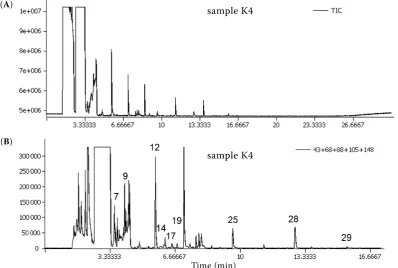
Figure 4. Chromatogram of Russian vodka K4: (A) Total Ion Current (TIC), (B) a record of selected m/z 43, 68, 88, 105, 148; the peak numbers in the chromatogram correspond to the compounds listed in Table 4
(A)
(B)
Time (min)
sample K4
[image:7.595.97.496.452.720.2]coal (sample K2) led to the removal of substituted furans and ethyl esters of carboxylic acids C3, C4, C5, C6, and C8, shown in Figure 3. The sample of imported Russian vodka (K4) contained ‘natural’ substances such as limonene, cymene, and ethyl esters of carboxylic acids C4, C8 and C10, shown in Figure 4.
VOCs were also analysed in sample K3 (Table 4). This vodka was produced from molasses alcohol and, as expected, all analyses showed the differ-ence of this product from all the other samples. The results of our study could provide the basis for a misleading conclusion that this product has a lower quality. However, in terms of its market value, this product has found its target segment of consumers who prefer it over the products from cereal alcohol because of characteristic aroma.
CONCLUSIONS
A pilot plant filtration device which contained a column packed with activated charcoal was installed on the production premises of the spirit producing company Fruko-Schulz, Ltd. A number of samples were collected in the course of testing, and the analysis of two sets is described in this study.
During the study, the direct GC-FID analysis was shown to be unsatisfactory as a tool for evaluating the efficiency of the filtration device tested under routine production conditions which dictate the use of high-quality pure alcohol.
In contrast, the sensory evaluation of the same samples proved differences between them and provided useful clues for the producer with re-spect to potential placement of the products on the market. The evaluators preferred samples that were subjected to filtration using the AC filled column; furthermore, slightly better rating scored the samples filtered at higher flow rates.
The high-sensitivity HS-SPME/GC-MS method, thanks to pre-concentration, allowed the identifi-cation of a number of organic volatile compounds, and partially revealed the groups of compounds that are adsorbed on AC. The results of these analyses, similar to the results of the sensory evaluation, surprisingly showed that, within the range tested, the use of higher flow rates during the filtration process does not reduce the adsorption efficiency of the filtration device. This means that the du-ration of the process as a part of the production operation can be significantly reduced.
References
ART MASKI s.r.o.: Dějiny ruské vodky. Available at http:// www.extravodka.cz (accessed 31. 3. 2011).
Blecha V. (2008): Technologie výroby vodek. (Internal material of Fruko-Schulz, Ltd., Jindřichův Hradec. Dudetskij I.A., Khomutov V.K., Popova Z.N., Guz A.P.
(2001): Method of purifying aqueous alcoholic solutions. RU patent 2173705.
Dunnet W. (1975): Vodka. Patent US 3930042.
Eliseev V.V., Glukhova, L.N., Vavilov V.V., Bernikova N.P. (2006): Method for producing vodka. RU patent 2272830.
Eurachem Guide (1998): The Fitness for Purpose of Analyti-cal Methods: A Laboratory Guide to Method Validation and Related Topics. 1st Ed. LGC, Teddington: 14-26.
EC 2870/2000: Commission Regulation (EC) No. 2870/2000 laying down Community reference methods for the analy-sis of spirits drinks. Official Journal of the European Union, L 333: 20.
EC 100/2008: Regulation (EC) No. 110/2008 of the Euro-pean Parliament and of the Council of 15 January 2008 on the definition, description, presentation, labelling and the protection of geographical indications of spirit drinks and repealing Council Regulation (EEC) No. 1576/89. Official Journal of the European Union, L 39: 16.
Fillipova I.V. (1994): Production of vodka. US patent 5370891.
Fillipova I.V., Fillipova N.L. (1997): Production of vodka by supercooling technology. US patent 5618573. Il’inich V.V., Il’inich A.V. (2006): Method for producing
vodka. RU patent 2276186.
Kovalev N.I., Chagai G.G. (2007): Method for producing vodka. RU patent 2297448.
Lachenmeier D.W., Attig R., Frank W., Athanasakis C. (2003): The use of ion chromatography to detect adul-teration of vodka and rum. European Food Research and Technology, 218: 105–110.
Lachenmeier D.W., Schmidt B., Bretschneider T. (2008): Rapid and mobile brand authentication of vodka using conductivity measurement. Microchimica Acta,
160: 283–289.
Mukhin V.M., Shubina N. A., Abramova I.M., Zubova I.D., Lupascu T.G. (2009): New carbonic adsorbents for industrial sorting purification in vodka production. Environmental Engineering and Management Journal,
8:1017–1019.
Ng L.-K., Hupe M., Harnois J., Moccia D. (1996): Char-acterisation of commercial vodkas by solid-phase micro-extraction and gas chromatography/mass spectrometry analysis. Journal of the Science of Food and Agriculture,
corresponding author:
Ing. Lucie Siříšťová, Ph.D., Vysoká škola chemicko-technologická v Praze, Fakulta potravinářské a biochemické technologie, Ústav biotechnologie, Technická 5, 166 28 Praha 6, Česká republika
tel. + 420 220 444 126, e-mail: [email protected] Reshetnikova V.N., Filatova E.A., Kuznetsov V.V.
(2007): Identification of raw materials for the production of vodkas based on the results of gas-liquid chromato-graphic analysis with the use of fuzzy logic. Journal of Analytical Chemistry, 62: 1113–1016.
Siříšťová L., Melzoch K. (2009): Přehled metod puri-fikace lihu využívaných v nápojovém průmyslu. Kvasný Průmysl, 55: 16–20.
Uher J., Grégr V. (1964): Průmyslová výroba lihovin. SNTL, Prague: 238–247.