Goal-driven
service mediation
solution
University of Twente P.O. Box 217 7500 AE Enschede The Netherlands
by:
Camlon H. Asuncion
Thesis for a degree in Master of Science in Business Information Technology University of Twente, Enschede, The Netherlands
Graduation committee:
Internal:
dr. ir. Marten J. van Sinderen (UT- EEMCS)
dr. Maria-Eugenia Iacob (UT-MB)
External:
Menno Holtkamp, MSc (TNO-ICT)
dr. ir. Wout Hofman (TNO-ICT)
Enschede The Netherlands 2009
Nederlandse Organisatie voor Toegepast Natuurwetenschappelijk Onderzoek, Informatie- en Communicatietechnologie
X
Abstract
This thesis proposes a solution to the interoperability problem of enterprise systems in the context of service mediation. Service mediation is ideal when two or more systems want to interoperate but their functionalities, exposed as services, are fixed and are difficult, if not impossible to change, for the purpose of integration. A Mediator is a software that sits between two or more systems to resolve process and data mismatches. Process mismatches occur when collaborating systems use services that follow different ordering of message exchanges. Data mismatches occur when collaborating systems use different information models (or vocabularies) to describe the messages that are exchanged by their services
However, we find that designing integration solutions has always been traditionally technology-driven where Information Technology (IT) specialists do most of the job of building the technical solutions. We argue that business domain experts should be given the opportunity to participate more actively in the design of the mediation solution. We believe that their involvement is crucial in ensuring that the mediation solution delivers its intended business purpose.
This thesis investigates the use of goal-driven approaches to enable business domain experts in specifying and elaborating the requirements of the mediation solution. Goals capture the reasons why the integration is needed. Goals also provide business domain experts a sufficient level of abstraction in specifying and validating integration design choices at the business level and for communicating such choices among different stakeholders. As such, we argue that business domain experts are at the best position to describe the requirements of the service mediation solution through goals.
X
Acknowledgements
This thesis culminates my two-year Master’s program in Business Information Technology at the University of Twente, Enschede, The Netherlands.
I would not have been able to successfully complete this thesis without the patient tutelage and support of my supervisors during these past eight months: My thanks go to my supervisors from the University of Twente – Marten van Sinderen and Maria-Eugenia Iacob. It was because of Marten that I came to know of service mediation, and Maria who introduced me to her work on rule-based design of SOA systems. The contents, structure, and overall result of this thesis would have been realized if it were not for their valuable inputs. I also owe this thesis to my supervisors at TNO-ICT – Menno Holtkamp and Wout Hofman both of whom have given me what I considered to be an excellent dynamic working environment at TNO. Their advice on the content and structure on the thesis were also valuable. I also would like to thank other folks at TNO Enschede for always making me feel welcome: Frederik, Michael, Wout, Roel, Jasper, Dennis, Erwin, Matthijs, and Catalijna.
My thanks also go to Dick Quartel and Stanislav Pokraev of Novay whom I had the great pleasure of working with to solve the Payment Problem Scenario of the SWS Challenge. I thank Stan for his valuable inputs in structuring the first parts of my thesis, for introducing me to MDSL, and for giving me the opportunity to exercise my programming passion in Java. I thank Dick for assisting me in many ways especially during the simulation of the Mediator ISDL and for helping me understand the concepts behind ARMOR.
I would also like to thank the Royal Dutch/Shell Centenary Scholarship Fund for giving me the opportunity to come to the Netherlands in the first place. I also thank the folks at the International Office of the University of Twente for also assisting me in coming to Holland.
My thanks also go to a fellow BITer, Chris Jager, who has generously given his time to provide comments to my thesis.
Labaw sa tanan, gapasalamat ko ug daku sa akong mga pinaggang ginikinan, Raul ug Shirley Asuncion, ug igsuon, Shella Asuncion, sa ilang kanunay nga pag-ampo para sa akong malampuson nga pag-iskwela diri sa Holland ug sa ilang kanunay nga pagsuporta sa akong mga pangandoy. Para kini sa ila. Hinaot unta muabot ang panahon, malooy ang Ginoo, nga makabalos ko sa ilang kaayo.
Camlon Asuncion
September 21, 2009
X
Table of Contents
Abstract ii
Acknowledgements iii
Figures viii
Tables x
Listings xi
Abbreviations xiii
1.
Introduction 1
1.1. Motivation 1 1.2. Research objective 3 1.3. Research approach 3 1.4. Report structure 5
Part I 7
Problem Analysis 7
2.
The business domain expert 9
2.1. Who is the business domain expert? 9 2.2. Why involve them? 11
2.3. How can they be involved? 12 2.4. Chapter summary 13
3.
On goal-oriented system design 15
3.1. Definition 15 3.2. Goals classification 16
3.2.1. Strategic vs. operational goals 17 3.2.2. Functional vs. non-functional goals 17 3.2.3. Soft vs. hard goals 17
3.3. Why use goals in engineering requirements? 18 3.4. GORE activities 19
3.4.1. Goal analysis/identification 19 3.4.2. Goal decomposition/refinement 20 3.4.3. Goal abstraction 21
3.5.1. Business rules basics 23 3.5.2. Business rules classification 24
3.5.3. Implementing goals as business rules 25 3.5.4. When to use a rule-based solution? 26 3.6. Goal modeling approaches 27
3.6.1. i* 28 3.6.2. KAOS 30 3.6.3. BMM 32 3.6.4. ARMOR 33 3.7. Chapter summary 35
4.
Service mediation 37
4.1. Definitions 37
4.2. State-of-the-art service mediation approaches 40 4.2.1. DERI approach 40
4.2.2. SWE-ET approach 42 4.2.3. jABC/jETI framework 43 4.2.4. COSMO approach 45 4.2.5. Discussions 46 4.3. Chapter summary 47
Part II 49
Solution Design 49
5.
A goal-driven service mediation solution 51
5.1. Overview of approaches 51 5.1.1. ARMOR + ArchiMate 53
5.1.2. The COSMO approach to service mediation 56 5.1.3. Goal- and model-driven approach to SOA design 57 5.2. Model transformation architecture 58
5.2.1. ISDL 60 5.2.2. ACE 62 5.2.3. RuleML 63 5.2.4. Jess 64
5.3. The Enterprise Architecture 67 5.4. The methodology 69
5.4.1. Step 1– Abstracting from PSMs to PIMs 70 5.4.2. Step 2 – Semantic enrichment of PIMs 72 5.4.3. Step 3 – Model goals and business rules at CIM 73 5.4.4. Step 4 – Transformation of business rules 76 5.4.5. Step 5 – Design of the Mediator PIM 77 5.4.6. Step 6 – Validation of Mediator PIM 79 5.4.7. Step 7 –Transformation to Mediator PSM 81 5.5. Chapter summary 82
6.
Tool support 85
6.1. Design Space 85
6.1.1. BiZZDesign Architect 85 6.1.2. Grizzle 87
6.1.3. Sizzle 88 6.1.4. Tizzle 89
6.1.5. Omondo EclipseUML 90 6.2. Goals and Business Rules Space 91
6.2.1. APE Web client 91 6.2.2. ACE2RRML 93
6.2.3. RuleML to Jess transformation 95 6.2.4. JessDE 96
Part III 101
Solution Validation 101
7.
SWS Payment Problem Scenario 103
7.1. The Semantic Web Service (SWS) Challenge 103 7.2. The Payment Problem Scenario 104
7.3. Applying the methodology 108
7.3.1. Step 1 – Abstracting from PSMs to PIMs 108 7.3.2. Step 2 – Semantic enrichment of PIMs 111 7.3.3. Step 3 – Model goals and business rules at CIM 112 7.3.4. Step 4 – Transformation of business rules 118 7.3.5. Step 5 – Design of the Mediator PIM 121 7.3.6. Step 6 – Validation of the Mediator PIM 126 7.4. The Enterprise Architecture 129
7.5. Business rules as design artifacts 129 7.6. Chapter summary 131
8.
Final remarks 133
8.1. Conclusions 133 8.2. Contributions 137 8.3. Limitations 138 8.4. Future work 139
8.5. Recommendations to the SEW 141
References 143
Appendices 151
A.
SWS Challenge Payment Problem Scenario solution artifacts 153
A.1. ARMOR goal model 153
A.2. ARMOR + ArchiMate enterprise architecture 154 A.3. Derived ACE sentences 155
A.4. Generated RuleML files 155
A.5. RuleML to JESS XSLT stylesheet 163 A.6. Generated JESS rules 165
A.7. JESS rule set added with JESS-specific code 165 A.8. WSDL for AuthorityService 167
A.9. Java wrapper for getNextAuthority operation of AuthorityService 168 A.10. ISDL behavior model 170
A.11. MDSL semantic data mapping 171
B.
Discourse Representation Structures 175
B.1. Overview 175 B.2. DRS in ACE 176
C.
RuleML to Jess Transformation 179
Figures
Figure 1-1: Research approach 4
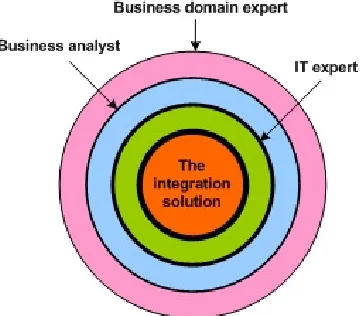
Figure 2-1: The integration solution stakeholder onion model 11 Figure 3-1: A sample business goal decomposition 21
Figure 3-2: Business rule scheme (Von Halle, 2002) 23
Figure 3-3: From goal to rules (Kardasis and Loucopoulos, 2005) 26 Figure 3-4: A sample Strategic Dependency model (Deng, 2006) 29 Figure 3-5: A sample Strategic Rationale model (Deng, 2006) 29
Figure 3-6: Summary of KAOS concepts and notations (Respect-IT, 2007) 31 Figure 3-7: A sample goal model in KAOS (Respect-IT, 2007) 31
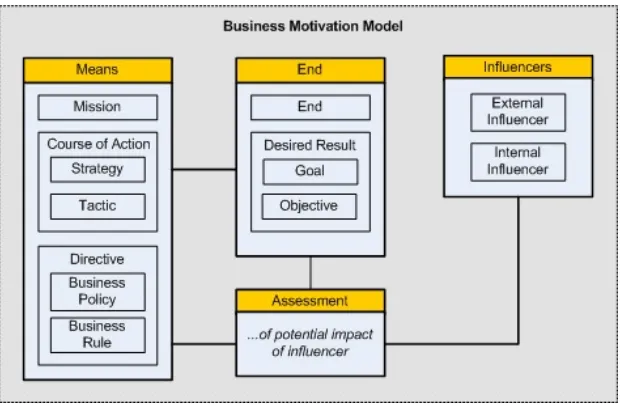
Figure 3-8: BMM meta-model relations 33
Figure 3-9: Extending ArchiMate with ARMOR (Quartel, et al., 2009c) 34 Figure 3-10: A sample goal model in ARMOR (Quartel, et al., 2009c) 35 Figure 4-1: Service mediation (Quartel, et al., 2008a) 38
Figure 4-2: Message reordering 39
Figure 4-3: Synonym type message heterogeneity 39 Figure 4-4: WSMO mediation architecture 41
Figure 4-5: The SWE-ET approach for service mediation 43
Figure 4-6: jABC/jETI framework for service mediation (adopted from Pessoa, et al, 2008) 45 Figure 4-7: The COSMO approach for service mediation 45
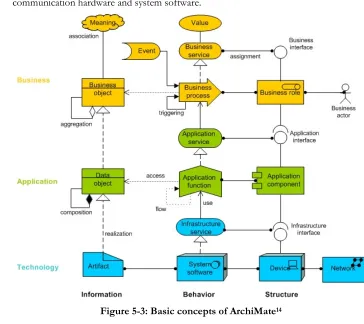
Figure 5-1: Abstract syntax of ARMOR (Quartel, 2009a) 54 Figure 5-2: Concrete syntax of ARMOR (Quartel, 2009a) 54 Figure 5-3: Basic concepts of ArchiMate 55
Figure 5-4: The COSMO approach 56
Figure 5-5: The COSMO approach for service mediation 56
Figure 5-6: A goal-based, model-driven approach for SOA design (Iacob, et al., 2009) 57 Figure 5-7: Model transformation architecture 58
Figure 5-8: Representing service-oriented design concepts in ISDL (Quartel, et al., 2004) 60 Figure 5-9: Basic action relations 61
Figure 5-10: Causality relations combination 61 Figure 5-11: Operation concept in ISDL 61
Figure 5-15: Abstracting from PSMs to PIMs 71
Figure 5-16: Abstracting operations in ISDL (Quartel, et al., 2008a) 71
Figure 5-17: Semantic enrichment of behavior model in ISDL (Quartel, et al., 2008a) 72 Figure 5-18: Modeling goals and business rules at CIM (modeled in BiZZDesigner) 74 Figure 5-19: Matching provided and requested services (Quartel, et al., 2008a) 78 Figure 5-20: Composing services by relating their operations 78
Figure 5-21: Sample data transformation mapping in MDSL 79 Figure 5-22: Adding BPEL constructs as stereotypes to ISDL 81
Figure 5-23: Sample ISDL to CBPL to BPEL transformation (Dirgahayu, et al., 2007) 82 Figure 5-24: Methodology summary 84
Figure 6-1: BiZZDesign’s ArchiMate Professional for Enterprise Architecture modeling 86 Figure 6-2: Grizzle for behavior modeling in ISDL 87
Figure 6-3: Sizzle for behavior simulation in ISDL 88 Figure 6-4: Tizzle for mapping data translations in MDSL 90 Figure 6-5: Omondo Eclipse UML 91
Figure 6-6: Attempto Parsing Engine (APE) web interface 92 Figure 6-7: ACE to Reaction RuleML translator by Bahr (2008) 94 Figure 6-8: RuleML differences in version 0.8 and 0.9 95
Figure 6-9: Oxygen XML Editor 96 Figure 6-10: JessDE Eclipse Plugin 98
Figure 6-11: Jess rules deployed as web service 99 Figure 6-12: Eclipse Web Tool Platform 99
Figure 7-1: SWS Challenge Payment Problem Scenario 106 Figure 7-2: Payment Problem Scenario activity diagram 108 Figure 7-3: Generated ISDL model for Blue and Moon 109 Figure 7-4: UML diagram of CdtrTrfTxInf 110
Figure 7-5: Generated ISDL model for Blue and Moon with information type 111 Figure 7-6: Semantically enriched ISDL behavior model 111
Figure 7-7: Semantically enriching information model between Blue and Moon 112 Figure 7-8: Stakeholder and primary goal model in ARMOR 113
Figure 7-9: Refining primary goal into high-level use cases 113 Figure 7-10: Refined primary goal using use cases 114 Figure 7-11: Refining use cases as requirements 114 Figure 7-12: Mapping requirements to existing services 115 Figure 7-13: Refining a requirement as a business rule 116 Figure 7-14: Business rule modeled in ARMOR 116 Figure 7-15: Translating business rules in APE 117
Figure 7-16: Abstracting getNextAuthority in ISDL 121 Figure 7-17: Realizing a business rule as a service in ArchiMate 122
Figure 7-18: Matching provided and requested services on Mediator’s side 122 Figure 7-19: Composing services through operation parameter matching 123 Figure 7-20: payInit mapping function in MDSL 124
Figure 7-21: Authorization behavior type in ISDL 124 Figure 7-22: Behavior model of Mediator in ISDL 125 Figure 7-23: Mediator simulation in Sizzle: PO < €2000 126 Figure 7-24: Mediator simulation in Sizzle: PO > €2000 (1) 127 Figure 7-25: Mediator simulation in Sizzle: PO > €2000 (2) 128 Figure 7-26: Mediator simulation in Sizzle: PO > €2000 (3) 128
Figure 8-2: Validating goals and business rules 140
Figure 8-3: Conceptual model of the SEW (Hofman, 2008b) 142 Figure B-1: DRS box notation (Hirtle, 2006) 175
Figure B-2: DRS pretty print in ACE (Fuchs and Kaljurand, 2006) 176 Figure B-3: object-predicates representation in ACE (Fuch, et al., 2009) 176 Figure B-4: predicate-predicates representation in ACE (Fuch, et al., 2009) 177 Figure B-5: property-predicates representation in ACE (Fuch, et al., 2009) 177 Figure C-1: Authority1 in ACE 179
Figure C-2: Authority1 in DRS 179 Figure C-3: RuleML to Jess transformation 181
Tables
Table 7-1: Authorities and their designated amounts 105 Table 7-2: Summary of WSDL operations and messages 109
Listings
List 3-1: A sample goal 16 List 3-2: A sample strategic goal 17 List 3-3: A sample operational goal 17 List 3-4: A sample functional goal 17 List 3-5: A sample non-functional goal 17 List 3-6: A sample soft goal 17
List 3-7: A sample hard goal 18
List 3-8: Prescriptive search keywords for goal identification 20 List 3-9: Intentional search keywords for goal identification 20 List 3-10: Amelioration search keywords for goal identification 20 List 3-11: A common term 23
List 3-12: A business term 23 List 3-13: A sample fact 23 List 3-14: A sample rule 23
List 3-15: A sample derivation rule 24
List 3-16: A sample integrity rule with state constraint 24 List 3-17: A sample integrity rule with process constraint 24 List 3-18: A sample reaction rule 24
List 3-19: A sample production rule in Jess 25 List 5-1: ACE sentence general structure 62 List 5-2: A sample of a simple ACE sentence 62 List 5-3: A sample of a composite ACE sentence 63 List 5-4: A sample fact in Datalog 64
List 5-5: A sample fact in RuleML 64 List 5-6: A sample rule in Datalog 64 List 5-7: A sample rule in RuleML 65 List 5-8: A sample fact in Jess 65 List 5-9: Asserting a fact in Jess 65
List 5-10: Viewing the working memory using (facts) function in Jess 66 List 5-11: Retracting a fact from working memory in Jess 66
List 7-1: SWS Challenge Payment Problem Scenario case description 105 List 7-2: Generated JAXB code fragment of XSD element CdtrTrfTxInf 110 List 7-3: Translated business rules to ACE 118
List 7-4: Translated Jess rule (Authority1) 118
List 7-5: Translated ACE rule (Authority1) to RuleML 119 List 7-6: Java code to invoke Jess 120
Abbreviations
ACE Attempto Controlled English
ADS Accounting Department System
AJAX Asynchronous Javascript And XML
APE Atttempto Parsing Engine
ARMOR Architectural Modeling of Requirements
ASM Abstract State Machines
BMM Business Motivation Model
BPEL Business Process Execution Language
BPMN Business Process Modeling Notation
CBPL Common Business Patterns Language
CIM Computation Independent Model
CNL Controlled Natural Language
CLIPS C Language Integrated Production System
COSMO COnceptual Service MOdelling
DERI Digital Enterprise Research Institute
DRS Discourse Representation Structure
DRT Discourse Representation Theory
DSL Domain Specific Language
EA Enterprise Architectures
ECA Event-Condition-Action
EMF Modeling Framework Project
ERD Entity-Relationship Diagrams
FIP Financial Information Provider
GEF Graphical Editing Framework
GORE Goal Oriented Requirements Engineering
G&BR Goals and Business Rules
IFIP International Federation of Information Processing
ISDL Interaction Systems Design Language
IT Information Technology
jABC Java Application Building Center
JAXB Java Architecture for XML Binding
JAX-WS Java API for XML Web Services
Jess Java Expert System Shell
JessDE Jess Development Environment
KAOS Knowledge Acquisition in autOmated Specification
LHS Left-hand side
LPC Lightweight Process Coordination
MDA Model Driven Architecture
MDS Management Department System
MDSL Mapping Domain Specific Language
OMG Object Management Group
PIM Platform Independent Models
PO Purchase Order
PRR Production Rule Representation
PSM Platform Specific Models
QoS Quality of Service
RAM Random Access Memory
RDF Resource Description Framework
RE Requirements Engineering
RFC Request for Comment
RHS Right-hand side
RIF Rule Interchange Format
ROI Return of Investment
RuleML Rule Markup Language
SBVR Semantics of Business Vocabulary and Business Rules
SD Strategic Dependency
SD Strategic Rationale
SEW Service Engineering Workbench
SIB Service Independent Building Blocks
SLG Service Logic Graph
SOA Services Oriented Architecture
SOAP Simple Object Access Protocol
SQL Structured Query Language
SWEET Semantic WEb Enabling Technology
SWOT Strength, Weakness, Opportunity, and Threat
SWRL Semantic Web Rule Language
SWSC Semantic Web Service Challenge
TNO-ICT Nederlandse Organisatie voor Toegepast Natuurwetenschappelijk Onderzoek, Informatie- en Communicatietechnologie
UDDI Universal Description Discovery and Integration
UML Unified Modeling Language
UMM UN/CEFACT's Modeling Methodology
URL Universal Resource Locator
W3C World Wide Web Consortium
WSDL Web Service Description Language
WSMO Web Service Modeling Ontology
WSML Web Service Modeling Language
WSMX Web Service Execution Environment
WSMT Web Service Modeling Toolkit
WTP Web Tools Platform
XSD XML Schema Definition
XSLT EXtensible Stylesheet Language Transformations
1
1.
Introduction
his thesis proposes a solution for service-oriented mediation of applications. In particular, we seek to provide non-technical business domain experts an active participation in the design of the solution enabled by goal-driven and model-driven approaches. This chapter presents the motivation, objectives, approach and the overall structure of this thesis.
The structure is as follows: Section 1.1 positions the reasons why this research was done. Section 1.2 describes research objective and questions. Section 1.3 presents the research approach that we adopt for achieving the research objectives and answering the research questions. Finally, Section 1.4 gives an overview of the general structure of this report.
1.1.
Motivation
In today’s era where there are strong demands to quickly adapt to rapidly changing business environments, no enterprise can ever afford to be an island. To a large extent, the competitiveness of an enterprise depends on its capabilities to foster innovativeness with other enterprises (Charalabidis, Gionis, Hermann and Martinez, 2008). With current advances in networking and computing technologies, autonomous enterprises are joining together to form
networks of enterprises (often called virtual enterprises) so as to collectively achieve added value in their services and ensue exploration of more business opportunities (Van Sinderen, 2008).
Achieving such networks of enterprises, however, is not an easy task. Among the current challenges in enterprise computing, as described by Van Sinderen (2008), is providing
interoperability solutions to the seamless collaboration of networked enterprises. Most of today’s industries have investments in large legacy systems that were not originally designed to be interoperable, aggravated further by the oversupply of standards (or the lack thereof), proprietary developments or extensions, and heterogeneous hardware and software platforms. It is no surprise therefore that much research interest is currently being conducted in the area of enterprise interoperability to ensure growth and competitiveness of enterprises. Such example of
this is one initiated by the International Federation of Information Processing1 (IFIP). Another
challenge is for enterprises to be flexible so that they can continuously adapt to current and future
changes and demands from within and outside their business environment. This is especially true
1
http://www.ifip.or.at/homeintro.html
when business goals need to be changed, temporary partnerships need to be created, technological changes need to be considered, etc. It is therefore imperative that such networked enterprises are designed for change so that they can quickly respond to emerging business opportunities (Van Sinderen, 2008).
This thesis responds to these challenges, firstly, and in particular, by providing a solution to
mismatching process specifications of interoperating enterprise systems through service mediation.
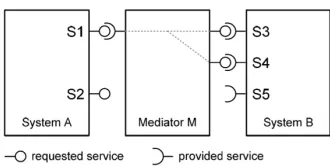
Service mediation is ideal when systems need to interoperate but have existing and often difficult-to-change services. Matching the sequence of message invocations between such services is oftentimes difficult, if not impossible, as these systems may follow proprietary or standards-based message structures. A Mediator therefore is a piece of software that acts as an intermediary in reconciling message protocol and semantic data mismatches (Quartel, Pokraev, Mantovaneli Pessoa and Van Sinderen, 2008a).
Secondly, we want to provide flexibility to our mediation solution by keeping it business-driven; that is, we want to keep the solution problem-oriented rather than technology-oriented. A change in the business requirements should not adversely affect the underlying technology
implementation. We keep it business-driven by providing direct involvement of business domain
experts during the integration design. The solution should allow them to see how their business requirements are aligned with technological implementations.
However, designing integration solutions has always been traditionally technology-driven where Information Technology (IT) specialists do most of the job of building solutions based on such technologies as WSDL, BPEL, etc. Business domain experts are merely consulted at the early stage of requirements elicitation. Even if business domain experts do get involved in the collaboration design, they will have to contend with learning such technologies and sophisticated tools which may be too technical for them. (Pokraev, Quartel, Steen, Wombacher and Reichert, 2007; Hofman, 2008a). Furthermore, infusing the participation of business domain experts in integrating service-based systems is often difficult because technology standards (e.g. WSDL) are inherently defined with so little business semantics that business people do not understand them. For business people to match and compose services at the technology level is a daunting task. It is difficult therefore to compose the integration solution using these standards at the business level (An and Jeng, 2007).
In our objective to keep our mediation solution business-driven, we investigate whether a goal-driven approach can be used by business domain experts in specifying the requirements specifications of the mediation solution. Goals are high-level objectives of a business,
organization, or system. They capture the reasons why a system is needed and guide decisions at
various levels within the enterprise (Anton, McCracken and Potts, 1994). Goals are important as they can be used to elaborate system requirements. They also provide decision makers a sufficient level of abstraction in specifying and validating system design choices at the business level, and for communicating such choices among different stakeholders (Iacob, Rothengatter and Van Hillegersberg, 2009). As such, we argue that business domain experts are at the best position to describe the requirements of the service mediation solution through goals.
Once we have the requirements of the service mediation solution expressed in terms of goals
driven by business requirements, we further investigate the use of model-driven techniques to
transform these abstract goals into technology-specific implementations, and investigate how business rules can be used in the process. Model-driven development allows us to raise the problem and solution analyses spaces to a level of abstraction that is technology independent more suited for business-level analysis (Miller and Mukerji, 2003). We believe that model-driven techniques should be able to give added flexibility to our solution as it treats business requirements, their design specifications, and technical implementations as separate concerns with the resulting artifacts maintainable and reusable.
Realizing the need for a business-level design of services, the Nederlandse Organisatie voor Toegepast
provide a tooling environment that allows technology-independent, business-viewpoint design and choreography of services. Information (semantic) and behavior (process) requirements of business transactions, interactions, and protocols between service consumers and providers serve as inputs to the SEW. These requirements are modeled at the business level which can later be transformed into technology specifications and implementations which serve as its outputs (Hofman, 2008b). As the project is still at its early stages, we aim to contribute to this workbench by exploring service mediation as one of its solution components. The mediation solution will detail requirements that can be supported by the SEW. Consistent with SEW’s general requirements, we strive to provide technology-independent, business-level design of services and their transformation to platform specific implementations in the context of service mediation.
1.2.
Research objective
Our main research objective in general is:
To improve the participation of business domain experts in the design of networked enterprises
We hypothesize that our general objective can be achieved by:
Adopting a service-oriented mediation approach and applying goal-driven and model-driven techniques in the design
Specifically, the following research questions (RQ) have to be answered:
RQ1: Who are the business domain experts? Why and in what ways should business
domain experts be involved in the design of a service mediation solution?
RQ2: What are goals? How are they used to specify software requirements? What
goal-driven approaches are there? How can goal-goal-driven approaches be used to specify requirements for the design of the mediation solution?
RQ3: What is service mediation? What service mediation approaches are currently
available? How do they involve business domain experts in the design of an integration solution?
RQ4: How can goal-driven and service mediation approaches be combined to allow
business-level design of the service mediation solution? How can model-driven techniques be used to combine these approaches?
RQ5: What available tools are there to help in the (semi-)automated Mediator design,
goal modeling, and model transformations?
RQ6: What requirements can be drawn from the service mediation solution which can
serve as inputs to the design of the Service Engineering Workbench of TNO-ICT?
1.3.
Research approach
The development of this research shall follow research and design methodology principles proposed by Wieringa (2007; 2008). We show graphically our research approach in Figure 1.
As this research attempts to devise a way to improve the involvement of business domain experts in the design of networked enterprises, we thus view our research as largely based on solving a
practical problem; that is, we want to reduce the difference in the current and desired state of the world. In particular, we tackle selection problems where we seek one solution from out of a
selected solution. To some extent, this research also deals with solving knowledge problems; that is, we want to reduce the gap between current and desired knowledge states. Following the engineering lifecycle of Wieringa (2008), we divide our research methodology into three phases:
problem analysis, solution design, and solution validation.
Figure 1-1: Research approach
During problem analysis, we solve both knowledge and selection problems. We first do a literature
study to describe who business domain expert are and the necessity of their involvement during system design – this is largely a knowledge problem. We then do another literature study of goal concepts, goal-oriented requirements engineering and modeling concepts, and how goals can be implemented as business rules (a knowledge problem). This literature study includes a survey of goal modeling approaches to see how they can specify requirements for the design of the
mediation solution; that is, we look into how they use goals as basis for specifying the Enterprise
Architecture(EA) design of the Mediator (a selection problem). We then do a state-of-the-art literature survey to determine and select an appropriate service-oriented mediation approach (a selection problem). In particular, we investigate how these approaches involve business domain experts in the design of their mediation solution. In addition to these literature studies, our selection will also be motivated by looking into current established research work in similar areas within our community. We answer research questions 1, 2 and 3 in the process, and report the results in Chapters 2, 3 and 4, respectively.
During solution design, we solve an implementation problem. We determine the best way to
combine the selected goal modeling and service-oriented approaches that allows better involvement of business domain experts during the design process. We also describe which tools are available in the industry and academe that provide partial or full automation of mediation design, goal modeling and transformations. We answer research questions 4 and 5 in the process, and report the results in Chapter 5 and 6, respectively.
Lastly during solution validation, we apply our solution to two case studies for illustration and validation purposes. We assess how the solution allows better participation of business domain experts in the design through case study using the Semantic Web Service Challenge (SWS)
Payment Problem Scenario2. During the validation process, we use new knowledge we can gain
as feedback to the solution design phase. We answer research question 4 in the process, and report the results in Chapter 7.
Finally, we use the results of this research to propose design considerations to the SEW. We answer research question 6 in the process, and report the results in Chapter 8 along with the conclusion, other recommendation, limitations, contributions, and possible future work for the thesis.
2
1.4.
Report structure
Congruent to the research objectives, questions and approach in Figure 1-1, we structure the report into three parts: problem analysis (Part I), solution design (Part II), and solution validation (Part III). Please refer to Figure 1 to see how the chapters map to the research questions.
Part 1: Problem Analysis
C2:Chapter 2 reports the result of a literature study that describes who business domain experts are. We also describe why their involvement during the design is necessary and the ways in which they can manifest their involvement.
C3: Chapter 3 reports the result of a literature study on the concepts of goals, their classification, and activities related to goal oriented requirements engineering. We also show the relationship between goals and business rules, provide a basic classification of the latter relevant to this research, motivate their importance, and provide recommendations when to use them in the design of software systems. This chapter concludes with a survey of goal modeling approaches aimed at observing how they can specify requirements for the design of the mediation solution; that is, we look into how they use goals as basis for specifying the
Enterprise Architecture design of the Mediator (a selection problem).
C4: Chapter 4 presents the results of a literature study that clarifies the concept of service mediation, including the assumptions we applied to this thesis. It also presents the results of a state-of-the-art literature survey of service mediation approaches that compares them according to how they involve business domain experts in the design of integration solutions.
Part II: Solution Design
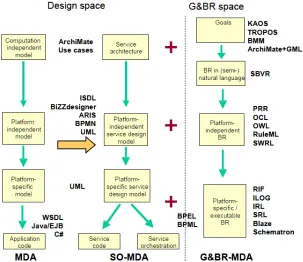
C5: Chapter 5 presents our goal-driven service mediation solution in detail. The solution is comprised of both a methodology and architecture. We first describe the three approaches we have used as basis for our solution which includes a goal-driven approach for requirements
engineering in Enterprise Architectures, a methodology for service mediation, and a framework
for model-driven design of service systems using goals and business rules. We then provide an overview of the technologies we used to realize each step of the methodology and architecture. Specifically, we show architecturally how business domain experts can have goals of the integration, expressed in terms of refined business rules, be formulated, validated and transformed into design and executable architectural artifacts. We strive to keep the methodology as generic as possible so that other technologies may be used in lieu of those we have chosen to realize our solution. This essentially keeps our methodology problem-oriented rather than technology-oriented.
C6: Chapter 6 presents available commercial, open source, and academic software tools we used to carry out the design and implementation of the methodology and architecture.
Part III: Solution Validation
C7: Chapter 7 reports how our solution is applied through a case scenario. We take the Semantic Web Service (SWS) Challenge as an illustrative and validating case.
Part
I
Problem Analysis
his part is comprised of Chapters 1, 2, and 3. The objective of this part is to report the results of a literature study on the concepts of business-level design and roles and skills of business domain experts in the design of integration solutions. Next to this a literature study on the concepts of goals, goal oriented requirements engineering, and current goal modeling approaches is undertaken. Also a literature study on the concepts of service mediation is performed. Finally a state-of-the-art literature survey on service-oriented mediation approaches is included.
2
2.
The business domain expert
his chapter introduces who the business domain experts are as used in this research, why their involvement during the design of software systems is necessary, and the ways in which they can manifest their involvement.
The structure is as follows: Section 2.1 describes our understanding of the business domain expert. Section 2.2 describes the importance of their involvement in the design of integration solutions. Section 2.3 describes ways in which they can be involved. We end this chapter with a summary in Section 2.4.
2.1.
Who is the business domain expert?
This section describes how we define who business domain experts are in the design of software systems. To do this, we first review the literature to see how they are characterized in various research areas. We formalize our definition at the end of this section.
Findings
In the field of Requirements Engineering (RE) research, business domain experts are stakeholders
– “an individual or group who is actively involved in the project, who is affected by the project, or who can influence its outcome” (Wiegers, 2006). They are those who gain or lose something (e.g. functionality, revenue, status, compliance with rules, etc.) as a result of the development of the software system. More specifically in this research, they are those whose skills are needed to build the system (Alexander and Robertson, 2004). These stakeholders may have competing interests that cause the acquisition, specification, and evolution of requirements to be inconsistent (Ryan and Greenspan, 1996; Alexander, 2007).
In the area of service mediation research, business domain experts do not necessarily “speak” the language of IT experts. They do not have or want to have the technical knowledge to understand how these requirements are implemented at the IT level (Quartel, Pokraev, Pessoa and Van Sinderen, 2008a). They have detailed knowledge about how the business logic of a process that is to be designed, but are not computer programmers and may not even have a technical background (Steffen, Margaria, Nagel, Jorges and Kubczak, 2006).
implement these requirements into technical implementation such as specifying them in service description (e.g. through WSDL, BPEL, XSD) because of a lack of background in these technologies. Furthermore, they may not have the faculty to select, from among an array of existing or required services, the right service to form a composition (Ying and Li, 2007).
In the design of Model Driven Architectures (MDA), business domain experts have expertise in the business domain and can provide the requirements of the system as imposed by the business. They do not need to know how these requirements are realized as functionalities of the systems implementing these requirements. In contrast, IT experts are those who have the technical expertise to design and construct the business requirements as software artifacts (e.g. architecture, model, code, technical documentation, etc.) that satisfy those requirements (Miller and Mukerji, 2003)
In the area of business-driven service personalization, business domain experts are able to demonstrate a mastery of their own business; however, they are only able to understand the functionalities of an IT system when these functionalities are expressed in business terms (also
called Business Semantics). Their interests may be different from other business domain experts and
may only wish to know concrete business details on areas they are interested in and only basic
information in others (also called Diversity of Interests in Business Functions). Next to this, they may
have different, and often conflicting, demands over what functional or non-functional properties a system should have, even if their requirements are similar at the higher level (also called
Personalized Business Requirements) (Wang, Yu and Han, 2005).
Summary
Summarizing the salient characteristics, a business domain expert is:
• Is a stakeholder to the realization of the integration solution,
• Has the expertise or mastery of his respective business domain (e.g. finance, health, banking,
insurance, etc.),
• Is able to describe the requirements of the system from the business perspective,
• May have conflicting interests with other business domain experts as to how the
requirements of the system will be specified and eventually implemented, and
• Does not have (or does not want to have) technical background or expertise to understand
how business requirements are translated into their technical implementations.
Applying these observations to our research, we thus define a business domain expert as:
A stakeholder who has the expertise of a business domain, and whose expertise is used as basis to specify the business requirements (which may also run in conflict with those of the other business experts in the same or different domain) of the integration solution. However, he does not necessarily have (or does not want to have) the technical knowledge to translate the business requirements into their technical implementations.
Comparing business domain experts to other participants of the integration solution
We distinguish in this thesis a business domain expert from that of a business analyst and an IT expert. We use the term business analyst as described Vongsavanh and Campbell (2008) and Lister (2009) (seeing that there are several confusions as to their names as reported in literature). A
business analyst is someone whose main role is to liaise between the business and IT professionals
operate from either the IT or business side of the organization. As such, a key skill set among business analysts is their ability to display fundamental consulting skills such as communication, listening, writing, presenting, abstraction and negotiation by keeping a close working relationship with the business community. This thesis views them as mediating between business domain experts and IT experts. This thesis assumes that business analysts are familiar with goal oriented requirements engineering activities and modeling concepts.
If business analysts are concerned with the business and how to use IT to achieve business goals,
then IT experts are more concerned with software development and implementation. IT experts
are regarded as having a technical role with more emphasis placed on business process and system
design. As with business analysts, their skill sets include communication and technical, general analysis, design and problem solving ability (Vongsavanh and Campbell, 2008). This thesis uses the term IT expert to loosely refer to system architects, systems analysts, developers, programmers, quality assurance testers, etc. We further assume in this research that they are knowledgeable of service specifications (e.g. WSDL, BPEL, SOAP, etc), Services-Oriented Architecture (SOA) concepts, or service-oriented design principles (e.g. service coherence, reusability, granularity, autonomy, parsimony, etc.), Model Driven Architecture (MDA) concepts, and rule-based technologies.
To model their relationships, we use the stakeholder map (also known as the onion model) proposed
[image:25.612.234.414.345.503.2]by (Alexander and Robertson, 2004) that distinguishes their level of involvement in the design of integration solution: the closer they are to the innermost center circle, the greater is their involvement. The model is shown in Figure 2-1.
Figure 2-1: The integration solution stakeholder onion model
2.2.
Why involve them?
Requirements initially come from preliminary materials given to the requirements engineer. More often than not, however, most of the requirements come from stakeholders (Van Lamsweerde, 2001). Alexander and Robertson (2004) argue that maintaining the involvement of stakeholders in the design of software systems is crucial to successfully implementing software projects. The
consultant Tim Lister3 regards project success as “meeting the set of all requirements and
constraints held as expectations by key stakeholders” (Wiegers, 2006).
However, studies show that inadequate involvement of stakeholders is one of the leading causes of software projects failure. The Standish Group research in 2001 reports that of the 280.000 projects that were studied, 137.000 projects were challenged (49%), while 65.000 (23%) failed entirely. Project failure was not caused by the lack of money to sustain the project but, to some
3
extent, the lack of user involvement (second to lack of executive support). A project can still fail even if it is delivered on time and within the allotted sources if the needs of the users were not properly addressed.
User involvement in the design of information systems has been a much researched area. And the general conclusion has been that their involvement is critical to the successful design of software applications, especially in large-scale projects. In fact, it is considered good practice as evidenced by the wide array of available methodologies available today (e.g. prototyping, agile programming, etc.). Involving users ensures their commitment, reduces resistance to change, increases satisfaction and acceptance of the system. Conversely, the lack of user involvement ensue high failure rates in terms of the software’s implementation and use, late delivery of the software, over-budget implementations, scope creep, user backlash, and limited technical functionality, among others (Wagner and Piccoli, 2007).
Particularly in this research, the importance of the business domain expert in the design of integration solution can be appreciated more when several enterprises wish to have their enterprise collaborate at a massive scale. The complexity involved in this exercise is no easy task; and it is hard to imagine if all the integration design is done by IT experts lest we fall to the same old requirements problem where requirements are misidentified, inaccurate, or insufficient. Furthermore, collaborating enterprises may not belong to the same business domain; for example, a large hospital may want to perform a collaborative business venture with an insurance company through the interoperation of their enterprise systems. Business domain experts from these two fields have expertise from entirely different domains. Their expertise is therefore needed to accurately and completely specify and reconcile integration requirements.
In conclusion, getting the right software requirements is therefore critical to getting the right software (Van Lamsweerde, 2008). And we argue that business domain experts play a vital role in requirements specification as they drive and guide the requirements elicitation process. Their role is all the more important for the successful implementation of integration solutions between large, mission-critical, enterprise systems.
2.3.
How can they be involved?
This thesis looks at the following ways in which business domain experts can be involved in the in the design of integration solutions:
By serving as the source of the requirements
Stakeholders have an interest in the requirements since they have an interest in, or an effect on, the outcome of the product. They have an interest the product because they want it to do their work correctly. Moreover, they want their work to be successfully implemented. The importance attached to stakeholders comes from the fact that they are the source of the requirements (Robertson, & Robertson, 2006).
By validating the requirements specifications
To ensure the quality of the integration solution, business domain experts can validate requirements specification. Requirements validation ensures quality by detection of defects of the requirements, reporting them, analyzing their causes and doing the necessary corrective actions to fix them. The earlier the error in the requirements is detected, the less costly it is to repair it. To validate requirements, business domain experts can perform
By validating solution artifacts
In business process modeling, even when workflow models are syntactically or structurally correct (e.g. free from deadlock occurrences), it does not necessarily mean that such models have captured the specified business logic. The knowledge of business domain experts is thus of paramount importance to determine if the business logic, business rules, and other requirements have been met (Sadiq, Orlowska, Sadiq and Foulger, 2004). Thus, during integration design, business domain experts can validate the business logic of the integration’s business process model.
By providing semantic information to the mapping of data elements
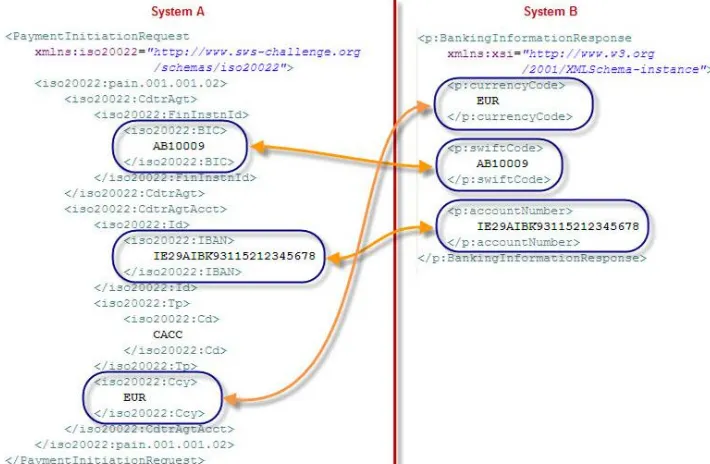
When collaborating systems interoperate through their existing service operations, message-level heterogeneities may exist. For example, one system may not have the same semantic interpretation of the message data passed by the other (semantic heterogeneity). On the other hand, naming conflicts may arise where the meaning of a message data is interpreted the same by both services only that the message is structured differently (syntactic heterogeneity) (Nagarajan, Verma, Sheth and Miller, 2007). During the integration design, business domain experts from collaborating enterprise can come together to resolve these message heterogeneities.
By specifying modifications to the requirements
Modifications to the integration requirements may come in a form of maintenance activities. Several types of maintenance such as corrective, adaptive and perfective maintenance best
suit the involvement of the business domain expert. In the corrective maintenance, the
business domain expert needs to identify the things that are not functioning properly. These therefore were referred to as the bugs, misinterpreted designs, missed specified designs, and
ignored needs. The adaptive maintenance takes place as to meet the changing demands of the
environment such as government regulations and improving old policies and procedures.
Involvement in the perfective maintenance counts on improving the existing system to
upgrade and efficiently perform the routine functions (Alge, and Upright, 2009).
2.4.
Chapter summary
This thesis defines a business domain expert as a stakeholder to the integration process. He belongs to some business domain (e.g. banking, health, insurance) of an enterprise. He manifests his expertise by his ability to specify the requirements of the integration solution. However, he does not necessarily have (or does not want to have) the technical knowledge to translate the business requirements into their technical implementations.
To assist business domain experts during the integration design, a business analyst may liaise in his behalf with the IT expert. A business analyst does not necessarily have the business expertise as the business domain expert but has knowledge of eliciting, decomposing, validating requirements of the integration; furthermore, they may not have the same technical expertise as IT experts. We loosely coin the term IT expert to refer to an individual who has the ability to realize the requirements into their technical implementations.
several enterprises wish to have their enterprise collaborate at a massive scale, and when enterprise systems belong to different business domains.
3
3.
On goal-oriented system design
his chapter looks into the concept of goals and how they are used to specify software requirements. We also show how goals can be implemented as business rules for the design of software systems. Finally, we show what goal-driven approaches are currently available, and compare them as to how they can be used to specify the requirements for the design of the service mediation solution.
The structure is as follows: Section 3.1 describes the definition of goals as used in this thesis. Section 3.2 provides a general classification of goals. Section 3.3 describes the importance of goals in requirements engineering. Section 3.4 describes activities related to Goal Oriented Requirements Engineering (GORE). Section 3.5 describes goals and their relation to business rules including a basic definition and classification of rules. Section 3.6 provides an overview of the goal-driven approaches reported in literature. Section 3.7 provides a summary of this chapter.
3.1.
Definition
Today, developing the right software largely depends on getting the right software requirements. This is the study of Requirements Engineering (RE) which deals with “the elicitation, evaluation, specification, consolidation, and evolution of the objectives, functionalities, qualities, and constraints that a software based system should meet within some organizational or physical setting”. RE, however, has always been a very difficult task intrinsically. But, many consider that it bears a critical impact on the quality of software that can be produced. Poor requirements specification is widely believed to cause frequent, persistent, expensive and recurrent types of software errors leading to serious project cost overruns, delivery delays, failure to meet customer expectation, etc. (Van Lamsweerde, 2008).
Faced by the inadequacy of traditional approaches to RE, especially in dealing with complex software systems, researchers, since the 1990s, have looked at how objectives that a system should achieve or provide can best be captured from various levels of abstraction. They started to treat these system objectives or goals as first-class citizens in the RE world. This is in contrast with early practices where requirements focus only on processes and data without capturing the rationale of the software systems, making it difficult to relate requirements to the higher problem domain. Furthermore, traditional RE approaches tend to focus only on the software-to-be without considering the environment and assumptions that the software will have to eventually
interact with (Lapouchnian, 2005). This gave way to the concept of Goal-Oriented Requirements
Engineering (GORE) which investigates how goals can be used for eliciting, elaborating, structuring, specifying, analyzing, negotiating, documenting, and modifying software requirements (Van Lamsweerde, 2001).
A widely accepted definition of goals is given by Anton, McCracken, and Potts (1996):
“Goals are high-level objectives of the business organization or system. They capture the reasons why a system is needed and guide decisions at various levels within the enterprise.”
Van Lamsweerde (2009) adds to this definition by stating that:
“Goals are prescriptive statements of intent that the system should satisfy through the cooperation of its agents.”
Goals are optative properties of a system under development; that is, they express intentions, wishes, or desires and are thus declarative. This is in contrast with descriptive statements which describe real facts (Jackson, 1995). For example, “Ascend to the third floor” is a goal stated declaratively, while “The third floor is empty” is a descriptive statement.
Agents are required to cooperate with one another by playing a role to satisfy and achieve a goal. They can be either be a human being (e.g. organizational actors, operators, end users, etc.), devices (e.g. sensors, actuators, etc.), existing software components (e.g. legacy, COTS, etc.), or new software components. They perform such roles in a way that restricts the behavior of a
system (i.e. the system-to-be or the system-as-is). For example, the statement:
A student should first fully pay his tuition fee
before he can be allowed to graduate
List 3-1: A sample goal
This prescriptive statement is a goal which requires several agents to cooperate before a student is allowed to graduate. These agents may include for example the University’s enrollment system, the student himself, the University’s Admission Personnel, the Professor, etc. One can see that the finer the goal is, the less the number of agents required to achieve the goal.
Goals can be formulated at different levels of abstraction (also called goal granularity). Strategic or
high-level goals can represent some generally desired situation (high granularity) such as “improve
company image”, “attract more international students”, "satisfy customer", etc. They can also represent low-level technical concerns (low granularity) such as “keep door closed while ascending or descending” as in elevator systems (Van Laamswerde, 2009, p. 261).
3.2.
Goals classification
Several authors propose various goal classification schemes. This research, however, only gives an overview of a relevant general classification of goals. We compare strategic vs. operational goals, functional vs. non-functional goals, and hard goals vs. soft goals. For an extensive classification, we refer you to the work of Van Lamsweerde (2001, 2009) specific to the KAOS approach for GORE.
3.2.1.
Strategic vs. operational goals
Soffer and Wand (2005), in their study of incorporating goals in business process modeling, propose a distinction between strategic goals and operational goals. A business process is a set of partially ordered activities aimed at reaching a goal. Strategic goals are more abstract objectives that organizations want to achieve. They cannot usually be performed by a specific process but nevertheless important for the organization.
To be the leading University in the Netherlands
List 3-2: A sample strategic goal
Operational goals define the desired state to be achieved which can be accomplished by a specific process.
Handle student enrollment
List 3-3: A sample operational goal
3.2.2.
Functional vs. non-functional goals
Functional goals underlie services that a system is expected to deliver; that is they describe what the software does (Keller, Kahn and Panara, 1990). They state the intent behind a system service like satisfying an agent’s request, informing the agent of the system’s status, providing responses to specific events, etc., (Van Lamsweerde, 2009). In most cases, they can be assigned to a specific process, actor or organizational structure (Iacob, et, al. 2009).
Send purchase order invoice
List 3-4: A sample functional goal
Non-functional goals refer to expected system qualities such as security, safety, performance, usability, flexibility, customizability, interoperability, and so forth (Keller, et al., 1990). They refer to quality requirements that the software needs to satisfy while delivering the services (e.g., how the software provides security) (Jureta, et al., 2006). They do not apply to any specific process, actor or organizational structure. Both functional and non-functional goals can be both clearly defined and are thus measurable (Iacob, et al., 2009).
The customer should immediately receive payment receipt in one second
List 3-5: A sample non-functional goal
3.2.3.
Soft vs. hard goals
Soft goals are goals whose satisfaction cannot be established in a clear-cut sense (such as for example in for modeling and analyzing non-functional, quality-related requirements) (Mylopoulos, Chung and Yu, 1999). Their criteria for satisfaction are typically abstract and may be subject to interpretation. Lacking objective criteria to measure achievement, they thus involve subjectivity where evaluating its achievement depends on its stakeholders (Jureta, et al., 2006). They specify high-level qualitative objectives that are difficult to measure (Iacob, et al., 2009).
The student’s enrollment system should be secured
List 3-6: A sample soft goal
Increase product sales to 5%
List 3-7: A sample hard goal
3.3.
Why use goals in engineering requirements?
The authors Yu and Mylopoulos (1998), Van Lamsweerde (2001) and Van Lamsweerde (2009, p. 272) enumerate the importance of goals in the engineering of requirements in the following manner:
• Specification refinement. Goals provide a natural way for structuring complex specifications. Such structure can be accomplished by defining a goal into a set of sub-goals that together contribute, satisfy or achieve it. Furthermore, goals can be used to clarify requirements especially in situations where requirements are difficult to make precise. For an instance, in describing non-functional requirements of a system-to-be such as flexibility, robustness, reusability, etc.
• Requirement rationalization. As a consequence to goals being refinable, we are able to reason the
existence of a specific requirement especially in situations where its rationale may not be clear by simply looking at the goal’s refinement. Goals and their refinements can also be used as basis to explain the requirements to various stakeholders. Requirements are often unclear when first elicited from clients and stakeholders.
• Requirements identification. Goals serve as the starting point for the identification of
requirements that support such goals. This is especially important when goals appear in the identification and evaluation phases of requirements engineering process. Goal identification
naturally involves repetitively asking “why”, “how”, and “how else” questions. Doing so allows
us to explore various alternatives to achieve such goal, and may in fact give ways to new requirements that can contribute to it. This prevents stakeholders from prematurely adopting certain technological solutions right away.
• Business-IT alignment. Goals have been used as an important mechanism for connecting
requirements to design seeing that requirements should ultimately lead to the design and implementation of the system-to-be. Goal refinements can be used as basis to describe to various stakeholders how the organization’s strategic objectives, refined into goals, will be aligned to the system that will be developed, and back. Today, requirements no longer solely focus on what the system-to-be is supposed to do. Requirements should also be able to motivate how such systems will be able respond to the more dynamic nature of organizational environments.
• Risk analysis. Goals have been used to analyze potential risks which can result from the loss
of achieving some goal. Goals can be used to create goal negations that prevent the goal from ever being satisfied. Goal negations allow possible exploration of countermeasures as new goals to reduce, mitigate, or prevent risks from occurring. This is especially helpful in critical safety- and security-critical systems.
• Managing conflicts among requirements. Goals can be used to manage conflicts among
• Structuring agent dependency. Goals are eventually achieved by cooperating agents. Goals and
their refinements can thus allow us to capture the agents that need to perform the goals and their relation with one another while distinguish their respective definitions, capabilities and responsibilities.
• Delimiting scope. The system to be developed is bounded according to how agents cooperate
together to satisfy the goals of the system. These agents are both “good” and “bad” agents (with the former trying to perform the goal while the latter obstructing it). These agents define the scope of the system to be developed.
• Reasoning about alternatives. Goalscan be refined through various alternative combinations of
its sub-goals where the fine-grained goal can be operationalized through alternative system services and assigned to alternative agents. Negative goals can be avoided by considering alternative countermeasure goals. Conflicting goals can be managed by exploring alternative resolution goals. Goals are thus able to provide alternative options explicitly.
• Requirements traceability. When there are changes to the requirements, it is important that such
changes are managed throughout the engineering process by ensuring that the impact of the change is localizable to manage and propagate. Goal refinements allow us to determine where a requirement comes from, why it came from there, and where it goes to next.
• Evolution support. A lower-level goal may be one particular way of achieving a higher-level
goal. This lower-level goal may likely to change in the future as new ways may be identified to better achieve the higher-level goal. The higher the goal, the higher is its stability. This means that we can isolate higher-level goals which are stable from lower-level goals which may change in the future.
3.4.
GORE activities
In GORE, the main purpose of goals is to aid in the elaboration or elicitation of requirements that support them. Goals are treated as high-level objectives of the organization or system. The elicitation of goals can be done in a top-down, bottom-up or hybrid fashion. Top-down approach usually starts from analyzing abstract strategic goals of an organization which are then refined into a set of soft goals refined further until they become hard goals. Bottom-up approach starts from analyzing individual actors and goals which are then aggregated into more abstract or higher-level goals that represent the desires of the organization (Iacob, et al., 2009).
GORE is problem-oriented RE which focuses on understanding requirements from a
problem-oriented view (Wieringa, 2004). It takes a system-engineering approach to the modeling and analysis of the problem domain. The goal model describes the problematic phenomena, their relations, why they are seen as problematic and which stakeholders see them as so; they help reason about the purpose of the proposed solution, analyze and demonstrate which goals realize other goals including those that negatively contribute to their achievement (Quartel, Engelsman, Jonkers and Van Sinderen, 2009c).
3.4.1.
Goal analysis/identification
Goal analysis, a top-down approach to goal elicitation, is the process of exploring gathered documentation for the purpose of identifying, organizing and classifying goals. The objective of this step is to build a preliminary draft of the goal model, and this is usually done at the early phases of requirements elicitation (Van Lamsweerde, 2009). This is a top-down approach to goal elicitation.
business goals and policies. Similarly, analyzing the current objectives and problems of the system-as-is (and their negations) could bring forth opportunities for identifying goals of the system-to-be. (Van Lamsweerde, 2009). Requirements may also come from stakeholders themselves so that they have to be extracted through interviews and documented. Other sources include process descriptions, flow charts, Entity-Relationship Diagrams (ER), preliminary documents, domain knowledge (Anton, 1996).
When requirements are given in a textual form, goals may also be extracted by searching for statements which seem to guide design decisions at various levels within a system or organization. Searching for action words is a useful way of extracting goals from stakeholders’ description (Anton, 1996). These action words are intentional keywords which may be of the
prescriptive, intentional, or amelioration types. Keyword searching is a simple, cheap, and quite an effective way of identifying preliminary goals. The preliminary goals are then temporarily given a name, a rough preliminary information definition, and assigned into some classification in terms of the goal taxonomies defined at the meta-level. Examples of keywords that can be used for goal identification are given below (Van Lamsweerde, 2009, p. 310):
shall, should, must, has to, to be, may never, may not, should never…
List 3-8: Prescriptive search keywords for goal identification
in order to, so as to, so that, objective, aim, purpose, achieve, maintain, avoid, ensure, guarantee, want, wish, motivate, expected to…
List 3-9: Intentional search keywords for goal identification
improve, increase, decrease, reduce, enhance, enable, support, provide…
List 3-10: Amelioration search keywords for goal identification
Once a preliminary set of goals have been identified and validated by stakeholders, more goals can be identified by their refinement or abstraction. Finally, when a goal is refined enough to be performed by a single agent, the process of goal operationalization can take place (Lamsweerde, Darimont and Massonet, 1995; Van Lamsweerde, 2000; Van Lamsweerde, 2001).
3.4.2.
Goal decomposition/refinement
Goal refinement or decomposition is a process of refining goal granularity by breaking down a
higher-level goal into several lower-higher-level goals in such a way that the latter contributes to the achievement or satisfaction of the former. It is the process of subdividing a set of identified goals into a logical sub-grouping so that system requirements can be more easily understood, defined and specified (Anton, 1996).
This informal, but effective, technique involves finding out sub-goals and requirements by asking
“HOW” questions; that is, the sub-goals of G can be determined by asking “How can G be
satisfied?”, or “Is this sub-goal sufficient or is there any other sub-goal needed for satisfying G?” Furthermore,
every time a How question has been answered, we can ask How Else again to explore