EXTENSION POLYMORPHISM
Dharini Balasubramaniam
A Thesis Submitted for the Degree of PhD
at the
University of St Andrews
1998
Full metadata for this item is available in
St Andrews Research Repository
at:
http://research-repository.st-andrews.ac.uk/
Please use this identifier to cite or link to this item:
http://hdl.handle.net/10023/13495
f .
Extension Polymorphism
f.
i:
Dharini Balasubramaniam
School of Mathematical and Computational Sciences
University of St Andrews
St Andrews
Fife
KYI6 9SS
ProQuest Number: 10167264
All rights reserved
INFORMATION TO ALL USERS
The quality of this reproduction is dependent upon the quality of the copy submitted.
In the unlikely event that the author did not send a com plete manuscript and there are missing pages, these will be noted. Also, if material had to be removed,
a note will indicate the deletion.
uest
ProQuest 10167264
Published by ProQuest LLO (2017). Copyright of the Dissertation is held by the Author.
All rights reserved.
This work is protected against unauthorized copying under Title 17, United States C ode Microform Edition © ProQuest LLO.
ProQuest LLO.
789 East Eisenhower Parkway P.Q. Box 1346
Declarations
I, Dharini Balasubramaniam, hereby certify that this thesis, which is approximately 44,000 words in length, has been written by me, that it is the record of work carried out by me, and that it has not been submitted in any previous application for a higher degree.
Date 0 6 - 0 4- % Signature of candidate
I was admitted as a research student in October 1993 and as a candidate for the degree of Doctor of Philosophy in October 1994 ; the higher study for which this is a record was carried out in the University of St Andrews between 1993 and 1997.
Date OG • 0 4 - Signature of candidate
I hereby certify that the candidate has fulfilled the conditions of the Resolution and Regulations appropriate for the degree of Doctor of Philosophy in the University of St Andrews and that the candidate is qualified to submit this thesis in application for that degree.
Date 4 S Signature of supervisor
In submitting this thesis to the University of St Andrews I understand that I am giving permission for it to be made available for use in accordance with the regulations of the University Library for the time being in force, subject to any copyright vested in the work not being affected thereby. I also understand that the title and abstract will be published, and that a copy of the work may be made
and supplied to any bona fide library or research worker.
Abstract
Any system that models a real world application has to evolve to be consistent with its changing domain. Dealing with evolution in an effective manner is particularly important for those systems that may store large amounts of data such as databases and persistent languages. In persistent programming systems, one of the important issues in dealing with evolution is the specification of code that will continue to work in a type safe way despite changes to type definitions.
Polymorphism is one mechanism which allows code to work over many types. Inclusion polymorphism is often said to be a model of type evolution. However, observing type changes in persistent systems has shown that types most commonly exhibit additive evolution. Even though inclusion captures this pattern in the case of record types, it does not always do so for other type constructors. The confusion of subtyping, inheritance and evolution often leads to unsound or at best, dynamically typed systems. Existing solutions to this problem do not completely address the requirements of type evolution in persistent systems.
The aim of this thesis is to develop a form of polymorphism that is suitable for modelling additive evolution in persistent systems. The proposed strategy is to study patterns of evolution for the most generally used type constructors in persistent languages and to define a new relation, called extension, which models these patterns. This relation is defined independent of any existing relations used for dealing with evolution. A programming language mechanism is then devised to provide polymorphism over this relation. The polymorphism thus defined is called extension polymorphism.
Acknowledgements
Many people have contributed in different ways to this thesis. I would particularly like to thank the following for their role:
My supervisor Ron Morrison for his advice, guidance, encouragement and good humour throughout this project and for his dedication and drive which made this thesis complete
My second supervisor Richard Connor for encouraging my interest in type systems and for his invaluable help and advice during the project
Graham Kirby for his time and effort in meticulously reading the draft of the thesis and suggesting many improvements
Past and present members of the persistent programming research group in St Andrews, Quintin Cutts, Graham Kirby, Dave Munro and Stephan Scheuerl, for their contributions to various aspects of the thesis
My mother and my brother for their constant support and understanding
The secretary of the Computer Science Division, Helen Bremner, for always being helpful, kind and patient
Frédérique Stintzy for being a great friend and for all those cups of tea
Contents
1 Introduction 1...1
1.1 Persistent Evolution... 1
1.2 Polymorphism ... 2
1.3 The History of Type Evolution...3
1.4 Motivation... .4
1.5 Outline of Thesis ... 4
1.5.1 Fundamentals...5
1.5.2 Background...5
1.5.3 Schema Evolution...5
1.5.4 Related W ork...6
1.5.5 Extension Polymorphism...6
1.5.6 A Type Checker for Extension Polymorphism...6
2 The Base Language ... 7
2.1 Programs ...7
2.2 Types ...7
2.3 Declarations ... 9
2.4 Expressions ... 9
2.5 Abbreviations ... 12
2.6 Naming Conventions... 12
2.7 Typing Rules ...12
2.7.2 Declarations...13
2.7.3 Expressions... 14
2.7.3.1 Integers... 14
2.7.3.2 Booleans... 15
2.7.3.3 Records... 16
2.7.3.4 Variants... 16
2.7.3.5 Functions... 16
2.13.6 Identifiers... 17
2.7.3.7 Locations... 17
2.7.3. 8 Infinite Union ... 18
2.7.3.9 Sequence... 18
2.7.3.10 Block... 18
2.7.3.11 Conditional... ...19
2.8 Summary 19 3 Semantics of the Base Language... 20
3.1 A Semantic Context for Types...20
3.2 Meta-operations ...21
3.3 A Semantics for Base ...23
3.3.1 Programs...24
3.3.2 Declarations... 24
3.3.3 Integers ...24
3.3.4 Booleans...24
3.3.6 Variants... 25
3.3.7 Functions...25
3.3.8 Identifiers...25
3.3.9 Locations...25
3.3.10 Infinite Union... 25
3.3.11 Sequence...26
3.3.12 Block ...26
3.3.13 Conditional... 26
3.4 Type Mapping ...26
3.5 Summary 27 4 A Proof of Soundness for B ase... 28
4.1 Programs 28 4.2 Declarations ...29
4.3 Base Cases 30 4.4 Expressions ...30
4.4.1 Integers ...30
4.4.2 Booleans...32
4.4.3 Records ... 34
4.4.4 Variants...34
4.4.5 Functions...35
4.4.6 Identifiers...36
4.4.7 Locations... 37
4.4.9 Sequence... 39
4.4.10 Block ...39
4.4.11 Conditional... 39
4.5 Summary 40 5 Background 41 5.1 Polymorphic Systems... 41
5.1.1 Sets and Types ...41
5.1.2 Partial Orders and Lattices...42
5.1.3 System F ...43
5.1.3.1 Parametric Polymorphism... 44
5.1.3.2 Quantification... 46
5.1.4 System F^...46
5.1.4.1 Inclusion Polymorphism... 46
5.1.4.2 Subsets, Subtypes and Type Constructors 47 5.1.4.3 Subsumption... 55
5.1.4.4 Anomalies of Subsumption... 56
5.1.4.5 Bounded Quantification...57
5.1.5 Summary... 58
5.2 Type Checking ...58
5.2.1 Properties of Type Checking Algorithms...59
5.2.1.1 A Sound Algorithm...60
5.2.1.3 A Sound, Complete and Convergent
Algorithm...61
5.2.2 Type Representation...62
5.2.3 Type Checking Algorithms... 63
5.2.3.1 Monomorphic Type Systems...63
5.2.3.2 Polymoiphic Type Systems... 64
5.2.4 Summary...65
5.3 Object Oriented Programming... 65
5.3.1 Introduction...65
5.3.2 Objects and Classes...66
5.3.3 Inheritance... 68
5.3.4 Delegation...69
5.3.5 Subclassing... 70
5.3.6 self and MyType...72
5.3.7 Advantages of Object Oriented Programming... 74
5.3.8 Summary...74
6 Schema Evolution 75 6.1 Introduction ... 75
6.2 The Effects of Schema Evolution... 75
6.3 Data Evolution in the O2 Database System... 79
6.3.1 Introduction... 79
6.3.2 The 0% System Structure...79
6.3.4 Schema Evolution in O2 ...80
6.3.5 Database Updates in O2...80
6.3.5.1 Restructuring Data in O2 ...80
6.3.5.2 Moving Data to Other Classes...81
6.3.5.3 Time of Update in O2 ...82
6.3.6 The Implementation of Database Updates...83
6.4 Summary...83
7 Related Work... ...85
7.1 Eiffel ...85
7.1.1 An Overview of the Eiffel Type System...85
7.1.2 Genericity...86
7.1.3 Inheritance... 86
7.1.4 Feature Calls... 90
7.1.5 Conformance... 91
7.1.6 Reattachment of Entities...92
7.1.7 Type Checking Feature Calls... 93
7.1.8 Comments... 94
7.2 Type Matching ... ...94
7.2.1 Motivation... 95
7.2.2 Syntax ... 95
7.2.3 Subtyping...96
7.2.4 Subclasses...98
7.2.6 Inheritance... ....101
7.2.7 Matching... 102
7.2.8 Type Checking self... 103
7.2.9 Adding Bounded Polymorphism...104
7.2.10 Reconciling Subtyping, Matching and Quantification... 106
7.2.11 Replacing Subtyping by Matching... 107
7.2.12 Extending Matching to Function Types...110
7.3 Other Languages ... I l l 7.3.1 Simula ... I l l 7.3.2 SmallTalk... I l l 7.3.3 Ada ... I l l 7.3.4 C++ 112 7.3.5 Java ... 112
7.4 Summary 112 Extension Polymorphism ... 114
8.1 Examples of Extension in Persistent Systems...115
8.1.1 Records ... 115
8.1.2 Variants... 116
8.1.3 Functions... 116
8.1.4 Locations... 118
8.2 The Extension Relation...118
8.2.2 Base Types... 119
8.2.3 Records ... 119
8.2.4 Variants... 119
8.2.5 Functions ...119
8.2.6 Locations... 119
8.3 Adding Polymorphism...120
8.3.1 Typing Extension Variables... 120
8.3.2 Explicit Extension Variables... 121
8.3.3 Implicit Extension Variables... 124
8.3.4 Polymorphism over Type Constructors... 124
8.3.4.1 Base Types...125
8.3.4.2 Records... 125
5.3.4.3 Variants... 125
5.3.4.4 Functions... 126
8.3.4.5 Locations... 127
8.3.5 Quantified Functions... 128
8.4 Interaction with Other Kinds of Polymorphism... 128
8.5 Summary 129 9 A Language with Extension Polymorphism...130
9.1 Types 130 9.2 Expressions ... 130
9.3 Typing Rules ... 131
9.3.2 Records ... 131
9.3.3 Variants... 132
9.3.4 Quantified Functions...132
9.3.5 Locations... 133
9.3.6 Infinite Union...133
9.3.7 Extension Quantifier Variables... 133
9.4 Semantic Context... 133
9.5 Meta-operations ... 134
9.6 Semantics 134 9.6.1 Quantified Functions...134
9.7 Proof of Soundness... 134
9.7.1 Base Types with Extension... 135
9.7.2 Records with Extension...135
9.7.3 Variants with Extension... 136
9.7.4 Quantified Functions...137
9.7.5 Locations with Extension... 138
9.7.6 Infinite Union with Extension... 138
9.8 Summary 139 10 Type Checking of Extension Polymorphism...140
10.1 Implementation Strategy... 140
10.1.1 Functionality...140
10.1.2 Implementation Procedure... 140
10.2.1 Base Types...143
10.2.2 Records... 143
10.2.3 Variants... 144
10.2.4 Functions... 145
10.2.5 Locations... 146
10.2.6 Any ... 146
10.2.7 Quantifier Variables...147
10.2.8 Quantified Functions ... 147
10.3 Type Checking ... 148
10.3.1 Type Equivalence Checking... 148
10.3.2 Type Extension Checking... 149
10.3.3 Dealing with Extension Quantifier Variables...150
10.3.3.1 Creating Extension Quantifier Variables 151 10.3.3.2 Using Extension Quantifier Variables 152 10.4 Summary 153 11 Conclusions 154 11.1 A Polymorphic Type System for Evolution...154
1.1.1 Aim and Motivation ... 154
1.1.2 Related W ork...154
1.1.3 Extension Polymorphism...155
1.1.4 Type Checking Extension Polymorphism...156
11.2 Advantages of Extension Polymorphism... 156
11.3 Disadvantages of Extension Polymorphism...157
11.4 Future W ork ... 157
Appendix A A Context-free Definition of the Language Base... 159
Appendix B A Context-free Definition of the Language E x t... 162
Glossary 165
1 Introduction
1.1 Persistent Evolution
Systems that fail to evolve will atrophy and eventually die. The cost of failing to evolve can be gauged by the resources being invested in interfacing with legacy systems. Databases are systems which store potentially large amounts of data that model real world entities. This data may be used for computations by application programs which model real world operations. Database schemata or meta-data organise the data into logically related groups. Since the real world being modelled is constantly changing, the data and its uses also change. These changes are reflected in the database in the form of changes to data, application programs and schemata. The focus of this thesis is the evolution of database schemata.
Schema evolution [SZ87, Cla92, Rod92, MCC+93, Cla94, Odb94, Rod95, MM96] can be additive, subtractive or descriptive. Additive evolution models more semantic knowledge than was previously available. Subtractive evolution models less semantic knowledge than before while descriptive evolution models the same knowledge in a different manner. Changing the schemata of a database while maintaining the consistency of the data and programs belonging to them with the semantics of change has proved to be a difficult problem [Zdo86, Cla92, MCC+93, Odb94].
As explained in [AM95], database programming languages have unified data models and type systems and some approximate equivalences can be recognised, as shown in Figure 1.1 below.
Databases Programming Languages
data model type system
schema type expression
database variable
database extent value
Figure 1.1 : Equivalences between Databases and Programming Languages
In contrast to databases, type evolution in programming languages does not normally cause a major problem as there is no extant data described by the type. In the case of programming languages data only exists during the execution of a program.
Persistent programming languages [ABC+83, Coc83, AM86, AMP86, AM95, MBC+96b] seek to eliminate the distinction between database systems and traditional programming languages by providing a single system that deals with both the storage and the manipulation of data. With persistent languages, as in the case of databases, when types evolve to reflect changes in the application domain, both programs that use them and the data that belong to them are affected by the changes. Thus the issue of evolution of types in persistent systems is important since it can potentially concern both large amounts of valuable data and a variety of types which may evolve in various ways.
One solution to this problem is to make use of a mechanism that will allow the same programs to keep working in a type safe manner despite changes to types. That is the subject of this thesis.
1.2 Polymorphism
Polymorphism [Str67, M1178, CW85] is one mechanism which provides programs with the ability to work over changing types. A polymorphic type system is one in which values and variables can have more than one type. This can be contrasted with the more traditional monomorphic systems in which each value belongs to at most one type.
Polymorphism preserves static typing while providing more flexibility and expressive power than is possible in a monomorphic type system with static typing. A piece of code exhibiting polymorphism can operate over a number of types provided they conform to some common structure. The structure required depends on the kind of polymorphism in use.
1.3 The History of Type Evolution
Traditionally record types have been the most commonly used database type structures. When record types evolve in database systems, it is usually by the addition of new fields or a similar change to one or more of the field types. Cardelli’s subtyping relation [Car84] completely captures this form of additive evolution in records and is used in the rest of the thesis as the basis for inclusion polymorphism.
In object oriented programming languages [DT88], there are two ways of creating a new class from an existing class : addition of new fields and over riding or redefining existing ones. Inheritance is one mechanism which supports such code reuse. The evolution of a subclass from a superclass is similar to the evolution of record types in databases. In order to ensure type safety, the type of a field that is inherited by a subclass is required to be in the subtyping relation with the type of its counterpart in the superclass. Due to this property, the meanings of inheritance, evolution and subtyping have often been confused and the terms aie used interchangeably.
However it is not always desirable for subtyping and subclassing to coincide when method types are taken into consideration. A binary method of an object of type o is a function that has at least one argument of type o. It is binary since it acts over at least two objects of the same type: the argument and the object itself. When methods with one or more parameters are inherited by a subclass they may be specialised to take and return values of smaller types. But the subtyping rule for functions is contravariant on the aigument type i.e. it requires the argument type of a subtype to be greater than that of the supertype. Thus subtyping fails to capture the specialisation often needed by inheritance of method types. Despite this incompatibility, the existence of a subtyping relation is often claimed between a superclass and its subclasses where it is not the case. In these contexts, the subtyping relation is forced to capture a situation it is not intended to model. This leads to unsound or, at best, dynamically type checked systems.
Despite these concerns, covariant subtyping, where the argument type of a function subtype is smaller than that of the supertype, is used in some object oriented systems as it is more intuitive and expressive in this context. Eiffel
[Mey92] and O2 [Zic89, Deu90, LRV90, Deu91, Zic91] use this technique to
use of covariance for the inheritance of binary methods has not, in practice, caused many problems regarding type safety.
In [Cas95], Castagna explains that covariance and contravariance are two distinct and independent mechanisms which need not be mutually exclusive. Contravariance is used by subtyping relations to allow substitution whereas covariance is a specialisation mechanism which permits substitution in some particular cases. In order to increase expressiveness, both can be integrated in a type-safe manner.
In recent years, a new concept called matching [Bra95, BCC+95, AC96, Bru96] has been introduced to deal with the problem of inheriting binary methods in object oriented systems. In this a matching relation between classes is defined and a subclass which matches its superclass can safely inherit and use its binary methods.
1.4 Motivation
The motivation for the work behind this thesis is to develop a mechanism for dealing with additive type evolution in persistent systems independently from any existing solutions. In particular, it is necessary to remove any ambiguity between inheritance and subtyping in the context of evolution. Even though matching is a useful solution to the problem of inheritance of binary methods, it is only applicable to object types in object oriented programming and does not deal with other type constructors or paradigms.
The aim of this work is to develop a more general mechanism that captures type evolution in most generally used type constructors. The proposed strategy for developing this mechanism is to study patterns of type evolution for different type constructors in persistent systems and to define a new relation, called
extension, without reference to any other existing ones, to model the most common patterns. A programming language mechanism is then devised to support polymorphism over this relation.
I.5 Outline of Thesis
This thesis consists of eleven chapters. Chapters 2 to 7 provide the basis for the new work and discuss the background topics and related work. Chapter 8 presents the new relation and the polymorphism mechanisms over it. A language supporting extension polymorphism, called Ext, is formally defined and its soundness is proved in Chapter 9. An implementation of a type checker for the features given in Chapters 8 and 9 and related issues are discussed in Chapter 10. The following sections give brief descriptions of the contents of each of these chapters. The conclusions from the work are presented in Chapter
I I.
1.5.1 Fundamentals
A core language called Base is introduced in Chapters 2, 3 and 4 as a basis for the work. The type system of Base supports base types such as integers and boolean and the most common type constructors used in programming languages such as records, variants, functions and locations. It does not support any form of polymorphism. A formal definition of Base and a proof of soundness of its type system is given. Base is extended further as necessary in later chapters to illustrate relevant concepts and to incorporate new features.
1.5.2 Background
Chapter 5 presents the background to the main work of the thesis. A detailed discussion of polymorphism, type checking and object oriented programming is given.
The main concepts behind polymorphism and its uses are explained in detail in section 5.1. The main function of a type checker is to match the expected type of an expression with its actual type to ensure type safety. It determines, for example, whether a function has been supplied with the right type of actual parameter and whether a location has been assigned the right type of expression. For a complete piece of code to be correctly typed, every expression and statement in it must be correctly typed. Examples of type checking are given and the properties of type checkers are discussed.
both state and behaviour. Section 5.3 explains the most important concepts used by object oriented programming.
1.5.3 Schema Evolution
Databases contain data that are logically grouped into schemata. Changes that have to be made to the schemata in a database in order to reflect changes in the application domain aie known as schema evolution. Chapter 6 presents an overview of the context and kinds of schema evolution and the problems caused by it. The strategy adopted by the Og database system to deal with schema evolution at the data level is also described.
1.5.4 Related Work
There have been various solutions proposed to overcome the problem of type evolution. Chapter 7 describes two of these that are of most relevance to this thesis. Eiffel makes use of covariant subtyping to deal with the inheritance of binary methods in subclassing. A dynamic check is used to ensure type safety.
The concept of matching has been recently introduced to capture the type safe inheritance of binary methods in object oriented languages. TooL [GM95, GM96] and PolyTOIL [BSG95] are two languages which have incorporated matching in their type systems. Chapter 7 also gives an overview of these type systems and describes how matching is used to guarantee type safety in inheritance. A brief account of the techniques used by some other languages is also presented.
1.5.5 Extension Polymorphism
The aim of the work behind this thesis is to develop a means of capturing the most common patterns of type evolution in persistent systems. A new relation,
called extension, which models additive evolution over records, variants,
functions and locations, is introduced. A bounded quantification mechanism is then developed over this relation to provide polymorphism. Chapter 8 explains the design and development of these features in detail.
1.5.6 A Type Checker for Extension Polymorphism
2 The Base Language
We introduce a core language, Base, which will be used as the basis for introducing parametric, inclusion and extension polymorphism. The type system of Base incorporates some of the most common types found in programming languages and is intended to be our experimental base. Base, as described here, contains no mechanism to provide polymorphism. The language will be extended in Chapter 5 to provide parametric and inclusion polymorphism and in Chapter 8 for extension polymorphism.
For the moment, Base does not support recursion at the type level which means that no type can be defined in terms of itself. This restriction is introduced to simplify the definition since it is known that recursion yields non-trivial anomalies. [Ghe93b] shows that the addition of recursion to System F< is not conservative. Conservativity is a property which ensures that any extension to a system preserves existing relations in the system. Thus, when recursion is added to F<, it is possible to create a type lattice in which previously unrelated types are in the subtyping relation. In the absence of recursion such complications in the prototype language are avoided and various forms of polymorphism can be considered. Section 11,4 incorporates a discussion on the addition of recursion to the language.
A definition of the syntax of Base is presented in sections 2.1 to 2.6 and the typing rules for all the syntactic constructs in Base aie given in section 2.7. Chapter 3 describes the semantics of Base and a proof of soundness of its type system is presented in Chapter 4.
2.1 Programs
The set of programs that can be constructed in Base can be defined as :
P::= D ;E
where D is a set of declarations and E is a set of expressions in the language. Thus a program in Base is a set of expressions preceded by a set of declarations. D and E are defined formally in later sections.
2.2 Types
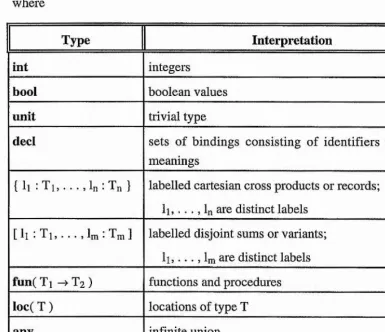
T ::= int I bool I unit I decl I { h : T , . . . , 1„ : T } I [ h : T , . . . , 1^ : T ] I
fun( T -» T ) I loc( T ) I any 11
where
Type Interpretation
int integers
bool boolean values
unit trivial type
decl sets of bindings consisting of identifiers and their
meanings
{ ll • Ti, . . . , In I Tn } labelled cartesian cross products or records; l l , .. ., In are distinct labels
[ ll • T j, . . . , Im I Tin ] labelled disjoint sums or variants; 1%,..., Im are distinct labels
fun(Ti ^ T2 ) functions and procedures
loc( T ) locations of type T
any infinite union
[image:27.615.77.462.134.466.2]t type identifier
Figure 2.1 : Types in the Base Language
The base types provided are integers, booleans and two trivial types unit and
decl which contain no elements, unit is the type of expressions that do not evaluate to a value of any other type and decl is the type of declarations. Records provide a means for collecting fields of different types into one structure. Variants offer the choice of any one of a predefined collection of fields of different types. Functions take a value of the argument type and return a value of the result type. Mutability is explicitly modelled in this type system
and hence the type constructor loc. Any value in the value space of Base can be
an element of the infinite union type any. While the rest of the types correspond
to values in the value space, decl is used to type declarations, unit is the type of
void constructs in Base, and variants and any provide abstractions over types.
2.3 Declarations
The set of possible declai'ations in the base language can be defined by
D ::= type t is T I let x = E 1 D ;D
where
Syntax Interpretation
type t is T binds the type identifier t to the type expression T
let X = E binds the identifier x to the expression E
D ;D sequences declarations
Figure 2.2 ; Declarations
Thus, Base allows type and identifier declarations and the sequencing of any of these declarations.
2.4 Expressions
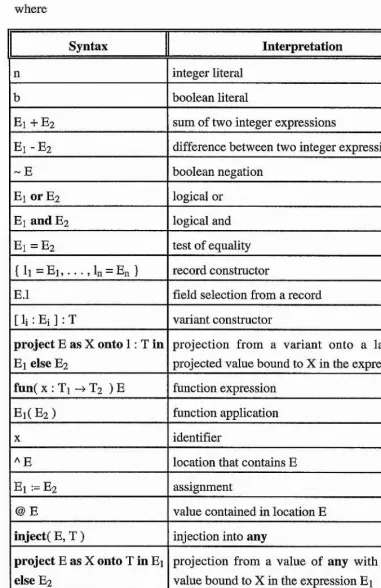
The set of expressions in the base language is given by the following syntax :
E::= n I b I E + E I E -E I ~E I E o r E I EandE I E = E I
{ ll = E, . . . , In = E } I E.l I
[ li : E ] : T i project E as X onto 1 : T in E else E I
fun( x : T - ^ T ) E I E(E) I x I
^E 1 E:=E I @ E I
inject( E, T ) I project E as X onto T in E else E I
where
Syntax Interpretation ‘s
n integer literal -.t
b boolean literal
El + E% sum of two integer expressions
E1-E2 difference between two integer expressions ■■ f) !■
~ E boolean negation
El or E2 logical or
El and E2 logical and
El = E2 test of equality i
{ ll = El, . . . , In = En } record constructor Î
E.1 field selection from a record <■*
[ l i : E i ] : T variant constructor
project E as X onto 1 : T in El else E2
projection from a variant onto a label with
projected value bound to X in the expression Ei 1
■
fun( X : Ti T2 ) E function expression 1
Ei( E2 ) function application f
X identifier
AE location that contains E ■Î
El := E2 assignment
@ E value contained in location E
inject( E, T ) injection into any project E as X onto T in Ei
else E2
projection from a value of any with projected value bound to X in the expression Ei
if E then Ei else E2 conditional
Ei ;E2 sequence of expressions
[image:29.612.78.460.68.657.2]begin D ; E end block definition
Figure 2.3 : Base Language Expressions
The atomic expressions n and b stand for literals of base types int and bool
defined over them. Booleans have the logical not, or and and operators defined over them. In addition to these, both integers and booleans have an equality operation.
Record expressions are constructed by associating an expression with each field of the record. A dot operator is provided to dereference a record field.
A variant expression can be constructed by associating an expression with the chosen field and specifying the variant type. This type information is necessary to identify the exact type to which the variant expression belongs since many variants may have the same labels. The project clause is provided to dereference the current value of a variant. This operation projects the value onto the label specified. If the projection is successful then the result of the operation is the
expression following the in keyword. The identifier specified following the as
keyword will have the value of the variant and the type T associated with it within this expression. If the label does not match the variant then the else
expression is chosen and the identifier will have the value and the type of the variant.
A function value is created by specifying the formal parameter, argument and result types and the expression for the function body. A function can be applied by supplying it with an actual parameter within round brackets.
Locations have three operations defined over them. The operator creates a location containing the expression following it. The infix assignment operator takes a location value and an expression and assigns the latter to the former. The value contained in a location can be dereferenced by the @ operator.
A value of type any can be created by performing an inject operation on an
expression along with its type. The projection operation over any is very similar
to the one for variants. In this case, the value is projected onto the type specified.
The infix ; operator allows the specification of a sequence of expressions just as
it is used for sequencing declarations. The keywords begin and end mark the
beginning and end of a block definition. The if then else clause provides the
2.5 Abbreviations
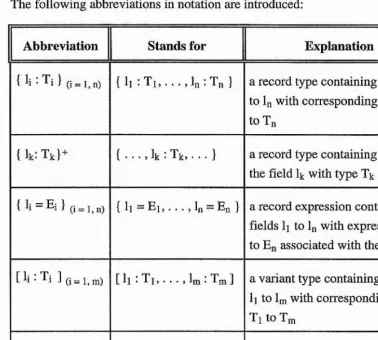
The following abbreviations in notation are introduced:
Abbreviation Stands for Explanation
{ li • Ti } (i= i,n) { Ij : T1 , . . . , In : Tn } a record type containing fields li to In with corresponding types T i to Tn
{lk:Tk}+ { • * • 5 Ik • T"k, • • • } a record type containing at least the field Ik with type Tk
[image:31.613.79.457.110.449.2]{li=Ei}(i = l,n) { Ij = E%, . . . , In = En } a record expression containing fields ll to In with expressions E% to En associated with them
[ li • Ti ] (i = 1, m) [ ll • T j, . . . , Im : Tjn ] a variant type containing branches ll to Im with corresponding types Ti to Tin
[lk:Tk]+ [ . . . , Ik . Tk, • • • I a variant type containing at least the branch Ik with type Tk
Figure 2.4 : Abbreviations
2.6 Naming Conventions
The conventions specified below are adopted for naming different constructs in Base in the sections to follow.
• expression variables belong to the set { x, y, z }
• type variables belong to the set { s, t, u, v }
• types belong to the set { S, T, U, V }
2.7 Typing Rules
The concept of environments is introduced to determine the types of the constructs in Base. In the following typing rules for programs, declarations and
expressions, environments are lists of bindings, n denotes the environments
environments in which type identifiers are bound to type expressions ( t = T ).
Ai ::b::A2 is used to represent a list A which contains a binding b. A++B is used
to denote the concatenation of two lists of bindings A and B. Both n and t are
global environments and support block structure. The notation a.i is used to represent the identifier i contained in environment a.
The function typeDecl takes a list of bindings between type identifiers and type
expressions and adds them to the environment t. Similarly, function idDecl
takes a list of bindings between identifiers and types as its arguments and
updates the environment k with the new bindings. Bindings are represented as
pairs and the notation < x, T > is used to denote a pair value consisting of x and T. ( b i , . . . , bn ) is a list containing bindings bi to bn.
The typing rules make use of a set Type which is a set of strings defined by T in
section 2.2. If a type S can be generated by this definition then S is a member of
Type. Thus Type is a set of all well-formed types in Base. Similarly all expressions e and e^ in the type rules belong to the set of all well-formed expressions. Expression, defined by E in section 2.4.
In the following type rules, all variables are in italics and all Base expressions are in c o u rie r font. The keywords of Base are in bold.
2.7.1 Programs
(j), (j) H D : decl typeDecl( ) idDecl( Y ) 0::Y f e : T ^ .
— --- e :T
---If declaration D causes the lists of bindings Q and T to be added to the type and identifier envkonments which were previously empty and given these bindings,
the type of expression e can be deduced to be T then the type of a program d ;
e is also T.
2.7.2 Declarations
T h T G Type
T htyp e t i s T : decl typeDecl( ( < t, T > ) ) [typeDecl]
If X has a new binding associating the type identifier t to type expression T then the declar ation type t is t is of type decl and will have the effect of updating
--- [MDec,]
T, 7T h l e t X = e : decl idDecl( ( < x, T > ) )
If it can be deduced that an expression e is of type T then the declaration l e t x = e is of type decl and will have the effect of updating n with the binding x : T.
T, ;r h D; : decl Decl; T + +Qp ;r + +Yj H : decl Decl^
T, ;r h ; Dg : decl typeDecl( ) idDecl( Yj ++ Y^ )
[declSeq]
where Decli stands for typeDecl(ai) and idDecl('Fi) and Decl2 stands for
typeDecl(Ü2) and idDecl(T2).
If declar ation Di causes changes Oi and Yi to be introduced to the environments
% and 7c, and when these changes have been incorporated into the environments,
declaration D2 causes changes £ 1 2 and ^ 2 to be added then the declaration sequence operation Di; D2 has the effect of causing changes Qi-h-1^2 and T1++T2
respectively.
2.7.3 Expressions
The type rules for expressions belonging to each base type and type constructor in the language are given below.
2.7.3.1 Integers
n e Integer n : int
If n belongs to the set of integer literals then n is of type int.
[intValue]
T, h e, : int T, ;r 1- e, : int _ ,. ,
--- ^--- [rntAdd]
r, ;r h ©1 + : int
If expressions ei and & 2 are of type int then the expression e i + es is also of type int.
T, ;r h e. : int r, 71: h e. • :nt r- . 0 1 -,
--- ^--- [rntSub]
If expressions ei and &2 are of type int then the expression e i - es is also of type int.
T, ;r I- e, : int T, ;r h e, : int _
-^ --- [intEq]
T, ©1 = ©2 : bool
If expressions ei and es are of type int then the expression e i = es is of type
bool.
2,13.2 Booleans
b © Boolean
b : bool
If b belongs to the set of boolean literals then b is of type bool.
[boolValue]
T, ;r I- e : bool ^ [negation]_ T, 7T h ~ © : bool
If expression e is of type bool then the expression -e is of type bool.
T, ;r h e, : bool t , ;r 1- e. : bool ^
,--- [or]
T, 7T I- ©1 o r ©2 : bool
If expressions ei and es are of type bool then the expression ei or es is also of type bool.
T, 7T I- e, : bool T, ;r h e, : bool ^ „
---T, :---r —;--- [and]
7T I- ©1 and ©2 : bool
If expressions e% and es are of type bool then the expression e i and es is also of type bool.
T, ;r h e, : bool t, ;r h e, : bool „ _
------- --- [boolEq]
T, ©1 = ©2 : bool
If expressions ei and es are of type bool then the expression ei = es is of type
2.T.3.3 Records
Vi e { L..n } ( 1^ e labels t, tt h e-: T; )
T, TC h { Ij = ej }( i = 1, n ) : { IjlTj }( i = 1, n ) [rec Value]
If 11 to In belong to the set of labels and expressions ei to en are of type T% to Tn
respectively then the record expression formed by { = ei ^ ^^isof
type { li :Ti}
T ) ' [recDereg
T, H e .l ; T
If e is a record expression with at least the field 1 of type T then the dereference expression e . l is of type T.
2.7.3.4 Variants
T, ;r h ej : Tj t, K { .:x : I- x : [ Ij : T. ]’'
Ij = ©il : T : [ Ij : T, r [vai-Value]
If T is a variant type with at least a label Ij of type Tj and expression ej has type Ti then the type of the expression [ l i = ei ] : t is a variant type with at
least a label li of type Ti.
T, ;r h e : [ Ij : TJ~^ T, k{.\x : T^x/r^ f ' T T, ;r H e^ : T
T, ;r f- project © as x onto Ij : Tj in ©^ else ©^ : T
[varProj]
If the type of expression e is a variant with at least a label li which is of type Ti, expression ei is of type T if the identifier x is of type Tj and expression e2 is of
type T then the project operation on the variant type, project e as x onto
l i ; Ti in e i else @2 , has type T.
2.7.3.S Functions
---^ - ^ 2 --- [funValue]
If X and 71 with a binding x : Ti imply that expression e is of type T2 then the
function expression ftin ( x : Ti T2 ) e is of type fun ( T i-> T2 ).
[knApp]
T, ;r h e(
If expression ei is of type T% and expression e is of a function type
fun ( Ti -> T2 ) then the expression e ( ei ) is of type T2.
2.7.3.6 Identifiers
[id]
T, ;Fj::x : h x : T
If 7c contains a binding associating the identifier x with type T then x is of type T.
2.7.3.7 Locations
T, ;r h e, : T t, ;r h e. : loc( T ) r •
--- ^T, TU \- := -— - [assign]
©2 : unit
If expression 0 2 is of type T and expression ei is of a location type loc( T ) then
the assignment expression ei := 0 2 is of type unit.
^ ^ [locValue]
T, f "^© : Ioc( T )
If expression e is of type T then the expression ''e is of type loc( T ).
[locDereq
T, ;r h @© : T
2.7.3.S Infinite Union
T, iTT h e : T [anylnj]
T, 7T h i n j e ct ( e, T ) : any
If expression e is of type T then the expression inject ( e , t ) is of type any.
r, 7T h e : any T, © types T, Tt^y.x : h ej : T t, ;r H e^ : T T, 7T I- p r o j e c t e a s X o n to T, in e l s e : T
[anyProj]
If expression e is of type any, Ti is a valid type in Base, expression ei is of type T if the identifier x is of type Ti and expression e2 is also of type T then the
project expression on any, pro j ect e as x onto Ti in e i else 6 2, is of
type T.
2.7.3.9 Sequence
T, ;r h ej : unit T, ;r f e^ : T
T, ;r h ; ©2 : T [seq]
If expression ei is of type unit and expression &2 is of some type T then the sequence of expressions ei ; 6 2 is also of type T.
2.7.3.10 Block
T, 7T h D : decl typePecl( Q. ) idPecl( Y ) t + +Q , ;r + + Y h e : T
T, ;r h b e gin D ; © end : T
[block]
If declaration P of type decl causes changes Q.and Y to environments x and n
respectively and if, after incorporating the changes to the environments, the expression e is of type T then the block definition begin d ; e end is also of
2.7.3.11 Conditional
T, K \r e: bool r, ;r H Cj : T T, H : T
T, 7T h if e then e, else e, : T [if]
If expression e is of type bool and expressions ei and e% are of the same type T
then the conditional expression if e then e i else eg is also of type T.
2.8 Summary
3 Semantics of t
he B
ase Language
The syntax of Base was formally defined in the previous chapter. We now
present a semantic context for the types in Base and a semantics for its constructs.
3.1 A Semantic Context for Types
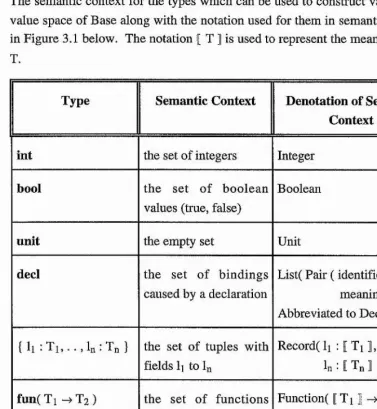
The semantic context for the types which can be used to construct values in the value space of Base along with the notation used for them in semantics is given in Figure 3.1 below. The notation [ T ] is used to represent the meaning of type T.
Type Semantic Context Denotation of Semantic
Context
int the set of integers Integer
bool the set of boolean
values (true, false)
Boolean
unit the empty set Unit
decl the set of bindings
caused by a declaration
List( Pair ( identifier, meaning ) ) Abbreviated to Decl
{ ll • Tj, . . , In ‘ Tn } the set of tuples with
fields ll to In
Record( li : [ Ti ] , . . ,
In ’ [ Tn ] )
fun(Ti -^T2) the set of functions
from [ Ti 1 to [ T2 ]
F u n c t i o n ( [ T i l - ^ [ T2 l )
loc( T ) the set of locations that
contain | T ]
[image:39.612.78.456.214.623.2]Location( [ T | )
Figure 3.1 : Semantic Context of Value Constructors
The semantics of type constmctors which merely provide an abstraction over other types rather than creating new values in the value space are given in Figure
3.2. The meta-type typeRep used in this table stands for type representations of
Type Context Denoted by
[ [ll : T i ,. . ,l m : T m ] ] the set of values being one
of 1 T1 I to [ Tm ] for labels
ll to Ifn
Pair (label, [ T „ ] ) where Tn is one of Ti to Tm
I any] the set of all the values in
the language coerced into a general type
Pair ( typeRep, [ T ] ) where T can be any type in Base
Figure 3.2 : Semantic Context of Type Abstractions
A variant type represents a union of the sets of values belonging to the types corresponding to all the labels. Since a variant value at any time can only be a value of one of the component types, it can be represented as a label - value pair and its type accordingly. Since any is an infinite union type incorporating all legal values in Base of any type, values of this type can be represented as a pair of type representation indicating the specific type and value.
3.2 Meta-operations
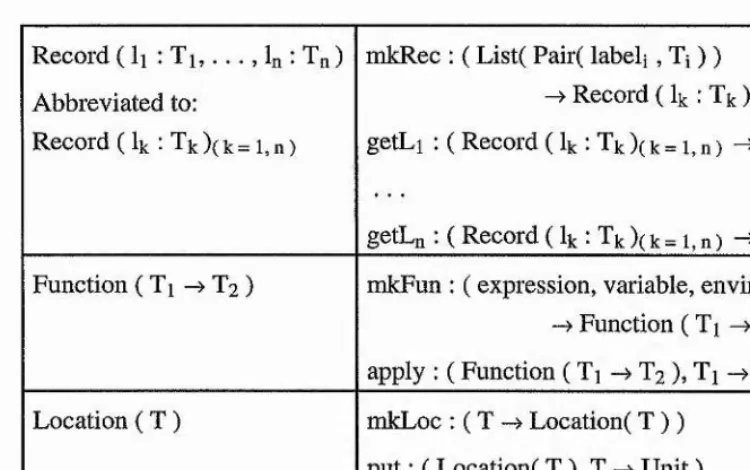
The meta-operations defined over the value constructors described in Figure 3.1 are given below in Figure 3.3.
Semantic Type Meta-operations
Integer add : ( Integer, Integer Integer )
subtract : ( Integer, Integer Integer ) intEquals : ( Integer, Integer Boolean )
Boolean andOp : ( Boolean, Boolean Boolean)
orOp : ( Boolean, Boolean Boolean ) notOp : ( Boolean Boolean )
boolEquals : ( Boolean, Boolean Boolean ) Unit
Record (1% : T i ,. . . , In : T„ )
Abbreviated to:
Record (Ik : Tk)(k=i,n)
mkRec : ( List( Pair( label], Tj ) )
^ R eco rd (lk :Tk)(k=i,n))
getLi : (Record (Ik :Tk)(k=i,n) Ti )
getLn :( Record ( Ik :Tk)(k=i,n) ^ T„ )
Function ( Ti ^ T2 ) mkFun : ( expression, variable, environment
-> Function ( Ti ^ T2 ) )
apply : ( Function ( Ti -> T2 ), Ti T2 )
Location ( T ) mkLoc : ( T Location( T ) )
put : ( Location( T ), T - 4 Unit )
[image:41.612.78.453.59.294.2]get : ( Location( T ) ^ T )
Figure 3.3 : Meta-operations for Type Constructors
Integers have the meta-operations add, subtract and intEquals defined over
them. They are used to perform integer addition, integer subtraction and the test
for integer equality respectively. Boolean values are provided with andOp,
orOp, notOp and boolEquals which are used for logical and, logical or, boolean negation and the test for boolean equality.
There are no meta-operations defined for Unit and Decl since no values are constructed of these types.
The meta-operations provided for records are a mkRec function that takes a list
of pairs consisting of labels and expressions and returns a record with fields corresponding to the pairs in the list and 'get functions' for each label of the record which take a record and return the value associated with the label.
Functions have a mkFun meta-operation that takes the expression of function
body, the parameter variable and the environment in which the expression is to
be evaluated and returns a function. The apply operation takes a function and a
parameter value and returns a value of the result type.
Mutable types have three meta-operations associated with them. The mkLoc
function takes a value of type T and returns a location which contains the value. The put operation takes a location containing T and a value of type T and assigns the value to the location. Since there is no value to be returned the result
type is Unit. The get operation takes a location and returns the value contained
The meta-operations for type abstractions are given below in Figure 3.4.
Semantic Type Meta-operations
Pair ( label, [ T ] ) for variants
mkPair : ( label, | T ] ^ Pair ( label, [ T ] ) ) fst : ( Pair ( label, [ T ] ) ^ label )
snd : ( Pair ( label, [ T 1 ) ^ [ T ] ) Pair ( typeRep, [ T J )
for any
mkPair : ( typeRep, [ T ] -> Pair ( typeRep, [ T ] ) ) fst : ( Pair ( typeRep, | T ] ) -> typeRep )
snd : ( Pair ( typeRep, [ T ] ) -4 [ T ] )
Figure 3.4 : Meta-operations for Type Abstractions
Since variants are modelled as a pair of label and value, the meta-operations on
these structures aie those available to pairs. A mkPair operation, which takes a
label and a value belonging to the type of the label and returns a pair, is provided as the constructor. In order to dereference the pair, two operations, fst and snd,
are defined which return the first and the second elements of the pair.
The meta-operations associated with any are very similar to those for variants
since any is also modelled as a pair. In this case the mkPair operation takes a type representation and a value of the type and returns a pair consisting of both.
The fst and snd operations are again defined to access the first and second elements of the pair.
3.3 A Semantics for Base
Given the semantic context and meta-operations specified in Figures 3.1 to 3.4, the semantics of the language can now be defined. [ e Jehv is used to denote the meaning of a well-typed expression e and Env is the environment against which meanings of expressions are defined. Envx = v e T is used to indicate that in this envh'onment, identifier x has meaning V belonging to type T associated with it. Similarly Env^ is used to mean that the environment incorporates any changes that might have been caused by an expression or declaration A. ^ stands for an
environment which contains no bindings. The function getTypeRep used for
3.3.1 Programs
I D ; e Itj, = [ e knvD where Envo = [ D ]<j, DI
3.3.2 Declarations
[ type t is T knv = 4) D2
[ let X = e ]Env = mkList( < x, [ e Jehv > ) D3
I D% ; Dg Iehv ~ ]Env [ Dz Iehvdj D4
3.3.3 Integers
[ n lEnv = n D5
where n is the semantic meaning (integer value n) of the syntactic form n.
[ ei + C2 Ierv = add( [ ei Jehv» [ % lEnv ) D6
I ei - C2 Jehv = subtract( [ ei ]Env, [ ©2 Iehv ) D7
I ei = C2 lEnv = intEquals( [ ei Jehv, [ ©2 knv ) D8
3.3.4 Booleans
[ b ]Env = b D9
where b is the semantic meaning (boolean value b) of the syntactic form b.
[ ~ 6 lEnv “ notOp( [ e ] Env ) DIO
[ ei or C2 knv = orOp( I ei knv, I ^2 knv ) D ll
[ ei and C2 knv = andOp( | ei knv, [ 6 2 lEnv ) D12
[ ei = C2 knv = boolEquals( [ ei knv, [ ^2 knv ) • D13
3.3.5 Records
[ ( b = 6i }(i = n) knv =
[ e.l ÎEnv = getL( [ e lEnv ) D15
3.3.6 Variants
[ [ li ' 6] ] I [ Ik" Tk] ( k = 1, m) knv — IIlkPair( 1], [ Cj knv ) D16
[ project e as X onto 1 : T in ei else 6%]Env =
if( sameLabel( fst( | e knv ), 1 ), I ei knvx = snd( [ e Iehv ) e [ t ] ’ It ^2 ] Env )
D17
3.3.7 Functions
[ fun( X : Ti T2 ) e knv = mkFun( e, x, Env ) D18
I 6 1(0 2) knv ~ apply( [ ©1 ]Env , [ 6 2 knv ) D19
3.3.8 Identifiers
[ X knvx = Y e T ~ ^ D20
3.3.9 Locations
[ e knv = mkLoc( [ e knv ) D21
[ X ;= e knv — PUt( [ X ]Env , I 6 ]Env ) D22
i @ 6 knv = get( [ e knv ) D23
3.3.10 Infinite Union
[ inject ( e, T ) knv = mkPair( getTypeRep( T ), [ e jEnv ) D24
project e as X onto T in ei else 62]Env =
if( sameTypeRep( fst( [ e knv ), getTypeRep( T ) ),
3.3.11 Sequence
[ 6i ; 62 ] Env = [ 62
1
Envej D2 63.3.12 Block
[ begin D ; e end Jehv = I e knvD D27
3.3.13 Conditional
[ if e then ei else 62 Jehv = if( [ e knv, I ei ]ehv, [ 62 knv )
D28
3.4 Type Mapping
Languages which support both structural type equivalence and the use of type
identifiers require a rewrite rule to reduce a type expression to its canonical form. A canonical form in this context is the expanded version of a type which contains no type identifiers. Consider the following type definitions in Figure
3.5. The type string used below is a base type representing a string of
characters.
type ageType is loc( int )
type person is { name : string , age : ageType }
type expandedPerson is { name : string , age : loc( int ) }
Figure 3.5 : The Canonical Form of a Type
The definition of type person contains a type identifier ageType. Type
expandedPerson is the canonical form of the type person since it defines the
same type and the type identifier ageType in its definition has been replaced by
the corresponding type expression.
The mapping of a type identifier t to its type expression T is denoted by t > T.
For this mapping to be valid, the type environment x should contain the binding
expression associated with it in x. The canonical form of any type expression can be determined by the recursive application of the following rules:
• { li • T j} (J ^ î> { li : T i} (J ^ 1
[ li : Ti ] (i = i,m) ^ E li : T i ] (J ^ m)
• fun( Ti T% ) 0 fun( T% -> T% )
• loc( T ) > loc( T )
It should be noted that both T and T represent the same set of values. However, while T may be needed to evaluate the meaning of T, the meaning of T can be evaluated independently. Thus, [ T = | T ](j).
3.5 Summary
4 A Proof of Soundness for Base
Given a framework in which meanings can be assigned to expressions, the
typing of an expression e of type T is sound if the meaning of e is in the set of meanings of T. The soundness of the typing rules for Base presented in section 2.7 can be proved by structural induction [FS91, Sch94] based on the following definition of soundness :
X, 7t f e : T => [ e Jgnv e [ T k
where Vi e Env, 3i e k . [ Env.i 1 e [ Tt.i ]
This definition states that if the type of a well typed expression e can be deduced to be T from the environments x (which contains the bindings between type identifiers and the types they stand for) and ti (which contains the bindings
between identifiers and their types) then the meaning of e evaluated with respect to an environment Env belongs to the meaning of T with respect to x under the condition that for every identifier i in Env there is a corresponding i in tu such
that the meaning of i in Env belongs to the meaning of i in t i. Since Env is a list of bindings between identifiers and their meanings, this condition ensures the consistency between the different environments used in the proof. It should also be noted here that given the definition of Decl in Figure 3.1, Env belongs to Decl.
The meanings of types in Base have been defined in Figures 3.1 and 3.2 and the meanings of expressions in Base can be evaluated using the semantics specified in section 3.4.
The proof of the whole type system can be broken down into proofs for programs, declarations and the different kinds of expressions that can be formed in the language. Sections 4.1 to 4.4 consider programs, declarations, base cases for the expressions and non-atomic expressions respectively.
4.1 Programs
The proof obligation for any program in Base can be stated as
([),(() h p : T = > [ p ] ^ e [T|(j)
Expression To be proved
Inductive Hypotheses
Inductive Step [ D J e ](j) = [ e knv %) But [ e knv£) ^ [ T Jt;
Therefore, [ D ; e ]<j, e However, [[ D ; e k s |
<{), (j) h D ; e : T [ D ; e k e [T]]^
[ D lc|) e [ decl k and [ e ]ehvd ^ [ T k
since D : decl and e : T with D added to t and k
by type rule [program]
by DI
by hypotheses T k
Tld> where T > T
4.2
Dec
larations
The declarations are considered below.
Expression x,n \-type t is T : decl
To be proved [ type t is T ]ehvg [ decl k
Inductive Hypothesis T e Type by type rule [typeDecl]
Inductive Step
[ type t is T ]ehv= (|) by D2
Since, in this case, (|) stands for the environment Env without any bindings,
(j) e [ decl by the definition of Env and Decl
Therefore, [ type t is T knv s [ decl Jx
Expression To be proved
Inductive Hypothesis Inductive Step
[ let X = e lEnv — EnVx = [ e ]Env But EnVx = I e lEnv ^ [ ^ecl k Therefore, [ let x = e ]Env e [ decl k
t, 7c h let X = e : decl
I let X = e knv G [ decl k
[ 6 ]Env G I T ]x by type rule [idDecl]
by D3
Expression x,n H Di ; D2 : decl
To be proved [ Di ; D2 knv s [ decl k
Inductive Hyp. [ Di knv s [ decl ]x and [ D2 knvDj ^ Idecl ]x
since x,k I- D% : decl and x\ n' h D2 : decl where x' and k'
stand for x and n with D% added to them
by type rule [declSeq] Inductive Step
[ Di ; D2 knv = [ Di ]Env ++ [ D2 JEnvD^ by D4
But [ Di knv e [ decl ]x and [ D2 knvDj^ [ decl Jx by hypotheses
[ Di ] Env ++ [ D2 ] EnvDi ^ E decl k by the definition of Env
Therefore, [ Di ; D2J e h v e [ decl k
4.3 Base Cases
The two base cases for the proof are considered below.
Case 1 Expression x,n h n : int
[ n ]eiiv = n by D5
n e Integer by type rule [intValue]
[ int k = Integer from Table 3.1
Therefore [ n k n v e [ k t ]x
Case 2 Expression x,n I- b : bool
I b knv = b by D9
b € Boolean by type rule [boolValue]
[ bool k = Boolean from Table 3.1
Therefore [ b knv g [ bool ]x
4.4 Expressions
4.4.1 Integers
Expression x,n I- ei + 0 2 : int
Inductive Hypotheses [ ei Jehv g | int Jx and [ ez Jehv g [ int Jx
since I- e% : int and x, ti I- e2 : int
by type rule [intAdd]
Inductive Step
[ ei + e2 Jehv = add( | e% Jehv, [ 6 2 Jsnv ) by D6
[ int Jx = Integer from Table 3.1
I 61 Jehv g Integer and [ 0 2 Jsnv g Integer by hypotheses
Since add is a function that takes two Integer values and returns an Integer, add( [ ei Jsnv, [ 6 2 Jeov ) g Integer
i.e. add( | e% Jsnv, [ 62 Jedv ) g [ int Jx
i.e. [e i + 6 2 JEnv G [in t Jx
Expression x, t i f e% - 0 2 : int
To be proved [ ei - 0 2 Jsnv g [ int Jx
Inductive Hypotheses [ e% Jsnv g [ int Jx and [ 0 21 E n v g [ int Jx
since x, tt: t- e% : int and x, tc h e2 : int
by type rule [intSub] Inductive Step
[ ei - e2 JEnv = subtract( [ ei Jehv, [ 6 21 Env ) by D7
[ int Jx = Integer from Table 3.1
[ 6i JEnv G Integer and [ 0 2 JEnv g Integer by hypotheses
Since subtract is a function that takes two Integer values and returns an Integer, subtract( [ ei JEnv, [ ^ 2 JEnv)G Integer
i.e. subtract( [ 6%JE nv, [ 62JEnv ) G [ int Jx
i.e. [e i -e2 jEnvG [in t Jx
Expression x, tc h ei = 0 2 : bool
To be proved [ ei = e2 JEnv g [ bool Jx
Inductive Hypotheses [ ei Jehv g [ int Jx and [ 0 2 Jehv g [ int Jx
since x, tc h ei : int and x, tc f 0 2 : int
Inductive Step
[ ei = e2 lEnv = intEquals( [ ei JEnv, [ 6 2 Jsnv )
[ int Jx = Integer
[ ei JEnv g Integer and [ eg JEnv g Integer
by D8
from Table 3.1 by hypotheses
Since intEquals is a function that takes two Integer values and returns a Boolean, intEquals( [ e% JEnv, E 6 2 JEnv ) G Boolean
i.e. intEquals( [ e% JEnv, [ 6 2 Jehv ) g [ bool Jx
i.e. [e i = e2 jEnvG [bool Jx
4.4.2 Booleans
Expression To be proved
Inductive Hypothesis
T, TC I— e : bool
[ ~ e lE n v G [ bool Jx
[ 6 Jp.nv € I bool Jx
since H e: bool
Inductive Step
[ ~ 6 JEnv ~ no top ( [ e JEnv )
[ bool Jx = Boolean
I 6 JEnv G Boolean
Since notOp is a function that takes a Boolean value and returns a Boolean, notOp( [ e JEnv ) G Boolean
i.e. notOp( [ e Jehv ) g [ bool Jx i.e. [ ~ e JEnvG [boolJx
by type rule [negation]
by DIO
from Table 3.1 by hypothesis
Expression To be proved
Inductive Hypotheses
X, TC h ei or e2 : bool
[ ei or 0 2 JEnv G [ bool Jx
[ ei JEnv G [ bool J x and [ 0 2 JEnv G [ bool J x
since x, tc t- e% : bool and x, t i t- 0 2 : bool
by type rule [or] Inductive Step
[ ei or 0 2 JEnv = OrOp( [ Oi JEnv, I 6 2 JEnv )
I bool Jx = Boolean
I 61 Jsnv G Boolean and [ 0 2 Jehv g Boolean
by D ll
Since orOp is a function that takes two Boolean values and returns a Boolean, orOp( I ei knv, I 6 2 j E n v ) e Boolean
i.e. orOp( [ e% ]Env, [ 6% Jeov ) e [ bool
i.e. [ ei or e2 knv g [ bool
Expression t, tc h ei and 0 2 : bool
To be proved [ e% and 0 2 Jehv e | bool ]x
Inductive Hypotheses [ ei ]Env g [ bool and [ 6 2 Jehv g [ bool
since x,n h ei : bool and x,n \- &2 '-bool
by type rule [and] Inductive Step
I ei and 02 k n v = andOp( [ e% k n v , [ ©2 Iehv ) by D12
[ bool Ix = Boolean from Table 3.1
I 6i Jeov g Boolean and [ 0 2 Iehv g Boolean by hypotheses
Since andOp is a function that takes two Boolean values and returns a Boolean, andOpC [ ei Jehv, I 6 2 Jehv ) g Boolean
i.e. andOp( [ e% knv, [ 6 2 k n v ) G [ bool ]x
i.e. I ei and 02 jEnv g | bool
Expression x,n h ei = 0 2 : bool
To be proved [ ei = e2 k n v g [ bool ]t
Inductive Hypotheses [ ei ]Env g [ bool ]x and [ 0 2 k n v g [ bool |t
since x,n h ei : bool and x,n h e2 : bool
by type rule [boolEq] Inductive Step
[ ei = e2 k n v = boolEquals( [ e% k n v , [ 6 2 k n v ) by D13
f bool Jt: = Boolean from Table 3.1
I 61 lEnv G Boolean and [ 0 2 k n v g Boolean by hypotheses
Since boolEquals is a function that takes two Boolean values and returns a Boolean,
booIEquals( [ ei jEnv , [ 6 2 knv ) g Boolean
i.e. boolEquals( [ ei knv , I 6 2 knv ) g [ bool ]x
4.4.3 Records
Expression 1,71: t- { 1^ = 0, }
To be proved [ { li = 6 i} (j = i,„)]Env e [ { Ij : Tj } (j = i^n)]T
Inductive Hypotheses [ ei knv g [ Ti ]x e„ knv g [ T^ Jt
since t, 71 h ei : T i , . . . t, 71 l- e„ : T„
by type mie [recValue] Inductive Step
[ { li = 6i } (i = l,n) k n v =
mkRec( < I l , [ e 1 knv >++ • . • ++<ln, [enJEnv > ) by D14
Since mkRec is an operation that takes a list of n pairs each of type < Label, Tj > and returns a record with fields corresponding to the labels,
m k R ec ( < 1% , [ e % JEnv ^ In , [ 6 ^ JEnv ^ ) g
Record (Ik : Tk )(k=i,n) i.e. mkRec( < h , [ e 1JEnv > ++ • • • ++ < In , [ 6n JEnv > ) G
[{ ii ‘ Ti } (i=i,n) i.e. [ { li = Cj } (i 1 (i) JEnv G [ { Ij : Tj } (j = 1 Jt
Expression x, 7t f e.l : T
To be proved [ e.l JEnv g [ T Jt
Inductive Hypothesis [ e J^nv g Record( I : T )+
since x, 7t h e : { 1 : T }+ by type rule [recDeref] Inductive Step
[ 6.1 JEnv — §6tL( [ e Jehv ) by D15
[ 6 JEnv G Record( 1 ; T )+ by hypothesis
Since getL takes a record and returns a value of the type of field 1 of that record, getL( [ e JEnv ) G I T Jt
i.e. [ e.l JEnv G [ T Jt
4.4.4 Variants
Expression x, 7c h [ li = e ] : [ Ij : Ti ]+