1
The interplay between conformation
and absolute configuration in chiral
electron dynamics of small diols
Steven Daly1,2†, Maurice Tia2, ‡, Gustavo A. Garcia2, Laurent Nahon2, and Ivan Powis1,*
1
School of Chemistry, University Park, University of Nottingham, Nottingham NG7 2RD, UK
2
Synchrotron SOLEIL, l’Orme des Merisiers, Saint Aubin BP 48, 91192 Gif sur Yvette Cedex, France.
†
Current Address: Institut Lumiere Matière, UMR5306, CNRS, Université Lyon 1, 69622 Villeurbanne, France
‡
Current Address: Institut für Kernphysik, Johann Wolfgang Goethe Universität, Max-von-Laue-Strasse 1, 60438 Frankfurt am Main, Germany
*Corresponding Author:
Email [email protected]
Tel +44 115 9513467
2
Abstract
A competition between chiral characteristics alternatively attributable to
either conformation or to absolute configuration is identified. Circular
dichroism associated with photoexcitation of the outer orbital of
configurational enantiomers of 1,3- and 2,3-butanediols has been examined
with a focus on the large changes in electron chiral asymmetry produced by
different molecular conformations. Experimental gas phase measurements
offer support for the theoretical modelling of this chiroptical effect. A
surprising prediction is that a conformationally produced
pseudo-enantiomerism in 1,3-butanediol generates a chiral response in the frontier
electron dynamics that effectively outweighs the influence of the permanent
configurational handedness established at the asymmetrically substituted
carbon. Induced conformation, and specifically induced conformational
chirality, may thus be a dominating factor in chiral molecular recognition in
such systems.
Concepts describing molecular shape lie at the heart of much intuitive thinking about
chemical reaction and interaction, from the simplest nucleophilic substitution processes to
more complex enzyme interactions. Central to such considerations is the role of molecular
chirality and consequent specificity of chiral recognition. Because macro-biomolecules tend
to be chiral and built from smaller chiral units, an appreciation of how chiral information
transfers at the molecular level assumes a wide-ranging significance for understanding the
mechanisms of asymmetric synthesis. This includes the building up of supra-molecular
chirality and the many enantioselective processes of life (odor perception, pharmaceutical
action, etc.). The commonest source of molecular chirality is, of course, an asymmetrically
substituted carbon —a configurational chirality that could be considered to be hard-wired into
the molecule. Among other sources of chirality one also encounters the possibility for
molecular handedness to arise from a particular conformation. Chiral induction, the process
whereby a static chirality can be induced in a prochiral or transiently chiral species by
interaction with a moiety of specific chirality, without a requirement for bond-breaking, is a
3
remove a multitude of fluctuating solvent interactions of comparable energy that might
obscure the intrinsic effect, have an important role to play.[4]
Here we examine exhibited chirality using photoelectron circular dichroism (PECD). A
particular advantage over other chiroptical measures is that PECD provides an orbitally
selective probe of molecular chirality,[5-7] allowing specific focus to be given to responses of the HOMO frontier orbital. Specifically, PECD isolates and extracts the phenomenological
coefficient, 𝑏1{+1}, of an odd cos 𝜃 term in the photoelectron angular distribution (See
Supporting Information and Refs [5, 6])which can then directly express the chiral asymmetry observed in the forward-backward (𝜃 = 0, 𝜋) directions as a Kuhn asymmetry factor,
𝑔 = 2𝑏1{+1} . From a theoretical perspective for interpretation, the 𝑏1{+1} parameter embodies
the dynamics of the mobile electron[5] as it is ejected from the selected orbital and moves out through the chiral potential of the molecular framework.
The small diols we consider here — 1,3 propanediol (13PD), 1,3R butanediol (13BD), and
2R,3R butanediol (23BD) — are flexible molecules with rotation around various bonds
providing numerous possible conformations, but the energetically most favorable ones are
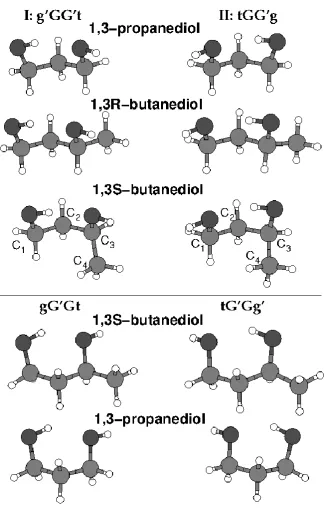
significantly stabilized by the formation of intramolecular H-bonds. In Figure 1 we compare
the two most stable conformers calculated for 13PD [8, 9] and those calculated for 13BD. [10, 11] The four letter designations used in this literature — g′GG′t and tGG′g — describe the four
dihedral angles defining the structures; for brevity we also show and will use an alternative
Roman numeral numbering.
These two most stable 13PD conformers can be seen to constitute an enantiomeric pair,
related by the hindered rotation of the OH groups. However, as in many such conformational
enantiomers these chiral structures rapidly interconvert. In 13PD the relevant tunneling
frequency is found to be 5.42 MHz[9] and consequently its chirality is transient. Nevertheless, it is interesting to examine the instantaneous chirality. Theoretical calculations for the
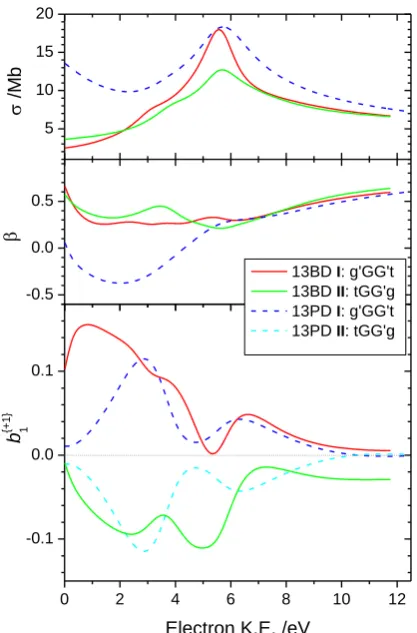
HOMO photoionization are presented in Figure 2. In particular we discuss here the non-zero
chiral 𝑏1{+1} parameter values that appear in the lower panel. Just as for any chiroptical
asymmetry, exchanging the enantiomers (here conformers) flips the sign of 𝑏1{+1}. The
(transient) conformational enantiomerism of 13PD is thus evidenced in the exact mirroring of
4
It can be expected that methyl group substitution at the C(3) atom in 13PD, to form 13BD,
will effectively quench the tunneling identified in 13PD by destroying the C(1):C(3)
equivalence and, consequently, the symmetric double well inversion potential.[12] This is fully corroborated by the observation of uncoupled asymmetric top spectra for the I and II pair of
13BD, indicating their existence as distinct conformers.[10, 11] But such addition of a methyl also creates an asymmetric substitution at the C(3) site, so generating permanent
configurational enantiomerism in 13BD, with separable R,S enantiomers. Nevertheless, as
can be seen in Figure 2, the calculated HOMO ionization cross section and anisotropy
parameter, , (both enantiomer independent properties) retain many similarities to those for
13PD. More remarkably, the chirally sensitive 𝑏1{+1} parameter curves for the two most stable
13BD conformers I and II also still approximate the chiral mirroring seen for the analogous
conformers of 13PD, albeit for a fixed choice (R-) of 13BD configurational enantiomer. The
strong visual similarities between the low energy structures of 13PD and 13BD (Figure 1)
and between their 𝑏1{+1} parameter curves (Figure 2) suggests some residual conformational
enantiomerism in 13BD such that, for fixed absolute configuration, conformers I and II
effectively constitute a pseudo-enantiomeric pair. (An entirely analogous argument could be
developed for the 3S- configuration and its corresponding conformers).
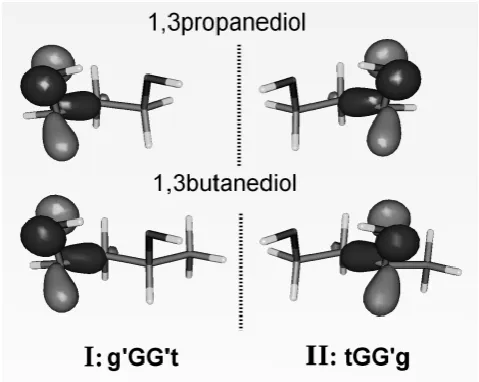
This suggested pseudo-enantiomerism is further underscored by examining 13PD and 13BD
HOMO orbital isosurface visualizations (Figure 3). Because of the strongly localized HOMO
character, the (pseudo-) enantiomerism is seen to be equally imprinted on the HOMO orbitals
of both 13PD and 13BD in a manner that is not encountered with other, more delocalized
valence orbitals.
Before further discussing 13BD we turn to an examination of its isomer, 2,3 butanediol. A
computational investigation of the conformer space of 23BD has been previously reported by
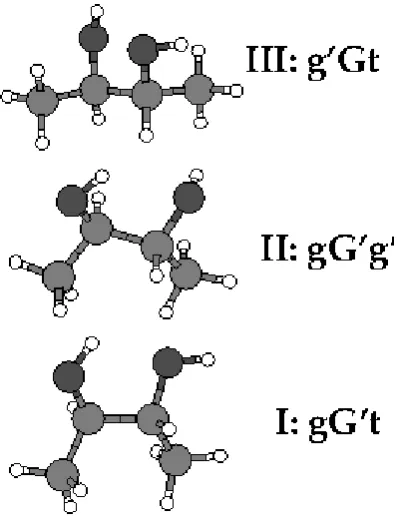
Jesus et al.[13] The three most stable 2R,3R conformers (designated [13]I, II, III) are shown in Figure 4. These are estimated to jointly account for 90% of the room temperature population,
and >99% at 100K. Our own calculations, summarized in Table S1, replicate the energetics
reported previously.[13, 14] Experimentally, a molecular beam Fourier Transform microwave spectroscopy study[14] has unambiguously identified conformer I as the dominant species present in jet-cooled conditions. Employing a similar cold molecular beam for an
experimental PECD measurement we therefore have the opportunity to examine, effectively,
5
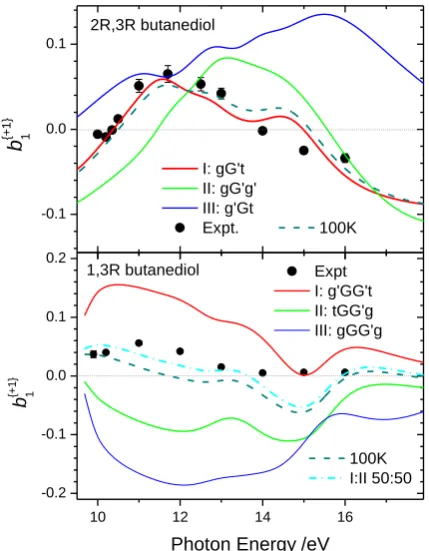
Jet cooled experimental results showing mean HOMO electron PECD values for 2R,3R
butanediol, recorded at various photon excitation energies, are presented in Figure 5 along
with calculated 𝑏1{+1}parameter curves for single conformers I – IIIand for an assumed 100
K conformer population average. Good agreement with the calculated PECD for the most
stable conformer I is demonstrated, while significant contributions (more than the 15%
expected for a 100 K Boltzmann distribution) from conformers II and III can be discounted,
corroborating previous experiments.[14]
Having thus validated the theoretical method applied here to study HOMO PECD of single
conformers of the butanediols we return to explicit consideration of 13BD. Our calculated
properties for the quasi-degenerate conformers I and II and for the next most stable
conformer, III, which is >2 kJ mol-1 higher in energy, are summarized in Table S2. FTIR measurements[10] on an annealed, cold 10K matrix isolated 13BD found that the population collapsed to a 1:1 mix of the two thermodynamically most stable conformers.
Correspondingly, an equally weighted preponderance of conformers I and II was inferred in a
pulsed jet FT microwave experiment.[11] It can thus be expected that under the cold molecular beam conditions of our PECD experiment an approximately 1:1 mixture of conformers I and
II will be obtained.
The lower panel of Figure 5 compares the predicted PECD for 13(R-)BD conformers I – III
and experiment. Individually, none of the 13BD conformers provides a good match with the
jet-cooled experimental data. In particular, the magnitude of the experimental
𝑏1{+1}parameters is less than that of the calculated single conformer PECD curves. However,
the anticipated 1:1 average of the conformer I and II 𝑏1{+1}parameters provides significantly
better agreement with experiment and we may infer that it is the approximate mutual
cancellation (i.e. the pseudo-enantiomerism) of this conformer pair responsible for an
apparent attenuation of the PECD observed experimentally.
It is well established that PECD measurements are sensitive to absolute configuration at one
or more stereogenic centers.[6] Although not included here, repeating the above calculations for true enantiomers of the various conformations (e.g. 13(R-)BD g′GG′t 13(S-)BD gG′Gt
— see Figure1) negates all the 𝑏1{+1}parameter curves shown, and creates a clear disparity
with the experimental data. Nevertheless, the calculated PECD curves for the chosen R-
6
assumed conformation, a sensitivity which is fully anticipated from previous PECD studies [6] including cases where, as here, such large differences were ascribed simply to the rotational
orientation of an OH group.[15, 16] Equally, structural isomers such as camphor and fenchone can display very different PECD response even when sharing the same absolute
configuration.[17] In these senses the various differences between 13BD and 23BD seen here are not unexpected. Perhaps more surprising are the highlighted similarities between 13PD
and 13BD.
This pseudo-enantiomeric mirroring for 13BD I and II does, however, disappear at photon
energies around 15 eV, nor does the experimental datum fit the calculated 1:1 mean PECD
at this energy (Figure 5). A full analysis of the calculations indicates this region corresponds
to a shape resonance in the electron continuum.[18] Here, it suffices to note that such
resonances correspond to a temporary trapping of the photoelectron in the molecular vicinity.
This allows the outgoing electron, which here we have seen is initially OH localized, an
extended coupling to the entire molecular structure including, one may assume, the
asymmetrically substituted C(3) chiral center. The chiral electron dynamics observed in
PECD generally derive from both the initial state (orbital), and a final state scattering of the
outgoing electron off the chiral molecular potential.[5] A reasonable inference is that in the 13BD calculated PECD, conformation induced, pseudo-enantiomerism of the initially highly
localized HOMO provokes the dominant sensed chirality but that this is effectively
suppressed by an enhanced influence of configurational chirality at energies around the shape
resonance. At the same time fixed geometry calculations such as these are known to
overemphasize such resonant effects.[18]
Overall, notwithstanding the hν 15 eV region of shape resonance, there is a clear
implication that the conformers I and II of a given absolute configuration of 13BD constitute
a pseudo-enantiomeric pair in which the terminal methyl group, despite strictly breaking
mirror symmetry at the asymmetric C(3) substitution site (hence leading to R or S absolute
configurations), is a quasi-spectator. This therefore mimics the 13PD situation. Evidently this
conformational pseudo-enantiomerism impacts the chirally sensitive HOMO PECD to an
extent at least comparable to the absolute configurational chirality, leading to the
approximate mirroring in the inferred HOMO electron dynamics.
Significantly, these findings illustrate that the effective chirality of even a relatively small
7
geometric arrangement of atoms — which is what most definitions of molecular chirality
reference. While it can be argued that orbital chirality must ultimately follow from a chiral
framework, this evidently need not span the whole molecule. In probing such localized
electronic structure, PECD is perhaps closer than more traditional chiroptical methods (such
as solution phase electronic absorption CD) to the many chemical processes that interrogate
molecular chirality via localized electronic interactions. As the orbital-specific response
revealed here demonstrates, this may entail some quite subtle considerations and
consequently may be an important concept for understanding how chirality operates in
macromolecular systems built up from smaller chiral units.
The quasi-degeneracy, and non-separability, of such isolated conformational enantiomers
could be readily lifted in a molecular recognition event. Imprinting of chiral information
through relatively weak molecular interactions (such as the formation and disruption of
H-bonds, and any consequent modification of frontier orbital response) assumes a wide-ranging
significance for understanding the many enantioselective processes encountered in life. The
involvement of such interactions in any chiral recognition processes with 13BD is clearly
sufficient to induce different pseudo-enantiomeric conformations. Although the single photon
PECD technique as applied here offers no time resolution, the new ultrafast laser based
variants of PECD that are emerging[19-21] offer a clear prospect of performing time-resolved pump-probe PECD measurements capable of following the interconversion of conformers,
and any associated chiral switching, in real time.[6, 7]
Methods
Experiments were performed at the Soleil synchrotron on the DESIRS beamline.[22] An imaging photoionization
spectrometer equipped with a skimmed supersonic molecular beam source was employed to measure
photoelectron angular distributions for alternating left and right circularly polarized vacuum ultraviolet
radiation, with b1{1}values extracted following a general methodology described previously.[23] Calculations of
the chiral photoionization dynamics used the CMS-X method. More specific details on both experiment and
calculation are provided as Supporting Information.
Acknowledgements
We thank the general staff of SOLEIL and particularly J.-F. Gil, for his technical help on the
DESIRS beamline under proposal n°20110312, funded from the European Community’s
8
the EPSRC UK National Service for Computational Chemistry Software (NSCCS) is
9 References
[1] A. Zehnacker, M. A. Suhm, Angew. Chem.-Int. Edit. 2008, 47, 6970. [2] G. A. Hembury, V. V. Borovkov, Y. Inoue, Chem. Rev. 2008, 108, 1. [3] J. Thomas, W. Jager, Y. Xu, Angew. Chem.-Int. Edit. 2014, 53, 7277.
[4] A. Zehnacker, Chiral Recognition in the Gas Phase, Taylor & Francis, Boca Raton, US, 2010. [5] I. Powis, in Advances in Chemical Physics, Vol. 138 (Ed.: J. C. Light), Wiley, New York, 2008,
pp. 267.
[6] L. Nahon, G. A. Garcia, I. Powis, J. Electron Spectrosc. Relat. Phenom. 2015, 204, 322. [7] M. H. M. Janssen, I. Powis, Phys. Chem. Chem. Phys. 2014, 16, 856.
[8] S. Vazquez, R. A. Mosquera, M. A. Rios, C. Vanalsenoy, Theochem-J. Mol. Struct. 1988, 50, 149.
[9] D. F. Plusquellic, F. J. Lovas, B. H. Pate, J. L. Neill, M. T. Muckle, A. J. Remijan, J. Phys. Chem. A
2009, 113, 12911.
[10] M. T. S. Rosado, A. J. L. Jesus, I. D. Reva, R. Fausto, J. S. Redinha, J. Phys. Chem. A 2009, 113, 7499.
[11] B. Velino, L. B. Favero, A. Maris, W. Caminati, J. Phys. Chem. A 2011, 115, 9585.
[12] S. L. Baughcum, R. W. Duerst, W. F. Rowe, Z. Smith, E. B. Wilson, J. Am. Chem. Soc. 1981,
103, 6296.
[13] A. J. L. Jesus, M. T. S. Rosado, I. Reva, R. Fausto, M. E. Eusebio, J. S. Redinha, J. Phys. Chem. A
2006, 110, 4169.
[14] J. Paul, I. Hearn, B. J. Howard, Mol. Phys. 2007, 105, 825.
[15] G. A. Garcia, H. Soldi-Lose, L. Nahon, I. Powis, J. Phys. Chem. A 2010, 114, 847.
[16] G. A. Garcia, L. Nahon, C. J. Harding, I. Powis, Phys. Chem. Chem. Phys. 2008, 10, 1628. [17] L. Nahon, L. Nag, G. A. Garcia, I. Myrgorodska, U. Meierhenrich, S. Beaulieu, V. Wanie, V.
Blanchet, R. Géneaux, I. Powis, Phys. Chem. Chem. Phys. 2016, 12696.
[18] J. L. Dehmer, D. Dill, A. C. Parr, in Photophysics and Photochemistry in the Vacuum Ultraviolet
(Eds.: S. P. McGlynn, G. L. Findley, R. H. Huebner), D. Reidel, Dordrecht, 1985, pp. 341. [19] C. Lux, M. Wollenhaupt, T. Bolze, Q. Q. Liang, J. Kohler, C. Sarpe, T. Baumert, Angew.
Chem.-Int. Edit. 2012, 51, 5001.
[20] C. S. Lehmann, N. B. Ram, I. Powis, M. H. M. Janssen, J. Chem. Phys. 2013, 139, 234307. [21] A. Ferré, C. Handschin, M. Dumergue, F. Burgy, A. Comby, D. Descamps, B. Fabre, G. A.
Garcia, R. Géneaux, L. Merceron, E. Mével, L. Nahon, S. Petit, B. Pons, D. Staedter, S. Weber, T. Ruchon, V. Blanchet, Y. Mairesse, Nat. Photon. 2015, 9, 93.
[22] L. Nahon, N. d. Oliveira, G. Garcia, J. F. Gil, B. Pilette, O. Marcouille, B. Lagarde, F. Polack, J. Synchrotron Rad. 2012, 19, 508.
10
Figure Captions
Figure 1. A comparison of the lowest energy conformers (I, II) of 1,3-propanediol and 1,3R-butanediol. The alternative 1,3S-butanediol configuration, but retaining the same carbon C1– C3 conformations appears in the third row while true enantiomers of I and II appear in the bottom rows.
Figure 2. Calculated photoionization cross section, , anisotropy parameter, β, and chiral 𝑏1{+1} parameter for the HOMO of the 1,3R-butanediol quasi-degenerate conformers I and II
(solid lines) compared with corresponding conformers of 1,3- propanediol (dashed lines). For and β the two 1,3-propanediol conformers (conformational enantiomers) provide
indistinguishable results and so only one is plotted.
Figure 3. Hartree-Fock HOMO orbitals for conformers I, II of (a) 1,3-propane diol and (b) 1,3R-butanediol.
Figure 4. Lowest energy conformers of 2R,3R- butanediol. I is most stable by at least 1.4 kJ mol-1.
Figure 5. HOMO electron chiral 𝑏1{+1} parameters for 2R,3R-butanediol (top) and 1,3R-butanediol (bottom). Calculations made at fixed, equilibrium geometry for the low energy conformers I – III are shown as solid curves. 100 K Boltzmann population weighted
averages (calculated using data from Tables S1, S2) and, for 13BD, a 1:1 mean of conformers
11
[image:11.595.73.399.64.581.2]
12
Fig. 2
0 2 4 6 8 10 12
-0.1 0.0 0.1 -0.5 0.0 0.5 5 10 15 20
b
{+
1
}
1
Electron K.E. /eV
13BD I: g'GG't
13BD II: tGG'g
13PD I: g'GG't
13PD II: tGG'g
/
M
13
[image:13.595.71.311.71.262.2]14
[image:14.595.72.271.70.336.2]15
Fig 5.
10 12 14 16
-0.2 -0.1 0.0 0.1 0.2 -0.1 0.0 0.1 1,3R butanediol b {+ 1 } 1
Photon Energy /eV
Expt I: g'GG't II: tGG'g III: gGG'g 100K I:II 50:50 2R,3R butanediol b {+ 1 } 1 I: gG't II: gG'g' III: g'Gt
16 TOC: