-.9205250 1>7.8,>,42, 8.742,+;250 5.;=6839 .R?K +ICT?KBCN =LLB
+ ;FCOGO 9Q@JGPPCB DLN PFC -CENCC LD 7F-?P PFC
<KGRCNOGPU LD 9P +KBNCSO
&$$)
/QII JCP?B?P? DLN PFGO GPCJ GO ?R?GI?@IC GK PFC 9P +KBNCSO -GEGP?I 8COC?NAF 8CMLOGPLNU
?P*
FPPMO*##NCOC?NAF!NCMLOGPLNU"OP!?KBNCSO"?A"QH#
7IC?OC QOC PFGO GBCKPGDGCN PL AGPC LN IGKH PL PFGO GPCJ*
FPPM*##FBI"F?KBIC"KCP#%$$&'#'($
;FGO GPCJ GO MNLPCAPCB @U LNGEGK?I ALMUNGEFP
Designing Hypercyclic Replicating Networks
By
Evan Alexander Wood
A Thesis Presented for the Degree of
Doctor of Philosophy
in the
School of Chemistry
University of St Andrews
Synopsis
In the last 20 years there has been a number of synthetic and natural product based molecular replicators published in the literature. The majority of these systems have focused on the minimal model with only a few examples of cross-catalytic or reciprocal replication. Of the cross-catalytic systems investigated the majority focus around the use of natural products, oligonucleotides, peptides etc. This thesis will investigate the
design, synthesis and kinetic analysis of both synthetic minimal and reciprocal replicating systems, and how these two forms of replication interact in a complex hypercyclic network.
Chapter 1 introduces key concepts such as molecular recognition, intramolecularity/ enzyme kinetic, bisubstrate systems and the work conducted into replication systems to date.
Chapter 2 describes the design, synthesis and kinetic analysis of a reciprocal replicating system, based on Diels-Alder and 1,3-dipolar cycloadditions, before going on to discuss what we have learned and how this system can be improved.
Chapter 3 focuses on the design, synthesis and kinetic analysis of a replicating network (minimal and reciprocal replication), based on 1,3-dipolar cycloadditions. Initial individual systems are examined in isolation to determine their behavior and nature. After which the systems are combined to observe how each species interacts in a potential complex hypercyclic network.
Chapter 4 investigates the redesign of the replicating network in Chapter 3 in order to overcome the problems identified from its kinetic analysis.
Acknowledgements
Firstly I would like to thank my supervisor Dr Douglas Philp for all the help, guidance he has given my over the course of the last 3.5 years, which has helped to make
completion of this thesis possible.
Next I would like to thank all the members of the Philp group for their help and making the lab such an enjoyable place to work; Dr Simon Turega, (Dr) Jan Sadownik, (Dr) Annick Vidonne, Peter Donnelly, Dr Eleftherisos Kassianidis, Dr Mairead Minto, Dr Rosalyn Cowie and all the project students. Special thanks goes to Simon, Jan and Annick for an enjoyable last year and a half of my work, and an interesting conference trip to Budapest.
Special thanks go to the technical staff at the University of St Andrews, for making completion of my thesis possible. Thanks to Melanja Smith for NMR assistance, Caroline Horsburgh for mass Spectrometry, Prof A. Slawin for X-ray crystallography, Sylvia Williamson for Elemental Analysis. Special thanks must go to Oscar the 500 MHz NMR machine despite initial difficulties in the 1st year of my research in the end we managed to get along like old friends.
List of abbreviations
AP amidopyridine
br broad
CA carboxylic acid
d doublet
CDI carbodiimide
DCC dynamic combinatorial chemistry
DCL dynamic combinatorial library
dd doublet of doublets
DMSO dimethyl sulfoxide
DNA deoxyribonucleic acid
EDC N-ethyl-N’-(3-dimethylaminopropyl)
carbodiimide
EM effective molarity
eq equivalent
ESI-MS electrospray ionization mass spectrometry
Et ethyl
EtOAc ethyl acetate
h hour(s)
HMTA Hexamethylenetetramine
HOMO highest occupied molecular orbital
IR infra-red
k rate constant
Ka association constant
Kd dissociation constant
kEM kinetic effective molarity
LUMO lowest unoccupied molecular orbital
m meta
Me methyl
NAC near attack conformation
p para
Ph phenyl
PNP para-nitrophenyl
Pyr Pyridine
ppm parts per million
q quaternary
RNA ribonucleic acid
rt room temperature
s singlet
R Percent of mean absolute difference between
theoretical concentrations with respect to the mean of experimental concentration
t triplet
tEM thermodynamic effective molarity
THF tetrahydrofuran
Contents
Synopsis
3Acknowledgements
4List of Abbreviations
51. Introduction
121.1 Supramolecular and nanochemistry 12
1.2 Molecular Recognition 12
1.3 Hydrogen bonding molecular recognition 13
1.4 Recognition motifs containing one hydrogen bonding and the concept of
cooperativity 15
1.5 Motifs containing two hydrogen bonds 17
1.6 Triply hydrogen bonded recognition motifs 18
1.7 Quadruply hydrogen bonded recognition motifs 19
1.8 Catalysis 23
1.9 Effective Molarities 24
1.10 Study of Intramolecularity 25
1.11 Templated Synthesis 32
1.12 Minimal model of replication 37
1.13 Potential Problems in a self-replicating system 39
1.14 Autocatalytic reactions vs. Self-replication 40
1.15 Reciprocal model of replication 41
1.17 Minimal synthetic replicating systems 47
1.18 Reciprocal replication incorporating natural products 62
1.19 Synthetic Reciprocal replication 69
1.20 Hypercyclic networks 77
1.21 Aims and Objectives 80
2.0 The design and synthesis of a reciprocal
replicating system
812.1 Designing a reciprocal replicating system 81
2.2 The recognition motif 82
2.3 The reactive site 85
2.4 The spacer unit 89
2.5 The potential reciprocal replicating system 89
2.6 The synthesis of a reciprocal replicating system 93
2.7 Azide 103 93
2.8 Maleimide 73a 93
2.9 Maleimide 86 94
2.10 Furan 70 95
2.11 Synthesis of bis(amidopyridine) template 104 95
2.12 Synthesis of dicarboxylic acid template exo-105 96
2.13 Results and Discussion 96
2.14 Kinetic analysis 96
2.15 Cross-catalytic formation of exo- dicarboxylic acid 105 98
2.17 Conclusions 2.18 Future work
115 115
3. Design and Synthesis of a replicating network
1173.1 Design of a replicating network 117
3.2 The synthesis of the potential replicating systems 123
3.3 Maleimide 116 124
3.4 Nitrone 115 124
3.5 Nitrone 117 125
3.6 Isoxazolidine 118a and 118b 126
3.7 Isoxazolidine 119 126
3.8 Isoxazolidine 120 127
3.9 Isoxazolidine 121 127
3.10 Results and discussion 128
3.11 Kinetic experiments 128
3.12 Potential minimal replicator isoxazolidine trans-118 130
3.13 Potential minimal replicator isoxazolidine trans-119 143
3.14 Potential reciprocal replicator isoxazolidine trans-120 148
3.15 Potential reciprocal replicator isoxazolidine trans-121 160
3.16 Hypercyclic Networks 168
3.17 Conclusions 180
3.18 Future work 181
4.1 Design of a replicating network 183
4.2 Synthesis of the potential replicating systems 188
4.3 Maleimide 132 188
4.4 Carboxylic acid nitrone 133 189
4.5 Bis(amidopyridine) isoxazolidine trans-135
4.6 Dicarboxylic acid isoxazolidine 136
190 190
4.7 Isoxazolidine 134, 134b 191
4.8 Results and Discussion 191
4.9 Kinetic experiment 191
4.10 Minimal replicator trans-118 192
4.11 Minimal replicator cis-134 198
4.12 Reciprocal replicator trans-135 206
4.13 Reciprocal replicator cis-136 219
4.14 Hypercyclic Networks 225
4.15 Conclusions 240
4.16 Future work 242
5. The future of small molecule synthetic replicating
systems
2435.1 Dynamic Combinatorial Chemistry 243
5.2 Synthetic artificial template system 247
5.3 Synthesis of synthetic artificial template systems 251
5.4 Synthesis of building block isoxazole 155 and 158 251
5.5 Synthesis of building block 156 and 159 254
5.7 Dynamic replicating templates, via reversible nitrone exchange 256
5.8 Conclusions and Future work 263
6. General Conclusions
2657. Experimental
2678. References
3091. Introduction
1.1 Supramolecular and nanochemistry
One of the most exciting and promising branches of chemistry is the recently emergent field of nanochemistry[1]. Much of the development in this new field has arisen from advances in supramolecular chemistry. Over the past 20 years, there has been a dramatic increase[1-2] in the number and complexity of so-called ‘molecular machines’ which are formed from complex supramolecular structures. The development of novel architectures like catenanes[3-5], rotaxanes[6-9] and knots[4], has allowed the research groups of Stoddart and Leigh to develop functional assemblies like molecular shuttles[7], valves[1], elevators[2] and memory[6] to name just a few examples. Other structure with potential applications in the area of supramolecular and nanochemistry are dendrimers [10-15]. Their branched structure can be utilized in molecular recognition, as a consequence of the presence of multiple surface groups which are able to amplify binding interactions by multivalency. Dendrimers can also bind at their core encapsulating the guest in a unique microenvironment, this mimics the three dimensional structure of complex peptide structures like the active site of an enzyme. The work of Smith has demonstrated[11-15] examples of cation and anion binding at the dendrimer core in both organic and aqueous media. Other examples of their work include the controlled release of an ammonium template encapsulated by the dendrimer, through the addition of K+ ions. There are a large number of potential applications for dendrimer structures, and as a result of this the future of dendrimer chemistry looks very promising.
However, an often overlooked area of supramolecular chemistry and nanochemistry is synthetic organic molecular replicating systems. These replicating systems incorporate a wide scope of supramolecular chemistry such as molecular recognition, intramolecularity and catalysis and templated synthesis.
1.2 Molecular Recognition
two molecules A and B can occur molecules of solvent have to be replaced with specific
intermolecular interactions. Molecular recognition occurs when more favorable interactions occur between two molecules A, B and the association of released solvent,
than occurs when A and B are solvated, resulting in the formation of complex A-B.
Before investigating molecular recognition it is important to introduce two key principles, complementarity and preorganization. Complementarity is the use of a host that has a binding cavity which resembles the guest structure. Preorganization is where the receptor is complementary before the binding event, which is energetically favorable. In 1967, Pedersen noted[16-17, 21] that the cyclic polyether, 18-crown-6, formed (Figure 1.1) very tight complexes to potassium cations, K+.
O O
O
O O
O
K O
O O
O O
Na
O O
O O
Li
18-Crown-6 15-Crown-5 12-Crown-4
1 2 3
Figure 1.1 Variety of Crown ether of different ring sizes. The size of the ring cavity determines the
preference for the cation.
The crown nomenclature arises from the shape of these complexes. Pedersen’s discovery was utilized by Cram[14] and Lehn[16-17] and all three received the Nobel prize for chemistry in 1987. After the discovery of crown ethers, a whole host of different molecular recognition processes were investigated, like the hydrophobic effect[22] in cyclodextrins, π interactions via thermodynamic cycles[23-24] and ion pairing to name but
a few examples. A detailed analysis of molecular recognition is out with the scope of this thesis. Instead, a focused examination of only one form of recognition which is of the upmost relevance to work conducted in this investigation of replicating networks, namely hydrogen bonding.
1.3 Hydrogen bonding molecular recognition[25]
and the lone pair on the Y atom. Therefore, the strongest hydrogen bonding occurs when N, O and F are the X and Y atoms.
The strength of a single hydrogen bond is not large enough to control the structure of macromolecules or encourage binding of guest molecules. However, the contribution of a number of hydrogen bonds acting together cooperatively can provide the necessary energy to allow binding between hosts and guest molecules. In 1967, Rich and co-workers discovered[26] that different hydrogen bonding networks containing triply bonded dimeric complexes in CHCl3 had very different stability constants (Scheme 1.1).
N N O N H H
N N
N N O
N H
H
H N
O
O H
N N N H H
N H
H
C G DAA ADD
Ka ~ 104 M-1
U DAP ADA DAD
Ka ~ 102 M-1
D A
A D
A D
A D
D A
A D
repulsive secondary interactions
attractive secondary interactions
4 5
Scheme 1.1 Attractive secondary interactions account for the differences in thermodynamic stability of
for the 1-methylcytosine, 9-methylguanine (C●G), 4 dimer and the 1-methyluracil,
2,6-diaminopyridine (U●DAP) dimer, 5. A = hydrogen bond acceptor, D = hydrogen bond
donor. Ka is used as a measure of the stability of binding. Adapted from reference 28
This result proved surprising, after all why should two structures comprising of identical hydrogen bonds arranged differently have such a large discrepancy in association. Clearly, the number of hydrogen bonds is not the sole determinant of binding stability between complementary molecules[27]. After a period of more than 20 years, Jørgensen and co-workers determined[28,29] that the difference in binding stabilities observed in
Scheme 1.1 corresponded to attractive and repulsive secondary interactions.
number of attractive secondary interactions are occurring with no repulsive ones to reduce binding[30]. Sartorius and Schneider derived[31] an empirical rule in order to predict binding strength of a complex. They stated that the free energy of dimerization consists of only two increments; (i) a contribution of 1.88 kcal mol-1 for each hydrogen bond and (ii) ± 0.7 kcal mol-1 for each attractive or repulsive secondary interaction.
1.4 Recognition motifs containing one hydrogen bonding and the concept of cooperativity
There are a number of functionalities which can dimerize through one hydrogen bond, for example phenol, amines, amides etc. However, these have low stability and are of little use in molecular recognition in host guest chemistry. There are a few strategies employed to overcome this problem, but they all use the concept of cooperativity between a number of hydrogen bonding interactions to increase stability. A complex which makes two intermolecular hydrogen bonds may be associated with a binding which is more than twice as large as a similar complex that makes only one. This effect[25, 32-36] is referred to as positive cooperativity when the Gibbs free energy of binding is more negative than the sum of all free energies for individual binding interactions. In the case of positive cooperativity, the formation of one hydrogen bond encourages the creation of another, but the formation of one interaction does not always enhance the formation of another. Sometimes the creation of one hydrogen bond weakens the formation of another and therefore, the overall binding is weaker than the sum of its parts, this effect is referred to as negative cooperativity. Stated in terms of free energy, negative cooperativity occurs when the Gibbs free energy of binding is more positive than the sum of the Gibbs free energy change for each individual binding interaction. The final type of cooperativity is non-cooperative where overall binding is the sum of individual binding or ∆G of binding is equal to the sum of the individual binding ∆G.
The binding energy of molecule A-B to the host consists of three parts (Figure 1.3),
s i
B i
A
AB G G G
G =∆ +∆ +∆
∆ °
Figure 1.3 Equation of free energy for binding guest molecule A-B to the host structure.
The connection Gibbs free energy is the extent to which through linking A and B
together as AB differs in binding strength compared to the sum of individual binding of A
and B to the host. It is claimed that the favorable portion of ∆Gs is mostly a consequence
of entropic factors, however, enthalpy can be involved. In binding AB to the host, the
loss in translational/rotational entropy is paid only once, but if A and B were bound
separately to the host this cost would be paid twice. Therefore, binding of AB will be
favored compared to the individual binding of A and Bby the amount corresponding to a
loss of translational and rotational entropy of a single molecule. This linking of molecules
A and B together to obtain more favorable binding to the host than individually binding A
and B is known as the chelate effect. The intrinsic binding energy of A (or B) is the
additional energy this motif brings to the binding of the rest of the molecule, B (or A), if
no difference in strain or entropy occurs when A (or B) interacts with the host molecule
(Figure 1.4).
° A ° °
B
°-∆G ∆ =∆ -∆G
∆
=
∆
i AB
B BA
i
A G G G
G
Figure 1.4 Equations for intrinsic binding energy of motif A and B.
If Figure 1.3 is rearranged to calculate free energy of connection and the equations for
intrinsic energy of binding of A and B are then substituted into this calculation, the result
is Figure 1.5.
° °
°+∆ -∆
∆
=
∆Gs GB GA GAB
Figure 1.5 Equation for calculating Gibbs free energy of connection ∆Gs.
If a positive value for Gibbs free energy is calculated using the equation in Figure 1.5 it
represents a favorable positive cooperativity, the opposite is true for a negative value which indicates negative cooperativity. Normally, cooperativity is determined by
multiplying individual binding values together for A and B and comparing the result to
the actual value for associating AB, any difference is considered cooperativity. However,
using Figure 1.5 and substituting ∆G° = -RTInK into this equation an empirical
= ∆
B A
AB s
K K
K RTIn G
Figure 1.6 Equation for calculating free energy of connection, cooperativity, using association
constants for binding of A, B and AB.
In Figure 1.6 R is the gas constant, T temperature in Kelvin, KA, KB and KAB is the
binding constant for binding of moiety A, B and guest AB to the host.
1.5 Motifs containing two hydrogen bonds
There is a wide variety of polar functionalities which can dimerize through two hydrogen bonding recognition motifs, for example carboxylic acids, amides, oxalamides and heterodimers based on carboxylic acid 2-amidopridine derivatives etc. Two hydrogen
bonding complexes with the AD●DA (A = Hydrogen bond acceptor, D = Hydrogen bond
donor) recognition pattern are only stable at relatively high (> 10-2 M) concentrations (as
a consequence of repulsive secondary interactions). A Ka value for these patterns of
around 60 M-1 is predicted, which is too low to be useful in non-covalent synthesis. The
stability of complexes with AA●DD recognition patterns is considerably higher than the
previous self-complementary motifs. Zimmerman and Murray calculated[37] values of
association around 260 M-1 for these complexes, however, interestingly they
recorded[38-39] much greater binding constants for bifurcated (Figure 1.7) hydrogen
bonding systems, AA●DDD.
N N
N H
N N
O OPr O
OPr
NO2
H H
H H
H
6
Figure 1.7 Zimmerman and Murray’s two hydrogen bonded motif with bifurcated hydrogen bond.
Zimmerman and Murray in this work showed by adding a bifurcated hydrogen bond an
increase in association to around 3000 M-1 could be obtained.
1.6 Triply hydrogen bonded recognition motifs
Complexes formed by three hydrogen bonding interactions demonstrate larger binding stability than their two hydrogen bonding counterparts as expected. Whereas, one and two hydrogen bonding recognition pattern could recognize themselves, homodimerization is impossible for these motifs. As mentioned previous Jørgensen predicted that the most stable triply hydrogen bonded complex would have the
recognition pattern AAA●DDD. Zimmerman and co-workers investigated[40, 209] similar
complexes with the patterns ADA●DAD, AAD●DDA and AAA●DDD with 0, 2 and 4
favorable secondary hydrogen bonding interactions. The stability constants determined
for these complexes matched Jørgensen’s prediction with values of 102,103 to 104 and
>105 M-1 in CHCl3. The AAA●DDD complex used by Zimmerman is illustrated in Figure
1.8.
N N N
N H
N N
O OEt O
OEt
NO2
H H
H H
H
N N N
N H
N N
O OEt O
OEt
NO2
H H
H H
H
Ph Ph
Ka = 2 × 10⁷ M-1
(CH2Cl2, fluorescence)
Ka > 105 M-1
(CDCl3, 1HNMR)
7 7
[image:19.612.188.455.411.594.2]8 9
Figure 1.8 AAA●DDD triple hydrogen bonded complex [7●8], by Zimmerman and co-workers, and
[7●9], byLeigh, McNab and Zerbetto.
Since the original work by Zimmerman and Murray into triple hydrogen bonded
complexes there have been few advances in developing enhanced AAA●DDD systems.
However, in 2007 a communication by Leigh, McNab and Zerbetto tried to address[41]
better AAA●DDD complex. The two problems with the complex [7●8] in Figure 1.8 are
that the association constant is only an approximation, as a consequence of the limits of
measuring Ka by 1H NMR spectroscopy. The second problem is a result of the reactive
nature (Figure 1.9) of the donor molecule, DDD.
N H N N O EtO
O EtO O2N
H
H H H
H
N N N O EtO
O EtO O2N
H
H H H
H H
1,4-dihydro 3,4-dihydro
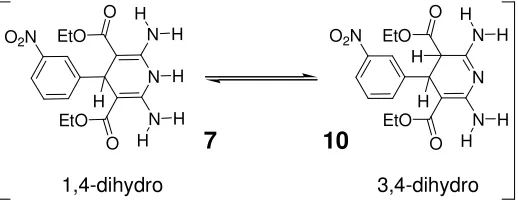
[image:20.612.192.451.162.264.2]7 10
Figure 1.9 7 can convert between two tautomeric forms; 1,4-dihydro, DDD, and its unwanted
3,4-dihydro state, 10.
The donor molecule DDD, 7, can convert (Figure 1.9) to its tautomeric form 10, which
has a DAD configuration. In order to overcome this problem, Zimmerman used 1,8-bis(dimethylamino)naphthalene (proton sponge) to prevent hydride shift between the
C-4 and C-10 position of 7. Leigh and co-workers in an attempt to stabilize the chemical
stability of complex 7●8 extended the anthyridine aromatic framework of 8 to form 9, as
shown in Figure 1.8. It was hoped that 9 would bind more strongly to 7 stabilizing the
structure and preventing or reducing conversion to its tautomeric form 10. The end result
was a complex with an association constant of 2 × 10⁷ M-1 in CH2Cl2 measured by
fluorescence. This increased binding strength results in a more chemically stable
complex [7●9] compared to [7●8]. In Zimmerman’s original system, 10 equivalents of 8
were required to fully convert 10 to its 1,4 dihydro-form, however, in this system only
0.5 equivalents of 9 are required to convert 10 to it 1,4 dihydro-form in > 98:2.
1.7 Quadruply hydrogen bonded recognition motifs[25, 42,46]
The final group of complexes investigated are those involved in quadruple hydrogen bonding arrays. As anticipated these form more stable complexes than their three hydrogen bonding complex counterparts, but like their two hydrogen bonding cousins can form homodimers. With four bonding arrays the number of possible complexes has
A A A A D D D D A A A D D D D A A A D A D D A D A D D A D A A D A A D D D D A A D A D A A D A D
Complementary Arrays Self-complementary Arrays
3.9 ×10⁸ 3.6 ×10⁵ 3.3 ×10⁴ 3.3×10⁴ 3.6 ×10⁵ 3.1 ×10²
Figure 1.10 All the possible combinations of arrays formed by four hydrogen bonding sites and their
predicted stability constants (in M-1) in CDCl
3. Attractive and repulsive secondary
interactions are indicated by green and red double headed arrows. Adapted from reference 42.
Conceptually, the simplest way of forming a quadruple hydrogen bonded array is to link together two doubly bonded arrays into one molecule. A good example, and one of the
first examples of this approach utilised two pyridine units and was developed[43-44]
(Figure 1.11) by Ducharme and Weust. The self-complementary nature of 11 meant it
could dimerize as the complex [11●11], with a binding constant of 6 × 10⁴ M-1. Figure
1.11 also demonstrates a non-self complementary bispyridone where dimerization via
only two hydrogen bonds is possible, this complex has considerably weaker association
of 102 M-1.
N N
O H O H
N N O H O H N N
O H H O
N N O H H O N N
O H H O
Ka > 6 × 10⁴ M-1 Ka = 102 M-1
11
11
12 12
Figure 1.11 Self and non-self complementary dipyridone quadruple hydrogen bonding arrays 11 and 12.
Another method of forming quadruple hydrogen bonded arrays is to create entirely new
recognition motifs. An example of such a recognition motif was created accidentally[42]
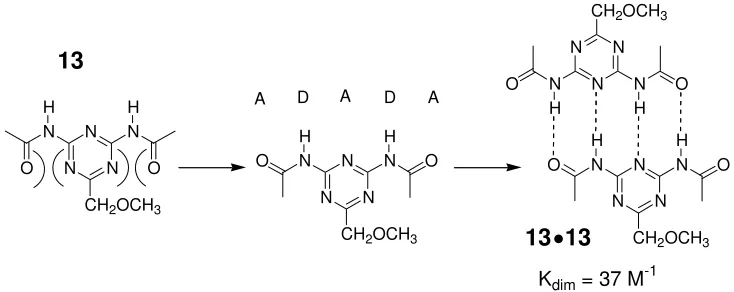
by Sijbesma and Meijer in their attempts to create a strong triple hydrogen bonded
complex. In fact they had actually created a molecule capable of forming (Figure 1.12)
O N
N N
N N
O CH2OCH3
H H
N
N N
N N
CH2OCH3
H H
O O
A D A D A
N
N N
N N
CH2OCH3
H H
O O
N N N
N N
CH2OCH3
H H
O O
13
13 13
[image:22.612.137.504.77.223.2]Kdim = 37 M-1
Figure 1.12 Weak ADADA hydrogen bonding molecule 13 capable of dimerizing in an ADAD●DADA
complex, )( indicates spectator repulsions. Adapted from reference 42.
Unfortunately, however, the dimer complex in Figure 1.12 demonstrated a much lower
stability constant than predicted (Figure 1.10). The reason for this disappointingly low
value was concluded to be the result of what Sijbesma coined as ‘spectator repulsions’ (Figure 1.12), between the carbonyl groups and nitrogen atoms on the triazine ring not
involved in hydrogen bonding. Initial attempts at improving the stability of this recognition motif involved removing an acyl group, to prevent these spectator repulsions, this
modification resulted in an increase in binding to 530 M-1. A further increase in complex
stability (Ka = 2 × 10⁴ M-1) was observed when an intramolecular hydrogen bond was
used to preorganize the DADA array in a planar conformation. Finally, Sijbesma found
the strongest bound DADA dimer complex was created[42] when preorganization and a
pyrimidine ring, in place of the triazine ring, were both utilized (Figure 1.13).
N N
N N
CH2OCH3
H H
N O
H O
N N N N
CH2OCH3
H H
N O H O
Kdim > 2 × 10⁵ M-1 [14 14]
Preorganizing intramolecular hydrogen bond
Figure 1.13 An extremely stable DADA array, as a result of an intramolecular preorganizing hydrogen
bond.
The importance of this investigation is that it demonstrates the limits of using secondary interactions for predicting stability of hydrogen bonding arrays. According to Jørgensen’s
Sijbesma has created a dimer complex with a considerably higher association constant. Sijbesma and co-workers claim this difference is a result of preorganization and other factors like overall charge distribution.
A number of other quadruple hydrogen bonding recognition motifs have been
investigated utilizing an AADD self-complementary array. One example[45] utilized the
above concept of preorganization via an intramolecular hydrogen bond to form dimers
which could undergo further self-assembly into “extended sheet like supramolecular structures”.
Although a vast amount of investigation has gone into the study of self-complementary
quadruply hydrogen bonded arrays (Figure 1.10), hardly any examination of
complementary arrays has occurred.
Despite these advances there is still a requirement for recognition units that form complexes with high stability and selectivity. The examples in this Section are mostly homocomplexes, there are few methods of forming heterocomplexes with high binding
constants. However, recently Zimmerman and Meijer have conducted[46-49, 210-211]
detailed studies into the development of quadruply hydrogen bonded heterocomplexes which exhibit high fidelity. The major problem in developing such complexes is that a number of recognition motifs exhibit tautomeric forms which can result in self-association weakening the association between heterocomplexes. However, Zimmerman and co-workers have recently demonstrated examples of heterocomplexes with high stability
and selectivity (Figure 1.14).
N N X N R
O
N O N H
Bu H H
N N N
O R
H
N O
R H
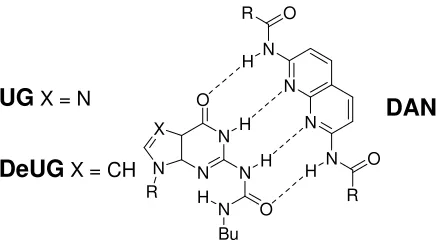
UG X = N
DeUG X = CH
[image:23.612.211.433.511.634.2]DAN
Figure 1.14 UG forms a stable quadruply hydrogen-bonded heterocomplex with DAN, but fidelity of
complex is lower by Hoogsteen side oligomerization of UG. DeUG however lacks the
Hoogsteen nitrogen atom and therefore forms a more stable complex with DAN.
Zimmerman initial developed the UG motif which was found to bind DAN with a
of oligomerization of UG (Ka ≈ 230 M-1) via the Hoogsteen nitrogen, therefore the author
created DeUG to overcome this problem. DeUG lacks the Hoogsteen nitrogen, and
therefore cannot oligomerize, this fact resulted in the formation of a much more stable
complex with DAN (>10 fold higher Ka compared to UG). However DeUG was also
found to dimerize reasonably strongly (Ka = 880 ± 40 M-1) which reduces it fidelity.
DeUG has a higher association constant for binding DAN and increased fidelity
compared to UG, however, there is still scope for designing quadruply hydrogen-bonded
heterocomplexes which exhibit improved fidelity recognition.
There are a few examples of hydrogen bonding arrays composed[50] of greater than four
intermolcular interactions, but these will not be discussed here.
1.8 Catalysis
The ability of enzymes to catalyze reactions[51] with excellent regio- and stereoselectivity
has intrigued chemists for decades. Enzymes are referred to as biological catalysts; however, there is a key feature which distinguishes enzymes from catalysts. This feature is the enzyme’s ability to bind a substrate in close proximity to the catalytic group(s) on the enzyme. So how do enzymes accelerate a reaction? The basic principle of enzyme catalysis was first suggested by Pauling some 50 years ago. He stated that enzyme catalysis was achieved through the stabilization of the transition state. This stabilization of transition state can be achieved through either lowering the energy of the transition
state or by raising the energy of the ground state. Therefore, ∆Gcat must be larger than
∆GES, when the transition state is stabilized more than the ground state of the substrate
E S GES
o
Gcat
TSuncat
Guncat
TScat
E P E + P E + P
E + S
Uncatalysed Enzyme catalysed
Theoretical reaction coordinate
G
G
ib
bs
fr
ee
e
ne
rg
y
/
GTSo
Scheme 1.2 Energy profile for enzyme-catalyzed and uncatalyzed reaction of substrate S.
Chemists hope through understanding how enzymes[52] work, that it will become
possible to further the understanding of controlling and accelerating reactions.
From what has been observed of catalysis in nature, a number of key areas have been identified as important by chemists. The hope is that through improving our understanding of catalysis chemists will be able to develop systems capable of enzymatic like catalysis.
One area of study which has been identified as a large factor in the incredible acceleration observed by enzymes is that the reaction occurs in an [E•S] complex, this
bringing of reactive sites close together renders the reaction pseudo intramolecular. This
has lead chemists to study synthetic intramolecular reactions in an attempt to further the understanding of enzyme reactions.
1.9 Effective Molarities [53]
The study of intramolecular reactions has resulted in the invention of the term effective molarity (EM) as a way of measuring rate enhancement of intra over intermolecular reactions. The EM term is a hypothetical concentration of a reactant in an intermolecular reaction required to proceed at the same rate (or to the same extent) as its intramolecular equivalent. Effective molarity is measured through comparing the rate constant of the intramolecular (catalyzed in the case of enzymes) over that of the
intermolecular (the uncatalyzed reaction) as shown in Figure 1.15.
r ermolecula
r ramolecula uncat
cat
k k k
k
int int
(M)
EM = =
Figure 1.15 Calculation for determining effective molarity (EM), used to compare intra to
intermolecular reactions.
Values of effective molarities ranging from 10-3 to 1016 M have been observed[53].
These values have lead to the question of why is there such a large variation in the effective molarities observed, and for what reason do intramolecular reactions proceed so much faster than their intermolecular counterparts? One of the simplest examples of
the effect of intramolecularity is the comparison[54] between the formation of succinic
anhydride and acetic anhydride (Scheme 1.3). As this shows there is a dramatic
increase in the observed rate on going from an inter to an intramolecular reaction.
H3C O
OAr H
3C O
O OAr
O O
O H3C
H3C O O
O
O O
O
+ krel = 3 x 10
5 M
krel = 1
15 16 17 18 19
Scheme 1.3 Intermolecular vs. Intramolecularity.
1.10 Study of intramolecularity[54-70]
In the 1950 and 1960’s Bruice and Pandit conducted[54-57] extensive studies into the
effect of intramolecularity, through studying carboxylic group nucleophilic catalysis of the
hydrolysis of various esters (Table 1.1).Their argument for the dramatic increase
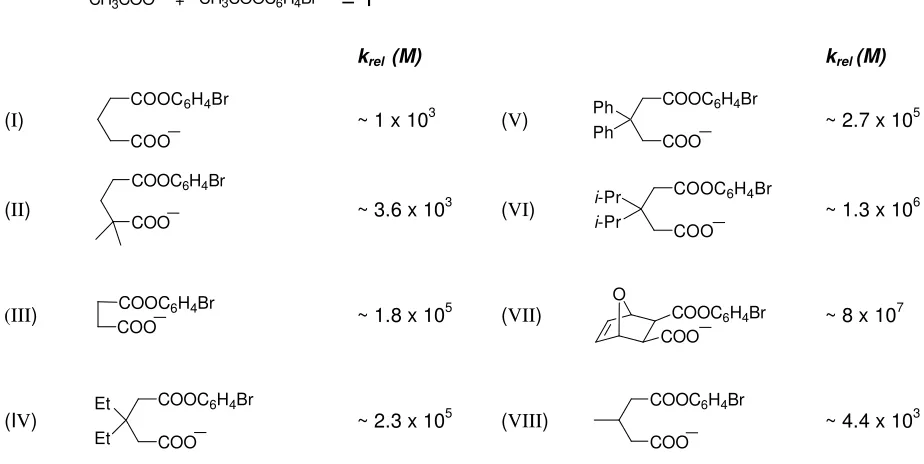
Table 1.1 The relative rates of (I) to (VIII) for the intramolecular reaction between a carboxylate anion
with a monophenyl ester to form the cyclic anhydride product compared to the standard intermolecular reaction.
+
_
CH3COO CH3COOC6H4Br = 1
krel (M) krel (M)
(I)
COOC6H4Br COO_
~ 1 x 10³ (
V)
COOC6H4Br COO Ph
Ph _ ~ 2.7 x 10 5
(II)
COOC6H4Br
COO_ ~ 3.6 x 10 3 (
VI)
COOC6H4Br COO_ i-Pr
i-Pr ~ 1.3 x 10 6
(III) COOC6H4Br
COO_ ~ 1.8 x 10
5 (VII) O COOC 6H4Br
COO_ ~ 8 x 10 7
(IV)
COOC6H4Br COO Et
Et _ ~ 2.3 x 10 5 (
VIII)
COOC6H4Br
COO_ ~ 4.4 x 10 3
Bruice and Pundit claimed the results they obtained showed the tremendous rate enhancement which enzymes can obtain through fixing their reactive sites in a steric conformation similar to that of the transition state of the reaction. They also concluded that bringing reactants close together resulted in considerable loss in translational entropy and these factors explain why enzymes can obtain high rate increases in the
area of 108 M. Analysis of Table 1.1 reveals the addition of a methyl group, comparison
between (II) and (VIII) in Table 1.1, results in an increase in rate. The explanation for
this effect is what is referred to as stearic compression. The electrophile and nucleophile are pushed together forcing the structure towards that of the transition state. Another
way of causing steric compression is through the use of gem di-alkyl groups, Table 1.1
(III), (V), and (VI), in what is referred to as the Thorpe-Ingold effect[67].
The proximity theory was not accepted by everyone though, and around the same time
Koshland and Jencks suggested[58-59] an alternative theory, that holding reactants in
close proximity would only result in a rate enhancement of 55 M. Koshland’s arguments
revolve around the basis that reactant A and B are the size of water molecules, A is
dissolved in neat B then the observed pseudo-first order rate constant (kobsd) could only
be 55.5 times greater than kobsd when B is at 1 M. This argument did not, however,
with the theory of ‘orbital steering’ to account for this. The argument behind this theory is that not only must reactants be in close proximity their orbitals must be optimally aligned. It is the latter which Koshland argues is the most important and even a small deviation of
10degrees would result in a 10000 fold decrease in reaction rate (Figure 1.16).
Favourable Proximity Unfavourable Orientation (a)
Favourable Proximity Optimal Orientation
(b)
krel - 1 × 10⁴ M - 1 M
Figure 1.16 Koshland orbital steering theory (a) intramolecular reaction with close proximity and
optimal orbital alignment (b) intramolecular reaction lacking optimal orbital alignment by more than 10 degrees.
Koshland also argued that this helped to explain the huge variations in values of EMs for intramolecular reactions.
Bruice attacked this theory on the argument that it required an unreasonably large force constant. However, the theory of orbital steering was upheld by two theoretical
studies[62] and a study by Menger[63-64] pointed out that Bruice had overlooked the effect
of solvent. Despite this, Menger also concluded that the effect of orbital steering was not as great as first believed.
In 1971, Jencks[60-61] reversed his position and conceded that entropic contributions
must have been larger then previous believed. Jencks, along with Page, went on to suggest that entropic factors account completely for large intramolecular rate acceleration. At this stage it is worth considering the different entropy contributions between bimolecular and intramolecular. There are different degrees of freedom lost in intramolecular and intermolecular reactions, which results in large differences in the entropy change between these two systems. A bimolecular reaction of a non-linear molecule containing n atoms has 3 degrees of translation, 3 degrees of rotation as well as (3n-6) degrees of vibration. When the transition state forms or the product of bimolecular reaction forms there is an overall loss of three translational and three rotational degrees of freedom, however, there is a gain of 6 vibrational degrees of
Table 1.2 The change in degrees of freedom during a bimolecular reaction.
A + B P
Translational 3 3 3 Rotation 3 3 3
Vibrational 3n-6 3n’-6 3n+3n’-6
In a unimolecular (intramolecular) reaction there is no net gain or loss in the number of
degrees of freedom during a reaction (Table 1.3).
Table 1.3 The changes in molecular degrees of freedom during the course of a unimolecular reaction.
A B P
Translational 3 3
Rotation 3 3 Vibration 3n-6 3n-6
These changes in degrees of freedom observed on passing from reactant to product can
be quantified in terms of a change in entropy. It was observed that a loss of
190 J mol-1 K-1 could be estimated for a bimolecular reaction. The maximum rate
acceleration obtained from rendering a reaction pseudo-unimolecular, can be estimated
using the Eyring equation derived (Figure 1.17) from transition state theory.
If we assume there are no differences in ∆S‡ between the inter- and intramolecular
reactions ∆S‡, we can easily calculate the kuni / kbi value using the estimate of
190 J mol-1 K-1.
∆
−
∆
− =
∆ ∆
∆
=
R RT
h T k k RT
h T k
k b b
‡
‡ S
exp H
exp
S and H of terms in Rewriten
G -exp
Figure 1.17 Eyring equation transformed into its ∆G‡ form, where R, k, kb, h, and T are the gas constant, rate constant, Boltzmann constant, Planck’s constant, vibrational frequency and absolute temperature. ∆G‡, ∆H‡ and ∆S‡ are the activation parameter free energy,
enthalpy and entropy.
The value for kuni / kbi is calculated by dividing the Eyring equation for the unimolecular
reaction, kuni, by the Eyring equation for the bimolecular reaction, kbi, which simplifies to
Figure 1.18 Equation for determining maximum rate acceleration.
Therefore, from the equation in Figure 1.18 a value of 8 × 10⁹ M for the maximum rate
acceleration in an entropy only scenario can be calculated.
Menger argued[62-64] however, that this does not account for differences between inter
and intramolecularity, and this led him to develop his own approach to intramolecularity. The basis of this was that rate of reaction between functionalities A and B is proportional to the time that A and B reside at a critical distance. He suggested that reaction proceeds at intramolecular rates when the distance between reactants is at van der Waals contact distance (less than solvent distance), he referred to this as the ’spatiotemporal postulate’.
The conclusion drawn from the various studies into intramolecularity has lead to severally widely accepted concepts about the mechanics of enzyme reactions. In the
1990’s, Bruice and Lightstone[56-57,65] came up with another theory to explain
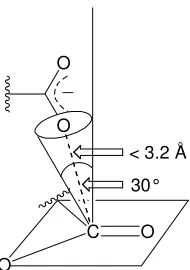
intramolecularity- the theory of Near Attack Conformation (NAC). They claimed that changes in translational and rotational energies in the juxtaposing nucleophile and electrophile is not enough to explain large rate enhancements observed in intramolecular reactions. The large rate enhancement must be explained by the probability of formation of ground state conformers where the reacting groups are held in conformations to enter the transition state (NAC). The NAC is defined as the conformation required for the juxtaposed reactants to enter a transition state. The NAC is a genuine ground state where the reaction centres are properly aligned for reaction but are separated by 3 Å, where bond making and breaking has not yet been initiated (Figure 1.19).
∆ ∆
=
R S k
k o
bi
O O
O
O C
30° _
[image:31.612.273.368.55.190.2]< 3.2 Ao
Figure 1.19 The geometry of a NAC for an intramolecular carboxylate anion interaction with a
carbonyl ester. In which carbonyl is still sp2 and the carboxylic acid is positioned above
the carbonyl 3.2 Å away at a 30° angle from the perpendicular trajectory.
Bruice claims NAC calculations on esters highlight that the rate constant for the reaction
is dependent on the mole fraction (P) of ground state of each ester present as a NAC,
and that the values of P are related to the change in enthalpy for NAC formation rather
than the change in entropy. He supported this claim by using the energies of the
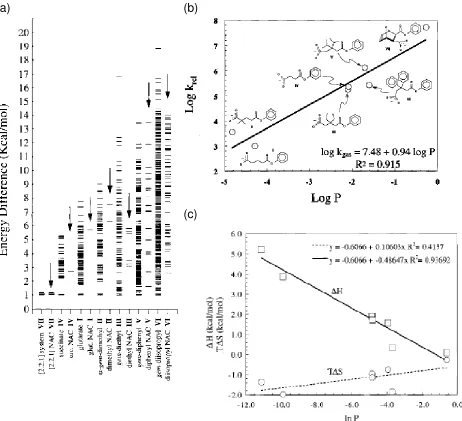
conformations of the mono-p-bromophenyl esters (Table 1.1) and a weighted Boltzmann
distribution to calculate the P of the conformations present as NACs (Figure 1.20 (a)). A
plot of log P vs. experimental relative rate constants, k(rel) , (Figure 1.20 (b)) revealed a
slope of 0.94 indicating a linear relationship between the log of the fraction of
conformations present as NACs and ∆G‡. Therefore, Bruice stated that the rate constant
for the reactions of the esters of Table 1.1 are directly dependent upon the mole fraction
of the ground state of each ester present as NACs. When the ground state consists of
only NACs, the rate enhancement is 108. Figure 1.20 (c) shows the values of P are
related to the change in ∆H° for NAC and not the variation in phase space entropy
(T∆S°). Therefore, the activation free energy (∆G‡) is a function of the ground state
enthalpy (∆H°) for NAC formation. Mandolini[204] stated intramolecular lactonizations,
offered support for entropy of activation (∆S‡) as the key feature of ∆G‡, but Bruice and
Lightstone’s work supports the idea that intramolecular lactone formation is driven by a
(b) (a)
[image:32.612.96.558.56.477.2](c)
Figure 1.20 (a) Plot of differences of MM3 final energies of all local minimum conformations relative to
the lowest energy ground state conformations for each ester in Table 1.1. (b) Log of the
relative rate constants (krel) for formation of mono-p-bromophenyl esters vs. the log of the probability of (P) for the NAC formation of each monophenyl ester in Table 1.1. (c) Phase
space calculated thermodynamic entropy change T∆S and internal energy (∆H°) to attain
a NAC vs. the natural log of the probability of being in a NAC. Figure 1.18 taken from
reference 65.
These NAC calculations agree with Menger’s ‘spatiotemporal’ hypothesis that the “rate
of reaction is directly proportional to the time A and B reside at a critical distance. Bruice
restates this as the “rate of reaction between functionalities A and B is directly
proportional to the mole fraction of A and B that reside at a critical distance, when P = 1
These studies into intramolecularity have provided invaluable insight into reactions in
enzymes[68-70, 208] and have allowed chemistry to attempt to design and synthesize
artificial enzymes and, ultimately self-replicating systems.
1.11 Templated Synthesis[71-84]
The development of “artificial enzymes” capable of conducting reactions at rates normally not attainable in lab conditions, is of great interest to the synthetic chemist. As
examined in the previous section (Section 1.10) enzymes exploit the kinetic advantage
of turning what is normally an intermolecular reaction into an intramolecular process.
However, until Kelly’s pioneering[74-75] work the focus of artificial enzymes was
exclusively[79-84] on single substrates, which has limited applications to the synthetic
chemist.
Kelly and co-workers were the first to examine a fully synthetic system where two substrates were bound to a template, in which a reaction between the substrates was accelerated because of transient intramolecularity. The reaction chosen to link the substrates together was a straightforward SN2 alkylation of an amine to an alkyl halide. A
cartoon model of the overall reaction process is illustrated in Scheme 1.4.
NH2
Br
Br NH2
N H
N H
dissociate
react -HBr Binding site A Binding site B
20
21
22
23 24
25
Scheme 1.4 Cartoon representation of the mechanism of amine alkylation by an artificial enzyme.
The ditopic receptor binds the two substrates, 21 and 22 via complementary recognition
to form the ternary complex structure 23, bringing the two reactive sites into close
proximity. Bond formation then occurs to form a template-product duplex structure, 24
which then dissociates to complete the process.
The first system developed (Scheme 1.5) by Kelly utilized identical recognition motifs for
simplicity. However, Kelly and co-workers would latter go on to demonstrate the undesirable nature of this feature.
N
O N
H H
H N N O
H H H N N H N O NH2 N N Br N H O N O N H H
H N N O
H H H N N N O NH2 H N N Br N O H N O N H H H N O N H H H N N N O H
N N N
O H H N HBr N N N O H N N N O
H NH
N
O N
H H
H N N O
H H H React Dissociate 26 27 28 26 29
Scheme 1.5 Artificial enzyme system developed by Kelly and co-workers featuring identical binding
sites on the template structure. Adapted from reference 75.
Kinetic measurements of the above system indicated a rate acceleration of six-fold for
the alkylation of the amine when the reaction was conducted with template 26 compared
to the simple bimolecular process. The authors also conducted a control experiment to
demonstrate that the reaction was indeed accelerated via a ternary complex structure
of the substrates to the template indicated that the ternary complex [26●27●28] is the
primary constituent of a mixture of 26, 27 and 28. Although these result support the
basic concepts involved in designing a bisubstrate template the rate enhancements are less than expected for an intramolecular reaction.
Kelly ascribed the poor rate enhancement to the identical recognition sites on the
template. By having identical recognition sites the complex [26●27●28] will not be the
only ternary complex structure formed. Non-productive ternary complex structures will
occur where two molecules of the same substrate bind to the template as in Figure
1.21.
N
O N
H H
H N N O
H H H
N N
Br N
O H N
N Br
N O
H
26
27 27
Figure 1.21 Example of one of the nonproductive ternary complex formed through the association of
two identical molecules of substrate with the template.
These complexes will have the effect of reducing the rate of formation of 29. Therefore,
in order to circumvent this problem Kelly and co-worker designed a new system with non-identical recognition sites on the template. However, this modification is not as simple as it first sounds.
The binding sites in template 26 consists of a linear triad of two hydrogen bond donors
and one acceptor, and therefore, can associate with a structure containing two hydrogen
bond accepters and one donor. This complex is represented as D in Figure 1.22, where
crossed square represent hydrogen bond donors and white squares hydrogen bond acceptors. By rearranging hydrogen bond acceptors and donors a possible of seven other triads, along with their complementary substrate triads, are possible. Kelly decided to maintain the recognition on one of the template binding sites but alter the other. The
original template binding site corresponds to D, therefore the other site must contain a
Triad H is not acceptable as the two substrates would then have complementary binding
and could associate with each other instead of the template, the same problem also
applies to triad F. Another unsuitable triad is B as this arrangement is a mirror image of
H, therefore, the same unproductive ternary complex formed in the system in Scheme
1.5 would still occur. Therefore, only A, C, E and G are suitable triads for the other
binding site on the template. Kelly decided to utilize hydrogen bonding pattern C and
chose the recognition motifs in Figure 1.23 for the substrate and other template binding
site.
receptor
substrate
A B C D E F G H
Figure 1.22 Representation of the eight possible linear arrangements of triads of hydrogen bonds
involving receptor and substrate. Crossed boxes represent hydrogen bond donors; white box represents hydrogen bond acceptors. Adapted from reference 75.
However, this hydrogen bonding motif still contained a vertical axis of symmetry, with the substrate having the possibility of aligning itself in two possible orientations. One has the
alkyl bromide pointing towards the amine ((A), Figure 1.23) in a productive complex,
whereas the other has the alkyl bromide orientated away from the amine in a
non-productive complex ((B), Figure 1.23).
N N
N
O
H
H H
N N O
H Br
N N
N
O
H
H H
N N O
H
Br NH2
NH2
(A) Productive complex (B) Non-productive complex
Unfavourable repulsion prevents this complex forming
Figure 1.23 (A) Productive ternary complex with the alkyl bromide and amine in close proximity. (B)
Unproductive ternary complex with alkyl bromide isolated from amine. Repulsive interaction between the phenyl group and alkyl bromide prevent the formation of this ternary complex.
prevent the formation of this complex. The new template and substrates can now bind
together and react through the ternary complex structure shown in Figure 1.24.
N
O N
H H
H N N
H H
N O
H
N N
Br
H O
N N
N O
NH2 H
31
28
30
Figure 1.24 Kelly new ternary complex comprised of template with non identical binding sites and new
alkyl bromide designed to fit new recognition motif.
Kelly predicted his new system should display a twelve-fold rate enhancement
compared to the six fold enhancement observed by the system in Scheme 1.5. This
doubling in rate arises from the difference in productive ternary complexes formed between the two systems. In the original system, containing two identical recognition
sites on the template, a possible four ternary complexes could be formed (Figure 1.25),
two productive and two non-productive complexes.
R R R R
R
A A A BB BB A BB BB
A B
R R
Identical recognition sites on template
different recognition sites on template
4 ternary complexes
2 productive
1 productive ternary complex
32 33
34 35 36
38 37
Figure 1.25 Possible ternary complex structures for template with identical recognition motifs, 33, 34, 35 and 36 and for template with different recognition groups, 38.Adapted from reference
In the diagrams in Figure 1.25 A represents the amine and B the alkyl bromide.
However, in his new system only one productive ternary complex is possible. Therefore, in the original system 50 % of the ternary complexes formed will be productive, whereas in the new system 100 % of the ternary complexes are productive.
Indeed Kelly did observe a rate enhancement of twelve-fold compared to the bimolecular reaction for his new system, a doubling in rate of the six-fold enhancement observed in the original. However, the author noted the match of the predicted to the experimental is somewhat coincidental as a number of assumptions were made when comparing the two systems which happened to cancel each other out. One was the fraction of ternary complex present in the two systems. The new system has weaker binding than the original meaning a low fraction of the materials are present in the ternary complex yet increased rate acceleration is still observed. Indicating the new system is more efficient than the original, but this is partly offset by competitive inhibition, resulting in the twelve-fold enhancement observed by Kelly.
The work done by Kelly demonstrates how rational design can be utilized for the production and optimization of bisubstrate systems. Although Kelly’s work focused on investigation of simple templated process his work is equally applicable to more
complicated bisubstrate systems[76-78, 212]. The concepts investigated by Kelly are also
important in a special form of templated synthesis know as replication. As with the bisubstrated template reactions, replication occurs through the close proximity of two substrates bound to a template in a ternary complex structure. Therefore, the concepts developed by Kelly and co-workers on ternary complexes are essential to anyone who wishes to design, synthesize and analyze a replicating system. The work of Kelly provides a good link between templated synthesis and replication which will be examined in the next section.
1.12 Minimal model of replication[85-92, 213-214]
The minimal model of replication is based on template directed synthesis and involves the production of identical versions of the same molecule. Utilizing the lessons learned by Kelly and co-workers the template molecule contains non-identical recognition units to avoid formation of unproductive complexes. In this system there are three possible
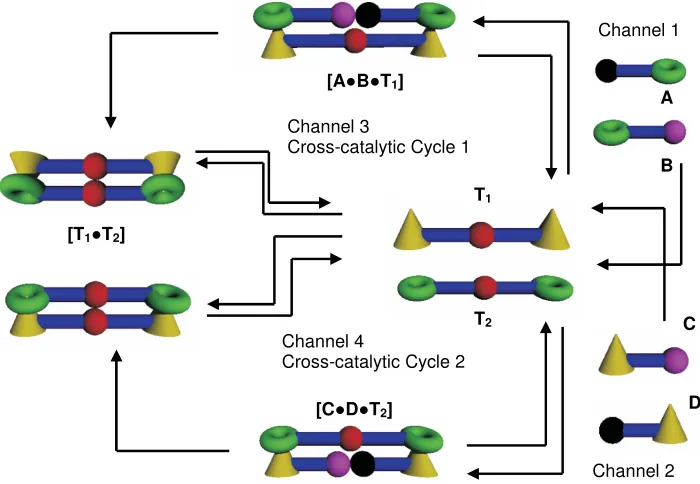
Channel 1 Uncatalyzed Bimolecular
Channel 3 Autocatalytic Cycle
Channel 2 [A B] Complex [A B]
T T
T
T T'
A B
[A B T]
[T T]
Figure 1.26 Schematic representation of minimal replicating system highlighting the three reaction
channels available to building blocks A and B.
A and B contain a reactive site (Purple color sphere reacts with Black sphere) and
complementary recognition (Green doughnut can associate with Yellow cones). The first of these channels is a simple bimolecular reaction between the template building blocks
A and B, which results in the formation of a molecule of template (T), containing
self-complementary recognition motifs. The second channel available is an autocatalytic
cycle, in this channel A and B simultaneously associate to a molecule of T, via the self-
complementary recognition to form a ternary complex [A•B•T]. The proximity of reactive
sites and the correct orientation of the molecular orbitals in this ternary complex renders
the reaction pseudo-unimolecular, facilitating bond formation between A and B. This
reaction results in the formation of another molecule of T in a [T•T] duplex complex. The
correct orientation and proximity are as a result of the specific interactions between the
building blocks A, B and the molecule of T in the ternary complex, which has the effect
of controlling the regio- and stereochemistry of the product T. At the [T•T] complex stage
the system can be considered self-replicating as another molecule of T has been
formed. However, it can not yet be considered autocatalytic, only when the [T•T]
complex dissociates returning two molecules of T to the start of the cycle can the system
results in the sigmoidal shape observed in the rate profile of an autocatalytic
self-replicating system (Figure 1.27).
Time / mins Lag Period
Maximum Autocatalytic Rate
Reactant Limiting Stage Smooth Transitions
[ T
]
[image:40.612.213.421.117.285.2]/ M
Figure 1.27 Rate profile for minimal self-replication consisting of three periods, a lag period, a
maximum autocatalytic rate period and a reactant limiting period.
The final channel available to A and B is the AB channel. This channel arises because
A and B have complementary recognition sites, these can associate leading to the
reversible formation of an [A•B] complex. If the reactive sites of A and B are brought
close enough together and in the correct orientation to each other, the reaction once
again can be rendered pseudo-unimolecular. Through controlling the approach of the
reactive sites the regio- and stereochemistry of the resulting product can be controlled.
In the [A•B] channel the approach of the reactive sites can still be controlled and so an
AB channel can still have regio- and stereochemical control. However, unlike the previous channel the reaction can not be considered autocatalytic as the product does not catalyze its own formation. This is because the complementary recognition sites are
still associated in T’, in effect it is a closed template. Therefore T’ is unable to associate
with a molecule of A and B building blocks and so can not catalyze its own formation.
1.13 Potential problems in a self-replicating system
One of the potential problems that can occur in a minimal replicating system is if the AB
channel is competing with the autocatalytic channel. The formation of the [A•B] complex
is more favorable as this only requires one association between two molecules; whereas
result of this is that there is a much greater concentration of [A•B] complex than [A•B•T].
As previously mentioned, the [A•B] complex is not autocatalytic, therefore, the amount
of T returned to the system is reduced, quenching the reaction. However, this problem
can be reduced or eradicated through careful consideration and manipulation of the molecular structure.
In addition to the previous mentioned problem the stability of the product duplex [T●T]
can also hinder autocatalytic replication.By its nature the product duplex [T•T] should be
more stable than the ternary complex [A•B•T] from which it was formed. This enhanced
stability is a consequence of going from three molecules bound through two complementary recognition sites in the ternary complex, to only two molecules
associated via two complementary recognition sites in the product duplex. A problem
arises if the product duplex becomes too stable, if this occurs individual molecules of template are trapped in this complex structure, preventing them catalyzing the formation of more molecules of themselves. When this problem occurs the system can still be considered self-replicating but it cannot be thought of as autocatalytic.
1.14 Autocatalytic reactions vs. Self-replication
At this stage it is important to distinguish between self-replication and autocatalysis. In an autocatalytic reaction the product of the reaction is itself a catalyst for its own formation, returning more catalyst after each turn of the cycle. If it does not return catalyst to the reaction then it is not autocatalytic. A good example of an autocatalytic
reaction is the bromination of acetone (Scheme 1.6).
O
H Br O
H H
Br
O H H H
Br Br
Br O H O
Br HBr +
39
O
H Br O
H H
O H H H
Br Br
Br O H Br
O Br HBr +
40
Scheme 1.6 An example of autocatalysis showing the reaction between HBr and acetone, 39, where
![Figure 1.8 AAA●DDD triple hydrogen bonded complex [7●8], by Zimmerman and co-workers, and [7●9], by Leigh, McNab and Zerbetto](https://thumb-us.123doks.com/thumbv2/123dok_us/8673997.377289/19.612.188.455.411.594/figure-triple-hydrogen-bonded-complex-zimmerman-workers-zerbetto.webp)