From the Department of Epidemiology and Public Health (T.M.) and the Notting-ham Respiratory Research Unit (T.H.), National Institute for Health Research (NIHR) Biomedical Research Centre, and the Nottingham Clinical Trials Unit (A.S., L.D., L.B., R.H., E.M.), University of Not-tingham, NotNot-tingham, the Liverpool School of Tropical Medicine and Aintree University Hospital, Liverpool (K.M.), the University of Leicester (A.W.) and the Leicester NIHR Biomedical Research Centre, University of Leicester (C.B.), Leicester, Asthma UK, London (S.W.), the Respiratory Medicine Unit and Oxford Respiratory Biomedical Research Centre, Nuffield Department of Medicine, Univer-sity of Oxford, Oxford (I.P.), the Centre of Academic Primary Care (D.P.) and the Institute of Medical Sciences (G.D.), Uni-versity of Aberdeen, Aberdeen, the Pri-mary Care and Population Science and NIHR Southampton Biomedical Research Centre, University of Southampton, South-ampton (M.T.), and the Department of Respiratory Medicine, Newcastle upon Tyne Hospitals NHS Trust, Newcastle upon Tyne (B.H.) — all in the United Kingdom. Address reprint requests to Dr. Harrison at the Nottingham Respiratory Research Unit, NIHR Biomedical Research Centre, University of Nottingham, Hucknall Rd., Nottingham NG5 1PB, United Kingdom, or at tim . harrison@ nottingham . ac . uk.
Drs. McKeever and Mortimer contributed equally to this article.
This article was published on March 3, 2018, at NEJM.org.
DOI: 10.1056/NEJMoa1714257
Copyright © 2018 Massachusetts Medical Society. BACKGROUND
Asthma exacerbations are frightening for patients and are occasionally fatal. We tested the concept that a plan for patients to manage their asthma (self-manage-ment plan), which included a temporary quadrupling of the dose of inhaled gluco-corticoids when asthma control started to deteriorate, would reduce the incidence of severe asthma exacerbations among adults and adolescents with asthma.
METHODS
We conducted a pragmatic, unblinded, randomized trial involving adults and adoles-cents with asthma who were receiving inhaled glucocorticoids, with or without add-on therapy, and who had had at least add-one exacerbatiadd-on in the previous 12 madd-onths. We compared a self-management plan that included an increase in the dose of inhaled glucocorticoids by a factor of 4 (quadrupling group) with the same plan without such an increase (non-quadrupling group), over a period of 12 months. The primary outcome was the time to a first severe asthma exacerbation, defined as treatment with systemic glucocorticoids or an unscheduled health care consul-tation for asthma.
RESULTS
A total of 1922 participants underwent randomization, of whom 1871 were in-cluded in the primary analysis. The number of participants who had a severe asthma exacerbation in the year after randomization was 420 (45%) in the quadru-pling group as compared with 484 (52%) in the non-quadruquadru-pling group, with an adjusted hazard ratio for the time to a first severe exacerbation of 0.81 (95% confidence interval, 0.71 to 0.92; P = 0.002). The rate of adverse effects, which were related primarily to local effects of inhaled glucocorticoids, was higher in the quadrupling group than in the non-quadrupling group.
CONCLUSIONS
In this trial involving adults and adolescents with asthma, a personalized self-management plan that included a temporary quadrupling of the dose of inhaled glucocorticoids when asthma control started to deteriorate resulted in fewer severe asthma exacerbations than a plan in which the dose was not increased. (Funded by the Health Technology Assessment Programme of the National Institute for
ABS TR ACT
Quadrupling Inhaled Glucocorticoid Dose
to Abort Asthma Exacerbations
Tricia McKeever, Ph.D., Kevin Mortimer, Ph.D., Andrew Wilson, M.D., Samantha Walker, Ph.D., Christopher Brightling, Ph.D., Andrew Skeggs, B.Sc.,
Ian Pavord, F.Med.Sci., David Price, F.R.C.G.P., Lelia Duley, M.D., Mike Thomas, Ph.D., Lucy Bradshaw, M.Sc., Bernard Higgins, Ph.D., Rebecca Haydock, B.Sc., Eleanor Mitchell, B.A., Graham Devereux, Ph.D.,
and Timothy Harrison, M.D.
A
sthma is one of the most commonchronic diseases, with an estimated 300 million people affected worldwide.1 Acute exacerbations of asthma are frightening for pa-tients, cause considerable illness and death, and account for a large proportion of the overall costs related to asthma.2
Although plans for patients to manage their asthma (self-management plans) have been shown to improve asthma control,3 the previously rec-ommended step of doubling the dose of inhaled glucocorticoids when asthma control is deterio-rating is ineffective at preventing acute exacer-bations.4,5 Although some guidelines suggest a greater increase in the dose of inhaled glucocor-ticoids, a 2016 Cochrane review concluded that it is unlikely that increasing the dose of inhaled glucocorticoids reduces the odds of systemic glucocorticoid use or hospitalization or shortens recovery time.6
A large, pragmatic trial was therefore com-missioned by the Health Technology Assessment Programme of the National Institute for Health Research in the United Kingdom. We performed an individually randomized, unblinded, pragmat-ic, multicenter trial involving adults and adoles-cents to test the hypothesis that a self-manage-ment plan that included a temporary increase in the dose of inhaled glucocorticoids by a factor of 4 when asthma control started to deteriorate would reduce the use of oral glucocorticoids or unscheduled health care consultations for asth-ma as compared with a plan that did not include this step.
Methods
Trial Oversight
The North West–Greater Manchester South NHS Research Ethics Committee approved the proto-col. The last author vouches for the completeness and accuracy of the data and analyses and for the fidelity of the trial to the protocol (available with the full text of this article at NEJM.org). Written informed consent was obtained from each participant before inclusion in the trial.
Population
Patients 16 years of age or older with a clinical diagnosis of asthma who were receiving any United Kingdom–licensed dose of inhaled
gluco-corticoids, with or without add-on medication, and who had had at least one exacerbation lead-ing to treatment with systemic glucocorticoids in the previous 12 months were eligible to par-ticipate. (For further details, see the Methods section in the Supplementary Appendix, avail-able at NEJM.org.)
Intervention and Randomization
We compared two self-management plans that were based on a plan developed by Asthma UK and used in the United Kingdom at the time of trial design (Figs. S1 and S2 in the Supplemen-tary Appendix). The plans were identical other than zone 2 of the plans. Zone 1 described well-controlled asthma and recommended continua-tion of current treatment. Zone 2 described de-teriorating asthma control and recommended increased bronchodilator medication and an in-crease in the dose of inhaled glucocorticoids by a factor of 4 (quadrupling group) or increased bronchodilator medication alone (non-quadru-pling group) (Table 1). (For details, see the Methods section in the Supplementary Appendix and the protocol.7) Zones 3 and 4 described the development of an exacerbation and when to start oral glucocorticoids and seek medical in-tervention (zone 3) and what to do in the event of a life-threatening exacerbation (zone 4). Par-ticipants were sent an automated text message every month to remind them to follow their self-management plan. Additional glucocorticoid in-halers that were required to achieve a quadru-pling of the dose were provided free of charge.
Outcome Measurements
The primary outcome was the time to a first severe asthma exacerbation, defined as treatment with systemic glucocorticoids or an unscheduled health care consultation for asthma. Scheduled visits occurred at 6 months and 12 months after randomization. For participants who were lost to follow-up, site staff attempted to review elec-tronic patient records to document whether they had had an asthma-related general-practice ap-pointment or had been prescribed systemic gluco-corticoids during the trial period.
Secondary outcomes included the number of participants who had a severe exacerbation, the area under the curve of the morning peak expi-ratory flow 2 weeks after activation of zone 2 of the self-management plan, the change in score on the Mini Asthma Quality of Life Question-naire (Mini-AQLQ; scores range from 1 to 7, with higher values indicating better quality of life; minimal important difference, 0.5)8 2 weeks af-ter activation of zone 2 of the self-management plan, and the cumulative dose of inhaled and systemic glucocorticoids used in the 12 months after randomization. (For details, see the Meth-ods section in the Supplementary Appendix.)
Safety
Adverse events and serious adverse events relat-ing to established adverse effects of inhaled glucocorticoids were reported during the 14 days after activation of zone 2 of the self-management plan. After a request from the data monitoring
committee, cases of pneumonia were reported for up to 4 weeks after activation of zone 2.
Statistical Analysis
A group of local general practitioners, asthma nurses, and asthma experts suggested that a reduction of one third in the number of people initiating a course of systemic glucocorticoids is a worthwhile treatment effect. With 1000 partici-pants per group, a log-rank test (at the two-sided 5% significance level) had at least 90% power to detect a between-group difference of 30% (rela-tive effect), with the assumption of an exacerba-tion rate of 13% in the non-quadrupling group.4,9 We initially proposed to recruit 2300 patients to allow for withdrawals and losses to follow-up, but this was reduced in March 2015 to a mini-mum of 1774 because the combined primary-outcome rate was higher than expected. (For details, see the section on sample size in the protocol.7)
All analyses were conducted with the use of Stata software, version 13.1 (StataCorp). Cox proportional-hazards regression was used to analyze the primary outcome, including the randomization-stratification variables, the dose of inhaled glucocorticoids (high vs. low), and smoking status (never smoked vs. former smoker vs. current smoker) as covariates and using a shared-frailty model to account for stratification according to regional center. Participants were included in analyses according to their random-ized group, regardless of their adherence to their
Quadrupling Group Non-Quadrupling Group
Indication of deteriorating asthma control (one or more) Indication of deteriorating asthma control (one or more)
You need your reliever inhaler more than usual. Your need your reliever inhaler more than usual.
You have more difficulty sleeping because of your asthma. You have more difficulty sleeping because of your asthma. Your peak flow is below [80% of your normal level]. Your peak flow is below [80% of your normal level].
Action Action
Use your reliever inhaler to relieve your symptoms and quadruple your inhaled glucocorticoid dose as described.
Once your symptoms or peak flow have returned to normal or after a maximum of 14 days, return to your normal treatment. If your symptoms get worse, follow Zone 3 instructions.
Use your reliever inhaler to relieve your symptoms and continue your inhaled glucocorticoid medication at your normal dose.
If your symptoms get worse, follow Zone 3 instructions. Start to record your morning peak flow, symptoms, and medication
in the trial diary. Start to record your morning peak flow, symptoms, and medication in the trial diary.
assigned self-management plan. All the par-ticipants were included in the analysis of the primary outcome, except for those who had no further contact after randomization and had no data on systemic glucocorticoid use or un-scheduled health care consultations for asth-ma. A sensitivity analysis that included all the participants was performed. (For details, see the Methods section in the Supplementary Ap-pendix.)
R esults
Participants
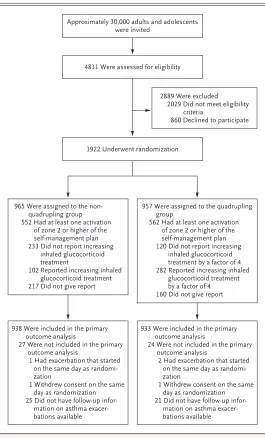
We wrote to approximately 30,000 potential pa-tients from general-practice and volunteer data-bases and also used posters, social media, and face-to-face discussions in clinics to recruit pa-tients. A total of 4811 patients were screened, of whom 1922 underwent randomization (957 to the quadrupling group and 965 to the non-quadru-pling group). All the participants received their assigned self-management plan, although 51 (3%) were excluded from the primary analysis, pri-marily owing to being lost to follow-up and hav-ing no outcome data. A total of 933 participants in the quadrupling group and 938 participants in the non-quadrupling group were included in the primary analysis (Fig. 1). Participants were en-rolled from May 2013 through January 2016, and follow-up was completed by March 2017.
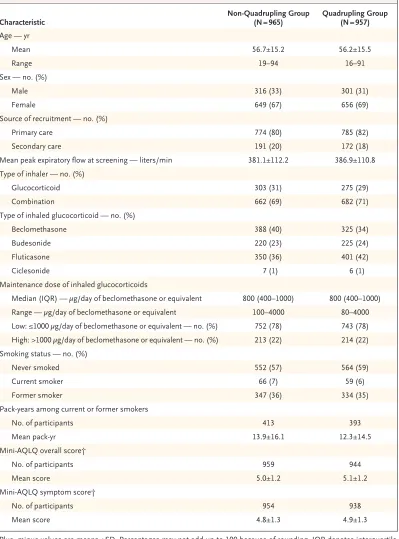
A total of 81% of recruited participants were identified in primary care and 19% in secondary care. The mean (±SD) age of the participants was 57±15 years, 1305 participants (68%) were female, 1495 (78%) were receiving 1000 μg or less per day of beclomethasone (or equivalent glucocorticoid), and 1344 (70%) were using a long-acting beta-agonist–inhaled glucocorticoid combination inhaler at the time of randomiza-tion. A total of 1116 participants (58%) had never smoked, 125 (7%) were current smokers, and 681 (35%) were former smokers. Character-istics at baseline were well balanced between the two treatment groups (Table 2).
Attendance at the scheduled visits was similar in the two groups. A total of 773 participants (81%) in quadrupling group and 772 (80%) in the non-quadrupling group attended the 6-month visit, and 679 (71%) and 700 (73%), respectively, attended the 12-month visit.
Outcomes
[image:4.567.32.297.52.490.2]Of the 1922 participants, 1114 (58%) reached zone 2 or higher of their self-management plan at some point during follow-up (562 participants in the quadrupling group and 552 participants in the non-quadrupling group). The number of par-ticipants who reported a severe exacerbation of asthma in the year after randomization was 420 (45%) in the quadrupling group as compared
Figure 1. Screening, Randomization, and Follow-up.
Approximately 30,000 adults and adolescents were invited
4811 Were assessed for eligibility
1922 Underwent randomization
2889 Were excluded 2029 Did not meet eligibility
criteria
860 Declined to participate
965 Were assigned to the non-quadrupling group 552 Had at least one activation
of zone 2 or higher of the self-management plan 233 Did not report increasing
inhaled glucocorticoid treatment
102 Reported increasing inhaled glucocorticoid treatment 217 Did not give report
957 Were assigned to the quadrupling group
562 Had at least one activation of zone 2 or higher of the self-management plan 120 Did not report increasing
inhaled glucocorticoid treatment by a factor of 4 282 Reported increasing inhaled
glucocorticoid treatment by a factor of 4 160 Did not give report
938 Were included in the primary outcome analysis
27 Were not included in the primary outcome analysis
1 Had exacerbation that started on the same day as randomi-zation
1 Withdrew consent on the same day as randomization 25 Did not have follow-up
infor-mation on asthma exacer-bations available
933 Were included in the primary outcome analysis
24 Were not included in the primary outcome analysis
2 Had exacerbation that started on the same day as randomi-zation
1 Withdrew consent on the same day as randomization 21 Did not have follow-up
Characteristic Non-Quadrupling Group (N = 965) Quadrupling Group (N = 957) Age — yr
Mean 56.7±15.2 56.2±15.5
Range 19–94 16–91
Sex — no. (%)
Male 316 (33) 301 (31)
Female 649 (67) 656 (69)
Source of recruitment — no. (%)
Primary care 774 (80) 785 (82)
Secondary care 191 (20) 172 (18)
Mean peak expiratory flow at screening — liters/min 381.1±112.2 386.9±110.8
Type of inhaler — no. (%)
Glucocorticoid 303 (31) 275 (29)
Combination 662 (69) 682 (71)
Type of inhaled glucocorticoid — no. (%)
Beclomethasone 388 (40) 325 (34)
Budesonide 220 (23) 225 (24)
Fluticasone 350 (36) 401 (42)
Ciclesonide 7 (1) 6 (1)
Maintenance dose of inhaled glucocorticoids
Median (IQR) — μg/day of beclomethasone or equivalent 800 (400–1000) 800 (400–1000)
Range — μg/day of beclomethasone or equivalent 100–4000 80–4000
Low: ≤1000 μg/day of beclomethasone or equivalent — no. (%) 752 (78) 743 (78)
High: >1000 μg/day of beclomethasone or equivalent — no. (%) 213 (22) 214 (22)
Smoking status — no. (%)
Never smoked 552 (57) 564 (59)
Current smoker 66 (7) 59 (6)
Former smoker 347 (36) 334 (35)
Pack-years among current or former smokers
No. of participants 413 393
Mean pack-yr 13.9±16.1 12.3±14.5
Mini-AQLQ overall score†
No. of participants 959 944
Mean score 5.0±1.2 5.1±1.2
Mini-AQLQ symptom score†
No. of participants 954 938
Mean score 4.8±1.3 4.9±1.3
* Plus–minus values are means ±SD. Percentages may not add up to 100 because of rounding. IQR denotes interquartile range.
[image:5.567.69.468.70.609.2]† Scores on the Mini Asthma Quality of Life Questionnaire (Mini-AQLQ) range from 1 to 7, with higher scores indicating a better quality of life. For the Mini-AQLQ overall score, a within-patient change of 0.5 represents the minimal impor-tant difference.
with 484 (52%) in the non-quadrupling group, yielding an adjusted hazard ratio for the time to a first exacerbation of 0.81 (95% confidence in-terval [CI], 0.71 to 0.92; P = 0.002) (Fig. 2). Ad-ditional adjustment for age, sex, and peak flow at randomization had little effect on the hazard ratio (0.80; 95% CI, 0.71 to 0.92; P = 0.001). There was also little difference in the hazard ratio ac-cording to smoking status or dose of inhaled glucocorticoids (high vs. low) at randomization (Table S1 in the Supplementary Appendix). A sen-sitivity analysis that included all 1922 partici-pants yielded a hazard ratio for the time to a first exacerbation of 0.81 (95% CI, 0.72 to 0.92).
The percentage of participants who used sys-temic glucocorticoids was lower in the quadru-pling group than in the non-quadruquadru-pling group, as was the percentage of participants who had unscheduled health care consultations for asth-ma. A total of 311 participants (33%) in the quadrupling group versus 377 (40%) in the non-quadrupling group started systemic glucocorti-coids, with a mean number of courses of 0.50 versus 0.61 (incidence rate ratio, 0.82; 95% CI, 0.70 to 0.96). A total of 379 participants (41%) in the quadrupling group versus 442 (47%) in the non-quadrupling group had an unscheduled health care consultation, with a mean total num-ber of visits of 0.73 versus 0.84 (incidence rate ratio, 0.86; 95% CI, 0.75 to 0.99). (For details,
Self-reported adherence to the instruction to quadruple or to not adjust the dose of inhaled glucocorticoids was similar in the two groups. Among participants with a reported activation of zone 2, 50% of those in the quadrupling group and 42% of those in the non-quadrupling group were judged by the researcher as having good adherence, and 6% and 3%, respectively, were judged as having poor adherence. No informa-tion was available for 28% and 39% of the par-ticipants in the respective groups.
Approximately 47% of the participants had a peak-flow value recorded on activation of zone 2 of their self-management plan and at least one value on or after day 10 (54% of those in the quadrupling group and 41% of those in the non-quadrupling group). From these values, the mean area under the curve of the peak flow was 1166 liters per minute per day in the quadrupling group and 1130 liters per minute per day in the non-quadrupling group (adjusted difference in means, 38 liters per minute per day; 95% CI, 13 to 62; 529 participants) (Table S4 in the Supple-mentary Appendix). Similarly, Mini-AQLQ data after the first activation of zone 2 was available for only 45% of the participants, with data avail-able for more participants in the quadrupling group than in the non-quadrupling group (50% vs. 39%). The mean Mini-AQLQ score 2 weeks after zone 2 activation was also higher in the quadrupling group, with an adjusted difference in means of 0.20 (95% CI, 0.03 to 0.46; 499 partici-pants) (Table S4 in the Supplementary Appendix). Among participants who attended the 12-month follow-up visit, the estimated mean total dose of inhaled glucocorticoids taken in the 12 months after randomization was 385 mg in the quadru-pling group (679 participants) and 328 mg in the non-quadrupling group (700 participants). The mean total dose of systemic glucocorticoids was 121 mg and 151 mg, respectively.
[image:6.567.32.298.53.261.2]In the 14 days after zone 2 activation, 11 par-ticipants (2%) in the quadrupling group (9 receiv-ing a high maintenance dose of inhaled gluco-corticoids) reported a total of 11 serious adverse events, and 22 participants (4%) in the non-quadrupling group (8 receiving a high mainte-nance dose of inhaled glucocorticoids) reported a total of 32 serious adverse events. The most common serious adverse event was hospitalization for asthma, occurring 3 times in the quadrupling
Figure 2. Kaplan–Meier Curves for the Time to the First Severe Asthma Exacerbation, According to Assigned Group.
Participants with Exacerbation (%)
100
80
60
40
20
0
0 60 120 180 240 300 365
Days since Randomization No. at Risk
Non-quadrupling group Quadrupling
group
938
933 791
806 30
671
727 90
592
644 150
521
558 210
463
508 270
349
366 330 Non-quadrupling group
the primary outcome, they are included in the primary outcome analysis, so caution is needed when considering total adverse events in the two groups. There were 5 events in the quadrupling group and 6 in the non-quadrupling group relat-ing to pneumonia or lower respiratory tract in-fection in the 4 weeks after activation of zone 2 of the self-management plan. One participant in the quadrupling group died of severe pneumonia. (For details, see the Supplementary Appendix.)
In the 14 days after zone 2 activation, 41 par-ticipants (7%) in the quadrupling group reported a total of 56 nonserious adverse events, and 10 participants (2%) in the non-quadrupling group reported a total of 13 nonserious adverse events. Oral candidiasis and dysphonia accounted for the great majority of nonserious adverse events, with 36 events in the quadrupling group (19 events of oral candidiasis) and 9 events in the non-quadru-pling group (7 events of oral candidiasis).
Discussion
Our trial involving adults and adolescents showed that a temporary quadrupling of the dose of in-haled glucocorticoids at the time of worsening asthma control resulted in a lower rate of severe exacerbations of asthma than no increase in the dose (45% vs. 52%). The main strength of our trial is its pragmatic design and 80% recruit-ment in primary care, giving it considerable ex-ternal validity. Broad inclusion criteria ensured that the trial results are applicable to adult pa-tients with a clinical diagnosis of asthma who are taking any licensed dose of inhaled gluco-corticoids, with or without add-on medication and regardless of smoking status. We minimized trial visits after training participants to follow a personalized self-management plan to reflect follow-up in clinical practice as closely as pos-sible, although the requirement to report zone 2 activations is different than real-life clinical prac-tice and may have influenced adherence to the assigned self-management plan. Finally, we chose a primary outcome that was directly relevant to the trial participants, and owing to the time-to-event analysis, only 3% of the participants could not be included in the primary analysis.
The pragmatic design of our trial may also be considered to limit the implications of its find-ings. The open-label nature of the intervention
ing physicians may have been aware, of the person’s intervention, and this may have influ-enced the decision by participants to seek medi-cal help or by physicians to advise treatment with systemic glucocorticoids. If such an effect occurred, it reflects the beneficial effects likely to be seen in clinical practice that are missed in strict explanatory studies. The pragmatic nature of the trial also affected the quality of secondary outcome data such as the number of peak-flow measurements and quality-of-life questionnaires completed, but the data that were collected were consistent with better asthma control in the quadrupling group. A further potential bias was that more participants in the quadrupling group than in the non-quadrupling group attended a post-activation visit and, therefore, provided diary-card data; the extent to which this affected the outcomes observed is unknown.
The estimated rate of severe exacerbations was deliberately conservative, to ensure adequate power, and was based on our previous studies, in which participants did not have to have had an exacerbation leading to the use of systemic glucocorticoids in the previous 12 months.4,9 In reality, the rate of severe exacerbations was much higher in the non-quadrupling group than we estimated, enabling a reduction in the number of participants required for the trial to detect a 30% effect size without a loss of statistical power. Our finding that approximately 50% of the patients included in the trial had an exacer-bation, within a year, that led to treatment with oral glucocorticoids or an unscheduled health care consultation confirms that our inclusion criteria identified a group of patients at high risk for an asthma exacerbation and is consistent with generally poor asthma control reported in many asthma surveys.10,11 It also highlights the pragmatic nature of our trial, because the exac-erbation rate was much higher than that seen in more explanatory trials in which patient selec-tion, a high degree of follow-up care, and a high rate of adherence to medication are all likely to reduce the background exacerbation rate.
of inhaled glucocorticoids when asthma control is deteriorating was no more effective than not changing the dose,4,5 and a 2016 Cochrane re-view concluded that it is unlikely that increasing the dose of inhaled glucocorticoids reduces the odds of systemic glucocorticoid use or hospital-ization or shortens recovery time.6 When we designed our trial, a 30% reduction in the inci-dence of asthma exacerbations was thought to be a minimum that was clinically meaningful. Al-though we observed a significant 19% reduction in the incidence of severe exacerbations, the mag-nitude of reduction was smaller than expected.
We believe that our safety data support the clinical benefit of temporarily quadrupling the dose of inhaled glucocorticoids, because partici-pants in the quadrupling group reported fewer asthma-related hospitalizations than those in the non-quadrupling group (3 vs. 18). However, the bias of the open-label aspect of the trial may have altered the threshold to hospitalize partici-pants and cannot be measured.
As expected, the quadrupling group had a higher frequency of treatment-related adverse effects, such as oral candidiasis that led to treat-ment with topical antifungal medication. We paid particular attention to the issue of pneumo-nia because of reports of pneumopneumo-nia associated with the use of inhaled glucocorticoids in asth-ma12 and chronic obstructive pulmonary dis-ease,13 but there was no significant between-group difference in the incidence of pneumonia in our trial. The median dose of inhaled gluco-corticoids in our trial was 0.8 mg per day, so quadrupling this would be approximately equiva-lent to 3.2 mg per day of inhaled beclometha-sone for 7 to 14 days. Unfortunately, the sys-temic effects of high-dose inhaled glucocorticoids
are not well understood. In terms of milligrams of prednisolone, adrenal suppression from 1.0 mg per day of budesonide has been estimated to be as high as that from 8.7 mg of prednisolone.14 Because we included patients receiving 1.6 mg of inhaled budesonide and 2 mg of inhaled flutica-sone propionate, and if the potency ratio be-tween inhaled glucocorticoids and prednisolone is linear, then the quadrupled dose in these participants could have had the same systemic effects on adrenal suppression as a course of prednisolone that is used to treat severe asthma exacerbations.
In our trial, the number of patients who needed to be provided with such a self-manage-ment plan in order to prevent one severe asthma exacerbation was 15 (95% CI, 9 to 43). Given the potential benefit with respect to preventing ex-acerbations and in view of the toxic effects of inhaled glucocorticoids and the biases that may have been introduced by the absence of blinding, individual practitioners, patients, and guideline committees will need to consider whether the magnitude of the reduction achieved is clinically meaningful.
Supported by the Health Technology Assessment Programme of the National Institute for Health Research.
Disclosure forms provided by the authors are available with the full text of this article at NEJM.org.
We thank the trial participants, all the staff at the trial sites and the Nottingham Clinical Trial Unit who managed the trial, the members of the independent trial steering committee (Philip Ind [chair], consultant respiratory physician, Imperial College Healthcare NHS Trust; Adel Mansur, consultant physician, Bir-mingham Heartlands Hospital; Jacqui Cooper, chronic obstruc-tive pulmonary disease–respiratory team leader, Keyworth Pri-mary Care Centre; and Kim-Leng Hills, patient representative), and the members of the independent data monitoring commit-tee (Steven Julious [chair], professor of medical statistics, Uni-versity of Sheffield; Ian Sabroe, professor of inflammation biol-ogy, University of Sheffield; and Stephen Scott, consultant respiratory physician, Countess of Chester Hospital).
References
1. The global asthma report 2014.
Auck-land, New Zealand: Global Asthma Net-work, 2014 (http://www .globalasthmareport .org/ resources/ Global_Asthma_Report _2014 .pdf).
2. Nunes C, Pereira AM, Morais-Almeida
M. Asthma costs and social impact. Asth-ma Res Pract 2017; 3: 1.
3. Powell H, Gibson PG. Options for
self-management education for adults with asthma. Cochrane Database Syst Rev 2003; 1: CD004107.
4. Harrison TW, Oborne J, Newton S,
Tattersfield AE. Doubling the dose of
in-exacerbations: randomised controlled trial. Lancet 2004; 363: 271-5.
5. FitzGerald JM, Becker A, Sears MR,
Mink S, Chung K, Lee J. Doubling the dose of budesonide versus maintenance treatment in asthma exacerbations. Tho-rax 2004; 59: 550-6.
6. Kew KM, Quinn M, Quon BS,
Du-charme FM. Increased versus stable doses of inhaled corticosteroids for exacerba-tions of chronic asthma in adults and chil-dren. Cochrane Database Syst Rev 2016; 6: CD007524.
7. Skeggs A, McKeever T, Duley L, et al.
protocol for a randomised controlled trial evaluating the clinical cost-effectiveness of temporarily quadrupling the dose of inhaled steroid to prevent asthma exacer-bations. Trials 2016; 17: 499.
8. Juniper EF, Guyatt GH, Willan A,
Griffith LE. Determining a minimal im-portant change in a disease-specific Qual-ity of Life Questionnaire. J Clin Epidemiol 1994; 47: 81-7.
9. Oborne J, Mortimer K, Hubbard RB,
random-parallel-group clinical trial. Am J Respir Crit Care Med 2009; 180: 598-602.
10. Price D, Fletcher M, van der Molen T. Asthma control and management in 8,000 European patients: the REcognise Asthma and LInk to Symptoms and Expe-rience (REALISE) survey. NPJ Prim Care Respir Med 2014; 24: 14009.
11. Demoly P, Annunziata K, Gubba E,
Adamek L. Repeated cross-sectional sur-vey of patient-reported asthma control in Europe in the past 5 years. Eur Respir Rev 2012; 21: 66-74.
12. McKeever T, Harrison TW, Hubbard R,
Shaw D. Inhaled corticosteroids and the risk of pneumonia in people with asthma: a case-control study. Chest 2013; 144: 1788-94.
13. Suissa S, Patenaude V, Lapi F, Ernst P.
Inhaled corticosteroids in COPD and the risk of serious pneumonia. Thorax 2013; 68: 1029-36.
14. Toogood JH, Baskerville J, Jennings B, Lefcoe NM, Johansson SA. Bioequivalent doses of budesonide and prednisone in moderate and severe asthma. J Allergy Clin Immunol 1989; 84: 688-700.