Wave sensitivity analysis for periodic and arbitrarily
complex composite structures
D. Chronopoulosa, M. Colletb, M. Ichchouc
a
Institute for Aerospace Technology &The Composites Group, The University of Nottingham, NG7 2RD, UK
b
LTDS, UMR-CNRS 5513, 36 Avenue Guy de Collongue, 69130 Ecully, France
c
Ecole Centrale de Lyon, 36 Avenue Guy de Collongue, 69130 Ecully, France
Abstract
Purpose: This paper presents the development of a numerical continuum-discrete approach for computing the sensitivity of the waves propagating in
periodic composite structures. The work can be directly employed for
eval-uating the sensitivity of the structural dynamic performance with respect to
geometric and layering structural modifications.
Design/methodology/approach: A structure of arbitrary layering and geometric complexity is modelled using solid FE. A generic expression for
computing the variation of the mass and the stiffness matrices of the structure
with respect to the material and geometric characteristics is hereby given.
The sensitivity of the structural wave properties can thus be numerically
de-termined by computing the variability of the corresponding eigenvalues for
the resulting eigenproblem. The exhibited approach is validated against the
FD method as well as analytical results.
Findings: An intense wavenumber dependence is observed for the sensitivity
results of the sandwich structure. This exhibits the importance and potential
of the presented tool with regard to the optimization of layered structures for
specific applications. The model can also be used for computing the effect of
the inclusion of smart layers such as auxetics and piezoelectrics.
Originality/value: The paper presents the first continuum-discrete ap-proach specifically developed for accurately and efficiently computing the
sensitivity of the wave propagation data for periodic composite structures
ir-respective of their size. The considered structure can be of arbitrary layering
and material characteristics as FE modelling is employed.
Keywords: Sensitivity analysis, Wave propagation, Composite structures
1. Introduction
Layered and complex structures are nowadays widely used within the
aerospace, automotive, construction and energy sectors with a general
in-crease tendency. The wave propagation data for such structures are often
employed for energy harvesting, vibration control, health monitoring and
vibroacoustic transmission modelling purposes. Optimizing the layer
char-acteristics of such structures for certain objectives is often a challenging task
due to the large number of varying parameters to be considered as well as
due to the lack of exact modelling approaches. The same it true about taking
into account for the effect of these parametric uncertainties on the structural
behaviour.
The numerical analysis of wave propagation within periodic structures
was firstly considered in the pioneering work of the author of [1]. The work
a structured linearization method using state space eigenvalue problem for
large matrices among other considerations for smoothening the solution of
wave propagation in periodic structures. The WFE method was introduced
in [4, 5] in order to facilitate the post-processing of the eigenproblem
solu-tions and further improve the computational efficiency of the method. The
vibration of a uniform waveguide using the same technique was investigated
by the authors of [6, 7, 8]. The WFE method for two dimensional structures
was introduced in [9] . The same method was used in [10] in order to
com-pute the dynamic response of two dimensional infinite structures. The WFE
has recently found applications in predicting the vibroacoustic and dynamic
performance of composite panels and shells [11, 12, 13, 14, 15, 16, 17] , with
pressurized shells [18, 19] and complex periodic structures [20, 21, 22] having
been investigated. The variability of acoustic transmission through layered
structures [23, 24], as well as wave steering effects in anisotropic composites
[25] have been modelled through the same methodology.
Structural sensitivity analysis is of great importance for understanding
the overall impact of a design parameter variation to the structural
perfor-mance which is to be optimised. Accurate sensitivity models are an important
tool for design optimization, system identification as well as for statistical
me-chanics analysis. Many authors [26, 27, 28, 29] have been focusing on the
eigenvalue derivative analysis of a structural system. With regard to the
variability analysis of the waves travelling within a structural medium the
conducted work has been mainly focused on deriving expressions [30, 31] of
the stochastic wave parameters from analytical models. In [32] the authors
numerical approaches the authors in [33] used Bloch’s theorem in
conjunc-tion with the FE method in order to calculate the sensitivity of the acoustic
waves within an auxetic honeycomb, while with regard to the computation
of the variability of the propagating waves the authors in [34, 35] have
pre-sented a stochastic WFE method approach for computing the stochastic wave
propagation in one dimensional media.
In this paper a continuum-discrete approach for efficiently computing the
sensitivity of the wave propagation data for periodic structures is presented.
The considered structure can be of arbitrary layering and material
character-istics as FE modelling is employed. The effect of local parameter variation
(e.g. varying the stiffener thickness or adding mass to a single location) can
also be considered. The sensitivities of the mass and stiffness matrices for a
solid FE are computed with respect to any structural parameter including
the material characteristics and the thickness of the element. The sensitivity
of the propagating structural waves can thus be numerically determined. The
exhibited approach is validated against the FD method as well as analytical
results.
The paper is organized as follows: In Sec.2 the formulation of the
sensi-tivity of the waves propagating within the periodic structure is elaborated.
More precisely in Sec.2.1 a general approach for two dimensional waveguides
is adopted while in Sec.2.2 a more efficient approach for one dimensional
waveguides is considered. In Sec.3 the method is validated by comparison to
analytical results for a metallic waveguide as well as by comparison to a FD
approach for a layered sandwich waveguide. Conclusions on the presented
the stiffness and mass matrices of a solid FE are presented in the Appendix A.
2. Sensitivity of the wave propagation data
2.1. General formulation
2.1.1. Formulation of the PST for an arbitrary structural segment
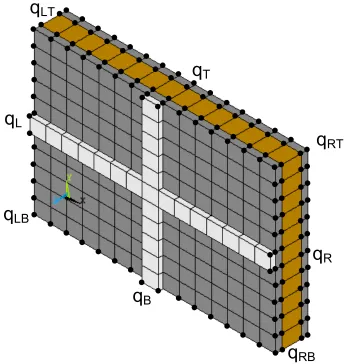
A periodic segment of a panel having arbitrary layering and complexity
is hereby considered (see Fig.1) with lx, ly its dimensions in the x and y
directions respectively. The segment is modelled using a conventional FE
software. The mass and stiffness matrices of the segment M and K are
extracted and the DoF set qis reordered according to a predefined sequence such as:
q={qI qB qT qL qR qLB qRB qLT qRT}⊤ (1)
corresponding to the internal, the interface edge and the interface corner DoF
(see Fig.1). The free harmonic vibration equation of motion for the modelled
segment is written as:
[K−ω2
M]q=0 (2)
The analysis then follows as in [36] with the following relations being
as-sumed for the displacement DoF under the passage of a time-harmonic wave:
qR =e−iεxqL, qT =e−iεyqB
qRB =e−iεxqLB, qLT=e−iεyqLB, qRT =e−iεx−iεyqLB
(3)
with εx andεy the propagation constants in the xandydirections related to
the phase difference between the sets of DoF. The wavenumbers kx, ky are
directly related to the propagation constants through the relation:
q
Rq
Lq
Tq
LBq
LTq
RBq
RT [image:6.595.131.475.193.557.2]q
BConsidering Eq.(3) in tensorial form gives: q=
I 0 0 0
0 I 0 0
0 Ie−iεy 0 0
0 0 I 0
0 0 Ie−iεx 0
0 0 0 I
0 0 0 Ie−iεx
0 0 0 Ie−iεy
0 0 0 Ie−iεx−iεy
x=Rx (5)
with x the reduced set of DoF: x = {qI qB qL qLB}⊤. The equation of
free harmonic vibration of the modelled segment can now be written as:
[R∗KR−ω2R∗MR]x=0 (6)
with ∗ denoting the Hermitian transpose. The most practical procedure for
extracting the wave propagation characteristics of the segment from Eq.(6)
is injecting a set of assumed propagation constants εx, εy. The set of these
constants can be chosen in relation to the direction of propagation towards
which the wavenumbers are to be sought and according to the desired
reso-lution of the wavenumber curves. Eq.(6) is then transformed into a standard
eigenvalue problem and can be solved for the eigenvector x which describe the deformation of the segment under the passage of each wave type at an
angular frequency equal to the square root of the corresponding eigenvalue
A complete description of each passing wave including its x and y
direc-tional wavenumbers and its wave shape for a certain frequency is therefore
acquired. It is noted that the periodicity condition is defined modulo 2π,
therefore solving Eq.(6) with a set of εx,εy varying from 0 to 2π will suffice
for capturing the entirety of the structural waves. Further considerations
on reducing the computational expense of the problem are discussed in [36].
It should be noted that only propagating waves will be considered in the
subsequent analysis. Evanescent waves can also be captured by introducing
imaginary values for εx, εy however the precise computation of these waves
would require a very fine resolution of the propagation constants, drastically
increasing the computational effort.
2.1.2. Parametric sensitivity
It is noted that matrices K = R∗KR and M = R∗MR in Eq.(6) are
Hermitian therefore their resulting eigenvalues are real and the eigenvectors
will be orthogonal. Assuming the known eigenvalueλ0iand the corresponding
eigenvectorx0i for the problem described in Eq.(6), then the following is true
K0x0i =λ0iM0x0i (7)
Now if matricesK0,M0 are changed by a small amount, sayδK,δM then the eigenvalue λ0i and the corresponding eigenvector x0i will also be perturbed
so that
K=K0+δK
M=M0 +δM λi =λ0i+δλi xi =x0i+δxi
A direct consequence of the orthogonality of the eigenvectors is that
x⊤0kM0x0i =δki (9)
with δk
i the Kronecker delta function. Substituting Eq.(8) into Eq.(7), we
get
(K0+δK)(x0i+δxi) = (λ0i+δλi)(M0 +δM)(x0i +δxi) (10)
then expanding and using Eq.(7) we can write
δKx0i+K0δxi+δKδxi =
λ0iM0δxi+λ0iδMx0i+δλiM0x0i +λ0iδMδxi +δλiδMx0i +δλiM0δxi+δλiδMδxi
(11)
and removing the higher-order terms simplifies to
K0δxi+δKx0i =λ0iM0δxi+λ0iδMx0i+δλiM0x0i (12)
The orthogonality properties of the unperturbed eigenvectors in Eq.(6) allow
for using them as a basis for expressing the perturbed eigenvectors. That is
the perturbation of the eigenvector x0i can be expressed as
δxi =
N X
k=1
ǫikx0k (13)
with ǫik small unknown constants. Substituting Eq.(13) into Eq.(12) gives
K0
N X
k=1
ǫikx0k+δKx0i =λ0iM0
N X
k=1
ǫikx0k+λ0iδMx0i+δλiM0x0i (14)
which can also be written as
N X
k=1
ǫikK0x0k+δKx0i =λ0iM0
N X
k=1
Making use of Eq.(7) it is true that
N X
k=1
ǫikλ0kM0x0k+δKx0i =λ0iM0
N X
k=1
ǫikx0k+λ0iδMx0i+δλiM0x0i (16)
Again due to the orthogonality of the eigenvectors in Eq.(9), the summations
can be removed by left multiplying by x⊤
0i, therefore
x⊤
0iǫiiλ0iM0x0i+x⊤0iδKx0i =λ0ix⊤0iM0ǫiix0i+λ0ix⊤0iδMx0i +δλix⊤0iM0x0i
(17)
and eliminating the equal terms gives
x⊤
0iδKx0i =λ0ix⊤0iδMx0i+δλix⊤0iM0x0i (18)
Rearranging the expression with regard to δλi we get
δλi = x⊤
0i(δK−λ0iδM)x0i x⊤
0iM0x0i
(19)
However, because of Eq.(9) the expression of the eigenvalue perturbation is
given as
δλi =x⊤0i(δK−λ0iδM)x0i (20)
When the partial derivatives of K,M with regard to a design parameter β are known then the sensitivity of an eigenvalue λi to this design parameter
will be equal to
∂λi
∂β =x
⊤
0i
∂K
∂β −λ0i ∂M
∂β
x0i (21)
The global mass and stiffness matrices M,K of the structural segment
are formed by adding the local mass and stiffness matrices of individual
FEs. Therefore it can be concluded that when the expression of the partial
derivatives for every local mass and stiffness matrix ∂m ∂β ,
∂k
the expressions for the global matrices ∂M ∂β ,
∂K
∂β can be derived simply by adding the expressions of the local matrices together. Eq.(21) can therefore
be written as:
∂λi
∂β =x
⊤
0i
R∗∂K
∂βR−λ0iR
∗∂M
∂β R
x0i (22)
It is known however that ∂λi ∂β =
∂(ω2
i)
∂β , therefore
∂λi
∂β = ∂(ω2
i)
∂β =
∂(ω2
i)
∂ωi
∂β ∂ωi
= 2ωi
∂ωi
∂β (23)
Eq.(22) can therefore be written as:
∂ωi
∂β =
x⊤
0i
R∗∂K
∂βR−λ0iR∗ ∂M
∂βR
x0i
2ωi
(24)
with ωi the angular frequency at which the set ofεx,εy is true for the iwave
type described by the x0i deformation. The generic symbolic expressions
of the m,k matrices for an orthotropic structural segment modelled with a linear solid FE is given in Appendix A. The wavenumber sensitivity ∂ki
∂β can be deduced as
∂ki
∂β =− ∂ki
∂ωi
∂ωi
∂β =− 1 cg,i
∂ωi
∂β (25)
with cg,i =
∂ωi
∂ki
the group velocity associated with the wave type i at
fre-quency ωi which can be evaluated by avoiding any numerical differentiation
as exhibited in [37].
2.2. Transfer matrix formulation
2.2.1. Condensation process
When wave propagation is considered only in thexdirection, the problem
structural segment is again partitioned, this time with regard to its left/right
sides and internal DoF
DLL DLI DLR DIL DII DIR DRL DRI DRR
qL qI qR = fL 0 fR (26)
with q the displacement and f the force vectors. Using a Guyan type con-densation for the internal DoF the problem can be expressed as
DLL−DLID−II1DIL DLR−DLID−II1DIR DRL−DRID−1
IIDIL DRR−DRID−
1 IIDIR qL qR = fL fR (27)
Assuming that no external forces are applied on the segment the displacement
continuity and force equilibrium equations at the interface of two consecutive
periodic segments s and s+ 1 give
qs+1
L =qsR fs+1
L =−f s R
(28)
Using Eqs.(27),(28) the relation of the displacements and forces of the left
and right sides of the segment can be written as
qsL+1 fs+1
L =T qs L fs L (29)
and the expression of the symplectic transfer matrix T can be written as
T=
D11 D12
D21 D22
with
D11=−(DLR−DLID−II1DIR)−1(DLL−DLID−II1DIL)
D12= (DLR−DLID−II1DIR)−1
D21=−DRL+DRID−II1DIL+ (DRR−DRID−II1DIR)(DLR−DLID−II1DIR)−1(DLL−DLID−II1DIL)
D22=−(DRR−DRID−II1DIR)(DLR−DLID−II1DIR)−1
(31)
Free wave propagation is described by the eigenproblem
γ
qs
L fs
L
=T
qs
L fs
L
(32)
whose solution γi is related to the structural wavenumber kxi by
kxi=−
ln(γi)
ilx
(33)
2.2.2. Parametric sensitivity
Assuming the known eigenvalue γ0i and the corresponding eigenvector
z0i =
q0i
f0i
for the problem described in Eq.(32), then the following is
true
γ0iz0i =T0z0i (34)
Now if the matrix T0 is changed by a small amount, say δT then the eigen-value γ0i and the corresponding eigenvector z0i will also be perturbed so
that
(γ0i+δγi)(z0i+δzi) = (T0+δT)(z0i+δzi) (35)
Expanding we have
However using Eq.(34) and removing the higher-order terms eventually
sim-plifies the relation to
γ0iδzi+δγiz0i =T0δzi+δTz0i (37)
The symplectic orthogonality properties [5] of the unperturbed eigenvectors
of T0 suggest that if γi is an eigenvalue of T0 with the corresponding right eigenvector zi, then 1/γi will also be an eigenvalue of T0 with a corre-sponding left eigenvector yi = ziJn, with Jn a 2n × 2n matrix given as
Jn =
0 In
−In 0
. The following will also apply if the eigenvectors are
appropriately scaled
Y⊤0Z0 =I (38)
and
Y⊤
0T0Z0 =Γ0 (39)
with Γ0 the diagonal matrix containing the eigenvalues of T0, while
Y0 = [y01y02· · ·y0n] (40)
is the matrix containing the left eigenvectors of T0 and
Z0 = [z01z02· · ·z0n] (41)
the matrix containing the right eigenvectors of T0. The orthogonality prop-erty allows for expressing the perturbation of the eigenvector z0i as
δzi =
N X
k=1
with ǫik small unknown constants. Substituting Eq.(42) into Eq.(37) and
making use of Eq.(34) once again gives
γ0i N X
k=1
ǫikz0k+δγiz0i = N X
k=1
ǫikγ0kz0k+δTz0i (43)
and due to Eq.(38), the summations can be removed by left multiplying by
y⊤
0i, therefore
y⊤
0iǫiiγ0iz0i+y0⊤iδγiz0i =y0⊤iǫiiγ0iz0i+y0⊤iδTz0i (44)
Eliminating the equal terms gives
y⊤
0iδγiz0i =y0⊤iδTz0i (45)
Due to the orthogonality of the eigenvectors it is true that
y⊤0iz0i = 1 (46)
therefore the expression of the eigenvalue perturbation δγi as a function of
the transfer matrix perturbation δT can be written as
δγi =y⊤0iδTz0i (47)
When the partial derivative of T with regard to a design parameter β is known then the sensitivity of an eigenvalue γi to β is equal to
∂γi
∂β =y
⊤ i
∂T
∂βzi (48)
It is known however that ∂γi ∂β =
∂(e−ikxilx)
∂β , therefore
∂(e−ikxilx)
∂kxi
∂β ∂kxi
=−ilxe−ikxilx
∂kxi
Eq.(48) can therefore be written as:
∂kxi
∂β =
1
−ilxe−ikxilx y⊤i
∂T
∂βzi (50)
The symbolic expression of the ∂k ∂β,
∂m
∂β matrices for a structural segment modelled with a linear solid FE can be derived using the expressions given
in Appendix A.. The corresponding expression of the DSM in Eq.(27) can
therefore be directly computed. The symbolic expression of T as well as of the sensitivity ∂T
∂β can thereafter be derived using Eq.(31). It should be noted that due to the inversion and multiplication of DSM partitions involved
in Eq.(31), this approach tends to be less computationally efficient than the
one presented in Sec.2.1.2, especially for large structural segments.
3. Numerical case studies
Two case studies are presented below in order to validate the presented
work. In the first case a metallic monolayer panel is modelled by the
pre-sented approach and the results on the sensitivity of the propagating waves
are compared to the values derived by the CPT. In the second case study a
sandwich panel comprising facesheets of different thicknesses is modelled and
the results are validated through the FD method. Both cases were modelled
using the approach presented in Sec.2.1. All computations were conducted
using the R2013a version of MATLABr.
3.1. Monolayer panel
A metallic single layer panel is hereby modelled. The panel has a
Young’s modulus E = 70GPa and a Poisson’s ratio equal to v=0.1. Three
equidimensional FE are used in order to model the structure in the sense of
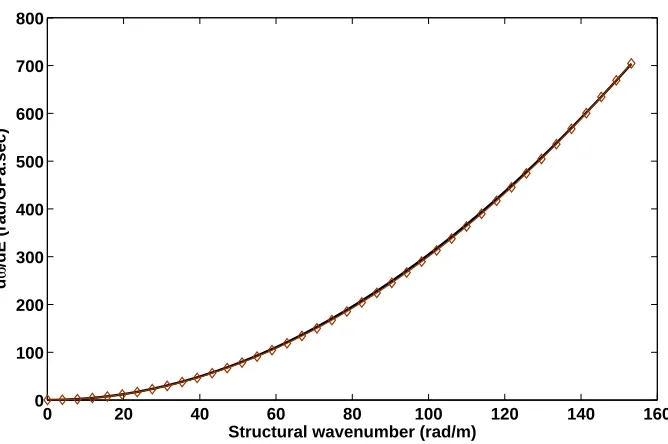
thickness. The first result in Fig.2 refers to the sensitivity of ω at which a
specific εx, εy set occurs for the first bending wave propagating in the
struc-ture. Real values are considered forεx, εy throughout this paper. The result
is compared to the CPT theory by differentiating the expression relating the
flexural wavenumber kf to the angular frequency ωf
ωf =
k2
f r
ρh Dm
(51)
with Dm =
Eh3
12(1−v2) the flexural stiffness of a monolayer panel. Very good agreement is observed between the two curves with the maximum divergence
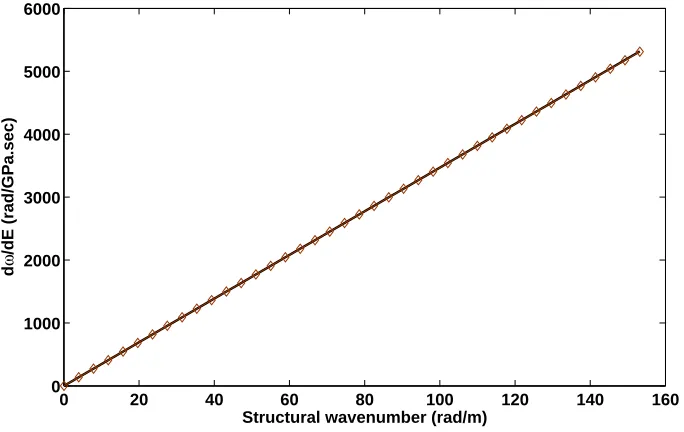
being equal to 0.18%. The perturbation of ω for the first membrane wave
propagating in the structure with relation toE is presented in Fig.3. The
re-sult is compared to the CPT theory by differentiating the expression relating
the membrane wavenumber km to the angular frequency ωm
ωm =
km r
ρ(1−v2) E
(52)
Again excellent agreement is observed between the analytical and
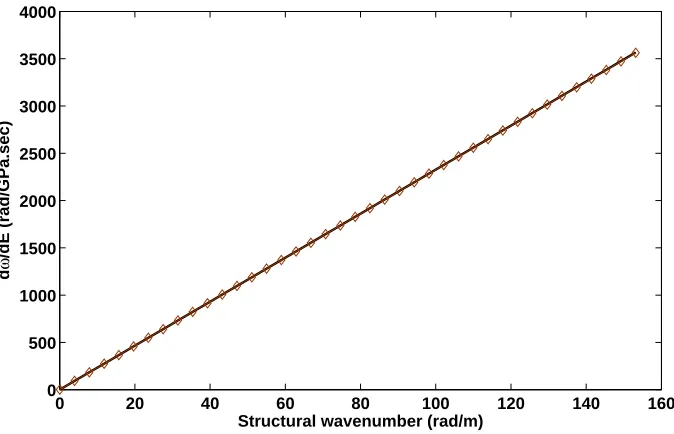
numeri-cal results. The perturbation of ω for the first shear wave propagating in
the structure with relation to E is presented in Fig.4. The result is
com-pared to the CPT theory by differentiating the expression relating the shear
wavenumber ks to the angular frequency ωs
ωs=
ks r
2ρ(1 +v) E
0 20 40 60 80 100 120 140 160 0
100 200 300 400 500 600 700 800
Structural wavenumber (rad/m)
d
ω
[image:18.595.139.473.253.475.2]/dE (rad/GPa.sec)
0 20 40 60 80 100 120 140 160 0
1000 2000 3000 4000 5000 6000
Structural wavenumber (rad/m)
d
ω
[image:19.595.135.477.259.475.2]/dE (rad/GPa.sec)
0 20 40 60 80 100 120 140 160 0
500 1000 1500 2000 2500 3000 3500 4000
Structural wavenumber (rad/m)
d
ω
[image:20.595.137.474.124.341.2]/dE (rad/GPa.sec)
Figure 4: Sensitivity of the angular frequency ω at which the set of εx, εy occur under a perturbation of E for the first shear wave type: Analytical solution (⋄), Numerical calculation (−)
Again excellent correlation is observed between the analytical and numerical
results. As expected, throughout Fig.2-4 it is exhibited that an increase of
E would stiffen the structure, shifting a certain wavenumber value towards
higher frequencies. The perturbation of ω for the first flexural wave
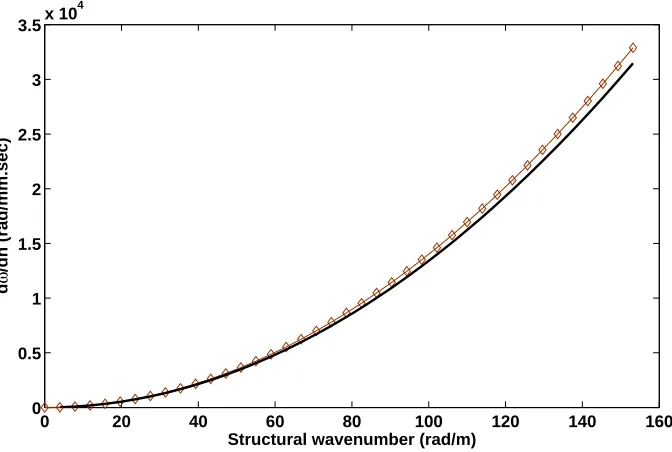
propa-gating in the structure with relation to the thickness h is presented in Fig.5.
Good agreement is generally observed between the results, however there is a
maximum discrepancy of 4.3% between the two curves. This is probably due
to an insufficiency of the analytical approach for modelling the dynamic
be-haviour at higher frequencies. Again an increase in thickness will stiffen the
structure, shifting the same wavenumber towards higher frequencies. There
0 20 40 60 80 100 120 140 160 0
0.5 1 1.5 2 2.5 3
3.5x 10
4
Structural wavenumber (rad/m)
d
ω
[image:21.595.138.474.126.352.2]/dh (rad/mm.sec)
Figure 5: Sensitivity of the angular frequency ω at which the set ofεx,εy occur under a perturbation of the thickness of the structure for the first flexural wave type: Analytical solution (⋄), Numerical calculation (−)
structure, therefore the corresponding results are not presented for the sake
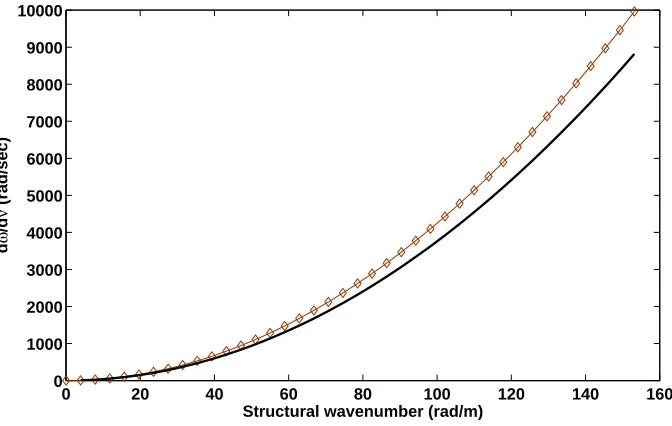
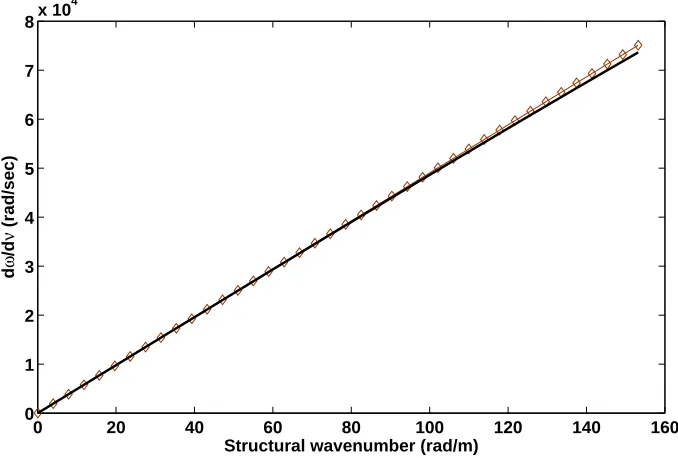
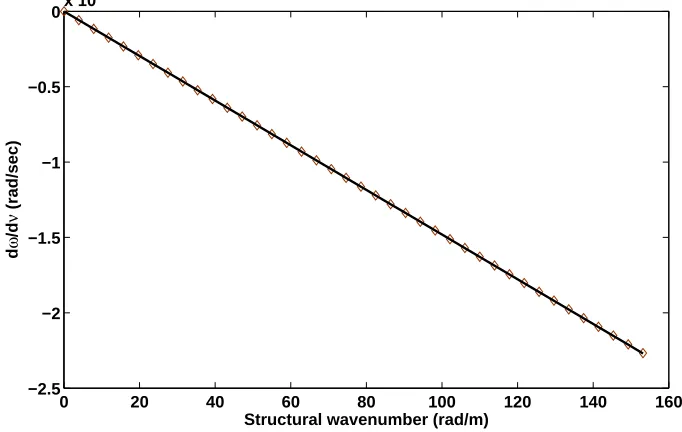
of brevity. The perturbation of ω with respect to the Poisson’s ratio of
the structure for the flexural, membrane and shear waves are presented in
Fig.6,7 and 8 respectively. A generally good agreement is observed between
the numerical and analytical results. Again for the flexural wave a
maxi-mum discrepancy of 11.5% between the two curves is taking place for high
wavenumber values due to the same aforementioned reason. It is interesting
to note that while increasing the Poisson’s ratio of the structure acts as a
stiffening effect for the flexural and membrane wave types, the same positive
perturbation ofv will result in shifting the shear wavenumber curves towards
0 20 40 60 80 100 120 140 160 0
1000 2000 3000 4000 5000 6000 7000 8000 9000 10000
Structural wavenumber (rad/m)
d
ω
/d
ν
[image:22.595.138.474.260.473.2](rad/sec)
0 20 40 60 80 100 120 140 160 0
1 2 3 4 5 6 7
8x 10
4
Structural wavenumber (rad/m)
d
ω
/d
ν
[image:23.595.135.474.253.482.2](rad/sec)
0 20 40 60 80 100 120 140 160 −2.5
−2 −1.5 −1 −0.5
0x 10
5
Structural wavenumber (rad/m)
d
ω
/d
ν
[image:24.595.133.474.262.478.2](rad/sec)
3.2. Sandwich panel
A sandwich panel comprising two facesheets and a core is modelled in
this section. The lower facesheet has a thickness hf l=0.001m and is made
of a material with ρf l=3000 kg/m3, Ef l = 70GPa and vf l=0.1. The upper
facesheet has a thickness equal to hf u=0.002m and is made of the same
material as the lower facesheet. The core has a thickness hc=0.01m and is
made of a material withρc=50 kg/m3,Ec = 0.07GPa andvc=0.4. Three FE
are used in the sense of thickness in order to model the structure. For the
sake of brevity and because of the fact that the out of plane waves are usually
the ones that are of interest for vibroacoustic, health monitoring and energy
harvesting applications -carrying most of the vibrational energy-, only results
on the flexural wave type are presented for the sandwich structure below. The
results are compared to a FD approach throughout this section. In order to
implement the FD approach a perturbation of 0.001% was considered for
each structural parameter. The resulting FD sensitivity can be computed by
∂ω ∂β =
ωp−ω0 βp−β0
(54)
with ωp the perturbated angular frequency at which a certain wavenumber
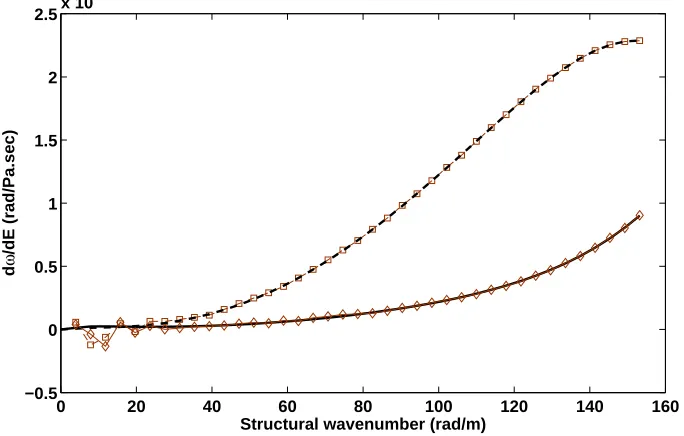
value occurs for βp and ω0 the corresponding angular frequency forβ0. The perturbation of ω with respect to Ef l, Ef u of the structure is presented in
Fig.9. It is observed that the increase of both values will stiffen the sandwich
structure. For the lower wavenumber values this increase in stiffness will
be similar for δEf l and δEf u. However in higher frequencies it can be seen
that increasing Ef u for the thicker upper facesheet will have a much greater
0 20 40 60 80 100 120 140 160 −0.5
0 0.5 1 1.5 2
2.5x 10
−7
Structural wavenumber (rad/m)
d
ω
[image:26.595.135.477.251.469.2]/dE (rad/Pa.sec)
0 20 40 60 80 100 120 140 160 −2
0 2 4 6 8 10 12
14x 10
−5
Structural wavenumber (rad/m)
d
ω
[image:27.595.136.475.127.354.2]/dE (rad/Pa.sec)
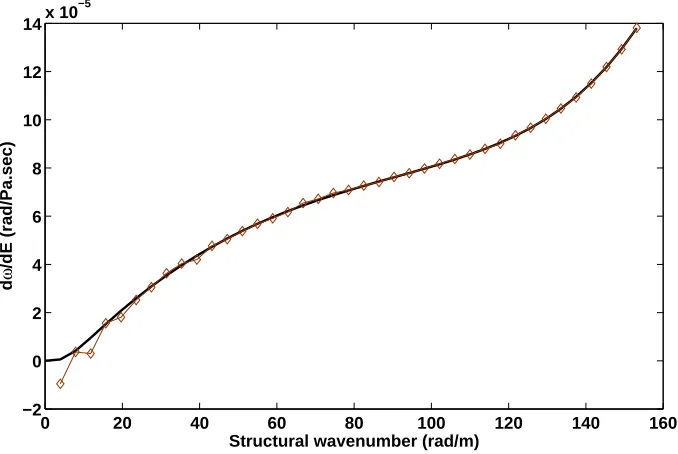
Figure 10: Sensitivity of the angular frequency ω at which the set of εx, εy occur under a perturbation of Ec for the first flexural wave type of a layered structure: Presented approach (−), FD computation (⋄)
ω with respect to Ec is presented in Fig.10. A fluctuation of the FD results
is observed again for low wavenumber values however the results are in very
good agreement for higher frequencies. Again it is observed that the effect
of δEc on the flexural wavenumber varies significantly with respect to the
wavenumber value. The perturbation of ω with respect to hf l, hf u of the
structure is presented in Fig.11. It is particularly interesting to note that for
lower wavenumbers increasing the thickness of both facesheets will imply a
softening effect to the structural behaviour, shifting the flexural wavenumbers
to lower frequencies. This mainly suggests that the effect of the added mass
overcomes the effect of added stiffness. This effect is similar for both δhf l
0 20 40 60 80 100 120 140 160 −2000
0 2000 4000 6000 8000 10000 12000 14000 16000 18000
Structural wavenumber (rad/m)
d
ω
[image:28.595.137.475.124.335.2]/dh (rad/mm.sec)
Figure 11: Sensitivity of the angular frequencyω at which the set ofεx,εy occur under a perturbation of the thickness of the sandwich facesheets for the first flexural wave type of a layered structure: Presented approach forhf l(−), FD computation forhf l(⋄), Presented approach for hf u (−−), FD computation forhf u ()
change radically for the thicker upper facesheet, with δhf u now shifting the
wavenumbers to higher frequencies. Again excellent agreement is observed
between the presented approach and the FD method. The perturbation ofω
with respect to hc of the sandwich is presented in Fig.12. A very interesting
effect is that the influence of δhc on the flexural wavenumber becomes
max-imum at a certain wavenumber value (approximately for k=100rad/m). A
constant decrease of this influence is observed beyond that point. The
stiffen-ing effect is probably due to the greater separation of the two facesheets with
δhc. It is very probable however that for higher wavenumber values δhc will
have a softening effect on the flexural wavenumber with the depicted curve
0 20 40 60 80 100 120 140 160 0
50 100 150 200 250 300 350
Structural wavenumber (rad/m)
d
ω
[image:29.595.135.474.257.474.2]/dh (rad/mm.sec)
0 20 40 60 80 100 120 140 160 0
1000 2000 3000 4000 5000 6000
Structural wavenumber (rad/m)
d
ω
/d
ν
[image:30.595.138.473.123.340.2](rad/sec)
Figure 13: Sensitivity of the angular frequency ω at which the set of εx, εy occur under a perturbation of the Poisson’s ratio of the sandwich facesheets for the first flexural wave type of a layered structure: Presented approach forvf l(−), FD computation forvf l (⋄), Presented approach forvf u(−−), FD computation forvf u ()
vf u of the structure is presented in Fig.13. In both cases it can be observed
that increasing v for the facesheets will shift the flexural wavenumber curve
towards higher frequencies. This phenomenon however will be much more
intense for δvf u especially at higher wavenumber values. Again excellent
agreement is observed between the FD results and the presented approach.
The perturbation of ω with respect to vc for the sandwich core is presented
in Fig.14. The effect of δvc is softening up to a certain wavenumber value,
beyond which a sudden exponential increase is observed which stiffens the
flexural structural behaviour. The perturbation of ω with respect to ρf l and
ρf u is presented in Fig.15. As expected both δρf l and δρf u will shift the
0 20 40 60 80 100 120 140 160 −5000
0 5000 10000 15000 20000
Structural wavenumber (rad/m)
d
ω
/d
ν
[image:31.595.138.474.259.473.2](rad/sec)
0 20 40 60 80 100 120 140 160 −6
−5 −4 −3 −2 −1 0
Structural wavenumber (rad/m)
d
ω
/d
ρ
(rad.m
[image:32.595.140.473.123.344.2]3 /sec.kg)
Figure 15: Sensitivity of the angular frequency ω at which the set of εx, εy occur under a perturbation of the mass density of the sandwich facesheets for the first flexural wave type: Presented approach for ρf l (−), FD computation for ρf l (⋄), Presented approach forρf u (−−), FD computation forρf u()
thicker upper facesheet at low k values. It is very interesting however to
see that there is a critical wavenumber value (approximately k=147rad/m)
at which the effect of δρf l and δρf u will be the same. Beyond this critical
wavenumber the softening effect will be more intense forδρf l thanδρf u. The
perturbation of ω with respect to ρc for the sandwich core is presented in
Fig.16. It is clear that δρc implies a softening effect to the flexural behaviour
of the panel which has an increasing intensity with wavenumber values.
Throughout Fig.9-16, a great wavenumber dependence has been observed
for the sensitivity results of the sandwich structure. This exhibits the
0 20 40 60 80 100 120 140 160 −40
−35 −30 −25 −20 −15 −10 −5 0
Structural wavenumber (rad/m)
d
ω
/d
ρ
(rad.m
[image:33.595.140.474.123.340.2]3 /sec.kg)
Figure 16: Sensitivity of the angular frequency ω at which the set of εx, εy occur un-der a perturbation of ρc for the first flexural wave type: Presented approach (−), FD computation (⋄)
layer for specific applications. The model can also be used for computing
the effect of the inclusion of smart layers such as auxetics and piezoelectrics
or computing the sensitivity of the propagating waves in the presence of
damage.
4. Conclusions
A numerical continuum-discrete approach for computing the sensitivity
of the waves propagating in periodic structures was presented in this paper.
The main conclusions of the work are as follows:
(i) A formulation of the two dimensional wave propagation problem was
propagating in the periodic structure. The structure can be of arbitrary
layering, material characteristics and geometric complexity. The effect of
local parameter variation can also be considered.
(ii) A reduced transfer matrix formulation of the wave propagation
anal-ysis in one dimensional periodic media was presented, followed by the
deriva-tion of the sensitivity of the wavenumber values. As for the first formuladeriva-tion,
the structure can be of arbitrary layering, material characteristics and
geo-metric complexity. This approach however tends to be less computationally
efficient due to the involved inversions and multiplications of DSM partitions.
(iii) A monolayer panel was modelled by the presented approach and the
resulting sensitivity values were validated through the CPT.
(iv) Moreover, an asymmetric sandwich structure was also modelled. The
sensitivity of the propagating flexural wave with respect to the structural
parameters of the facesheets and the core were computed and the results
were successfully compared to the ones provided by the FD method.
(v) A great wavenumber dependence has been observed for the sensitivity
results of the sandwich structure. This exhibits the potential of the presented
tool with regard to providing an efficient and robust optimization scheme for
layered structures, tailored for specific applications. The model can also be
used for computing the effect of the inclusion of smart layers such as auxetics
and piezoelectrics or computing the sensitivity of the propagating waves in
the presence of damage.
(vi) The formulation of the symbolic expression of the stiffness and mass
matrices for a linear solid FE were also presented. These formulations can
modelled segment, as well as the sensitivity of the global matrices with regard
to any structural parameter.
References
[1] D. J. Mead, A general theory of harmonic wave propagation in linear
periodic systems with multiple coupling, Journal of Sound and Vibration
27 (1973) 235–60.
[2] R. Langley, A note on the force boundary conditions for two-dimensional
periodic structures with corner freedoms, Journal of Sound and
Vibra-tion 167 (1993) 377–81.
[3] W. Zhong, F. Williams, On the direct solution of wave propagation
for repetitive structures, Journal of Sound and Vibration 181 (1995)
485–501.
[4] B. R. Mace, D. Duhamel, M. J. Brennan, L. Hinke, Finite element
prediction of wave motion in structural waveguides, The Journal of the
Acoustical Society of America 117 (2005) 2835–43.
[5] J.-M. Mencik, M. Ichchou, Multi-mode propagation and diffusion in
structures through finite elements, European Journal of
Mechanics-A/Solids 24 (2005) 877–98.
[6] D. Duhamel, B. R. Mace, M. J. Brennan, Finite element analysis of the
vibrations of waveguides and periodic structures, Journal of Sound and
[7] J.-M. Mencik, On the low-and mid-frequency forced response of elastic
structures using wave finite elements with one-dimensional propagation,
Computers & Structures 88 (2010) 674–89.
[8] J. M. Renno, B. R. Mace, On the forced response of waveguides using
the wave and finite element method, Journal of Sound and Vibration
329 (2010) 5474–88.
[9] B. Mace, E. Manconi, Modelling wave propagation in two-dimensional
structures using finite element analysis, Journal of Sound and Vibration
318 (2008) 884–902.
[10] J. Renno, B. Mace, Calculating the forced response of two-dimensional
homogeneous media using the wave and finite element method, Journal
of Sound and Vibration 330 (2011) 5913–27.
[11] D. Chronopoulos, B. Troclet, M. Ichchou, J. Laine, A unified approach
for the broadband vibroacoustic response of composite shells,
Compos-ites Part B: Engineering 43 (2012) 1837–46.
[12] D. Chronopoulos, B. Troclet, O. Bareille, M. Ichchou, Modeling the
re-sponse of composite panels by a dynamic stiffness approach, Composite
Structures 96 (2013) 111–20.
[13] D. Chronopoulos, M. Ichchou, B. Troclet, O. Bareille, Efficient
predic-tion of the response of layered shells by a dynamic stiffness approach,
Composite Structures 97 (2013) 401–4.
[14] D. Chronopoulos, M. Ichchou, B. Troclet, O. Bareille, Predicting the
loads by a krylov subspace reduction, Applied Acoustics 74 (2013) 1394–
405.
[15] D. Chronopoulos, M. Ichchou, B. Troclet, O. Bareille, Thermal
ef-fects on the sound transmission through aerospace composite structures,
Aerospace Science and Technology 30 (2013) 192–9.
[16] D. Chronopoulos, M. Ichchou, B. Troclet, O. Bareille, Predicting the
broadband response of a layered cone-cylinder-cone shell, Composite
Structures 107 (2014) 149–59.
[17] D. Chronopoulos, M. Ichchou, B. Troclet, O. Bareille, Computing the
broadband vibroacoustic response of arbitrarily thick layered panels by
a wave finite element approach, Applied Acoustics 77 (2014) 89–98.
[18] V. Polenta, S. Garvey, D. Chronopoulos, A. Long, H. Morvan, Optimal
internal pressurisation of cylindrical shells for maximising their critical
bending load, Thin-Walled Structures 87 (2015) 133–8.
[19] T. Ampatzidis, D. Chronopoulos, Acoustic transmission properties of
pressurised and pre-stressed composite structures, Composite Structures
152 (2016) 900–12.
[20] I. Antoniadis, D. Chronopoulos, V. Spitas, D. Koulocheris,
Hyper-damping properties of a stiff and stable linear oscillator with a negative
stiffness element, Journal of Sound and Vibration 346 (2015) 37–52.
[21] D. Chronopoulos, M. Collet, M. Ichchou, Damping enhancement of
composite panels by inclusion of shunted piezoelectric patches: A
[22] D. Chronopoulos, I. Antoniadis, M. Collet, M. Ichchou, Enhancement of
wave damping within metamaterials having embedded negative stiffness
inclusions, Wave Motion 58 (2015) 165–79.
[23] D. Chronopoulos, Design optimization of composite structures operating
in acoustic environments, Journal of Sound and Vibration 355 (2015)
322–44.
[24] M. Ben Souf, D. Chronopoulos, M. Ichchou, O. Bareille, M. Haddar,
On the variability of the sound transmission loss of composite panels
through a parametric probabilistic approach, Journal of Computational
Acoustics 24 (2016).
[25] D. Chronopoulos, Wave steering effects in anisotropic composite
struc-tures: Direct calculation of the energy skew angle through a finite
ele-ment scheme, Ultrasonics 73 (2017) 43–8.
[26] R. B. Nelson, Simplified calculation of eigenvector derivatives, AIAA
journal 14 (1976) 1201–5.
[27] R. T. Haftka, H. M. Adelman, Recent developments in structural
sen-sitivity analysis, Structural optimization 1 (1989) 137–51.
[28] S. Adhikari, M. I. Friswell, Eigenderivative analysis of asymmetric
non-conservative systems, International Journal for Numerical Methods in
Engineering 51 (2001) 709–33.
[29] K. K. Choi, N.-H. Kim, Structural sensitivity analysis and optimization
[30] K. Sobczyk, Stochastic wave propagation, Elsevier, 1985.
[31] A. Belyaev, Comparative study of various approaches to stochastic
elas-tic wave propagation, Acta mechanica 125 (1997) 3–16.
[32] K. Koo, B. Pluymers, W. Desmet, S. Wang, Vibro-acoustic design
sen-sitivity analysis using the wave-based method, Journal of Sound and
Vibration 330 (2011) 4340–51.
[33] M. Ruzzene, F. Scarpa, Directional and band-gap behavior of periodic
auxetic lattices, physica status solidi (b) 242 (2005) 665–80.
[34] M. Ichchou, F. Bouchoucha, M. Ben Souf, O. Dessombz, M. Haddar,
Stochastic wave finite element for random periodic media through
first-order perturbation, Computer Methods in Applied Mechanics and
En-gineering 200 (2011) 2805–13.
[35] B. Souf, O. Bareille, M. Ichchou, F. Bouchoucha, M. Haddar, Waves
and energy in random elastic guided media through the stochastic wave
finite element method, Physics Letters A 377 (2013) 2255–64.
[36] V. Cotoni, R. S. Langley, P. J. Shorter, A statistical energy analysis
sub-system formulation using finite element and periodic structure theory,
Journal of Sound and Vibration 318 (2008) 1077–108.
[37] S. Finnveden, Evaluation of modal density and group velocity by a finite
element method, Journal of Sound and Vibration 273 (2004) 51–75.
[38] C. A. Felippa, R. W. Clough, The finite element method in solid
X
Y
Z
L
x
[image:40.595.140.477.121.437.2]L
y
L
z
Figure 17: The considered solid FE
Appendix A. Sensitivity analysis of a solid FE
A linear solid FE is hereby considered as shown in Fig.17. Following
described as x y z =
x1 x2 x3 x4 x5 x6 x7 x8
y1 y2 y3 y4 y5 y6 y7 y8
z1 z2 z3 z4 z5 z6 z7 z8
N1 N2 N3 N4 N5 N6 N7 N8 (A.1)
The displacement interpolations are expressed as
ux uy uz =
ux1 ux2 ux3 ux4 ux5 ux6 ux7 ux8 uy1 uy2 uy3 uy4 uy5 uy6 uy7 uy8 uz1 uz2 uz3 uz4 uz5 uz6 uz7 uz8
Linear shape functions are assumed for the element
N1 = 18(1−ξ)(1−η)(1 +µ)
N2 = 18(1−ξ)(1−η)(1−µ)
N3 = 18(1−ξ)(1 +η)(1−µ)
N4 = 18(1−ξ)(1 +η)(1 +µ)
N5 = 18(1 +ξ)(1−η)(1 +µ)
N6 = 18(1 +ξ)(1−η)(1−µ)
N7 = 18(1 +ξ)(1 +η)(1−µ)
N8 = 18(1 +ξ)(1 +η)(1 +µ)
(A.3)
The element stiffness matrix k is formally given by the volume integral
k= Z 1
−1
Z 1
−1
Z 1
−1
B⊤DB|J|dηdξdµ (A.4)
while the element mass matrix m can be determined as
m= Z 1
−1
Z 1
−1
Z 1
−1
N⊤ρmN|J| dηdξdµ (A.5)
with
N=
N1 0 0 · · · N8 0 0
0 N1 0 · · · 0 N8 0
0 0 N1 · · · 0 0 N8
while ρm is the mass density of the material. It is also noted that B = ∂N1
∂x 0 0
∂N2
∂x · · ·
∂N8
∂x 0 0
0 ∂N1
∂y 0 0 · · · 0
∂N8
∂y 0
0 0 ∂N1
∂z 0 · · · 0 0
∂N8 ∂z ∂N1 ∂y ∂N1 ∂x 0 ∂N2
∂y · · ·
∂N8
∂y ∂N8
∂x 0
0 ∂N1
∂z ∂N1
∂y 0 · · · 0
∂N8 ∂z ∂N8 ∂y ∂N1 ∂z 0 ∂N1 ∂x ∂N2
∂z · · ·
∂N8 ∂z 0 ∂N8 ∂x
ux1 uy1 uz1 ux2
· · ·
ux8 uy8 uz8
(A.7)
The Jacobian matrix of the element is
J= ∂x ∂ξ ∂y ∂ξ ∂z ∂ξ ∂x ∂η ∂y ∂η ∂z ∂η ∂x ∂µ ∂y ∂µ ∂z ∂µ (A.8)
while the the flexibility matrix of the element for an orthotropic material
D−1 can generally be written as
D−1 =
1 Ex
−vxy
Ex
−vxz
Ex
0 0 0
−vyx
Ey
1 Ey
−vyz
Ey
0 0 0
−vzx
Ez
−vzy
Ez
1 Ez
0 0 0
0 0 0 1
Gxy
0 0
0 0 0 0 1
Gyz
0
0 0 0 0 0 1
Gxz (A.9)
The assumption of the undeformed FE being a rectangular parallelepiped is
andz1, z2, z3, z4, z5, z6, z7, z8,can then be replaced byLx, Ly, Lz in the
expres-sion of B. The generic expression form is thus given as
m= (ρLxLyLz)
1/27 0 0 1/54 0 0 1/108 0 0 1/54 0 0 1/54 0 0 1/108 0 0 1/216 0 0 1/108 0 0
0 1/27 0 0 1/54 0 0 1/108 0 0 1/54 0 0 1/54 0 0 1/108 0 0 1/216 0 0 1/108 0
0 0 1/27 0 0 1/54 0 0 1/108 0 0 1/54 0 0 1/54 0 0 1/108 0 0 1/216 0 0 1/108
1/54 0 0 1/27 0 0 1/54 0 0 1/108 0 0 1/108 0 0 1/54 0 0 1/108 0 0 1/216 0 0
0 1/54 0 0 1/27 0 0 1/54 0 0 1/108 0 0 1/108 0 0 1/54 0 0 1/108 0 0 1/216 0
0 0 1/54 0 0 1/27 0 0 1/54 0 0 1/108 0 0 1/108 0 0 1/54 0 0 1/108 0 0 1/216
1/108 0 0 1/54 0 0 1/27 0 0 1/54 0 0 1/216 0 0 1/108 0 0 1/54 0 0 1/108 0 0
0 1/108 0 0 1/54 0 0 1/27 0 0 1/54 0 0 1/216 0 0 1/108 0 0 1/54 0 0 1/108 0
0 0 1/108 0 0 1/54 0 0 1/27 0 0 1/54 0 0 1/216 0 0 1/108 0 0 1/54 0 0 1/108
1/54 0 0 1/108 0 0 1/54 0 0 1/27 0 0 1/108 0 0 1/216 0 0 1/108 0 0 1/54 0 0
0 1/54 0 0 1/108 0 0 1/54 0 0 1/27 0 0 1/108 0 0 1/216 0 0 1/108 0 0 1/54 0
0 0 1/54 0 0 1/108 0 0 1/54 0 0 1/27 0 0 1/108 0 0 1/216 0 0 1/108 0 0 1/54
1/54 0 0 1/108 0 0 1/216 0 0 1/108 0 0 1/27 0 0 1/54 0 0 1/108 0 0 1/54 0 0
0 1/54 0 0 1/108 0 0 1/216 0 0 1/108 0 0 1/27 0 0 1/54 0 0 1/108 0 0 1/54 0
0 0 1/54 0 0 1/108 0 0 1/216 0 0 1/108 0 0 1/27 0 0 1/54 0 0 1/108 0 0 1/54
1/108 0 0 1/54 0 0 1/108 0 0 1/216 0 0 1/54 0 0 1/27 0 0 1/54 0 0 1/108 0 0
0 1/108 0 0 1/54 0 0 1/108 0 0 1/216 0 0 1/54 0 0 1/27 0 0 1/54 0 0 1/108 0
0 0 1/108 0 0 1/54 0 0 1/108 0 0 1/216 0 0 1/54 0 0 1/27 0 0 1/54 0 0 1/108
1/216 0 0 1/108 0 0 1/54 0 0 1/108 0 0 1/108 0 0 1/54 0 0 1/27 0 0 1/54 0 0
0 1/216 0 0 1/108 0 0 1/54 0 0 1/108 0 0 1/108 0 0 1/54 0 0 1/27 0 0 1/54 0
0 0 1/216 0 0 1/108 0 0 1/54 0 0 1/108 0 0 1/108 0 0 1/54 0 0 1/27 0 0 1/54
1/108 0 0 1/216 0 0 1/108 0 0 1/54 0 0 1/54 0 0 1/108 0 0 1/54 0 0 1/27 0 0
0 1/108 0 0 1/216 0 0 1/108 0 0 1/54 0 0 1/54 0 0 1/108 0 0 1/54 0 0 1/27 0
0 0 1/108 0 0 1/216 0 0 1/108 0 0 1/54 0 0 1/54 0 0 1/108 0 0 1/54 0 0 1/27
(A.10)
while the symbolic generic expression ofkcan be derived exactly in the same way but is hereby intentionally omitted for the sake of brevity.
The generic sensitivity expressions ∂k ∂βi
, ∂m ∂βi
as well as ∂ 2k ∂βj∂βi
, ∂ 2m ∂βj∂βi
with βi, βj being design parameters can therefore be calculated as a function
of Ex, Ey, Ez, vxy, vxz, vyz,Gxy, Gxz, Gyz, Lx, Ly, Lz by differentiating over the
List of symbols
ℜ Real operator
D Dynamics Stiffness Matrix (DSM) of a waveguide’s modelled periodic segmen M, K Mass and stiffness matrices of the modelled segment
T Wave propagation transfer matrix
R Transformation matrix
m, k Mass and stiffness matrices of a single FE
f Forcing vector for an elastic waveguide
q Physical displacement vector for an elastic waveguide
x Reduced set of DoF
x0i Unperturbed eigenvector of the DSM
y0i Unperturbed left eigenvector of wave transfer matrixT z0i Unperturbed right eigenvector of wave transfer matrix T
B,T, L,R, I Bottom, Top, Left, Right sides and Internal indices
E Material Young’s modulus
Lx, Ly Dimensions of the entire panel
h Thickness
k Wavenumber
lx,ly Dimensions of the modelled periodic structural segment
s Periodic segment positioning index
t Time
x, y Propagation directions
β Design variable
γ Propagation constant and eigenvalue of wave transfer matrixT
ǫ Perturbation coefficient
ε Propagation constant
λ Eigenvalue of the DSM
v Poisson’s ratio
ρ Material density
List of abbreviations
CPT Classical Plate Theory
DoF Degree of Freedom
DSM Dynamic Stiffness Matrix
FD Finite Differences
FE Finite Element
PST Periodic Structure Theory