Progress in implementation of WHO FCTC Article 14
and its guidelines: a survey of tobacco dependence
treatment provision in 142 countries
Kapka Nilan
1, Martin Raw
1, Tricia M. McKeever
1, Rachael L. Murray
1& Ann McNeill
2 UK Centre for Tobacco and Alcohol Studies, School of Medicine, University of Nottingham, Nottingham, UK1and UK Centre for Tobacco and Alcohol Studies, Institute of Psychiatry, Psychology and Neuroscience (IoPPN), King’s College London, London, UK2ABSTRACT
Aims To (1) estimate the number of Parties to the Framework Convention on Tobacco Control (FCTC) providing tobacco dependence treatment in accordance with the recommendations of Article 14 and its guidelines; (2) assess association between provision and countries’ income level; and (3) assess progress over time. Design Cross-sectional study. Setting Online survey from December 2014 to July 2015.Participants Contacts in 172 countries were surveyed, representing 169 of the 180 FCTC Parties at the time of the survey.Measurements A 26-item questionnaire based on the Article 14 recommendations including tobacco treatment infrastructure and cessation support systems. Progress over time was assessed for those countries that also participated in our 2012 survey and did not change country income level classification.Findings We received responses from contacts in 142 countries, an 83% response rate. Overall, 54% of respondents reported that their country had an officially identified person responsible for tobacco dependence treatment, 32% an official national treatment strategy, 40% official national treatment guidelines, 25% a clearly identified budget for treatment, 17% text messaging, 23% free national quitlines and 26% specialized treatment services. Most measures were associated positively and significantly with countries’income level (P<0.001). Measures not associated significantly with income level included mandatory recording of tobacco use (30% of countries), offering help to health-care workers (HCW) to stop using tobacco (44%), brief advice integrated into existing services (44%), and training HCW to give brief advice (81%). Reporting having an officially identified person responsible for tobacco cessation was the only measure with a sta-tistically significant improvement over time (P= 0.0351).Conclusion Fewer than half of countries that are Parties to the Framework Convention on Tobacco Control have implemented the recommendations of Article 14 and its guidelines, and for most measures, provision was greater the higher the country’s income. There was little improvement in treatment provision between 2012 and 2015 in all countries.
Keywords Article 14 guidelines, FCTC Article 14, middle- and low-income countries, tobacco cessation, tobacco control, tobacco dependence treatment.
Correspondence to:Kapka Nilan, UK Centre for Tobacco and Alcohol Studies, School of Medicine, The University of Nottingham, Clinical Sciences
Building, Nottingham City Hospital, Hucknall Road, Nottingham NG5 1PB, Nottingham, UK. E-mail: [email protected]
Submitted 13 January 2017; initial review completed 7 February 2017;final version accepted 2 June 2017
INTRODUCTION
Article 14 of the World Health Organization (WHO) Framework Convention on Tobacco Control (FCTC) requires Parties to promote tobacco cessation and imple-ment effective measures to help tobacco users quit [1]. The Article 14 guidelines, adopted at the fourth Conference of the Parties in 2010 [2] provide further details on the implementation of Article 14 [3], including the key elements of basic treatment infrastructure and
support systems that Parties should implement, and were outlined in our previous paper [4].
Our previous survey found that most countries, espe-cially middle- and low-income countries, had not fully implemented the Article 14 guidelines recommendations [4]. The aims of this study were to (1) estimate the cur-rent level of provision of tobacco dependence treatment; (2) assess association between provision and countries’ income level; and (3) assess progress since the previous survey.
© 2017 The Authors.Addictionpublished by John Wiley & Sons Ltd on behalf of Society for the Study of Addiction. Addiction
METHODS
We identified contacts in 169 FCTC Parties at the time of the survey. We excluded the EU as a non-state Party and were unable to find contacts for 10 Parties. Our survey sample consisted of 168 Parties and the United Kingdom (which is one Party but made up of four countries (England, Northern Ireland, Scotland and Wales), each with a different health-care system, which were therefore surveyed individually)—172 countries in all.
We approached the contacts from our previous survey by e-mail in December 2014, inviting them to take part in this survey. For contacts we could not reach or who did not reply, we identified new ones with the help of the WHO regional offices, the Framework Convention Alliance (FCA), Action on Smoking and Health (ASH) in the United States, the InterAmerican Heart Foundation and other professional networks and contacts. The contacts included tobacco treatment specialists and government and non-government representatives, involved in tobacco cessation or tobacco control in their countries.
The questionnaire was based on our previous one, with a few questions improved for clarity or for better alignment with the Article 14 guidelines. However, this time we conducted two surveys: one on treatment pro-vision and one on treatment guidelines. In this paper we report the findings of the treatment provision survey only. The guidelines results are reported in a second paper. The questionnaire was translated into French, Spanish and Russian and sent electronically as a Word attachment. A link to an online version of the questionnaire in English was also provided. The treatment questionnaire (see Appendix S1) covered basic treatment infrastructure (an officially identified person in government responsible for cessation, a na-tional treatment strategy, a treatment budget, treat-ment guidelines, mandatory recording of tobacco use in medical notes, training of health-care workers (HCW) to give brief advice and help to stop using to-bacco) and cessation support systems (brief advice inte-grated into existing services, medications, mass media campaigns, quitlines, text messaging, specialized treat-ment services). In order to help validate the responses, we asked the respondents to send supporting informa-tion and references with their answers where possible. We sent reminders every 2 weeks until July 2015, when the survey was closed.
Survey data were analysed by country World Bank (WB) income level on 1 July 2014 [5]. The statistical anal-yses were conducted in Stata version 14. We used theχ2 statistic to test association between implementation of measures and countries’ income level. We used the McNemar exact test to assess changes in implementation between our two surveys.
RESULTS
Survey response rate
We received responses from contacts in 142 countries, an 83% response rate. Response rates by income level were: 92% in high-income countries (HIC,n= 49), 80% in upper middle-income countries (UMIC,n= 40), 82% in lower middle-income countries (LMIC,n= 36) and 68% in low-income countries (LIC,n= 17).
Basic treatment infrastructure
According to respondents, just more than half of countries had a government official responsible for treatment (54%). Only a quarter reported having a clearly identified treat-ment budget (25%), fewer than a third an official treat-ment strategy (32%) and fewer than half official national treatment guidelines (40%). Just under a third reported mandatory recording of tobacco use in medical notes (30%) and fewer than half that cessation support was offered to HCW to stop using tobacco (44%) (Table 1). Just more than 80% reported training some HCW to give brief advice and more than a third incorporated tobacco cessation into training curricula of health-care students and workers (36%). There was a significant difference in provision across income level for treatment budget, official treatment strat-egy, national treatment guidelines and cessation in training curricula, but not for the other measures (Table 1).
Cessation support systems
Mass media campaigns
Overall, only 13% of respondents reported mass media campaigns promoting cessation in the past 6 months: 23% of HIC, 15% of UMIC, 3% of LMIC and 6% of LIC (P= 0.002 for difference across income level, Table 2).
Brief advice
According to respondents, brief advice was integrated into existing services in fewer than half of countries (44%): 51% of HIC, 48% of UMIC, 31% of LMIC and 41% of LIC (P= 0.281 for difference across income level, Table 2).
Text messaging
Overall, 17% of respondents reported that text messaging support was available in their countries: 35% of HIC, 8% of UMIC, 11% of LMIC and no LIC (P<0.001 for difference across income level, Table 2).
Quitlines
helplines that were not tobacco-only, were reported in fewer than 10% of countries.
More than 80% of respondents reported that all quitlines had people answering always or almost always, and referred callers to local treatment services. Just more than half offered multiple sessions with counsellors calling
back, and 67% provided information about tobacco cessation medications (Table 2).
Specialized treatment support
Respondents in just more than a quarter of countries
[image:3.594.71.510.77.322.2](26%) reported a network of specialized tobacco
Table 1 Tobacco treatment infrastructure by World Bank income level.
Question, % Yes (n) All (142) HIC (49) UMIC (40) LMIC (36) LIC (17)
P-value for difference across income level
Is there an officially identified person in government (or contracted by government) who is responsible for tobacco dependence treatment?
54(76) 57(28) 63(25) 53(19) 24(4) 0.052
Does your country have a clearly identified budget for tobacco dependence treatment?
25(35) 43(21) 20(8) 17(6) 0(0) 0.001
Does your country have an official, written, national tobacco treatment strategy?
32(46) 51(25) 25(10) 31(11) 0(0) <0.001
Does your country have official national tobacco treatment guidelines?
40(57) 63(31) 38(15) 28(10) 6(1) <0.001
Is it mandatory to record patients’tobacco use in medical notes in your country?
30(42) 39(19) 25(10) 25(9) 24(4) 0.425
Does your country offer help to health-care workers and other relevant groups to stop using tobacco?
44(63) 53(26) 53(21) 25(9) 41(7) 0.132
Are health-care workers trained to give brief advice? (Yes, some)
81(100) 73(36) 80(32) 58(21) 65(11) 0.129
Is tobacco cessation incorporated into the training curricula of health-care students and workers?
36(51) 59(29) 28(11) 19(7) 24(4) <0.001
HIC = high-income countries; UMIC = upper middle-income countries; LMIC = lower middle-income countries; LIC = low-income countries. Bold data indicate percentages.
Table 2 Tobacco cessation support systems by World Bank income level.
Question, % Yes (n) All (142) HIC (49) UMIC (40) LMIC (36) LIC (17)
P-value for difference across income level
Mass media campaigns promoting cessation in the past 6 months?
13(19) 23(11) 15(6) 3(1) 6(1) 0.002
Brief advice integrated into existing services? 44(62) 51(25) 48(19) 31(11) 41(7) 0.281 Cessation support via text messaging? 17(24) 35(17) 8(3) 11(4) 0(0) 0.001 Quitlines
A free national quitline in all major regions? 23(33) 53(26) 15(6) 3(1) 0(0) <0.001 A free quitline but only in selected regions? 6(9) 4(2) 10(4) 8(3) 0(0)
A free national quitline but not tobacco only? 8(11) 10(5) 8(3) 6(2) 6(1) People answering always or almost always? 82(42) 87(27) 85(11) 50(3) 100(1) Offer multiple sessions with counsellors calling back
to offer support?
51(26) 66(20) 39(5) 17(1) 0(0)
Refer callers to local specialist treatment services? 84(43) 87(27) 92(12) 50(3) 100(1) Offer information about tobacco cessation medications? 67(34) 74(23) 62(8) 33(2) 100(1) Specialized tobacco dependence treatment service
A network of support covering the whole country? 26(37) 55(27) 20(8) 6(2) 0(0) <0.001 Treatment support in selected areas? 37(53) 35(17) 45(18) 33(12) 35(6)
Free to users? 48(43) 55(24) 54(14) 14(2) 50(3)
Partially free to users? 38(35) 36(16) 31(8) 57(8) 50(3)
Not free to users? 12(11) 7(3) 15(4) 29(4) 0(0)
[image:3.594.69.516.367.632.2]dependence treatment services covering the whole coun-try: 55% of HIC, 20% of UMIC, 6% of LMIC and no LIC (P<0.001 for difference across income level, Table 2).
An additional third (37%) reported specialized treat-ment support in selected areas: 35% of HIC, 45% of UMIC, 33% of LMIC and 35% of LIC.
Specialized treatment support was free to users in 48% of countries that offered it: 55% of HIC, 54% of UMIC, 14% of LMIC and 50% of LIC (Table 2).
Access to cessation support
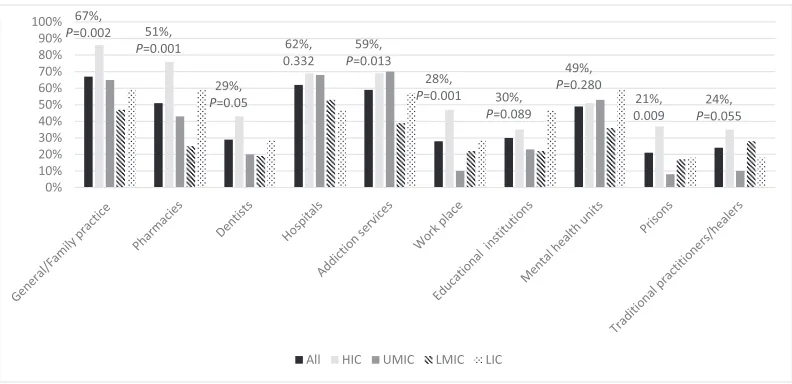
Respondents in more than half of countries reported that tobacco users could access cessation support from general practitioners (GPs) (67%), hospitals (62%), addiction ser-vices (59%) and pharmacies (51%) and in 49% of mental health settings. Cessation support from dentists, educa-tional institutions, work-places and prisons could be accessed in fewer than a third of countries. Access to cessa-tion support from GPs, pharmacies, dentists, addiccessa-tion services, work-places and prisons was significantly less in middle- and low-income countries than in high-income countries (Fig. 1).
Availability of cessation medications
In approximately three-quarters of countries, respon-dents reported that nicotine patches and gum were available, ranging from 98% of HIC to 47% of LIC (P < 0.001 for difference across income level). Avail-ability of bupropion and varenicline also decreased with income level. Bupropion was reported to be available in 90% of HIC and 18% of LIC (P < 0.001 for difference across income level), varenicline in 88% of HIC and
6% of LIC (P < 0.001 for difference across income level, (Table 3). Cytisine was reported to be available only in 14% of countries overall (P = 0.692 for differ-ence across income level).
Affordability of cessation medications
In countries where cessation medications were available, most respondents rated them as affordable, but with a clear gradient from high- to low-income countries. For example, nicotine gum was rated affordable in 85% of HIC, 58% of UMIC, 45 of LMIC and 33% of LIC (P < 0.001 for difference across income level); varenicline was rated affordable in fewer than a third of UMIC and LMIC and in no LIC. There was no income gradient in the affordability of cytisine (P = 0.821) (Table 4).
Changes in treatment provision since 2012
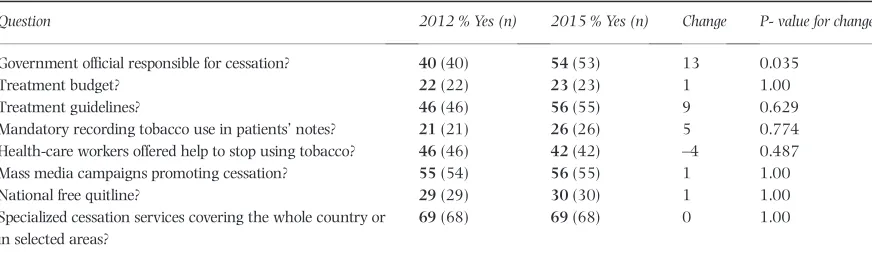
We compared our current results with our previous survey in 2012, for those measures which were comparable, for a subset of 99 countries that completed both surveys and did not change their WB income level: 36 HIC, 28 UMIC, 23 LMIC and 12 LIC (Table 5).
[image:4.594.107.503.502.694.2]Overall, while provision of some measures reportedly increased over time, such as having a government official responsible for cessation, an increase of 13 percentage points (P= 0.0351) and treatment guidelines, an increase of 9 percentage points (P= 0.629), there was little change in others, such as mass media campaigns promoting cessation, mandatory recording of tobacco use in medical notes, an official treatment budget and having a free national quitline (Table 6).
Figure 1 Access to cessation support in different settings.‘Can tobacco users get help to stop smoking in the following settings?’. The bars show
DISCUSSION
Our mainfinding is that implementation of FCTC Article 14 remains slow, with relatively little improvement during the last 3 years. Overall, in 2015, only three measures in our survey were reported to be in place in the majority of countries: 81% reported training some HCW to give brief advice, just more than half (54%) a nominated official
[image:5.594.73.510.77.207.2]responsible for tobacco dependence treatment and just more than 50% providing access to cessation support in primary care, pharmacies and hospitals. All other infra-structure and support systems were provided in only a mi-nority of countries. Only 25% reported having an identified treatment budget, fewer than a third had an official treat-ment strategy (32%), fewer than half had official treatment guidelines (40%), only 30% mandated recording of tobacco
Table 3 Availability of cessation medications by World Bank income level.
Medication
Available, % Yes (n)
P-value for difference across income level All (142) HIC 49) UMIC (40) LMIC (36) LIC (17)
NRT patch 74(104) 98(48) 73(29) 53(19) 47(8) <0.001
NRT gum 72(102) 96(47) 60(24) 61(22) 53(9) <0.001
Other NRT 45(63) 69(34) 40(16) 25(9) 24(4) <0.001
Bupropion 60(84) 90(44) 58(23) 39(14) 18(3) <0.001
Varenicline 54(76) 88(43) 48(19) 36(13) 6(1) <0.001
Nortriptyline 33(46) 53(26) 28(11) 19(7) 12(2) 0.001
Cytisine 14(19) 10(5) 13(5) 19(7) 12(2) 0.692
[image:5.594.72.511.276.409.2]HIC = high-income countries; UMIC = upper middle-income countries; LMIC = lower middle-income countries; LIC = low-income countries; NRT = nicotine replacement therapy.
Table 4 Affordability of cessation medications by World Bank income level.
Medication
Affordable, % Yes (n)
P-value for difference across income level
All HIC UMIC LMIC LIC
NRT patch 63(65) 79(36) 52(15) 53(10) 25(2) <0.001
NRT gum 66(67) 85(40) 58(14) 45(10) 33(3) <0.001
Other NRT 68(43) 94(32) 38(6) 44(4) 25(1) <0.001
Bupropion 57(48) 73(32) 43(10) 36(5) 33(1) <0.001
Varenicline 54(41) 77(33) 32(6) 15(2) 0(0) <0.001
Nortriptyline 59(27) 65(17) 55(6) 57(4) 0(0) 0.003
Cytisine 68(13) 80(4) 80(4) 57(4) 50(1) 0.821
The percentages are calculated by dividing the number of countries where the medication is affordable by the number of countries where the medication is available (n), as shown in Table 3. HIC = high-income countries; UMIC = upper middle-income countries; LMIC = lower middle-income countries; LIC = low-income countries; NRT = nicotine replacement therapy.
Table 5 Country respondents in 2012 and 2015 by income.
Countries WB income category
Responded in 2012 survey, n
Responded in 2015 survey, n
Excluded from longitudinal analyses (did not respond or changed income category), n
Included in longitudinal analyses, n
Low-income 19 17 5 12
Lower middle-income 30 36 13 23
Upper middle-income 36 40 12 28
High-income 36 49 13 36
All 121 142 43a 99
aThe 43 excluded countries included 23 that did not respond in the 2012 survey, 12 that did not respond in the 2015 survey and 10 that changed their World
[image:5.594.70.514.482.593.2]use in medical notes, and there continued to be a clear income gradient in provision. For most measures, and with few exceptions, treatment provision was available in more high- than middle- and low-income countries.
To our knowledge, this is the most detailed and compre-hensive tobacco treatment survey conducted to date, sent to contacts in 94% of FCTC Parties at the time of the survey and achieving an 83% response rate. However, a survey of such scale has limitations. We used a purposive sample of contacts with expertise in tobacco cessation or tobacco control identified through various channels, some from national government, others outside government; hence, there is potential response bias and subjectivity in some responses. To minimize response bias, we encouraged the respondents to discuss and verify their responses with colleagues and, where possible, provide supporting infor-mation with their answers, such as copies of documents and links to websites. Wherever possible, we corroborated the responses using data from our previous survey or other sources. Differences in cultural context and respondents’ expertise could lead occasionally to differences in interpre-tations of questions about national cessation strategy and guidelines, or mass media campaigns. In particular, respondents may not distinguish between occasional advertisements on television and a major, comprehensive mass media campaign. When necessary, we corresponded with the respondents to check and clarify their answers.
Our main finding, that progress in Article 14
implementation is slow, is consistent with that of the 2014 WHO Global Progress Report [6]. Based on 130 Parties’implementation reports, the report estimated that the average implementation rate of the provisions under Article 14 was 51%, below that of other substantive articles: 84% for Article 8 (Protection from exposure to to-bacco smoke); 70% for Article 11 (Packaging and labelling of tobacco products); 63% for Article 13 (Tobacco advertising, promotion and sponsorship); and 62% for Article 6 (Price and tax measures to reduce the demand for tobacco) [6].
As with the previous survey, we found a positive rela-tionship between income level and treatment [4]. This is not surprising, as many HIC had already had treatment infrastructure in place [7–9] prior to the FCTC entry into force in 2005, while for many middle- and low-income countries, engagement with tobacco treatment might not have started before the adoption of the Article 14 implementation guidelines in 2010 [3]. If this trend in tobacco treatment provision across countries’ income level continues, it will lead inevitably to widening health inequality between HIC and middle- and low-income countries.
The clear income gradient in almost all our main mea-sures suggests that cost is (or is perceived to be) a barrier to the implementation of Article 14, with just a quarter of countries in the whole sample, and no LIC, having a clearly identified budget for tobacco dependence treatment. The Article 14 guidelines emphasize the importance of securing sustainable funding for cessation through tobacco price and tax increases, but clearly few countries have done so yet, although some countries (for
example Panama, Korea) have identified adequate
funding for treatment.
However, the Article 14 guidelines also stress the importance of using existing infrastructure and resources as much as possible, in order to keep costs down and facilitate quick action, and highlight several measures that are low cost. These include identifying tobacco users in medical notes and integrating brief advice by an HCW into the existing health-care system, as well as developing an official national strategy and guidelines.
[image:6.594.87.523.76.208.2]Recording tobacco use in all medical notes is essential to identify tobacco users and thus put the issue onto the health-care system agenda, as well as providing an oppor-tunity for brief advice to stop smoking. Brief advice given by a primary care physician has been shown to encourage quit attempts and can potentially be one of the most cost-effective interventions when implemented throughout the health-care system [7]. According to a survey of smokers
Table 6 Changes in treatment provision from 2012 to 2015.
Question 2012 % Yes (n) 2015 % Yes (n) Change P- value for change
Government official responsible for cessation? 40(40) 54(53) 13 0.035
Treatment budget? 22(22) 23(23) 1 1.00
Treatment guidelines? 46(46) 56(55) 9 0.629
Mandatory recording tobacco use in patients’notes? 21(21) 26(26) 5 0.774 Health-care workers offered help to stop using tobacco? 46(46) 42(42) –4 0.487
Mass media campaigns promoting cessation? 55(54) 56(55) 1 1.00
National free quitline? 29(29) 30(30) 1 1.00
Specialized cessation services covering the whole country or in selected areas?
69(68) 69(68) 0 1.00
in 15 countries, between 50 and 70% of smokers visited a physician or other health-care providers during 1 year [10]. Our finding, that only 30% of countries record tobacco use in medical notes and only 44% provide brief advice as part of the existing health-care services, demonstrates the potential for quick improvement in the provision of low-cost broad-reach interventions that would save many lives.
Delivering anti-smoking messages and encouraging quit attempts via mass communication channels are measures recommended by both Article 14 and Article 12 guidelines [3,11]. Mass media campaigns in particular can potentially have wide population reach and low per-capita cost [12]. However, such campaigns require substantial funding and may not be easily affordable in middle- and low-income countries. Our findings showed that just more than half of respondents reported that their
countries ran mass media campaigns promoting
cessation, and this increased by only one percentage point during the last 3 years. Effective mass media campaigns [13] can be adapted for use with smokers in different countries, thus reducing the set-up and production cost substantially. Self-help materials (leaflets, booklets), printed or distributed electronically, is another affordable measure [14] that can be effective in lower-income coun-tries with widespread literacy and internet access. How-ever, evidence suggests that adequately funded mass media campaigns need to be sustained over a period of time to be optimally effective as part of a comprehensive tobacco control strategy [15,16].
We found that free national quitlines were available in only 23% of countries (Table 2), and increased by just one percentage point during the last 3 years in our cohort of 99 countries (Table 5). Quitlines require invest-ment in infrastructure, people and training. As demand for cessation continues to grow in middle- and low-income countries [17,18], text messaging might be a cheaper alternative to quitlines. There is emerging evidence of the effectiveness of behavioural support delivered via automated mobile phone text messaging [14].
Although medicines availability is excellent in HIC (for example almost all HIC have NRT; Table 3), the availabil-ity of affordable cessation medications remains an issue for middle- and low-income countries, including those medications considered to be globally affordable by a WHO definition [14]. We found that nicotine replacement therapy (NRT) patches and gum, which have been on the WHO List of Essential Medications since 2009 [19,20], are available in just more than half of LMIC and approximately half of LIC, and their affordability is low. Cytisine, a low-cost medication, estimated to be 25 times cheaper than varenicline [21], is not licensed as a cessa-tion medicacessa-tion outside countries in Central and Eastern
Europe, and was available in fewer than 20% of middle-and low-income countries.
Cessation medications have been shown to increase the success rate of cessation attempts [22,23]. The Article 14 guidelines recommend that countries should make cessation medications available for tobacco users wanting to quit, and where possible provide them free or at an affordable cost. As cigarettes are becoming more affordable over time in middle- and low-income countries [24], countries need to implement measures to reduce the cost of NRT and license low-cost cessation medications such as cytisine, estimated to be a globally affordable intervention [14] .
Our cohort data showed very little change in specialized treatment services. Although all countries should aim eventually for comprehensive treatment provision, free nation-wide specialized cessation services such as those in England clearly require a national cessation strategy and government funding [25], and thus are unlikely to be feasible in middle- and low-income countries. An addi-tional consideration here is coverage, as they tend to reach a small proportion of the population. Were such specialized support to be delivered by trained multiple providers, in-cluding GPs, nurses, dentists, pharmacists and community workers, as well as cessation specialists, and also delivered through telephone counselling [26,27], then they might achieve better reach. However, we believe middle- and low-income countries should follow the Article 14 guide-lines by first prioritizing core infrastructure broad-reach low-cost measures.
The main recommendations of Article 14 and its guidelines were that countries should develop and disseminate national treatment guidelines and a national cessation strategy, yet this has been achieved by only 40% of countries, an increase of only 9 percentage points in the last 3 years.
FCTC A14 implementation is slow and shows a signifi -cant gradient by income level, with less treatment provi-sion the lower the income. If the current pattern of implementation continues the gap between HIC and middle- and low-income countries will grow wider, wors-ening existing health inequalities between countries. Im-plementation needs to be improved, with an emphasis on affordable, broad-reach measures. This means prioritizing core infrastructure measures, including developing an offi -cial national cessation strategy and guidelines, mandatory recording of tobacco use in medical notes and helping HCW to stop using tobacco, along with broad-reach low-cost interventions, including brief advice and text messaging.
Declaration of interests
Acknowledgements
This work was supported by the Medical Research Council [grant number MR/K023195/1]; British Heart Founda-tion; Cancer Research UK; the Economic and Social Research Council; and the National Institute of Health Research, under the auspices of the UK Clinical Research Collaboration, which is gratefully acknowledged. K.N. and A.M. are supported by the UK Centre for Tobacco and Alco-hol Studies which is administered by the Medical Research Council. We are most grateful to the country contacts who took the time to complete the survey for us, and to many colleagues who helped with the survey, especially identify-ing country contacts: Adriana Blanco, Ahmed Ogwell, Annabel Lyman, Barbara McGaw, Beatriz Champagne, Chris Bostic, Fatimah El-Awa, Gustavo Zabert, Hiba Ayub, Jacques Le Houezec, Jahan Nurmuhamedova, James Hospedales, Kristina Mauer-Stender, Maisha Hutton and Mina Kashiwabar. We also thank Jacques Le Houezec, Jahan Nurmuhamedova, Magdalena Opazo Breton and Vicky Baldi, who helped us translate the questionnaires.
References
1. World Health Organization (WHO). WHO Framework Convention on tobacco control. 2003. Available at: http:// apps.who.int/iris/bitstream/10665/42811/1/9241591013. pdf?ua=1 (accessed 18 December 2016) (Archived at http://www.webcitation.org/6oFBNRGGq on 13 February 2017).
2. World Health Organization (WHO). Conference of the Parties to the WHO Framework Convention on tobacco control. Fourth sessions. 2010. Available at: http://apps. who.int/gb/fctc/PDF/cop4/FCTC_COP4_REC1.pdf (accessed 18 December 2016) (Archived at http://www. webcitation.org/6oFFMxHXu on 13 February 2017). 3. World Health Organization (WHO). FCTC/COP4(8) guidelines
for implementation of Article 14 of the WHO Framework Convention on tobacco control 2010. Available at: http:// www.who.int/fctc/Guidelines.pdf?ua=1 (accessed 18 December 2016) (Archived at http://www.webcitation.org/ 6oFCXDlo6 on 13 February 2017).
4. Pine-Abata H., McNeill A., Murray R., Bitton A., Rigotti N., Raw M. A survey of tobacco dependence treatment services in 121 countries.Addiction2013;108: 1476–84.
5. World Health Organization (WHO). World Bank country and lending groups: the World Bank; 2014. Available at: http:// blogs.worldbank.org/opendata/new-country-classifications (accessed 18 December 2016) (Archived at http://www. webcitation.org/6oFD6JKOk on 13 February 2017). 6. World Health Organization (WHO). Global progress report on
implementation of the WHO Framework Convention on tobacco control 2014. Available at: http://www.who.int/ fctc/reporting/2014globalprogressreport.pdf?ua=1 (accessed 18 December 2016) (Archived at http://www.webcitation. org/6oFDo1M8K on 13 February 2017).
7. Raw M., McNeill A., West R. Smoking cessation guidelines for health professionals—a guide to effective smoking cessation interventions for the health care system. Thorax 1996; 53(Suppl 5, Part 1):S1.
8. Raw M., Regan S., Rigotti N. A., McNeill A. A survey of tobacco dependence treatment services in 36 countries. Addiction2009;104: 279–87.
9. Raw M., Regan S., Rigotti N. A., McNeill A. A survey of tobacco dependence treatment guidelines in 31 countries. Addiction2009;104: 1243–50.
10. Borland R., Li L., Driezen P., Wilson N., Hammond D., Thompson M. E. et al. Cessation assistance reported by smokers in 15 countries participating in the International tobacco control (ITC) policy evaluation surveys. Addiction 2012;107: 197–205.
11. World Health Organization (WHO). FCTC/COP4(7) guidelines for implementation of Article 12 of the WHO Framework Convention on tobacco control 2010. Available at: http:// www.who.int/fctc/guidelines/Decision.pdf?ua=1 (accessed 18 December 2016) (Archived at http://www.webcitation. org/6oFFXdq87 on 13 February 2017).
12. Durkin S., Brennan E., Wakefield M. Mass media campaigns to promote smoking cessation among adults: an integrative review.Tob Control2012;21: 127–38.
13. Wakefield M., Bayly M., Durkin S., Cotter T., Mullin S., Warne C.et al.Smokers’responses to television advertise-ments about the serious harms of tobacco use: pre-testing results from 10 low- to middle-income countries.Tob Control 2013;22: 24–31.
14. West R., Raw M., McNeill A., Stead L., Aveyard P., Bitton J. et al.Health-care interventions to promote and assist tobacco cessation: a review of efficacy, effectiveness and affordability for use in national guideline development.Addiction2015; 110: 1388–403.
15. Wakefield M. A., Loken B., Hornik R. C. Use of mass media campaigns to change health behaviour.Lancet2010;376: 1261–71.
16. Sims M., Langley T., Richardson S., Salway R., Lewis S., McNeill A.et al.The effectiveness of mass media campaigns in reducing smoking in England: an observational study. Lancet.2013;382: S15.
17. International Tobacco Control (ITC). FCTC Article 14 tobacco dependence and cessation. Evidence from the ITC Project: International Tobacco Control Policy Evaluation Project. November 2010; 2010. Available at: http://www.itcproject. org/files/Article/itccessationreport.pdf (accessed 18 December 2016) (Archived at http://www.webcitation.org/6oFHTK0j2 on 13 February 2017).
18. Asma S. M. J., Song S. Y., Zhao L., Morton J., Palipudi K. M. et al.The GATS Atlas. In:Global Adult Tobacco Survey 2015. Atlanta, GA: CDC Foundation, p. 2015.
19. World Health Organization (WHO). World Health Organization (WHO): 16th WHO model list of essential medicines 2015. Available at: http://www.who.int/medicines/publications/ essentialmedicines/EML_2015_FINAL_amended_NOV2015. pdf?ua=1 (accessed 18 December 2016) (Archived at http:// www.webcitation.org/6oFITHi9k on 13 February 2017). 20. Kishore S. P., Bitton A., Cravioto A., Yach D. Enabling access
to new WHO essential medicines: the case for nicotine replacement therapies.Global Health2010;6: 22.
21. Walker N., Bullen C., Barnes J., McRobbie H., Tutka P., Raw M.et al.Getting cytisine licensed for use world-wide: a call to action.Addiction2016;111: 1895–8.
23. Cahill K., Stevens S., Perera R., Lancaster T. Pharmacological interventions for smoking cessation: an overview and network meta-analysis. Cochrane Database Syst Rev 2013; Issue 5. Art. No.: CD009329. https://doi.org/110.1002/ 14651858.CD009329.pub2.
24. International Tobacco Control (ITC). FCTC Article 14 tobacco dependence and cessation ITC cross-country report on tobacco tax and price: quick summary: international tobacco control policy evaluation Project; 2014. Available at: http:// www.itcproject.org/files/ITC_Price_and_Tax_infographic_ May2014.pdf (accessed 18 December 2016) (Archived at http://www.webcitation.org/6oFFcLn8x on 13 February 2017). 25. Raw M., McNeill A. Tobacco dependence treatment in England. 2003. Available at: http://www.who.int/tobacco/re-search/cessation/en/best_practices_england.pdf (accessed 18
December 2016) (Archived at http://www.webcitation.org/ 6rTAIDU2w on 24 June 2017).
26. Fiore M. A clinical practice guideline for treating tobacco use and dependence: A US Public Health Service report.JAMA 2000;283: 3244–54.
27. Fiore M. Treating tobacco use and dependence: 2008 update. Resp Care2008;53: 1217–22.
Supporting Information
Additional Supporting Information may be found online in the supporting information tab for this article.