
Tuning the electronic environment of the anion by using binary ionic liquid mixtures
Shuang Men1* and Peter Licence2*
1 School of Material Science and Engineering Shenyang Ligong University
Shenyang, P. R. China 110159
2 School of Chemistry The University of Nottingham
Nottingham, UK NG7 2RD
*To whom correspondence should be addressed:
Tel: +86 18240150162
Abstract
The electronic environment of the anion is tuned by using binary ionic liquid mixtures employing a common anion and two cations with large difference in acidity. X-ray photoelectron spectroscopy is used to monitor the change of the electronic environment of the anion by measuring the binding energy of elements present in the anion. It is found that due to the large difference in acidity of the two cations, noticeable shifts can be observed for all anion-based components, no matter how basic the anion is.
Introduction
Ionic liquids are also known as low temperature molten salts. Due to their fascinating properties [1], especially negligible volatility and non-flammability, ionic liquids have been employed as potential alternatives for the replacement of traditional organic solvents [2]. By varying the functionality of either the cation or the anion, the potential to tune physico-chemical properties of ionic liquids has also been realised [3-5], which subsequently leads to the application of ionic liquid mixtures. There are a vast number of cation-anion combinations which can yield over 106 possible primary ionic liquids and at least 1012 binary and 1018 ternary ionic liquid mixtures respectively [6]. To date, the widespread use of a series of families of ionic liquids has been carried out in many research areas, such as organic/inorganic synthesis [7, 8], electrochemistry [9], catalysis [10, 11], phase separation [12, 13], CO2 capture [14] and material science [15]. However, the investigation of ionic liquids has been mainly focused on primary ionic liquids, i.e.
imidazolium [8] and pyridinium [16, 17]. For the purpose to extend the scope of application of ionic liquids, a proper selection of binary and/or ternary ionic liquid mixtures is considered as an effective pathway [18, 19].
X-ray photoelectron spectroscopy (XPS), as an effective method to reveal information, such as the elemental composition, surface enrichment, the subtle change of the electronic environment of a certain component present in an ionic liquid [20, 21], the cation-anion interaction [22-24] and the catalyst-ionic liquids interaction[25, 26], has been successfully used to investigate ionic liquids. XPS analysis of binary ionic liquid mixtures has also been conducted for a series of families of ionic liquids, especially imidazolium [27]. By properly using binary ionic liquid mixtures, i.e. a definite cation and two anions with different basicity, the electronic environment of the caiton can be effectively tuned [27]. It is expected that the opposite is also true since recent studies have probed the impact of the acidity of the cation on the electronic environment of the anion [28]. It inspires an idea to illustrate the possibility to tune the electronic environment of the anion by using binary ionic liquid mixtures composed of a common anion and two cations with different acidity.
analysed by XPS, together with two binary ionic liquid mixtures composed of a common anion and two different cations. The impact of the cation acidity on the electronic environment of the anion of the two binary ionic liquid mixtures is revealed. It concludes that the electronic environment of the anion can be tuned by using binary ionic liquid mixtures employing a definite anion and cations with different acidity.
Experimental
Materials: All chemicals were purchased from Sigma-Aldrich or Alfa Aesar and were used as received except for 1-methylimidazole, which was distilled over calcium hydride prior to use. The procedure for the synthesis of ionic liquids, NMR data and XP spectra of ionic liquids can be found in more detail in Supplementary Information.
XPS Data Collection: All XP spectra were recorded using a Kratos Axis Ultra spectrometer employing a focused, monochromated Al Kα source (hn = 1486.6 eV), hybrid (magnetic/electrostatic) optics, hemispherical analyser and a multi-channel plate and delay line detector (DLD) with a X-ray incident angle of 30° and a collection angle, θ, of 0° (both relative to the surface normal). X-ray gun power was set to 100 W. All spectra were recorded using an entrance aperture of 300 ´ 700 µm with a pass energy of 80 eV for survey spectra and 20 eV for high-resolution spectra. The instrument sensitivity was 7.5 × 10⁵ counts s-1 when measuring the Ag 3d5/2 photoemission peak for a clean Ag sample recorded at a pass energy of 20 eV and 450 W emission power. Ag 3d5/2 full width half maximum (FWHM) was 0.55 eV for the same instrument settings. Binding energy calibration was made using Au 4f7/2 (83.96 eV), Ag 3d5/2 (368.21 eV) and Cu 2p3/2 (932.62 eV). The absolute error in the acquisition of binding energies is ± 0.1 eV, as quoted by the instruments manufacturer (Kratos); consequently, any binding energies within 0.2 eV can be considered the same, within the experimental error. Charge neutralisation methods were not required (or employed) in the measurement of these data. Sample stubs were earthed via the instrument stage using a standard BNC connector.
Ionic liquid samples were presented as thin films (approx. thickness 0.5-1 mm) on a stainless sample bar. Pumping of ionic liquids was carried out with care as the high viscosities associated with these samples meant that significant bubbling due to removal of volatile impurities was observed. The preparation chamber pressure achieved was ≈ 10-7 mbar. The samples were then transferred to the main analytical vacuum chamber. The pressure in the main chamber remained below 1 ´ 10-8 mbar during all XPS measurements, suggesting that all volatile impurities, such as water, are removed, leading to high purity samples.
liquids were carried out according to Ref. [31]. All XP spectra in this study were charge corrected by setting the binding energy of Caliphatic 1s to 285.0 eV [22, 23, 32-34].
To aid visual interpretation of the XP spectra, all spectra were normalised to the fitted area of F 1s peak of [C8C1Im][Tf2N] or Cl 2p3/2 peak of [C8C1Im]Cl. The normalisation is applied to all XP spectra for a particular ionic liquid, and therefore does not affect the relative ratios of different elements within the ionic liquid.
Survey XP spectra indicate that no silicon or oxygen impurities were detected, as has been observed previously for ionic liquids using XPS [35, 36]. In addition, no additional hydrocarbon signal was observed, indicating that the samples were of high purity, as shown in Figure S1-S6 (see Supplementary Information).
Results and Discussion For the more basic anion
When the basicity of the anion is higher, the charge-transfer effect between the cation and the anion is significant. Therefore, the acidity of the cation can effectively influence the electronic environment of the anion, given the large deviation in cation acidity [28]. In this paper, we choose two types of cations, [C8C1Im]+ and [P6,6,6,14]+ to yield binary ionic liquid mixtures, simply because of the large deviation in cation acidity between these two cations.
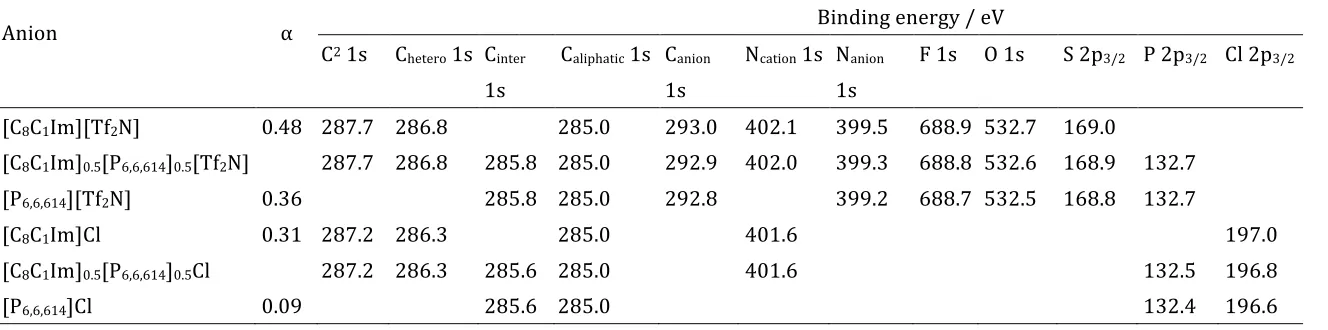
Figure 1 shows Cl 2p spectra of the two primary ionic liquids, [C8C1Im]Cl and [P6,6,6,14]Cl, as well as the binary mixture, [C8C1Im]0.5[P6,6,6,14]0.5Cl. At the first glance, it is apparent that the measured binding energy of Cl 2p3/2 for [P6,6,6,14]Cl is found at 196.6 eV, which is 0.4 eV lower than that of [C8C1Im]Cl (197.0 eV), as demonstrated in Table 1 as well. The dramatic decrease in binding energy for [P6,6,6,14]Cl is due to the less acidity of the [P6,6,6,14]+ cation (α=0.09 [37]), when compared to that of the [C8C1Im]+ cation (α=0.31 [37]). It confirms the conclusion of the previous study that the less acidic the cation, the less charge is transferred from the anion to the cation [28]. Consequently, Cl- is left bearing more negative charge and exhibits lower binding energy.
Figure 1 Cl 2p XP spectra for [C8C1Im]Cl, [C8C1Im]0.5[P6,6,6,14]0.5Cl and [P6,6,6,14]Cl. For the less basic anion
When the basicity of the anion is low, the charge transferred from the anion to the cation is less. Therefore, the impact of the cation acidity on the electronic environment of the anion-based component is thought negligible. In some critical cases, when the difference in cation acidity is large, such effect has been found concentrated on the atom within the anion bearing more point charges [28]. In this study, we choose the two cations with large deviation in acidity, aiming to ensure measurement of binding energy shifts larger than the experimental error. It has to be noted that the experimental error associated with XPS is of the order ± 0.1 eV. Consequently, any reported shift in binding energy should be no less than 0.2 eV. Otherwise, a series of samples have to be included to demonstrate the trend of the change in binding energy.
Table 1 Binding energy of all elements for all ionic liquids in this study.
Anion α Binding energy / eV
C2 1s Chetero 1s Cinter
1s
Caliphatic 1s Canion
1s
Ncation 1s Nanion
1s
F 1s O 1s S 2p3/2 P 2p3/2 Cl 2p3/2
[C8C1Im][Tf2N] 0.48 287.7 286.8 285.0 293.0 402.1 399.5 688.9 532.7 169.0
[C8C1Im]0.5[P6,6,614]0.5[Tf2N] 287.7 286.8 285.8 285.0 292.9 402.0 399.3 688.8 532.6 168.9 132.7
[P6,6,614][Tf2N] 0.36 285.8 285.0 292.8 399.2 688.7 532.5 168.8 132.7
[C8C1Im]Cl 0.31 287.2 286.3 285.0 401.6 197.0
[C8C1Im]0.5[P6,6,614]0.5Cl 287.2 286.3 285.6 285.0 401.6 132.5 196.8
Figure 2 XP spectra for [C8C1Im][Tf2N], [C8C1Im]0.5[P6,6,6,14]0.5[Tf2N] and [P6,6,6,14][Tf2N]: (a) F 1s, (b) O 1s, (c) Nanion 1s and (d) S 2p.
Conclusions
Four primary ionic liquids, i.e. [C8C1Im][Tf2N], [P6,6,6,14][Tf2N], [C8C1Im]Cl and [P6,6,6,14]Cl, as well as two binary ionic liquid mixtures including [C8C1Im]0.5[P6,6,614]0.5[Tf2N] and [C8C1Im]0.5[P6,6,614]0.5Cl, are successfully analysed by XPS. The impact of the cation acidity on the electronic environment of the anion is revealed. It concludes that the electronic environment of the anion can be tuned by using binary ionic liquid mixtures employing a definite anion and cations with different acidity.
Acknowledgements
We thank National Science Foundation (51503007), the General project of Science and Technology Research Project of Liaoning Provincial Department of Education (L2015461), Liaoning Provincial Foundation of Science and Technology (20170540780), EPSRC (EP/K005138/1) and China Postdoctoral Science Foundation funded project (2015M571344) for financial support. PL acknowledges the EPSRC for the award of an ARF (EP/D073014/1). SM acknowledges Shenyang Ligong University for the award of an Open Fund of the Key Discipline (4771004kfx18). The authors are grateful to Dr. Kevin RJ Lovelock for helpful discussions and critical advice.
References
[2] C. Capello, U. Fischer and K. Hungerbuhler, Green Chem. 9, 2007, 927.
[3] W. L. Hough, M. Smiglak, H. Rodríguez, R. P. Swatloski, S. K. Spear, D. T. Daly, J. Pernak, J. E. Grisel, R. D. Carliss, M. D. Soutullo, J. H. Davis and R. D. Rogers, New J. Chem. 31, 2007, 1429.
[4] M. Smiglak, A. Metlen and R. D. Rogers, Acc. Chem. Res. 40, 2007, 1182. [5] J. H. Davis, Chem. Lett. 33, 2004, 1072.
[6] N. V. Plechkova and K. R. Seddon, Chem. Soc. Rev. 37, 2008, 123. [7] T. Welton, Coord. Chem. Rev. 248, 2004, 2459.
[8] V. I. Pârvulescu and C. Hardacre, Chem. Rev. 107, 2007, 2615.
[9] D. R. Macfarlane, M. Forsyth, P. C. Howlett, J. M. Pringle, J. Sun, G. Annat, W. Neil and E. I. Izgorodina, Acc. Chem. Res. 40, 2007, 1165.
[10] F. van Rantwijk and R. A. Sheldon, Chem. Rev. 107, 2007, 2757.
[11] R. A. Sheldon, R. M. Lau, M. J. Sorgedrager, F. van Rantwijk and K. R. Seddon, Green Chem. 4, 2002, 147.
[12] J. P. Mikkola, P. Virtanen, K. Kordas, H. Karhu and T. O. Salmi, Appl. Catal. A-Gen.
328, 2007, 68.
[13] C. P. Mehnert, Chem.-Eur. J. 11, 2004, 50.
[14] N. M. Yunus, M. I. A. Mutalib, Z. Man, M. A. Bustam and T. Murugesan, Chem. Eng. J.
189, 2012, 94.
[15] T. Torimoto, T. Tsuda, K. Okazaki and S. Kuwabata, Adv. Mater. 22, 2010, 1196. [16] B. K. Ni, Q. Y. Zhang and A. D. Headley, Tetrahedron Lett. 49, 2008, 1249. [17] L. Ford, F. Atefi, R. D. Singer and P. J. Scammells, Eur. J. Org. Chem. 2011, 942. [18] P. M. Bayley, A. S. Best, D. R. MacFarlane and M. Forsyth, Phys. Chem. Chem. Phys.
13, 2011, 4632.
[19] T. Kakibe, J. Y. Hishii, N. Yoshimoto, M. Egashira and M. Morita, J. Power Sources
203, 2012, 195.
[20] E. F. Smith, I. J. Villar-Garcia, D. Briggs and P. Licence, Chem. Commun. 2005, 5633.
[21] S. Caporali, U. Bardi and A. Lavacchi, J. Electron Spectrosc. Relat. Phenom. 151, 2006, 4.
[22] T. Cremer, C. Kolbeck, K. R. J. Lovelock, N. Paape, R. Wölfel, P. S. Schulz, P. Wasserscheid, H. Weber, J. Thar, B. Kirchner, F. Maier and H.-P. Steinrück, Chem.-Eur. J. 16, 2010, 9018.
[23] S. Men, K. R. J. Lovelock and P. Licence, Phys. Chem. Chem. Phys. 13, 2011, 15244. [24] S. Men, D. S. Mitchell, K. R. J. Lovelock and P. Licence, ChemPhysChem 16, 2015,
2211.
[25] S. Men, K. R. J. Lovelock and P. Licence, RSC Adv. 5, 2015, 35958. [26] S. Men and J. Jiang, Chem. Phys. Lett. 646, 2016, 125.
[28] S. Men and J. Jiang, Chem. Phys. Lett. 677, 2017, 60.
[29] C. D. Wagner, L. E. Davis, M. V. Zeller, J. A. Taylor, R. H. Raymond and L. H. Gale, Surf. Interface Anal. 3, 1981, 211.
[30] S. Men, J. Jiang and P. Licence, Chem. Phys. Lett. 674, 2017, 86.
[31] R. K. Blundell and P. Licence, Phys. Chem. Chem. Phys. 16, 2014, 15278.
[32] E. F. Smith, F. J. M. Rutten, I. J. Villar-Garcia, D. Briggs and P. Licence, Langmuir 22, 2006, 9386.
[33] C. Kolbeck, T. Cremer, K. R. J. Lovelock, N. Paape, P. S. Schulz, P. Wasserscheid, F. Maier and H.-P. Steinrück, J. Phys. Chem. B 113, 2009, 8682.
[34] I. J. Villar-Garcia, E. F. Smith, A. W. Taylor, F. Qiu, K. R. J. Lovelock, R. G. Jones and P. Licence, Phys. Chem. Chem. Phys. 13, 2011, 2797.
[35] J. M. Gottfried, F. Maier, J. Rossa, D. Gerhard, P. S. Schulz, P. Wasserscheid and H. P. Steinrück, Z. Phys. Chemie-Int. J. Res. Phys. Chem. Chem. Phys. 220, 2006, 1439. [36] H. Hashimoto, A. Ohno, K. Nakajima, M. Suzuki, H. Tsuji and K. Kimura, Surf. Sci.
604, 2010, 464.
![Figure 1 Cl 2p XP spectra for [C8C1Im]Cl, [C8C1Im]0.5[P6,6,6,14]0.5Cl and [P6,6,6,14]Cl](https://thumb-us.123doks.com/thumbv2/123dok_us/8577620.369360/5.595.93.302.88.249/figure-cl-spectra-im-cl-im-cl-and.webp)
![Figure 2 XP spectra for [C8C1Im][Tf2N], [C8C1Im]0.5[P6,6,6,14]0.5[Tf2N] and [P6,6,6,14][Tf2N]: (a) F 1s, (b) O 1s, (c) Nanion 1s and (d) S 2p](https://thumb-us.123doks.com/thumbv2/123dok_us/8577620.369360/7.595.93.486.85.387/figure-xp-spectra-for-im-tf-nanion-and.webp)
