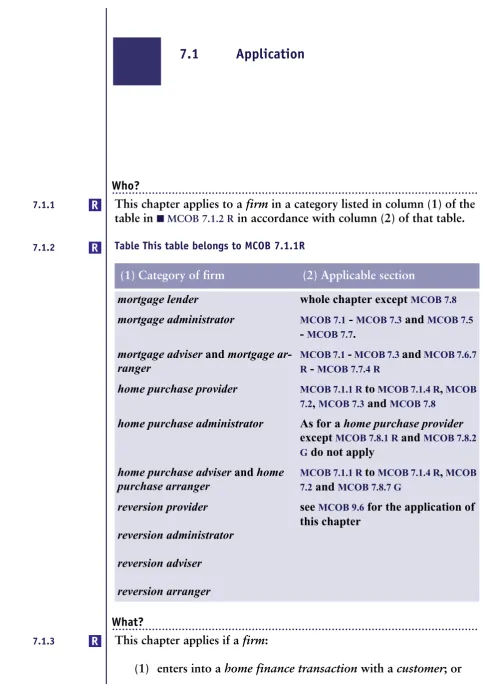
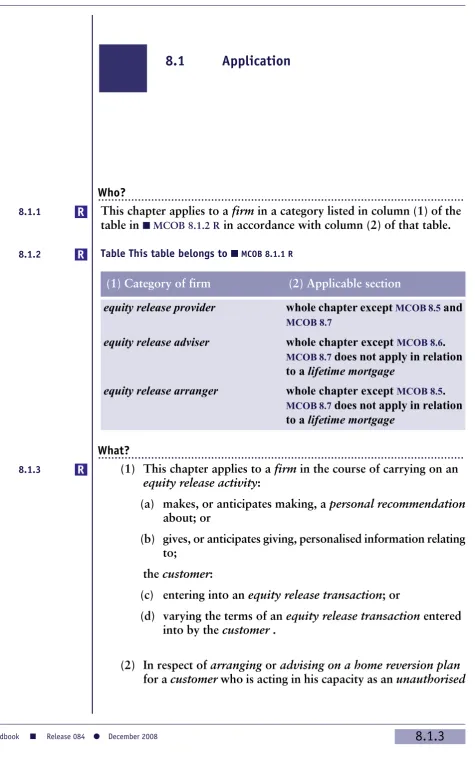
Mortgages and Home Finance: Conduct of Business sourcebook
MCOB 1 Application and purpose
1.1 Application and purpose
1.2 General application: who? what?
1.3 General application: where?
1.4 [deleted]
1.5 Application to appointed representatives
1.6 Application to mortgages in relation to the Consumer Credit Act 1974
1 Annex 1 [deleted]
1 Annex 2 [deleted]
1 Annex 3 [deleted]
1 Annex 4 [deleted]
MCOB 2 Conduct of business standards: general
2.1 Application
2.2 Communications
2.3 Inducements: regulated mortgage contracts and home reversion plans
2.4 High pressure sales: regulated mortgage contracts and home reversion plans
2.5 Reliance on others
2.6 Exclusion of liability
2.6A Protecting customers' interests: home purchase plans and home reversion
plans
2.7 Application to electronic media and distance communications
2.7A E-Commerce
2.8 Record keeping
MCOB 3 Financial Promotion of qualifying credit and of home reversion plans
3.1 Application: who?
3.2 Application: what?
3.3 Application: where?
3.4 Purpose
3.5 General
3.6 Form and content of non-real time qualifying credit promotions
3.7 Unsolicited real time financial promotions of qualifying credit or a home
reversion plan
3.8 Form and content of real time qualifying credit promotions
3.8A Form and content of financial promotions of home reversion plans
3.9 Confirmation of compliance: financial promotions of qualifying credit or
home reversion plans
3.10 Records: non-real time financial promotions of qualifying credit or of a
home reversion plan
3.11 Communication and approval of qualifying credit promotions for an overseas
person or an unauthorised person
PAGE
1
3 Annex 1 Examples of qualifying credit promotions
MCOB 4 Advising and selling standards
4.1 Application
4.2 Purpose
4.3 Scope of service provided
4.4 Initial disclosure requirements
4.5 Additional disclosure for distance mortgage mediation contracts and
distance home purchase mediation contracts with retail customers
4.6 Cancellation of distance mortgage mediation contracts and distance
home purchase mediation contracts
4.7 Advised sales
4.8 Non-advised sales
4.9 Business loans
4.10 Home purchase plans
4 Annex 1 Initial disclosure document
4 Annex 2 Combined initial disclosure document [deleted - see COBS 6 Annex 2]
4 Annex 3 Additional information requirements in respect of distance mortgage
mediation contracts and distance home purchase mediation contracts with consumers
MCOB 5 Pre-application disclosure
5.1 Application
5.2 Purpose
5.3 Applying for a home finance transaction
5.4 Mortgage illustrations: general
5.5 Provision of illustrations
5.6 Content of illustrations
5.7 Business loans
5.8 Home purchase plans
5 Annex 1 The mortgage illustration: table of contents, prescribed text and prescribed section headings and subheadings.
MCOB 6 Disclosure at the offer stage
6.1 Application
6.2 Purpose
6.3 General
6.4 Mortgages: content of the offer document
6.5 Mortgages: information to be provided in the offer document or
separately
6.6 Mortgages: offer documents in place of illustrations
6.7 Business loans
6.8 Home purchase plans
6 Annex 1 Distance home purchase plans: information to be provided to retail
customers.
FSA Handbook ■ Release 084 ● December 2008
MCOB Contents
PAGE
MCOB 7 Disclosure at start of contract and after sale
7.1 Application
7.2 Purpose
7.3 General
7.4 Mortgages: disclosure at the start of the contract
7.5 Mortgages: statements
7.6 Mortgages: event-driven information
7.7 Business loans
7.8 Home purchase plans
7 Annex 1 An example of the Total Borrowing section.
MCOB 8 Equity release: advising and selling standard
8.1 Application
8.2 Purpose
8.3 Application of rules in MCOB 4
8.4 [deleted]
8.5 Advised sales
8.6 Non-advised sales
8.7 Initial disclosure information: unauthorised reversion provider
8 Annex 1 Initial disclosure document
8 Annex 2 Combined initial disclosure document [deleted]
MCOB 9 Equity release: product disclosure
9.1 Application
9.2 Purpose
9.3 Pre-application disclosure
9.4 Content of illustrations
9.5 Disclosure at the offer stage for equity release transactions
9.6 Disclosure at the start of the contract and after sale for equity release
transactions
9.7 Disclosure at the start of the contract: lifetime mortgages
9.8 Disclosure after sale: lifetime mortgages
9.9 Disclosure after sale: home reversion plans
9 Annex 1 The illustration: table of contents, prescribed text and prescribed section headings and subheadings (R).
9 Annex 2 The illustration: table of contents, prescribed text and prescribed section headings and sub-headings
MCOB 10 Annual Percentage Rate
10.1 Application
10.2 Purpose
10.3 Formula and assumptions for calculating the APR
10.4 Total charge for credit
10 Annex 1 A guide to the substantively identical provisions of MCOB 10 and the
PAGE
3
MCOB 11 Responsible lending, and responsible financing of home purchase plans
11.1 Application
11.2 Purpose
11.3 Responsible lending , and responsible financing of home purchase plans
MCOB 12 Charges
12.1 Application
12.2 Purpose
12.3 Early repayment charges: regulated mortgage contracts
12.4 Arrears charges: regulated mortgage contracts
12.5 Excessive charges : regulated mortgage contracts and home reversion
plans
12.6 Business loans
12.7 Home purchase plans
MCOB 13 Arrears and repossessions: regulated mortgage contracts and home purchase plans
13.1 Application
13.2 Purpose
13.3 Dealing fairly with customers in arrears: policy and procedures
13.4 Arrears: provision of information to the customer of a regulated mortgage
contract
13.5 Dealing with a customer in arrears or with a sale shortfall on a regulated
mortgage contract
13.6 Repossessions
13.7 Business loans
13.8 Home purchase plans
Transitional Provisions and Schedules
TP 1 Transitional Provisions
TP 2 Transitional Provisions
Sch 1 Record keeping requirements
Sch 2 Notification Requirements
Sch 3 Fees and other required payments
Sch 4 Powers exercised
Sch 5 Rights of action for damages
Sch 6 Rules that can be waived
FSA Handbook ■ Release 084 ● December 2008
MCOB Contents
PAGE
PAGE
5
Mortgages and Home Finance: Conduct of Business sourcebook
Chapter 1
Application and purpose
PAGE
1
1.1
Application and purpose
Application
... MCOB applies as described in this chapter.
1.1.1
Purpose
...
The purpose of this chapter is to set out to whom, for what activities, and within what territorial limits the rules, evidential provisions and guidance in MCOB apply.
1.1.2
1
Section 1.1 : Application and purpose
MCOB 1 : Application and purpose
PAGE
1.2
General application: who? what?
1.2.1 (1) This sourcebook applies to every firm that:
(a) carries on a home finance activity (subject to the business loan application provisions ); or
(b) communicates or approves a financial promotion of qualifying credit, of a home purchase plan or of a home reversion plan.
(2) Where a firm has outsourced activities to a third party processor, any rule in MCOB which requires the third party processor, when acting as such, to disclose its identity to a customer must be read as requiring disclosure of the identity of the firm (or appointed representative, as appropriate) which is taking responsibility for the acts and omissions of the third party processor when carrying on the outsourced activities.
Firms which outsource regulated activities are reminded of the guidance on outsourcing
in ■SYSC 3.2.4 G and ■SYSC 8 .
1.2.1A
Firm types and the home finance activities
... 1.2.2 (1) This sourcebook applies to activities carried out in respect of three types of
product: regulated mortgage contracts (which includes lifetime mortgages),
home purchase plans, and home reversion plans. Together, these products are referred to as home finance transactions.
(2) Lifetime mortgages and home reversion plans are together referred to as equity release transactions.
(3) The application of most of this sourcebook is expressed by reference to four types of firm: lenders/providers, administrators, arrangers, and advisers. Arrangers and advisers are together referred to as intermediaries. This includes those firms that provide business loans to customers under a regulated mortgage contracts (see ■ MCOB 1.2.3 R to ■ MCOB 1.2.9 G). A single firm may fall into more than one of these types. PERG 4 contains detailed guidance on regulated mortgage activities and PERG 14 contains detailed guidance on home purchase activities and reversion activities.
PAGE
3
1.2.2
FSA Handbook ■ Release 084 ● December 2008Section 1.2 : General application: who? what?
MCOB 1 : Application and purpose
Business loans: application of MCOB
... In relation to a regulated mortgage contract for a business purpose
1.2.3
(1) MCOB applies if the customer is not a large business customer; and
(2) if MCOB applies, a firm must either:
(a) comply with MCOB in full (disregarding the tailored provisions for regulated mortgage contracts for a business purpose in the remainder of MCOB); or
(b) comply with MCOB taking account of those tailored provisions, including ■ MCOB 1.2.7 R.
For detail of the tailored provisions applying, see the section on 'business loans' set out in each relevant chapter.
1.2.4
1.2.5 (1) In order for a loan to fall within the definition of a regulated mortgage contract, at least 40% of the total of the land to be given as security must be used as or in connection with a dwelling. Therefore, the variation in approach provided for in ■ MCOB 1.2.3 R(2) can only apply where the loan being used for a business purpose is secured against a property at least 40 per cent of which is used as a dwelling. It cannot apply to a loan secured on property that is used solely for a business purpose.
(2) Whether a regulated mortgage contract is for a business purpose will be a matter of fact to be determined by a firm depending on the individual circumstances of each case. In the FSA's opinion, a regulated mortgage contract secured, for example, on the borrower's own home, but used to finance the purchase of a single buy-to-let property will not be for a business purpose.
In determining whether a customer is a large business customer for the purposes of
■ MCOB 1.2.3 R(1), a firm will need to have regard to the figure given for the customer's 1.2.6
annual turnover in the customer's annual report and accounts or business plan. In addition, a firm may rely on information provided by the customer about the annual turnover, unless, taking a common-sense view of this information, it has reason to doubt it.
Business loans: additional requirements if tailored route is used
... In relation to a regulated mortgage contract for a business purpose, if a firm has opted for the tailored route , it must adopt the following modifications to the sourcebook:
1.2.7
(1) (except in relation to sections 6 and 8 of any initial disclosure document or sections 5 and 8 of any combined initial disclosure document) substitute an alternative description of the facility provided under the regulated mortgage contract for 'mortgage'
1
Section 1.2 : General application: who? what?
MCOB 1 : Application and purpose
PAGE
(2) substitute the term 'illustration' for 'key facts illustration' when opting to use the tailored business loans rules in ■ MCOB 4.9,
■ MCOB 5.7, ■ MCOB 6.7 or ■MCOB 7.7; and
(3) limit disclosure to facilities provided under the regulated mortgage contract.
1.2.8 (1) Firms are reminded of the requirement in ■MCOB 2.2.6 R that any communication should be clear, fair and not misleading when substituting an alternative for the term 'mortgage' in accordance with ■ MCOB 1.2.7 R(1).
(2) Possible alternatives to the term 'mortgage' include, for example, 'secured business overdraft', 'secured loan' or 'secured business credit'.
The disclosure rules in MCOB place particular emphasis on the description of borrowing. Where the regulated mortgage contract is for a business purpose, a firm should reflect
1.2.9
this emphasis in any disclosure by first describing any borrowing before addressing the other facilities provided under the regulated mortgage contract.
Home purchase plans
...
For detail of the tailored provisions applying to home purchase plans, see the section on 'home purchase plans' set out in each relevant chapter.
1.2.9A
Authorised professional firms
...
MCOB does not apply to an authorised professional firm with respect to its non-mainstream regulated activities except for:
1.2.10
(1) ■ MCOB 2.2 (Communications);
(2) ■ MCOB 3 (Financial promotion); and
(3) initial disclosure requirements but only as regards providing the information contained in section 7 (What to do if you have a complaint) and section 8 (Are we covered by the Financial Services Compensation Scheme?) of an initial disclosure document or
combined initial disclosure document (see ■MCOB 4.4 and
■ MCOB 4.10).
Authorised professional firms should be aware of the following:
1.2.11
(1) ■PROF 5 (Non-mainstream regulated activities); and
(2) ■MCOB 3.1.9 R (Authorised professional firms) and the exception in article 55
of the Financial Promotion Order (Communications by members of the professions) which applies in relation to financial promotion of qualifying credit
or of a home reversion plan of authorised professional firms under
■MCOB 3.2.5 R(3) (Exemptions).
PAGE
5
1.2.11
FSA Handbook ■ Release 084 ● December 2008Section 1.2 : General application: who? what?
MCOB 1 : Application and purpose
Pre-contractual arrangements by a home finance provider
... In MCOB the activities of a home finance provider which would be
arranging but for article 28A of the Regulated Activities Order
1.2.12
(Arranging contracts or plans to which the arranger is a party), are to be treated as arranging and therefore also as home finance activities.
The effect of article 28A of the Regulated Activities Order would normally mean that arrangements made by a party to a home finance transaction would not fall within
1.2.13
the home finance activity of arranging. So in a direct sale, a home finance provider
would not be carrying on the regulated activity of arranging but, where the transaction proceeds to completion, would instead be involved in a regulated activity comprising
entering into a home finance transaction . However, the provisions in MCOB on arranging home finance transactions are applied to pre-contractual arrangements by a home finance provider.
[deleted]
...
[deleted]
1.2.14
1
Section 1.2 : General application: who? what?
MCOB 1 : Application and purpose
PAGE
1.3
General application: where?
Location of the customer
... Except as set out in this section, MCOB applies if the customer of a firm
carrying on home finance activities is resident in:
1.3.1
(1) the United Kingdom; or
(2) another EEA State, but in this case only if the activity is carried on from an establishment maintained by the firm (or its appointed representative) in the United Kingdom;
at the time that the home finance activity is carried on. Financial Promotion
... The territorial scope of ■MCOB 3 (Financial promotion) is set out in
■MCOB 3.3 (Application: where?) rather than in this section.
1.3.2
Electronic commerce activities and communications
... This sourcebook does not apply to an incoming ECA provider acting as such.
1.3.3
Distance contracts entered into from an establishment in another EEA State ... 1.3.4 (1) The rules in (2) do not apply to a firm with respect to a regulated
mortgage activity or a home purchase activity exclusively concerning a distance contract if the following conditions are satisfied:
(a) the firm carries on the activity from an establishment
maintained by the firm in an EEA State other than the United Kingdom; and
(b) either the EEA State:
(i) has implemented the Distance Marketing Directive ; or (ii) has obligations in its domestic law corresponding to those
provided for by the Distance Marketing Directive ; and, in either case, with the result that the obligations provided for by the Distance Marketing Directive (or corresponding
PAGE
7
1.3.4
FSA Handbook ■ Release 084 ● December 2008Section 1.3 : General application: where?
MCOB 1 : Application and purpose
obligations) are applied by that State when the firm carries on that activity; and
(c) the firm is a national of an EEA State or a company or firm mentioned in article 48 of the Treaty.
(2) The rules which do not apply are:
(a) initial disclosure requirements in ■MCOB 4.4 (in respect of
regulated mortgage contracts) and ■MCOB 4.10 (in respect of home purchase plans);
(b) ■MCOB 4.5 (Additional disclosure for distance mortgage
mediation contracts and distance home purchase mediation contracts with consumers);
(c) ■MCOB 4.6 (Cancellation of distance mortgage mediation contracts) and distance home purchase mediation contracts) ;
(d) ■MCOB 5 (Pre-application disclosure); (e) ■MCOB 6 (Disclosure at offer stage);
(f) ■MCOB 7.6.7 R to ■ MCOB 7.6.17 R (Further advances); (g) ■MCOB 8.3 (Application of rules in ■MCOB 4) to the extent
that it applies ■MCOB 4.4 to ■MCOB 4.6; (h) [deleted]
(i) ■MCOB 9.3 (Pre-application disclosure); (j) ■MCOB 9.4 (Content of illustrations); and
(k) ■MCOB 9.5 (Disclosure at offer stage for equity release
transactions).
Distance contracts with retail customers
...
Parts of MCOB relate to distance contracts (or distance mortgage mediation contracts
and distance home purchase mediation contracts ) with consumers. These expressions
1.3.5
are derived from the Distance Marketing Directive, and the following paragraphs provide some guidance to firms on their meaning:
(1) consumer
The Distance Marketing Directive applies for distance contracts with 'any natural person who is acting for purposes which are outside his trade, business or profession', for which the term 'consumer' has been adopted. Examples of individuals who would be regarded as consumers include:
(a) personal representatives, including executors, unless they are acting in a professional capacity, for example a solicitor acting as executor; or
(b) private individuals acting in personal or other family circumstances, for
1
Section 1.3 : General application: where?
MCOB 1 : Application and purpose
PAGE
(2) Distance contract
To be a distance contract, a contract must be concluded under an 'organised distance sales or service-provision scheme' run by the contractual provider of the service who, for the purpose of the contract, makes exclusive use (directly or through an intermediary) of one or more means of distance communication up to and including the time at which the contract is concluded. So:
(a) the firm must have put in place facilities designed to enable a customer to deal with it exclusively at a distance, such as facilities for a customer to deal with it purely by post, telephone, fax or the Internet. If a firm normally operates face-to-face and has no facilities in place enabling a customer to deal with it customarily by distance means, the Distance Marketing Directive
will not apply. A one-off transaction effected exclusively by distance means to meet a particular contingency or emergency will not be a distance contract; and
(b) there must have been no simultaneous physical presence of the firm and the other party to the contract throughout the offer, negotiation and conclusion of the contract. So, for example, contracts offered, negotiated and concluded over the Internet, through a telemarketing operation, or by post will normally be distance contracts.
Use of intermediaries
...
The mere fact that an intermediary (acting for the supplier or for the consumer) is involved, does not make the sale of a financial product or service a distance contract. There will
1.3.6
not be a distance contract if there has been simultaneous physical presence of the intermediary and the consumer at some stage in the offer, negotiation and conclusion of the contract.
PAGE
9
1.3.6
FSA Handbook ■ Release 084 ● December 2008Section 1.3 : General application: where?
MCOB 1 : Application and purpose
1.4
[deleted]
[Deleted] 1.4.1
1
Section 1.4 : [deleted]
MCOB 1 : Application and purpose
PAGE
1.5
Application to appointed representatives
1.5.1 (1) Although MCOB does not apply directly to a firm's appointed representatives,
a firm will always be responsible for the acts and omissions of its appointed representatives in carrying on business for which the firm has accepted responsibility (section 39(3) of the Act). In determining whether a firm has complied with any provision of MCOB, anything done or omitted by a firm's appointed representative (when acting as such) will be treated as having been done or omitted by the firm (section 39(4) of the Act).
(2) Firms should refer to ■SUP 12 (Appointed representatives), which sets out requirements which apply to firms using appointed representatives.
PAGE
11
1.5.1
FSA Handbook ■ Release 084 ● December 2008Section 1.5 : Application to appointed representatives
MCOB 1 : Application and purpose
1.6
Application to mortgages in relation to
the Consumer Credit Act 1974
MCOB applies to regulated mortgage contracts entered into on or after 31 October 2004. Variations made on or after that date to contracts entered into before that date
1.6.1
are not subject to FSA regulation but may be subject to the Consumer Credit Act 1974. PERG 4.4.13G contains guidance on the variation of contracts entered into before 31 October 2004.
Principle 2 requires a firm to conduct its business with due skill, care and diligence. The purpose of ■ MCOB 1.6.3 R is to reinforce this. The FSA would expect firms to take
1.6.2
appropriate steps to determine whether any mortgage it proposes to enter into is subject to FSA regulation.
Before a firm enters into a mortgage, it must take all reasonable steps to establish whether that mortgage will be a regulated mortgage contract
and therefore subject to MCOB.
1.6.3
If, notwithstanding the steps taken by a firm to comply with
■ MCOB 1.6.3 R, it transpires that a mortgage which the firm has treated
1.6.4
as unregulated is in fact a regulated mortgage contract, the firm must as soon as practicable after the correct status of the mortgage has been established:
(1) contact the customer and provide him with the following information in a durable medium:
(a) a statement that the mortgage contract is a regulated mortgage contract subject to FSA regulation, stating in particular the position with regard to redress and compensation; and
(b) (where relevant) a statement that the Consumer Credit Act 1974 will not apply to the mortgage contract and that any Consumer Credit Act rights or requirements set out in previous communications will not apply;
(2) apply to the regulated mortgage contract all relevant MCOB
requirements, such as those on disclosure (in ■ MCOB 7) or on
1
Section 1.6 : Application to mortgages in relation to the Consumer Credit Act 1974
MCOB 1 : Application and purpose
PAGE
1.6.5 (1) ■ MCOB 1.6.4 R(2) means, for example, that if a firm discovered immediately
after completion that a loan was a regulated mortgage contract, the firm would be required to comply with ■MCOB 7.4 (Disclosure at the start of the contract).
(2) Although ■ MCOB 1.6.4 R recognises that firms may become aware that a mortgage is a regulated mortgage contract at a late stage, the FSA expects this to be an extremely rare occurrence. It could arise, for example, if a firm has acted on the understanding, verified as far as was practicable, that in respect of a particular mortgage contract less than 40% of the land would be used in connection with a dwelling. If it was discovered later that more than 40% of the land was used in connection with the dwelling (and provided that all the other legal requirements were met) the mortgage will be a regulated mortgage contract to which MCOB applies.
(3) ■ MCOB 1.6.3 R and ■ MCOB 1.6.4 R do not override the application of MCOB
to any regulated mortgage contract. MCOB applies notwithstanding a firm's
genuine belief that a mortgage is unregulated. In deciding whether to take disciplinary action as a result of a breach of MCOB, the FSA will take into account whether the action by the firm was reckless or deliberate (see
■DEPP 6.2.1 G (1)(a)).
PAGE
13
1.6.5
FSA Handbook ■ Release 084 ● December 2008Section 1.6 : Application to mortgages in relation to the Consumer Credit Act 1974
MCOB 1 : Application and purpose
1
Section 1.6 : Application to mortgages in relation to the Consumer Credit Act 1974
MCOB 1 : Application and purpose
PAGE
[deleted]
PAGE
1
FSA Handbook ■ Release 084 ● December 2008
Annex 1
MCOB 1 : Application and purpose
1
Annex 1
MCOB 1 : Application and purpose
PAGE
[deleted]
PAGE
1
FSA Handbook ■ Release 084 ● December 2008
Annex 2
MCOB 1 : Application and purpose
1
Annex 2
MCOB 1 : Application and purpose
PAGE
[deleted]
PAGE
1
FSA Handbook ■ Release 084 ● December 2008
Annex 3
MCOB 1 : Application and purpose
1
Annex 3
MCOB 1 : Application and purpose
PAGE
[deleted]
PAGE
1
FSA Handbook ■ Release 084 ● December 2008
Annex 4
MCOB 1 : Application and purpose
1
Annex 4
MCOB 1 : Application and purpose
PAGE
Mortgages and Home Finance: Conduct of Business sourcebook
Chapter 2
Conduct of business
standards: general
PAGE
1
2.1
Application
[image:30.595.53.534.77.807.2]Who?
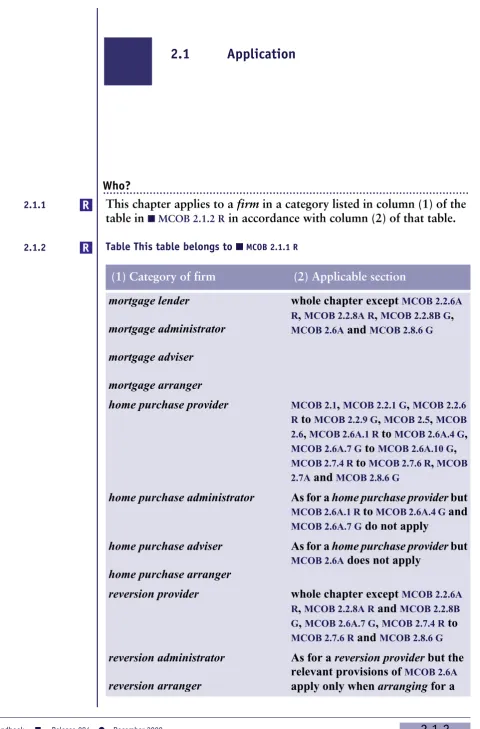
... This chapter applies to a firm in a category listed in column (1) of the table in ■ MCOB 2.1.2 R in accordance with column (2) of that table. 2.1.1
Table This table belongs to ■ MCOB 2.1.1 R
2.1.2
(2) Applicable section (1) Category of firm
whole chapter except MCOB 2.2.6A R, MCOB 2.2.8A R, MCOB 2.2.8B G, MCOB 2.6A and MCOB 2.8.6 G
mortgage lender
mortgage administrator mortgage adviser mortgage arranger
MCOB 2.1, MCOB 2.2.1 G, MCOB 2.2.6 R to MCOB 2.2.9 G, MCOB 2.5, MCOB
home purchase provider
2.6, MCOB 2.6A.1 R to MCOB 2.6A.4 G, MCOB 2.6A.7 G to MCOB 2.6A.10 G, MCOB 2.7.4 R to MCOB 2.7.6 R, MCOB 2.7A and MCOB 2.8.6 G
As for a home purchase provider but MCOB 2.6A.1 R to MCOB 2.6A.4 G and MCOB 2.6A.7 G do not apply
home purchase administrator
As for a home purchase provider but MCOB 2.6A does not apply
home purchase adviser home purchase arranger
whole chapter except MCOB 2.2.6A R, MCOB 2.2.8A R and MCOB 2.2.8B
reversion provider
G, MCOB 2.6A.7 G, MCOB 2.7.4 R to MCOB 2.7.6 R and MCOB 2.8.6 G
As for a reversion provider but the relevant provisions of MCOB 2.6A
reversion administrator
reversion arranger apply only when arranging for a
2
Section 2.1 : Application
MCOB 2 : Conduct of business
standards: general
PAGE
(2) Applicable section (1) Category of firm
home reversion plan to be entered
in-to by a reversion occupier with, or
administering a home reversion plan
provided by, an unauthorised
rever-sion provider.
As for a reversion provider but MCOB 2.6A does not apply
reversion adviser
MCOB 2.5, MCOB 2.6, MCOB 2.7 (except, when the financial promotion relates a firm that communicates or approves
a financial promotion of qualifying
credit or of a home reversion plan to a home reversion plan, MCOB 2.7.4 R to MCOB 2.7.6 R), MCOB 2.7A and MCOB 2.8 (except MCOB 2.8.6 G)
MCOB 2.2.6 R to MCOB 2.2.9 G, MCOB 2.5, MCOB 2.6, MCOB 2.7, MCOB 2.7A and MCOB 2.8.6 G
a firm that communicates or approves a financial promotion of a home
pur-chase plan
What?
... This chapter applies in relation to:
2.1.3
(1) home finance activities;
(2) those activities in ■ MCOB 12 and ■MCOB 13 that are carried on after a regulated mortgage contract or home purchase plan has come to an end following the sale of a repossessed property, and those activities in ■ MCOB 12 that are carried on after a home reversion plan has ended for any reason; and
(3) the communication or approval of a financial promotion of
qualifying credit, of a home purchase plan or of a home reversion plan.
PAGE
3
2.1.3
FSA Handbook ■ Release 084 ● December 2008Section 2.1 : Application
MCOB 2 : Conduct of business
standards: general
2.2
Communications
Purpose
...
The purpose of ■ MCOB 2.2 is to restate, in slightly amended form, and as a separate
rule, the part of Principle 7 (Communications with clients) that relates to
2.2.1
communication of information. This enables a customer, who is a private person, to bring an action for damages under section 150 (Contravention of rules) of the Act to recover loss resulting from a firm that carries on the activities referred to in
■ MCOB 2.1.3 R communicating information, in the course of those activities, in a way
that is not clear or fair, or that is misleading. ■ MCOB 2.2 also clarifies the expectations of the FSA where any rule requires the provision of information and there are two or more customers.
General
...
In many circumstances there will be two or more customers under any home finance transaction, or two or more prospective customers looking to enter into the same home 2.2.2
finance transaction. In such circumstances, where a rule in MCOB requires the provision of information to such customers and the customers have different addresses, a firm
sending out this information should send it to each address. If the customers share the same address it will be sufficient to send a single copy of the information addressed to each of the customers.
Prescribed terms for regulated mortgage contracts and home reversion plans
... In any communication to a customer, a firm must:
2.2.3
(1) describe any early repayment charge as an 'early repayment charge';
(2) describe any higher lending charge as a 'higher lending charge'; (3) describe any lifetime mortgage as a 'lifetime mortgage'; and (4) describe any home reversion plan as a 'home reversion plan'; and not use any other expression to describe them.
[deleted]
2.2.4
2
Section 2.2 : Communications
MCOB 2 : Conduct of business
standards: general
PAGE
Related investment advice
... Firms are reminded that they should follow the relevant rules in ■COBS 6 and ■COBS 13
relating to advice and disclosure on investments if they are advising the customer on an
2.2.5
investment such as an annuity associated with an equity release transaction or an ISA
used as a repayment vehicle.
Clear, fair and not misleading communications and financial promotions ... 2.2.6 (1) When a firm communicates information to a customer, it must
take reasonable steps to communicate in a way that is clear, fair and not misleading.
(2) [deleted]
A firm which approves a financial promotion of a home purchase plan
must take reasonable steps to ensure that the financial promotion is clear, fair and not misleading.
2.2.6A
When considering how to comply with the requirements of ,these rules on clear, fair and not misleading communications and financial promotions, a firm should have regard to
2.2.7
the customer's knowledge of the home finance transaction to which the information relates.
The rule on clear, fair and not misleading communications covers all communications with customers, for example any oral or written statements, telephone calls and any
2.2.8
correspondence which is not a financial promotion to which ■MCOB 3 (Financial
promotion) applies. In respect of financial promotions of qualifying credit or of home reversion plans, firms should note the separate requirements of ■MCOB 3.
If a firm uses a figure equivalent to an APR in a communication of a
financial promotion of a home purchase plan, when calculating that figure it must use an approach equivalent to the APR rules.
2.2.8A
The following guidance may be relevant to a firm that communicates or approves a
financial promotion of a home purchase plan:
2.2.8B
(1) guidance on what 'communicate', 'approve' and 'financial promotion' mean, and on the media of communication to which financial promotion rules apply (see ■MCOB 3.2.1 G and ■MCOB 3.2.2 G);
(2) guidance on other Handbook provisions relevant to financial promotions (see
■MCOB 3.2.8 G to ■MCOB 3.2.9 G);
(3) guidance on other regulations and guidelines relevant to financial promotions
(see ■MCOB 3.5.3 G);
(4) guidance on referring to the FSA (see ■MCOB 3.6.2 G (3));
(5) guidance on the clear, fair and not misleading standard (see ■MCOB 3.6.5 G,
■MCOB 3.6.10 G and ■MCOB 3.6.14 G); and
PAGE
5
2.2.8B
FSA Handbook ■ Release 084 ● December 2008Section 2.2 : Communications
MCOB 2 : Conduct of business
standards: general
(6) guidance on the use of the Internet for communicating financial promotions
(see ■MCOB 3.12 and ■PERG 8.22).
Note: A comparative financial promotion will need to comply with regulation 4A of the Control of Misleading Advertisements Regulations 1988.
Prominence of relevant information can play a key role in ensuring that a
communication is clear, fair and not misleading. Where this is the case, the firm should
2.2.9
consider prominence in the context of the communication as a whole. Use can be made of the positioning of text, background and text colour and type size to ensure that specified information meets the requirements of MCOB.
2
Section 2.2 : Communications
MCOB 2 : Conduct of business
standards: general
PAGE
2.3
Inducements: regulated mortgage contracts
and home reversion plans
Purpose
...
The purpose of ■ MCOB 2.3 is to ensure, in accordance with Principles 1, 6 and 8, that a
firm does not conduct business under arrangements that might give rise to a conflict with its duty to customers or to unfair treatment of them.
2.3.1
Prohibition of inducements
... A firm must take reasonable steps to ensure that it, and any person acting on its behalf, does not:
2.3.2
(1) offer, give, solicit or accept an inducement; or
(2) direct or refer any actual or potential business in relation to a
regulated mortgage contract or home reversion plan to another
person on its own initiative or on the instructions of an associate; if it is likely to conflict to a material extent with any duty that the firm
owes to its customers in connection withsuch a home finance transaction
or any duty which such a recipient firm owes to its customers in connection with such a home finance transaction.
An inducement is a benefit offered with a view to bringing about a particular course of action.
2.3.3
The purpose of ■ MCOB 2.3.2 R(2) is to prevent the requirement in ■ MCOB 2.3.2 R(1) being
circumvented by an inducement being given or received by an unregulated associate. There
2.3.4
may be circumstances, however, where a firm is able to demonstrate that it could not reasonably have knowledge of an associate giving or receiving an inducement. It should not, however, direct business to another person on the instruction of an associate if this is likely to conflict with the interests of its customers.
■ MCOB 2.3.2 R does not prevent a firm:
2.3.5
(1) assisting a home finance intermediary so that the quality of the home finance intermediary's service to customers is enhanced; or
(2) giving or receiving indirect benefits (such as gifts, hospitality and promotional competition prizes);
PAGE
7
2.3.5
FSA Handbook ■ Release 084 ● December 2008Section 2.3 : Inducements: regulated mortgage contracts and home reversion plans
MCOB 2 : Conduct of business
standards: general
providing in either case this is not likely to give rise to a conflict with the duties that the recipient owes to the customer. In particular, such benefits should not be of a kind or value that is likely to impair the ability of a firm to act in compliance with any rule
in MCOB, for example the suitability requirements in ■MCOB 4.7 (Advised sales).
2.3.6 (1) A firm must not operate a system of giving or offering
inducements to a mortgage intermediary, reversion intermediary
or any other third party whereby the value of the inducement increases if the intermediary or third party, such as a packager, exceeds a target set for the amount of business referred (for example, a volume override).
(2) A firm must not solicit or accept an inducement whereby the value of the inducement increases if the firm exceeds a target set for the amount of business referred.
Quantification of inducements
... 2.3.7 (1) A mortgage lender or reversion provider must quantify, in cash
terms, any material inducement it offers to a mortgage intermediary, reversion intermediary or a third party.
(2) In quantifying the value of the material inducement, the firm
must include any subsequent payments (such as a trail fee) made where the customer continues with the samehome finance transaction.
2.3.8 (1) Quantification of any material inducement offered by the mortgage lender
or reversion provider supports the disclosure requirements elsewhere in
MCOB. Further guidance on the disclosure of any inducement in cash terms is provided in ■MCOB 5.6.118 G for regulated mortgage contracts other than
lifetime mortgages, ■MCOB 9.4.124 G for lifetime mortgages and
■MCOB 9.4.173 G for home reversion plans.
(2) A payment made to a third party unconnected with thehome finance intermediary, where that payment only reflects the cost of outsourcing work relating to the processing of mortgage applications, would not be considered an inducement for these purposes.
2
Section 2.3 : Inducements: regulated mortgage contracts and home reversion plans
MCOB 2 : Conduct of business
standards: general
PAGE
2.4
High pressure sales: regulated mortgage
contracts and home reversion plans
Purpose
...
The purpose of this section is to remind firms of the relevance of the high level standards in PRIN, especially with regard to the use of sales methods that may lead a customer to
2.4.1
feel pressurised to enter into, or vary, a regulated mortgage contract or home reversion plan.
Fair treatment
... Principle 6 (Customers' interests) requires that a firm must pay due regard to the interests of its customers and treat them fairly. This means, for example, that a firm should avoid
2.4.2
selling practices that commit customers (or lead customers to believe that they are committed) to any regulated mortgage contract or home reversion plan before they have been able to consider the illustration and offer document. One such practice might be to present a new customer with an illustration, offer document and mortgage deed at one time and to require the mortgage deed to be signed on the same occasion (when there is no urgent need to do so).
Information
... Principle 7 (Communications with clients) requires that a firm must pay due regard to the information needs of its clients, and communicate information to them in a way which
2.4.3
is clear, fair and not misleading. This means, for example, that a firm should avoid giving any customer a false impression about the availability of a regulated mortgage contract
or home reversion plan, such as describing it as a 'special offer' not available after a certain date unless this is really the case.
PAGE
9
2.4.3
FSA Handbook ■ Release 084 ● December 2008Section 2.4 : High pressure sales: regulated mortgage contracts and home reversion plans
MCOB 2 : Conduct of business
standards: general
2.5
Reliance on others
Purpose
... Principle 2 requires a firm to conduct its business with due skill, care and diligence.
■ MCOB 2.5 indicates the extent to which firms that carry on home finance activities
2.5.1
and that communicate or approve a financial promotion can meet this requirement by relying on others.
When firms can rely on others
... A firm will be taken to be in compliance with any rule in MCOB that requires a firm to obtain information to the extent that the firm can
2.5.2
show that it was reasonable for it to rely on information provided to it by another person.
2.5.3 (1) In relying on ■ MCOB 2.5.2 R, a firm should take reasonable steps
to establish that the other person providing the information is:
(a) not connected with the firm; and
(b) competent to provide the information.
(2) Compliance with (1) may be relied on as tending to establish compliance with ■ MCOB 2.5.2 R.
(3) Contravention of (1) may be relied on as tending to establish contravention of ■ MCOB 2.5.2 R.
2.5.4 (1) Any information which a rule in MCOB requires to be sent to
a customer may be sent to another person on the instruction of the customer, so long as the recipient is not connected with the
firm.
(2) There is no need for a firm to send information to a customer
where it has taken reasonable steps to establish that this has been or will be supplied by another person.
2
Section 2.5 : Reliance on others
MCOB 2 : Conduct of business
standards: general
PAGE
2.6
Exclusion of liability
Purpose
... Principle 6 (Customers' interests) requires a firm to pay due regard to the interests of its
customers and treat them fairly. A firm may not exclude the duties it owes or the liabilities
2.6.1
it has to a customer under the regulatory system. It may exclude other duties and liabilities only if it is reasonable for it to do so.
Limits on the exclusion of liability
... A firm must not, in any written or oral communication, seek to exclude or restrict, or to rely on any exclusion or restriction of, any duty or liability it may have to a customer under the regulatory system.
2.6.2
A firm must not, in any written or oral communication to a customer, seek to exclude or restrict, or to rely on any exclusion or restriction of, any duty
2.6.3
or liability not referred to in ■ MCOB 2.6.2 R unless it is reasonable for it to do so.
PAGE
11
2.6.3
FSA Handbook ■ Release 084 ● December 2008Section 2.6 : Exclusion of liability
MCOB 2 : Conduct of business
standards: general
2.6A
Protecting customers' interests: home
purchase plans and home reversion plans
Protecting customers' interests: home purchase plans and home reversion plans
... A firm must ensure that the interests of its customer under a home purchase plan or home reversion plan are protected to a reasonable standard.
2.6A.1
Circumstances that a firm should consider include how the customer will be protected in the event of:
2.6A.2
(1) the failure of a reversion provider or home purchase provider;
(2) the transfer of a reversion provider's or home purchase provider's interest (or the interest the provider would have had, had it not nominated a third party to hold it) in the property to a third party;
(3) other dealings by a reversion provider or home purchase provider (or its nominee) with a third party; and
(4) a reversion provider's or home purchase provider's (or its nominee's) failure to perform obligations owed to third parties, or imposed by statute.
The steps that a firm might take in order to protect its customer's interests will depend on a number of factors, including the nature and structure of the home purchase plan 2.6A.3
or home reversion plan and the jurisdiction in which the property is situated. If it is not possible to achieve reasonable protection (for example, due to impediments under a particular legal system) then a firm should not enter into, arrange or administer the plan.
2.6A.4 (1) In the FSA's view, a customer's interests will include:
(a) protection of the customer's rights under the plan, in particular the right to occupy the property throughout its term;
(b) protection of any interest (legal or beneficial) that the customer retains, acquires or is intended to acquire in the property, including the expectation that such interests will be unencumbered by third party interests; and
(c) that, where a customer pays sums under a home purchase plan towards
2
Section 2.6A : Protecting customers' interests: home purchase plans and home reversion plans
MCOB 2 : Conduct of business
standards: general
PAGE
(for example, on repossession), that an appropriate amount will be returned to the customer.
(2) The protections that a firm should consider include:
(a) the extent to which different forms of tenure protect the tenant's right to occupy the property and afford protection against removal. In particular, granting the customer a licence to occupy the property is unlikely to provide an adequate level of security;
(b) (except in Scotland) the need for any agreement under which a customer
has a right to acquire an interest in the property to be specifically enforceable;
(c) the extent to which appropriate registrations, restrictions, notices or other entries should be made in the relevant land register;
(d) the timing of entries in the relevant land register and who should be responsible for making them; and
(e) the customer's need for a full and clear understanding of all the steps that the firm expects him or his advisers to take to protect his interests both at the time the plan is entered into, and throughout its duration.
Protecting customers' interests: additional material for home reversion plans
... Unless it is satisfied on reasonable grounds based on the customer's
knowledge, expertise and experience that it is unnecessary, a firm must
2.6A.5
obtain from its customer's legal adviser, before its customer enters into a
home reversion plan, confirmation that:
(1) he has been instructed to ensure that the customer's legal rights under the plan are protected to a reasonable standard; and (2) he has explained to the customer those aspects of the customer's
legal rights and obligations under the home reversion plan that he needs to understand.
Firms remain responsible for ensuring that their customers' interests are protected to a reasonable standard.
2.6A.6
Protecting customers' interests: additional material for home purchase plans ...
A home purchase provider should consider obtaining confirmation from the customer's
legal adviser that he has carried out, or will carry out, the steps that the firm expects the
2.6A.7
customer or his legal advisers to take to protect his interests at the time the plan is taken out.
Treating customers fairly: home purchase plans and home reversion plans ... A firm must pay due regard to the interests of its customer and treat him fairly when drafting, amending the terms of, or imposing obligations or
2.6A.8 PAGE
13
2.6A.8
FSA Handbook ■ Release 084 ● December 2008Section 2.6A : Protecting customers' interests: home purchase plans and home reversion plans
MCOB 2 : Conduct of business
standards: general
exercising rights or discretions under, a home purchase plan or home reversion plan.
A firm is unlikely, for example, to be treating its customer fairly in relation to termination of a home purchase plan or home reversion plan if:
2.6A.9
(1) the grounds on which it may terminate all or part of a plan are unduly wide, or on which a customer may terminate are unduly narrow; or
(2) the customer is not given appropriate notice of termination.
A firm is also unlikely to be treating its customer fairly if, upon termination of an agreement under a home purchase plan or home reversion plan, the customer does not receive (net of any reasonable sums payable by the customer):
2.6A.10
(1) in the case of a home reversion plan where the customer retains a beneficial interest in the property, the value of that beneficial interest; or
(2) in the case of a home purchase plan, the value of purchase payments made.
Note: The terms of a home purchase plan or home reversion plan should take into account relevant legal obligations such as those under the Unfair Terms Regulations and, where applicable, the Housing Act 1988 (or, in Scotland, the Housing (Scotland) Act 1988). A
firm may find material on the FSA website concerning the FSA's consumer protection
powers useful. The Office of Fair Trading has also published guidance on the impact of the Unfair Terms Regulations on tenancy agreements.
Treating customers fairly: home reversion plans
...
A firm is unlikely, for example, to be treating a reversion occupier fairly if:
2.6A.11
(1) the reversion occupier is obliged to maintain the property to a standard which exceeds the standard that the property is in when the home reversion plan commences;
(2) the reversion occupier is not entitled to, or is not given, reasonable notice of an inspection, or the inspection is conducted in a way that is biased against him;
(3) unreasonable restrictions are imposed on who may occupy the property, taking into account the potential needs of the reversion occupier throughout the duration of the home reversion plan;
(4) unreasonable restrictions are imposed on the uses to which the property may be put;
(5) the reversion occupier is unreasonably treated as having abandoned the property. For example, it is likely to be unreasonable to treat a property as abandoned based only on a period of non-occupation;
(6) where the reversion occupier has a reasonable expectation that the home reversion plan can be transferred to another property, agreement to such a transfer is, or can be, refused unreasonably.
2
Section 2.6A : Protecting customers' interests: home purchase plans and home reversion plans
MCOB 2 : Conduct of business
standards: general
PAGE
Independent valuation: home reversion plans
... A firm must ensure that any valuation is carried out by a competent valuer who is independent of the reversion provider.
2.6A.12
2.6A.13 (1) A valuer may be considered competent if he is a suitably qualified member of a professional body.
(2) A valuer may be considered independent if:
(a) the customer can choose the valuer subject to the firm objecting on reasonable grounds and to the valuer being competent;
(b) he owes a duty of care to the customer in valuing the property; and
(c) the customer has an appropriate remedy against him under a complaints procedure which allows the complaint to be referred to an independent person whose decision is binding on the valuer.
(3) Compliance with (1) and (2) may be relied on as tending to establish compliance with ■ MCOB 2.6A.12 R.
Members of the Royal Institution of Chartered Surveyors, for example, are required to operate a complaints procedure that allows the complaint to be referred to an independent
2.6A.14
person whose decision binds the valuer and which, in the FSA's view, provides a customer
with an appropriate remedy.
Obtaining best price: partial home reversion plans
... A firm must take reasonable steps to ensure that, when a home reversion plan ends and the customer retains a beneficial interest in the property:
2.6A.15
(1) the property is sold within a reasonable period of time; and (2) the best price that might reasonably be obtained is paid.
It is recognised that a balance has to be struck between the need to sell the property as soon as possible, and other factors, such as market conditions, which may prompt the
2.6A.16
delay of the sale. Legitimate reasons for deferring action might include the expiry of a period when a grant is repayable on re-sale, or the discovery of a title defect that needs to be remedied if the optimal selling price is to be achieved.
PAGE
15
2.6A.16
FSA Handbook ■ Release 084 ● December 2008Section 2.6A : Protecting customers' interests: home purchase plans and home reversion plans
MCOB 2 : Conduct of business
standards: general
Arranging or administering for unauthorised providers: home reversion plans
... For the purpose of this section (except this rule), a reversion arranger
or reversion administrator's customer:
2.6A.17
(1) includes a reversion occupier or potential reversion occupier
who enters, or proposes to enter, into a home reversion plan
with an unauthorised reversion provider who is the firm's customer; and
(2) excludes an unauthorised reversion provider.
A person may enter into a home reversion plan as provider without being regulated by the FSA (or an exempt person) if the person does not do so by way of business (see
2.6A.18
PERG 14.5). If a firm arranges for such a person to enter into a home reversion plan
as provider, the firm will be responsible for ensuring that the reversion occupier's
interests are protected to a reasonable standard, even if the reversion arranger is not acting for the reversion occupier. A reversion administrator is under the same obligation in relation to a reversion occupier under a home reversion plan which it administers
on behalf of an unauthorised reversion provider.
2
Section 2.6A : Protecting customers' interests: home purchase plans and home reversion plans
MCOB 2 : Conduct of business
standards: general
PAGE
2.7
Application to electronic media and distance
communications
■GEN 2.2.14 R (References to writing) has the effect that electronic media may be used to
make communications that are required by the Handbook to be 'in writing' unless a
2.7.1
contrary intention appears. In MCOB, the use of an electronic medium is restricted in certain circumstances to a durable medium as required by the Distance Marketing Directive.
Additional guidance in respect of electronic communication with or for customers
...
For any electronic communication with a customer in relation to a home finance transaction
a firm should:
2.7.2
(1) have in place appropriate arrangements, including contingency plans, to ensure the secure transmission and receipt of the communication; it should also be able to verify the authenticity and integrity of the communication together with the date and time sent and received; the arrangements should be proportionate and take into account the different levels of risk in a firm's business;
(2) be able to demonstrate that the customer wishes to communicate using this medium; and
(3) if entering into an agreement, make it clear to the customer that a contractual relationship is created that has legal consequences.
A firm should note that ■GEN 2.2.14 R (References to writing) does not affect any other legal requirement that may apply in relation to the form or manner of executing a document
or agreement.
2.7.3
General provisions related to distance contracts
... During the course of a distance contract with a consumer, the making or performance of which constitutes or is part of a regulated mortgage contract
or home purchase plan:
2.7.4
(1) the firm must, at the consumer's request, provide a paper copy of the contractual terms and conditions of the regulated mortgage contract, home purchase plan or services being provided by the
firm; and
PAGE
17
2.7.4
FSA Handbook ■ Release 084 ● December 2008Section 2.7 : Application to electronic media and distance communications
MCOB 2 : Conduct of business
standards: general
(2) the firm must comply with the customer's request to change the means of distance communication used, unless this is
incompatible with the regulated mortgage contract, home purchase plan or service being provided by the firm.
A firm must ensure that information provided to a consumer before the conclusion of a distance contract about his contractual obligations under
2.7.5
that contract conform with the contractual obligations that would be imposed on him under the law applying if the contract were concluded. Unsolicited services
...
2.7.6 (1) A firm must not:
(a) supply a service to a consumer without a prior request on his part, when this activity includes a request for immediate or deferred payment; or
(b) enforce any obligations against aconsumer in the event of unsolicited supplies of services, the absence of a reply not constituting consent.
(2) Paragraph (1) applies in relation to mortgage mediation activities, entering into a regulated mortgage contract, home purchase mediation activities or entering into a home purchase plan under an organised distance sales or service-provision scheme run by the firm or by an intermediary, who, for the purpose of that supply, makes exclusive use of one or more means of distance communication up to and including the time at which the services are supplied.
2
Section 2.7 : Application to electronic media and distance communications
MCOB 2 : Conduct of business
standards: general
PAGE
2.7A
E-Commerce
Application
... This section applies to a firm carrying on an electronic commerce activity
from an establishment in the United Kingdom, with or for a person in the
2.7A.1
United Kingdom or another EEA state, in relation to a home finance transaction.
Information about the firm and its products or services
... A firm must make at least the following information easily, directly and permanently accessible to the recipients of the information society services
it provides:
2.7A.2
(1) its name;
(2) the geographic address at which it is established;
(3) the details of the firm, including i