Exploring human factors in context aware services.
ZHANG, Xiaohui.Available from Sheffield Hallam University Research Archive (SHURA) at: http://shura.shu.ac.uk/20596/
This document is the author deposited version. You are advised to consult the publisher's version if you wish to cite from it.
Published version
ZHANG, Xiaohui. (2013). Exploring human factors in context aware services. Doctoral, Sheffield Hallam University (United Kingdom)..
Copyright and re-use policy
Sheffield Hallam University Learning and Information Sen/ices
Adsetts Centre, City Campus Sheffield S1 1WD
ProQuest N um ber: 10701243
All rights reserved
INFORMATION TO ALL USERS
The quality of this reproduction is de pen den t upon the quality of the copy submitted.
In the unlikely event that the author did not send a co m p le te manuscript and there are missing pages, these will be noted. Also, if material had to be removed,
a note will indicate the deletion.
uest
ProQuest 10701243
Published by ProQuest LLC(2017). Copyright of the Dissertation is held by the Author.
All rights reserved.
This work is protected against unauthorized copying under Title 17, United States C ode Microform Edition © ProQuest LLC.
ProQuest LLC.
789 East Eisenhower Parkway P.O. Box 1346
Exploring Human Factors in Context
Aware Services
Xiaohui Zhang
A thesis submitted in partial fulfilment of the requirements of
Sheffield Hallam University
for the degree of Doctor of Philosophy
* 6 t
TABLE OF FIGURES... IV
TABLE OF TABLES...V
ABSTRACT...VI
CANDIDATE'S STATEMENT...VII
1 INTRODUCTION... 1
1 .1 In t r o d u c t io nt ot h er e s e a r c h... 1
1 .2 Researcha i ma n do b j e c t iv e s... 2
1 .3 Researchs t r a t e g ie s... 4
1 .4 Co n t r i b u t i o n... 5
1 .5 Thesiss t r u c t u r e... 6
2 CONTEXT REVIEW... 8
2 .1 Ub iq u it o u sc o m p u t in ga n dc o n t e x ta w a r e n e s s...8
2 .2 Hu m a nf a c t o r s... 1 3 2 .3 Pa r t ic ip a t o r yd e s ig na n dh u m a nf a c t o r s... 2 0 2 .4 Co n c l u s io n...2 2 3 RESEARCH METHODOLOGY... 24
3 . 1 Ov e r v ie w... 2 4 3 .2 Researchq u e s t io n... 2 4 3 .3 Researchp a r a d i g m...2 4 3 .4 Researcha p p r o a c h...2 6 3 .5 DATA COLLECTION AND ANALYSIS...2 7 3 .6 Co n c l u s io n... 3 1 4 APPROACH AND DESIGN OF THE STUDIES...33
4 . 1 Ov e r v ie w... 3 3 4 . 2 Id e n t if ic a t io no ft h ein f l u e n c in gf a c to r so fu se r'sp r efer en c eint h ep r o p o s e dd o m a i n...3 6 4 . 3 Ev a l u a t io no ft h eeffectso fd if f e r e n tmo t iv a t io n so n u s e r'sp r e f e r e n c e... 3 8 4 . 4 En h a n c e ds t u d y... 4 0 4 .5 Desig na n dim p l e m e n t a t io n o ft h e G P S Na v ig a t o r... 4 0 4 . 6 Et h ic sr e v ie w...4 6 4 . 7 Co n c l u s io n... 4 8 5 IDENTIFICATION OF THE INFLUENCING FACTORS IN ROUTE SELECTION... 49
5 .1 Ov e r v ie wo ft h es t u d y...4 9 5 .2 Results & d is c u s s io n...5 0 5 .3 Me t h o d o l o g yr e v ie w... 5 2 5 . 4 Co n c l u s io n... 5 3 6 EVALUATION OF THE EFFECTS OF DIFFERENT MOTIVATIONS ON USER'S PREFERENCE... 54
6 .1 Ov e r v ie wo ft h es t u d y...5 4 6 .2 Pr e p a r a t io nf o rt h ee x p e r im e n t...5 5 6 .3 Pa r t ic ip a t io na n dd u r a t i o n... 5 7 6 .4 Resultsa n dd is c u s s io n s... 5 8 6 .5 Co n c l u s io n... 6 6 7 ENHANCED STUDY... 68
7 .3 Resultsa n dd is c u s s io n s... 7 0 7 . 4 Co n c l u s io n...7 7
8 EVALUATION OF RESEARCH...80
8 . 1 Ev a l u a t io no fo b j e c t iv e s... 8 0 8 . 2 Ther esearc hp r o c e s s...8 2 8 .3 Un e x p e c te dissuesa n dw h a tc o u l dbed o n ed if f e r e n t l y... 8 3 8 . 4 Co n t r ib u t io nt ok n o w l e d g e... 8 4 8 .5 Re c o m m e n d a t io n f o rs im il a rr e s e a r c h... 8 4 8 . 6 Co n c l u s io n...8 5 9 CONCLUSION...86
9 . 1 S u m m a ry o ft h e r e s e a r c h ... 8 6 9 . 2 Co n t r i b u t i o n... 9 5 9 .3 E x p e rt re v ie w o f t h e P M P E f r a m e w o r k a n d e m p iric a l a p p r o a c h ...9 6 9 . 4 Lim it a t io n sa n ds u g g e s t io n sf o rf u t u r ew o r k... 9 7 9 .5 Co n c l u s io n ...9 9 APPENDIX A-QUESTIONNAIRES AND OTHER FORMS USED IN THIS RESEARCH...2
APPENDIX B - THE SCREENSHOTS OF THE NAVIGATOR... 12
APPENDIX C - HUMAN FACTORS ASSESSMENT FOR CONTEXT AWARE DESIGN...16
APPENDIX D - FEEDBACKS ON THE PROPOSED FRAMEWORK AND APPROACH... 24
APPENDIX E -ATTACHED CD... 27
Table of Figures
Figure 2-1 Evolution Chain taken from Strand and Linnhoff-Popien (2004)...10
Figure 2-2 Conceptual framework for context aware adaptation... 12
Figure 2-3 Maslow Hierarchy of Needs Diagram (Myers, 2009)... 16
Figure 2-4 Seven Stages of Actions (Norman, 1988)... 17
Figure 2-5 Theories of Emotion (Myers, 2009)... 19
Figure 2-6The inverted-U function in Walker's Hedgehog theory taken from Russell (2008)... 19
Figure 2-7The Yerkes-Dodson Law...20
Figure 4-1 Research process flowchart... 34
Figure 4-2 Acer S200 with HP Mediascape, modified according to this study ..41
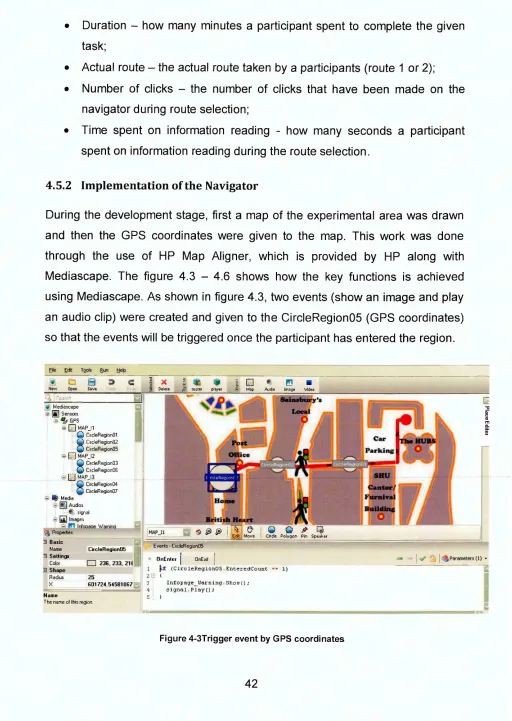
Figure 4-3Trigger event by GPS coordinates...42
Figure 4-4Use a timer... 43
Figure 4-5 Configure a timer...44
Figure 4-6 Create a user interface...44
Figure 4-7 Initial map layout...45
Figure 4-8Screenshots of the navigating screen...46
Figure 6-1 Experimental procedure diagram...54
Figure 9-1 Participants' responses to the experimental conditions...87
Table of Tables
Table 6-1 The experimental settings for intrinsic and extrinsic groups...56 Table 6-2The participants' motivational states before and after the given task (* Changing trends in motivational levels)...60 Table 6-3The effects of the influencing factors on participants' preference (* see Appendix A ) ...62 Table 6-4The participants' emotional states before and after the given task ....64 Table 6-5 Number of clicks on the navigator and time spent on information
reading...66 Table 7-1 The experimental settings for intrinsic and extrinsic groups...69 Table 7-2The participants' motivational states before and after the given task.72 Table 7-3The participants' emotional states before and after the given task ....73 Table 7-4The effects of the influencing factors on participants' preference 74 Table 7-5Number of clicks on the navigator and time spent on information
Abstract
As microchip and sensing technologies have developed, more and more context aware applications have been introduced to our daily lives. Many of the applications have been proposed to improve the quality of life, and furthermore, to engage the end users with a richer or augmented environment. However, although many researchers bring innovative ideas to the field of context aware computing, there is still a lack of human factors research in many projects, which could reduce the envisaged user acceptance and adoption.
This research takes a human-centred perspective, which mainly aims to explore the human factors and their relationships involved in context aware activities. Both deductive and inductive methods were used to achieve this aim. More specifically, qualitative methods like focus groups and interviews were used to identify the human factors in context aware activity. Quantitative methods like survey and empirical experiment were used to examine the relationships between the identified factors. The results of this research provided empirical evidence of the effects of different motivations on user's preference and behaviour in context aware adaptation. This influence was observed during the empirical experiment. A conceptual framework for the human factors involved in context aware activities was proposed and developed based on literature review and the results from the empirical studies, which consists of four sub-domains relating user’s motivation, perception, preference and subjective experience.
Candidate's Statement
During the course of my PhD, I wrote the following papers in conjunction with
my supervisors:
XIAOHUI, Zhang and URUCHURTU, Elizabeth (2011).A User Experience
Perspective of Design for Context-Aware Adaption. In: IE 2011 : 7th
International Conference on Intelligent Environments, Nottingham, 25-28 July
2011. IEEE, 322-325.d o i: 10.1109/IE.2011.47.
XIAOHUI, Zhang (2011). A User's Perspective of Design for Context-
Awareness.ln :UbiComp '11 : 13th international conference on Ubiquitous
Computing, Beijing, 17-21 September 2011. New York USA, ACM, 531 -
534.d o i: 10.1145/2030112.2030199.
CHRISTOPHER, Roast and XIAOHUI, Zhang (2012). Exploring the motivations
involved in context aware services. In: HCI 2012 : 26th BCS Conference on
Human Computer Interaction, Birmingham, 12-14 September 2012. Birmingham
1 In tro d u c tio n
1.1 Introduction to the research
As microchip and sensing technologies have developed, more and more
context aware applications have been introduced to our daily lives. The use of
context aware sensors and wireless connectivity, like GPS and WIFI, provides
many opportunities for data rich responsive applications, integrated with a
variety of products. Many of the applications have been proposed to improve
the quality of life, and furthermore, to engage the end users with a richer or
augmented environment, such as the GPS navigator and augmented reality.
However, although many researchers bring innovative ideas to the field of
context aware computing, there is still a lack of human factors research in many
projects, which could reduce the envisaged user acceptance and adoption.
Unlike many desktop applications, context aware services support users in
dynamic situations by utilizing surrounding context to help them manage and
utilise technology. It is by its nature highly dynamic since it responds to changes
in context of use, and this brings new challenges to interaction design.
Context aware adaptation is one of the most important concepts in context
aware computing. In general, contextual information is monitored and when it
changes the application or device configuration is changed to suit the new
situation. As a simple example, many portable devices use light sensors to
automatically adjust the backlight brightness for power saving. In this example,
the environmental brightness has been used as an indicator for adaptation.
Similarly, adaptation strategies for Quality of Service have been used by many
context aware applications to generate alternative reconfigurations when a
change in the context occurs. The problem here is that as well as systemic and
environmental factors, end users' internal states such as motivation may also be
unstable and produce different user preferences in context aware activities. For
instance, in the above example, an instantaneous adjustment of the backlight
brightness may not always make the user happy - people may not be able to
follow such adjustment because of both physical limitations (for example
changes in pupils' size) and psychological characteristics. Accordingly, the
adaptations of system configuration may raise user's awareness of the system,
or interrupt the user's ongoing activity and experience (see section 2.1.3).The
research of the user’s experience continues to increase in both academia and
industry. In addition to traditional components of usability, concepts such as
subjective experience have drawn increasing attention, as stated in the user
experience white paper (Roto et al., 2011) that "t/X(user experience) is not the same as usability, although usability, as perceived by the user, is typically an aspect contributing to the overall U X \ User experience of context aware applications, compared with desktop applications, may be influenced by various factors
involved in dynamic environments. Therefore, for the development of context
aware service, it is important to understand the relevant human factor issues in
order to promote the user experience.
Portable context aware devices, like GPS, have experienced a rapid
development in recent years. Such devices are usually limited by the lack of
size and ergonomic methods, which makes it difficult for the end users to
manage, for example the well-known fat-finger problem. In this regard, a better
understanding of the human factor issues involved in a context aware service
may contribute to the development of more effective interaction, by helping the
designers to optimize the interactive elements and processes.
1.2 Research aim and objectives
1.2.1 Research Aim
The aim of this research is:
"Exploring human factors in context aware activities."
1.2.2 Objectives
The specific objectives to achieve the above aim are identified as follows:
Objective 1:
Review the history and development of context awareness, and to identify the
major components of human factor issues involved in context aware activities
Measurement:
A conceptual framework will be proposed based upon the identified components
at the end of Chapter 2.
Objective 2:
Identify the human factors in a specific context aware activity based on the
above-identified components, using qualitative methods: focus groups and
interviews.
Measurement:
The identified factors will be listed in section 5.2.1, and used to help conduct
follow-on empirical experiment.
Objective 3:
Assess the relationships between the identified human factors through empirical
experiment. The data gathered by surveys will be statistically analysed, along
with the data collected in experimental task.
Measurement:
The relationships between the identified human factors will be revealed at the
end of this stage. This will be demonstrated in section 6.4 and 7.3.
Objective 4:
Further develop the proposed conceptual framework based on the above
identified relationships. This stage aims to provide a conceptual framework for
the human factor issues involved in context aware activities, which illustrates
the identified components and their relationships.
Measurement:
The framework will be presented and interpreted in section 9.1.1.
Develop an empirical approach to help the identification and evaluation of the
human factors involved in context aware activities. The developed approach
and the conceptual framework will be reviewed by interaction designers in a
workshop, in order to gain practical feedback.
Measurement:
This approach will be attached to this thesis as Appendix C, and the workshop
will be discussed in section 9.3.
These objectives will be evaluated in Chapter 8.
1.3 Research strategies
This research mainly consists of the following three phases:
1. Contextual Review - this phase will review the history and development
of ubiquitous computing and context aware applications, and then focus
on recognizing the challenges of context aware services from a user
centred perspective, and also exploring the human factors involved in
dynamic context aware adaptation through a literature review. This
phase aims to provide a fundamental basis for the following empirical
studies by reviewing related works in the field of human computer
interaction and psychology (see Chapter 2 and 3).
2. Identification of the influencing factors of user's preference - this phase
aims to identify the influencing factors of users' preference involved in the
proposed domain (see section 4.1) by using focus group discussion. The
identified influencing factors will be used to help conduct the following
between-group experiment (see section 4.2-4.3 and Chapter 6).
3. Evaluation of the effects of different motivations on user's preference -
this phase aims to examine the effects of different motivations on user's
preferences in digitally-assisted wayfinding activity. A controlled
between-group experiment will be designed and implemented in this
phase (see section 4.1, 4.3 and Chapter 6). Also, the results and
empirical findings from the experiment are expected to contribute the
understanding of human factor issues related to the design of context
1.4 Contribution
Based on the review of current knowledge in the field of ubiquitous computing,
context aware applications, human computer interaction and psychology, this
research proposes a conceptual framework for the human factors involved in
context aware activities, which mainly consists of four sub-domains including
user’s motivation, perception, preference and subjective experience. The
following empirical study examines the impacts of different motivations on user's
preferences in context aware adaptation, and further helps the understanding of
the relationships between the proposed sub-domains. Based on the findings,
the proposed framework was further developed.
As a result of the conducted research, the framework provides a better
understanding of the major human factors and their relationships involved in
context aware activities (see the section 9.1.1).Specifically the studies showed
that users’ preferences for different adaptation plans are greatly influenced by
their motivational states and subjective perceptions of situational/environmental
factors. But the influencing factors, such as user’s personal historical
experience, are difficult to detect and assess automatically. Therefore it is worth
considering ways to help end users express their expectations and policies in
context aware adaptation, and to observe what is happening in the system,
especially where context aware services which aim to promote subjective user
experience in dynamic situations (see the section 2.1.3, 9.1.1 and 9.1.2.2). The
empirical findings also imply that poorly designed interaction might cause
interruptions to user's experience of on-going activity (see the section 9.1.2.2).
In this sense, a good understanding of the human factors involved in a context
aware service will help designers to create more efficient interactions for user-
involved context aware adaptation.
In order to evaluate the effects of different motivations on user's preference in
context aware adaptation, a two-phase empirical study in the domain of
digitally-assisted wayfinding activity was developed and employed in this
research. The results show the capability of the used empirical approach in
identifying and evaluating the human factors and their relationships involved in
application. Therefore, this empirical approach was presented with the purpose
of helping researchers and designers to gain a better understanding of the
human factors involved in an activity, and thereby to develop more effective and
pleasant context aware services (see the section 9.3 and Appendix C).
1.5 Thesis structure
1. Introduction - Introduction to the research
This chapter briefly introduces the background, objective, strategies and
contributions of this research.
2. Context review
This chapter introduces the history and development of ubiquitous
computing and context aware applications, and then illustrates a
conceptual framework of context aware adaptation, including the role of
end users. The following sections discuss one of the major challenges of
context aware services facing dynamic situation and users' internal state,
which is how to ensure the user's satisfaction. The last section reviews
the related psychological literatures and preliminarily provides a
conceptual framework for the human factors involved in context aware
activities.
3. Research methodology
This chapter presents the paradigms and data collection methods that
are used in this research.
4. Approach and design of the studies
This chapter presents the design and approach of the studies that are
used in this research.
5. Identification of the influencing factors in route selection
This chapter presents the identification of the influencing factors of
people's preferences in the proposed domain, through a focus group
discussion.
6. Evaluation of the effects of different motivations on user's
preference
This chapter presents the preparation and results of the controlled
between-group experiment.
The implemented between-group experiment provided preliminary
evidence of the impacts of participants' motivation on their preferences.
However, some weaknesses of the empirical method were identified
during the data analysis. The initial method was therefore analysed and
improved to address the identified weaknesses. This chapter presents
the design, evaluation and results of the enhanced empirical method.
8. Review
This chapter presented a detailed review of this research, which mainly
includes how well the work presented in this thesis meets the initial
research objectives. The research process and the difficulties that were
encountered are also discussed. Based on that, recommendations for
similar research are given in the last section of this chapter.
9. Conclusion
This chapter concludes the present research with the summary, findings,
contributions and recommendations. It discusses the details, insights,
and rationale of the proposed framework for the human factors involved
in context aware adaptation. Also, other findings that emerged in the
2 Context Review
2.1 Ubiquitous computing and context awareness
2.1.1 History and development
Context awareness is usually linked to the term "Ubiquitous Computing".
Ubiquitous computing was first used in 1991 by Xerox PARC Chief Scientist
Mark Weiser. It has been initially defined as "the nonintrusive availability o f computers throughout the physical environment, virtually, i f not effectively, invisible to the user" (Weiser, 1993). In the early days of ubiquitous computing, many research efforts were focused on Location-Based services, such as outdoor
navigation (for example GPS) o r "a richly equipped network environment" th a t"the user-interfaces o f the applications themselves can fo llo w the user as they move, using the equipment and networking resources available" (Harter et al, 2002).
Along with the development of microchip and sensing technologies, more and
more new concepts and applications have been introduced in the field of
ubiquitous computing to improve the quality of our daily life and work, such as
the sensor-network-based smart home/health care system evaluated by Jakkula
et al (2007). More specifically, context aware applications use various sensors
to utilize the context changes and resources available through physical
environments. For example in the study by De Silva (2009) on smart home, four
different active sensors (temperature, motion, height, and pressure) have been
used to detect the human activities in a room. A video based analysis has been
used to understand the human actions in a home environment, such as entering,
walking, exiting, standing, sitting, using a PC, taking an object, placing an object
and any other unusual event including falling. De Silva states that these
activities can also be used by an automatic agency to control the room lighting,
air-conditioning etc. to reduce the cost of electricity.
The term "Context-Awareness" has been introduced to describe the link
between changes in environment with computer systems, and context aware
system including any devices or applications which are able to adapt
themselves to improve the system efficiency or user experience according to
dynamic context aware entities (Nilsson et al., 2006). As one the most important
suggested contextual attributes (entities) can include "The attributes o f the physical and software platform used fo r interacting with the system", such as data
flow, screen size or network bandwidth, and "the environmental attributes that describe the physical surroundings o f the interaction", such as user actions or light conditions (for example the human actions in De Silva's study).
Apart from smart environments, context aware applications are also highly
related to mobile computing. As Hakkila et al. (2009) states, Context-Awareness
is one of the rising trends of future mobile technology, and they further define
the Context-Awareness in a mobile technology domain as:
"A state where the device is aware o f the situation in which it is used, can be harnessed to serve numerous different types o f use cases where the system adapts its behaviour according to the circumstances."
For example, some mobile phones with integrated brightness sensor like Nokia
e71 can automatically adjust the backlight to save the batteries.
In recently years, many research efforts have focused on the development of
Location-based applications, as Hakkila et al. suggested that:
"Location-based applications form a significant area within mobile
Context-Awareness, and have great potential f o r future commercial applications; this is particularly relevant with today's GPS-enabled mobile devices with mobile maps. Common applications demonstrating location-awareness are tour guides in the city, campus or museum environments, shopping assistants, messaging systems, and location-sensitive reminders". (Hakkila et al. 2009)
Other context aware location-based services, such as augmented reality,
provide great opportunities for everyday use and entertainment of the future.
2.1.2 The conceptual framework of context aware adaptation
An important concept in many emerging context aware applications is utilizing
the context changes and resources available through physical environments. In
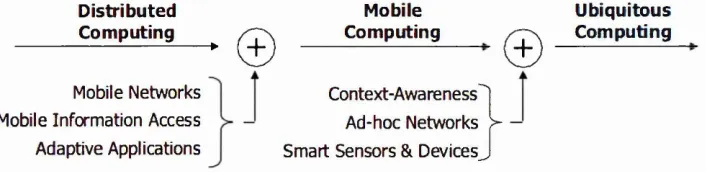
is "a major issue in recent research work in the area o f ubiquitous computing systems which are specialisations o f mobile, distributed systems", as shown in figure 2.1.
D istributed C om puting
©
Mobile Com puting
©
U biquitous C om puting >
Mobile Networks Mobile Information Access
Adaptive Applications
Context-Awareness Ad-hoc Networks
[image:20.612.135.488.79.165.2]Smart Sensors & Devices
!}
Figure 2-1 Evolution Chain taken from Strand and Linnhoff-Popien (2004)
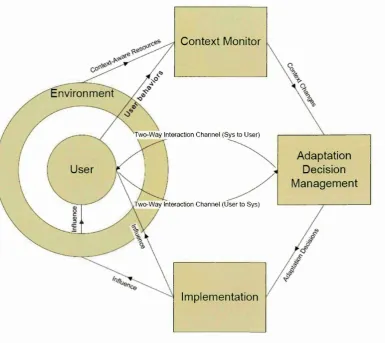
At the infrastructure level, Geihs et al. (2009) concluded a conceptual functional model for context aware systems, consisting of the following three components:
1. Context Monitor - monitors the context, detects context changes and reason about the relevance of these changes;
2. Adaptation Decision Management (ADM) - make decisions about what adaptation to perform;
3. Implementation - implements the adaptation choices, i.e. reconfigure the user interface or attributes of applications.
2.1.3 Context aware adaptation: model and challenges
state like motivation and preference are also highly dynamic and influenced by
environmental factors; therefore, the question of interest is: how can we ensure
that dynamic context aware adaptations are able to meet end user's
changeable internal state? Those difficulties are also emerging at the
infrastructure level of context aware applications, as Angermann and Robertson
(2005) argued that “A major issue in most context-aware systems is how to deal with uncertain, incomplete or ambiguous data", such as end user's internal state.
In order to clarify the influential factors that affect user's preference in context
aware adaptation, a more complete conceptual framework of context aware
adaptation has been developed which consists of context aware system,
environment and end user, as shown in figure 2.2. The end user not only
interacts with context aware systems but also with environment. For example, a
driver needs to react to both GPS navigator and dynamic situations on road (e.g.
road condition). Meanwhile, users’ internal state, such as motivation, perception,
preference and emotional state can also be influenced by environmental and
situational factors. The interaction of all these factors makes it very difficult to
detect user's needs. This problem is very hard to solve even from a static point
of view. In regard to user interface consistency, Grudin (1989) described how
difficult it will be to organize interface in accordance with the rule that
"consistently default to the item the user is most likely to select next" - It
requires a detailed knowledge of target users and their tasks.
A possible solution to this problem, as Angermann and Robertson (2005)
suggested, is the actual end user could be treated as an additional domain
expert for human issues because “he or she is the person who often has the best understanding o f the personal domain’. In a study of the most relevant current approaches to modelling context for ubiquitous computing by Strand and
Linnhoff-Popien (2004), a number of existing approaches have been evaluated
according to six requirements. A problem with their evaluating standards is the
absence of end users, as Salehie and Tahvildari (2009) summarized that much
of the self-adaptive software do not have a human in the loop for policy
changing or tracing adaptation processes. They further stated that the user
involvement includes either express their expectations and policies, or to
self-adaptive software is to provide an appropriate mechanism for collecting user policies, and establishing a proper mechanism to involve humans in the adaptation loop.
Context Monitor
nvironment
Two-Way Interaction Channel (Sys to User)
Adaptation Decision Management User
.Two-Way Interaction Channel (User to Sys)
[image:22.613.125.511.86.429.2]Implementation
Figure 2-2 Conceptual framework for context aware adaptation
But it does not mean that designers should use end user as a "human- processor" in context aware adaptation decision-making process. Poor designed, complicated monitoring and control usually leads to low efficiency and poor user experience. As Scott Jenson (2002) suggested that there are four types of blindness within consumer product design, including user blindness, feature blindness, innovation blindness and implementation blindness. Feature blindness refers to:
"being awash in sophisticated features. Usually, so many must be crammed
into the product, the design becomes muddled and hard to understand. While
the sheer number o f features is a large part o f the problem, the real cause o f
cornucopia o f features, the product ends up overwhelming the users, so they don’t know where to start with the p roduct" (Scott Jenson, 2002)
In simple terms, end users are not computer processor that is able to effectively
handle multiple tasks at the same time. On the other hand, poor designed
monitoring and control for user-involved context aware adaptation may interrupt
user's experience of on-going activity, or as Csikszentmihalyi (1975) argued,
interrupt the "flow" (which a person is fully immersed in a feeling of energized focus, full involvement, and enjoyment in the process of an activity). Therefore,
designers must have an in-depth understanding of the human factors involved
in a context aware activity, in order to develop more effective interaction
techniques for helping end users express their expectations in dynamic context
aware adaptation, and to observe what is happening in the system.
2.2 Human factors
In order to study the human factors involved in context aware adaptation, it's
necessary first to understand the underlying foundation behind user's
preference and behaviour. In 1988, Donald Norman (pp. 47-49) proposed in his
book that human action consists of two aspects, execution and evaluation.
Execution involves doing something and Evaluation is the comparison of what
happened in the world with what we wanted to happen. Evaluation starts with
our perception of the world and this perception must then be interpreted
according to people’s expectations and then compared with respect to both their
intention and their goals. The following sections will explore the relevant
literature with a specific focus on people's motivation (reasons behind goal),
perception, preference (reasons behind intention) and emotion (refers to
subjective user experience).
2.2.1 Motivation and preferences
In general, motivation can be classified into two types: intrinsic and extrinsic.
Intrinsic motivation refers to motivation that is driven by pleasure or satisfaction
that comes from the task itself, and extrinsic motivation generally refers to
activities that could only be prompted from outside of the individual, such as
One of the earliest theories of motivation that considered both psychological
and physical factors was Drive-reduction Theory (Friedman and Schustack,
1999, pp. 201-202), which argued that a physiological need creates an aroused
state that drives the organism to reduce their needs, such as food and drink.
When a need is satisfied, drive is reduced and the organism returns to a state of
homeostasis - the maintenance of a steady internal state. On the other hand,
people are not only pushed by our "need" to reduce drives, but also by
incentives - positive or negative stimuli that lure or repel us.
Another important development in this field is the Reversal Theory, created and
developed by K.C.P. Smith and Michael Apter (2013), in order to account for
observations of psychological, emotional and motivational states reversals, in
child and family clinics. This early work led to the description of a dynamic
system, based on the concept of the “reversal”: the switching between opposed
motivational states. For example, you can eat being serious and pursuing a goal
in eating, or being in a spirit of seeking pleasure in the moment. Thus, “serious,
future-oriented” and “playful, focused on the present” are two possible (and
opposite) motivational states that can be associated with the activity of eating.
The theory is structured around four domains of experience, each
corresponding to two opposed motivational states:
• Means-Ends - The two states in the first pair are called "Telic" (or
"Serious") and "Paratelic" (or "Playful") and refer to whether one is
motivated by achievement and future goals, or the enjoyment of process
in the moment.
• Rules - The next two states are called "Conforming" and "Rebellious" (or
"Negativistic") and refer to whether one enjoys operating within rules and
expectations; or whether one wishes to be free and push against these
structures.
• Transactions - The next two states are called "Mastery" and "Sympathy"
and relate to whether one is motivated by transacting power and control;
or by care and compassion.
• Relationships - The final two states are called "Autic" (or "Self') and
interests (personal accountability and responsibility) or by the interests of
others (altruism and transcendence).
The key concept of the Reversal Theory is that only one state in each p a ir can be active at a time. Therefore a person can only be either goal or pleasure oriented at a time. Goal Directed Selection (Yantis, 1993) may provide some support for
the Reversal Theory, which people are more likely to focus their attention on
goal-related parameters when they are goal motivated - one side or the other.
In recent years, the relationship between user's motivation and preference has
drawn increasing attention from HCI researchers. Hassenzahl (2003, 2008)
suggested that people perceive interactive products along two different
dimensions, which are Pragmatic quality - refers to the fulfilment of task-related
“do-goals” (e.g. make a phone call, usability) and non-instrumental Hedonic
quality - refers to the fulfilment of “be-goals” (e.g. novelty, beauty or being
competent). He argued that the perceived quality of interactive products heavily
depends on features of the context of use, such as whether an individual has to
perform a specific task or not (2003). Hassenzahl and his colleagues (2008,
2010) have conducted a series of studies showing that the user's preference for
different music players can be influenced by pre-set scenarios. The studies
provided further support to the idea that:
"hedonic quality being a “ motivator”, capturing the product’s perceived ability to create positive experiences through need fulfilm ent and pragmatic quality being a “ hygiene fa c to r”, enabling the fulfilm ent o f needs through removing barriers but not being a source ofpositive experience in its e lf"
A relevant argument regarding their findings that of Abraham Maslow (1997),
suggesting that deficiency need is a need which creates a negative feeling if not
fulfilled, but does not contribute much to a positive feeling. In order to
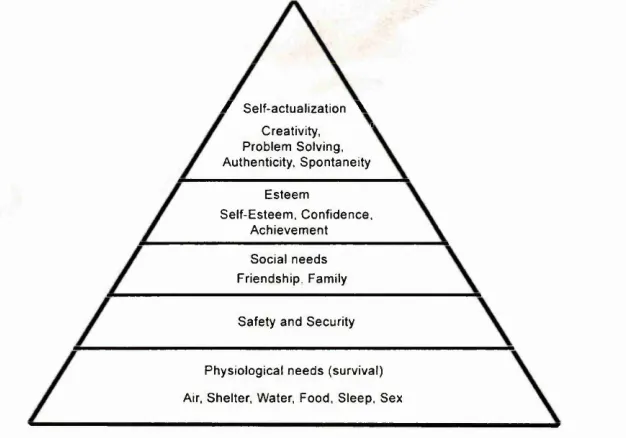
understand the different priorities of human needs, Maslow (1943) described a
hierarchy of needs, as shown in the figure 2.3. He also argued that only when
our lower-level needs are met, then we will be prompted to satisfy our higher-
I Self-actualization \ Creativity, * Problem Solving, Authenticity, Spontaneity
Esteem Self-Esteem, Confidence,
Achievement
Social needs Friendship. Family
Safety and Security
Physiological needs (survival)
[image:26.612.159.472.16.235.2]Air, Shelter, Water, Food, Sleep, Sex
Figure 2-3 Maslow Hierarchy of Needs Diagram (Myers, 2009)
In summary, motivation is the major driving force behind our behaviours (see Drive-reduction Theory), and it largely determines what we will do when we face opportunities. On the other hand, our preferences may be influenced by different factors depending on the type of motivation (see the Reversal Theory
and Hassenzahl’s studies).Therefore, in order to understand users’
expectations in dynamic context aware adaptation, it's necessary to first clarify the relationship between user’s motivation and preference.
2.2.2 Perception
pp. 47-49) proposed seven stages of action to describe the process of human
behaviours, which consists of Forming the Goal, Forming the Intention,
Specifying an Action Sequence, Executing an Action, Perceiving the State of
the World, Interpreting the State of the World and Evaluating the Outcome, as
shown in the figure 2.4 (1988, p. 47). As described earlier, he also proposed
that human action consists of two aspects, execution and evaluation. Execution
involves doing something and Evaluation is the comparison of what happened
in the world with what we wanted to happen (Norman, 1988).
Sequence o f actions
Interpreting the perception
Execution o f the action sequence
Goals
Perceiving the state o f the world Intention to act Evaluation o f
interpretations
[image:27.613.151.411.191.488.2]World
Figure 2-4 Seven Stages of Actions (Norman, 1988)
Evaluation starts with our perception of the world and this perception must then
be interpreted according to our expectations and then compared with respect to
both our intention and our goals. In summary, perception is usually the
beginning of our daily activities, and user’s role in context aware activities is
2.2.3 Subjective experience
As one of the most important components of user experience, subjective
experience and emotion have drawn more and more attention in the field of HCI.
As described in section 2.2.1, subjective experience can be promoted through
need fulfilment and removal of barriers. At a very basic level, human behaviours
and preferences can be manipulated by reinforcements. The two types of
reinforcers are primary (e.g. getting food when hungry) and conditioned
reinforcers. Conditioned reinforcers, also called secondary reinforcers, get their
power through learned association with primary reinforcers. Our lives are filled
with conditioned reinforcers - money, good grades or a pleasant tone of voice -
each of which has been linked with more basic rewards (Myers, 2009, p. 307).
The secondary reinforcers are greatly influenced by our personal historical
experience - we only respond to a conditioned stimulus if we have already
learnt it.
One of the most important developments in the field of emotion research is the
Two-Factor theory proposed by Stanley SchAchter and Jerome Singer (1962).
The Two-Factor theory suggests that our physiology and our cognitions -
perceptions, memories, and interpretations - together create emotion. It argues
that our emotions have two ingredients: physical arousal and a cognitive label.
Like James and Lange (Cannon, 1927), Schachter and Singer presumed that
our experience of emotion grows from our awareness of our body's arousal, as
shown in the figure 2.5. They also believed that emotions are physiologically
similar. In summary, an emotional experience requires a conscious
interpretation (refers to reinforcers) of the arousal (Myers, p. 498). Research in
the field of HCI also suggested that people "can have indirect experience before
their first encounter through expectations formed from existing experience of
related technologies, brand, advertisements, presentations, demonstrations, or
others’ opinions" (User Experience White Paper, 2011). Therefore, both
perception and personal historical experience play important roles in the
Schachter-Singer Two-Factor -—^ T h e o r y
James-lange Theory
Fear (em o tio n ) Pounding h eart
(arousal)
Fear (em otio n)
Pounding h eart (arousal)
"I'm afraid" (Cognitive label) Sight o f oncom ing car
[image:29.612.137.507.20.270.2](perception o f stimulus)
Figure 2-5 Theories of Emotion (Myers, 2009)
Emotion is also closely related to performance. Csikszentmihalyi (1975) argues
that there is a balance of skill and challenge to achieve positive experience
(“enter the flow”). A similar argument has been proposed by Edward L. Walker,
and he argued that subjective complexity determines preference (also known as
a hedgehog theory, Russell, 2008). Furthermore, he indicated that organisms
prefer to do things that are neither too simple nor too complex but at an
optimum level of complexity, as shown in the figure 2.6.
Optimal Complexity
0) 0
High LOW
Complexity
Figure 2-6The inverted-U function in W alker's Hedgehog theory taken from Russell (2008)
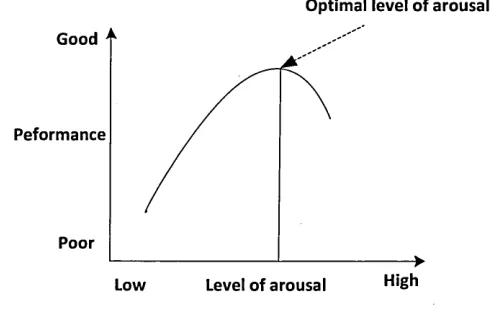
The problem is that people's ability to execute a task is unstable - it increases
[image:29.612.195.440.470.634.2]too aroused, and then their performance falls off sharply (Yerkes and Dodson,
1908), as shown in figure 2.7. On the other hand, psychologically well-practiced
tasks are carried out by using automatic processing rather than controlled
processing, which required less attentional resources and usually provides
better performance (Birnboim, 2003). Therefore, in order to promote user's
subjective experience, designers at least need to pay attention to three pairs of
relationships, including skill-challenge, arousal-performance and ski 11-practice.
Optimal level of arousal Good ^
Peformance
Poor
High Level of arousal
[image:30.612.205.450.177.342.2]Low
Figure 2-7The Yerkes-Dodson Law
2.3 Participatory design and human factors
As discussed earlier, people's preferences may be influenced by their
motivations. It may bring new challenges to interaction design and research.
Participatory design (PD) is a widely used technique and also a maturing field of
research (Kensing&Blomberg, 1998). These years, PD has been introduced to
the field of ubiquitous computing and context awareness. While some recent
projects have attempted to put configuration into the hands of users, there is still
much work to do on integrating PD with ubiquitous computing (Hornecker et al.,
2006).
Participatory design generally helps designers and researchers understand their
potential users and objective domain, as Clay Spinuzzi states:
workflow, and work environments; and argues that this partnership must be conducted iteratively so that researcher-designers and participants can develop and refine their understanding o f the activity. The result o f the research typically consists o f designed artefacts, work arrangements, or work environments." (2005)
On the broader perspective, the skills and experiences of workers need to be
present in the design and organizational implementation of computer systems,
in order to ensure a better fit between technology and the ways people perform
their work (Kensing & Blomberg, 1998). An example of participatory design is
Plastic Interface for Collaborative Technology Initiatives through Video
Exploration (also known as PICTIVE) that developed by Michael J. Muller
(1991). PICTIVE usually use simple instruments like paper mock-up to create
representations of graphical user interface, in order to show participants how a
system will look like and how it will behave once it is finished. Participants will
be required to manipulate the mock-up so it becomes easier for them to use.
The participant's behaviours will be recorded by designer or researchers to
explore the potential tacit issues.
An important concern involved in participatory design is how to obtain an
accurate understanding of potential users' abilities, requirements and
preferences. The success of a participatory design can therefore be influenced
by many factors. For example, in the early days of participatory design,
managers from workplace rarely participated with workers in such projects. The
reason for this was that management's participation would silence the voices of
workers and undermine the goal of increasing worker's say over their working
conditions (Kensing & Blomberg, 1998). A possible solution, as Torpel (2006)
stated, was to separate the weak and the strong parties from each other, so that
the strong parties could not dominate the situation, exert their power of shaping
and defining topics, functionality, meaning, relevant work/life conditions.
Participatory design can also be influenced or even misled by culture issues.
Heike argues that participatory design methods are highly cultured and not
universally applicable. True participatory design, especially in a cross-cultural
context, can only be achieved if the participatory process itself is appropriated
The design game, an important method in participatory design, is a highly
collaborative technique. Participants in design game will explore various design
possibilities within a game setting. A potential problem of the method, as Torpel
(2006) argued, is:
"The variety o f dealing with concrete form s o f work and organization o f taking f o r granted when using the design game can take the form s o f mistakenly assuming certain features o f work and organization that are not present, or seemingly neutrally notice the existing fo rm o f work or organization, without taking into account possible meanings, implications, historical changes and development potentials."
From a dynamic point of view, this problem may emerge in various forms - if
participants' preferences are influenced by their motivations to participate, then
the inconsistency between motivations in real-life task and experimental task will
result in misunderstanding of real-users' needs. In this respect, it's important to
clarify the influence of different motivations on participants' preferences in order
to promote participatory design in ubiquitous computing and context aware
applications.
2.4 Conclusion
Unlike many desktop applications, ubiquitous computing engages the end users
with a richer environment by utilizing surrounding context to help them manage
and utilise technology. Accordingly, context aware adaptation by its nature is
highly dynamic since it responds to changes in context of use. A major issue in
most context aware systems is how to deal with uncertain, incomplete or
ambiguous data, which includes not only systemic and environmental factors,
but also user's internal states like motivation and perception. Such human
factors are dynamic and may produce different user's preferences in context
aware activities. Similarly, subjective user experience is influenced by many
dynamic factors, but the influencing factors like personal historical experience or
arousal, are difficult to detect and assess automatically. Therefore it is worth
considering ways to help end users express their expectations and policies in
context aware adaptation, and to observe what is happening in the system,
experience in dynamic situations. Accordingly, an in-depth understanding of the
human factor issues involved in a context aware activity may help develop more
effective interaction techniques. As a simple example, the parameters that have
been identified as less influential in user's decision making could be moved to
the advanced options, in order to simplify the user interface design.
However first of all, it's necessary to understand the components and their
relationships to the human factor issues involved in context aware activities. As
stated and discussed in section 2.1.3 - 2.2.3, the human factors involved in
context aware adaptation consists of perception, motivation, preference and
subjective experience (PMPE). In order to provide a more solid theoretical basis
for the proposed PMPE framework, follow-up studies will be done to evaluate
the effect of different motivations on user’s preference, and also to study user’s
3 Research M eth odology 3.1 Overview
Based on the review and discussion in Chapter2, this chapter first presents the
main question that this research attempts to answer. The following sections
discuss the research paradigm and approach that are used in this research.
The last section of this chapter introduces the data collection methods that are
used according to the research objectives.
3.2 Research question
As discussed in Chapter 1 and 2, the main research question is:
Do different motivations affect users' preference in dynamic context
aware adaptation?
Accordingly, the null and alternative research hypotheses under investigation
are as follows:
• Null hypothesis: There is no difference in preference between intrinsically
and extrinsically motivated users.
• Alternative hypothesis: There is a difference in preference between
intrinsically and extrinsically motivated users.
If the null hypothesis is rejected, then the following investigation will consider
how different motivations influence users' preference.
3.3 Research paradigm
Research paradigm is an interpretative framework that guided by “a set o f beliefs and feelings about the world and how it should be understood and stu d ied \Guba,
1990).The two widely accepted research paradigms are positivism and
view o f writers who have been critical o f the application o f the scientific model to the study o f the social w orld'- they believe that there is a fundamental difference between people and the objects of the natural sciences (Bryman, pp. 28-30). An
important point to be clear about is that each of the two paradigms - positivism
and interpretivism - has its own advantages in some areas (Saunders et a/.,
2007). Therefore this section will focus on the distinction between these
paradigms with regard to the nature of this research.
In order to understand positivism as a paradigm of human knowledge, two
related suppositions were identified by Giddens (1975). First, the
methodological procedures of natural science may be directly applied to the
social sciences. Second, the end-product of investigation by social scientists
can be formulated in terms parallel to those of natural science. Positivism
generally claims that science provides us with the clearest possible ideal of
knowledge. Accordingly, positivism in social and human sciences usually tries
to create law-like theories to explain human behaviours in social activities.
However, it is “less successful in the study o f human behaviour where the immense complexity o f human nature and the elusive and intangible quality o f social phenomena contrast strikingly with the order and regularity o f the natural w orld’ (Cohen et a/., 2003, p. 9). By contrast, interpretivism has been critical of the application of the
scientific model to the study of the social world and who have been influenced
by different intellectual traditions. It is “predicated upon the view that a strategy is required that respects the differences between people and the objects o f the natural sciences and therefore requires the social scientist to grasp the subjective meaning o f social action’ (Bryman, 2012, pp. 28-30).
According to the proposed research question that “do different motivations
affect users' preference in dynamic context aware adaptation”, positivistic
methods can be used to examine the relationship between the two human
factors (motivation and preference), mainly including survey and empirical
experiment. On the other hand, this research also attempts to investigate user’s
perception and subjective experience in context aware activities, and both of the
factors may be greatly influenced by different learning histories between
different users (see section 2.2.2 and 2.2.3). In consideration of that, focus
3.4 Research approach
In the early days of HCI research, measurement was based on standards for
human performance from human factors and psychology. Accordingly the
metrics are very much based on a task-centred model, including task
correctness, time performance, error rate, time to learn, retention over time, and
user satisfaction. These metrics are still well-accepted, however many of the
phenomena that interest HCI researchers cannot be measured in a quantitative
way (Lazar, 2010, p. 5). New ways of research and forms of measurement are
needed to answer questions like “why people no longer used a specific interface”
or “how people use portable/mobile technology”.
Research can be quantitative or qualitative or a mix of both. Quantitative can be
construed as a research strategy that emphasizes quantification in the
collection and analysis of data. It entails a deductive approach to the
relationship between theory and research, in which the accent is placed on the
testing of theories. By contrast, qualitative research can be construed as a
research strategy that usually emphasizes words rather than quantification in
the collection and analysis of data. It predominantly emphasizes an inductive
approach to the relationship between theory and research, in which the
emphasis is placed on the generation of theories (Bryman, 2012, pp. 35-36).
The key issue when choosing a correct research approach to examine or
explore a particular research problem is the suitability of the selected method to
accomplish and address the research objectives (Saunders et al., 2007, p.
610).According to the main research question, a quantitative approach will be
employed to examine the relationships between user’s motivation and
preference through empirical experiments. Self-reported surveys will be used as
source of quantitative data, mainly including user’s motivational level and
preference. In order to conduct the empirical experiments in the domain of a
specific context aware activity (wayfinding, see section 4.1 for the further
details), a focus group study will first be used to identify the human factors in
the activity. Unstructured interview may also take place in the empirical
experiments, the information gathered is hoped to be used to explain user’s
internal states and behaviours. In summary, both quantitative and qualitative
3.5 Data collection and analysis
This section discusses the data collection and analysis methods used in this
research in regard to the proposed research question and objectives, which
focuses on user’s motivation, preference and subjective experience. In the field
of affective science multiple methods have been developed to measure
people’s emotions and subjective experiences, such as surveys and monitoring
of physiological symptoms (changes in breath and heartbeat, stomach troubles,
muscles relaxing, et al.). The monitoring of physiological symptoms usually
requires specific experience and specialized equipment. Comparatively
speaking, measures for people’s motivations are more relied on self-reported
surveys that developed based on existing theories (see section 3.5.1).
Considering the research aim and resources available, it was decided to use
self-reported surveys as the main measuring tools in the following experiments.
The details are discussed in the following sections.
3.5.1 Motivation
The main aim of context aware computing is to support users in highly dynamic
situations, so the evaluation method for users’ motivational states should be
able to assess their instant motivations, rather than long-term life goals. Based
on self-determination theory, Vallerand (1997) proposed a hierarchical model
which consists of global, contextual and situational level for different terms of
motivations. Motivation at the global level reflects how an individual generally
interacts with his or her environment, be that in an intrinsic, extrinsic, or
amotivated fashion (Vallerand & Rousseau, 2001, pp. 389-416). At the
contextual level, motivation pertains to a relatively stable motivational
disposition that one adopts toward a particular context, such as sport, work, or
education. Motivation at the situational level reflects why individuals engage in a
specific activity at a particular time (Vallerand, 1997, pp. 271-360). In the
intention to assess motivational states at the situational level in different
contexts, Guay and Vallerand have developed the Situational Motivation Scale
(SIMS, Guay and Vallerand, 1995; Guay et al., 2000, pp. 175-213). The SIMS is
a 16-item self-report inventory (see Appendix A) designed to measure the
regulation, external regulation, and amotivation) in both laboratory and field
settings.
• Identified regulation - refers to relatively autonomous behaviours that
occur when individuals come to value a certain activity as important to
their personal goals (e.g., “I participate in exercise for my own good”);
• External regulation - refers to non-autonomous behaviours that are
underpinned and dictated by externally controlled factors such as reward,
payment, or threats (e.g., “I participate in PE because I have to”);
• Amotivation - refers to individual does not perceive contingencies
between his or her behaviour and subsequent outcomes (e.g., “I
participate in sport but I’m not sure it’s worth it”).
The reliability of the SIMS has been assessed by Standage et al. (2003, pp. 19-
43) in two studies. Both studies consisted of a large sample size (n1=978,
n2=1008) and as the authors concluded, the SIMS represents a promising
measure of motivation at the situational level applicable to both field and
laboratory settings. For the pre-post experimental design, results from multiple
regression analyses (Guay et al., 2000, pp. 175-213) showed that the SIMS
was sensitive enough to detect intraindividual changes in motivation. The SIMS
was further assessed by Standage et al. (2003). Their studies showed that two
items produced scores that did not conform to the hypothesised factor structure.
Following their suggestions, the scores of the two items should be removed
before the data analysis. The two advantages of the SIMS are that: 1) the scale
is short and versatile that makes it possible to capture ongoing motivational
regulations at the psychological state level and 2) it is not restricted to one
context and it can be readily applied to many field and laboratory settings. Both
of the above advantages make the SIMS suitable for the assessment of
motivational states in context awareness research. Therefore the SIMS was
chosen to be used in follow-up experiment.
3.5.2 Subjective Experience
For the purpose of exploring participant's subjective experience and its
relationship with other human factors, a competent evaluation method for user's
ethnographic and emotional study has become an important trend in the field of
human computer interaction. Many research efforts have been devoted to
develop a universal definition of user experience. Although it's hard to
generalize because different aspects and landscapes have been chosen, many
researchers agree that user experience is dynamic, context-dependent and
subjective (Lai-Chong Law, et al., 2009). However, several psychological
methods have been introduced into the field. Two commonly used methods for
subjective experience evaluation are Positive Affect and Negative Affect scales
(Watson, et al., 1988, pp. 1063-1070) and Pleasure-Arousal-Dominance
emotion scales (Mehrabian and Russell, 1974, 1977).
The Positive Affect and Negative Affect scales (PANAS) consists of 20 verbal
descriptors of different affective experiences, including afraid, scared, nervous,
jittery, irritable, hostile, guilty, ashamed, upset, and distressed for negative
affect and active, alert, attentive, determined, enthusiastic, excited, inspired,
proud, strong and interested for positive affect. Participants indicated how much
they experienced the particular effect on a five-point scale ranging from not at
all to extremely. The PANAS allow researchers to examine the user experience
of a product as a whole, rather than numbers of irrelevant fragments. In a study
on the relationship between universal psychological needs fulfilments and
emotional affects by Hassenzahl, Diefenbach and Goritz (2010), the PANAS
was successfully used for the evaluation of the emotional effects on interactive
products.
The Pleasure-Arousal-Dominance emotion scales (see Appendix A) is a three-
dimensional emotion state measurement that developed by Mehrabian and
Russell (1974, 1977). In their three dimensional model, Pleasure-Displeasure
refers the positive-negative emotion state; Arousal-Non arousal refers to how
active a person is (e.g. sleep or excited) and Dominance refers to the extent to
which a person feels unrestricted or free from outside control. The PAD emotion
scales consist of a set of 18 bipolar adjective pairs. Each of the three
dimensions has been measured by six pairs. The PAD scale scores can be
used to indicate the accurate emotional state for the participants, such as bored
(P—, A--, D-), curious (P+, A++, D-) or unconcerned (P-, A--, D+). With respect
for the measurement of emotional state, which made it become possible to
assess the user’s internal states in that domain. Therefore the PAD emotion
scales were chosen to be used in follow-up empirical experiment.
3.5.3 Preference
According to the research objectives, fist the influencing factors of user’s
preference in a context aware activity will be identified through a focus group
study. The influence of the identified factors on user’s preference will be
evaluated in follow-up experiments. A measurement was therefore needed to