Designing gamification for constructive competition
FEATHERSTONE, Mark <http://orcid.org/0000-0001-6701-6056>
Available from Sheffield Hallam University Research Archive (SHURA) at:
http://shura.shu.ac.uk/22572/
This document is the author deposited version. You are advised to consult the
publisher's version if you wish to cite from it.
Published version
FEATHERSTONE, Mark (2018). Designing gamification for constructive competition.
In: GERIL, Philippe and KING, David, (eds.) GAME-ON 2018 - 19th International
Conference on Intelligent Games and Simulation. Belgium, Eurosis-Eti, 138-143.
Copyright and re-use policy
See http://shura.shu.ac.uk/information.html
Designing Gamification for Constructive Competition
Mark Featherstone Sheffield Hallam University
Sheffield
Email: [email protected]
Keywords
Gamification, mobile, education, constructive competition, video games
Abstract
This paper examines the need for constructive positive extrinsic motivational competition within gamification projects. Gamification takes common game design principles such as points, leaderboards and competition, then applies them to non-gaming activities. Participants often require extrinsic motivators to engage with gamification, such as financial reward, compulsory participation or prizes. This approach can reduce intrinsic motivation, creativity and sense of agency. One powerful extrinsic motivator is competition, which can be effective even without any real world prize. Competition can be divided into constructive and destructive types. Destructive competition can cause anxiety and lower self-esteem in participants. Constructive competition is motivating without these negative side-effects. It isn't possible to guarantee that a competition will be constructive, but there are broad principles that can be applied to design for constructive competition. These principles were investigated using a purpose built mobile application called UniCraft. This app was used in a cross-over study with university students in an attempt to increase their satisfaction with one of their subjects and it featured a 3D video game-like competitive battle mode. Online analytics recorded a statistically significant increase in app usage when this competitive game mode was enabled.
Introduction
To gamify an activity is to take something that is not game-like and then wrap game design principles around that activity
(Deterding et al., 2011a), for example increasing your heart rate beyond a previous exercise session earns points, displayed on a leaderboard (Whitson, 2013). When game design principles are applied to an activity, people have a tendency to find that activity more compulsive, which some perceive as being more fun (Hopson, 2001). Points, leaderboards and achievements tend to make it easier for 'players' to judge their progress and aptitude for a task both alone and in comparison to others. Gamification can have the following positive impacts on any task (Deterding, 2015):
• The task becomes more enjoyable due to the new sense of playfulness.
• The task is performed correctly.
• The 'player' increases their productivity.
• The task is performed to a higher quality.
However, gamification often reduces intrinsic motivation, a desirable state where a participant is engaged fully with a task, often in a state of flow (Chen, 2007), it's a condition of optimal learning potential and creativity. The participant is engaged with the task for its own sake with no outside coercion.
Reduced intrinsic motivation can manifest negatively within the individual in a number of ways (Fuchs et al., 2014; Raczkowski, 2013):
• A loss of agency.
• Reduction in creativity.
• A loss of self-worth.
• A loss of interest or engagement with the activity.
• Feelings of oppression or that the system is overly prescriptive.
Gamification requires progress within any activity to be measured so points can be awarded or removed. Measuring an activity means defining it in detail, which can reduce the creative freedom of participants. Such measurements are often made public via a leaderboard to encourage participants to compete and compare their progress.
Competition is an extrinsic motivator, people are generally competitive and it can provide an extra impetus to progress. This can cause anxiety, demotivation and stress (Hanus and Fox, 2015; Lepper and Malone, 1987; Shafer, 2012).
Rewards provide further extrinsic motivation when they are of value to participants. Rewards can be linked into compulsory participation, for example, a prize for students achieving a certain grade. Participants can focus on the reward instead of the activity, becoming disillusioned if they don't get the reward or unhappy with the value of the reward (Deci and Ryan, 2000).
It's not possible to predict with accuracy how human participants will respond to gamification schemes, just as it isn't possible to guarantee the success of a video game design (Koster, 2013). However, like video game design methodology, there should be a 'best practice' approach to the design of gamification (Deterding, 2015). This paper analyses the design of competition in gamification. The term, 'constructive competition' refers to competitions designed to avoid negative side-effects which might reduce intrinsic motivation.
Design
What follows is a set of 'best practice' guidelines that can be applied when designing for constructive competition.
Non-prescriptive measurement
Any complex activity can be distilled into measurable sub-tasks, with points awarded for completion. Sometimes a sub-task has a very specific methodology, especially if there are health and safety implications. Often, sub-tasks can be more general or fluid in their definition of methodology and outcome. This supports
the participant's desire for independence and agency (Deci and Ryan, 2000).
Team based play
When participants compare their progress, scores can represent the individual or the group. When participants feel they are acting together as part of a group, the impact of success or failure is shared. Persevering together and even failing together can foster a feeling of comradeship and mutual support that nurtures friendships.
Cohort based play
To compare progress and compete doesn't mean pitting one group against another. In video game design this is known as PvP and can be very stressful. Another approach, known as PvE, allows an entire cohort of participants to work together against a virtual opponent, such as a fantasy monstrous enemy (Adams, 2013). There is the potential within competition for participants to become antagonistic towards each other. If the participants see the 'opposition' as a virtual enemy then feelings of antagonism towards that opponent can be expressed safely and healthily.
Multiple measures of progress
When sub-tasks within an activity have to be completed in sequence, there is the potential for a participant that is struggling with the task to feel there is no path forwards or no obvious way to increase their scores as they fall to the bottom of the leaderboard. In video games this issue is addressed by including multiple measures of success with multiple paths to achieve them. This approach enhances participant agency allowing them to delay or bypass or navigate around challenging tasks, while remaining competitive.
Fun - the power of video games
Unreal allow developers to deliver gamification projects that more closely resemble popular modern 3D video game aesthetics on small budgets (Axon, 2016).
Asynchronous play
Maintaining a sense of agency in participants can include allowing them to decide when, how and where they take part. One way to enable flexible participation is using personal mobile devices to interact with the gamification system. In terms of games design, asynchronous multiplayer competition allows players to participate in a shared world together, but without having to be present concurrently (Zagal et al., 2000).
Virtual rewards
Gamification's extrinsic motivators (points, leaderboards, competition, etc.) require an extra driver which is often some kind of reward (Whitson, 2013). As previously discussed, valuable rewards can create negative associations, for example, becoming overly reliant on financial reward. Video games often use virtual rewards, without real-world importance. Usually these are associated with a player avatar, for example, clothing, pets, housing, vehicles, etc. Virtual rewards can form part of an economy, for example, a stallion or sports car that is expensive and rare within the virtual economy of the game. Players transfer value onto virtual items, yet they don't have any real-world importance.
Avatars
People care about how they are perceived by their peers. Within a competition, where progress is displayed on a public leaderboard, this can be motivating, however there are risks, as previously discussed. Avatars are anonymous virtual representations of participants and work optimally when the user can customise the avatar to better represent their idealised image (usually using virtual reward items). People care about their virtual avatars (Behm-Morawitz, 2013), but it provides a degree of separation between them and the potential tension and embarrassment of being identified via competition.
Elective participation
When any activity becomes compulsory, participants lose agency and independence. However, if a competition is not compulsory then participants may drop out at any point. Within video games participation in multi-player competition is a well know problem. This can be addressed by allowing people to take part asynchronously at a convenient time. The competition event can be split into multiple shorter competition events creating multiple smaller prizes. This allows participants to take part in a more ad-hoc fashion, maintaining their independence.
Player matching
People respond positively to a well-played game, even if they lose (DeKoven, 2002). Video games often use algorithms to match players of similar ability or rank for competition, increasing the likelihood of a well-played game (Jennings, 2014).
Holistic approach
UniCraft battles
[image:5.595.347.472.84.287.2]The author has investigated these ideas within a gamification project with second year computing higher education students (Featherstone and Habgood, 2018). UniCraft is a mobile gamification platform with cloud hosted database and built in analytics to record the time and type of every interaction with the application, see Figure 1.
Students in the second year of their course were separated into two tutorial groups by surname. These two groups were offered the chance to participate in a cross-over study and became groups A and B totalling 26 students, see Table 2. The organisation of the study is shown in Table 1.
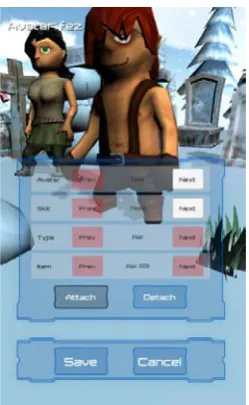
Students earn credits for attendance, asking questions, completing tutorials, handing in work, etc. Credits buy virtual items to customise their virtual avatars, see Figure 2. Participants compete within a fantasy battle competition. Outcomes of battles are randomised, but those with more expensive virtual items are more likely to survive longer, therefore encouraging students to earn as many achievements as possible.
These competitive battles can themselves be used to earn more credits, proportional to how long the player survives. They can be played non-interactively, while the student is working or interactively with the player gaining a small advantage by 'catching' hearts from fallen enemies. It is based on the popular one-click game design mechanic seen in many mobile games (Unger and Novak, 2012).
Avatars can compete alone or in small teams (see Figure 3) against a computer controlled enemy (PvE).
Figure 1. UniCraft mobile app
[image:5.595.130.209.202.352.2]Figure 2. UniCraft virtual avatars
[image:5.595.365.467.484.666.2]Figure 3. Three student avatars team up for a battle
[image:5.595.74.281.493.585.2]When in non-interactive mode, a competition event can be displayed on a projector, with the avatars of the entire cohort taking part in a 'battle royale'. This example of constructive competition showed an increase in engagement with the gamification app of 217% compared to using the system without the competitive battles, see Table 2.
Within the student group it was noted that people interacted with the system on different days of the week, at different times of the day, using the app to differing degrees, interacting with some aspects more than others, both in and outside class. This technologically enabled and designed-for flexibility helped maximise engagement.
During interviews, the students reported that they had enjoyed the competitive battle game and did not find it stressful. They claimed this was because it was seen as a light-hearted fun activity allowing them to compete with their peers without pressure and it helped motivate them to engage with the gamification project.
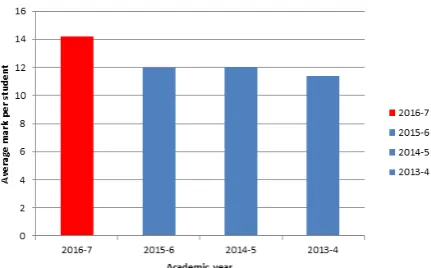
After the study a comparison of student attainment was made to see if there had been any impact. Student assessment results were compared to the previous cohorts over three years. A 17% increase in attainment was measured, compared to the three previous years (single factor ANOVA F(3,162)=3.45, P=0.018,η2=0.06),
see Figure 4.
Conclusion
Gamification has repeatedly demonstrated its efficacy when applied to a range of activities (Deterding et al., 2011b; Laird, 2017; Rigsby, 2012) and competition plays a key part in engaging participants. However, it isn't possible to accurately predict how people will react to such systems. The likelihood of competition having a positive and constructive impact can be increased if a theory of best practice can be developed, promoting a holistic design approach. Constructive competition is one example of a powerful extrinsic motivator that is compatible with maintaining intrinsic motivation, which is vital in supporting an individual's sense of self-determination.
Gamification works, but participants must be motivated to stay engaged with the gamification process. Constructive competition can provide that motivation while limiting the chance of any negative impact that competition might have on the intrinsic enjoyment or satisfaction in the task being gamified.
References
Adams, E., 2013. Fundamentals of game design. New Riders.
Axon, S., 2016. Unity at 10: For better—or worse—game development has never been easier | Ars Technica UK [WWW Document]. Arstechnica. URL https://arstechnica.co.uk/gaming/2016/09 /unity-at-10-easy-game-development/ (accessed 9.2.17).
Behm-Morawitz, E., 2013. Mirrored selves: The influence of self-presence in a virtual world on health, appearance, and well-being. Comput. Human Behav. 29, 119– 128.
Table 2. Impact of constructive competition on app engagement
[image:6.595.311.527.71.205.2] [image:6.595.73.280.197.370.2]Chen, J., 2007. Flow in games (and everything else). Commun. ACM 50, 31. doi:10.1145/1232743.1232769
Deci, E.L., Ryan, R.M., 2000. The “What” and “Why” of Goal Pursuits: Human Needs and the Self-Determination of Behavior. Psychol. Inq. 11, 227–268.
DeKoven, B., 2002. The well-played game: a playful path to wholeness. iUniverse. Deterding, S., 2015. The lens of intrinsic skill
atoms: A method for gameful design. Human–Computer Interact.
Deterding, S., Dixon, D., Khaled, R., Nacke, L., 2011a. From game design elements to gamefulness: defining gamification, in: Proceedings of the 15th International Academic MindTrek Conference: Envisioning Future Media Environments. ACM, pp. 9–15.
Deterding, S., Sicart, M., Nacke, L., O’Hara, K., Dixon, D., 2011b. Gamification. using game-design elements in non-gaming contexts, in: CHI’11 Extended Abstracts on Human Factors in Computing Systems. ACM, pp. 2425–2428.
Featherstone, M., Habgood, J., 2018. Unicraft: exploring the impact of asynchronous multiplayer game elements in gamification. Int. J. Human-Computer Stud. (in Press.
Fuchs, M., Fizek, S., Ruffino, P., Schrape, N., 2014. Rethinking gamification. Meson Press.
Hanus, M.D., Fox, J., 2015. Assessing the effects of gamification in the classroom: A longitudinal study on intrinsic motivation, social comparison, satisfaction, effort, and academic performance. Comput. Educ. 80, 152– 161. doi:10.1016/j.compedu.2014.08.019 Hopson, J., 2001. Behavioral Game Design
[WWW Document]. Gamasutra. URL https://www.gamasutra.com/view/feature/ 131494/behavioral_game_design.php (accessed 9.8.17).
Jennings, I., 2014. Matchmaking Algorithm: Skill-based Matchmaking | PubNub [WWW Document]. PubNub. URL https://www.pubnub.com/blog/2014-07- 31-skill-based-matchmaking-multiplayer-games-tutorial/ (accessed 8.16.17). Koster, R., 2013. Theory of fun for game
design. O’Reilly Media, Inc.
Laird, S., 2017. Top 10 Enterprise Gamification Cases That Will Make Employees More Productive [WWW Document]. yukaichou.com. URL
http://yukaichou.com/gamification- examples/top-10-enterprise-gamification-cases-employees-productive/ (accessed 9.2.17).
Lepper, M., Malone, T., 1987. Intrinsic motivation and instructional effectiveness in computer-based education. Aptitude, Learn. Instr.
Raczkowski, F., 2013. It’s all fun and games... A history of ideas concerning gamification. DiGRA Conf.
Rigsby, J., 2012. Yammer, Badgeville Join to Bring Gamification to Enterprise Social
[WWW Document]. CMSWire. URL
http://www.cmswire.com/cms/social- business/yammer-badgeville-join-to- bring-gamification-to-enterprise-social-015629.php (accessed 9.2.17).
Shafer, D.M., 2012. Causes of State Hostility and Enjoyment in Player Versus Player and Player Versus Environment Video Games. J. Commun. 62, 719–737. doi:10.1111/j.1460-2466.2012.01654.x Unger, K., Novak, J., 2012. Mobile game
development. Delmar/Cengage Learning. Whitson, J.R., 2013. Gaming the quantified
self. Surveill. Soc. 11, 163–176.
Zagal, J.P., Nussbaum, M., Rosas, R., 2000. A Model to Support the Design of Multiplayer Games. Presence Teleoperators Virtual Environ. 9, 448– 462. doi:10.1162/105474600566943
Author Biography
Mark Featherstone is a PhD student and lecturer at Sheffield Hallam University within its Applied Gaming Technology research group.