Improving Semantic Dependency Parsing with Syntactic Features
Robin Kurtz, Daniel Roxbo, Marco Kuhlmann
Link¨oping University
Department of Computer and Information Science
[email protected],[email protected]
Abstract
We extend a state-of-the-art deep neural ar-chitecture for semantic dependency parsing with features defined over syntactic depen-dency trees. Our empirical results show that only gold-standard syntactic informa-tion leads to consistent improvements in semantic parsing accuracy, and that the magnitude of these improvements varies with the specific combination of the syn-tactic and the semantic representation used. In contrast, automatically predicted syntax does not seem to help semantic parsing. Our error analysis suggests that there is a significant overlap between syntactic and semantic representations.
1 Introduction
Semantic dependency parsing (SDP) is the task of mapping a sentence into a formal representation of its meaning in the form of a directed graph with arcs between pairs of words. Ever since the release of the now-standard datasets for this task (Oepen et al., 2014, 2015), most of the approaches to se-mantic dependency parsing have been based on previous and ongoing work in syntactic parsing. In particular, several semantic parsers make use of fea-tures defined over syntactic dependency trees; one recent example is the system of Peng et al. (2018).
In this paper we study to what extent semantic dependency parsing actually benefits from syntac-tic features. More specifically, we carry out experi-ments to identify those combinations of semantic and syntactic representations that yield the highest parsing accuracy. This is interesting not only for parser developers – using improvement or non-im-provement in parsing accuracy as an indicator, our study also contributes to a better understanding of the similarities and contentful differences between semantic and syntactic representations.
Semantic dependency parsers are typically con-ceptualized as systems for structured prediction, combining a data-driven component that learns how to score dependency graphs with a decoder that retrieves one or several highest-scoring tar-get graphs from the exponentially large search space of candidate graphs. Among decoding algo-rithms we find approaches based on integer linear programming (Almeida and Martins, 2015; Peng et al., 2017), dynamic programming algorithms that support exact decoding for restricted classes of graphs (Kuhlmann and Jonsson, 2015; Cao et al., 2017), and transition-based approaches introduc-ing new shift–reduce-style automata (Zhang et al., 2016; Wang et al., 2018). Regarding the learning component, state-of-the-art parsing results have been achieved using neural architectures (Peng et al., 2017; Wang et al., 2018; Dozat and Man-ning, 2018). The system of Dozat and Manning (2018) even draws essentially all of its strength from its neural core, employing a trivial decoder. The parser used in this paper is a (slightly modi-fied) re-implementation of that system developed by Roxbo (2019), which adds syntactic information via a simple head feature, along the lines of Peng et al. (2018).
Paper Structure.After providing some background in Section 2, we describe the architecture of our parser in Section 3, and our data and experimental setup in Section 4. In Section 5 we present our empirical results and complement them with an error analysis in Section 6. Section 7 concludes the paper and provides an outlook on future work.
2 Background
In both semantic and syntactic dependency parsing, the target structures are directed graphs with lexi-calized nodes and bilexical arcs. More formally, a
dependency graphfor a sentencex=x1, . . . , xn
He tried to take my hand to show me
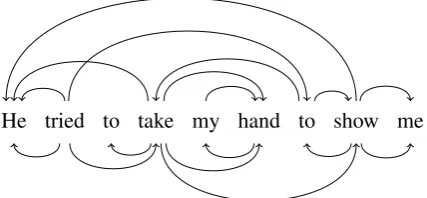
Figure 1: A sample sentence with a gold-standard semantic dependency graph in the DM represen-tation (Flickinger et al., 2016, #41526060) (upper half-plane) and a predicted syntactic dependency tree in the Stanford Basic representation (lower half-plane). (Arc labels omitted in this example.)
one-to-one correspondence to the tokens ofx. For
an arci→jwe refer to the nodesiandjashead
anddependent, respectively. We follow standard conventions and visualize dependency graphs with their nodes laid out on a line according to the linear order of the sentence, and their arcs drawn in the half-plane above (or sometimes below) the nodes. An example graph is provided in Figure 1.
In syntactic dependency parsing, target
represen-tations are restricted to trees. Formally, a
depen-dency treeis a dependency graph that is connected, acyclic, and such that each node except a distin-guished root node has at most one incoming arc. The root node has no incoming arc. In a depen-dency tree we writeh(i)to denote the head of the incoming arc to the (non-root) nodei.
3 Parser
We now give a compact description of our parser, a version of the system of Dozat and Manning (2018); for more details, we refer to Roxbo (2019). We use essentially the same architecture for seman-tic parsing and for predicting the trees over which we define our syntactic features.
3.1 Neural Network Model
The core of our parser is a bidirectional recur-rent neural network with Long Short-Term Mem-ory cells (BiLSTM; Hochreiter and Schmidhu-ber, 1997). Feeding this network with a sentence
x=x1, . . . , xnin the form of a sequence of
(ini-tially random) word embeddingswi, we obtain a
sequence of context-dependent embeddingsci:
c1, . . . ,cn=BiLSTM(w1, . . . ,wn)
The word embeddings can be easily augmented by additional lexical features, such as pre-trained word embeddings or embeddings for part-of-speech tags or lemmas. In this study we add embeddings cre-ated via character-based LSTMs and 100-dimen-sional GloVe (Pennington et al., 2014) embeddings. The network processes the contextual token em-beddingsciby two parallel feedforward neural
net-works (FNN), which are meant to learn specialized representations for the potential roles of each word as head and dependent:
hi =FNNh(ci) di=FNNd(ci)
These embeddings are then used to score each
po-tential arci→jvia a bilinear model with weight
matrixU that will be learned during training:
score(hi,dj) =h>i U dj
3.2 Decoding
The matrix of arc scores can be processed by any type of arc-factored decoder to return the high-est-scoring graph for the complete sentence. Our semantic parser greedily selects all arcs with a non-negative score. The syntactic parser uses the Chu– Liu/Edmonds (CLE) maximum spanning tree algo-rithm (Chu and Liu, 1965; Edmonds, 1967) imple-mented in Uniparse (Varab and Schluter, 2018).
3.3 Adding Labels
To predict labelled arcs, we take two different ap-proaches: The semantic parser computes, for each token pair, scores for all potential labels, including a special NONElabel that represents the absence of an arc between the two tokens; this yields a three-dimensional score tensor rather than a score matrix. The syntactic parser factorizes the computation and predicts a label for each token pair independently of the arc scorer; this label is only used if an arc is actually selected by the decoder.
3.4 Adding Syntactic Features
To add syntactic features to our semantic parser, we follow the same simple approach as Peng et al. (2018): Before feeding the contextual embedding of each token to the arc- and label-scoring compo-nents, we extend it with the contextual embedding of its syntactic head in the dependency tree:
c0i = [ci;ch(i)]
Parameter Value
Embeddings 100
Char LSTM 1 @ 400
Char linear 100
BiLSTM 3 @ 600
Arc/Label FNN 600
Epochs 100
Mini-batch size 50
Adamβ1 0
Adamβ2 0.95
Learning rate 1·10−3
Gradient clipping 5
Interpolation constant 0.025
[image:3.595.115.248.63.222.2]L2regularization 3·10−9
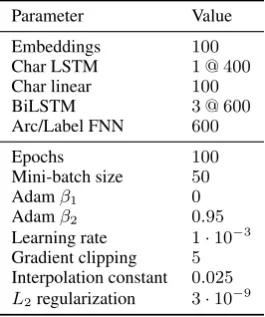
Table 1: Network sizes and training parameters.
3.5 Training
We train our parser with the Adam optimizer (Kingma and Ba, 2014) and mini-batching. To train the arc and label scorers, we use a binary and a softmax cross-entropy loss, respectively. In the factorized approach used by the syntactic parser, the arc- and label-specific losses are summed up to an overall loss, weighted by an interpolation constant to emphasize the arc scorer:
losstotal= (1−0.025)·lossarc+ 0.025·losslabel
Due to the size of the model and its fairly large number of trainable parameters (see Table 1), it is prone to overfitting. To address this, we ap-ply equally large dropout rates to nearly all parts of the model (see Table 2). We apply variational dropout (Gal and Ghahramani, 2016) sharing the same dropout mask between all time steps in a se-quence. On the LSTM hidden states we use Drop-Connect (Wan et al., 2013; Merity et al., 2017), a more general variant of dropout which drops indi-vidual connections instead of complete nodes of the computation graph.
Substructure Rate
Embeddings 20% Char LSTM feedforward 33% Char LSTM recurrent 33% Char Linear 33% BiLSTM feedforward 45% BiLSTM recurrent 25%
Arc FNN 25%
Arc scorer 25% Label FNN 33% Label scorer 33%
Table 2: Dropout rates.
4 Method
In this section we describe our data and the setup of our experiments.
4.1 Data
The main dataset for our experiments is the English part of the standard SDP distribution (Flickinger et al., 2016), which contains semantic dependency graphs for Sections 00–21 of the venerable Penn Treebank (Marcus et al., 1993) in a predefined train/test split, as well as graphs for out-of-domain test sentences from the Brown Corpus (Francis and Kuˇcera, 1985). The graphs come in four differ-ent represdiffer-entation types, of which we use three: graphs derived from DeepBank (DM, Oepen and Lønning, 2006; Ivanova et al., 2012); predicate– argument structures computed by the Enju parser (PAS, Miyao, 2006); and graphs derived from the tectogrammatical layer of the Prague Dependency Treebank (PSD, Hajic et al., 2012). Due to their structural differences, the three graph types are more or less difficult to parse into; PSD graphs, for example, feature a considerably larger label inventory than the other types.
The graphs in the SDP dataset come with differ-ent types of gold-standard syntactic analyses, of which we use Stanford Basic Dependencies (SB, de Marneffe and Manning, 2008), derived from the Penn Treebank, and DELPH-IN Syntactic Deriva-tion Trees (DT, Ivanova et al., 2012), derived from DeepBank. In addition to those we also use the English Web Treebank (EWT) from the Universal Dependencies (UD) project (Nivre et al., 2017), which contains syntactic dependency trees for text that does not overlap with the SDP data. We note that the EWT is considerably smaller than the SDP dataset.
4.2 Experimental Setup
We train three types of semantic dependency pars-ing models: no syntactic features (N), features
ex-tracted from gold-standard syntax trees (G), and
features extracted from predicted syntax trees (P).
The models of typeNserve as our baseline and
per-form on par with the parser of Dozat and Manning
(2018). For models of type Gwe use gold trees
as inputs both during training and at test time; for
models of typeP, at test time we instead feed the
[image:3.595.111.247.615.742.2]Dataset Our parser StanfordNLP UDPipe
id ood id ood
SB 93.2 89.9 94.2 90.9 DT 94.0 90.3 94.9 91.7
[image:4.595.82.280.64.128.2]EWT 85.9 85.4
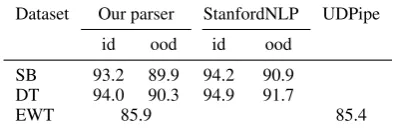
Table 3: Parsing accuracy for our syntactic models on the in-domain (id) and out-of-domain (ood) test sets for the SDP data, and the regular test set for the EWT data.
Our three syntactic models (for SB, DT, and EWT) were trained using the same architecture and specifications as the semantic models, but use the factorized approach with CLE-decoding instead. Their accuracy is reported in Table 3, with addi-tional results from StanfordNLP (Qi et al., 2018) and UDPipe (Straka and Strakov´a, 2017) for ref-erence. We note that in contrast to those systems’ results, ours were achieved without gold POS tags.
5 Empirical Results
The results for our semantic dependency parsing models for the three graph types in the SDP dataset are presented in Table 4. For comparison, we add results reported by Dozat and Manning (2018) and Peng et al. (2018), and emphasize for each test set the overall best-performing model.
Baseline Our baseline using no syntactic features performs comparable to the systems of Dozat and Manning (2018) and Peng et al. (2018). We note that the results reported for Dozat and Manning (2018) are for models that not only use character embeddings (which we also use), but also
part-of-speech tag embeddings (which we do not use).1
The results reported for Peng et al. (2018) are for models that use predicted syntax. The slight advan-tage of our baseline over the latter models suggests that the network architecture can provide the same benefits as additional syntactic information.
Contribution of Syntactic Structure Looking at the results for the models informed by gold-standard syntax, we see consistent gains in both in-domain and out-of-domain settings, with sub-stantial improvements of 3.1 labelled F1 points for DM–DT, and 2.2 points for PAS–SB. The models informed by predicted syntax, on the other hand, do not achieve any significant improvements over
1The best-performing model of Dozat and Manning (2018)
additionally uses lemma embeddings.
the baseline, and in several cases actually perform slightly worse than it. We saw the same trend in additional experiments (not reported here) where we used predicted trees even during training. Inter-estingly, while the baseline and the models using predicted syntax have similar F-scores, for the lat-ter we observe a reduction of the number of false negatives (i.e., missing arcs), but also an increase in the number of false positives (i.e., incorrectly pre-dicted arcs). The models using EWT trees do not outperform the baseline, and we omit their further investigation from the rest of the paper.
6 Error Analysis
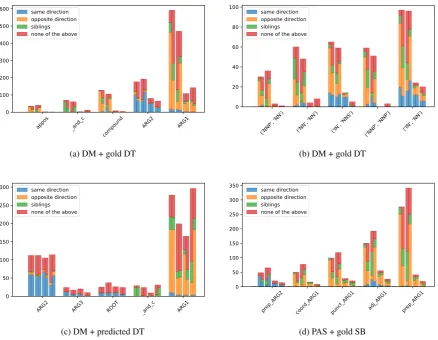
To gain a deeper understanding for our empirical results, we complement them with an error analysis. For space reasons we will focus our analysis on the DM models (Figures 2a–2c); however, we will also discuss results from one PAS model (Figure 2d).
6.1 Error Types
Our analysis is based on a two-dimensional classi-fication of errors. In the first dimension, for each
semantic parsing modelM, we break down all
er-rors relative to the no-syntax baseline model into the following four types:
1. false negatives of the baseline avoided byM
2. false positives of the baseline avoided byM
3. false negatives ofM avoided by the baseline
4. false positives ofM avoided by the baseline
Type 1 thus consists of arcs that the baseline
incor-rectly does not and the syntax-informed modelM
correctly does predict, and so on.
In the second dimension, for each error type we distinguish four different sub-categories, based on the correspondence between the incorrectly
pre-dicted/not predicted arc i → j in the semantic
graph and the structural relation between the head
iand dependentjin the syntactic dependency tree:
(a) the dependency tree has an arci→j
(b) the dependency tree has an arcj→i
(c) iandjare siblings in the dependency tree
(d) none of the above
Model DM PAS PSD
id ood id ood id ood
N– no syntax (baseline) 92.1 87.4 92.6 89.7 79.7 77.3
DT G– gold syntax 95.2 90.9 93.2 90.3 80.0 78.3
P– predicted syntax 92.2 89.3 92.4 88.9 79.5 77.5
SB G– gold syntax 92.7 88.1 94.8 92.1 80.4 79.0
P– predicted syntax 92.0 87.0 92.4 88.9 79.6 77.2
EWT P– predicted syntax 91.8 87.1 92.7 89.3 79.6 77.3
Dozat and Manning (2018) 92.7 87.8 94.0 90.6 80.5 78.6
[image:5.595.137.460.88.264.2]Peng et al. (2018) 91.6 86.7 78.9 77.1
Table 4: Labeled F1 for our semantic parsers on the in-domain (id) and out-of-domain (ood) test sets.
appos _and_c
compound ARG2 ARG1
0 100 200 300 400 500
600 same direction opposite direction siblings none of the above
(a) DM + gold DT
('NNP', 'NN') ('NN', 'NN') ('IN', 'NNS') ('NNP', 'NNP') ('IN', 'NN')
0 20 40 60 80
100 same direction opposite direction siblings none of the above
(b) DM + gold DT
ARG2 ARG3 ROOT _and_c ARG1
0 50 100 150 200 250
300 same direction opposite direction siblings none of the above
(c) DM + predicted DT
prep_ARG2 coord_ARG1 punct_ARG1 adj_ARG1 prep_ARG1
0 50 100 150 200 250 300
350 same direction opposite direction siblings none of the above
(d) PAS + gold SB
[image:5.595.84.523.349.689.2]subordneg conj mwe appostimes ARG3 loc _and_cposs ROOT BV cmpndARG2ARG1
0 2000 4000 6000 8000
10000 same directionopposite direction siblings none of the above
Figure 3: Relation between DM arcs and syntac-tic features extracted from gold-standard DT trees, broken down by arc type.
To show how syntactic heads and semantic arcs correlate independently of the parsing model, we add Figure 3. As we can see, arcs denoting the first
argument of a semantic predicate (ARG1) occur
mostly with syntactic arcs in the opposite tion. Similarly, a syntactic arc in the same direc-tion often accompanies arcs denoting the second
argument of a semantic predicate (ARG2); two
in-stances from the example analysis in Figure 1 are
“take”→“hand”and“show”→“me”. Another
example of a clear pattern is withcompoundand
conjunction ( and c). Both types of arcs connect
mostly nouns, but whereascompoundarcs correlate
with opposite syntactic arcs, head and dependent in a conjunction more typically share the same
syn-tactic head (the conjunction“and”).
6.2 Results
We now explain how to read the graphs with the re-sults of our two-dimensional error analysis for the DM parsing models. Figure 2a shows the outcome of this analysis when the model is informed by syntactic features extracted from gold-standard DT trees and evaluated on the development data. More specifically, it shows results for those five DM arc types for which adding syntax has the greatest ef-fect on the absolute difference of mistakes relative to the baseline. For each arc type we plot four pairs of bars, one for each of the error types 1–4, from left to right. Figure 2b breaks down results by head–dependent part-of-speech pairs instead. Figure 2c compares the baseline with the model using predicted syntax, also on DM graphs and DT trees. Note that, as the ordering follows the abso-lutedifferenceof mistakes, the arc types shown in Figure 2c are not the same as the ones in Figure 2a.
In all plots, the two bars in each of the four pairs of bars show the (colour-coded) distributions of the types (a)–(d) relative to gold-standard syntax (first bar) and predicted syntax (second bar); thus the distribution relative to the syntactic information actually used by each model is in the first bar in Figures 2a–2b (models informed by gold-standard syntax), and in the second bars in Figure 2c (models informed by predicted syntax).
6.3 Relation between Syntax and Semantics
To directly compare how gold-standard and pre-dicted syntax relate to semantic arcs, we look at the differently coloured sub-columns in Figures 2a and 2b. We recall that these figures compare the no-syntax baseline to a model informed by syntactic features extracted from gold-standard analyses.
The errors avoided by the syntax-informed model (columns 1 and 2) have similar syntactic-head distributions as the general distribution in Fig-ure 3 when looking at gold syntax. The distribution for predicted syntax does not match, due to wrong predictions when parsing these related substruc-tures. For example, in the predicted syntax, much
fewer of the avoided false negativeARG1arcs have
syntactic arcs in the opposite direction, and instead many more of the false positives (error type 2). Us-ing a syntactic arc in the opposite direction as an indicator, fewer false negatives would have been avoided and more false positives would have been predicted. This shows that the baseline system and the syntactic parser have difficulties analyzing the same substructures.
In Section 6 we stated that the model informed by predicted syntax increases recall at the cost of precision. This is illustrated by Figure 2c, and most
pronounced for theARG1type, where the number
death in a plane crash of his old boss
will go a long way toward enhancing
Figure 4: Graph fragments for sentences
#22013118 and #22012010. Semantic arcs are shown in black, syntactic arcs in red. False nega-tives are drawn with continuous lines, false posi-tives are drawn with dashed lines.
6.4 Where can Syntax help?
In order to better understand where syntax helps the semantic dependency parser, we look at the part-of-speech pairs of head and dependent in Figure 2b. The five pairs which receive the largest improve-ment when informed by gold-standard syntax can be divided into two groups:
(i) arcs between prepositions (IN) and nouns (NN, NNS)
(ii) arcs between multiple (proper) nouns (NN, NNS, NNP, NNPS)
Prepositional Attachment The arcs in group (i), between prepositions and nouns, represent the ma-jority of baseline errors not only in the case of DM/DT but also in the case of PAS/SB, where they
[image:7.595.322.510.536.663.2]correspond (roughly) to the arc typeprep ARG1in
Figure 2d. Figure 4 shows two graph fragments with arcs from this group; these fragments hap-pen to be identical for DM/DT and for PAS/SB. In the two examples the gold-standard syntactic arc goes into the opposite direction than the semantic arc (our type b), and this regularity seems to be learned by the models informed by gold-standard syntax to such a degree that when the syntactic arc is incorrectly predicted, the parser also makes a corresponding mistake on the semantic side: In the examples, the prepositional phrase“of his old boss”
is wrongly attached to the neighbouring “plane
crash”, while“toward”is attached to the distant
predicate“use”instead of the neighbouring“way”.
Examples of this kind seem to suggest that having access to gold-standard syntax essentially ‘solves’ the prediction problem on the semantic side.
Compounds and Conjuncts The arcs in group (ii) include both compounds and conjuncts. The difficulties with compounds lie in determining which token is the governing head of the complete phrase and deciding which tokens are part of
the compound. They naturally appear as part
of conjunctions as well, where the difficulty of correctly identifying the heads of the two conjuncts is the same as identifying the heads of the compounds themselves. Similar to what we observed for preposition–noun arcs, having the governing head basically given by a syntactic arc, essentially eliminates the problem for compounds and conjuncts.
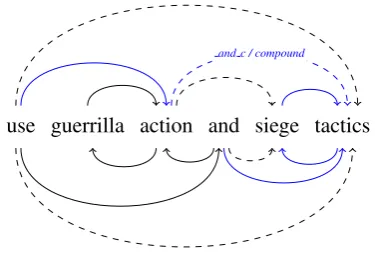
The example in Figure 5 showcases how failing to recognize a compound results in a cascade of
follow-up mistakes. While“guerrilla action”is
recognized as a compound,“siege tactics”is not.
The word “tactics” is left out of the compound
and therefore also the conjunct, receiving“use”as
its syntactic head instead. This leads the seman-tic parser to not only fail to analyse the second compound and hence also the conjunct, but also
attaching“tactics”as second argument (ARG2) to
the predicate“use”, instead of the actual head of
the complete phrase,“action”.
6.5 Where can Syntax not help?
While syntactic information appears to help the semantic parser in some cases, there are similar examples where syntax does not seem to be able to help at all, two of which are shown in Figure 6.
use guerrilla action and siege tactics and c / compound
beheading of Hugo Spadafora
dislike of President Bush’s proposal
Figure 6: Graph fragments for sentences
#22013141 and #22030001. Semantic arcs are shown in black, syntactic arcs in red. False nega-tives are drawn with continuous lines, false posi-tives are drawn with dashed lines.
Both graph fragments contain a nominalized verb (“beheading”and“dislike”) followed by“of ”and
the object of the nominalization (“Spadafora”and
“proposal”). In both cases, the parser has access to gold-standard syntax that connects the nominaliza-tion, the preposition and the object left to right. In the first instance, the parser interprets the
nominal-ization and the object both as arguments of“of ”,
instead of directly attaching the object as an argu-ment to the nominalization. In the second instance, the intended and observed behaviours are switched.
7 Conclusion
Our re-implementation of the state-of-the-art se-mantic dependency parsing architecture of Dozat and Manning (2018) performs on par with that sys-tem. Surprisingly, adding syntactic features to the standard lexical and morphological embeddings does not generally increase parsing accuracy. More specifically, while gold-standard syntactic informa-tion is highly beneficial, yielding accuracies signif-icantly above the state of the art, adding predicted syntax does not lead to consistent improvements.
Our error analysis shows that there is some over-lap of the information that syntactic dependency trees and semantic dependency graphs encode, in the sense that both tend to mirror each other. We have provided examples for cases that are difficult to analyze due to their inherent ambiguity. In some cases, these examples suggest that adding gold-standard syntax essentially also reveals the correct semantic analysis to the parser. This means that high-precision syntactic parsing holds significant
promises even for semantic parsing, but our experi-ments suggest that the state of the art in syntactic dependency parsing may still be too low to fully capitalize on this potential. We believe however, that a joint syntactic–semantic parser that is able to dynamically leverage both structures (trained, perhaps, using a multi-task objective), would be an opportunity for further advances in both syntactic and semantic dependency parsing.
Acknowledgements
We are grateful for the computational resources provided by Sigma2 in Oslo through the Nordic e-Infrastructure Collaboration (NeIC) and the Nordic
Language Processing Laboratory (NLPL, www.
nlpl.eu).
References
Mariana S. C. Almeida and Andr´e F. T. Martins. 2015. Lisbon: Evaluating TurboSemanticParser on
Multi-ple Languages and Out-of-Domain Data.
Proceed-ings of the 9th International Workshop on Semantic Evaluation (SemEval 2015), pages 970–973.
Junjie Cao, Sheng Huang, Weiwei Sun, and
Xiao-jun Wan. 2017. Parsing to 1-Endpoint-Crossing,
Pagenumber-2 Graphs. Proceedings of the 55th
An-nual Meeting of the Association for Computational Linguistics (Volume 1: Long Papers), 1:2110–2120.
Yoeng-Jin Chu and Tseng-Hong Liu. 1965. On the
shortest arborescence of a directed graph. Scientia Sinica, 14:1396–1400.
Marie-Catherine de Marneffe and Christopher D. Man-ning. 2008. The Stanford Typed Dependencies
Rep-resentation. In CF+CDPE@COLING, pages 1–8.
Coling 2008 Organizing Committee.
Timothy Dozat and Christopher D. Manning. 2018. Simpler but More Accurate Semantic Dependency
Parsing. Proceedings of the 56th Annual Meeting of
the Association for Computational Linguistics (Vol-ume 2: Short Papers), 2:484–490.
Jack Edmonds. 1967. Optimum Branchings. Journal
of Research of the national Bureau of Standards B, 71(4):233–240.
Dan Flickinger, Jan Hajiˇc, Angelina Ivanova, Marco Kuhlmann, Yusuke Miyao, Stephan Oepen, and
Daniel Zeman. 2016. SDP 2014 & 2015:
Broad Coverage Semantic Dependency Parsing LDC2016T10.
W. Nelson Francis and Henry Kuˇcera. 1985. Frequency Analysis of English Usage: Lexicon and Grammar.
Yarin Gal and Zoubin Ghahramani. 2016. A Theoreti-cally Grounded Application of Dropout in Recurrent
Neural Networks. InProceedings of the 30th
Inter-national Conference on Neural Information Process-ing Systems, NIPS’16, pages 1027–1035. Curran As-sociates Inc.
Jan Hajic, Eva Hajicov´a, Jarmila Panevov´a, Petr Sgall, Onˇdrej Bojar, Silvie Cinkov´a, Eva Fu´cikov´a, Marie Mikulov´a, Petr Pajas, Jan Popelka, Ji´ri Semeck´y, Jana Sindlerov´a, Jan Sˇtep´anek, Josef Toman, Zdenka Uresov´a, and Zdenek Zabokrtsk´y. 2012. Announc-ing Prague Czech-English Dependency Treebank 2.0. InProceedings of the 8th International Confer-ence on Language Resources and Evaluation (LREC 2012), pages 3153–3160, ˙Istanbul, Turkey. Euro-pean Language Resources Association.
Sepp Hochreiter and J¨urgen Schmidhuber. 1997. Long
Short-term Memory. Neural computation, 9:1735–
80.
Angelina Ivanova, Stephan Oepen, Lilja Øvrelid, and Dan Flickinger. 2012. Who Did What to Whom?: A Contrastive Study of Syntacto-semantic Dependen-cies. InProceedings of the Sixth Linguistic Annota-tion Workshop, LAW VI ’12, pages 2–11, Strouds-burg, PA, USA. Association for Computational Lin-guistics.
Diederik P. Kingma and Jimmy Ba. 2014. Adam:
A Method for Stochastic Optimization. CoRR,
abs/1412.6980.
Marco Kuhlmann and Peter Jonsson. 2015.
Pars-ing to NoncrossPars-ing Dependency Graphs.
Transac-tions of the Association of Computational Linguis-tics, 3(1):559–570.
Mitchell P. Marcus, Mary Ann Marcinkiewicz, and Beatrice Santorini. 1993. Building a Large
Anno-tated Corpus of English: The Penn Treebank.
Com-put. Linguist., 19(2):313–330.
Stephen Merity, Nitish Shirish Keskar, and Richard Socher. 2017. Regularizing and Optimizing LSTM
Language Models. CoRR, abs/1708.02182.
Yusuke Miyao. 2006. From Linguistic Theory to
Syn-tactic Analysis: Corpus-Oriented Grammar Devel-opment and Feature Forest Model. Ph.D. thesis.
Joakim Nivre, ˇZeljko Agi´c, Lars Ahrenberg, Maria Je-sus Aranzabe, Masayuki Asahara, Aitziber Atutxa, Miguel Ballesteros, John Bauer, Kepa Bengoetxea,
Riyaz Ahmad Bhat, Eckhard Bick, Cristina
Bosco, Gosse Bouma, Sam Bowman, Marie Can-dito, G¨uls¸en Cebiro˘glu Eryi˘git, Giuseppe G. A.
Celano, Fabricio Chalub, Jinho Choi, C¸ a˘grı
C¸ ¨oltekin, Miriam Connor, Elizabeth Davidson,
Marie-Catherine de Marneffe, Valeria de Paiva, Arantza Diaz de Ilarraza, Kaja Dobrovoljc, Tim-othy Dozat, Kira Droganova, Puneet Dwivedi, Marhaba Eli, Tomaˇz Erjavec, Rich´ard Farkas, Jen-nifer Foster, Cl´audia Freitas, Kata´rına Gajdoˇsov´a,
Daniel Galbraith, Marcos Garcia, Filip Ginter, Iakes Goenaga, Koldo Gojenola, Memduh G¨okırmak, Yoav Goldberg, Xavier G´omez Guinovart, Berta
Gonz´ales Saavedra, Matias Grioni, Normunds
Gr¯uz¯itis, Bruno Guillaume, Nizar Habash, Jan Hajiˇc, Linh H`a M˜y, Dag Haug, Barbora Hladk´a, Pet-ter Hohle, Radu Ion, Elena Irimia, Anders Jo-hannsen, Fredrik Jørgensen, H¨uner Kas¸ıkara, Hi-roshi Kanayama, Jenna Kanerva, Natalia Kot-syba, Simon Krek, Veronika Laippala, Phuong Lˆe H`ˆong, Alessandro Lenci, Nikola Ljubeˇsi´c, Olga Lyashevskaya, Teresa Lynn, Aibek Makazhanov, Christopher Manning, C˘at˘alina M˘ar˘anduc, David Mareˇcek, H´ector Mart´ınez Alonso, Andr´e Mar-tins, Jan Maˇsek, Yuji Matsumoto, Ryan McDonald, Anna Missil¨a, Verginica Mititelu, Yusuke Miyao, Si-monetta Montemagni, Amir More, Shunsuke Mori, Bohdan Moskalevskyi, Kadri Muischnek, Nina Mustafina, Kaili M¨u¨urisep, Luong Ngu˜yˆen Th i, Hu`yˆen Ngu˜yˆen Th i Minh, Vitaly Nikolaev, Hanna Nurmi, Stina Ojala, Petya Osenova, Lilja Øvre-lid, Elena Pascual, Marco Passarotti, Cenel-Augusto Perez, Guy Perrier, Slav Petrov, Jussi Piitulainen, Barbara Plank, Martin Popel, Lauma Pretkalnin¸a, Prokopis Prokopidis, Tiina Puolakainen, Sampo Pyysalo, Alexandre Rademaker, Loganathan Ra-masamy, Livy Real, Laura Rituma, Rudolf Rosa, Shadi Saleh, Manuela Sanguinetti, Baiba Saul¯ite, Se-bastian Schuster, Djam´e Seddah, Wolfgang Seeker, Mojgan Seraji, Lena Shakurova, Mo Shen, Dmitry Sichinava, Natalia Silveira, Maria Simi, Radu Simionescu, Katalin Simk´o, M´aria ˇSimkov´a, Kiril Simov, Aaron Smith, Alane Suhr, Umut Sulubacak, Zsolt Sz´ant´o, Dima Taji, Takaaki Tanaka, Reut Tsar-faty, Francis Tyers, Sumire Uematsu, Larraitz Uria, Gertjan van Noord, Viktor Varga, Veronika Vincze,
Jonathan North Washington, Zdenˇek ˇZabokrtsk´y,
Amir Zeldes, Daniel Zeman, and Hanzhi Zhu. 2017. Universal Dependencies 2.0.
Stephan Oepen, Marco Kuhlmann, Yusuke Miyao, Daniel Zeman, Silvie Cinkova, Dan Flickinger, Jan Hajic, and Zdenka Uresova. 2015. SemEval 2015 Task 18: Broad-Coverage Semantic Dependency Parsing. Proceedings of the 9th International Work-shop on Semantic Evaluation (SemEval 2015), pages 915–926.
Stephan Oepen, Marco Kuhlmann, Yusuke Miyao, Daniel Zeman, Dan Flickinger, Jan Hajic, Angelina Ivanova, and Yi Zhang. 2014. SemEval 2014 Task 8: Broad-Coverage Semantic Dependency Parsing.
Proceedings of the 8th International Workshop on Semantic Evaluation (SemEval 2014), pages 63–72.
Stephan Oepen and Jan Tore Lønning. 2006.
Discriminant-Based MRS Banking. InProceedings
of the Fifth International Conference on Language Resources and Evaluation (LREC-2006), Genoa, Italy. European Language Resources Association (ELRA).
Parsing. Proceedings of the 55th Annual Meeting of the Association for Computational Linguistics (Vol-ume 1: Long Papers), 1:2037–2048.
Hao Peng, Sam Thomson, and Noah A. Smith. 2018. Backpropagating through Structured Argmax using
a SPIGOT. InProceedings of the 56th Annual
Meet-ing of the Association for Computational LMeet-inguistics (Volume 1: Long Papers), pages 1863–1873, Mel-bourne, Australia. Association for Computational Linguistics.
Jeffrey Pennington, Richard Socher, and Christopher D. Manning. 2014. GloVe: Global Vectors for Word
Representation. In Empirical Methods in Natural
Language Processing (EMNLP), pages 1532–1543.
Peng Qi, Timothy Dozat, Yuhao Zhang, and
Christo-pher D. Manning. 2018. Universal Dependency
Parsing from Scratch. InProceedings of the CoNLL
2018 Shared Task: Multilingual Parsing from Raw Text to Universal Dependencies, pages 160–170. As-sociation for Computational Linguistics.
Daniel Roxbo. 2019. A Detailed Analysis of
Se-mantic Dependency Parsing with Deep Neural
Net-works. Master’s thesis, Link¨oping University,
Human-Centered systems.
Milan Straka and Jana Strakov´a. 2017. Tokenizing,
POS Tagging, Lemmatizing and Parsing UD 2.0
with UDPipe. InProceedings of the CoNLL 2017
Shared Task: Multilingual Parsing from Raw Text to Universal Dependencies, pages 88–99. Association for Computational Linguistics.
Daniel Varab and Natalie Schluter. 2018. UniParse:
A universal graph-based parsing toolkit. CoRR,
abs/1807.04053.
Li Wan, Matthew Zeiler, Sixin Zhang, Yann LeCun,
and Rob Fergus. 2013. Regularization of
Neu-ral Networks Using Dropconnect. In Proceedings
of the 30th International Conference on Interna-tional Conference on Machine Learning - Volume 28, ICML’13, pages III–1058–III–1066. JMLR.org.
Yuxuan Wang, Wanxiang Che, Jiang Guo, and Ting Liu. 2018. A Neural Transition-Based Approach for
Se-mantic Dependency Graph Parsing. InAAAI, pages
5561–5568. AAAI Press.
Xun Zhang, Yantao Du, Weiwei Sun, and Xiaojun Wan. 2016. Transition-Based Parsing for Deep
De-pendency Structures. Computational Linguistics,