Arabic Dialect Identification Using iVectors and ASR Transcripts
Shervin Malmasi Harvard Medical School, USA Macquarie University, Australia
Marcos Zampieri University of Cologne
Germany
Abstract
This paper presents the systems submit-ted by the MAZA team to the Arabic Di-alect Identification (ADI) shared task at the VarDial Evaluation Campaign 2017. The goal of the task is to evaluate com-putational models to identify the dialect of Arabic utterances using both audio and text transcriptions. The ADI shared task dataset included Modern Standard Arabic (MSA) and four Arabic dialects: Egyp-tian, Gulf, Levantine, and North-African. The three systems submitted by MAZA are based on combinations of multiple ma-chine learning classifiers arranged as (1) voting ensemble; (2) mean probability en-semble; (3) meta-classifier. The best re-sults were obtained by the meta-classifier achieving71.7%accuracy, ranking second among the six teams which participated in the ADI shared task.
1 Introduction
The interest in Arabic natural language process-ing (NLP) has grown substantially in the last decades. This is evidenced by several publica-tions on the topic and the dedicated series of work-shops (WANLP) co-located with major interna-tional computainterna-tional linguistics conferences.1
Several Arabic dialects are spoken in North Africa and in the Middle East co-existing with Modern Standard Arabic (MSA) in a diglossic situation. Arabic dialects are used in both spo-ken and written forms (e.g. user-generated con-tent) and pose a number of challenges for NLP applications. Several studies on dialectal variation of Arabic have been published including corpus
1https://sites.google.com/a/nyu.edu/ wanlp2017/
compilation for Arabic dialects (Al-Sabbagh and Girju, 2012; Cotterell and Callison-Burch, 2014), parsing (Chiang et al., 2006), machine translation of Arabic dialects (Zbib et al., 2012), and finally, the topic of the ADI shared task, Arabic dialect identification (Zaidan and Callison-Burch, 2014; Sadat et al., 2014; Malmasi et al., 2015).
In this paper we present the MAZA entries for the 2017 ADI shared task which was organized as part of the VarDial Evaluation Campaign 2017 (Zampieri et al., 2017). The ADI shared task dataset (Ali et al., 2016) included audio and tran-scripts from Modern Standard Arabic (MSA) and four Arabic dialects: Egyptian, Gulf, Levantine, and North-African.
2 Related Work
There have been several studies published on Ara-bic dialect identification applied to both speech and text.2 Examples of Arabic dialect identifica-tion on speech data include the work by Biadsy et al. (2009), Biadsy (2011), Biadsy and Hirschberg (2009), and Bahari et al. (2014). Identifying Ara-bic dialects in text also became a popular research topic in recent years with several studies published about it (Zaidan and Callison-Burch, 2014; Sadat et al., 2014; Tillmann et al., 2014; Malmasi et al., 2015).
To our knowledge, however, the 2017 ADI is the first shared task to provide participants with the opportunity to carry out Arabic dialect identi-fication using a dataset containing both audio and text (transcriptions). The first edition of the ADI shared task, organized in 2016 as a sub-task of the DSL shared task (Malmasi et al., 2016c), used a similar dataset to the ADI 2017 dataset, but in-cluded only transcriptions.
2See Shoufan and Al-Ameri (2015) for a survey on NLP methods for processing Arabic dialects including a section on Arabic dialect identification.
3 Methods and Data
We approach this task as a multi-class classifica-tion problem. For our base classifier we utilize a linear Support Vector Machine (SVM). SVMs have proven to deliver very good performance in discriminating between language varieties and in other text classification problems, SVMs achieved first place in both the 2015 (Malmasi and Dras, 2015a) and 2014 (Goutte et al., 2014) editions of the DSL shared task.3
3.1 Data
The data comes from the aforementioned Arabic dialect dataset by Ali et al. (2016) used in the 2016 edition of the ADI shared task. It contains audio and ASR transcripts of broadcast, debate, and dis-cussion programs from videos by Al Jazeera in MSA and four Arabic dialects: Egyptian, Gulf, Levantine, and North-African. In 2016, the or-ganizers released only the transcriptions of these videos and in 2017 transcriptions are combined with audio features providing participants with an interesting opportunity to test computational methods that can be used both for text and speech. We combined all the train/dev data (25,311 sam-ples). The test set contained1,492instances.
3.2 Features
In this section we describe our features and evalu-ate their performance under cross-validation.
We employ two lexical surface feature types for this task, as described below. These are ex-tracted from the transcriptions without any pre-processing (e.g. case folding or tokenization) on texts prior to feature extraction. Pre-processing was not needed as the data are computer-generated ASR transcripts. We also used the provided iVec-tor features, as described below.
• Charactern-grams: This sub-word feature uses the constituent characters that make up the whole text. When used asn-grams, the features are n-character slices of the text. Linguistically, these substrings, depending on the length, can implicitly capture various sub-lexical features including single letters, phonemes, syllables, morphemes & suffixes. Here we examinen-grams of size1–8. 3See the 2014 and 2015 DSL shared task reports for more information (Zampieri et al., 2015; Zampieri et al., 2014) and Goutte et al. (2016) for a comprehensive evaluation on the first two DSL shared tasks.
• Wordn-grams:The surface forms of words can be used as a feature for classification. Each unique word may be used as a feature (i.e. unigrams), but the use of bigram distri-butions is also common. In this scenario, the
n-grams are extracted along with their fre-quency distributions. For this study we eval-uate unigram features.
• iVector Audio Features: Identity vectors or iVectors are a probabilistic compression pro-cess for dimensionality reduction. They have been used in speech processing for dialect and accent identification (Bahari et al., 2014), as well as for language identification systems (Dehak et al., 2011).
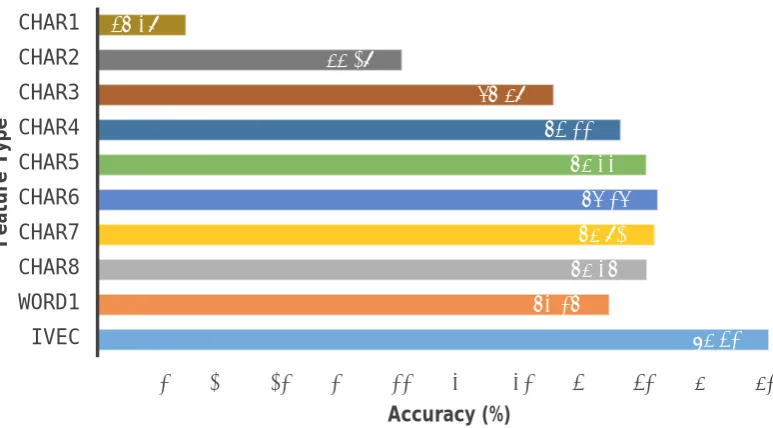
We now report our cross-validation results on the training data. We began by testing individual fea-ture types, with results displayed in Figure 1.
We observe that many character n-grams out-perform the word unigram features. Character 4-grams and above obtained higher results than those obtained using word unigrams. The best transcript-based results were obtained with char-acter 6-grams achieving 76.2% accuracy. The audio-based iVector features, however, performed substantially better with 85.3% accuracy. This is a very large difference of almost 10% accu-racy compared to the performance obtained using words and characters.
Having demonstrated that these features are useful for this task, we proceed to describe our systems in the next section.
3.3 Systems
We created three systems for our submission, as described below.
3.4 Voting Ensemble (System 1)
85.31% 72.17%
75.27% 75.90%
76.16% 75.22% 73.11% 67.59% 55.09%
37.29%
30 35 40 45 50 55 60 65 70 75 80 85
IVEC WORD1 CHAR8 CHAR7 CHAR6 CHAR5 CHAR4 CHAR3 CHAR2 CHAR1
Accuracy (%)
Fe
at
ure
T
[image:3.595.107.494.61.275.2]ype
Figure 1: Cross-validation performance for each of our individual feature types.
We follow the methodology described by Mal-masi and Dras (2015a): we extract a number of different feature types and train a single linear model using each feature type. Our ensemble was created using linear Support Vector Machine clas-sifiers.4 We used all of the feature types listed in Section 3.2 to create our ensemble of classifiers.
Each classifier predicts every input and also as-signs a continuous output to each of the possible labels. Using this information, we created the fol-lowing two ensembles.
In the first system each classifier votes for a sin-gle class label. The votes are tallied and the la-bel with the highest number5 of votes wins. Ties are broken arbitrarily. This voting method is very simple and does not have any parameters to tune. An extensive analysis of this method and its the-oretical underpinnings can be found in the work of (Kuncheva, 2004, p. 112). We submitted this system as run 1.
3.5 Mean Probability Ensemble (System 2)
Our second system is similar to System 1 above, but with a different combination method. Instead of a single vote, the probability estimates for each class6 are added together and the class label with the highest average probability is the winner. An 4Linear SVMs have proven effective for text classification tasks (Malmasi and Dras, 2014; Malmasi and Dras, 2015b).
5This differs with amajorityvoting combiner where a la-bel must obtain over50%of the votes to win. However, the names are sometimes used interchangeably.
6SVM results can be converted to per-class probability scores using Platt scaling.
important aspect of using probability outputs in this way is that a classifier’s support for the true class label is taken in to account, even when it is not the predicted label (e.g.it could have the sec-ond highest probability). This method has been shown to work well on a wide range of problems and, in general, it is considered to be simple, intu-itive, stable (Kuncheva, 2014, p. 155) and resilient to estimation errors (Kittler et al., 1998) making it one of the most robust combiners discussed in the literature. We submitted this system as run 2.
3.6 Meta-classifier (System 3)
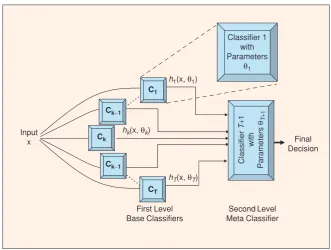
In addition to classifier ensembles, meta-classifier systems have proven to be very competitive for text classification tasks (Malmasi and Zampieri, 2016) and we decided to include a meta-classifier in our entry. Also referred to as classifier stacking, a meta-classifier architecture is generally com-posed of an ensemble of base classifiers that each make predictions for all of the input data. Their individual predictions, along with the gold labels are used to train a second-level meta-classifier that learns to predict the label for an input, given the decisions of the individual classifiers. This setup is illustrated in Figure 2. This meta-classifier at-tempts to learn from the collective knowledge rep-resented by the ensemble of local classifiers.
Input x
Classifier 1 with Parameters
θ1
Final Decision
C1
h1(x, θ1)
Ck−1
hk(x, θk) Ck
Ck−1
CT
First Level Base Classifiers
SecondLevel Meta Classifier
Classifier
T
+
1
with
Parameters
θT+
1
[image:4.595.132.464.62.312.2]hT(x, θT)
Figure 2: An illustration of a meta-classifier architecture. Image reproduced from Polikar (2006).
In this system we combined the probability out-puts of our seven individual classifier and used them to train a meta-classifier via cross-validation. Following Malmasi et al. (2016b), we used a Ran-dom Forest as our meta-classification algorithm. We submitted this system as run 3.
4 Results
4.1 Cross-validation Results
We first report the cross-validation results of our three systems on the training data. Results are shown in Table 1.
System Accuracy
Majority Class Baseline 0.219 Voting Ensemble (System 1) 0.854 Probability Ensemble (System 2) 0.950 Meta-Classifier (System 3) 0.977
Table 1: Cross-validation results for the Arabic training data.
We note that all of these methods outperform any individual feature type, with the meta-classifier achieving the best result of97.7%. This is a very large increase over the weakest system, which is the voting ensemble with85.4%accuracy. For the voting ensemble 1,165 of the 25,311 training sam-ples (4.60%) were ties that were broken arbitrarily.
This is an issue that can occur when there are an even number of classifiers in a voting ensemble.
4.2 Test Set Results
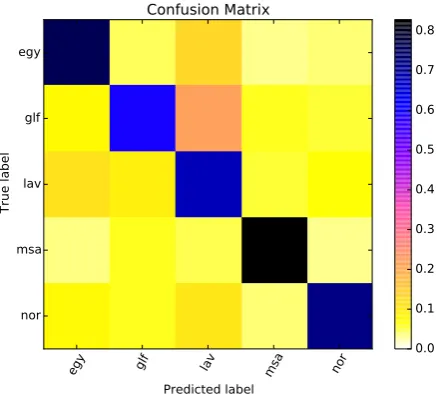
Finally, in this section we report the results of our three submissions generated from the unla-belled test data. The samples in the test set were slightly unbalanced with a majority class baseline of 23.1%. Shared task performance was evalu-ated and teams ranked according to the weighted F1-score which provides a balance between preci-sion and recall. Accuracy, along with macro- and micro-averaged F1-scores were also reported.
System Accuracy F1 (micro) F1 (macro) F1 (weighted)
Majority Class Baseline 0.231 — — —
Voting Ensemble (run1) 0.6086 0.6086 0.6032 0.6073
Probability Ensemble (run2) 0.6689 0.6689 0.6671 0.6679
[image:5.595.73.292.170.367.2]Meta-classifier (run3) 0.7165 0.7165 0.7164 0.7170
Table 2: MAZA Results for the ADI task.
egy glf lav msa nor
Predicted label egy
glf
lav
msa
nor
True label
Confusion Matrix
0.0 0.1 0.2 0.3 0.4 0.5 0.6 0.7 0.8
Figure 3: Confusion Matrix for Run 3.
Finally, another important observation is that the test set results are somewhat lower than the cross-validation results. Although this was not specified by the task organizers, it may have been the case that the test data was drawn from a different dis-tribution as the training data. An analysis of the most informative features and the misclassified in-stances in both the training and test sets may pro-vide an explanation for this difference.
5 Conclusion
We presented three systems trained to identified MSA and four Arabic dialects using iVectors and ASR transcripts. The best results were obtained by a meta-classifier achieving71.7%accuracy and ranking second in the ADI shared task 2017. To the best of our knowledge, this was the first time that computational methods have been evaluated on Arabic dialect detection using audio and text.
An important insight is that combining text-based features from transcripts with audio-text-based features can substantially improve performance. Additionally, we also saw that a meta-classifier can provide a significant performance boost com-pared to a classifier ensemble approach.
Acknowledgements
We would like to thank Preslav Nakov and Ahmed Ali for proposing and organizing the ADI task. We also thank the VarDial workshop reviewers who provided us valuable feedback and suggestions to improve this manuscript.
References
Rania Al-Sabbagh and Roxana Girju. 2012. YADAC:
Yet another Dialectal Arabic Corpus. In
Proceed-ings of LREC.
Ahmed Ali, Najim Dehak, Patrick Cardinal, Sameer Khurana, Sree Harsha Yella, James Glass, Peter Bell, and Steve Renals. 2016. Automatic Dialect
Detection in Arabic Broadcast Speech. In
Proceed-ings of INTERSPEECH.
Mohamad Hasan Bahari, Najim Dehak, Lukas Burget, Ahmed M Ali, Jim Glass, et al. 2014. Non-negative Factor Analysis of Gaussian Mixture Model Weight Adaptation for Language and Dialect Recognition. IEEE/ACM transactions on audio, speech, and lan-guage processing, 22(7):1117–1129.
Fadi Biadsy and Julia Hirschberg. 2009. Using Prosody and Phonotactics in Arabic Dialect
Identifi-cation. InProceedings of INTERSPEECH.
Fadi Biadsy, Julia Hirschberg, and Nizar Habash. 2009. Spoken Arabic Dialect Identification using
Phonotactic Modeling. InProceedings of the
Work-shop on Computational Approaches to Semitic Lan-guages.
Fadi Biadsy. 2011. Automatic dialect and accent
recognition and its application to speech
recogni-tion. Ph.D. thesis, Columbia University.
David Chiang, Mona T Diab, Nizar Habash, Owen Rambow, and Safiullah Shareef. 2006. Parsing
Ara-bic Dialects. InProceedings of EACL.
Ryan Cotterell and Chris Callison-Burch. 2014. A Multi-dialect, Multi-genre Corpus of Informal
Writ-ten Arabic. InProceedings LREC.
Najim Dehak, Pedro A Torres-Carrasquillo, Douglas A Reynolds, and Reda Dehak. 2011. Language Recognition via i-vectors and Dimensionality
Cyril Goutte, Serge L´eger, and Marine Carpuat. 2014. The NRC System for Discriminating Similar
Lan-guages. InProceedings of the VarDial Workshop.
Cyril Goutte, Serge L´eger, Shervin Malmasi, and Mar-cos Zampieri. 2016. Discriminating Similar
Lan-guages: Evaluations and Explorations. In
Proceed-ings of LREC.
Josef Kittler, Mohamad Hatef, Robert PW Duin, and
Jiri Matas. 1998. On combining classifiers. IEEE
Transactions on Pattern Analysis and Machine In-telligence, 20(3):226–239.
Ludmila I Kuncheva. 2004. Combining Pattern
Clas-sifiers: Methods and Algorithms. John Wiley & Sons.
Ludmila I Kuncheva. 2014. Combining Pattern
Clas-sifiers: Methods and Algorithms. Wiley, second edi-tion.
Shervin Malmasi and Mark Dras. 2014. Chinese
Native Language Identification. InProceedings of
EACL.
Shervin Malmasi and Mark Dras. 2015a. Language
identification using classifier ensembles. In
Pro-ceedings of the LT4VarDial Workshop.
Shervin Malmasi and Mark Dras. 2015b. Multilingual
Native Language Identification. Natural Language
Engineering, pages 1–53.
Shervin Malmasi and Marcos Zampieri. 2016. Ara-bic Dialect Identification in Speech Transcripts. In Proceedings of the VarDial Workshop.
Shervin Malmasi, Eshrag Refaee, and Mark Dras. 2015. Arabic Dialect Identification using a Parallel
Multidialectal Corpus. InProceedings of PACLING.
Shervin Malmasi, Mark Dras, and Marcos Zampieri. 2016a. LTG at SemEval-2016 Task 11: Complex Word Identification with Classifier Ensembles. In Proceedings of SemEval.
Shervin Malmasi, Marcos Zampieri, and Mark Dras. 2016b. Predicting Post Severity in Mental Health
Forums. InProceedings of the CLPsych Workshop.
Shervin Malmasi, Marcos Zampieri, Nikola Ljubeˇsi´c, Preslav Nakov, Ahmed Ali, and J¨org Tiedemann. 2016c. Discriminating between Similar Languages and Arabic Dialect Identification: A Report on the
Third DSL Shared Task. InProceedings of the
Var-Dial Workshop.
Robi Polikar. 2006. Ensemble based systems in
deci-sion making. Circuits and Systems Magazine, IEEE,
6(3):21–45.
Fatiha Sadat, Farnazeh Kazemi, and Atefeh Farzindar. 2014. Automatic Identification of Arabic Language
Varieties and Dialects in Social Media. In
Proceed-ings of the SocialNLP Workshop.
Abdulhadi Shoufan and Sumaya Al-Ameri. 2015. Nat-ural Language Processing for Dialectical Arabic: A
Survey. In Proceedings of the Arabic NLP
Work-shop.
Christoph Tillmann, Saab Mansour, and Yaser Al-Onaizan. 2014. Improved Sentence-Level Arabic
Dialect Classification. In Proceedings of the
Var-Dial Workshop.
Yang Xiang, Xiaolong Wang, Wenying Han, and Qinghua Hong. 2015. Chinese grammatical error
diagnosis using ensemble learning. InProceedings
of the NLP-TEA Workshop.
Omar F Zaidan and Chris Callison-Burch. 2014.
Ara-bic Dialect Identification. Computational
Linguis-tics.
Marcos Zampieri, Liling Tan, Nikola Ljubeˇsi´c, and J¨org Tiedemann. 2014. A Report on the DSL
Shared Task 2014. InProceedings of the VarDial
Workshop.
Marcos Zampieri, Liling Tan, Nikola Ljubeˇsi´c, J¨org Tiedemann, and Preslav Nakov. 2015. Overview
of the DSL Shared Task 2015. InProceedings of the
LT4VarDial Workshop.
Marcos Zampieri, Shervin Malmasi, Nikola Ljubeˇsi´c, Preslav Nakov, Ahmed Ali, J¨org Tiedemann, Yves Scherrer, and No¨emi Aepli. 2017. Findings of the
VarDial Evaluation Campaign 2017. InProceedings
of the VarDial Workshop.
Rabih Zbib, Erika Malchiodi, Jacob Devlin, David Stallard, Spyros Matsoukas, Richard Schwartz, John Makhoul, Omar F Zaidan, and Chris Callison-Burch. 2012. Machine translation of Arabic