Peer Assisted Multicast Streaming for
On-Demand Applications
John Paul O’Neill
Trinity College Dublin, the University of Dublin School of Computer Science and Statistics
A thesis submitted for the degree of
Doctor of Philosophy in Computer Science
Declaration
I declare that this thesis has not been submitted as an exercise for a degree at this or any other university and it is entirely my own work.
I agree to deposit this thesis in the Universitys open access institutional repository or allow the library to do so on my behalf, subject to Irish Copyright Legislation and Trinity College Library conditions of use and acknowledgement.
Signature
Acknowledgements
I would like to thank my supervisor, Dr Jonathan Dukes, for his guidance and support throughout my time working with him. I would also like to thank the other members of the Computer Architecture Group and the School of Computer Science and Statistics, in particular John Walsh for his technical support with my simulations.
The work described here has been part-funded by Irish Research Council for Science, Engineering & Technology and I am grateful for their support.
Abstract
On-demand multimedia streaming applications allow users to select and view content at a time of their choosing and to control the playback of this content. This level of control typically requires that each user receives a dedicated stream from the service provider. The provision of these streams can place a high load on a centralized server and can result in network bottlenecks near the server.
An approach called Peer Assisted Multicast Streaming is proposed to reduce the load on a centralized server, and to partially re-distribute the remaining load to the edges of the network.
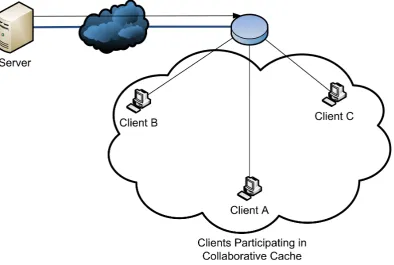
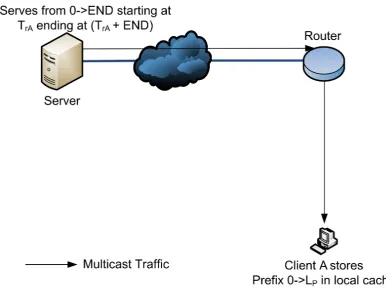
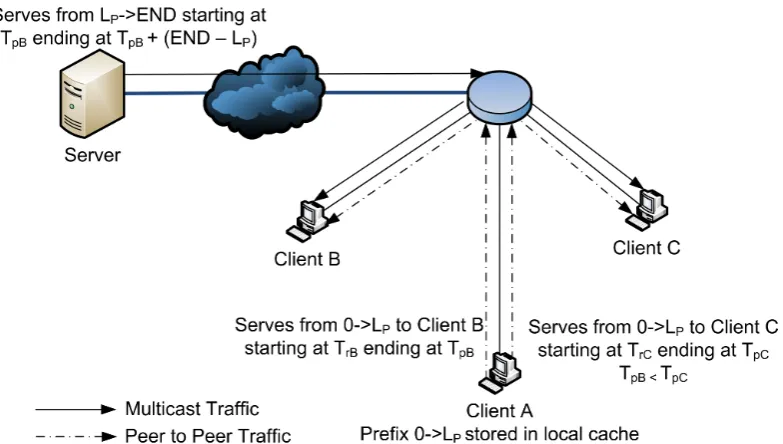
Peer Assisted Multicast achieves this by allowing participating users to share with each other the beginning, or “prefix” of content items that they have previously received and cached, thus creating a decentralized collaborative cache. By doing this, a server will only need to serve the remainder of the content and can delay doing so until the content is required. This content can be provided using a multicast stream. Other requests received before the multicast stream begins can be serviced by the same stream. This allows the server to benefit from the use of multicast without affecting an individual user’s experience. Serving multiple requests with a single stream will reduce the overall network bandwidth requirements of a server. As the users of the system will be providing content to each other, some of the network load will also be distributed away from the server.
Contents
Declaration ii
Acknowledgements iii
Abstract iv
1 Introduction 1
2 On-Demand Multimedia Streaming 8
2.1 Multimedia Systems . . . 8
2.2 Multimedia Streaming Applications . . . 13
2.2.1 Broadcast Streaming Applications . . . 14
2.2.2 On-Demand Streaming Applications . . . 14
2.3 Resource Requirements of Streaming Applications . . . 15
2.3.1 Broadcast Streaming Server Resources . . . 15
2.3.2 On-Demand Streaming Server Resources . . . 16
2.3.3 Client Resources . . . 17
2.4 On-Demand Multimedia Streaming Architectures . . . 19
2.4.1 Centralised Content Delivery . . . 19
2.4.2 Content Distribution Networks . . . 19
2.4.3 Proxy Prefix Caching . . . 20
2.5 Implementing Multimedia Streaming . . . 22
2.5.1 Real-Time Streaming Protocol . . . 22
2.5.2 RTSP Messages . . . 23
2.5.3 RTSP Session and States . . . 24
2.6 Summary . . . 25
3 Multicast Multimedia Streaming 27 3.1 Multicast . . . 27
3.1.1 Building Efficient Multicast Trees . . . 32
3.2 Multicast Multimedia Streaming . . . 34
3.2.1 On-Demand Multicast Multimedia Streaming . . . 34
3.2.2 Implementing Patching Using RTSP . . . 37
3.2.3 Multicast Subscription Policy . . . 41
3.2.4 Evaluation of Multicast Patching . . . 45
3.3 Summary . . . 46
4 Peer-to-Peer Multimedia Streaming 47 4.1 Chord Overlay Network . . . 48
4.1.1 Chord Routing . . . 49
4.1.2 Application Example: Squirrel . . . 52
4.2 Peer-to-Peer content delivery . . . 53
4.2.1 Hybrid Architectures . . . 54
4.2.2 Application Level Multicast . . . 55
4.3 Combining Peer-to-Peer and Multicast Streaming . . . 55
4.4 Summary . . . 56
5 Peer Assisted Multicast Streaming 57 5.1 Rationale . . . 58
5.2 Behaviour . . . 63
5.3.1 Prefix Retrieval . . . 68
5.3.2 Prefix Announcement . . . 69
5.3.3 Prefix Validation . . . 70
5.3.4 Delegate Selection . . . 82
5.3.5 Local Cache Management . . . 85
5.3.6 Joining the Collaborative Cache . . . 87
5.4 Server . . . 87
5.5 Summary . . . 88
6 Implementation of Peer Assisted Multicast Streaming 90 6.1 Implementing the Collaborative Prefix Cache . . . 90
6.1.1 Joining and Leaving the Collaborative Cache . . . 91
6.1.2 Replication . . . 92
6.1.3 Implementing Prefix Streaming with RTSP . . . 92
6.2 Server Stream Control Protocol . . . 95
6.3 Client Communication . . . 98
6.4 Simulation . . . 99
6.5 Summary . . . 99
7 Simulation and Evaluation 100 7.1 Simulation Framework . . . 101
7.2 Experiment Parameters and Performance Metrics . . . 102
7.2.1 Independence of Parameters . . . 103
7.3 Experiment 1: Performance and Behaviour . . . 105
7.4 Experiment 2: Client Population Size . . . 112
7.5 Experiment 3: Prefix Duration . . . 115
7.6 Experiment 4: Popularity of Content . . . 119
7.7 Experiment 5: Client Cache Size . . . 121
7.8 Experiment 6: Number of Content Items . . . 124
7.10 Experiment 8: Churn . . . 132 7.11 Summary . . . 137 7.12 Conclusions . . . 140
8 Conclusion 141
8.1 Future Work . . . 146 8.2 Concluding Remark . . . 147
List of Tables
2.1 Comparison between Download and Streaming Services . . . 13
7.1 Experiment 1 Parameters: Investigating General Behaviour. . . 109
7.2 Experiment 2 Parameters: Effect of Client Population Size . . . 114
7.3 Experiment 3 Parameters: Effect of Prefix Duration . . . 116
7.4 Experiment 4 Parameters: Effect of Content Popularity . . . 120
7.5 Experiment 5 Parameters: Effect of Client Cache Size . . . 123
7.6 Experiment 6 Parameters: Effect of Size of Content Library . . . 125
7.7 Experiment 7 Parameters: Impact of Flash Crowds . . . 130
List of Figures
2.1 Storage requirement for uncompressed video . . . 10
2.2 Simple buffer . . . 18
2.3 Centralised Content Delivery . . . 19
2.4 Content Delivery Network . . . 20
2.5 Proxy Prefix Caching . . . 21
2.6 RTSP State Machine . . . 24
3.1 Multicast Listener Query Message [VC04] . . . 30
3.2 Multicast Listener Report Message [VC04] . . . 31
3.3 Multicast Address Record [VC04] . . . 31
3.4 Multicast Subscription using MLD Listener Reports . . . 33
3.5 Multicast Traffic Resulting From an Inefficient Multicast Tree . . . 34
3.6 Multicast Subscription using MLD Listener Reports and PIM-SSM . . . 35
3.7 Multicast Traffic Resulting from PIM-SSM . . . 35
3.8 Timing and method of delivery of streams with Patching . . . 38
3.9 Simple RTSP Session . . . 39
3.10 Patching RTSP Session . . . 40
3.11 RTSP Patching session where the client “misses” the start of the stream 42 3.12 Effect of Buffer Size on Grace Patching Using Minimum Subscription at Increasing Network “Hops” from the Server . . . 46
4.1 Chord Routing Tables . . . 50
5.1 Proxy Prefix Caching . . . 60
5.2 Collaborative Prefix Caching . . . 61
5.3 Peer Assisted Multicast Streaming . . . 63
5.4 Delivery of content to Client A . . . 64
5.5 Delivery of content to Client B . . . 65
5.6 Delivery of content to Client C . . . 66
5.7 Clients B and C retrieve cached prefixes from Client A and the remainder of the stream from the server . . . 67
5.8 Case #1: Not in local cache, not in collaborative cache . . . 72
5.9 Case #2: Stale in local cache, not in collaborative cache, not modified . 73 5.10 Case #3: Stale in local cache, not in collaborative cache, modified . . . 74
5.11 Case #4: Stale in local cache, fresh in collaborative cache, not modified 75 5.12 Case #5: Stale in local cache, fresh in collaborative cache, modified . . 76
5.13 Case #6: Not in local cache, fresh in collaborative cache . . . 77
5.14 Case #7: Stale in local cache, stale in collaborative cache, modified . . . 78
5.15 Case #8: Stale in local cache, stale in collaborative cache, not modified 79 5.16 Case #9: Not in local cache, stale in collaborative cache, not modified . 80 5.17 Case #10: Not in local cache, stale in collaborative cache, modified . . . 81
5.18 Client Decision Flow Chart . . . 83
5.19 Home Node and Delegate Decision Flow Chart . . . 84
6.1 (a) RTSP PLAY request issued by a client at time T, for a content item of duration Lt, that has obtained a prefix of duration Lp from the col-laborative cache . . . 97
6.2 (b) RTSP PLAY request issued by a client at time T, that requires the entire content stream of duration Lt from the server . . . 97
6.3 PAMS Client Communication . . . 98
7.2 Experiment 1 – Mean requests served per multicast stream using PAMS 112 7.3 Maximum Number of Concurrent Multicast Streams Using PAMS . . . 113 7.4 Experiment 2 – Effect of population size on the mean number of per title
concurrent streams . . . 115 7.5 Experiment 2 – Effect of population size on server performance . . . 116 7.6 Experiment 3 – Effect of Prefix Duration on Server Performance . . . . 117 7.7 Experiment 3 – Effect on prefix duration on client performance (averaged
across all clients) . . . 118 7.8 Experiment 3 – Effect of prefix duration on requests served per multicast
stream . . . 119 7.9 Experiment 4– Effect of popularity on server performance . . . 121 7.10 Experiment 4 – Effect of popularity on mean requests served per
multi-cast stream . . . 122 7.11 Experiment 4 – Experiment 4 – Effect of popularity on server
perfor-mance for the five most popular items . . . 122 7.12 Experiment 5 – Effect of cache size on server performance . . . 124 7.13 Experiment 5 – Effect of cache size on cache hit rate . . . 125 7.14 Experiment 6 – Effect of number of content items on server performance 126 7.15 Experiment 6 – Effect of number of content items on requests served per
multicast stream . . . 127 7.16 Experiment 6 – Effect of number of content items on requests on
Chapter 1
Introduction
On-demand, Internet-based multimedia streaming services are gaining mass-market acceptance as an alternative to traditional broadcast services for television and ra-dio [Gro10]. The emergence and popularity of services such as BBC’s iPlayer1, Hulu2 and NetFlix3is evidence of this. Services such as these, which had been used primarily by technology enthusiasts using desktop PCs, are now readily available to consumers through easy-to-use televisions, set-top boxes, video game consoles and smart phones. Multimedia streaming services may be broadly classified into two groups, which are referred to here as broadcast services and on-demand services. There is a close relationship between the categorization of a service and the technology used to to deliver it.
In a broadcast service, the service provider controls the content that clients re-ceive. Broadcast services are built around content schedules determined by the service provider. Service providers may offer a number of broadcast channels. Clients may choose to receive one of these channels, but have no further control over the broadcast content. All of the clients receiving the same channel will receive the same content at the same time. This broadcast approach is an efficient way to deliver either live or pre-recorded content and is the model used to deliver familiar services such as digital
1
http://www.bbc.co.uk/iplayer
2
http://www.hulu.com
3
satellite television or Internet radio.
On-demand multimedia streaming services, in contrast, offer clients greater con-trol over the content they receive. These services allow clients to select and view content at a time of their choosing and to control the playback of the content, for example, allowing clients to pause the playback of content, or to skip ahead to a future point of interest within the content. In other words, each client creates his or her own content schedule. This level of control prohibits the use of broadcast technology for offering on-demand services and makes on-demand multimedia streaming a resource-intensive application.
As the availability of high bandwidth Internet access becomes more widespread, the availability and popularity of on-demand streaming services has increased. Many content providers now offer on-demand libraries of content, either through their own websites in the form of so-called “catchup services” (e.g. BBC iPlayer or RT ´E Player4) or through dedicated on-demand streaming services (e.g. Hulu or NetFlix). Current trends indicate that on-demand services such as these are replacing traditional broad-cast services [Gro10].
Offering on-demand streaming services to large numbers of clients is challenging and expensive, however, as each client requires an individual multimedia stream over which they have independent control. Furthermore, as the demand for high definition video and high quality audio increases, the demands placed on existing network in-frastructure become a concern [Wak08]. The cost of delivering a broadcast service is usually independent of the number of clients and dependent only on the number of broadcast channels, and the quality of the stream. In contrast, the cost of delivering an on-demand streaming service is dependent on the number clients receiving the content as well as the quality of the stream. This is an important consideration for on-demand content providers as the cost of delivering the content is beyond their control and will be subject to the popularity of the service.
The focus of this thesis is on reducing the cost of delivering on-demand multimedia
4
streaming services. The approach that is taken seeks to reduce this cost by reducing the number of individual streams required to deliver the on-demand service and also to shift the provision of part of some of these streams towards the edges of the network away from the server. This will be achieved without any reduction in the interactive functionality provided to clients.
In the proposed approach, which will be referred to as Peer Assisted Multicast Streaming or PAMS, each client maintains a local cache of the beginning, or “prefix”, of each content item that they receive. Each client contributes the prefixes in its local cache, creating a “collaborative cache” from which a participating client can retrieve the prefix of a content item that it has requested. If a prefix can be obtained from the collaborative cache, the server only needs to supply the client with the remainder of the content item. The client does not need to begin receiving the remainder of the content until it has received the prefix. This provides an opportunity to the server to delay delivering the remainder of the content item. During this delay, if the server receives further requests for this content item, all of these delayed requests can be served using a single multicast stream. Multicast is a network delivery technique where one packet is sent, then duplicated and delivered to multiple destinations throughout the network. Multicast can offer a significant reduction in bandwidth utilisation for a server in the case where the same packets must be sent from a source to a number of destinations.
Both multicast and collaborative caching exploit the locality principle [Den05] to reduce the costs of supplying popular content. With multicast streaming, the locality principal is exploited by using a single multicast stream to serve clients who wish to receive the same portion of a content item at approximately the same time. Collabo-rative caching exploits the locality principle by allowing clients at a distance from the server to supply each other with recently received content items, thus reducing the load at and near the server.
the network. This is achieved without the introduction of additional dedicated infras-tructure. Furthermore, clients retain the control that would normally be expected from an on-demand streaming service.
As the collaborative cache is implemented using the resources of the clients that access it, it will grow in proportion to the popularity of the system, thus providing a scalable solution for providing prefixes. Since the server still operates independently of the collaborative cache, the performance of the system will degrade gracefully to-wards that of a centralized unicast server if the performance of the collaborative cache deteriorates.
The collaborative cache uses a peer-to-peer approach to allow clients to locate prefixes stored by other clients. Peer-to-peer approaches for on-demand multimedia streaming have often been seen as unattractive by content providers, mainly due to concerns over Digital Rights Management and security. Since the approach proposed here, however, only uses the peer-to-peer network to provide a portion of each content item, the access to the reminder of the content can still be restricted by the content provider at the server.
As the collaborative cache is independent of the server, it could also be used in conjunction with a non-multicast server to reduce bandwidth utilisation of the server, without the use of multicast, by caching and serving prefixes in a similar manner to the proxy prefix cache architecture proposed elsewhere [SRT99].
In implementing PAMS, some key philosophies dictated the approach taken and decisions made. It was felt that the collaborative cache should be lightweight, with regard to the network overhead required to maintain the collaborative cache. It was also decided that servers should act independently of the cache and that a server should require only minor modifications to implement PAMS. The implementation of PAMS should also ensure that the service is not dependent on the collaborative cache but is augmented by it. Finally, the design of PAMS should support client and server implementations that are compatible with standard network streaming protocols.
Experiments in Chapter 7 will demonstrate that PAMS can significantly reduce outgoing server bandwidth utilization in comparison to the bandwidth required by a simple unicast approach. Furthermore it will be be shown that PAMS scales more effectively than a simple unicast approach as the number of clients accessing the ser-vice increases. In particular, unlike a unicast approach, when the number of clients requesting a particularly popular content item is sufficiently high the server resources required to deliver this content ceases to increase. In this situation, this maximum limit is independent of the popularity of the content item. This has important implications for resource provisioning for a service provider. It will also be shown that PAMS adapts effectively to sudden increases in the popularity of content.
Alternative approaches to the one proposed here typically focus on either reducing the number of streams required to serve on-demand content, or distributing the load to other locations in the network. Multicast is one way of reducing the total number of streams required to deliver an on-demand service. The challenge when using multicast, however, is to achieve this reduction without losing the interactivity that clients expect from an on-demand service.
the cost of deploying additional server infrastructure.
A more cost-effective approach to distributing the load generated by an on-demand service is to use a peer-to-peer based system. Peer-to-peer systems adapt well to increases and decreases in usage, but without a dedicated centralized server from which all content can be retrieved, some content may become unavailable within the peer-to-peer system.
There are some issues which fall outside the scope of this thesis. For example, issues related to digital rights management and security have not been considered. Providing a Quality of Service guarantee to consumers of the streamed content is also outside of the remit of this thesis.
Contributions
The primary contribution of this thesis is the Peer Assisted Multicast Streaming (PAMS) architecture. The architecture represents a new approach for delivering on-demand multimedia content. The approach combines the use of multicast with a peer-to-peer collaborative cache. In addition to the design of the architecture an approach for im-plementing the PAMS using standard network protocols and existing multicast and peer-to-peer overlay technologies is proposed, and aspects of the approach may be applicable to other multicast streaming architectures.
A detailed simulation framework for evaluating large-scale multimedia systems was developed. The framework simulates behaviour of multimedia streaming systems down to the network packet level. This framework was used to perform a detailed per-formance evaluation of Peer Assisted Multicast Streaming. Furthermore, the framework was used in the re-evaluation of existing multimedia approaches.
Overview
Chapter 2
On-Demand Multimedia
Streaming
In this chapter, the nature, properties and requirements of on-demand multimedia streaming systems will be presented and discussed. An initial description of what is meant by the term “multimedia” will serve to define more precisely the context of the thesis. This will be followed by a discussion of multimedia streaming applications, in which multimedia content is transmitted between network nodes. The properties and requirements of different types of multimedia streaming applications, will be presented and compared, focusing on the on-demand applications that are the main concern of this thesis. Finally, different approaches to the efficient implementation of on-demand multimedia streaming services will be presented and discussed.
2.1
Multimedia Systems
content.
In analogue form, video is stored on film as a series of images, often referred to as frames. These frames, when displayed, or “rendered”, in rapid succession appear to a viewer to be a moving image. The speed at which the images are displayed is referred to as the frame rate, and is measured in frames per second (fps). The usual rate of an analogue cinema presentation is 24 frames per second.
This approach can also be applied to digitizing video, where each image is digitally stored and then rendered at a specified framerate. A single digital image is made up of a collection of pixels, where each pixel represents a colour. The number of bits used to represent a the colour of a pixel is referred to as the colour depth. To represent two colours (e.g. black and white), a single bit can be used. The larger the number of bits used, the more colours are available, with 24 bits (16,777,216 colours) being an acceptable standard for photo-realistic image quality. The number of pixels used to represent an image can vary from one format to another and is known as the resolution. A typical standard of resolution is 720 horizontal pixels and 480 vertical pixels.
The basic storage requirements of an image can be calculated as the product of the number of pixels (resolution) and the number of bits used to represent the colour of each pixel (colour depth). For example, the basic storage requirement of a digital image using the resolution and colour depth described above would be 720×480×24 = 8294400 bits or 0.99 MB.
Techniques for compressing digital images such as JPEG, PNG and GIF are frequently used to reduce the amount of space required to store a digital image, but these will be ignored for this example.
Figure 2.1: Storage requirement for uncompressed video
125GB of storage, which is clearly unfeasible.
To overcome these storage requirements, video compression standards are used, such as MPEG-4 [Koe99] and H.264 [WSBL03]. These compression algorithms exploit the similarities between consecutive frames. The differences between two frames are generally minuscule, so, to save space, rather than save two consecutive frames, these algorithms are based around storing the differences between the current frame and the following frame. Using MPEG-2 compression, which is the standard upon which DVD’s are based, a resolution of 720×480 pixels, with a 24 bit colour depth and a frame rate of 30fps will result in a bit rate of approximately 9.8Mbps. Assuming this bit rate, the storage requirements for a ninety minute (90×60 = 5400 second) DVD quality video would be:
Multimedia presentations typically contain audio as well as video. Audio is nor-mally digitised using pulse-code modulation. Pulse-code modulation requires the am-plitude of the audio to be sampled at specific intervals and this is known as the sampling rate. The amplitude of the audio at the sampling time is quantized to a discrete value determined by the bit depth and the quantization algorithm. A higher bit depth and sampling rate give rise to better quality recordings of the original audio, but this will result in higher storage requirements. Digitised audio can be compressed using algo-rithms such as MP3 [Bra99].
Using linear pulse code modulation, the amplitude of an audio wave is sampled at a constant rate and quantized to a discrete value, with the number of possible values determined by the bit-depth. For example, 8-bit audio provides 28 unique values to represent the sampled amplitude. CD-quality audio has a sampling rate of 44,100Hz and a bit-depth of 16, meaning that the amplitude of the original audio wave was sampled 44,100 times per second and each sample was assigned a 16-bit value.
types such as news items, films or sporting events. There are two models for remote retrieval: download and streaming.
In a download based system, the entirety of content must be retrieved from the server by the client and stored locally before rendering of the content can begin. Once the content has been fully retrieved it is accessed and rendered in the same way as locally stored content would be rendered. The single biggest disadvantage of a download based system is that it can take a substantial amount of time to fully download content, with the time required determined by the bitrate of the content, the available download bandwidth and the duration of the content. Download based services also require the client to have sufficient storage space to store the entirety of the content.
A more advanced model of download is progressive download, in which playback of content can be started once download has commenced. This significantly reduces the time a requesting client must wait to begin consuming the requested content, but has the disadvantage of reducing the interactivity the client can have within playback as features such as skipping to a future point in the content item are not supported.
In a multimedia streaming application, a multimedia stream is transmitted from a source location, over transport medium such as a network, to a destination, where it is rendered, processed or stored as it is received. The transmitted content may be pre-existing, stored content (e.g. a video-on-demand service) or it may be produced in real-time (e.g. a video conference or live news broadcast).
In a streaming based service, rendering can begin once the client has received the start of the content. Streaming services require less client storage capacity than download services, as once the content has been rendered it can be discarded. The duration of the content is a factor in determining the storage space required in a download system, but in a streaming system, the duration of the content has little impact on the client’s required client storage capacity as content does not need to be stored once it has been rendered. A small amount of storage is required to buffer content as it is received, this is discussed below.
Property Download Service Streaming Service Client Latency High - content must be fully
re-ceived before playback can com-mence
Low - playback can begin once buffer has received enough content
Server Load Server can balance needs of all re-quests as there are no real-time con-straints
Server must deliver content to each requesting client in a timely fashion to avoid clients experiencing inter-ruption in playback
Client Storage Clients must have sufficient storage to store entirety of content
Clients need only have enough stor-age to meet the buffers require-ments
Playback Playback is only started once all content is received, so will be un-interrupted
Playback is subject to interruption, due to changes in network quality, a buffer is required to overcome this Commercial
Exam-ples
iTunes, Amazon YouTube, BBC iPlayer, Hulu
Table 2.1: Comparison between Download and Streaming Services
resources. In a download system the server can deliver the content at a rate that is limited by the bandwidth available between the server and the client. In a streaming service though, as the client has real-time demands, clients must receive the content stream at a pre-determined rate, determined by the encoding of the content. If the client receives the content too slowly then rendering of the content will be effected, and the client will not see an uninterrupted media presentation. In contrast, if the client receives the content too quickly, it will need to buffer the content before rendering it, which increases the local storage requirements of the client. If the server can deliver the content at a rate that approximately matches the bitrate of the content, the client may still need to maintain a small buffer to allow for variations in the rate at which content is received (for example, as a result of network congestion) or the availability of local resources to render the content. The properties of download and streaming services are summarised in Table 2.1
2.2
Multimedia Streaming Applications
streaming applications will be compared while the following section will discuss the resource requirements of both.
2.2.1 Broadcast Streaming Applications
In a broadcast streaming application, the content that is transmitted and the time that it is transmitted at is determined at the source of the transmission. Clients are limited to choosing whether or not a transmitted stream is received. The content streams may originate from an archive, for example, in the case of broadcast television. Alternatively, the content streams may be produced in real-time, for example, in the case of a live event broadcast over the Internet or a video conference
Broadcast streaming can be delivered over a broadcast medium, such as digital satellite, or it can be delivered over a network through a stream from a server to a number of clients, with each client receiving the same data at approximately the same time. Broadcast streaming services do not offer clients the ability to interact with streams, i.e. clients cannot view a different part of the broadcast than is currently being provided by the server.
2.2.2 On-Demand Streaming Applications
Examples of on-demand streaming applications include TV catchup or movie-on-demand services.
2.3
Resource Requirements of Streaming Applications
The characteristics and, in particular, resource requirements of a multimedia streaming application depend on whether the service offered is broadcast or on-demand and these characteristics and requirements are discussed here.
The main parameters that determine the resource requirements of a streaming application can be divided into two types, requirements that result from the character-istics of the content being served and requirements that result from the nature of client demands.
The bitrate and duration of content will determine the requirements of a stream served to a client, while the total number of concurrent clients and the method of delivery will determine the requirements for the system as a whole.
2.3.1 Broadcast Streaming Server Resources
Resource requirements of a broadcast streaming application are dependent on how the broadcast service is implemented. Broadcast streaming applications can be delivered using broadcast, unicast or multicast delivery. With both broadcast and multicast delivery, the server will only deliver a single multimedia stream for each channel which all clients will receive. Broadcast techniques such as network-level broadcast involve data being delivered to all receivers, whereas multicast involves a single data packet being delivered to a select group of receivers.
over networks such as the Internet. Multicast delivery is discussed in further detail in Chapter 3.
A unicast approach may also be used to implement live streaming applications, in circumstances where broadcast or multicast delivery is not available. Unicast, however, has significantly higher server resource requirements than either broadcast or multicast approaches, since the server must supply an individual stream to each client. This results in the resource requirements of the server being determined by the number of concurrent users as well as the properties of the stream.
2.3.2 On-Demand Streaming Server Resources
The focus of this thesis is on on-demand multimedia streaming applications and, in par-ticular, on reducing the server and network resource requirements of such applications. Basic on-demand streaming services provide each user with an individual data stream, placing a substantial demand on the resources of service providers. The resource re-quirements of a multimedia streaming service are determined by the number of clients accessing the service, the duration of each concurrent stream, the bitrate of each stream and the total number of content items offered by the service. Due to decreasing cost of storage, storage space is no longer a determining factor for how many content items are offered by the service. The bandwidth available to a streaming service is a major factor though, as multimedia streams tend to be both bandwidth intensive and long-lived.
For a service offering N content items, each with a known bit rate, Bi, and an
average stream duration, Lti, then the mean bit rate for all concurrent streams in the
system can be calculated for a known mean request rate ofR. For a content itemiwhich is requested with probabilitypi, the request rate for the itemiisR×pi. Using Little’s
formula [Lit61]1, which may be rewritten in this context asSi =R×pi×Lti, the number
of concurrent streams of a content item (Si) can be calculated for a given request rate
and mean stream duration. For content itemi, the mean number of concurrent streams is R×pi ×Lti and the bandwidth required for this number of concurrent streams is
1
R×pi×Lti×Bi. Thus, the aggregate bandwidth required to serve all content items is
R×
N
X
i=1
(pi×Lti×Bi)
!
To illustrate this, consider a service that receives a client request every 4 sec-onds. Each client requests a movie with an average duration of 3600 seconds and each stream has a bandwidth requirement of 5Mbps. In this example, the total bandwidth requirement of the service is 4,500Mbps.
Although this simple example illustrates how factors such as bit-rate and stream duration impact on the bandwidth required to supply a multimedia streaming service, there are other factors that must also be considered.
Concurrent Users While the calculation above gives the mean number of concurrent users a service could handle, the actual number of concurrent users at a given time can vary significantly. Factors that can cause this include the time of day, with a system experiencing peak loads at certain times. In extreme cases, “flash crowds” [JKR02] may occur, where there is a substantial and unpredicted increase in the load on the system. Such an event can occur during a breaking-news event or after the release of new and highly popular content and can result in the service becoming overloaded.
Popularity of Content The distribution of requests over the entire collection of content items can be modelled using a Zipf [Zip49] [SD00] distribution. For a simple streaming service, the popularity of individual titles has no affect on the requirements of a system, unless the content items have differing bit-rates and durations.
2.3.3 Client Resources
Figure 2.2: Simple buffer
to some fluctuation. Due to changing network conditions between the two endpoints, there may be some variation in the time required to transmit any two packets from the server to the client. This variation is commonly referred to as jitter, and is outside of the control of the endpoints. This results in fluctuations in the rate at which the media content is received, which could result in the content being received at a rate less than the bitrate of the content. If this was the case the result would be an interruption to rendering of the content. To prevent such fluctuations being perceived by users in the rendering of the content, received multimedia streams are usually buffered by the client.
Clients implement buffering by locally storing streamed content as it is received. The buffered content is then rendered from the buffer. Rendering will only begin once the buffer is filled sufficiently to overcome the expected jitter. This allows for continuous playback if there are delays in the transmission, as there is still multimedia content available to be rendered. A buffer not only allows for some delays in the transmission, but also allows for the content to be received at a higher rate than the bit-rate of the content. Depending on the size of the buffer, the entirety of the content could be received by the client long before it is due to be rendered.
Figure 2.3: Centralised Content Delivery
2.4
On-Demand Multimedia Streaming Architectures
A number of techniques have been proposed in the literature and used in practice to provide on-demand streaming services. This section will discuss the main approaches that have been used commercially or proposed in the literature.
2.4.1 Centralised Content Delivery
The most basic approach for implementing a multimedia streaming service is a cen-tralised architecture. In this architecture a single server or a cencen-tralised cluster of servers will receive the requests from the clients and will service these requests by providing streams containing the requested content.
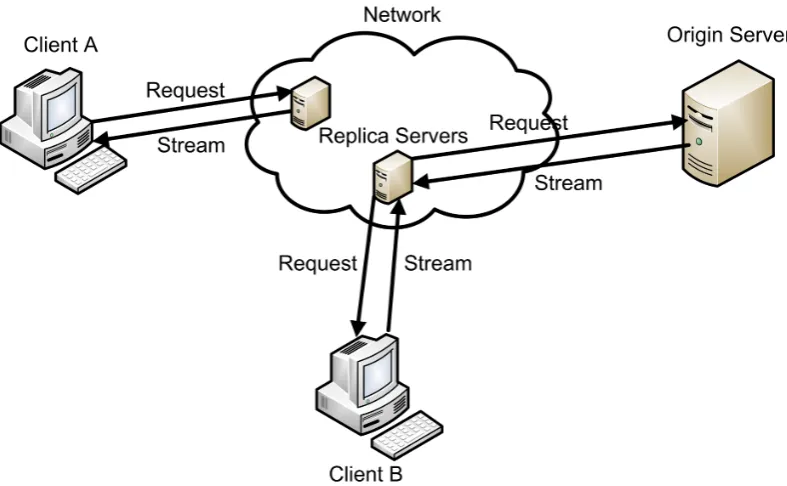
2.4.2 Content Distribution Networks
Figure 2.4: Content Delivery Network
2.4.3 Proxy Prefix Caching
Proxy prefix caches [SRT99] are similar in architecture to CDNs but instead of repli-cating entire content items, only the beginning of each stream is cached and served to requesting clients. The rest of the content is then streamed from the server to the client through the proxy prefix cache, with the cache responsible for smoothing the delivery of content to allow for a near constant bit rate supplied to the client. The effect of proxy prefix caching is that streams have low startup latency and the bit-rate of the received stream can be controlled as there is less likelihood of variable jitter between the prefix cache and client than there is between the server and client.
2.4.4 Peer-to-Peer Systems
Figure 2.5: Proxy Prefix Caching
2.4.5 Comparison of On-Demand Multimedia Streaming
Architec-tures
The main disadvantage of centralised content delivery architectures is their limited scalability. Although adding more resources to a centralised cluster may allow the cluster to provide more concurrent streams, network bandwidth remains a constraint on service capacity. Furthermore, the server is inherently a single point of failure in the architecture. Finally, if the network distance between a centralised server and a client is substantial, clients may experience high stream startup latencies between requesting a content item and rendering the beginning of the content.
Although Content Delivery Networks and Proxy Prefix Caches address issues such as startup latency, network congestion and server load, they both require the de-ployment of additional infrastructure. The costs involved in deploying and maintaining CDNs can be prohibitive and, unless there is a guaranteed demand on the network, the benefits can be outweighed by the costs. It is now common practice for multimedia content providers to outsource the provision of CDNs to dedicated providers, such as Akamai 2. Currently, Akamai has over 95,000 servers in 71 countries operating within nearly 1,900 networks3.
Flash crowds [JKR02], which are defined as an unexpected surge in accesses to a system, can also affect CDNs as they may be slow to adapt to changes in content popularity. Furthermore, decreasing popularity of content is difficult to define as these
2
http://www.akamai.com
3
decreases could be linked to other factors, such as time of day, rather than an actual decrease in the access rate of the content.
2.5
Implementing Multimedia Streaming
In order to establish, control and teardown a multimedia streaming session between two points, an appropriate protocols must be used. One such commonly used control protocol is the Real Time Streaming Protocol (RTSP) [SRL98]. RTSP is now discussed in detail as it is later proposed in Chapter 6 as a suitable protocol for controlling streaming in the Peer Assisted Multicast Streaming architecture proposed in this thesis. The details of the operation of RTSP are described below. While RTSP can be used for a variety of multimedia streaming applications, including, for example, recording applications that may involve the transmission of a stream from a client to a server, the protocol will only be discussed in the context of the control of a stream from a server to a client and in the context of on-demand multimedia streaming applications in particular.
2.5.1 Real-Time Streaming Protocol
RTSP is an application level protocol in the OSI model [Tan96] for the control of multimedia streams. Typically there will be two parties involved in an RTSP session, the client requesting the stream and the server providing the stream. Within an RTSP session, both parties can issue requests that can effect the control of the streaming session. As RTSP is an application level protocol, the connection between the client and server will use a transport level protocol such as TCP [Pos81]. The multimedia stream itself is delivered out-of-band of with respect to the RTSP session through a different protocol such as RTP [SCFJ03] or UDP [Pos80].
however, the client and server in an RTSP session must maintain the state of the session.
2.5.2 RTSP Messages
RTSP messages are sent between a client and a server in order to control a stream. Each request message requires a response message to be sent. The format of messages is based on HTTP, with a header specifying the type of message, followed by the body of the message. Generally, a client will issue requests and the server will issue responses, although the server may also issue requests, such as those to change the transport parameters of the stream or to teardown a stream. Upon sending or receiving a request or response, a change of state can occur at either the client or the server, depending on the nature of the message.
Only a small subset of the functionality of RTSP must be considered in the specific context of on-demand streaming applications, which are the focus of this thesis. The following RTSP request types will be of interest:
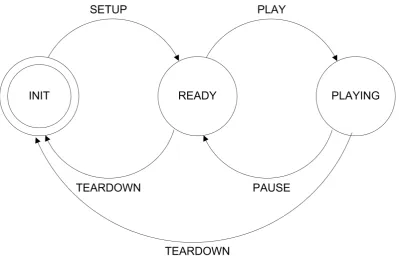
SETUP Upon receipt of aSETUPrequest, the server will allocate resources for the stream, and create a new RTSP session. However, it is important to note that the server does not commence transmitting the multimedia content at this point. In a
SETUP request, a client can specify the transport parameters that are available and acceptable to it. The server, in its response, will provide the client with details of the transport parameters that it has selected for the session. Upon receipt of the response the client can open up the required transport channel with the server.
PLAY After receiving the response to aSETUPrequest, a client may issue aPLAYrequest to the server. Upon receipt of this request, the server will respond to the request and, if the response is positive (OK), will begin sending the data through the agreed transport channel.
Figure 2.6: RTSP State Machine
suspend sending data to the client. If the client wishes to resume playback, it may issue aPLAY request again.
TEARDOWN A TEARDOWN message can be issued by either a server or a client. In either case, the server will free any allocated resources, and the RTSP session will be ended. TEARDOWNwill be the only request sent by a server, with all other requests sent by clients.
2.5.3 RTSP Session and States
A simple RTSP session and the states of the client and server is outlined in Figure 2.6. Generally, a state change occurs in the client upon receipt of a response to a request while the server’s state will change upon the receipt of a request.
to provide the stream, a response will be sent with the agreed transport parameters and the server will enter the READY state. Upon receipt of the response, the client will enter the READY state as well.
In the READY state, all transport parameters for the stream have been agreed and the control of the playback of the stream can now be performed. In order to start receiving the content the client will issue a PLAY request. If the SERVER is able to begin streaming, the response to aPLAY request will beOK. In this case, the server will enter the PLAYING state and begin transmission of the content. On receipt of the response, the client will also enter its PLAYING state.
While in the PLAYING state, streaming can be temporarily suspended by the client by sending aPAUSErequest. If successful, this will result in the server re-entering the READY state and, on receipt of the OK response, the client will also re-enter its READY state. From this state, a PLAY request can again be sent to the server to request the resumption of streaming. The server must record the point at which the stream was paused to allow the stream to be resumed at the same point.
To end a session completely, aTEARDOWNrequest must be sent by either the client or the server. The result of aTEARDOWNrequest will be to free up the transport channel resources.
2.6
Summary
This chapter began with an introduction to multimedia and multimedia streaming ap-plications. Multimedia streaming applications may be classified as either broadcast or on-demand applications. In general, broadcast streaming applications are ideally suited to delivery using broadcast or multicast approaches, while on-demand applica-tions usually require a unicast approach, making them significantly more server and network resource intensive.
Chapter 3
Multicast Multimedia Streaming
The Peer Assisted Multicast Streaming architecture proposed in this thesis combines multicast and peer-to-peer technologies to reduce the cost of providing on-demand streaming services. This chapter will begin with an overview of multicast and its implementation, followed by a description of how multicast can be used to provide multimedia services, and specifically on-demand streaming services.
3.1
Multicast
Multicast provides a means of sending the same data from a source to multiple destina-tions without requiring the source to send multiple copies of the data. The destinadestina-tions receiving the same data are often referred to as a multicast group.
Multicast can be supported at the network level, through multicast enabled infras-tructure, or in the absence of multicast enabled infrasinfras-tructure, may be delivered through application level support. While network level multicast is more efficient and has lower associated overheads, the historical lack of support by Internet Service Providers (ISPs) means that application level multicast is often used as a means to delivering multicast traffic.
system of the identifier of the associated group, thereby joining the multicast group. A sender sends data to this multicast group, specifying the group’s identifier. Finally, the multicast system will be responsible for routing the data to each member of the multicast group. An important consideration when implementing multicast delivery is establishing the multicast tree that will result in packets being delivered to the receivers in the multicast group.
The focus of the remainder of this chapter is on network level multicast as it has the potential to provide the greatest efficiencies.
Network Level Multicast
IP Multicast, as proposed by Deering et al. [DC90], allows a single IP packet to be delivered to multiple Internet hosts. This has the potential to significantly reduce network traffic generated by an application that requires the same data to be sent to multiple receivers, as the total number of packets required for data transmission is reduced.
Multicast Listener Discovery Version 2
The MLDv2 protocol allows routers to discover, for each direct link attached to the router, the multicast addresses, and optionally the associated source or sources of traffic sent to that address, that the entities connected to the link are interested in. This information allows routers to direct packets intended for these multicast addresses to the required links. The router may be required to duplicate and send the packet to zero, one or more connected links depending on the multicast group interests of each link.
There are two roles specified within the MLDv2 protocol,multicast routers and multicast address listeners. In practice, end-users (clients) of the network are
multi-cast address listeners and routers act as both multimulti-cast routers and multimulti-cast address listeners.
The current interests of each link are maintained by using MLDv2 Query Mes-sages. A multicast router will periodically send these messages to each of its links in order to learn and refresh the multicast group interests for each connected link. Upon receipt of a query, a multicast listener will respond to the multicast router with a MLD Current State Report listing the multicast addresses, and, if applicable the source ad-dress the listener is interested in receiving data from. In the case where a number of multicast routers exist within a subnet, one of the routers is elected to be the Querier, which is the router responsible for sending periodic query messages, the responses to which allow all the multicast routers to maintain the correct state of their routing ta-bles. MLDv2 is a sub-protocol of ICMPv6 [CDG06], and both the Query and Report messages and are based on ICMPv6 messages.
Figure 3.1: Multicast Listener Query Message [VC04]
matches the listeners’ current interests, otherwise they will ignore it.
Figure 3.2: Multicast Listener Report Message [VC04]
For example, if a listener wishes to subscribe to or unsubscribe from a multicast group it can send a State Change Report to the multicast router it is connected to. Upon receipt of this State Change Report, the multicast router, will either add or remove the listener’s interests to or from its routing table.
If the multicast router receives a State Change Report which includes a multicast address that the router is not currently a multicast address listener for, then the router must send a subsequent State Change Report to all connected multicast routers, indi-cating this router is now a multicast address listener for that address. This will ensure that this router will receive data sent for that multicast address and can forward it on the relevant listener.
Similarly, if the result of the receipt of a State Change Report is that the multicast router no longer has any links interested in an address, the router must send a State Change Report to all neighbouring routers indicating it no longer wishes to receive multicast traffic associated with that address.
Through the exchange of Current State Reports and State Change Reports, mul-ticast routers can maintain a knowledge of the interests of all mulmul-ticast address listeners (clients and other routers) linked to the multicast router and thus deliver any packets it receives to the subscribed multicast address listeners.
The MLDv2 protocol allows source specific multicast to be implemented. Using source specific multicast, a multicast listener can specify a particular source that it wishes to receive or not receive multicast traffic from on the multicast addresses it is subscribed to. This is done using the Source Address fields in the Multicast Address Record.
3.1.1 Building Efficient Multicast Trees
Figure 3.4: Multicast Subscription using MLD Listener Reports
unnecessary duplication of packets directed from the source to the client.
While the MLD protocol allows clients and routers to communicate their interest in specific multicast groups, it is insufficient by itself, for constructing efficient multicast trees and a further protocol is required. As the on-demand multimedia streaming architecture proposed in this thesis is based on a one-to-many service model with a centralised server (or servers) at the centre of the network, a protocol for implementing source specific multicast is appropriate.
Figure 3.5: Multicast Traffic Resulting From an Inefficient Multicast Tree
3.7.
3.2
Multicast Multimedia Streaming
Due to the potential for reducing the bandwidth required for data delivery, multicast is an excellent option for high bandwidth applications where potentially large number of clients will receive the same data, as may be the case with multimedia streaming. Multicast is ideally suited for live streaming, where each subscribed client will receive the same content at the same time and does not expect individual control of the stream. This thesis explores the more challenging problem of using multicast to achieve effi-ciencies within on-demand multimedia services.
3.2.1 On-Demand Multicast Multimedia Streaming
Figure 3.6: Multicast Subscription using MLD Listener Reports and PIM-SSM
receiving the start of the stream. With true on-demand services, in contrast, the response to a client request will be issued by the service as soon as possible.
A number of solutions have been proposed in the past for delivering on-demand multimedia streaming using multicast. For example, one approach proposed by Fei et al. [FAKM05] relies on clients buffering an incoming multicast stream and using the buffered content to implement interactivity for the client. Other approaches, such as those proposed by Liao et al. [LL97] and Fonseca et al [dFR05] used contingency chan-nels in addition to the multicast channel to provide interactivity. Poon et al.[PLF05] proposed a combination of the above techniques to provide interactivity. Techniques such as Batching [And93] and Patching[HCS98] are based around exclusive use of mul-ticast streams to deliver an on-demand service and these techniques are now described in detail.
Batching [And93] uses multicast to provide Near on-demand services. The basic premise of batching is to delay servicing playback requests for content items for a certain amount of time. This delay allows for requests for the same content items to be accumulated and when playback begins, all of the accumulated requests for the content are served with a single multicast stream. The key trade off with batching is balancing the number of requests served using a single multicast stream with the delay experienced by the users of the system. Scheduling policies for Batching, such as those proposed by Dan et al [DSS94] and Aggarwal et al. [AWY96] try to minimize both the average waiting time of clients and the likelihood of a client giving up on a requested stream while also ensuring that all requests are equally likely to be serviced. Batching techniques were originally proposed as an approach for handling requests to a fully utilised server, and these scheduling policies were used to select which multicast stream would be served when resources become available. In a modern context where service providers typically over provision for expected usage, the relevance of Batching is somewhat diminished.
control of streams, thus offering a true on-demand service.
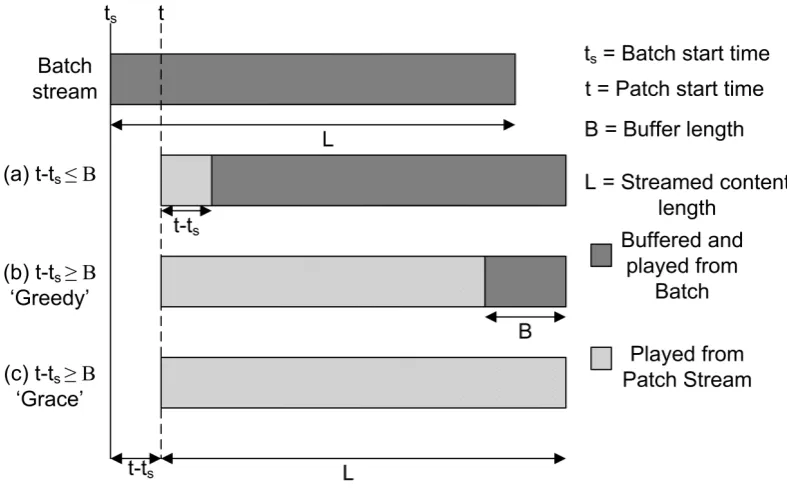
Using the Patching technique, a request from a new client will be serviced, where possible, by an existing multicast stream of the same content, referred to as a “batch” stream. Since the new client will have missed the beginning of the stream, it must begin buffering the batch stream while the server delivers the beginning of the content using a second stream. This second stream is referred to as the “patch” stream. Once the patch stream has caught up with the buffered content from the batch stream, the client can begin retrieving the remainder of the stream from the buffer.
Client buffer capacity is assumed to be a finite resource. If the missed portion of the stream is smaller than the buffer, then the patch stream only needs to provide this portion of the stream (Figure 3.8(a)). The original Patching technique proposed two different approaches to handle the case where the buffer capacity is insufficient to store the batch stream while the patch stream is being received. The first approach, called Greedy Patching, uses the patch stream to deliver the entire content stream, excluding the final portion of the end of the stream that can be buffered from the original batch stream (Figure 3.8(b)). In the second approach, called Grace Patching, the patch stream becomes a new batch stream and serves the entirety of the multimedia content (Figure 3.8(c)). It is important to note that both the patch and batch streams are delivered as multicast streams.
3.2.2 Implementing Patching Using RTSP
The Peer Assisted Multicast Streaming architecture proposed in this thesis shares some of the features of Patching. In particular, when a client requests a content item, it will receive the content in either one or two streams, which may be multicast streams. As a result of this similarity, the implementation of Patching is considered in detail as this was not addressed in the original work on Patching. A new approach to the implementation of patching using a real world protocol, in this case the Real Time Streaming Protocol [SRL98] (RTSP), is described in [OD09b].
Figure 3.8: Timing and method of delivery of streams with Patching
negotiation between the server and the client. In this phase, which begins when the client issues an RTSP SETUP request, both parties must agree on all aspects of the transport mechanism that is to be used. Once the transport mechanism has been agreed, the multimedia stream can be delivered in the second phase, which begins when the client issues the first PLAY request. During this second phase, users can perform familiar stream control operations, such as play, pause and skip to, by issuing the relevant RTSP requests such asPLAY and PAUSE. The third phase is the tear-down phase, which is initiated when either the client or the server issues an RTSPTEARDOWN
request to end the streaming session. A simple RTSP session is illustrated in Figure 3.9.
Figure 3.10: Patching RTSP Session
request might result in a client being assigned to a batch stream and a new patch stream, whereas a PAUSE or TEARDOWN request may have no effect on the multicast streams being transmitted by the server, unless the requesting client is the only client with an interest in the corresponding streams.
This relationship between streaming control protocol and the content streams transmitted by the server may be contrasted with the typical relationship that exists within a simpler unicast multimedia server. In the unicast server, on receipt of aPLAY
request, the server will typically begin transmitting the content stream to the client and will stop transmitting the stream on receipt of a PAUSErequest.
receiving a stream, a client will unsubscribe from the corresponding multicast address (or addresses) when it issues the TEARDOWN request. A more detailed description of the policy used by clients to determine when they subscribe to and unsubscribe from multicast addresses is detailed in section 3.2.3.
The transport mechanism, which according to the RTSP protocol must be agreed in the first phase of an RTSP session, may be invalidated in the second phase when the client interacts with the stream. Specifically, the transport mechanism, which includes the multicast addresses that the client should use to receive the multimedia stream, is established in the first phase. The server, however, can only make Patching policy decisions, specifically the assignment of clients to multicast groups, during the second phase when clients request operations such as PLAY and PAUSE. There will often be a delay between the client establishing the session with a SETUP request, and entering the second phase by requesting playback with a PLAY request. As a result, the initial assignment by the server of the client to a multicast stream in the first phase may be invalidated if the server has already commenced transmitting data to the multicast stream. This issue can be resolved within the bounds of the RTSP standard by instead of issuing an RTSPOKresponse to thePLAYrequest, the server issues an error response indicating that the transport information detailed in the original SETUP response is no longer valid and it will be necessary for the client to re-submit the original request. Once the response to this newSETUPrequest has been received, including new transport information and specifically a new multicast address, the client can immediately re-send itsPLAYrequest, which on this occasion is likely to succeed. This behaviour is illustrated in Figure 3.11.
3.2.3 Multicast Subscription Policy
from batch and patch streams, as this will have an effect on network resource utilisa-tion. As the Peer Assisted Multicast Streaming architecture also relies on multicast this is an important consideration.
The original work on Patching focused on server resources and server behaviour, treating everything external to the server as a “black box”. To fully evaluate end-to-end network resource utilisation, however, it is necessary to model the behaviour of individual clients with respect to multicast stream subscription. As noted earlier, Patching requires each client to subscribe to either one or two multicast channels. If the server only returns a single multicast address to the client, that channel will contain the whole stream. If the server returns two channels then one of the following cases will apply.
Case 1 The missing portion of the Batch stream is smaller than the client’s buffer. The beginning of the stream must be obtained from the patch stream, with the remainder obtained from the buffered batch stream. (Figure 3.8 case (a))
Case 2 The missing portion of the Batch stream is larger than the client’s buffer and the server is using the Greedy Patching scheme. The first L−B seconds of the stream will be obtained from the patch stream and the remaining B seconds are obtained from the buffered batch stream. (Figure 3.8 case (b))
Case 3 The missing portion of the Batch stream is larger than the client’s buffer and the server is using a Grace Patching scheme. The entire stream must be obtained from the patch stream. (Figure 3.8 case (c))
Two approaches are proposed here to determine when clients subscribe to and unsubscribe from multicast patch and batch streams. These approaches are termedfull subscription and minimum subscription.
In thefull subscription policy, when the server returns two multicast group ad-dresses to a client, the client subscribes to both multicast groups for the duration of the streaming session. While this scheme lends itself to a simple implementation, it also results in the receipt of substantial quantities of duplicated stream data. For example, take a buffer length of 5 minutes, and a stream length of 90 minutes. In case 2, if the patch stream started half way through the batch stream, then the client would receive a patch for 85 minutes, and buffer the last 5 minutes of the batch. But it would also receive 40 minutes of redundant data from the batch stream. This means that for 44% of the stream duration, the client is using double the bandwidth of a single stream, despite half of this data being redundant.
Similarly, in case 3, the patch stream would provide the entire 90 minutes of the multicast stream, and the original batch would provide 45 minutes of redundant data. This means that for the first half of the session the client is using up to twice as much bandwidth as is necessary.
It is sufficient when conducting a server-centric evaluation to simply model full subscription, since the server will transmit data for every multicast stream with at
least one subscriber. However, to observe the real benefit of multicast over an entire network, it is necessary to model a more efficient multicast subscription policy, which is termed minimum subscription.
If case 2 applies, then the client can analyse the batch stream data and calculate how long it will be until the batch stream will provide useful data. The client can then unsubscribe from the batch stream and resubscribe at a later time. This can be only be done if the server is sending the multicast data packets at a fixed rate. To compensate for jitter in the network, the client may choose to subscribe slightly earlier than the calculated time, to avoid data loss. A client may estimate how much earlier it should resubscribe to the multicast stream based on an estimation of network performance.
In case 3, the client can unsubscribe from the batch stream and will not need to resubscribe, as the patch stream will provide the entire content stream.
These unsubscriptions are independent of the RTSP control protocol, as it is not necessary for the server to be aware when the client has unsubscribed from or resubscribed to the batch stream.
3.2.4 Evaluation of Multicast Patching
A performance evaluation of multicast Patching was performed using the network sim-ulation framework discussed in Section 6.4. This evaluation differed from the original evaluation of Patching which took a server-centric approach to performance evaluation. The original evaluation modelled the external network and clients as a “black box”, whereas the new evaluation took into account the impact of a realistic network topology and real network protocols.
The results of this evaluation showed, in a similar manner to the original eval-uation of Patching, the benefit of the Grace Patching policy over Greedy Patching. The results differed though in showing that the behaviour of both the client and server will have a significant effect on performance, and that this effect is closely related to network distance from the origin server. This effect is shown in Figure 3.12.
Figure 3.12: Effect of Buffer Size on Grace Patching Using Minimum Subscription at Increasing Network “Hops” from the Server
buffer has a diminishing effect as the network distance from the server increases.
3.3
Summary
This chapter has described how multicast may be used to improve the performance of on-demand multimedia streaming applications. Maintaining fully interactive client con-trol, however, is a significant challenge, and a number of solutions have been previously proposed. The Peer Assisted Multicast Streaming (PAMS) approach proposed in this thesis is inspired by the prior work on Patching, but differs in the way that interactive is maintained when using multicast. Specifically, PAMS uses peer-to-peer technology to provide interactivity while receiving multicast streams from a server that effectively implements Batching. The PAMS architecture is described in detail in Chapter 5 while the peer-to-peer technology upon which it is based is described in the next chapter.
Chapter 4
Peer-to-Peer Multimedia
Streaming
Peer-to-peer networking is a distributed architecture, in which the workload and re-sponsibilities of the application are usually distributed among the participating peers. In a peer-to-peer application, peers both supply and consume resources within the network. This differs from the general client-server model in which the server is the supplier and the client is the consumer of a service.
Peer-to-peer applications are scalable due to their decentralized approach. Ex-amples of peer-to-peer applications include BitTorrent for file-sharing [Coh03], Skype for Voice over IP 1, and SOPCast 2 for live multimedia streaming. Peer-to-peer ap-plications attempt to balance the load fairly amongst all peers participating in the application.
One of the challenges that must be addressed by a peer-to-peer application is the continual arrival and departure of peers. This is referred to as churn [RGRK04] and may significantly impact the performance of the application. The impact of churn have been highlighted and solutions proposed in the literature [RGRK04].
Peer-to-peer applications are usually built on top of peer-to-peer architectures
1http://www.skpe.com 2
which are independent of the application. The underlying architectures are generally tasked with locating peers or data within the network, and for maintaining the structure of the peer-to-peer network. Peer-to-peer architectures are usually implemented as Overlay Networks in which the Overlay Network structure is implemented on top of an existing network structure. One such Overlay Network is Chord [SMK+01] and a description of this architecture will now be presented.
4.1
Chord Overlay Network
Overlay networks such as Chord [SMK+01], Pastry [RD01] and Tapestry [ZHS+04], among others, provide routing mechanisms that facilitate finding peers or data within the overlay network. Within a peer-to-peer network it may not be possible for a peer to route a message directly to another peer without knowing the exact location of the peer or data in the underlying network.
Within a peer-to-peer network, while a peer may know the identity of another peer within the context of the overlay network, it may not know the underlying network identity of that peer. As a result the peer cannot directly send a message to the other peer. The overlay network provides a mechanism to route messages between any two peers, by ensuring that each peer maintains knowledge of the underlying network identities of a subset of the peers.

![Figure 3.1: Multicast Listener Query Message [VC04]](https://thumb-us.123doks.com/thumbv2/123dok_us/1472059.686312/43.595.123.515.111.446/figure-multicast-listener-query-message-vc.webp)
![Figure 3.3: Multicast Address Record [VC04]](https://thumb-us.123doks.com/thumbv2/123dok_us/1472059.686312/44.595.124.517.446.699/figure-multicast-address-record-vc.webp)