Proceedings of NAACL-HLT 2018, pages 1435–1445
Using Morphological Knowledge in
Open-Vocabulary Neural Language Models
Austin Matthews and Graham Neubig
Language Technologies Institute Carnegie Mellon University
Pittsburgh, PA, USA
{austinma,gneubig}@cs.cmu.edu
Chris Dyer
DeepMind London, UK
Abstract
Languages with productive morphology pose problems for language models that generate words from a fixed vocabulary. Although character-based models allow any possible word type to be generated, they are linguis-tically naïve: they must discover that words exist and are delimited by spaces—basic lin-guistic facts that are built in to the structure of word-based models. We introduce an open-vocabulary language model that incorporates more sophisticated linguistic knowledge by predicting words using a mixture of three gen-erative processes: (1) by generating words as a sequence of characters, (2) by directly gener-ating full word forms, and (3) by genergener-ating words as a sequence of morphemes that are combined using a hand-written morphological analyzer. Experiments on Finnish, Turkish, and Russian show that our model outperforms character sequence models and other strong baselines on intrinsic and extrinsic measures. Furthermore, we show that our model learns to exploit morphological knowledge encoded in the analyzer, and, as a byproduct, it can perform effective unsupervised morphological disambiguation.
1 Introduction
Language modelling of morphologically rich lan-guages is particularly challenging due to the vast set of potential word forms and the sparsity with which they appear in corpora. Traditional closed vocabulary models are unable to produce word forms unseen in training data and unable to gen-eralize sub-word patterns found in data.
The most straightforward solution is to treat language as a sequence of characters (Sutskever et al., 2011). However, models that operate at two levels—a character level and a word level— have better performance (Chung et al.,2016). An-other solution is to use morphological information,
which has shown benefits in non-neural models (Chahuneau et al.,2013). In this paper, we present a model that combines these approaches in a fully neural framework.
Our model incorporates explicit morphological knowledge (e.g. from a finite-state morphological analyzer/generator) into a neural language model, combining it with existing word- and character-level modelling techniques, in order to create a model capable of successfully modelling morpho-logically complex languages. In particular, our model achieves three desirable properties.
First, it conditions on all available (intra-sentential) context, allowing it, in principle, to capture long-range dependencies, such as that the verb agreement between “students” and “are” in the sentence “The students who studied the hardest are getting the highest grades”. While traditional n-gram based language models lack this property, RNN-based language models fulfill it.
Second, it explicitly captures morphological variation, allowing sharing of information be-tween variants of the same word. This allows faster, smoother training as well as improved pre-dictive generalization. For example, if the model sees the phrase “gorped the ball” in data, it is able to infer that “gorping the ball” is also likely to be valid. Similarly, the model is capable of un-derstanding that morphological consistency within noun phrases is important. For example in Rus-sian, one might saymalen’kaya chërniya koshka ("small black cat", nominative), or malen’kuyu chërniyu koshku(accusative), butmalen’kiy chër-nuyu koshke (mixing nominative, accusative and dative) would have much lower probability.
Third, the language model seamlessly handles out of vocabulary items and their morphological variants. For example, even if the word Obama was never seen in a Russian corpus, we expect Ya dal eto prezidentu Obame(“I gave it to
dent Obama”) to have higher probability using the dativeObame thanYa dal eto prezidentu Obama, which uses the nominative. The model can also learn to decline proper nouns, including OOVs. Here it can recognize thatdal(“gave”) requires a dative, and that nouns ending with “a” generally do not meet that requirement.
In order to capture these properties, our model combines two pieces: an alternative embedding module that uses sub-word information such as character and morpheme-level information, and a generation module that allows us to output words at the word, morpheme, or character-level. The embedding module allows for the model to share information between morphological variants of surface forms, and produce sensible word embed-dings for tokens never seen during training. The generation model allows us to emit tokens never seen during training, either by combining a lemma and a sequence of affixes to create a novel sur-face form, or by directly spelling out the desired word character by character. We then demonstrate the effectiveness both intrinsically, showing re-duced perplexity on several morphologically rich languages, and extrinsically on machine transla-tion and morphological disambiguatransla-tion tasks.
2 Multi-level RNNLMs
Recurrent neural network language models are composed of three parts: (a) an encoder, which turns a context word into a vector, (b) a recur-rent backbone that turns a sequence of word vec-tors that represent the ordered sequence of con-text vectors into a single vector, and (c) a genera-tor, which assigns a probability to each word that could follow the given context. RNNLMs often use the same process for(a) and(c), but there is no reason why these processes cannot be decou-pled. For example, Kim et al. (2016) and Ling et al.(2015) compose character-level representa-tions for their word encoder, but generate words using a softmax whose probabilities rely on inner products between the current context vector and type-specific word embeddings.
In our model both the word generator (§2.1) and the word encoder (§2.2) compute representations that leverage three different views of words: fre-quent words have their own parameters, words that can be analyzed/generated by an analyzer are rep-resented in terms of sequences of abstract mor-phemes, and all words are represented as a
se-quence of characters.
2.1 Word generation mixture model
In typical RNNLMs the probability of theith word in a sentence, wi given the preceding words is
computed by using an RNN to encode the context followed by a softmax:
p(wi |w<i) =p(wi |hi=ϕRNN(w1, . . . , wi−1))
= softmax(Whi+b)
whereϕRNN is an RNN that reads a sequence of
words and returns a fixed sized vector encoding,
Wis a weight matrix, andbis a bias.
In this work, we will use a mixture model over M different models for generating words in place of the single softmax over words (Miyamoto and Cho,2016;Neubig and Dyer,2016):
p(wi |hi) =
M
X
mi=1
p(wi, mi|hi)
=
M
X
mi=1
p(mi|hi)p(wi |hi, mi),
where mi ∈ [1, M]indicates the model used to
generate wordwi. To ensure tractability for
train-ing and inference, we assume thatmiis
condition-ally independent of allm<i, given the sequence of
word formsw<i.
We use three (M = 3) component models:
(1) directly sampling a word from a finite vocabu-lary (mi =WORD), (2) generating a word as a
se-quence of characters (mi=CHARS), and (3)
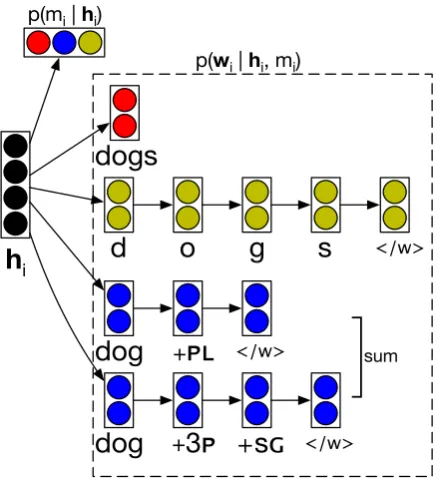
gen-erating as a sequence of (abstract) morphemes which are then stitched together using a hand-written morphological transducer that maps from abstract morpheme sequences to surface forms (mi = MORPHS). Figure1 illustrates the model
components, and we describe in more detail here: Word generator. Select a word by directly sam-pling from a multinomial distribution over surface form words. Here the vocabulary is the|Vw|most
common full-form words seen during training. All less frequent words are assigned zero probability by this model, and must be generated by one of the remaining models.
Character sequence generator. Generate a word as a sequence of characters. Each character is predicted conditioned on the LM hidden state
with an RNN. The product of these probabilities is the total probability assigned to a full word form. Morpheme sequence generator. Similarly to the character sequence generator, we can gener-ate a word as a sequence of morphemes. We first generate a rootr, followed by a sequence of affixes
a1, a2, . . .. For example the word “devours” might
be generated as devour+3P+SG+EOW. Since
mul-tiple sequences of abstract morphemes may in general give rise to a single output form,1 we
marginalize these, i.e.,
p(wi |hi,mi =MORPHS) =
X
ai∈{a|GEN(a)=wi}
pmorphs(ai|hi).
where GEN(a) gives the surface word form
pro-duced from the morpheme sequencea.
Due to the model’s ability to produce output at the character level, it is able to produce any out-put sequence at all within the language’s alpha-bet. This is critical as it allows the model to gen-erate unknown words, such as novel names or de-clensions thereof. Furthermore, the morphologi-cal level facilitates the model’s generation of word forms whose lemmas may be known, but whose surface form was nevertheless unattested in the training data. Finally the word-level generation model handles generating words that the model has seen many times during training.
2.2 Morphologically aware context vectors Word vectors are typically learned with a single, independent vector for each word type. This inde-pendence means, for example, that the vectors for the word “apple” and the word “apples” are com-pletely unrelated. Seeing the word “apple” gives no information at all about the word “apples”.
Ideally we would like to share information be-tween such related words. Nevertheless, some-times words have idiomatic usage, so we’d like not to tie them together too tightly.
We accomplish this by again using three differ-ent types of word vectors for each word in the vo-cabulary. The first is a standard per-type word vec-tor. The second is the output of a character-level
1In general analyzers encode many-to-many relations, but
our model assumes that any sequence of morphs in the under-lying language generates a single surface form. This is gen-erally true, although free spelling variants of a morph (e.g., American-izevs. British-iseas well as alternative realiza-tions likeshined/shone and learned/learnt) violate this as-sumption.
d
o
g
s
dog
dogs
+
ᴘʟ
p(mi | hi)p(wi | hi, mi)
h
i </w></w>
dog
+3
ᴘ
+s
ɢ
</w>sum
[image:3.595.308.528.66.306.2]]
Figure 1: We allow the model to generate an output word at the word, morpheme, or character level, and marginalize over these three options to find the total probability of a word.
RNN using Long Short-Term Memory (LSTM) units (Hochreiter and Schmidhuber, 1997). The third is the output of a morphology-level LSTM over a lemma and a sequence of affixes, as output by a morphological analyzer.
Typically language models first generate a word wigiven some (initially empty) prior contextci−1,
and then that word is combined with the context to generate a new contextcithat includes the new
word. Since we have just used one or more of our three modes to generate each word, intuitively we would like to use the same mode(s) to generate the embedding used to progress the context.
Unfortunately, doing so introduces dependen-cies among the latent variables p(mode | ci) in
our model, making exact inference intractable. As such, we instead drop the dependency on how a word was generated and instead represent the word at all three levels, regardless of the mode(s) actually used to generate it, and combine them by concatenating the three representations. A visual representation of the embedding process is shown in Figure2.
Mathemati-d o g s
dog dogs
+ ᴘʟ </w>
</w>
dog +3ᴘ +sɢ
max
[image:4.595.78.287.61.271.2]</w>
Figure 2: We concatenate word- morpheme- and character-level vectors to build a better input vec-tor for our RNNLM.
cally, theith dimension of the morphological em-beddingem is given by
emi = max j eaji
where eaj is the embedding of the jth
possi-ble analysis, as computed by the LSTM over the lemma and its sequence of affixes.
The intuition behind the use of all analyses plus a pooling operation can be seen by observing the case of the word “does”, which could be do+3-person+singular ordoe+plural. If this word ap-pears after the word “he”, what we care about more is whether “does” could feasibly be a third person singular verb, thus agreeing with the sub-ject. The max-pooling operation captures this in-tuition by ensuring that if a feature is active for one of these two analyses, it will also be active in the pooled representation. This procedure affords us the capability to efficiently marginalize over all three possible values of the latent variable at each step, and compute the full marginal of the wordwi
given the contextci−1during generation.
This formulation allows words with the same stem to share vector information through the char-acter or morphological embeddings, but still af-fords each word the ability to capture idiomatic us-ages of individual words through the word embed-dings. Furthermore, it allows a language model to explicitly capture morphological information, for example that third person singular subjects should co-occur with third person singular verbs. Finally,
the character-level segment of the embedding al-lows the model to at least attempt to build sensible embeddings for completely unknown words. For example in Russian where names can decline with case this formulation allows the model to know thatObameis probably dative, even if it’s an OOV at the word level, and even if the morphological analyzer is unable to produce any valid analyses.
We combine our three-layer input vectors, our factored output model, and a standard LSTM backbone to create a morphologically-enabled RNNLM that, as we will see in the next section, performs well on morphologically complex lan-guages.
3 Intrinsic Evaluation
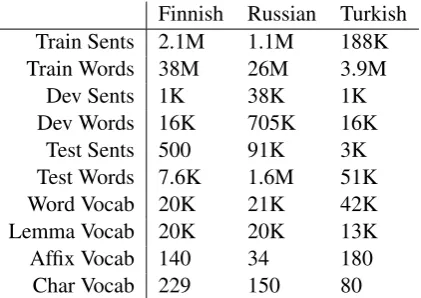
We demonstrate the effectiveness of our model by experimenting on three languages: Finnish, Turk-ish, and Russian. For Finnish we use version 8 of the Europarl corpus, for Turkish we use the SE-TIMES2 corpus, and for Russian we use version 12 of the News Commentary corpus. Statistics of our experimental corpora can be found in Table1. Each data set was pre-processed byUNKing all
but the top≈20k words and lemmas by frequency. No characters or affixes wereUNKed. This step is
not strictly required—our model is, after all, ca-pable of producing arbitrary words— but it speeds up training immensely by reducing the size of the word and lemma softmaxes. Since the morphol-ogy and/or character-level embeddings can still capture information about the original forms of these words, the degradation in modelling perfor-mance is minimal.
For morphological analysis we use Omorfi2for
Finnish, the analyzer ofOflazer(1994) for Turk-ish, and PyMorphy3for Russian.
3.1 Baseline Models
Since models are not accurately comparable un-less they share output vocabularies, our baselines must also allow for the generation of arbitrary word forms, including out-of-vocabulary items. We compare to three such models: an improved Kneser-Ney (Kneser and Ney,1995) 4-gram base-line, with an additional character-level backoff model for OOVs, an RNNLM with character-level backoff, and a pure character-based RNN lan-guage model (Sutskever et al.,2011).
venäjän
presidentillä
vladimir
putinilla
on yksiässähihassaan
ukrainan
suhteen
.
0.0
0.1
0.2
0.3
0.4
0.5
0.6
0.7
0.8
0.9
p(mode | context)
venäjän
presidentillä
vladimir
putinilla
on yksiässähihassaan
ukrainan
suhteen
.
0.0
0.1
0.2
0.3
0.4
0.5
0.6
0.7
0.8
0.9
p(mode | context, w)
[image:5.595.84.475.61.201.2]Finnish: “Russian President Vladimir Putin has an ace up his sleeve in the Ukrainian relationship.”
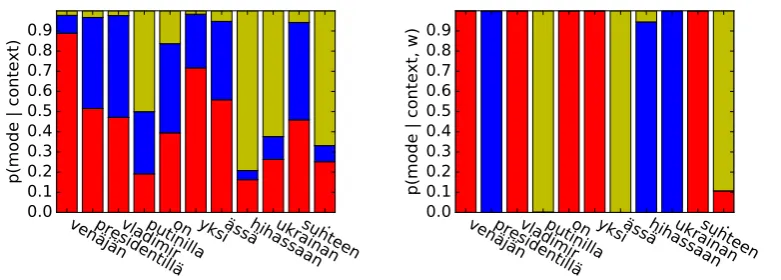
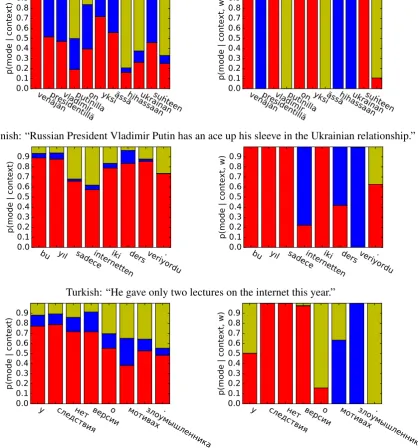
Figure 3: An example of the priors (left) and posteriors (right) over modes used to generate each word in a sample sentences. Probability given to the word-, morpheme-, and character-level models are shown in red, blue, and gold respectively. More examples can be found in the appendix.
Since Kneser-Ney language models (and other count-based models) are typically word-level and do not model out-of-vocabulary items, we employ a two-level approach with separate Kneser-Ney models at the word and character levels. We train the word-level model afterUNKing low frequency
words, and we train the character-level model on the same list of low frequency words. Now when we want to predict a word wi given some
con-textcwe can use the word-level model to directly predict p(wi|c)unlesswi is an out-of-vocabulary
item. In that case we modelp(wi |c)as
p(wi|c) =p(UNK|c)·p(wi |UNK)
where the first factor is the probability of the word-level model emitting UNK, and the second is the
probability of the actual out-of-vocabulary word form under the character-level model.
Secondly we compare to a similar hybrid RNN model that first predicts the word-level proba-bility for each word, and if it predicted UNK
then also predicts a sequence of characters us-ing a separate network. This model uses 256-dimensional character and word embeddings, and a 1024-dimensional recurrent hidden layer.
Finally we also compare to a standard RNN lan-guage model trained purely on the character level. For this baseline we also use 256-dimensional character embeddings and a 1024-dimensional re-current hidden layer.
3.2 Multi-factored Models
For our model we use 128-dimensional word and root embeddings, 64-dimensional affix and char-acter embeddings, 128-dimensional word-internal
recurrent hidden layers for characters and mor-phemes, and a 256-dimensional recurrent hidden layer for the main inter-word LSTM.
The network is trained to stochastically opti-mize the log likelihood of the training data using Adam (Kingma and Ba, 2014). After each 10k training examples (Finnish, Turkish) or 100k train-ing examples (Russian) we evaluate the model on a development set.4 If the perplexity on the
de-velopment set represents a new best, we save the current model to disk, thereby mitigating overfit-ting via early stopping. No other regularization is used.
For each language we run four variants of our model. In order to preserve the ability to model and emit any word in the modelled language, it is essential that we keep the character-level part of our model intact. The morpheme- and word-level models, however, may be removed without compromising the generality of the model. As such, we present our model using only character-level input and outputs (C), using character- and morpheme-level inputs and outputs (CM), using character- and word-level inputs, but no morphol-ogy (CW), and using all three levels as per the full model (CMW).
3.3 Results and Analysis
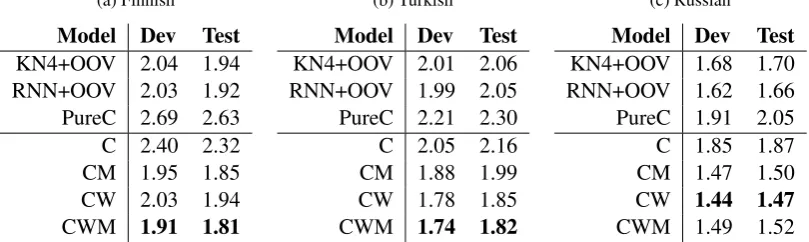
Our experimental results (Table 2) show that our multi-modal model significantly outperforms all three baselines: a naïve n-gram model, a purely character-level RNNLM, and a hybrid RNNLM
4We evaluate less frequently on Russian since the dev set
Finnish Russian Turkish
Train Sents 2.1M 1.1M 188K
Train Words 38M 26M 3.9M
Dev Sents 1K 38K 1K
Dev Words 16K 705K 16K
Test Sents 500 91K 3K
Test Words 7.6K 1.6M 51K
Word Vocab 20K 21K 42K
Lemma Vocab 20K 20K 13K
Affix Vocab 140 34 180
[image:6.595.77.288.62.211.2]Char Vocab 229 150 80
Table 1: Details of our data sets. Each cell indi-cates the number of sentences and the number of words in each set.
for open-vocabulary language models. Further-more, they confirm that morphological analyz-ers can improve performance of such language models on particularly morphologically rich guages. We observe that across all three lan-guages the space-aware character-level model out-performs the purely character-based model that treats spaces just as any other character. Further-more we see that the Kneser-Ney language model performs admirably well on this task, underscor-ing the difference in settunderscor-ing between the familiar, traditional closed-vocabulary LMs, and the open-vocabulary language modelling task. Additionally we find that the relative success of the n-gram model and the hybrid model over the character only models underscores the importance of access to word-level information, even when using a less sophisticated model.
Table 3shows some examples of sentences on which our model heavily outperforms the RNN baseline and vice-versa. We find that the sentences on which our model peforms well contain much less frequent word forms. For each sentence we examine the frequency with which each token ap-pears in our training corpus. The sentences on which our model performs best have a median to-ken frequency of 305 times, while the sentences where the RNN performs better has an average to-ken frequency of 3031 times. Overall our model has better log-likelihood than the RNN baseline on 88.1% of sentences.
Our methods outperform the n-gram model in all languages with either set of just two mod-els, CM or CW. The same models outperform the hybrid baseline in Turkish and Russian, and achieves comparable results in Finnish. Finally, in
the agglutinative languages, using all three modes performs best, while in Russian, a fusional lan-guage, characters and words alone edge out the model with morphology. We hypothesize that our morphology model is better able to model the long strings of morphemes found in Turkish and Finnish, but gains little from the more idiosyn-cratic fusional morphemes of Russian.
Some examples of the priors and posteriors of the modes used to generate some randomly se-lected sentences from the held out test set can be seen in Figure3and the appendix (Figure4). The figures show that all of the models tend a priori to prefer to generate words directly when possi-ble, but that context can certainly influence its pri-ors. In Finnish, after seeing the wordVladmir, the model suddenly assigns significantly more weight to the character-level model to generate the fol-lowing word, which is likely to be a surname. In Russian, after the preposition o, the following noun is required to be in a rare case. As such, the model suddenly assigns more probability mass to the following word being generated using the morpheme-level model.
The posteriors tell a similarly encouraging story. In Finnish we see that the word presiden-tillä is overwhelmingly likely to be produced by the morphology model due to its peculiar adessive (“at”) case marking. Vladmiris common enough in the data that it can be generated wholly, but the last namePutinis again inflected into the adessive case, forming Putinilla. Unfortunately the mor-phological analyzer is unfamiliar with the stem Putin, forcing the word to be generated by the character-level model. In our Turkish example, all of the short words are generated at the word level, while the primary nouns internetten (“internet”) and ders (“lecture”) are possible to generate ei-ther as words or as a sequence of morphemes. The verb, which has much more complex morphology (progressive past tense with a third person singular agent), is generated via the morphological model.
4 Extrinsic Evaluation
(a) Finnish
Model Dev Test KN4+OOV 2.04 1.94 RNN+OOV 2.03 1.92 PureC 2.69 2.63 C 2.40 2.32 CM 1.95 1.85 CW 2.03 1.94 CWM 1.91 1.81
(b) Turkish
Model Dev Test KN4+OOV 2.01 2.06 RNN+OOV 1.99 2.05 PureC 2.21 2.30 C 2.05 2.16 CM 1.88 1.99 CW 1.78 1.85 CWM 1.74 1.82
(c) Russian
[image:7.595.92.497.57.178.2]Model Dev Test KN4+OOV 1.68 1.70 RNN+OOV 1.62 1.66 PureC 1.91 2.05 C 1.85 1.87 CM 1.47 1.50 CW 1.44 1.47 CWM 1.49 1.52
Table 2: Intrinsic evaluation of language models for three morphologically rich languages. Entropy for each test set is given in bits per character on the tokenized data. Lower is better, with 0.0 being perfect.
Komünizmpe¸sinde ko¸sanArnavut pek yok
Parlaklı˘gınıkaybedenmücevher:Kirlilik Karadeniz’iesir alıyor
Olaylarınbaskısıyla kar¸sıla¸sanrejim tutumunuyava¸sça yumu¸sattı, 1991 yılında çok partili →seçimleri düzenledi ve sonunda da ertesi yıltümdeniktidarı bıraktı.
Southeast European Times için Belgrad’dan Dusan Kosanoviç’in haberi - 24/06/04 23 Temmuz’dan bu yana Balkanlar’la ilgili i¸s ve ekonomi haberlerine genel bakı¸s:
[image:7.595.319.513.423.489.2]AB’nin Geni¸slemeden Sorumlu Komisyon Üyesi Olli Rehn (solda) Arnavutluk Ba¸sbakanı Sali →Beri¸sa ile 15 Mart Per¸sembe günü Tiran’da bir araya geldi.
Table 3: Some examples of Turkish sentence on which our morphological model heavily outperforms the baseline RNNLM (top) and some examples of the opposite (bottom). The sentences that our model performs well on have many particularly rare words, whereas the sentences the RNNLM performs well on were seen hundreds or thousands of times in the training corpus. Words in bold were seen fewer than 25 times in the training corpus. Arrows indicate line wrapping.
4.1 Machine Translation
As an extrinsic evaluation we test whether our language model improves machine translation be-tween Turkish and English. While we could form our model into a source-conditioned trans-lation model, we choose here to focus on testing our model as an external unconditional language model, leaving the conditional version for future work. Since neural machine translation systems struggle with low-resource languages (Koehn and Knowles,2017), we choose to introduce the score of our LM as an additional feature to a cdec (Dyer et al.,2010) hierarchical MT system. We train on the WMT 2016 Turkish–English data set, and
per-formn-best reranking after re-tuning weights with
the new feature.
The results, shown in Table4demonstrate small
but significant gains in both directions, particu-larly into Turkish, where modelling productive morphology should be more important.
4.2 Morphological Disambiguation
Our model is a joint model over words and the latent processes giving rise to those words (i.e., which generation process was selected and, for the
Lang. Pair System BLEU
TR-EN Baseline 15.0
Morph. Input 15.2
EN-TR Baseline 10.1
Morph. Output 10.5
Table 4: Machine Translation Results
morpheme process, which morpheme sequence was generated). While our model is not directly trained to perform morphological disambiguation, it still performs this task quite admirably. Given a trained morphological language model, a sen-tence s, and a set of morphological analyses z, we can query the model to find p(s,z) =
p(w1, w2, . . . , wN)for a given sentence. Most
no-tably, each wi may have a set of possible
mor-phological analyses{a1, a2, . . . aMi}from which
we would like to choose the most likely a pos-teriori. To perform this task, we simply query the model Mi times, each time hiding all but
the jth possible analysis from the model. We
can then re-normalize the resulting probabilities to findp(aj|s)for eachj∈1. . . Mi.
Model Supervised? Ambiguous Words All words
Random Chance no 34.08% 52.66%
Unidirectional no 55.15% 80.28%
Bidirectional no 63.85% 84.11%
[image:8.595.144.454.61.133.2]Shen et. al yes 91.03% 96.43%
Table 5: Morphological disambiguation accuracy results for Turkish.
tractable, we have assumed independence between previous adjacent events and the next word gen-eration given the previous surface word forms (§2.1). Thus, the posterior probability over the analysis is only determined by the left context— subsequent decisions are independent of the pro-cess used to generate a word at timet. However, since disambiguating information may be present in either direction, we introduce a model variant that conditions on information in both directions. Bidirectional dependencies mean that we can no longer use the chain rule to factor the probability distribution from left-to-right. Rather we have to switch to a globally normalized, undirected model (i.e., a Markov random field) to define the prob-abilities of selecting the mode of generation and generation probability (conditional on the mode). The factors used to parameterize the model are de-fined in terms of two LSTMs, one encoding from left-to-right the prefix of theith word (hi, defined
exactly as above), and a second encoding from right-to-left its suffix (h0i). These two vector
rep-resentations are used to compute a score using a locally normalized mixture model for each word. Intuitively, the morphological analysis generated at each time step should be compatible with both the preceding words and the following words.
Optimizing this model with the same MLE cri-terion we used in the direct model is, unfortu-nately, intractable since a normalizer would need to be computed. Instead, we use a pseudo-likelihood objective (Besag,1975).
LPL =Y
i
p(wi |w−i)
=Y
i
X
m
p(mi =m|w−i)p(wi|m,w−i)
We note that although this model has a very differ-ent semantics from the directed one, the PL train-ing objective is identical to the directed model’s, the only difference is that features are based both on the past and future, rather than only the past.
Similarly to training, evaluating sentence like-lihoods using this model is intractable, but
poste-rior inference overmi andai is feasible since the
normalization factors cancel and therefore do not need to be computed.
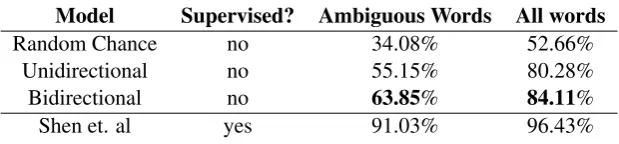
For our experiments we use the data set of
Yuret and Türe (2006) who manually disam-biguated from among the possible forms identified by an FST. We significantly out-perform the sim-ple baseline of randomly guessing, and our results are competitive withYatbaz and Yuret(2009), al-though they evaluated on a different dataset so they are not directly comparable. Furthermore, we also compare to a supervised model (Shen et al.,
2016). While unsupervised techniques can’t hope to exceed supervised accuracies, this comparison provides insight into the difficulty of the problem. See Table5for results.
5 Related Work
Purely Character-based or Subword-based LMs have a rich history going all the way back toMarkov(1906)’s work modelling Russian character-by-character with his namesake models. More recentlySutskever et al.(2011) were the first to apply RNNs to character-level language mod-elling, leveraging their ability to handle the long-range dependencies required to model language at the character level. It is also possible to alleviate the closed vocabulary problem by training models on automatically acquired subword units (Mikolov et al.,2012;Sennrich et al.,2015). While these ap-proaches allow for an open vocabulary (or nearly open, in the case of subwords) they discard a large amount of higher-level information, inhibit-ing learninhibit-ing.
While these models allow for the elegant encoding of novel word forms they lack an open vocabulary.
Open-vocabulary hybrid models alleviate this problem, extending the benefits of character-level representations to the generation. Such hybrid models with open vocabularies have been around sinceBrown et al.(1992). More recently, Chung et al.(2016) andHwang and Sung(2016) describe methods of modelling sentences at both the word and character levels, using mechanisms to allow both a word-internal model that captures short-range dependencies and a word-external model to capture longer-range dependencies. These mod-els have been successfully applied to machine translation by Luong and Manning (2016), who use a character-level model to predict translations of out of vocabulary words. Our work falls in this category—we combine multiple representa-tion levels while maintaining the ability to gener-ate any character sequence. In contrast to these previous works, we demonstrate the utility of in-corporating morphological information in these open-vocabulary models.
Mixture model language generation where the mixture coefficients are predicted by a neural net are becoming quite common. Neubig and Dyer
(2016) use this strategy to combine a count-based model and a neural language model. Ling et al.
(2016) interpolate between character- and word-based models to translate between natural lan-guage text and computer code.Merity et al.(2016) also use multiple output models, allowing a word to either be generated by a standard softmax or by copying a word from earlier in the input sentence.
6 Conclusion
We have demonstrated a technique for language modelling that works particularly well on mor-phologically rich languages where having an open vocabulary is desirable. We achieve this by us-ing a multi-modal architecture that allows words to be input and output at the word, morpheme, or character levels. We show that knowledge of the existence of word boundaries is of critical im-portance for language modelling tasks, even when otherwise operating entirely at the character level, resulting in a surprisingly large reduction in per-character entropy across all languages studied.
Furthermore, we demonstrate that if we have ac-cess to a morphological analyzer we can leverage
it to further improve our LM, reinforcing the no-tion that the explicit inclusion of linguistic infor-mation can indeed aid learning of neural models.
Acknowledgements
We would like to thank Sebastian Mielke for his insightful discussion and feedback on this work.
This work is sponsored by Defense Advanced Research Projects Agency Information Innovation Office (I2O). Program: Low Resource Languages for Emergent Incidents (LORELEI). Issued by DARPA/I2O under Contract No. HR0011-15-C0114. The views and conclusions contained in this document are those of the authors and should not be interpreted as representing the official poli-cies, either expressed or implied, of the U.S. Gov-ernment. The U.S. Government is authorized to reproduce and distribute reprints for Government purposes notwithstanding any copyright notation here on.
References
Julian Besag. 1975. Statistical analysis of non-lattice data.The statisticianpages 179–195.
Jan A Botha and Phil Blunsom. 2014. Compositional morphology for word representations and language modelling. InICML. pages 1899–1907.
Peter F Brown, Vincent J Della Pietra, Robert L Mer-cer, Stephen A Della Pietra, and Jennifer C Lai. 1992. An estimate of an upper bound for the entropy of english. Computational Linguistics18(1):31–40. Victor Chahuneau, Noah A Smith, and Chris Dyer. 2013. Knowledge-rich morphological priors for bayesian language models. Association for Com-putational Linguistics.
Junyoung Chung, Sungjin Ahn, and Yoshua Bengio. 2016. Hierarchical multiscale recurrent neural net-works. arXiv preprint arXiv:1609.01704.
Chris Dyer, Jonathan Weese, Hendra Setiawan, Adam Lopez, Ferhan Ture, Vladimir Eidelman, Juri Gan-itkevitch, Phil Blunsom, and Philip Resnik. 2010. cdec: A decoder, alignment, and learning framework for finite-state and context-free translation models. In Proceedings of the ACL 2010 System Demon-strations. Association for Computational Linguis-tics, pages 7–12.
Sepp Hochreiter and Jürgen Schmidhuber. 1997. Long short-term memory. Neural computation
9(8):1735–1780.
Rafal Jozefowicz, Oriol Vinyals, Mike Schuster, Noam Shazeer, and Yonghui Wu. 2016. Exploring the limits of language modeling. arXiv preprint arXiv:1602.02410.
Moonyoung Kang, Tim Ng, and Long Nguyen. 2011. Mandarin word-character hybrid-input neural net-work language model. In INTERSPEECH. pages 625–628.
Yoon Kim, Yacine Jernite, David Sontag, and Alexan-der M. Rush. 2016. Character-aware neural lan-guage models. InProceedings of the Thirtieth AAAI Conference on Artificial Intelligence, February 12-17, 2016, Phoenix, Arizona, USA.. pages 2741– 2749.
Diederik Kingma and Jimmy Ba. 2014. Adam: A method for stochastic optimization. arXiv preprint arXiv:1412.6980.
Reinhard Kneser and Hermann Ney. 1995. Im-proved backing-off for m-gram language model-ing. In Acoustics, Speech, and Signal Processing, 1995. ICASSP-95., 1995 International Conference on. IEEE, volume 1, pages 181–184.
Philipp Koehn and Rebecca Knowles. 2017. Six challenges for neural machine translation. arXiv preprint arXiv:1706.03872.
Wang Ling, Edward Grefenstette, Karl Moritz Her-mann, Tomáš Koˇcisk`y, Andrew Senior, Fumin Wang, and Phil Blunsom. 2016. Latent predic-tor networks for code generation. arXiv preprint arXiv:1603.06744.
Wang Ling, Tiago Luís, Luís Marujo, Ramón Fernan-dez Astudillo, Silvio Amir, Chris Dyer, Alan W Black, and Isabel Trancoso. 2015. Finding function in form: Compositional character models for open vocabulary word representation. arXiv preprint arXiv:1508.02096.
Minh-Thang Luong and Christopher D Manning. 2016. Achieving open vocabulary neural machine trans-lation with hybrid word-character models. arXiv preprint arXiv:1604.00788.
Andrey Andreyevich Markov. 1906. Extension of the law of large numbers to dependent quantities. Izv. Fiz.-Matem. Obsch. Kazan Univ.(2nd Ser)15:135– 156.
Stephen Merity, Caiming Xiong, James Bradbury, and Richard Socher. 2016. Pointer sentinel mixture models. arXiv preprint arXiv:1609.07843.
Tomáš Mikolov, Ilya Sutskever, Anoop Deoras, Hai-Son Le, and Stefan Kombrink. 2012. Subword lan-guage modeling with neural networks .
Yasumasa Miyamoto and Kyunghyun Cho. 2016. Gated word-character recurrent language model.
arXiv preprint arXiv:1606.01700.
Graham Neubig and Chris Dyer. 2016. Generalizing and hybridizing count-based and neural language models. arXiv preprint arXiv:1606.00499.
Kemal Oflazer. 1994. Two-level description of turk-ish morphology. Literary and linguistic computing
9(2):137–148.
Rico Sennrich, Barry Haddow, and Alexandra Birch. 2015. Neural machine translation of rare words with subword units. arXiv preprint arXiv:1508.07909.
Qinlan Shen, Daniel Clothiaux, Emily Tagtow, Patrick Littell, and Chris Dyer. 2016. The role of context in neural morphological disambiguation .
Ilya Sutskever, James Martens, and Geoffrey E Hin-ton. 2011. Generating text with recurrent neural networks. InProceedings of the 28th International Conference on Machine Learning (ICML-11). pages 1017–1024.
Mehmet Ali Yatbaz and Deniz Yuret. 2009. Unsu-pervised morphological disambiguation using sta-tistical language models. In Pro. of the NIPS 2009 Workshop on Grammar Induction, Representa-tion of Language and Language Learning, Whistler, Canada. pages 321–324.
A Example sentences
venäjän
presidentillä
vladimir
putinilla
on yksiässähihassaan
ukrainan
suhteen
.
0.0
0.1
0.2
0.3
0.4
0.5
0.6
0.7
0.8
0.9
p(mode | context)
venäjän
presidentillä
vladimir
putinilla
on yksiässähihassaan
ukrainan
suhteen
.
0.0
0.1
0.2
0.3
0.4
0.5
0.6
0.7
0.8
0.9
p(mode | context, w)
Finnish: “Russian President Vladimir Putin has an ace up his sleeve in the Ukrainian relationship.”
bu y l sadeceinternetten
iki ders veriyordu
.
0.0
0.1
0.2
0.3
0.4
0.5
0.6
0.7
0.8
0.9
p(mode | context)
bu y l sadeceinternetten
iki ders veriyordu
.
0.0
0.1
0.2
0.3
0.4
0.5
0.6
0.7
0.8
0.9
p(mode | context, w)
Turkish: “He gave only two lectures on the internet this year.”
.
0.0
0.1
0.2
0.3
0.4
0.5
0.6
0.7
0.8
0.9
p(mode | context)
.
0.0
0.1
0.2
0.3
0.4
0.5
0.6
0.7
0.8
0.9
p(mode | context, w)
[image:11.595.105.524.111.560.2]Russian: “The investigation does not theorize about the attacker’s motives.”
Figure 4: Some examples of the priors (left) and posteriors (right) over modes used to generate each word in some sample sentences. Probability given to the word-, morpheme-, and character-level models are shown in red, blue, and gold respectively. The Finnish example is a reprint of Figure3