641
Enhancing Opinion Role Labeling with Semantic-Aware Word
Representations from Semantic Role Labeling
Meishan Zhang1 and Peili Liang2 and Guohong Fu3∗
1. School of New Media and Communication, Tianjin University, China 2. School of Computer Science and Technology, Heilongjiang University, China
3. Institute of Artificial Intelligence, Soochow University, China [email protected],
[email protected], [email protected]
Abstract
Opinion role labeling (ORL) is an important task for fine-grained opinion mining, which identifies important opinion arguments such as holder and target for a given opinion trigger. The task is highly correlative with semantic role labeling (SRL), which identifies important semantic arguments such as agent and patient for a given predicate. As predicate agents and patients usually correspond to opinion holders and targets respectively, SRL could be valu-able for ORL. In this work, we propose a sim-ple and novel method to enhance ORL by uti-lizing SRL, presenting semantic-aware word representations which are learned from SRL. The representations are then fed into a base-line neural ORL model as basic inputs. We verify the proposed method on a benchmark MPQA corpus. Experimental results show that the proposed method is highly effective. In ad-dition, we compare the method with two repre-sentative methods of SRL integration as well, finding that our method can outperform the two methods significantly, achieving 1.47% higher F-scores than the better one.
1 Introduction
Fine-grained opinion mining aims to detect struc-tured user opinions in text, which has drawn much attention in the natural language processing (NLP) community (Kim and Hovy, 2006; Breck et al., 2007; Ruppenhofer et al., 2008; Wilson et al., 2009; Qiu et al., 2011; Irsoy and Cardie, 2013, 2014;Liu et al., 2015;Wiegand et al., 2016). A structured opinion includes the key arguments of one opinion, such as expressions, holders and tar-gets (Breck et al.,2007;Yang and Cardie, 2012, 2013;Katiyar and Cardie,2016). Here we focus
on opinion role labeling (ORL) (Marasovi´c and
Frank,2018), which identifies opinion holders and
∗Corresponding author.
We want to resolve all issues peacefully
holder
expression
target
Figure 1: Examples of fine-grained opinion mining.
targets assuming that the opinion expressions are given. Figure1shows an example of the task.
The focused task behaves very similar with se-mantic role labeling (SRL) which identifies the core semantic roles for given predicates. Ear-lier work attempts to exploit a well-trained SRL model to recognize possible semantic roles for a given opinion expression, and then map the se-mantic roles into opinion roles (Kim and Hovy, 2006;Ruppenhofer et al.,2008). The heuristic ap-proach is unable to obtain high performance for ORL because there are large mismatches between SRL and ORL. For example, opinion expressions are different from verb/noun predicates in SRL, and meanwhile, opinion holders and targets may not always correspond to semantic agents (ARG0) and patients (ARG1), respectively.
We can exploit machine learning based method to solve the mismatching problem between ORL and SRL. With a small number of annotated ORL corpus, we can feed the SRL outputs as inputs to build a statistical model for ORL. By this way, the model can learn the consistencies and inconsis-tencies between SRL and ORL, arriving at a full exploration of SRL. The method is essentially a feature-based method, treating SRL outputs as a source of features for ORL. The main drawback of the method is that direct exploration of SRL out-puts may lead to the error propagation problem. SRL errors can be further propagated into ORL outputs, resulting in degraded ORL performance.
method by using implicit semantic-aware word representations from SRL to enhance ORL. The
method is referred to as SRL-SAWR for brief.
Thanks to the recent advances of encoder-decoder neural SRL models (Zhou and Xu,2015;He et al., 2017), we can extract implicit vectorized features from the intermediate encoder module instead, avoiding the direct exploration of the final one-best SRL outputs. The vectorized features from the encoder part are implicit semantic-aware rep-resentations for input sentences. By taking the semantic-aware representations from SRL as ORL inputs, we are able to make use of SRL informa-tion and meanwhile alleviate the error propagainforma-tion problem.
Here we exploit a neural conditional random field (CRF) model with deep bi-directional long short-term memory networks (Bi-LSTMs) as a
baseline, most of which is borrowed from
Kati-yar and Cardie (2016) and Marasovi´c and Frank
(2018). Our preliminary experiments show that
the model is able to achieve state-of-the-art per-formances for both ORL and SRL. Based on this model, we study the proposed implicit semantic-aware word representations for ORL. In addi-tion, we compare this method with two other rep-resentative methods of SRL integration as well: one uses discrete SRL outputs as features directly for ORL and the other one exploits a multi-task-learning (MTL) framework to benefit ORL by SRL information.
Experiments are conducted on the MPQA 2.0 dataset, which is a standard benchmark for opin-ion mining. Results show that SRL is highly ef-fective for ORL, which is consistent with
pre-vious findings (Kim and Hovy, 2006;
Ruppen-hofer et al., 2008; Marasovi´c and Frank, 2018). Meanwhile, our implicit SRL-SAWR method can achieve the best ORL performance, 2.23% higher F-scores than the second best method. All the codes and datasets are released publicly available for research purpose under Apache Licence 2.0 at https://github.com/zhangmeishan/SRL4ORL.
2 Method 2.1 Baseline
ORL aims to identify important opinion argu-ments for a given opinion expression. The task can be modeled as a sequence labeling problem, similar to SRL (Zhou and Xu, 2015; He et al.,
2017). We adopt the {BMESO} schema to
con-CRF
h1
h1
t1
hs
hs
ts
he
he
te
hn
hn
tn
. . . . . .
. . . . . .
. . . . . .
Deep Bi-LSTM
Word Representation
x1
x1
w1
xs
xs
ws
xe
xe
we
xn
xn
wn . . .
. . .
. . .
. . .
. . .
[image:2.595.327.511.63.205.2]. . .
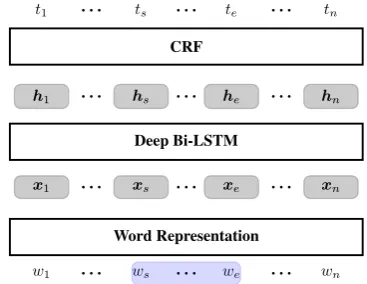
Figure 2: The overall architecture of the baseline.
vert opinion arguments into a sequence of bound-ary tags for each word, where B, M and E denote the beginning, middle and ending words of an ar-gument, S denotes a single-word arar-gument, and O denotes the other words. Formally, given a sen-tencew1· · ·wnand a span of opinion expression
ws· · ·we(1≤s≤e≤n), we aim to assign each word in the sentence by a tag, outputtingt1· · ·tn.
Inspired by Katiyar and Cardie (2016) and
Marasovi´c and Frank(2018), we exploit a deep
Bi-LSTM CRF model as the baseline. Figure2shows
the overall architecture of the baseline model. This model can achieve state-of-the-art performances for both ORL and SRL, which facilitates our study. The key components of the baseline model in-clude three parts: word representation, the deep Bi-LSTM encoder and the CRF decoder. The word representation takes sequential words and opinion expressions as input, mapping them into dense-valued feature vectorsx1· · ·xn. Following we extract high-level neural features based on the vectors by deep Bi-LSTM, arriving at h1· · ·hn. And finally a CRF decoder is applied to output the ORL resultst1· · ·tn.
2.2 SRL Integration
SRL aims to find the core semantic arguments for a given predicate, which is highly correlative with the ORL task. The semantic roles agent (ARG0) and patient (ARG1) are often corresponding to the opinion holder and target, respectively. Sev-eral works even directly transfer semantic roles into opinion roles for ORL (Kim and Hovy,2006; Ruppenhofer et al.,2008), treating opinion expres-sions as the major predicates. These systems can achieve good performances, indicating that SRL information can be greatly useful for ORL.
Deep Bi-LSTM
Word Representation Encoder
SRL CRF
[image:3.595.97.264.62.172.2]Input ORL CRF
Figure 3: SRL integration methods for ORL.
the SRL information implicitly, enhancing ORL model with semantic-aware word representations
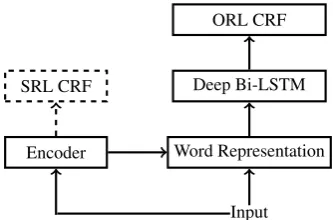
from a neural SRL model (SRL-SAWR). Figure3
shows the overall architectures of our SRL integra-tion method. Instead of using the discrete outputs from the SRL model, the SRL-SAWR method ex-ploits the intermediate encoder outputs as inputs for ORL, which can alleviate the problems in the above two methods. On the one hand, we do not rely on the discrete outputs of a well-trained SRL, reducing the error prorogation problem. And on the other hand, we handle ORL and SRL sepa-rately, avoiding the model structure dependencies between the two tasks.
We assume that the external SRL system is a neural-based encoder-decoder model. For fair comparisons with FS-MTL, here we use the same deep Bi-LSTM CRF model for SRL as well. Thus the encoder outputs are the hidden vectors from deep Bi-LSTMs. Assuming that the dumped hid-den vector sequence from the SRL encoder is
hSRL1 · · ·hSRLn , we integrate it into the ORL model
by the following equation:
x∗i =xi⊕WSRLhSRLi , (1)
where WSRL is a projection matrix which is a
model parameter, xi is the baseline word repre-sentation of wordwi, andx∗i is the new word rep-resentation, which will be further fed into the deep Bi-LSTM layer of the ORL model. Noticeably, the model parameters of the SRL encoder are also fine tuned according to the ORL objective, as the pre-liminary results indicate that fine-tuning can bring better performance.
3 Experiments 3.1 ORL Data
We exploit the MPQA version 2.0 corpus (Wiebe
et al.,2005; Wilson, 2008) to evaluate our
mod-els,1 which has been widely adopted as a bench-mark dataset for opinion mining (Yang and Cardie, 2013; Katiyar and Cardie, 2016; Marasovi´c and Frank, 2018). There are 482 documents in the dataset. Following these work, we set aside 132 documents as the development set, and the remain-ing 350 documents are used as the test set in our experiments. We conduct experiments using five-fold cross-validation (CV) on the test set at the
document level. FollowingMarasovi´c and Frank
(2018), we focus on opinion holders and targets only. The gold standard opinion expressions, hold-ers and targets correspond to the direct subjective annotations, agent annotations and target annota-tions, respectively.
3.2 Evaluation Metrics
We use recall (R), precision (P) and their F1-measure value to F1-measure our proposed models. The average values of the five-fold CV results are reported in this work. We exploit exact match-ing as the major metric. Followmatch-ingMarasovi´c and Frank(2018), two kinds of soft evaluation meth-ods are also adopted for evaluation, namely bi-nary and proportional overlapping, Bibi-nary overlap treats an entity as correct if it contains an over-lapped region with the gold-standard entity, and the proportional overlap assigns a partial score proportional to the ratio of the overlapped region.
3.3 Setting
There are several hyper-parameters to define our neural network structures. We simply set their val-ues according to previous work (He et al., 2017; Marasovi´c and Frank, 2018), without much tun-ing work. Concretely, we set the dimension size of all embeddings to 100, the output hidden size of LSTMs to 200 and the layer number of Bi-LSTM to 3. For external word embeddings, we use the pretrained 100-dimensional glove embed-dings (Pennington et al.,2014).
We exploit online training to learn model pa-rameters, and train on the entire training instances for 40 epochs, choosing the best-epoch model ac-cording to the performance on the development
corpus. We use Adam (Kingma and Ba, 2014)
with a learning rate10−3to update model
param-eters, and use gradient clipping by a max norm 1.0 andl2-regularization by a parameter10−8. We
tations, output layers of Bi-LSTMs to avoid over-fitting (Srivastava et al.,2014).
3.4 SRL
For SRL, we use the large-scale dataset of CoNLL-2012 shared task, which is extracted from OntoNotes v5.0 corpus. The description and sep-aration of train, development and test data set can be found inPradhan et al.(2013). The training cor-pus contains over 250K predicates, which is much larger than the number of opinion expressions in the ORL training corpus (averaged 3.6K).
We exploit the same neural network model as the ORL for SRL, in order to make fair com-parisons between our proposed model with FS-MTL. According to the preliminary experiments, the SRL model can reach an F-measure of 81.8%, which is comparable to the reported result (81.7%) inHe et al.(2017).
3.5 Results
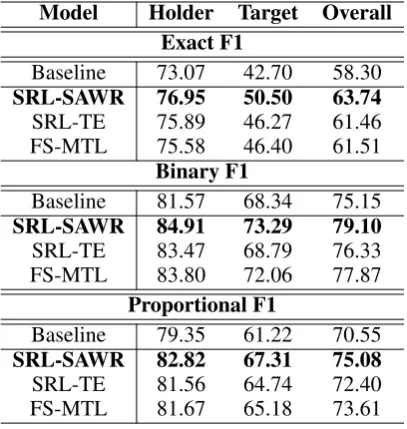
Table1shows the final results on the test dataset. We report the overall as well as the fine-grained performance in term of opinion arguments (i.e., holder and target). Compared with the baseline system, our final SRL-SAWR model can bring sig-nificantly better results (p < 10−5 under
pair-wise t-test). For fine-grained evaluations, the fi-nal model outperforms the baseline model consis-tently on opinion holders and targets. The tenden-cies are similar by exploiting the binary and pro-portional matching methods. The results show that SRL information is very helpful for ORL, which is consistent with previous studies (Kim and Hovy, 2006; Ruppenhofer et al., 2008; Marasovi´c and Frank,2018). The implicit SRL-SAWR method is highly effective to integrate SRL information into the ORL model.
Further, we compare the SRL-SAWR method with two other methods as well, namely SRL-TE and FS-MTL, respectively. The SRL-TE approach simply exploits the output SRL tags as inputs for ORL, embedding them as an additional source of word representations. The FS-MTL approach
is exactly the proposed model byMarasovi´c and
Frank(2018). As shown in Table1, all three meth-ods can bring improved performance by integrat-ing SRL, further demonstratintegrat-ing that SRL is indeed valuable for ORL. In addition, the SRL-SAWR method can achieve the best performance among the three methods, obtaining further significant improvements by at least 63.74−61.51 = 2.23
Model Holder Target Overall Exact F1
Baseline 73.07 42.70 58.30
SRL-SAWR 76.95 50.50 63.74
SRL-TE 75.89 46.27 61.46
FS-MTL 75.58 46.40 61.51
Binary F1
Baseline 81.57 68.34 75.15
SRL-SAWR 84.91 73.29 79.10
SRL-TE 83.47 68.79 76.33
FS-MTL 83.80 72.06 77.87
Proportional F1
Baseline 79.35 61.22 70.55
SRL-SAWR 82.82 67.31 75.08
SRL-TE 81.56 64.74 72.40
[image:4.595.315.519.62.277.2]FS-MTL 81.67 65.18 73.61
Table 1: Final results on the test dataset.
ARG0 Other ARG1 ARGM ARG2 0
20 40 60 80
Per
c.(%)
(a) Holder
ARG1 Other ARG2 ARG0 ARGM
[image:4.595.312.523.318.414.2](b) Target
Figure 4: Percentages with respect to semantic roles.
points on overall F1-measure with exact match-ing (p < 10−4). For fine-grained evaluations, the
SRL-SAWR method can also give the best perfor-mance. The results demonstrate that SRL-SAWR is most effective to integrate the SRL information into a neural ORL model. The two methods, SRL-TE and FS-MTL, are comparable by evaluations based on the exact matching.
3.6 Analysis
In this section, we conduct several experimental analysis on the test dataset to deeply understand the effectiveness of SRL information.
First, we examine the relationship between SRL and ORL. SRL identifies the semantic arguments for predicates, and ORL recognizes the opinion ar-guments for opinion expressions. Intuitively, in most cases, the opinion holders are correspond-ing to semantic agents/ARG0 of opinion trig-gers/expressions, and similarly, the opinion tar-gets are usually corresponding to patients/ARG1.
hold-Model Holder Target Overall
Baseline 73.07 42.70 58.30
[image:5.595.81.278.62.104.2]SRL Mapping 68.56 25.33 46.29
Table 2: The performance of the SRL mapping method.
Model Holder Target Overall Consistent arguments
Baseline 87.63 61.67 80.87
SRL-SAWR 88.72 67.58 82.87
SRL Mapping 82.57 40.36 63.77
SRL-TE 88.61 63.94 81.88
FS-MTL 88.16 66.80 82.28
Inconsistent arguments
Baseline 42.90 36.28 38.37
SRL-SAWR 49.09 44.24 44.65
SRL Mapping 0.00 0.00 0.00
SRL-TE 42.30 39.23 40.14
FS-MTL 43.47 39.04 40.25
Table 3: Comparisons in terms of the consis-tent/inconsistent arguments between SRL and ORL.
ers/targets being corresponding to semantic roles, which are calculated according to the word-level mapping over the 1-best SRL outputs and the gold-standard ORL tags. We list only the five seman-tic roles with highest mapping percentages. As shown, the results are consistent with our intuition. Thus SRL and ORL are highly correlative. Con-sidering the much larger scale of annotated SRL corpora, SRL can benefit ORL potentially.
According to the above findings, we design a simple system by mapping SRL outputs into ORL directly (Kim and Hovy,2006;Ruppenhofer et al., 2008). We simply convert the semantic role ARG0 into holder, and ARG1 into target. Table2shows the performance. The results of the baseline sys-tem are shown for comparison. We can see that the simple mapping method is also one feasible alter-native as a whole.
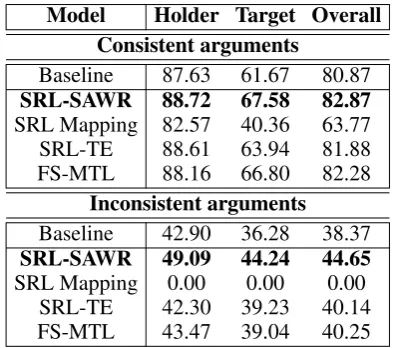
Further, we compare the SRL utilization capa-bilities of our proposed method and the other SRL-enhanced ORL systems, including the above SRL Mapping method. We categorize the opinion ar-guments by whether they can be directly mapped from the SRL outputs. The opinion arguments which can be directly mapped from SRL, referred to as consistent arguments, should be more eas-ily identified by SRL enhanced models than the
remaining inconsistent arguments. Table3shows
the comparison results. We can see that all
SRL-The white house is said to beholder embarrassedby the report
ARG1 target target holder
gold
SRL SRL-TE FS-MTL SRL-SAWR
target
[image:5.595.309.529.66.124.2]ARG0 holder holder target
Figure 5: One example for case study.
enhanced supervised models can achieve better performances for consistent arguments. For the in-consistent arguments, the tendency is similar, ex-cept the holder performance of SRL-TE. In addi-tion, our method can gain much larger improve-ments, which indicates that our method can better handle the inconsistencies between SRL and ORL. Finally, we show one case study to illustrate the
advantage of our SRL-SAWR method. Figure 5
shows one example. As shown, the SRL argu-ment ARG0, which is more probably mapped onto holder, is annotated by target in the example. The SRL argument ARG1 is labeled as opinion holder, which is also one inconsistent case. Compared with SRL-TE and FS-MTL, our model can better handle these inconsistent cases. The observation further confirms our results in Table3.
4 Conclusion
We proposed a simple and novel method (SRL-SAWR) to enhance ORL with SRL information by exploiting implicit semantic-aware word rep-resentations from SRL. The main idea is to export intermediate SRL encoder outputs as inputs to bet-ter word representations of an ORL model. This method does not impose any extra requirement for ORL, and meanwhile avoids the error proro-gation problem from discrete SRL outputs. We conducted experiments to verify our method on a benchmark MPQA dataset. The results showed that our method can exploit SRL information ef-fectively. We compared the proposed method with SRL-TE and FS-MTL, which are two representa-tive approaches to enhance ORL by SRL. The re-sults demonstrated our method can bring the best performance among the three approaches.
Acknowledgments
[image:5.595.82.282.140.314.2]References
Eric Breck, Yejin Choi, and Claire Cardie. 2007. Iden-tifying expressions of opinion in context. InIJCAI, volume 7, pages 2683–2688.
Luheng He, Kenton Lee, Mike Lewis, and Luke Zettle-moyer. 2017. Deep semantic role labeling: What works and whats next. In Proceedings of ACL), pages 473–483.
Ozan Irsoy and Claire Cardie. 2013. Bidirectional re-cursive neural networks for token-level labeling with structure. arXiv preprint arXiv:1312.0493.
Ozan Irsoy and Claire Cardie. 2014. Opinion mining with deep recurrent neural networks. In EMNLP, pages 720–728.
Arzoo Katiyar and Claire Cardie. 2016. Investigating lstms for joint extraction of opinion entities and re-lations. InACL, pages 919–929.
Soo-Min Kim and Eduard Hovy. 2006. Extracting opinions, opinion holders, and topics expressed in online news media text. InProceedings of the Work-shop on Sentiment and Subjectivity in Text, pages 1– 8.
Diederik Kingma and Jimmy Ba. 2014. Adam: A method for stochastic optimization. arXiv preprint arXiv:1412.6980.
Pengfei Liu, Shafiq Joty, and Helen Meng. 2015. Fine-grained opinion mining with recurrent neural net-works and word embeddings. In EMNLP, pages 1433–1443.
Ana Marasovi´c and Anette Frank. 2018. Srl4orl: Im-proving opinion role labeling using multi-task learn-ing with semantic role labellearn-ing. In Proceedings of NAACL, pages 583–594.
Jeffrey Pennington, Richard Socher, and Christopher Manning. 2014. Glove: Global vectors for word representation. InProceedings of the 2014 EMNLP, pages 1532–1543.
Sameer Pradhan, Alessandro Moschitti, Nianwen Xue, Hwee Tou Ng, Anders Bj¨orkelund, Olga Uryupina, Yuchen Zhang, and Zhi Zhong. 2013. Towards ro-bust linguistic analysis using ontonotes. In Proceed-ings of the CoNLL, pages 143–152.
Guang Qiu, Bing Liu, Jiajun Bu, and Chun Chen. 2011. Opinion word expansion and target extraction through double propagation. Computational Lin-guistics, 37(1):9–27.
Josef Ruppenhofer, Swapna Somasundaran, and Janyce Wiebe. 2008. Finding the sources and targets of sub-jective expressions. InLREC.
Nitish Srivastava, Geoffrey Hinton, Alex Krizhevsky, Ilya Sutskever, and Ruslan Salakhutdinov. 2014. Dropout: A simple way to prevent neural networks from overfitting. The Journal of Machine Learning Research, 15(1):1929–1958.
Janyce Wiebe, Theresa Wilson, and Claire Cardie. 2005. Annotating expressions of opinions and emo-tions in language. LRE, 39(2-3):165–210.
Michael Wiegand, Christine Bocionek, and Josef Rup-penhofer. 2016. Opinion holder and target extrac-tion on opinion compounds – a linguistic approach. InProceedings of NAACL, pages 800–810.
Theresa Wilson, Janyce Wiebe, and Paul Hoffmann. 2009. Recognizing contextual polarity: An explo-ration of features for phrase-level sentiment analy-sis.Computational linguistics, 35(3):399–433.
Theresa Ann Wilson. 2008. Fine-grained subjectiv-ity and sentiment analysis: recognizing the intenssubjectiv-ity, polarity, and attitudes of private states.
Bishan Yang and Claire Cardie. 2012. Extracting opin-ion expressopin-ions with semi-markov conditopin-ional ran-dom fields. In EMNLP-CoNLL, pages 1335–1345. Association for Computational Linguistics.
Bishan Yang and Claire Cardie. 2013. Joint infer-ence for fine-grained opinion extraction. InACL (1), pages 1640–1649.